CLINICAL PHARMACOKINETICS OF
PROCAINAMIDE/N-ACETYL
PROCAINAMIDE
JU School Of Pharmacy
Jimma, Ethiopia
12/5/2016
Clinical Pharmacokinetics of procainamide by Behailu & Bezie 1
By Behailu Terefe (BPharm, PGY1 clinical pharmacy
student)
behailu.terefe@ju.edu.et / terefebh@gmail.com
Phar 611
Contents
12/5/2016Clinical Pharmacokinetics of procainamide by Behailu & Bezie
2
 Introduction
 Therapeutic And Toxic Concentrations
 Adverse Events
 Basic Clinical Pharmacokinetic Parameters
 Disease States And Conditions Affecting Pk And Dosing
 Initial Dosage Determination Methods
 Use of Serum Conc. to Alter Doses
INTRODUCTION
12/5/2016Clinical Pharmacokinetics of procainamide by Behailu & Bezie
Procainamide
 type IA antiarrhythmic agent that is used I.V and
PO.
 used for the treatment of SV or ventricular
arrhythmias.
 MOA:-
 inhibits trans-membrane Na+ influx thereby ↓
conduction velocity.
 Increases
the duration of the action potential,
threshold potential toward zero, and
3
12/5/2016Clinical Pharmacokinetics of procainamide by Behailu & Bezie
4
 decreases
the slope of phase 4 of the action potential
and
Automaticity
 net effect
 ↑ refractoriness and ↓conduction in heart
conduction tissue, which establishes a
bidirectional block in reentrant pathways.
THERAPEUTIC AND TOXIC
CONCENTRATIONS
12/5/2016Clinical Pharmacokinetics of procainamide by Behailu & Bezie
 therapeutic range for procainamide is 4-10
μg/ml.
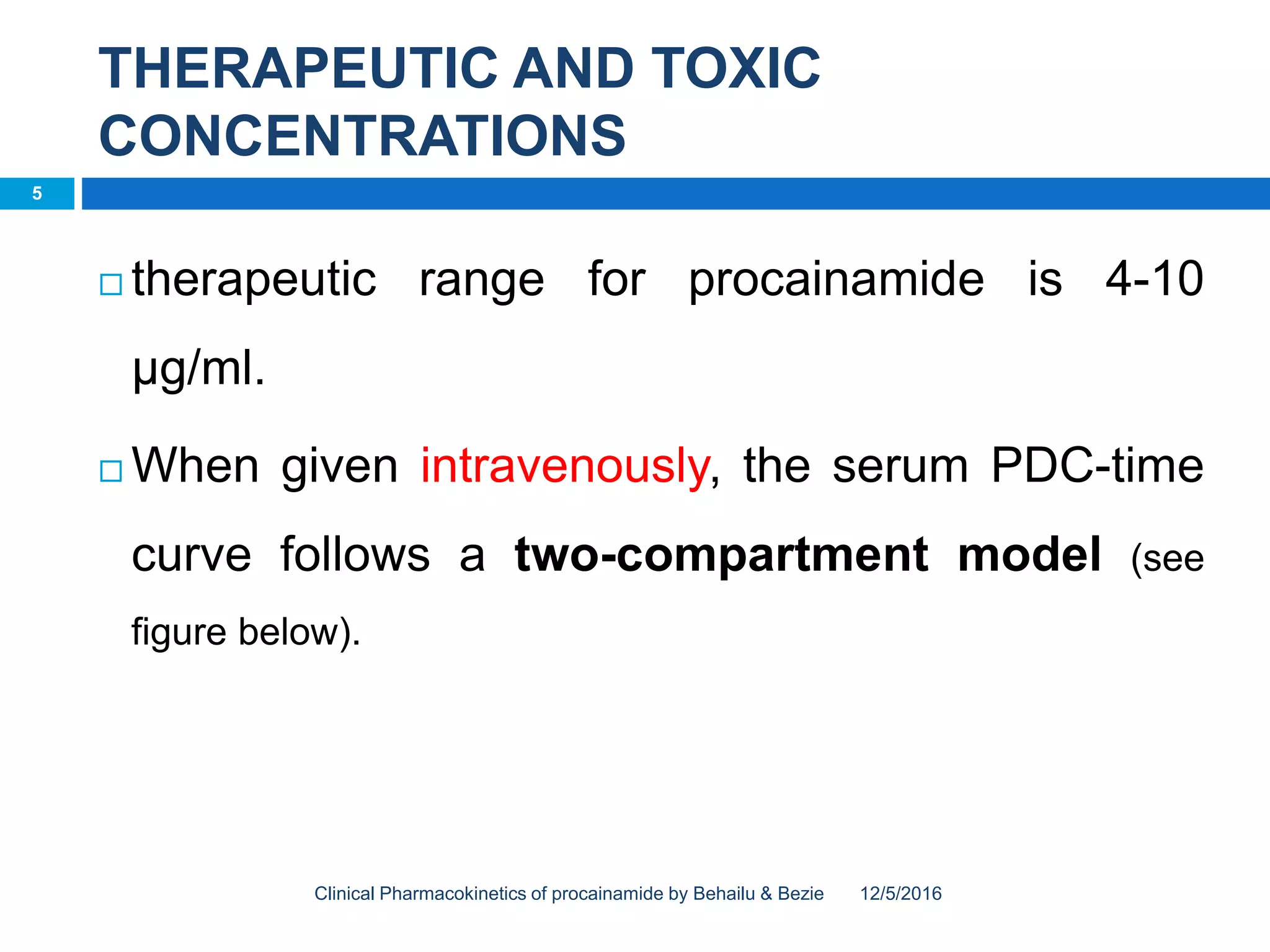
 When given intravenously, the serum PDC-time
curve follows a two-compartment model (see
figure below).
5
Date of download: 12/5/2016 Copyright © 2016 McGraw-Hill Education. All rights reserved.
Procainamide serum concentrations initially drop rapidly after an intravenous bolus as drug distributes from blood into the tissues
during the distribution phase. During the distribution phase, drug leaves the blood due to tissue distribution and elimination. After 20-
30 minutes, an equilibrium is established between the blood and tissues, and serum concentrations drop more slowly since
elimination is the primary process removing drug from the blood. A two-compartment model describes this type of serum
concentration/time profile.
Legend:
From: Cardiovascular Agents
Applied Clinical Pharmacokinetics, 3e, 2015
12/5/2016Clinical Pharmacokinetics of procainamide by Behailu & Bezie
 To maintain therapeutic procainamide
concentrations,
 an I.V LD (over 25-30 minutes) is followed by a
CII.
 distribution phase is still seen due to the adm.
of LD.
 administration of a LD may not establish
steady-state conditions immediately, and the
7
Date of download: 12/5/2016 Copyright © 2016 McGraw-Hill Education. All rights reserved.
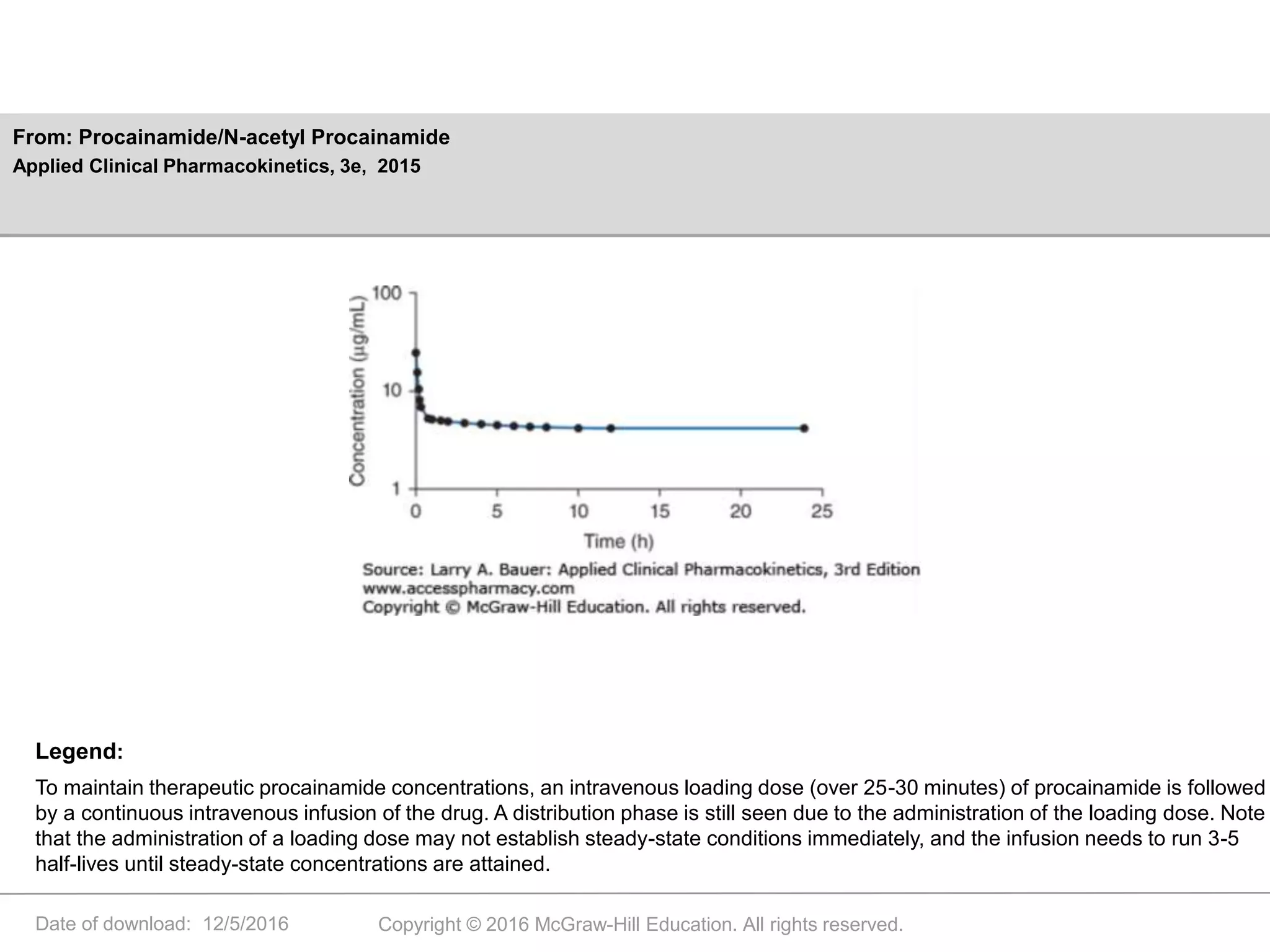
To maintain therapeutic procainamide concentrations, an intravenous loading dose (over 25-30 minutes) of procainamide is followed
by a continuous intravenous infusion of the drug. A distribution phase is still seen due to the administration of the loading dose. Note
that the administration of a loading dose may not establish steady-state conditions immediately, and the infusion needs to run 3-5
half-lives until steady-state concentrations are attained.
Legend:
From: Procainamide/N-acetyl Procainamide
Applied Clinical Pharmacokinetics, 3e, 2015
12/5/2016Clinical Pharmacokinetics of procainamide by Behailu & Bezie
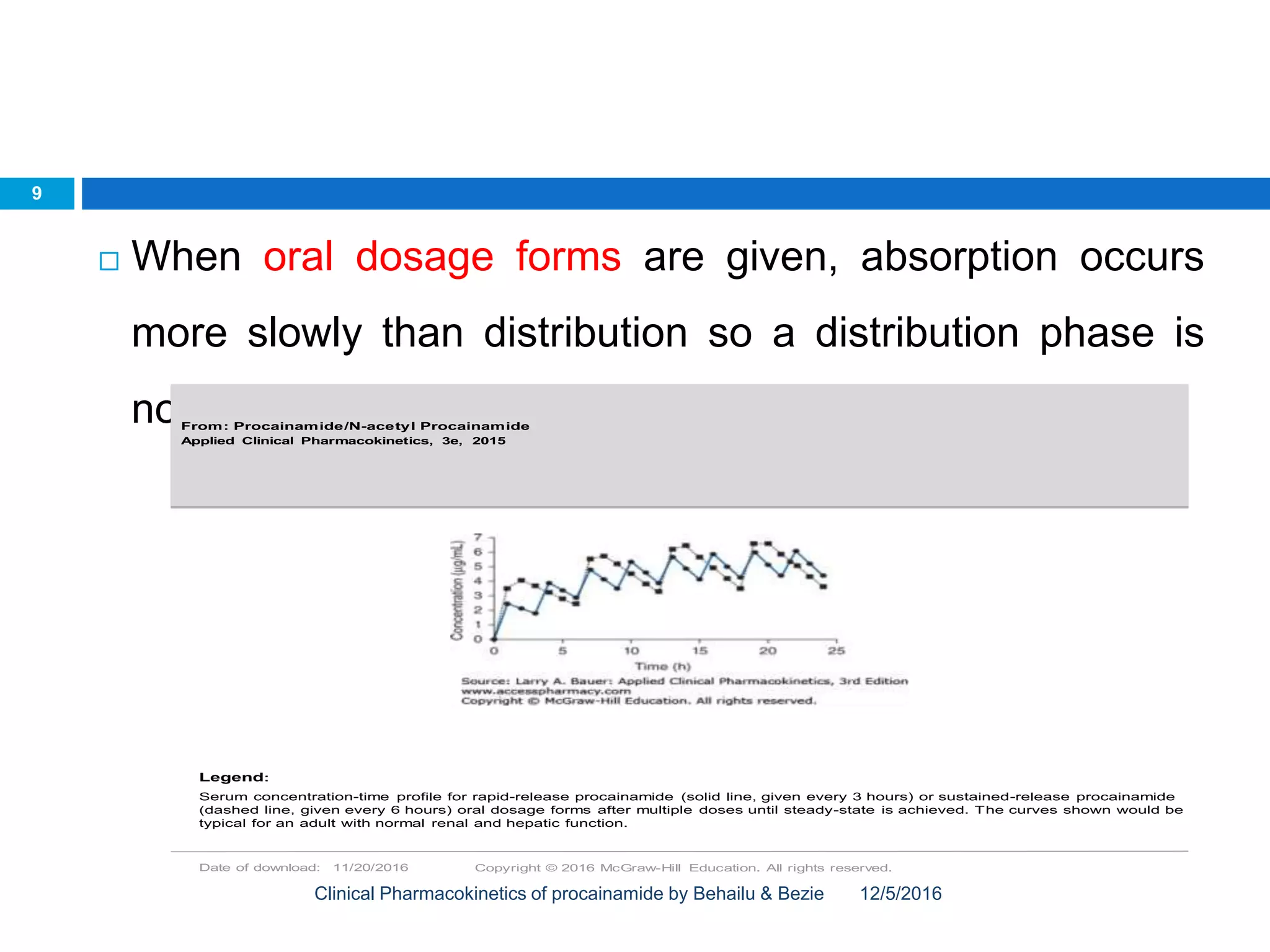
 When oral dosage forms are given, absorption occurs
more slowly than distribution so a distribution phase is
not seen.
Date of download: 11/20/2016 Copyright © 2016 McGraw-Hill Education. All rights reserved.
Serum concentration-time profile for rapid-release procainamide (solid line, given every 3 hours) or sustained-release procainamide
(dashed line, given every 6 hours) oral dosage forms after multiple doses until steady-state is achieved. The curves shown would be
typical for an adult with normal renal and hepatic function.
Legend:
From: Procainamide/N-acetyl Procainamide
Applied Clinical Pharmacokinetics, 3e, 2015
9
ADVERSE EVENTS
12/5/2016Clinical Pharmacokinetics of procainamide by Behailu & Bezie
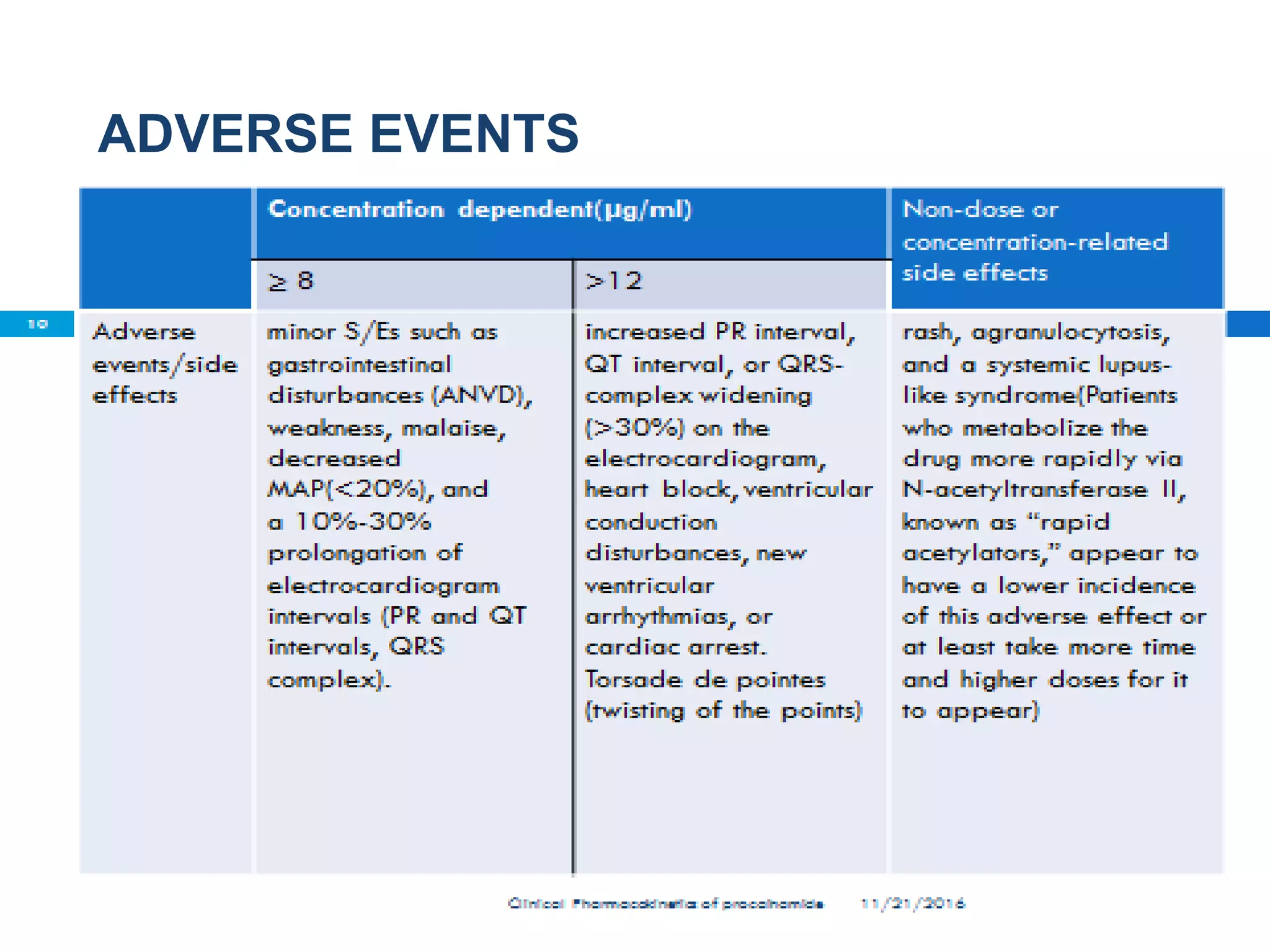
 can be concentration dependent or independent.
10
12/5/2016Clinical Pharmacokinetics of procainamide by Behailu & Bezie
Recommendations during I.V procainamide therapy,
 Continuous monitoring of B.P
 Ensuring availability or actual giving of phenylephrine or NE
 Constant ECG monitoring
 equipment to treat ventricular a systole, fibrillation, or both.
RX of Procainamide toxicity
 Have desirable attributes for extracorporeal drug removal.
 peritoneal dialysis, hemodialysis, hemoperfusion, and continuous
arteriovenous hemofiltration/hemodiafiltration.
11
12/5/2016Clinical Pharmacokinetics of procainamide by Behailu & Bezie
 NAPA or acecainide,
 has type III antiarrhythmic effects.
 Prolongs action potential via K+ channel
blockade.
 effective concentration is 10-30 μg/mL.
 Conc. dependent A/Es , similar to
procainamide.
12
BASIC CLINICAL PHARMACOKINETIC
PARAMETERS
12/5/2016Clinical Pharmacokinetics of procainamide by Behailu & Bezie
Absorption and distribution of procainamide
 average oral F`(both IR and SR DFs) is 83%.
 lag time of 20-30 minutes occurs in some
patients
 Plasma protein binding is only about 15%.
 Vd 2.7 L/kg (V = 2-3.8 L/kg)
13
12/5/2016Clinical Pharmacokinetics of procainamide by Behailu & Bezie
Elimination
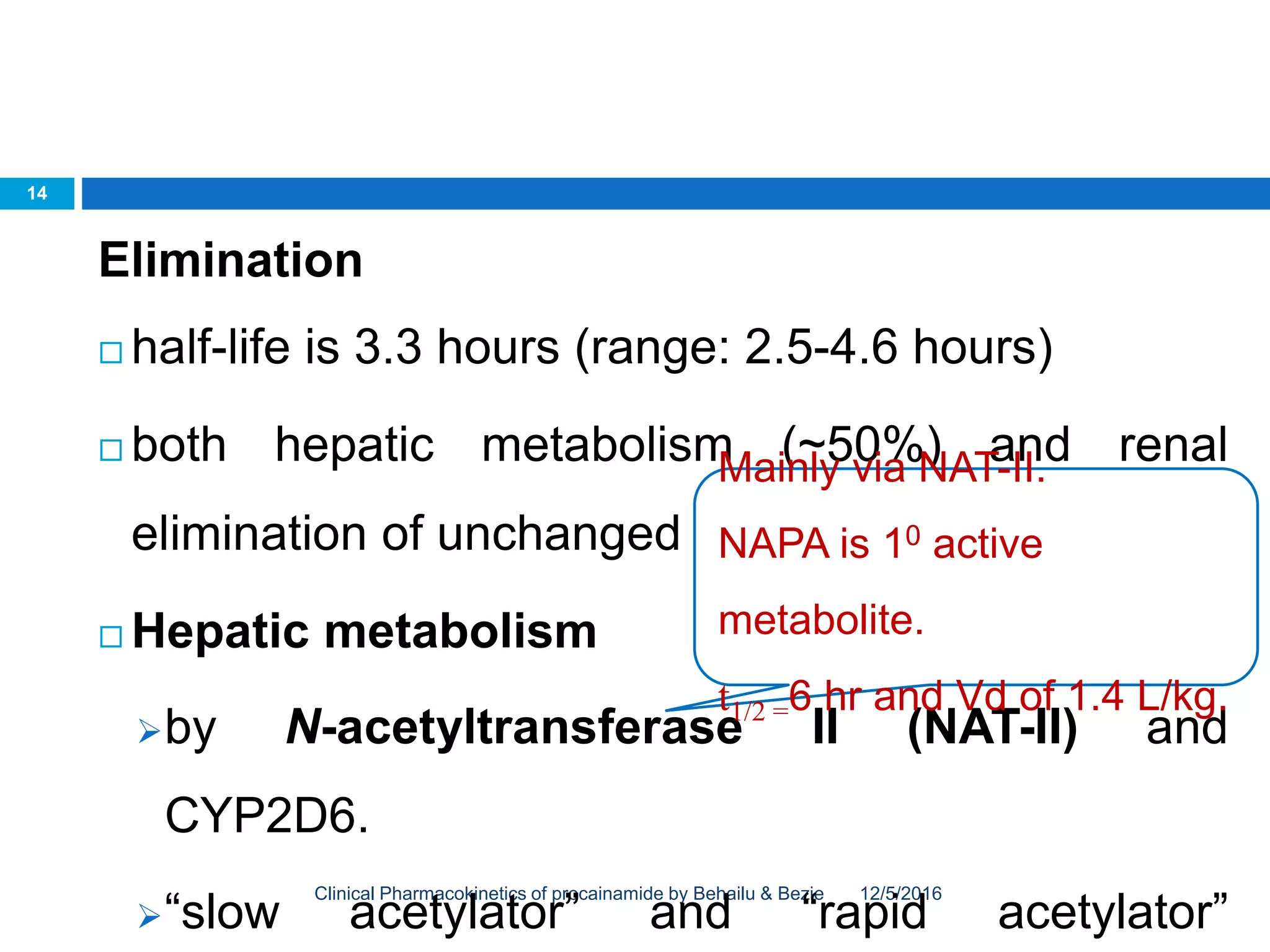
 half-life is 3.3 hours (range: 2.5-4.6 hours)
 both hepatic metabolism (~50%) and renal
elimination of unchanged drug (~50%).
 Hepatic metabolism
by N-acetyltransferase II (NAT-II) and
CYP2D6.
“slow acetylator” and “rapid acetylator”
14
Mainly via NAT-II.
NAPA is 10 active
metabolite.
t1/2 =6 hr and Vd of 1.4 L/kg.
12/5/2016Clinical Pharmacokinetics of procainamide by Behailu & Bezie
15
12/5/2016Clinical Pharmacokinetics of procainamide by Behailu & Bezie
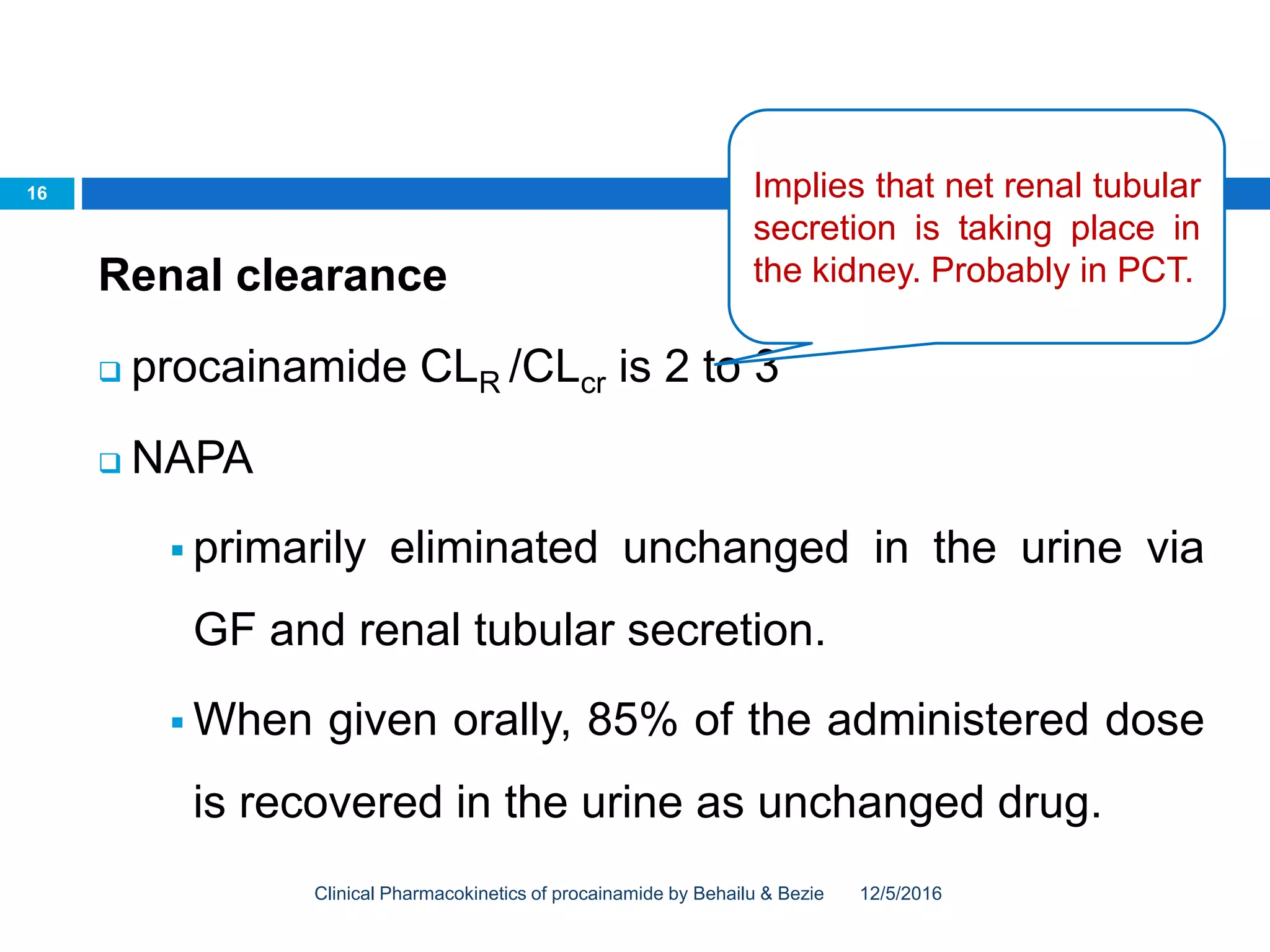
Renal clearance
 procainamide CLR /CLcr is 2 to 3
 NAPA
 primarily eliminated unchanged in the urine via
GF and renal tubular secretion.
 When given orally, 85% of the administered dose
is recovered in the urine as unchanged drug.
16 Implies that net renal tubular
secretion is taking place in
the kidney. Probably in PCT.
EFFECTS OF DISEASE STATES AND
CONDITIONS ON THE PK AND DOSING OF
PROCAINAMIDE
12/5/2016Clinical Pharmacokinetics of procainamide by Behailu & Bezie
Renal dysfunction
 clearance rate ↓ as Clcr ↓
 But it is not as reliable parameter to aid in the
estimation of procainamide clearance. Why????
the major route of CLR for procainamide is via
proximal tubular secretion
17
12/5/2016Clinical Pharmacokinetics of procainamide by Behailu & Bezie
 In patients with RF, the average procainamide t1/2
is 13.9 hours and Vd is 1.7 L/kg
 NAPA t1/2 ↑ to 41 hours on the average
 NAPA/Procainamide Css exceeds 1.
 Reason:-NAPA elimination is much more
dependent on renal function.
18
Thus, in patients with RF, NAPA may be
the predominant antiarrhythmic agent
present in the serum.
12/5/2016Clinical Pharmacokinetics of procainamide by Behailu & Bezie
Uncompensated heart failure
 Reduces both procainamide CL and Vd (V = 1.6
L/kg)
 Proca. t1/2 equal to 5.5 hours (t1/2 = [0.693•
↓V]/↓Cl).
 the effect on procainamide pharmacokinetics is
highly variable and difficult to accurately predict.
 ↓ initial procainamide doses by 25%-50%.
19
12/5/2016Clinical Pharmacokinetics of procainamide by Behailu & Bezie
Liver cirrhosis or hepatitis
 have not been adequately studied
 But recommended to ↓ the initial doses by applying
the Child-Pugh classification system
 normal liver function is 5
 15 is grossly abnormal
 ≥8 is grounds for a ↓ of 25% in the initial daily drug
dose while a score >10 suggests a ↓ of 50%.
20
12/5/2016Clinical Pharmacokinetics of procainamide by Behailu & Bezie
Test/Symptom Score 1 Point Score 2 Points Score 3 Points
Total bilirubin
(mg/dL)
<2.0 2.0-3.0 >3.0
Serum albumin
(g/dL)
>3.5 2.8-3.5 <2.8
PT (seconds
prolonged over
control)
<4 4-6 >6
Ascites Absent Slight Moderate
HE None Moderate Severe
TABLE 8-4Child-Pugh Scores for Patients With Liver
Disease
21
12/5/2016Clinical Pharmacokinetics of procainamide by Behailu & Bezie
Obesity
 30% above the IBW.
 Studies investigating the impact of obesity on PK
of procainamide shows best correlation of,
 Vd-IBW and,
 CL-TBW(0.52 L/h/kg TBW for normal renal
function)
22
12/5/2016Clinical Pharmacokinetics of procainamide by Behailu & Bezie
DRUG INTERACTIONS
 Cimetidine, trimethoprim, ofloxacin, levofloxacin,
and ciprofloxacin-compete for tubular secretion.
 procainamide CLR ↓ses by 30%-50% and
 NAPA renal clearance ↓ses by 10%-30%.
 Amiodarone ↑ses the Css of procainamide and
NAPA by 57% and 32%, respectively.
23
INITIAL DOSAGE DETERMINATION
METHODS
12/5/2016Clinical Pharmacokinetics of procainamide by Behailu & Bezie
 Goal:
 to compute the best dose possible dose.
 Several methods to initiate procainamide therapy
are available.
 Pharmacokinetic Dosing Method
 Literature-based recommended dosing
24
12/5/2016Clinical Pharmacokinetics of procainamide by Behailu & Bezie
Pharmacokinetic Dosing Method
 most flexible of the techniques.
 allows individualized target serum
concentrations
 each pharmacokinetic parameter can be
customized to reflect specific disease states and
conditions
25
Half-Life and Elimination Rate Constant Estimate
12/5/2016Clinical Pharmacokinetics of procainamide by Behailu & Bezie
 procainamide half-life
 moderate HF (NYHA CHF class III), 5.5 hours,
 renal failure, 3.9 hours.
 adjusted t1/2 (hrs)=
𝑡1/2 ℎ𝑟𝑠 𝑛𝑜𝑟𝑚𝑎𝑙
1−0.52[1−
𝐶𝐿 𝑐𝑟
100
]
 CrCl is adjusted for body SA
(ml/min/1.73m2).
26
12/5/2016Clinical Pharmacokinetics of procainamide by Behailu & Bezie
 multiple concurrent disease states or
conditions.
disease state or condition with the longest t1/2
should be used to compute doses.
avoid accidental over dosage as much as
currently possible.
 k = 0.693/t1/2
27
Volume of Distribution Estimate
12/5/2016Clinical Pharmacokinetics of procainamide by Behailu & Bezie
 chosen according to the disease states and
conditions
 help to compute procainamide clearance
 1.7 L/kg for RF, 1.6 L/kg for uncompensated HF
and 2.7 L/kg for all other patients.
 for obese patients, IBW is used to compute Vd.
 E.g., for a non obese 80-kg patient without HF or
liver disease, procainamide Vd is 2.7L/Kg* 80 kg
28
Selection of Appropriate Pharmacokinetic
Model and Equations
12/5/2016Clinical Pharmacokinetics of procainamide by Behailu & Bezie
 some reports that procainamide follows
nonlinear pharmacokinetics, for the purposes
of clinical drug dosing in patients, linear
pharmacokinetic concepts and equations can
be effectively used to compute doses and
estimate serum concentrations.
29
12/5/2016Clinical Pharmacokinetics of procainamide by Behailu & Bezie
Oral administration of procainamide
 follows a one-compartment pharmacokinetic model
 𝐶𝑠𝑠 =
𝐹
𝐷
𝜏
𝐶𝐿
or 𝐷 =
𝐶𝑠𝑠∗𝐶𝐿∗𝜏
𝐹
 clearance in L/h is computed: 𝐶𝑙 = 𝑘𝑉
 For example, what is the estimated clearance of
procainamide for a patient with an estimated KE of 0.210 h−1
and an estimated Vd equal to 189 L:
Cl = 0.210 h−1 • 189 L =39.7 L/h= 39.7 L/h
30
12/5/2016Clinical Pharmacokinetics of procainamide by Behailu & Bezie
When intravenous therapy is required,
 similar equation is widely used and
 allows dosage calculation for a continuous
infusion:
 𝐶𝑠𝑠 = 𝐾𝑂/𝐶𝐿 or 𝑘0 = 𝐶𝑠𝑠 • 𝐶𝐿, 𝐶𝑙 = 𝑘𝑉.
 Loading dose (LD in mg), 𝐿𝐷 = 𝐶𝑠𝑠 • 𝑉
 Intravenous procainamide loading doses should be
infused no faster than 25-50 mg/min.
31
12/5/2016Clinical Pharmacokinetics of procainamide by Behailu & Bezie
Methods to administer procainamide LD.
1) administers 100 mg q5` to a maximum of 500
mg; a 10 minute waiting period to allow drug
distribution to tissues is utilized if more than 500
mg is needed to abate the arrhythmia.
2) administers the loading dose as a short-term
infusion at a rate of 20 mg/min over 25-30
minutes, not to exceed a total dose of 17 mg/kg.
32
12/5/2016Clinical Pharmacokinetics of procainamide by Behailu & Bezie
Steady-State Concentration Selection
 therapeutic range
 procainamide is 4-10 μg/ml.
 + NAPA “total procainamide” is 10-30 μg/mL.
 but, are not equipotent anti-arrhythmics.
 individualized for each patient in order to
achieve optimal responses and minimal S/Es.
33
USE OF PROCAINAMIDE AND NAPA SERUM
CONC. TO ALTER DOSES
12/5/2016Clinical Pharmacokinetics of procainamide by Behailu & Bezie
 Because procainamide follows linear, dose-
proportional pharmacokinetics in most patients,
serum Css (procainamide and NAPA) change in
proportion to dose according to the following
equation:
Css, new = (Dnew/Dold)Css, old
34
12/5/2016Clinical Pharmacokinetics of procainamide by Behailu & Bezie
Example 1
LK is a 50-year-old, 75-kg (height = 5 ft 10 in)
male with VT who requires therapy with oral
procainamide SR tablets. He has normal liver and
cardiac function. Suggest an initial oral
procainamide dosage regimen designed to
achieve a steady-state procainamide
concentration equal to 4 μg/mL.
35
12/5/2016Clinical Pharmacokinetics of procainamide by Behailu & Bezie
a) Estimate t1/2 and KE according to disease states and
conditions present in the patient.
t1/2 is 3.3 hours. So,
KE = 0.693/t1/2 = 0.693/3.3 h =0.210 h−1.
b) Estimate the Vd and CL
V = 2.7 L/kg • 75 kg = 203 L. Cl = kV = 0.210 h−1 • 203
L = 42.6 L/h.
c) Compute dosage regimen
36
12/5/2016Clinical Pharmacokinetics of procainamide by Behailu & Bezie
Oral SR procainamide tablets will be prescribed to this
patient (F = 0.83). Because the patient has a rapid
procainamide CL and short t1/2 , the initial dosage
interval (τ) will be set to 6 hours.
The dosage equation for oral procainamide is:
𝐷=(𝐶𝑠𝑠∗𝐶𝐿∗𝜏)/𝐹= (4 mg/L • 42.6 L/h • 6 h)/0.83
= 1231 mg, rounded to 1250 mg every 6 hours.
37
Literature-Based Recommended Dosing
12/5/2016Clinical Pharmacokinetics of procainamide by Behailu & Bezie
 very commonly used method
 Doses are based on those that commonly
produce Css in the lower end of the therapeutic
range.
 procainamide Css expected from the lower end
of the dosage range is 4-6 μg/mL and 6-10
μg/mL for the upper end of the dosage range.
Seetable on next sld.
38
Half-Life and Elimination Rate Constant Estimate
12/5/2016Clinical Pharmacokinetics of procainamide by Behailu & Bezie
Disease
state/Condition
Procainamide,
oral tablets Procainamide Continuous Intravenous
Infusion
Adult, normal RF (clcr
>50 mL/min)
50 mg/kg/d 2-6 mg/min
Adult, renal dysfunction Clcr
=10-50 mL/min: 25-50% ↓
<10 mL/min: 50%-75% ↓
Clcr
=10-50 mL/min: 25-50% ↓
<10 mL/min: 50%-75% ↓
Adult, uncompensated
HF
CHF NYHA
class II: 25% dosage ↓,
class III or IV: 50% dosage
↓
CHF NYHA
class II: 25% dosage ↓,
class III or IV: 50% dosage
↓
Adult, liver disease Child/Pugh score
= 8-10: 25% dosage ↓
>10: 50% dosage ↓
Child/Pugh score
= 8-10: 25% dosage ↓
>10: 50% dosage ↓
Adult, obese Base dose on TBW
according to other disease
states/
Base dose on TBW
according to other disease
states/
39
Pediatric doses
12/5/2016Clinical Pharmacokinetics of procainamide by Behailu & Bezie
 similar to those given to adults when adjusted for
differences in body weight.
 The recommended I.V LD is 2-6 mg/kg over 5
minutes (maximum dose 100 mg), repeating as
necessary every 5-10 minutes to a maximum
dose of 15 mg/kg (no > 500 mg should be given
within a 30`).
40
12/5/2016Clinical Pharmacokinetics of procainamide by Behailu & Bezie
For patients with VT and poor perfusion
 15 mg/kg infused over 30-60 minutes as a single
dose can be considered if cardio version is
ineffective.
 I.V maintenance infusion rates equal 20-80
μg/kg/min (max. dose 2 g/d).
 Oral maintenance doses are 15-50 mg/kg/d.
41
12/5/2016Clinical Pharmacokinetics of procainamide by Behailu & Bezie
 The dosage interval chosen should be appropriate
for dosage form administered to the patient.
 For the example given on slide no. 34.
procainamide maintenance dose of 50 mg/kg/d is
suggested.
The suggested initial dose would be 3750 mg/d (50
mg/kg/d • 75 kg = 3750 mg/d), rounded to 4000
mg/d or 1000 mg every 6 hours.
42
IV TO PO CONVERSION OF PROCAINAMIDE
DOSE
12/5/2016Clinical Pharmacokinetics of procainamide by Behailu & Bezie
 Assuming that equal procainamide serum Css are
desired,
Intravenous [𝑘 𝑜 = 𝑐𝑠𝑠 ∙ 𝑐𝑙] and
oral [D = (𝑐 𝑠𝑠 ∙ 𝑐𝑙 ∙ 𝜏)/𝐹]
 corrected for procainamide salt form are
prescribed:
 𝑘 𝑜 = 𝐹𝐷/(
60𝑚𝑖𝑛
ℎ
∙ 𝜏) or 𝐷 𝑝𝑜 = (𝑘𝑜 ∙ 𝜏 ∙
60𝑚𝑖𝑛
ℎ𝑟
)/𝐹
 Dpo is equivalent oral dose in mg,
43
12/5/2016Clinical Pharmacokinetics of procainamide by Behailu & Bezie
44
1) Bauer, Larry A.. "Chapter 8. Procainamide/N-Acetyl
Procainamide." Applied Clinical Pharmacokinetics, 2e.
Ed. Larry A. Bauer. New York, NY: McGraw-Hill,
2008,http://accesspharmacy.mhmedical.com/content.
2) Lange RA, Hillis LD. Cardiovascular testing. In:
Dipiro JT, Talbert RL, Yee GC, Matzke GR,
Wells BG, Posey LM, eds. Pharmacotherapy. New
York, NY: McGraw-Hill; 2011:55–81.
12/5/2016Clinical Pharmacokinetics of procainamide by Behailu & Bezie
45

clinical pharmacokinetics of Procainamide

  • 1.
    CLINICAL PHARMACOKINETICS OF PROCAINAMIDE/N-ACETYL PROCAINAMIDE JUSchool Of Pharmacy Jimma, Ethiopia 12/5/2016 Clinical Pharmacokinetics of procainamide by Behailu & Bezie 1 By Behailu Terefe (BPharm, PGY1 clinical pharmacy student) behailu.terefe@ju.edu.et / terefebh@gmail.com Phar 611
  • 2.
    Contents 12/5/2016Clinical Pharmacokinetics ofprocainamide by Behailu & Bezie 2  Introduction  Therapeutic And Toxic Concentrations  Adverse Events  Basic Clinical Pharmacokinetic Parameters  Disease States And Conditions Affecting Pk And Dosing  Initial Dosage Determination Methods  Use of Serum Conc. to Alter Doses
  • 3.
    INTRODUCTION 12/5/2016Clinical Pharmacokinetics ofprocainamide by Behailu & Bezie Procainamide  type IA antiarrhythmic agent that is used I.V and PO.  used for the treatment of SV or ventricular arrhythmias.  MOA:-  inhibits trans-membrane Na+ influx thereby ↓ conduction velocity.  Increases the duration of the action potential, threshold potential toward zero, and 3
  • 4.
    12/5/2016Clinical Pharmacokinetics ofprocainamide by Behailu & Bezie 4  decreases the slope of phase 4 of the action potential and Automaticity  net effect  ↑ refractoriness and ↓conduction in heart conduction tissue, which establishes a bidirectional block in reentrant pathways.
  • 5.
    THERAPEUTIC AND TOXIC CONCENTRATIONS 12/5/2016ClinicalPharmacokinetics of procainamide by Behailu & Bezie  therapeutic range for procainamide is 4-10 μg/ml.  When given intravenously, the serum PDC-time curve follows a two-compartment model (see figure below). 5
  • 6.
    Date of download:12/5/2016 Copyright © 2016 McGraw-Hill Education. All rights reserved. Procainamide serum concentrations initially drop rapidly after an intravenous bolus as drug distributes from blood into the tissues during the distribution phase. During the distribution phase, drug leaves the blood due to tissue distribution and elimination. After 20- 30 minutes, an equilibrium is established between the blood and tissues, and serum concentrations drop more slowly since elimination is the primary process removing drug from the blood. A two-compartment model describes this type of serum concentration/time profile. Legend: From: Cardiovascular Agents Applied Clinical Pharmacokinetics, 3e, 2015
  • 7.
    12/5/2016Clinical Pharmacokinetics ofprocainamide by Behailu & Bezie  To maintain therapeutic procainamide concentrations,  an I.V LD (over 25-30 minutes) is followed by a CII.  distribution phase is still seen due to the adm. of LD.  administration of a LD may not establish steady-state conditions immediately, and the 7
  • 8.
    Date of download:12/5/2016 Copyright © 2016 McGraw-Hill Education. All rights reserved. To maintain therapeutic procainamide concentrations, an intravenous loading dose (over 25-30 minutes) of procainamide is followed by a continuous intravenous infusion of the drug. A distribution phase is still seen due to the administration of the loading dose. Note that the administration of a loading dose may not establish steady-state conditions immediately, and the infusion needs to run 3-5 half-lives until steady-state concentrations are attained. Legend: From: Procainamide/N-acetyl Procainamide Applied Clinical Pharmacokinetics, 3e, 2015
  • 9.
    12/5/2016Clinical Pharmacokinetics ofprocainamide by Behailu & Bezie  When oral dosage forms are given, absorption occurs more slowly than distribution so a distribution phase is not seen. Date of download: 11/20/2016 Copyright © 2016 McGraw-Hill Education. All rights reserved. Serum concentration-time profile for rapid-release procainamide (solid line, given every 3 hours) or sustained-release procainamide (dashed line, given every 6 hours) oral dosage forms after multiple doses until steady-state is achieved. The curves shown would be typical for an adult with normal renal and hepatic function. Legend: From: Procainamide/N-acetyl Procainamide Applied Clinical Pharmacokinetics, 3e, 2015 9
  • 10.
    ADVERSE EVENTS 12/5/2016Clinical Pharmacokineticsof procainamide by Behailu & Bezie  can be concentration dependent or independent. 10
  • 11.
    12/5/2016Clinical Pharmacokinetics ofprocainamide by Behailu & Bezie Recommendations during I.V procainamide therapy,  Continuous monitoring of B.P  Ensuring availability or actual giving of phenylephrine or NE  Constant ECG monitoring  equipment to treat ventricular a systole, fibrillation, or both. RX of Procainamide toxicity  Have desirable attributes for extracorporeal drug removal.  peritoneal dialysis, hemodialysis, hemoperfusion, and continuous arteriovenous hemofiltration/hemodiafiltration. 11
  • 12.
    12/5/2016Clinical Pharmacokinetics ofprocainamide by Behailu & Bezie  NAPA or acecainide,  has type III antiarrhythmic effects.  Prolongs action potential via K+ channel blockade.  effective concentration is 10-30 μg/mL.  Conc. dependent A/Es , similar to procainamide. 12
  • 13.
    BASIC CLINICAL PHARMACOKINETIC PARAMETERS 12/5/2016ClinicalPharmacokinetics of procainamide by Behailu & Bezie Absorption and distribution of procainamide  average oral F`(both IR and SR DFs) is 83%.  lag time of 20-30 minutes occurs in some patients  Plasma protein binding is only about 15%.  Vd 2.7 L/kg (V = 2-3.8 L/kg) 13
  • 14.
    12/5/2016Clinical Pharmacokinetics ofprocainamide by Behailu & Bezie Elimination  half-life is 3.3 hours (range: 2.5-4.6 hours)  both hepatic metabolism (~50%) and renal elimination of unchanged drug (~50%).  Hepatic metabolism by N-acetyltransferase II (NAT-II) and CYP2D6. “slow acetylator” and “rapid acetylator” 14 Mainly via NAT-II. NAPA is 10 active metabolite. t1/2 =6 hr and Vd of 1.4 L/kg.
  • 15.
    12/5/2016Clinical Pharmacokinetics ofprocainamide by Behailu & Bezie 15
  • 16.
    12/5/2016Clinical Pharmacokinetics ofprocainamide by Behailu & Bezie Renal clearance  procainamide CLR /CLcr is 2 to 3  NAPA  primarily eliminated unchanged in the urine via GF and renal tubular secretion.  When given orally, 85% of the administered dose is recovered in the urine as unchanged drug. 16 Implies that net renal tubular secretion is taking place in the kidney. Probably in PCT.
  • 17.
    EFFECTS OF DISEASESTATES AND CONDITIONS ON THE PK AND DOSING OF PROCAINAMIDE 12/5/2016Clinical Pharmacokinetics of procainamide by Behailu & Bezie Renal dysfunction  clearance rate ↓ as Clcr ↓  But it is not as reliable parameter to aid in the estimation of procainamide clearance. Why???? the major route of CLR for procainamide is via proximal tubular secretion 17
  • 18.
    12/5/2016Clinical Pharmacokinetics ofprocainamide by Behailu & Bezie  In patients with RF, the average procainamide t1/2 is 13.9 hours and Vd is 1.7 L/kg  NAPA t1/2 ↑ to 41 hours on the average  NAPA/Procainamide Css exceeds 1.  Reason:-NAPA elimination is much more dependent on renal function. 18 Thus, in patients with RF, NAPA may be the predominant antiarrhythmic agent present in the serum.
  • 19.
    12/5/2016Clinical Pharmacokinetics ofprocainamide by Behailu & Bezie Uncompensated heart failure  Reduces both procainamide CL and Vd (V = 1.6 L/kg)  Proca. t1/2 equal to 5.5 hours (t1/2 = [0.693• ↓V]/↓Cl).  the effect on procainamide pharmacokinetics is highly variable and difficult to accurately predict.  ↓ initial procainamide doses by 25%-50%. 19
  • 20.
    12/5/2016Clinical Pharmacokinetics ofprocainamide by Behailu & Bezie Liver cirrhosis or hepatitis  have not been adequately studied  But recommended to ↓ the initial doses by applying the Child-Pugh classification system  normal liver function is 5  15 is grossly abnormal  ≥8 is grounds for a ↓ of 25% in the initial daily drug dose while a score >10 suggests a ↓ of 50%. 20
  • 21.
    12/5/2016Clinical Pharmacokinetics ofprocainamide by Behailu & Bezie Test/Symptom Score 1 Point Score 2 Points Score 3 Points Total bilirubin (mg/dL) <2.0 2.0-3.0 >3.0 Serum albumin (g/dL) >3.5 2.8-3.5 <2.8 PT (seconds prolonged over control) <4 4-6 >6 Ascites Absent Slight Moderate HE None Moderate Severe TABLE 8-4Child-Pugh Scores for Patients With Liver Disease 21
  • 22.
    12/5/2016Clinical Pharmacokinetics ofprocainamide by Behailu & Bezie Obesity  30% above the IBW.  Studies investigating the impact of obesity on PK of procainamide shows best correlation of,  Vd-IBW and,  CL-TBW(0.52 L/h/kg TBW for normal renal function) 22
  • 23.
    12/5/2016Clinical Pharmacokinetics ofprocainamide by Behailu & Bezie DRUG INTERACTIONS  Cimetidine, trimethoprim, ofloxacin, levofloxacin, and ciprofloxacin-compete for tubular secretion.  procainamide CLR ↓ses by 30%-50% and  NAPA renal clearance ↓ses by 10%-30%.  Amiodarone ↑ses the Css of procainamide and NAPA by 57% and 32%, respectively. 23
  • 24.
    INITIAL DOSAGE DETERMINATION METHODS 12/5/2016ClinicalPharmacokinetics of procainamide by Behailu & Bezie  Goal:  to compute the best dose possible dose.  Several methods to initiate procainamide therapy are available.  Pharmacokinetic Dosing Method  Literature-based recommended dosing 24
  • 25.
    12/5/2016Clinical Pharmacokinetics ofprocainamide by Behailu & Bezie Pharmacokinetic Dosing Method  most flexible of the techniques.  allows individualized target serum concentrations  each pharmacokinetic parameter can be customized to reflect specific disease states and conditions 25
  • 26.
    Half-Life and EliminationRate Constant Estimate 12/5/2016Clinical Pharmacokinetics of procainamide by Behailu & Bezie  procainamide half-life  moderate HF (NYHA CHF class III), 5.5 hours,  renal failure, 3.9 hours.  adjusted t1/2 (hrs)= 𝑡1/2 ℎ𝑟𝑠 𝑛𝑜𝑟𝑚𝑎𝑙 1−0.52[1− 𝐶𝐿 𝑐𝑟 100 ]  CrCl is adjusted for body SA (ml/min/1.73m2). 26
  • 27.
    12/5/2016Clinical Pharmacokinetics ofprocainamide by Behailu & Bezie  multiple concurrent disease states or conditions. disease state or condition with the longest t1/2 should be used to compute doses. avoid accidental over dosage as much as currently possible.  k = 0.693/t1/2 27
  • 28.
    Volume of DistributionEstimate 12/5/2016Clinical Pharmacokinetics of procainamide by Behailu & Bezie  chosen according to the disease states and conditions  help to compute procainamide clearance  1.7 L/kg for RF, 1.6 L/kg for uncompensated HF and 2.7 L/kg for all other patients.  for obese patients, IBW is used to compute Vd.  E.g., for a non obese 80-kg patient without HF or liver disease, procainamide Vd is 2.7L/Kg* 80 kg 28
  • 29.
    Selection of AppropriatePharmacokinetic Model and Equations 12/5/2016Clinical Pharmacokinetics of procainamide by Behailu & Bezie  some reports that procainamide follows nonlinear pharmacokinetics, for the purposes of clinical drug dosing in patients, linear pharmacokinetic concepts and equations can be effectively used to compute doses and estimate serum concentrations. 29
  • 30.
    12/5/2016Clinical Pharmacokinetics ofprocainamide by Behailu & Bezie Oral administration of procainamide  follows a one-compartment pharmacokinetic model  𝐶𝑠𝑠 = 𝐹 𝐷 𝜏 𝐶𝐿 or 𝐷 = 𝐶𝑠𝑠∗𝐶𝐿∗𝜏 𝐹  clearance in L/h is computed: 𝐶𝑙 = 𝑘𝑉  For example, what is the estimated clearance of procainamide for a patient with an estimated KE of 0.210 h−1 and an estimated Vd equal to 189 L: Cl = 0.210 h−1 • 189 L =39.7 L/h= 39.7 L/h 30
  • 31.
    12/5/2016Clinical Pharmacokinetics ofprocainamide by Behailu & Bezie When intravenous therapy is required,  similar equation is widely used and  allows dosage calculation for a continuous infusion:  𝐶𝑠𝑠 = 𝐾𝑂/𝐶𝐿 or 𝑘0 = 𝐶𝑠𝑠 • 𝐶𝐿, 𝐶𝑙 = 𝑘𝑉.  Loading dose (LD in mg), 𝐿𝐷 = 𝐶𝑠𝑠 • 𝑉  Intravenous procainamide loading doses should be infused no faster than 25-50 mg/min. 31
  • 32.
    12/5/2016Clinical Pharmacokinetics ofprocainamide by Behailu & Bezie Methods to administer procainamide LD. 1) administers 100 mg q5` to a maximum of 500 mg; a 10 minute waiting period to allow drug distribution to tissues is utilized if more than 500 mg is needed to abate the arrhythmia. 2) administers the loading dose as a short-term infusion at a rate of 20 mg/min over 25-30 minutes, not to exceed a total dose of 17 mg/kg. 32
  • 33.
    12/5/2016Clinical Pharmacokinetics ofprocainamide by Behailu & Bezie Steady-State Concentration Selection  therapeutic range  procainamide is 4-10 μg/ml.  + NAPA “total procainamide” is 10-30 μg/mL.  but, are not equipotent anti-arrhythmics.  individualized for each patient in order to achieve optimal responses and minimal S/Es. 33
  • 34.
    USE OF PROCAINAMIDEAND NAPA SERUM CONC. TO ALTER DOSES 12/5/2016Clinical Pharmacokinetics of procainamide by Behailu & Bezie  Because procainamide follows linear, dose- proportional pharmacokinetics in most patients, serum Css (procainamide and NAPA) change in proportion to dose according to the following equation: Css, new = (Dnew/Dold)Css, old 34
  • 35.
    12/5/2016Clinical Pharmacokinetics ofprocainamide by Behailu & Bezie Example 1 LK is a 50-year-old, 75-kg (height = 5 ft 10 in) male with VT who requires therapy with oral procainamide SR tablets. He has normal liver and cardiac function. Suggest an initial oral procainamide dosage regimen designed to achieve a steady-state procainamide concentration equal to 4 μg/mL. 35
  • 36.
    12/5/2016Clinical Pharmacokinetics ofprocainamide by Behailu & Bezie a) Estimate t1/2 and KE according to disease states and conditions present in the patient. t1/2 is 3.3 hours. So, KE = 0.693/t1/2 = 0.693/3.3 h =0.210 h−1. b) Estimate the Vd and CL V = 2.7 L/kg • 75 kg = 203 L. Cl = kV = 0.210 h−1 • 203 L = 42.6 L/h. c) Compute dosage regimen 36
  • 37.
    12/5/2016Clinical Pharmacokinetics ofprocainamide by Behailu & Bezie Oral SR procainamide tablets will be prescribed to this patient (F = 0.83). Because the patient has a rapid procainamide CL and short t1/2 , the initial dosage interval (τ) will be set to 6 hours. The dosage equation for oral procainamide is: 𝐷=(𝐶𝑠𝑠∗𝐶𝐿∗𝜏)/𝐹= (4 mg/L • 42.6 L/h • 6 h)/0.83 = 1231 mg, rounded to 1250 mg every 6 hours. 37
  • 38.
    Literature-Based Recommended Dosing 12/5/2016ClinicalPharmacokinetics of procainamide by Behailu & Bezie  very commonly used method  Doses are based on those that commonly produce Css in the lower end of the therapeutic range.  procainamide Css expected from the lower end of the dosage range is 4-6 μg/mL and 6-10 μg/mL for the upper end of the dosage range. Seetable on next sld. 38
  • 39.
    Half-Life and EliminationRate Constant Estimate 12/5/2016Clinical Pharmacokinetics of procainamide by Behailu & Bezie Disease state/Condition Procainamide, oral tablets Procainamide Continuous Intravenous Infusion Adult, normal RF (clcr >50 mL/min) 50 mg/kg/d 2-6 mg/min Adult, renal dysfunction Clcr =10-50 mL/min: 25-50% ↓ <10 mL/min: 50%-75% ↓ Clcr =10-50 mL/min: 25-50% ↓ <10 mL/min: 50%-75% ↓ Adult, uncompensated HF CHF NYHA class II: 25% dosage ↓, class III or IV: 50% dosage ↓ CHF NYHA class II: 25% dosage ↓, class III or IV: 50% dosage ↓ Adult, liver disease Child/Pugh score = 8-10: 25% dosage ↓ >10: 50% dosage ↓ Child/Pugh score = 8-10: 25% dosage ↓ >10: 50% dosage ↓ Adult, obese Base dose on TBW according to other disease states/ Base dose on TBW according to other disease states/ 39
  • 40.
    Pediatric doses 12/5/2016Clinical Pharmacokineticsof procainamide by Behailu & Bezie  similar to those given to adults when adjusted for differences in body weight.  The recommended I.V LD is 2-6 mg/kg over 5 minutes (maximum dose 100 mg), repeating as necessary every 5-10 minutes to a maximum dose of 15 mg/kg (no > 500 mg should be given within a 30`). 40
  • 41.
    12/5/2016Clinical Pharmacokinetics ofprocainamide by Behailu & Bezie For patients with VT and poor perfusion  15 mg/kg infused over 30-60 minutes as a single dose can be considered if cardio version is ineffective.  I.V maintenance infusion rates equal 20-80 μg/kg/min (max. dose 2 g/d).  Oral maintenance doses are 15-50 mg/kg/d. 41
  • 42.
    12/5/2016Clinical Pharmacokinetics ofprocainamide by Behailu & Bezie  The dosage interval chosen should be appropriate for dosage form administered to the patient.  For the example given on slide no. 34. procainamide maintenance dose of 50 mg/kg/d is suggested. The suggested initial dose would be 3750 mg/d (50 mg/kg/d • 75 kg = 3750 mg/d), rounded to 4000 mg/d or 1000 mg every 6 hours. 42
  • 43.
    IV TO POCONVERSION OF PROCAINAMIDE DOSE 12/5/2016Clinical Pharmacokinetics of procainamide by Behailu & Bezie  Assuming that equal procainamide serum Css are desired, Intravenous [𝑘 𝑜 = 𝑐𝑠𝑠 ∙ 𝑐𝑙] and oral [D = (𝑐 𝑠𝑠 ∙ 𝑐𝑙 ∙ 𝜏)/𝐹]  corrected for procainamide salt form are prescribed:  𝑘 𝑜 = 𝐹𝐷/( 60𝑚𝑖𝑛 ℎ ∙ 𝜏) or 𝐷 𝑝𝑜 = (𝑘𝑜 ∙ 𝜏 ∙ 60𝑚𝑖𝑛 ℎ𝑟 )/𝐹  Dpo is equivalent oral dose in mg, 43
  • 44.
    12/5/2016Clinical Pharmacokinetics ofprocainamide by Behailu & Bezie 44 1) Bauer, Larry A.. "Chapter 8. Procainamide/N-Acetyl Procainamide." Applied Clinical Pharmacokinetics, 2e. Ed. Larry A. Bauer. New York, NY: McGraw-Hill, 2008,http://accesspharmacy.mhmedical.com/content. 2) Lange RA, Hillis LD. Cardiovascular testing. In: Dipiro JT, Talbert RL, Yee GC, Matzke GR, Wells BG, Posey LM, eds. Pharmacotherapy. New York, NY: McGraw-Hill; 2011:55–81.
  • 45.
    12/5/2016Clinical Pharmacokinetics ofprocainamide by Behailu & Bezie 45