Pharmacology
Dr. E. Okon, MD, MRCS(Ed)
Pharmacokinetics
● The description of a drug’s journey through a
patient’s body. (action of body on the drug)
● Involves four main processes:
● (1) absorption
● (2) distribution
● (3) metabolism
● (4) excretion
Absorption
● How the patient’s body takes in (absorbs) the
drug.
– Enteral - meaning absorbed through the intestines
– Parenteral, meaning absorbed without the
intestines
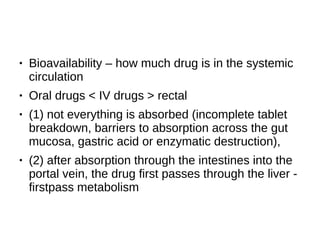
● Bioavailability – how much drug is in the systemic
circulation
● Oral drugs < IV drugs > rectal
● (1) not everything is absorbed (incomplete tablet
breakdown, barriers to absorption across the gut
mucosa, gastric acid or enzymatic destruction),
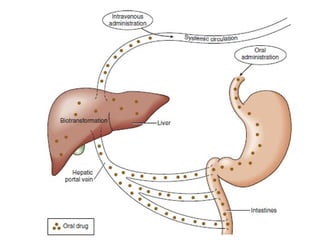
● (2) after absorption through the intestines into the
portal vein, the drug first passes through the liver -
firstpass metabolism
Distribution
● Distribution is where the drug goes after it is
absorbed and is usually discussed as the
volume of distribution (Vd).
– Vd = Amount of drug in body/Plasma drug
concentration
● How much of a drug stays in the patient’s
bloodstream and is unbound to protein.
● High Vd = Protein bound drug, Lipid soluble
●
Metabolism
● One of the two ways that the body can
decrease the concentration of active drug in the
bloodstream.
– Liver
● Two phases of biotransformation:
– phase I biotransformation (oxidation)
– phase II biotransformation (conjugation)
Phase I biotransformation
● Mediated by the microsomal cytochrome P-450
(CYP) monooxygenase system, with CYP3A4 (most
common subtype).
● Reactions - oxidations, reductions, or hydrolysis
● To make the drug more polar (more water soluble).
● Prodrugs: Levodopa.
● Older adults have decreased phase
biotransformation ability
Phase II biotransformation
● A molecule is “strapped on” (conjugated) to the
drug, such as an acetyl group, sulfide, or
glucuronide.
● Always makes the drug inactive.
●
Metabolism
● Metabolism
– Opioid analgesic codeine is metabolized into the
more active morphine by CYP2D6—10% of whites
have decreased CYP2D6 activity and will not get
adequate pain relief with codeine administration.
– CYP2C19 activates the antiplatelet agent clopidogrel
into the active form.
– Patients with poor CYP2C19 activity (more common
in Asian populations) will not have therapeutic levels
of the drug in their body.
● Differences in CYP activity vary based on
genetics; race and ethnicity.
– Grapefruit juice, cimetidine, erythromycin are
common CYP3A4 inhibitors.
– St. John’s wort, phenytoin, rifampin are common
CYP3A4 inducers
Excretion
● Typically by the kidneys
– Glomerular filtration: The drug must be delivered to the
glomerulus if it is to be filtered.
– Active tubular secretion: Probenecid
– Passive tubular reabsorption: Uncharged, lipid-soluble
molecules can be more readily absorbed through renal
tubular cell membranes.
– If the drug is a weak acid, then alkalization of the urine
will increase excretion by making more of the drug in
the charged A− form.
● Excretion via biliary system
– Through the bile to eventually be excreted in the
stool
– conjugation (recall that this is a phase II
biotransformation) with glucuronate can be excreted
in this fashion.
Calculations & Kinetics
● Elimination of drugs in terms of zero-order
kinetics versus first-order kinetics.
● Zero-order kinetics: A constant amount of drug
is eliminated per unit of time, so the rate of
elimination is constant regardless of
concentration of drug.
– Examples: phenytoin, ethanol, and aspirin (PEA)
● First-order kinetics: : A constant fraction of drug
is eliminated per unit time, so the rate of
elimination is proportional to the drug
concentration.
● More common method in which drugs are
metabolized.
● Almost all drugs are eliminated by first-order
kinetics
Half-life
● Half-life of a drug, which is the time it takes for
half the drug to be metabolized.
– Half-life of zero-order kinetics will change with the
concentration of the drug.
– In first-order kinetics, a constant proportion is
metabolized, the half-life is constant for a specific
drug.
– First-order kinetics drug, the half-life equation:
● Half-life = 0.7 × Vd/Clearance
Steady state
● After a patient has taken a drug for a period of
time (typically 4 to 5 times the half-life of the
drug), it reaches a steady state - where the
amount of drug taken equals the amount of
drug leaving the body.
●
● The concept of steady state also applies to
clinical practice.
● Levothyroxine has a half-life of about 1 week.
● How long before a steady state is achieved?
● When should TSH be assessed in a patient?
● The last calculations that you are expected to
know are the loading dose and maintenance
dose for a medication.
● Loading dose= Cp × Vd/F
– Cp is the target plasma concentration,
– Vd is the volume of distribution
– F is the bioavailability of the drug
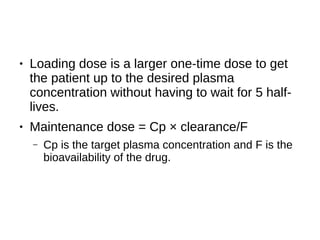
● Loading dose is a larger one-time dose to get
the patient up to the desired plasma
concentration without having to wait for 5 half-
lives.
● Maintenance dose = Cp × clearance/F
– Cp is the target plasma concentration and F is the
bioavailability of the drug.
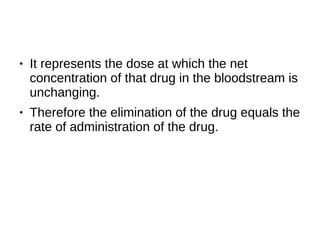
● It represents the dose at which the net
concentration of that drug in the bloodstream is
unchanging.
● Therefore the elimination of the drug equals the
rate of administration of the drug.
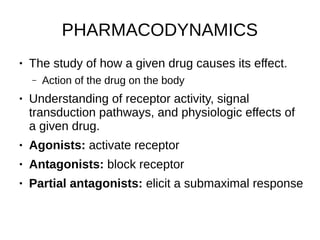
PHARMACODYNAMICS
● The study of how a given drug causes its effect.
– Action of the drug on the body
● Understanding of receptor activity, signal
transduction pathways, and physiologic effects of
a given drug.
● Agonists: activate receptor
● Antagonists: block receptor
● Partial antagonists: elicit a submaximal response
Pharmacology.pdf

Pharmacology.pdf

  • 1.
  • 2.
    Pharmacokinetics ● The descriptionof a drug’s journey through a patient’s body. (action of body on the drug) ● Involves four main processes: ● (1) absorption ● (2) distribution ● (3) metabolism ● (4) excretion
  • 3.
    Absorption ● How thepatient’s body takes in (absorbs) the drug. – Enteral - meaning absorbed through the intestines – Parenteral, meaning absorbed without the intestines
  • 4.
    ● Bioavailability –how much drug is in the systemic circulation ● Oral drugs < IV drugs > rectal ● (1) not everything is absorbed (incomplete tablet breakdown, barriers to absorption across the gut mucosa, gastric acid or enzymatic destruction), ● (2) after absorption through the intestines into the portal vein, the drug first passes through the liver - firstpass metabolism
  • 5.
    Distribution ● Distribution iswhere the drug goes after it is absorbed and is usually discussed as the volume of distribution (Vd). – Vd = Amount of drug in body/Plasma drug concentration ● How much of a drug stays in the patient’s bloodstream and is unbound to protein. ● High Vd = Protein bound drug, Lipid soluble ●
  • 6.
    Metabolism ● One ofthe two ways that the body can decrease the concentration of active drug in the bloodstream. – Liver ● Two phases of biotransformation: – phase I biotransformation (oxidation) – phase II biotransformation (conjugation)
  • 8.
    Phase I biotransformation ●Mediated by the microsomal cytochrome P-450 (CYP) monooxygenase system, with CYP3A4 (most common subtype). ● Reactions - oxidations, reductions, or hydrolysis ● To make the drug more polar (more water soluble). ● Prodrugs: Levodopa. ● Older adults have decreased phase biotransformation ability
  • 9.
    Phase II biotransformation ●A molecule is “strapped on” (conjugated) to the drug, such as an acetyl group, sulfide, or glucuronide. ● Always makes the drug inactive. ●
  • 10.
    Metabolism ● Metabolism – Opioidanalgesic codeine is metabolized into the more active morphine by CYP2D6—10% of whites have decreased CYP2D6 activity and will not get adequate pain relief with codeine administration. – CYP2C19 activates the antiplatelet agent clopidogrel into the active form. – Patients with poor CYP2C19 activity (more common in Asian populations) will not have therapeutic levels of the drug in their body.
  • 11.
    ● Differences inCYP activity vary based on genetics; race and ethnicity. – Grapefruit juice, cimetidine, erythromycin are common CYP3A4 inhibitors. – St. John’s wort, phenytoin, rifampin are common CYP3A4 inducers
  • 12.
    Excretion ● Typically bythe kidneys – Glomerular filtration: The drug must be delivered to the glomerulus if it is to be filtered. – Active tubular secretion: Probenecid – Passive tubular reabsorption: Uncharged, lipid-soluble molecules can be more readily absorbed through renal tubular cell membranes. – If the drug is a weak acid, then alkalization of the urine will increase excretion by making more of the drug in the charged A− form.
  • 13.
    ● Excretion viabiliary system – Through the bile to eventually be excreted in the stool – conjugation (recall that this is a phase II biotransformation) with glucuronate can be excreted in this fashion.
  • 14.
    Calculations & Kinetics ●Elimination of drugs in terms of zero-order kinetics versus first-order kinetics. ● Zero-order kinetics: A constant amount of drug is eliminated per unit of time, so the rate of elimination is constant regardless of concentration of drug. – Examples: phenytoin, ethanol, and aspirin (PEA)
  • 15.
    ● First-order kinetics:: A constant fraction of drug is eliminated per unit time, so the rate of elimination is proportional to the drug concentration. ● More common method in which drugs are metabolized. ● Almost all drugs are eliminated by first-order kinetics
  • 16.
    Half-life ● Half-life ofa drug, which is the time it takes for half the drug to be metabolized. – Half-life of zero-order kinetics will change with the concentration of the drug. – In first-order kinetics, a constant proportion is metabolized, the half-life is constant for a specific drug. – First-order kinetics drug, the half-life equation: ● Half-life = 0.7 × Vd/Clearance
  • 17.
    Steady state ● Aftera patient has taken a drug for a period of time (typically 4 to 5 times the half-life of the drug), it reaches a steady state - where the amount of drug taken equals the amount of drug leaving the body. ●
  • 18.
    ● The conceptof steady state also applies to clinical practice. ● Levothyroxine has a half-life of about 1 week. ● How long before a steady state is achieved? ● When should TSH be assessed in a patient?
  • 19.
    ● The lastcalculations that you are expected to know are the loading dose and maintenance dose for a medication. ● Loading dose= Cp × Vd/F – Cp is the target plasma concentration, – Vd is the volume of distribution – F is the bioavailability of the drug
  • 20.
    ● Loading doseis a larger one-time dose to get the patient up to the desired plasma concentration without having to wait for 5 half- lives. ● Maintenance dose = Cp × clearance/F – Cp is the target plasma concentration and F is the bioavailability of the drug.
  • 21.
    ● It representsthe dose at which the net concentration of that drug in the bloodstream is unchanging. ● Therefore the elimination of the drug equals the rate of administration of the drug.
  • 22.
    PHARMACODYNAMICS ● The studyof how a given drug causes its effect. – Action of the drug on the body ● Understanding of receptor activity, signal transduction pathways, and physiologic effects of a given drug. ● Agonists: activate receptor ● Antagonists: block receptor ● Partial antagonists: elicit a submaximal response