HINDRANCES TO PROBLEM SOLVING
 PRASHANT RAJ
 B A .ENGLISH (H)
 ENROLL.NO-A35306116004
 SUB-C0DE-BS 201
WHAT IS HINDRANCES?
 The situations, conditions, aspects, issues, behaviors etc. that
act as Hurdle in the achievement of a desired objective or in
getting a solution to a problem.
WHAT IS PROBLEM SOLVING BARRIER?
 A problem-solving barrier is something that stops people finding a
successful solution to a problem.
 These barriers are often caused by cognitive blocks – how we think and feel
– as well as by practical social and physical blocks.
COMMON CAUSES OF HINDRANCES
• Defining the problem too narrowly.
• Attacking the symptoms and not the real problem.
• Assuming there is only one right answer.
• Getting “hooked” on the first solution that comes to mind.
• Getting “hooked” on a solution that almost works (but really doesn’t).
• Being distracted by irrelevant information, called “mental dazzle.”
• Getting frustrated by lack of success.
• Being too anxious to finish.
• Defining the problem ambiguously.
6
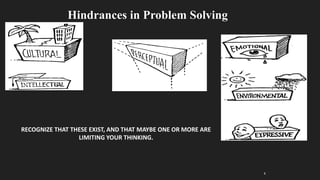
Hindrances in Problem Solving
RECOGNIZE THAT THESE EXIST, AND THAT MAYBE ONE OR MORE ARE
LIMITING YOUR THINKING.
1.PERCEPTION
 “ WE DON’T SEE THINGS AS THEY ARE, WE SEE THINGS
AS WE ARE”
 Perspective causes us to see the world in different ways, and from different
viewpoints. FOR EXAMPLE:- A marketing officer is likely to see a problem
in a different way to a service manager.
Perception is the process of selecting, organizing, receiving
stimuli and converting it into some meaningful picture of the
world.
Inaccurate perception of a problem creates difficulties & may be
caused by only seeking what we expect to see and not applying our
perspective.
E.g. Stereotyping, Halo effect, Horn effect, Recency effect, Primacy
effect, Selective Perception etc.
FACTORS INFLUENCING PERCEPTION:-
 PERCEIVER
 TARGET
 SITUATION
FACTORS IN THE PERCEIVER
 ATTITUDES
 MOTIVES
 INTERESTS
 EXPERIENCE
 EXPECTATIONS
FACTORS IN THE TARGET
 NOVELTY
 MOTIONS
 SOUNDS
 SIZE
 BACKGROUND
 PROXIMITY
 SIMILARITY
FACTORS IN THE SITUATION
 TIME
 WORK SETTING
 SOCIAL SETTING
2.WORK ENVIRONMENT
 The surroundings and factors around a person in his working environment that
effect his decisions.
 It is an important aspect in problem-solving as we know that the problems can be
solved in a healthier way if we have the support of our superiors, colleagues and
juniors at the work place
 Distractions (phones,interruptions)
 Unsupportive atmosphere
ENVIRONMENTAL BLOCKS
 Imposed by our immediate social and physical environments
Supportive environments - physical space and materials to encourage
creative thinking
Paper, pens, tape, music, space…
Emotional environment - honesty, trust and support so criticism is accepted
and incorporated
Competition and lack of trust destroy idea quality
Autocratic bosses.
3. EXPRESSION
 This is about how we express ourselves. Poor expression of problems and
solutions lead to misinterpretation and communication.
 Many problem-solving techniques often have a way to solve this directly via
creating a problem definition and the use of visual techniques.
 These are hindrances caused by the social or physical environment, and impact
on our ability to think clearly or to perform a task. For example, a noisy office
stops the problem solver being able to concentrate on the task.
EXPRESSIVE BLOCKS
Inability to Communicate
verbal
written
Report
Sketches
Drawingss
4 .EMOTION
 Emotions also strongly influence problem- solving.
 For example- If we are anxious about the outcome of a situation or are
impatient etc, the process of problem solving can be blocked
EMOTIONAL BLOCKS
Far of failure and taking a risk - rewarded when we do things right
and punished for wrong! Therefore we tend to safety and lower risk
ideas.
Inability to tolerate ambiguity - an overriding desire for order and no
appetite for chaos
Judging rather than generating - analysis, synthesis, criticism too early
Inability to relax and incubate
Lack of challenge - must be motivated
After a while the money doesn’t matter
Inability to distinguish reality from fantasy - manipulation of real and
imagined images
Imagining feelings, perceptions
5.INTELLECTUAL
 It is related to our knowledge, intelligence, skills or information regarding
a particular aspect.
 If we lack knowledge or skill in a particular area, or have developed an
inflexible mode of thinking or are not methodological in our approach to
difficulties, we are likely to exaggerate the problem and not solve it.
Intellectual Blocks
Inadequate use of problem-solving strategies
making a conscious choice
Imagining, visualising, transforming, randomising
 Lack of training
 Not knowing where to get the information
THANK YOU

Hindrances to problem solving copy

  • 1.
    HINDRANCES TO PROBLEMSOLVING  PRASHANT RAJ  B A .ENGLISH (H)  ENROLL.NO-A35306116004  SUB-C0DE-BS 201
  • 2.
    WHAT IS HINDRANCES? The situations, conditions, aspects, issues, behaviors etc. that act as Hurdle in the achievement of a desired objective or in getting a solution to a problem.
  • 3.
    WHAT IS PROBLEMSOLVING BARRIER?  A problem-solving barrier is something that stops people finding a successful solution to a problem.  These barriers are often caused by cognitive blocks – how we think and feel – as well as by practical social and physical blocks.
  • 4.
    COMMON CAUSES OFHINDRANCES • Defining the problem too narrowly. • Attacking the symptoms and not the real problem. • Assuming there is only one right answer. • Getting “hooked” on the first solution that comes to mind. • Getting “hooked” on a solution that almost works (but really doesn’t).
  • 5.
    • Being distractedby irrelevant information, called “mental dazzle.” • Getting frustrated by lack of success. • Being too anxious to finish. • Defining the problem ambiguously.
  • 6.
    6 Hindrances in ProblemSolving RECOGNIZE THAT THESE EXIST, AND THAT MAYBE ONE OR MORE ARE LIMITING YOUR THINKING.
  • 7.
    1.PERCEPTION  “ WEDON’T SEE THINGS AS THEY ARE, WE SEE THINGS AS WE ARE”  Perspective causes us to see the world in different ways, and from different viewpoints. FOR EXAMPLE:- A marketing officer is likely to see a problem in a different way to a service manager. Perception is the process of selecting, organizing, receiving stimuli and converting it into some meaningful picture of the world.
  • 8.
    Inaccurate perception ofa problem creates difficulties & may be caused by only seeking what we expect to see and not applying our perspective. E.g. Stereotyping, Halo effect, Horn effect, Recency effect, Primacy effect, Selective Perception etc.
  • 9.
    FACTORS INFLUENCING PERCEPTION:- PERCEIVER  TARGET  SITUATION
  • 10.
    FACTORS IN THEPERCEIVER  ATTITUDES  MOTIVES  INTERESTS  EXPERIENCE  EXPECTATIONS
  • 11.
    FACTORS IN THETARGET  NOVELTY  MOTIONS  SOUNDS  SIZE  BACKGROUND  PROXIMITY  SIMILARITY
  • 12.
    FACTORS IN THESITUATION  TIME  WORK SETTING  SOCIAL SETTING
  • 13.
    2.WORK ENVIRONMENT  Thesurroundings and factors around a person in his working environment that effect his decisions.  It is an important aspect in problem-solving as we know that the problems can be solved in a healthier way if we have the support of our superiors, colleagues and juniors at the work place  Distractions (phones,interruptions)  Unsupportive atmosphere
  • 14.
    ENVIRONMENTAL BLOCKS  Imposedby our immediate social and physical environments Supportive environments - physical space and materials to encourage creative thinking Paper, pens, tape, music, space… Emotional environment - honesty, trust and support so criticism is accepted and incorporated Competition and lack of trust destroy idea quality Autocratic bosses.
  • 15.
    3. EXPRESSION  Thisis about how we express ourselves. Poor expression of problems and solutions lead to misinterpretation and communication.  Many problem-solving techniques often have a way to solve this directly via creating a problem definition and the use of visual techniques.  These are hindrances caused by the social or physical environment, and impact on our ability to think clearly or to perform a task. For example, a noisy office stops the problem solver being able to concentrate on the task.
  • 16.
    EXPRESSIVE BLOCKS Inability toCommunicate verbal written Report Sketches Drawingss
  • 17.
    4 .EMOTION  Emotionsalso strongly influence problem- solving.  For example- If we are anxious about the outcome of a situation or are impatient etc, the process of problem solving can be blocked
  • 18.
    EMOTIONAL BLOCKS Far offailure and taking a risk - rewarded when we do things right and punished for wrong! Therefore we tend to safety and lower risk ideas. Inability to tolerate ambiguity - an overriding desire for order and no appetite for chaos Judging rather than generating - analysis, synthesis, criticism too early
  • 19.
    Inability to relaxand incubate Lack of challenge - must be motivated After a while the money doesn’t matter Inability to distinguish reality from fantasy - manipulation of real and imagined images Imagining feelings, perceptions
  • 20.
    5.INTELLECTUAL  It isrelated to our knowledge, intelligence, skills or information regarding a particular aspect.  If we lack knowledge or skill in a particular area, or have developed an inflexible mode of thinking or are not methodological in our approach to difficulties, we are likely to exaggerate the problem and not solve it.
  • 21.
    Intellectual Blocks Inadequate useof problem-solving strategies making a conscious choice Imagining, visualising, transforming, randomising  Lack of training  Not knowing where to get the information
  • 22.