1
Presented by:
Presented to:
Group members:
Abid Aziz
M.Qasim Sultani.
Sarim Zia.
Azqa Ameen.
Iram Awan.

Shaheen Group.
Ma’am Shehnila.
In this presentation we will
cover three topics.
 Introduction

to listening skills.

 Process

of listening.

 Hearing

vs. Listening.
Introduction to listening
skills.
What do you mean by
Listening.
Listening is:
 to pay attention to the sounds coming
into your ears
 to concentrate on a sound
 to make an effort to hear someone or
something
 to pay attention to someone or
something that you can hear.

In other words.
The process of receiving, constructing
meaning from, and responding to spoken
and/or nonverbal messages; to hear
something with thoughtful attention.
Introduction to listening skill.


Listening skills are vitally important both
at interview and in most workplaces. If
you demonstrate these skills at interview
then the interviewers are likely to be
confident that you will implement them
at work.
Active listening skills.


Engaging with what someone is saying so that they can tell that you
are listening to them.



Giving someone your full attention. You might make occasional
notes, but you will not be writing down everything they say or
interrupting them.



Making eye contact and nodding your head at appropriate times.



Able to ask for clarification on certain points, or to ask a question at
the end about something that was said during the interview.



Active listening is not only polite but also vital in an interview
situation. It will convey your interest in what the interviewers are
saying and prevent you from missing important information.
IMPORTANCE :
Listening is a skill that is important because it
helps us learn and understand different
things. Usually, a person who listens properly
is able to react appropriately to a particular
situation or towards a particular person.
Language skills.
Listening is the first skill from the four language
skill, which are:
 Listening
 Speaking
 Reading
 Writing
In our own language, listening is usually the
first language skill that we learn.
CONT...
Listening is one of the most important communication skills.
Without
careful listening, messages often are misinterpreted and people
do not
feel valued or understood. Too often people take listening for
granted
and do not pay enough attention to the speaker. In the case of
communicating across cultures, the act of listening becomes
even more
critical because there are additional factors such as
accents, idioms,
slang, etc.
A GOOD LISTENER:










looks at the person speaking
reacts responsively
pays close attention to the other
does not interrupt the speaker
is sensitive to the speaker
does not rush the speaker
ask appropriate questions
is emotionally controlled
has no hidden agenda
A BAD LISTENER:













Always interrupts
jumps to conclusions
makes moral judgments
keeps finishing the speaker's sentences
is inattentive
is always writing and taking notes
changes the subject
is unresponsive
is impatient
can't control emotions
"fidgets" nervously
LISTENING PROCESS :
The listening process starts out with






Receiving.
Understanding.
Remembering.
Evaluating.
Responding.
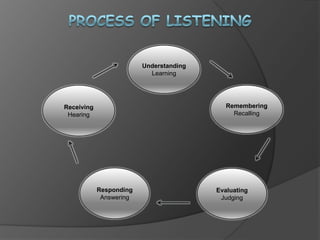
Understanding
Learning

Remembering
Recalling

Receiving
Hearing

Responding
Answering

Evaluating
Judging
Receiving.
 It refers to the response caused by sound waves
stimulating the sensory receptors of the ear; it is
physical response.

Understanding.
 It is the stage at which you learn what the speaker
means-the thoughts and emotional tone.
Remembering.




It is important listening process because it means that
an individual has not only received and interpreted a
message but has also added it to the mind's storage
bank.
But just as our attention is selective, so too is our
memory- what is remembered may be quite different
from what was originally seen or heard.
Evaluating.


It consists of judging the messages in some way. At
times, you may try to evaluate the speaker’s underlying
intentions or motives.
 Often this evaluation process goes on without much
conscious awareness.

Responding.


This stage requires that the receiver complete the
process through verbal and/or nonverbal feedback;
because the speaker has no other way to determine if a
message has been received .
 This stage becomes the only overt means by which the
sender may determine the degree of success in
transmitting the message.
Difference between Listening and Hearing:
Listening vs. Hearing.


To any layman, ‘hearing’ and ‘listening’ may
appear to be one and the same thing, but
there is a subtle difference between the two
words.



At one level, they are of course both functions
of the ear that involve receiving sounds and
processing them. However, herein lies the
difference: any sound that is received by the
ear and noted by the brain can be said to have
been ‘heard’; it is only when a conscious effort
is made to hear something that ‘listening’
comes into play.
Continue…


For example, if the sounds from a conversation carry to you, but
you make no effort to understand what is being said, you must
say that you ‘heard’ the conversation. On the other hand, as
soon as you make a conscious effort to understand or pay
attention to what you are hearing, you are ‘listening’.
Therefore, we do not ‘hear’ songs, we ‘listen’ to them (unless, of
course, they are simply part of the background and we aren’t
actually paying attention to them).



It must be noted that ‘hear’ can be used in place of ‘listen’
sometimes, but ‘listen’ should not be used in place of ‘hear’. For
example, you may tell someone that you heard what he or she
said, and it is understood that you were listening, ie, paying
attention.
FAQs.
THANK-YOU

Introduction to listening skills.

  • 1.
  • 2.
    Presented by: Presented to: Groupmembers: Abid Aziz M.Qasim Sultani. Sarim Zia. Azqa Ameen. Iram Awan. Shaheen Group. Ma’am Shehnila.
  • 3.
    In this presentationwe will cover three topics.  Introduction to listening skills.  Process of listening.  Hearing vs. Listening.
  • 4.
  • 5.
    What do youmean by Listening. Listening is:  to pay attention to the sounds coming into your ears  to concentrate on a sound  to make an effort to hear someone or something  to pay attention to someone or something that you can hear. 
  • 6.
    In other words. Theprocess of receiving, constructing meaning from, and responding to spoken and/or nonverbal messages; to hear something with thoughtful attention.
  • 7.
    Introduction to listeningskill.  Listening skills are vitally important both at interview and in most workplaces. If you demonstrate these skills at interview then the interviewers are likely to be confident that you will implement them at work.
  • 8.
    Active listening skills.  Engagingwith what someone is saying so that they can tell that you are listening to them.  Giving someone your full attention. You might make occasional notes, but you will not be writing down everything they say or interrupting them.  Making eye contact and nodding your head at appropriate times.  Able to ask for clarification on certain points, or to ask a question at the end about something that was said during the interview.  Active listening is not only polite but also vital in an interview situation. It will convey your interest in what the interviewers are saying and prevent you from missing important information.
  • 9.
    IMPORTANCE : Listening isa skill that is important because it helps us learn and understand different things. Usually, a person who listens properly is able to react appropriately to a particular situation or towards a particular person.
  • 10.
    Language skills. Listening isthe first skill from the four language skill, which are:  Listening  Speaking  Reading  Writing In our own language, listening is usually the first language skill that we learn.
  • 11.
    CONT... Listening is oneof the most important communication skills. Without careful listening, messages often are misinterpreted and people do not feel valued or understood. Too often people take listening for granted and do not pay enough attention to the speaker. In the case of communicating across cultures, the act of listening becomes even more critical because there are additional factors such as accents, idioms, slang, etc.
  • 12.
    A GOOD LISTENER:          looksat the person speaking reacts responsively pays close attention to the other does not interrupt the speaker is sensitive to the speaker does not rush the speaker ask appropriate questions is emotionally controlled has no hidden agenda
  • 13.
    A BAD LISTENER:            Alwaysinterrupts jumps to conclusions makes moral judgments keeps finishing the speaker's sentences is inattentive is always writing and taking notes changes the subject is unresponsive is impatient can't control emotions "fidgets" nervously
  • 14.
    LISTENING PROCESS : Thelistening process starts out with      Receiving. Understanding. Remembering. Evaluating. Responding.
  • 15.
  • 16.
    Receiving.  It refersto the response caused by sound waves stimulating the sensory receptors of the ear; it is physical response. Understanding.  It is the stage at which you learn what the speaker means-the thoughts and emotional tone.
  • 17.
    Remembering.   It is importantlistening process because it means that an individual has not only received and interpreted a message but has also added it to the mind's storage bank. But just as our attention is selective, so too is our memory- what is remembered may be quite different from what was originally seen or heard.
  • 18.
    Evaluating.  It consists ofjudging the messages in some way. At times, you may try to evaluate the speaker’s underlying intentions or motives.  Often this evaluation process goes on without much conscious awareness. Responding.  This stage requires that the receiver complete the process through verbal and/or nonverbal feedback; because the speaker has no other way to determine if a message has been received .  This stage becomes the only overt means by which the sender may determine the degree of success in transmitting the message.
  • 19.
  • 20.
    Listening vs. Hearing.  Toany layman, ‘hearing’ and ‘listening’ may appear to be one and the same thing, but there is a subtle difference between the two words.  At one level, they are of course both functions of the ear that involve receiving sounds and processing them. However, herein lies the difference: any sound that is received by the ear and noted by the brain can be said to have been ‘heard’; it is only when a conscious effort is made to hear something that ‘listening’ comes into play.
  • 21.
    Continue…  For example, ifthe sounds from a conversation carry to you, but you make no effort to understand what is being said, you must say that you ‘heard’ the conversation. On the other hand, as soon as you make a conscious effort to understand or pay attention to what you are hearing, you are ‘listening’. Therefore, we do not ‘hear’ songs, we ‘listen’ to them (unless, of course, they are simply part of the background and we aren’t actually paying attention to them).  It must be noted that ‘hear’ can be used in place of ‘listen’ sometimes, but ‘listen’ should not be used in place of ‘hear’. For example, you may tell someone that you heard what he or she said, and it is understood that you were listening, ie, paying attention.
  • 22.
  • 23.