CENTRAL BICOL STATE UNIVERSITY OF AGRICULTURE 
Pasacao Campus 
Sta. Rosa del Norte, Pasacao Camarines Sur
SPECIAL TOPICS 
IN 
EDUCATION
Prepared By: 
RODRIGUEZ, DIANA M. 
Bachelor of Secondary Education 
Mathematics IV 
Prepared To: 
PROF. CARLO CORNEJO 
Instructor
QUESTIONS 
and QUESTIONING
Topic: 
The art of questioning 
NCBTS: 
Domains 4-Curriculum; 5-Planning, 
Assessing and Reporting 
By: 
CELIA D. ANDAS, Ed.D
OBJECTIVES 
At the end of this Module, the learners 
should be able to: 
o List at least six principles of good questioning; 
o Define the six levels of cognitive thinking according to Bloom; 
o Write at least three questions( in his/her own discipline) at 
each of the six levels of questioning under the Bloom’s 
Classification System; 
o Justify the categorization of each questions developed in the 
specific level; 
o Create a 10=minute micro lesson during which a minimum of 
five different questions, two of which must be above the 
Comprehension level, will be asked; and 
o Using the 10-minute micro lesson, analyze the questions 
used.
INTRODUCTION 
Good teaching is more a giving of right questions than a 
giving of right answers- JOSEF ALBERS(1888-1976) 
A questions is any sentence which has an interrogative form 
or function. In classroom settings, teacher questions are 
considered as instructional cues or stimuli that convey to students 
the content elements to be learned and directions for what they are 
to do and how they are to do it. This calls for the teachers careful 
planning and crafting of questions. Questions should play a central 
role in the learning process.
DISCUSSION 
Good questioning is an excellent aid to teaching that is 
hardly utilized to the fullest extent. It challenges the higher order 
reasoning; it is a determinant of teaching and learning outcomes. 
The quality of the teachers questions affects the quality of 
thinking in the classroom. Low order questions, mostly in the 
lower levels of Bloom’s Taxonomy- particularly, knowledge and 
comprehension- are the most common questions teachers use. 
These questions require simple recall. Thus, there is not much 
challenge to students thinking and reasoning. Many of these are 
closed-ended questions, questions that require specific answers. 
Higher order questions, on the other hand, usually in the 
higher levels of Bloom’s Taxonomy, such as synthesis and 
evaluation, require higher order reasoning, stimulated through the 
use of open-ended questions.
PURPOSES OF QUESTIONING 
o To interest, engage and challenge the learners; 
o To check on prior knowledge; 
o To stimulate recall and use of existing knowledge and experience in 
order to create new understanding and meaning; 
o To focus thinking on key concepts and issues; 
o To extend learners thinking from the concrete and factual to the analytical 
and evaluative; 
o To lead learners through a planned sequence which progressively 
establishes key understandings; 
o To promote reasoning, problem solving, evaluation and the formulation of 
hypotheses; 
o To promote learners thinking about the way they have learned; 
o Develop critical thinking skills and inquiring attitudes and reinforce 
student understanding; 
o Provide feedback and enliven classroom discussion; 
o Nurture insights by exposing new relationships; 
o Stimulate students to pursue knowledge on their own.
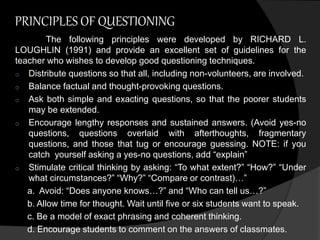
PRINCIPLES OF QUESTIONING 
The following principles were developed by RICHARD L. 
LOUGHLIN (1991) and provide an excellent set of guidelines for the 
teacher who wishes to develop good questioning techniques. 
o Distribute questions so that all, including non-volunteers, are involved. 
o Balance factual and thought-provoking questions. 
o Ask both simple and exacting questions, so that the poorer students 
may be extended. 
o Encourage lengthy responses and sustained answers. (Avoid yes-no 
questions, questions overlaid with afterthoughts, fragmentary 
questions, and those that tug or encourage guessing. NOTE: if you 
catch yourself asking a yes-no questions, add “explain” 
o Stimulate critical thinking by asking: “To what extent?” “How?” “Under 
what circumstances?” “Why?” “Compare or contrast)…” 
a. Avoid: “Does anyone knows…?” and “Who can tell us…?” 
b. Allow time for thought. Wait until five or six students want to speak. 
c. Be a model of exact phrasing and coherent thinking. 
d. Encourage students to comment on the answers of classmates.
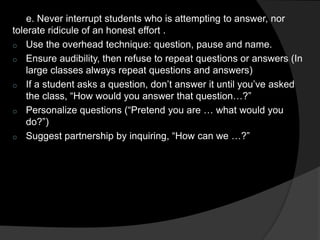
e. Never interrupt students who is attempting to answer, nor 
tolerate ridicule of an honest effort . 
o Use the overhead technique: question, pause and name. 
o Ensure audibility, then refuse to repeat questions or answers (In 
large classes always repeat questions and answers) 
o If a student asks a question, don’t answer it until you’ve asked 
the class, “How would you answer that question…?” 
o Personalize questions (“Pretend you are … what would you 
do?”) 
o Suggest partnership by inquiring, “How can we …?”
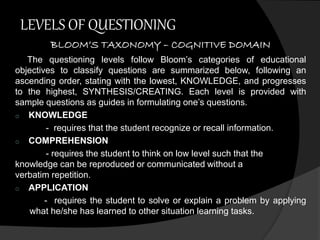
LEVELS OF QUESTIONING 
BLOOM’S TAXONOMY – COGNITIVE DOMAIN 
The questioning levels follow Bloom’s categories of educational 
objectives to classify questions are summarized below, following an 
ascending order, stating with the lowest, KNOWLEDGE, and progresses 
to the highest, SYNTHESIS/CREATING. Each level is provided with 
sample questions as guides in formulating one’s questions. 
o KNOWLEDGE 
- requires that the student recognize or recall information. 
o COMPREHENSION 
- requires the student to think on low level such that the 
knowledge can be reproduced or communicated without a 
verbatim repetition. 
o APPLICATION 
- requires the student to solve or explain a problem by applying 
what he/she has learned to other situation learning tasks.
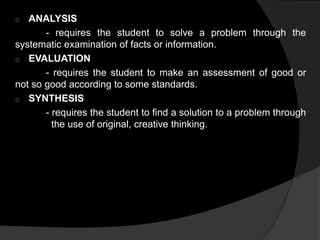
o ANALYSIS 
- requires the student to solve a problem through the 
systematic examination of facts or information. 
o EVALUATION 
- requires the student to make an assessment of good or 
not so good according to some standards. 
o SYNTHESIS 
- requires the student to find a solution to a problem through 
the use of original, creative thinking.
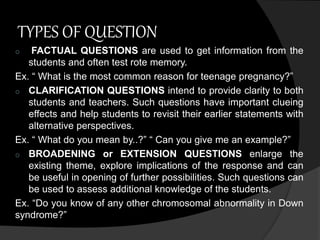
TYPES OF QUESTION 
o FACTUAL QUESTIONS are used to get information from the 
students and often test rote memory. 
Ex. “ What is the most common reason for teenage pregnancy?” 
o CLARIFICATION QUESTIONS intend to provide clarity to both 
students and teachers. Such questions have important clueing 
effects and help students to revisit their earlier statements with 
alternative perspectives. 
Ex. “ What do you mean by..?” “ Can you give me an example?” 
o BROADENING or EXTENSION QUESTIONS enlarge the 
existing theme, explore implications of the response and can 
be useful in opening of further possibilities. Such questions can 
be used to assess additional knowledge of the students. 
Ex. “Do you know of any other chromosomal abnormality in Down 
syndrome?”
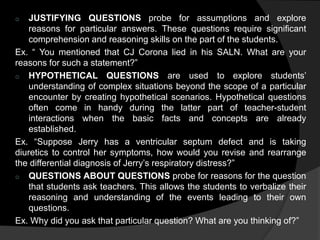
o JUSTIFYING QUESTIONS probe for assumptions and explore 
reasons for particular answers. These questions require significant 
comprehension and reasoning skills on the part of the students. 
Ex. “ You mentioned that CJ Corona lied in his SALN. What are your 
reasons for such a statement?” 
o HYPOTHETICAL QUESTIONS are used to explore students’ 
understanding of complex situations beyond the scope of a particular 
encounter by creating hypothetical scenarios. Hypothetical questions 
often come in handy during the latter part of teacher-student 
interactions when the basic facts and concepts are already 
established. 
Ex. “Suppose Jerry has a ventricular septum defect and is taking 
diuretics to control her symptoms, how would you revise and rearrange 
the differential diagnosis of Jerry’s respiratory distress?” 
o QUESTIONS ABOUT QUESTIONS probe for reasons for the question 
that students ask teachers. This allows the students to verbalize their 
reasoning and understanding of the events leading to their own 
questions. 
Ex. Why did you ask that particular question? What are you thinking of?”
o REDIRECTED QUESTIONS address the same question to 
several students and distribute responsibility. The benefits of 
such questions include generation of wider variety of responses 
and allowing the students to evaluate each other’s 
contributions. This technique shifts the focus from teacher-student 
interactions to student-student interactions.
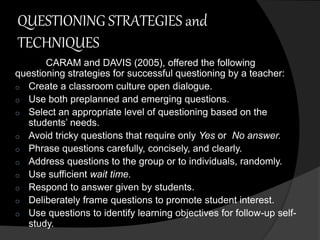
QUESTIONING STRATEGIES and 
TECHNIQUES 
CARAM and DAVIS (2005), offered the following 
questioning strategies for successful questioning by a teacher: 
o Create a classroom culture open dialogue. 
o Use both preplanned and emerging questions. 
o Select an appropriate level of questioning based on the 
students’ needs. 
o Avoid tricky questions that require only Yes or No answer. 
o Phrase questions carefully, concisely, and clearly. 
o Address questions to the group or to individuals, randomly. 
o Use sufficient wait time. 
o Respond to answer given by students. 
o Deliberately frame questions to promote student interest. 
o Use questions to identify learning objectives for follow-up self-study.
QUESTION ANALYSIS FORM 
A chart may be used to classify questions in the Bloom’s 
Classification System. Using the chart, the questions should be 
written on the left-hand margin and then classified according to 
one of the six categories. If the questions, for example, are 
creative, they should be classified under either the synthesis or 
evaluation categories. The questions should evaluated 
objectively. The definition or description of each of the level or 
category may be used as the basis of categorization.
EDUCATIONAL IMPLICATION 
Questions are an important element of any conversation. If we are 
to develop a learning environment and approach where questions come 
readily to children, then we need to use questions in a conversation rather 
than simply to start a conversation. Social learning through group projects 
and research through, for example, interviewing someone who knows 
what we do not yet know is the key to creating life-long questioners. This 
approach will also help children to learn how to listen. 
Asking secondary students insightful questions has many benefits 
for professional teaching practice. Whether the response is intended to be 
written, spoken, dramatized, or conveyed in some other manner, it will 
provide feedback on how successful the lesson was in stimulating their 
thought processes. The students will reflect on their learning through 
higher-level thinking processes such as analysis, synthesis, comparison, 
or summation. Finally, students are more likely to remember what they 
have learned when they explore the implications of their learning.
Thank you!

QUESTIONS AND QUESTIONING

  • 1.
    CENTRAL BICOL STATEUNIVERSITY OF AGRICULTURE Pasacao Campus Sta. Rosa del Norte, Pasacao Camarines Sur
  • 2.
  • 3.
    Prepared By: RODRIGUEZ,DIANA M. Bachelor of Secondary Education Mathematics IV Prepared To: PROF. CARLO CORNEJO Instructor
  • 4.
  • 5.
    Topic: The artof questioning NCBTS: Domains 4-Curriculum; 5-Planning, Assessing and Reporting By: CELIA D. ANDAS, Ed.D
  • 6.
    OBJECTIVES At theend of this Module, the learners should be able to: o List at least six principles of good questioning; o Define the six levels of cognitive thinking according to Bloom; o Write at least three questions( in his/her own discipline) at each of the six levels of questioning under the Bloom’s Classification System; o Justify the categorization of each questions developed in the specific level; o Create a 10=minute micro lesson during which a minimum of five different questions, two of which must be above the Comprehension level, will be asked; and o Using the 10-minute micro lesson, analyze the questions used.
  • 7.
    INTRODUCTION Good teachingis more a giving of right questions than a giving of right answers- JOSEF ALBERS(1888-1976) A questions is any sentence which has an interrogative form or function. In classroom settings, teacher questions are considered as instructional cues or stimuli that convey to students the content elements to be learned and directions for what they are to do and how they are to do it. This calls for the teachers careful planning and crafting of questions. Questions should play a central role in the learning process.
  • 8.
    DISCUSSION Good questioningis an excellent aid to teaching that is hardly utilized to the fullest extent. It challenges the higher order reasoning; it is a determinant of teaching and learning outcomes. The quality of the teachers questions affects the quality of thinking in the classroom. Low order questions, mostly in the lower levels of Bloom’s Taxonomy- particularly, knowledge and comprehension- are the most common questions teachers use. These questions require simple recall. Thus, there is not much challenge to students thinking and reasoning. Many of these are closed-ended questions, questions that require specific answers. Higher order questions, on the other hand, usually in the higher levels of Bloom’s Taxonomy, such as synthesis and evaluation, require higher order reasoning, stimulated through the use of open-ended questions.
  • 9.
    PURPOSES OF QUESTIONING o To interest, engage and challenge the learners; o To check on prior knowledge; o To stimulate recall and use of existing knowledge and experience in order to create new understanding and meaning; o To focus thinking on key concepts and issues; o To extend learners thinking from the concrete and factual to the analytical and evaluative; o To lead learners through a planned sequence which progressively establishes key understandings; o To promote reasoning, problem solving, evaluation and the formulation of hypotheses; o To promote learners thinking about the way they have learned; o Develop critical thinking skills and inquiring attitudes and reinforce student understanding; o Provide feedback and enliven classroom discussion; o Nurture insights by exposing new relationships; o Stimulate students to pursue knowledge on their own.
  • 10.
    PRINCIPLES OF QUESTIONING The following principles were developed by RICHARD L. LOUGHLIN (1991) and provide an excellent set of guidelines for the teacher who wishes to develop good questioning techniques. o Distribute questions so that all, including non-volunteers, are involved. o Balance factual and thought-provoking questions. o Ask both simple and exacting questions, so that the poorer students may be extended. o Encourage lengthy responses and sustained answers. (Avoid yes-no questions, questions overlaid with afterthoughts, fragmentary questions, and those that tug or encourage guessing. NOTE: if you catch yourself asking a yes-no questions, add “explain” o Stimulate critical thinking by asking: “To what extent?” “How?” “Under what circumstances?” “Why?” “Compare or contrast)…” a. Avoid: “Does anyone knows…?” and “Who can tell us…?” b. Allow time for thought. Wait until five or six students want to speak. c. Be a model of exact phrasing and coherent thinking. d. Encourage students to comment on the answers of classmates.
  • 11.
    e. Never interruptstudents who is attempting to answer, nor tolerate ridicule of an honest effort . o Use the overhead technique: question, pause and name. o Ensure audibility, then refuse to repeat questions or answers (In large classes always repeat questions and answers) o If a student asks a question, don’t answer it until you’ve asked the class, “How would you answer that question…?” o Personalize questions (“Pretend you are … what would you do?”) o Suggest partnership by inquiring, “How can we …?”
  • 12.
    LEVELS OF QUESTIONING BLOOM’S TAXONOMY – COGNITIVE DOMAIN The questioning levels follow Bloom’s categories of educational objectives to classify questions are summarized below, following an ascending order, stating with the lowest, KNOWLEDGE, and progresses to the highest, SYNTHESIS/CREATING. Each level is provided with sample questions as guides in formulating one’s questions. o KNOWLEDGE - requires that the student recognize or recall information. o COMPREHENSION - requires the student to think on low level such that the knowledge can be reproduced or communicated without a verbatim repetition. o APPLICATION - requires the student to solve or explain a problem by applying what he/she has learned to other situation learning tasks.
  • 13.
    o ANALYSIS -requires the student to solve a problem through the systematic examination of facts or information. o EVALUATION - requires the student to make an assessment of good or not so good according to some standards. o SYNTHESIS - requires the student to find a solution to a problem through the use of original, creative thinking.
  • 14.
    TYPES OF QUESTION o FACTUAL QUESTIONS are used to get information from the students and often test rote memory. Ex. “ What is the most common reason for teenage pregnancy?” o CLARIFICATION QUESTIONS intend to provide clarity to both students and teachers. Such questions have important clueing effects and help students to revisit their earlier statements with alternative perspectives. Ex. “ What do you mean by..?” “ Can you give me an example?” o BROADENING or EXTENSION QUESTIONS enlarge the existing theme, explore implications of the response and can be useful in opening of further possibilities. Such questions can be used to assess additional knowledge of the students. Ex. “Do you know of any other chromosomal abnormality in Down syndrome?”
  • 15.
    o JUSTIFYING QUESTIONSprobe for assumptions and explore reasons for particular answers. These questions require significant comprehension and reasoning skills on the part of the students. Ex. “ You mentioned that CJ Corona lied in his SALN. What are your reasons for such a statement?” o HYPOTHETICAL QUESTIONS are used to explore students’ understanding of complex situations beyond the scope of a particular encounter by creating hypothetical scenarios. Hypothetical questions often come in handy during the latter part of teacher-student interactions when the basic facts and concepts are already established. Ex. “Suppose Jerry has a ventricular septum defect and is taking diuretics to control her symptoms, how would you revise and rearrange the differential diagnosis of Jerry’s respiratory distress?” o QUESTIONS ABOUT QUESTIONS probe for reasons for the question that students ask teachers. This allows the students to verbalize their reasoning and understanding of the events leading to their own questions. Ex. Why did you ask that particular question? What are you thinking of?”
  • 16.
    o REDIRECTED QUESTIONSaddress the same question to several students and distribute responsibility. The benefits of such questions include generation of wider variety of responses and allowing the students to evaluate each other’s contributions. This technique shifts the focus from teacher-student interactions to student-student interactions.
  • 17.
    QUESTIONING STRATEGIES and TECHNIQUES CARAM and DAVIS (2005), offered the following questioning strategies for successful questioning by a teacher: o Create a classroom culture open dialogue. o Use both preplanned and emerging questions. o Select an appropriate level of questioning based on the students’ needs. o Avoid tricky questions that require only Yes or No answer. o Phrase questions carefully, concisely, and clearly. o Address questions to the group or to individuals, randomly. o Use sufficient wait time. o Respond to answer given by students. o Deliberately frame questions to promote student interest. o Use questions to identify learning objectives for follow-up self-study.
  • 18.
    QUESTION ANALYSIS FORM A chart may be used to classify questions in the Bloom’s Classification System. Using the chart, the questions should be written on the left-hand margin and then classified according to one of the six categories. If the questions, for example, are creative, they should be classified under either the synthesis or evaluation categories. The questions should evaluated objectively. The definition or description of each of the level or category may be used as the basis of categorization.
  • 19.
    EDUCATIONAL IMPLICATION Questionsare an important element of any conversation. If we are to develop a learning environment and approach where questions come readily to children, then we need to use questions in a conversation rather than simply to start a conversation. Social learning through group projects and research through, for example, interviewing someone who knows what we do not yet know is the key to creating life-long questioners. This approach will also help children to learn how to listen. Asking secondary students insightful questions has many benefits for professional teaching practice. Whether the response is intended to be written, spoken, dramatized, or conveyed in some other manner, it will provide feedback on how successful the lesson was in stimulating their thought processes. The students will reflect on their learning through higher-level thinking processes such as analysis, synthesis, comparison, or summation. Finally, students are more likely to remember what they have learned when they explore the implications of their learning.
  • 20.