Prime NumbersEratosthenes’ SieveBy Monica Yuskaitis
Copyright © 2000 by Monica YuskaitisEratosthenes(ehr-uh-TAHS-thuh-neez)Eratosthenes was the librarian at Alexandria, Egypt in 200 B.C.  Note every book was a scroll.
Copyright © 2000 by Monica YuskaitisEratosthenes(ehr-uh-TAHS-thuh-neez)Eratosthenes was a Greek mathematician, astronomer, and geographer.He invented a method for finding prime numbers that is still used today.This method is called Eratosthenes’ Sieve.
Copyright © 2000 by Monica YuskaitisEratosthenes’ SieveA sieve has holes in it and is used to filter out the juice.Eratosthenes’s sieve filters out numbers to find the prime numbers.
Copyright © 2000 by Monica YuskaitisDefinitionFactor – a number that is multiplied by another to give a product.7 x 8 = 56Factors
Copyright © 2000 by Monica YuskaitisDefinitionFactor – a number that divides evenly into another.56 ÷ 8 = 7Factor
Copyright © 2000 by Monica YuskaitisDefinitionPrime Number – a number that has only two factors, itself and 1.77 is prime because the only numbersthat will divide into it evenly are 1 and 7.
Copyright © 2000 by Monica YuskaitisHundreds ChartOn graph paper, make a chart of the numbers from 1 to 100, with 10 numbers in each row.
Copyright © 2000 by Monica YuskaitisHundreds Chart
Copyright © 2000 by Monica Yuskaitis1 – Cross out 1; it is not prime.
Copyright © 2000 by Monica YuskaitisHint For Next Step  Remember all numbers divisible by 2 are even numbers.
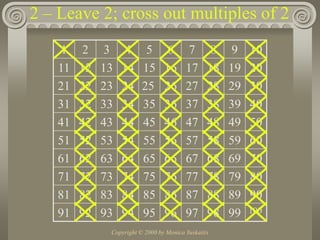
Copyright © 2000 by Monica Yuskaitis2 – Leave 2; cross out multiples of 2
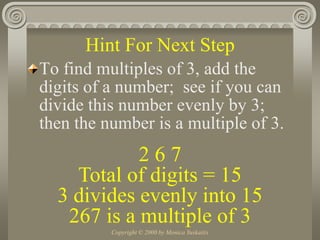
Copyright © 2000 by Monica YuskaitisHint For Next StepTo find multiples of 3, add the digits of a number;  see if you can divide this number evenly by 3; then the number is a multiple of 3. 2 6 7Total of digits = 153 divides evenly into 15267 is a multiple of 3
Copyright © 2000 by Monica Yuskaitis3– Leave 3; cross out multiples of 3
Copyright © 2000 by Monica YuskaitisHint For the Next StepTo find the multiples of 5 look for numbers that end with the digit 0 and 5.385 is a multiple of 5& 890 is a multiple of 5because the last digitends with 0 or 5.
Copyright © 2000 by Monica Yuskaitis4– Leave 5; cross out multiples of 5
Copyright © 2000 by Monica Yuskaitis5– Leave 7; cross out multiples of 7
Copyright © 2000 by Monica Yuskaitis6–Leave 11; cross out multiples of 11
Copyright © 2000 by Monica YuskaitisAll the numbers left are prime
Copyright © 2000 by Monica YuskaitisThe Prime Numbers from 1 to 100 are as follows:2,3,5,7,11,13,17,19,23,29,31,37,41,43,47,53,59,61,67,71,73,79,83,89,97
Copyright © 2000 by Monica YuskaitisCreditsClipart from “Microsoft Clip Gallery” located on the Internet at http://cgl.microsoft.com/clipgallerylive/default.asp

Prime Numbers

  • 1.
  • 2.
    Copyright © 2000by Monica YuskaitisEratosthenes(ehr-uh-TAHS-thuh-neez)Eratosthenes was the librarian at Alexandria, Egypt in 200 B.C. Note every book was a scroll.
  • 3.
    Copyright © 2000by Monica YuskaitisEratosthenes(ehr-uh-TAHS-thuh-neez)Eratosthenes was a Greek mathematician, astronomer, and geographer.He invented a method for finding prime numbers that is still used today.This method is called Eratosthenes’ Sieve.
  • 4.
    Copyright © 2000by Monica YuskaitisEratosthenes’ SieveA sieve has holes in it and is used to filter out the juice.Eratosthenes’s sieve filters out numbers to find the prime numbers.
  • 5.
    Copyright © 2000by Monica YuskaitisDefinitionFactor – a number that is multiplied by another to give a product.7 x 8 = 56Factors
  • 6.
    Copyright © 2000by Monica YuskaitisDefinitionFactor – a number that divides evenly into another.56 ÷ 8 = 7Factor
  • 7.
    Copyright © 2000by Monica YuskaitisDefinitionPrime Number – a number that has only two factors, itself and 1.77 is prime because the only numbersthat will divide into it evenly are 1 and 7.
  • 8.
    Copyright © 2000by Monica YuskaitisHundreds ChartOn graph paper, make a chart of the numbers from 1 to 100, with 10 numbers in each row.
  • 9.
    Copyright © 2000by Monica YuskaitisHundreds Chart
  • 10.
    Copyright © 2000by Monica Yuskaitis1 – Cross out 1; it is not prime.
  • 11.
    Copyright © 2000by Monica YuskaitisHint For Next Step Remember all numbers divisible by 2 are even numbers.
  • 12.
    Copyright © 2000by Monica Yuskaitis2 – Leave 2; cross out multiples of 2
  • 13.
    Copyright © 2000by Monica YuskaitisHint For Next StepTo find multiples of 3, add the digits of a number; see if you can divide this number evenly by 3; then the number is a multiple of 3. 2 6 7Total of digits = 153 divides evenly into 15267 is a multiple of 3
  • 14.
    Copyright © 2000by Monica Yuskaitis3– Leave 3; cross out multiples of 3
  • 15.
    Copyright © 2000by Monica YuskaitisHint For the Next StepTo find the multiples of 5 look for numbers that end with the digit 0 and 5.385 is a multiple of 5& 890 is a multiple of 5because the last digitends with 0 or 5.
  • 16.
    Copyright © 2000by Monica Yuskaitis4– Leave 5; cross out multiples of 5
  • 17.
    Copyright © 2000by Monica Yuskaitis5– Leave 7; cross out multiples of 7
  • 18.
    Copyright © 2000by Monica Yuskaitis6–Leave 11; cross out multiples of 11
  • 19.
    Copyright © 2000by Monica YuskaitisAll the numbers left are prime
  • 20.
    Copyright © 2000by Monica YuskaitisThe Prime Numbers from 1 to 100 are as follows:2,3,5,7,11,13,17,19,23,29,31,37,41,43,47,53,59,61,67,71,73,79,83,89,97
  • 21.
    Copyright © 2000by Monica YuskaitisCreditsClipart from “Microsoft Clip Gallery” located on the Internet at http://cgl.microsoft.com/clipgallerylive/default.asp