HISTORY
 The theory has its origin in game of chances related to
gambling.
“Girolamo cardano (1501-76) ,an Italian mathematician , was
first man to wrote a book on subject entitled “Book on Games
of Chances” published after his death in 1663.
 Galileo (1564-1642), also an Italian mathematician was first
to attempt quantitative measure of probability.
 Jacques Bernoulli (1654-1705)was one who made extensive
study of subject for over 2 decades and his treatise on
probability is a major contribution to theory of probability.
DEFINITION-
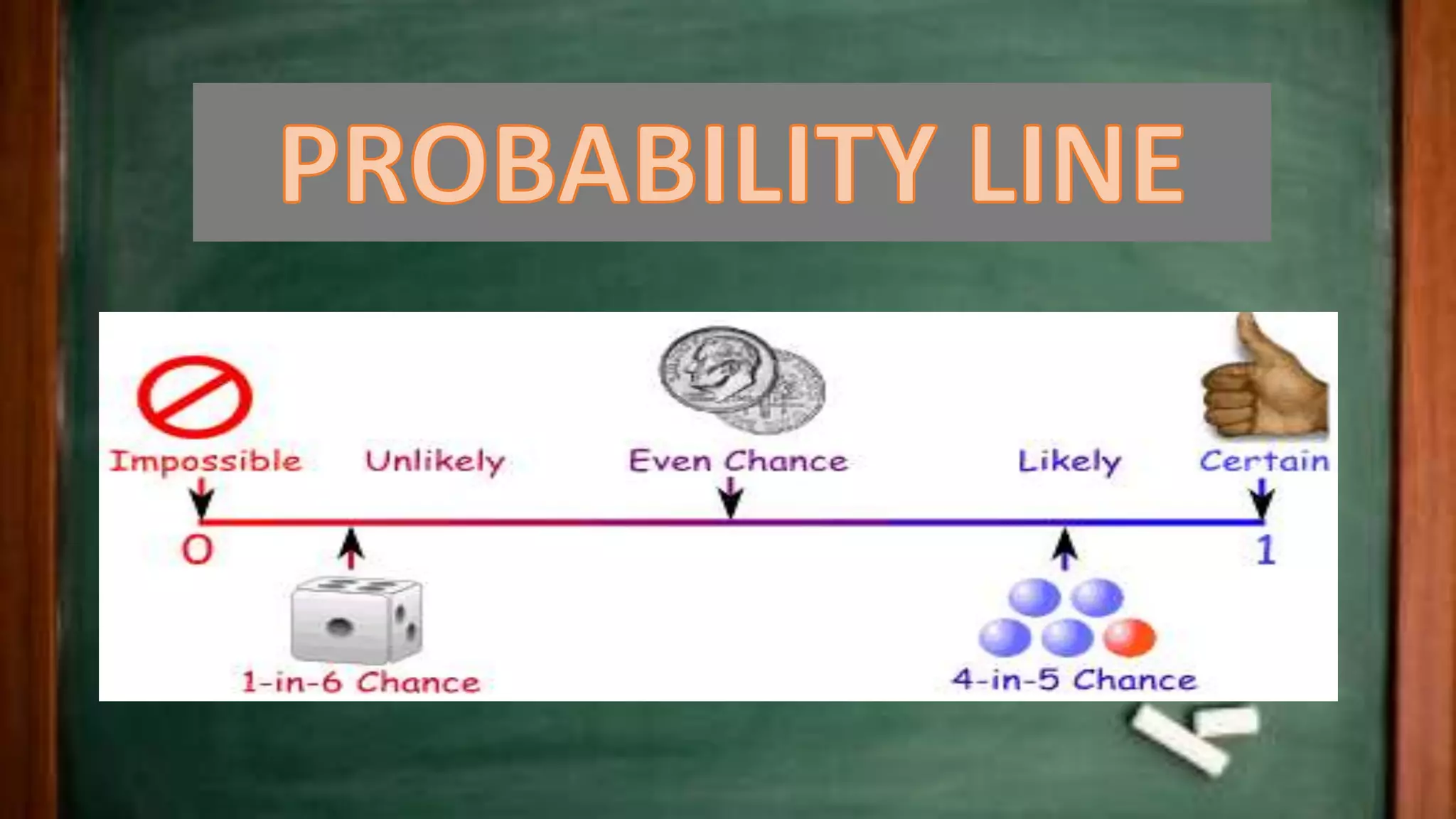
Probability is measure of how likely something will
occur.
It is the ratio of desired outcomes to total outcomes.
( # desired/ # total)
A probability of an outcome is a number and has 2
properties-
1.The probability assigned to each outcome is non
negative
2.The sum of all the probabilities equals to 1.
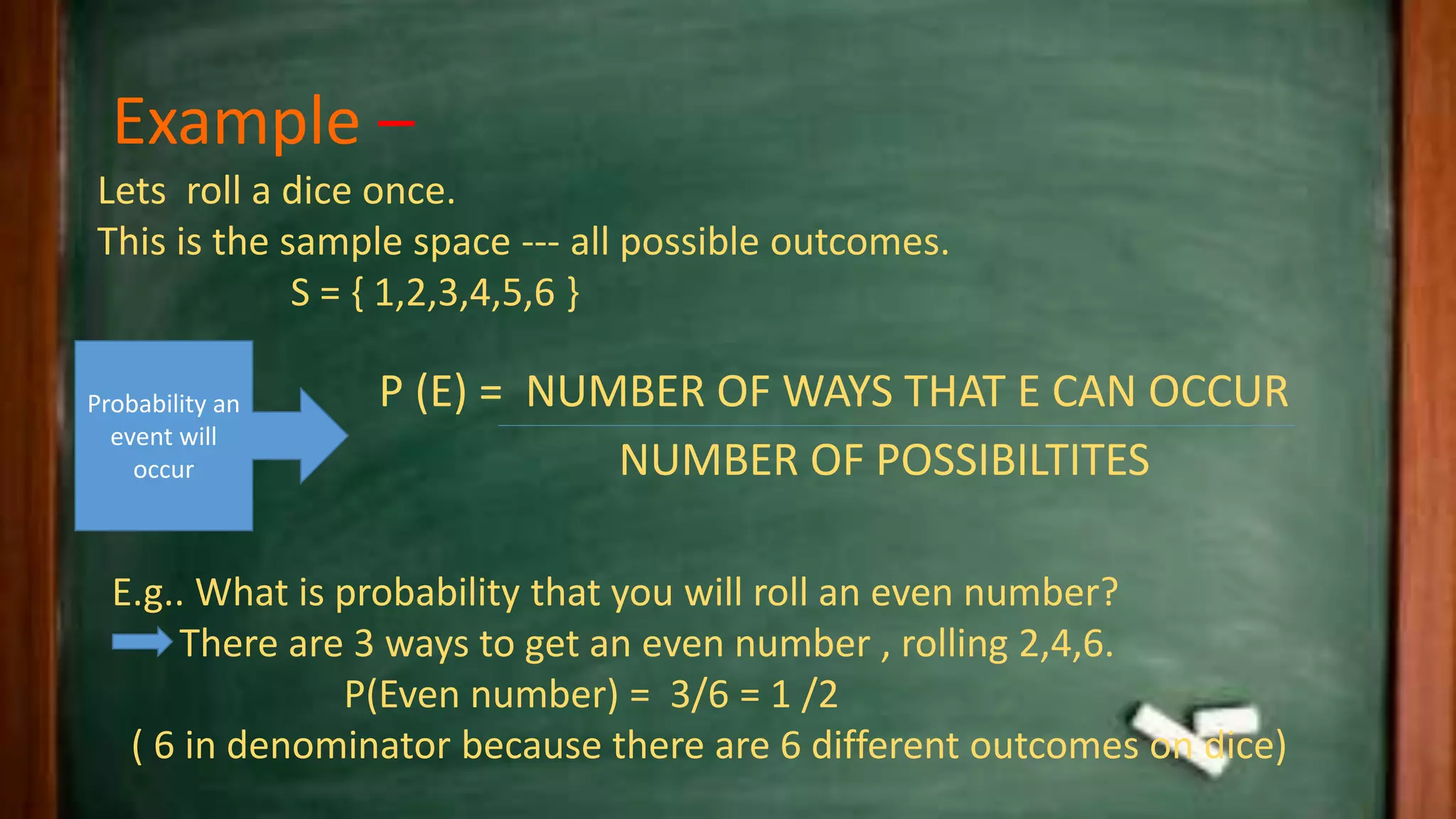
Example –
Lets roll a dice once.
This is the sample space --- all possible outcomes.
S = { 1,2,3,4,5,6 }
Probability an
event will
occur
P (E) = NUMBER OF WAYS THAT E CAN OCCUR
E.g.. What is probability that you will roll an even number?
There are 3 ways to get an even number , rolling 2,4,6.
P(Even number) = 3/6 = 1 /2
( 6 in denominator because there are 6 different outcomes on dice)
NUMBER OF POSSIBILTITES
ADDITION THEOREM
It states that –
“ If two events A and B are mutually exclusive the probability of
occurrence of either A or B is the sum of individual probability of A and
B.
i.e. P(A U B ) = P(A) + P(B)
If A and B are not mutually exclusive events then –
P(A U B) = P(A) + P(B) – P( AB )
e.g. A single die is rolled ,probability of getting 2 or 5 = 1/6 + 1/6 = 1/ 3 .
e.g. A standard deck of card, a card is chosen probability that it’s a club
and king = 13/52 + 4/52 - 1/52 = 4/13.
A B
MULTIPLICATION THEOREM
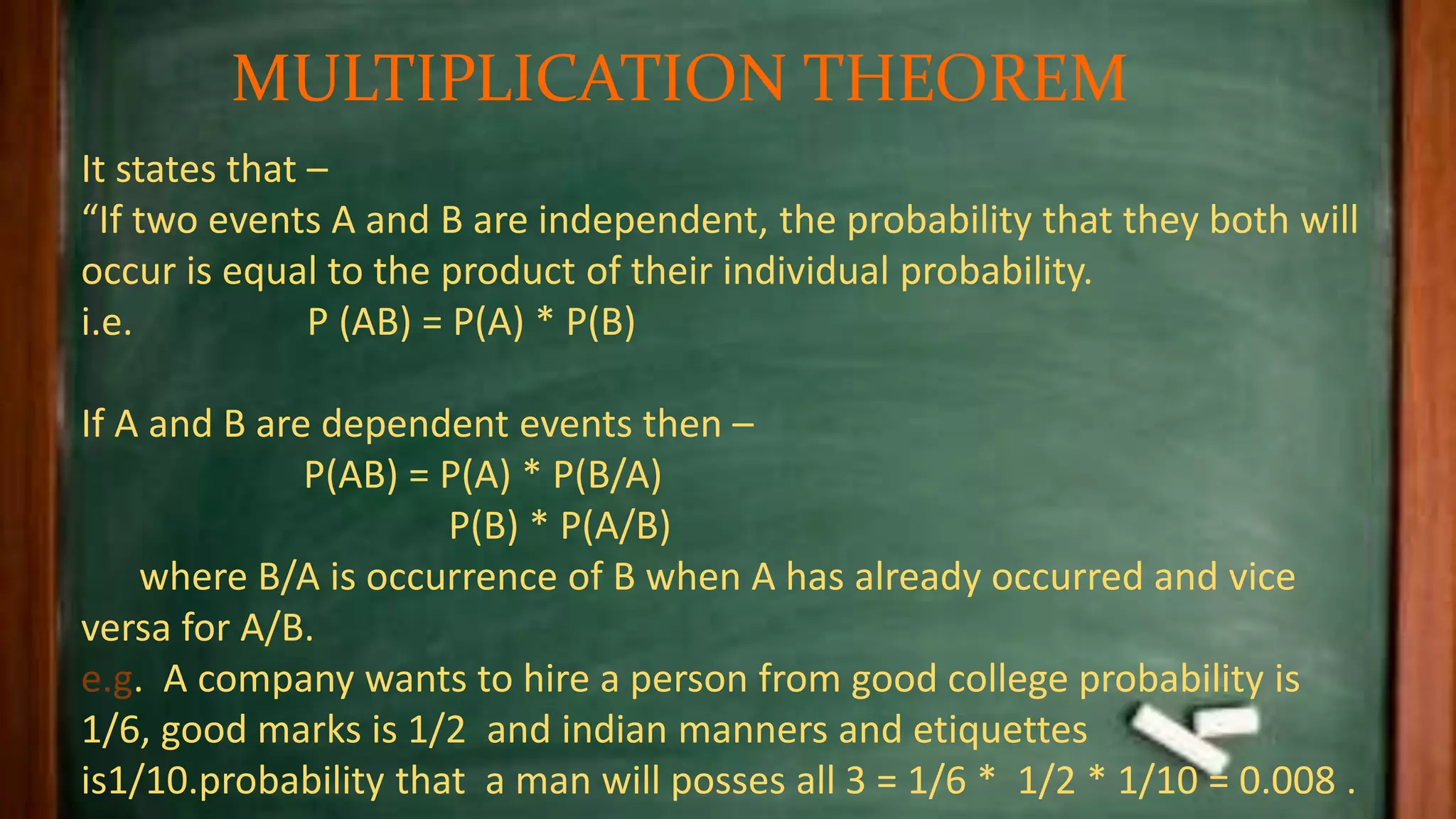
It states that –
“If two events A and B are independent, the probability that they both will
occur is equal to the product of their individual probability.
i.e. P (AB) = P(A) * P(B)
If A and B are dependent events then –
P(AB) = P(A) * P(B/A)
P(B) * P(A/B)
where B/A is occurrence of B when A has already occurred and vice
versa for A/B.
e.g. A company wants to hire a person from good college probability is
1/6, good marks is 1/2 and indian manners and etiquettes
is1/10.probability that a man will posses all 3 = 1/6 * 1/2 * 1/10 = 0.008 .
NEED OF PROBABILITY -
 Probability models can be useful for making predictions.
 Concerned with constructions of econometric models , with managerial
decisions on planning.
 Provides a media of coping up with uncertainty.
 It is applied in the solution of social ,economic , political and business
problems.
 The insurance industry is emerged as the place which requires precise
knowledge about risk of loss.
 It is the foundation of statistical inference.
PRESENTED BY –
AVI VANI
M.A. Economics. 1st year.
School of Economics.

PROBABILITY

  • 2.
    HISTORY  The theoryhas its origin in game of chances related to gambling. “Girolamo cardano (1501-76) ,an Italian mathematician , was first man to wrote a book on subject entitled “Book on Games of Chances” published after his death in 1663.  Galileo (1564-1642), also an Italian mathematician was first to attempt quantitative measure of probability.  Jacques Bernoulli (1654-1705)was one who made extensive study of subject for over 2 decades and his treatise on probability is a major contribution to theory of probability.
  • 3.
    DEFINITION- Probability is measureof how likely something will occur. It is the ratio of desired outcomes to total outcomes. ( # desired/ # total) A probability of an outcome is a number and has 2 properties- 1.The probability assigned to each outcome is non negative 2.The sum of all the probabilities equals to 1.
  • 5.
    Example – Lets rolla dice once. This is the sample space --- all possible outcomes. S = { 1,2,3,4,5,6 } Probability an event will occur P (E) = NUMBER OF WAYS THAT E CAN OCCUR E.g.. What is probability that you will roll an even number? There are 3 ways to get an even number , rolling 2,4,6. P(Even number) = 3/6 = 1 /2 ( 6 in denominator because there are 6 different outcomes on dice) NUMBER OF POSSIBILTITES
  • 6.
    ADDITION THEOREM It statesthat – “ If two events A and B are mutually exclusive the probability of occurrence of either A or B is the sum of individual probability of A and B. i.e. P(A U B ) = P(A) + P(B) If A and B are not mutually exclusive events then – P(A U B) = P(A) + P(B) – P( AB ) e.g. A single die is rolled ,probability of getting 2 or 5 = 1/6 + 1/6 = 1/ 3 . e.g. A standard deck of card, a card is chosen probability that it’s a club and king = 13/52 + 4/52 - 1/52 = 4/13. A B
  • 7.
    MULTIPLICATION THEOREM It statesthat – “If two events A and B are independent, the probability that they both will occur is equal to the product of their individual probability. i.e. P (AB) = P(A) * P(B) If A and B are dependent events then – P(AB) = P(A) * P(B/A) P(B) * P(A/B) where B/A is occurrence of B when A has already occurred and vice versa for A/B. e.g. A company wants to hire a person from good college probability is 1/6, good marks is 1/2 and indian manners and etiquettes is1/10.probability that a man will posses all 3 = 1/6 * 1/2 * 1/10 = 0.008 .
  • 8.
    NEED OF PROBABILITY-  Probability models can be useful for making predictions.  Concerned with constructions of econometric models , with managerial decisions on planning.  Provides a media of coping up with uncertainty.  It is applied in the solution of social ,economic , political and business problems.  The insurance industry is emerged as the place which requires precise knowledge about risk of loss.  It is the foundation of statistical inference.
  • 9.
    PRESENTED BY – AVIVANI M.A. Economics. 1st year. School of Economics.