MAHATMA GANDHI
NATIONAL RURAL
EMPLOYMENT
GURANTEE ACT.
Presentation by-
Avi Vani
INTRODUCTION
 Enacted by legislation on August 25,2005.
Legal guarantee of 100 days of employment.
Employment within 15 days of application.
Payment within 15 days.
Work within 5kms.
No gender discrimination.
Basic worksite facilities.
HISTORY
 Launched on Feb 2,2006,from Anantapur in Andhra Pradesh.
Implemented in phased manner covering 200 districts, with
min.wages of Rs.60.
Started with budget of 1100 cr.
Strengthen the social and gender equality dimensions at 23%
workers in the scheme are SC,17% ST and 50%Women.
On 7th Jan,2010 NREGA was renamed as MGNREGA.
How it came into being-
OBJECTIVE
▪ The primary objective of the Act is augmenting wage employment for the poorest of the
poor while the secondary objective is to strengthen natural resource management
through works that address causes of chronic poverty, like drought, and thus encourage
sustainable development.
▪ The Act is an attempt to provide a legal guarantee of employment to anyone in rural areas
willing to do casual manual labour at a statutory minimum wage.
▪ Strengthening grass route processes of democracy infusing transparency and
accountability in governance.
▪ Guaranteed demand based funding from central budget.
▪ To reduce rural urban migration.
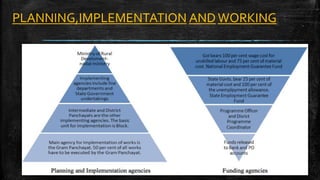
PLANNING,IMPLEMENTATION AND WORKING
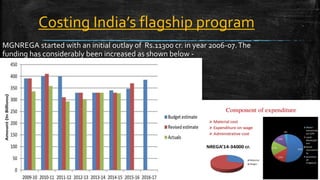
Costing India’s flagship program
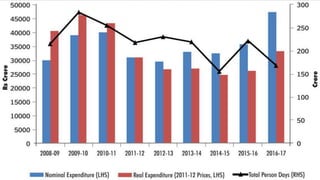
MGNREGA started with an initial outlay of Rs.11300 cr. in year 2006-07.The
funding has considerably been increased as shown below -
Issues of MGNREGA
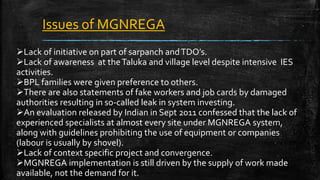
Lack of initiative on part of sarpanch andTDO’s.
Lack of awareness at theTaluka and village level despite intensive IES
activities.
BPL families were given preference to others.
There are also statements of fake workers and job cards by damaged
authorities resulting in so-called leak in system investing.
An evaluation released by Indian in Sept 2011 confessed that the lack of
experienced specialists at almost every site under MGNREGA system,
along with guidelines prohibiting the use of equipment or companies
(labour is usually by shovel).
Lack of context specific project and convergence.
MGNREGA implementation is still driven by the supply of work made
available, not the demand for it.
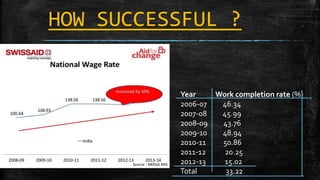
HOW SUCCESSFUL ?
Year Work completion rate (%)
2006-07 46.34
2007-08 45.99
2008-09 43.76
2009-10 48.94
2010-11 50.86
2011-12 20.25
2012-13 15.02
Total 33.22
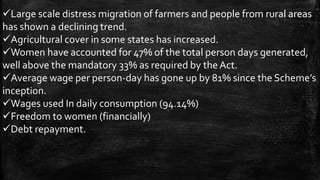
Large scale distress migration of farmers and people from rural areas
has shown a declining trend.
Agricultural cover in some states has increased.
Women have accounted for 47% of the total person days generated,
well above the mandatory 33% as required by theAct.
Average wage per person-day has gone up by 81% since the Scheme’s
inception.
Wages used In daily consumption (94.14%)
Freedom to women (financially)
Debt repayment.
Avi presemtation

Avi presemtation

  • 1.
  • 2.
    INTRODUCTION  Enacted bylegislation on August 25,2005. Legal guarantee of 100 days of employment. Employment within 15 days of application. Payment within 15 days. Work within 5kms. No gender discrimination. Basic worksite facilities.
  • 3.
    HISTORY  Launched onFeb 2,2006,from Anantapur in Andhra Pradesh. Implemented in phased manner covering 200 districts, with min.wages of Rs.60. Started with budget of 1100 cr. Strengthen the social and gender equality dimensions at 23% workers in the scheme are SC,17% ST and 50%Women. On 7th Jan,2010 NREGA was renamed as MGNREGA.
  • 4.
    How it cameinto being-
  • 5.
    OBJECTIVE ▪ The primaryobjective of the Act is augmenting wage employment for the poorest of the poor while the secondary objective is to strengthen natural resource management through works that address causes of chronic poverty, like drought, and thus encourage sustainable development. ▪ The Act is an attempt to provide a legal guarantee of employment to anyone in rural areas willing to do casual manual labour at a statutory minimum wage. ▪ Strengthening grass route processes of democracy infusing transparency and accountability in governance. ▪ Guaranteed demand based funding from central budget. ▪ To reduce rural urban migration.
  • 6.
  • 7.
    Costing India’s flagshipprogram MGNREGA started with an initial outlay of Rs.11300 cr. in year 2006-07.The funding has considerably been increased as shown below -
  • 10.
    Issues of MGNREGA Lackof initiative on part of sarpanch andTDO’s. Lack of awareness at theTaluka and village level despite intensive IES activities. BPL families were given preference to others. There are also statements of fake workers and job cards by damaged authorities resulting in so-called leak in system investing. An evaluation released by Indian in Sept 2011 confessed that the lack of experienced specialists at almost every site under MGNREGA system, along with guidelines prohibiting the use of equipment or companies (labour is usually by shovel). Lack of context specific project and convergence. MGNREGA implementation is still driven by the supply of work made available, not the demand for it.
  • 11.
    HOW SUCCESSFUL ? YearWork completion rate (%) 2006-07 46.34 2007-08 45.99 2008-09 43.76 2009-10 48.94 2010-11 50.86 2011-12 20.25 2012-13 15.02 Total 33.22
  • 12.
    Large scale distressmigration of farmers and people from rural areas has shown a declining trend. Agricultural cover in some states has increased. Women have accounted for 47% of the total person days generated, well above the mandatory 33% as required by theAct. Average wage per person-day has gone up by 81% since the Scheme’s inception. Wages used In daily consumption (94.14%) Freedom to women (financially) Debt repayment.