OLIGOPOLY - CARTEL
Presentation By-
Avi Vani
M.A.Economics.
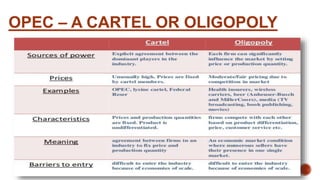
A Cartel is formal “agreement’’ among competing firms. It is a formal organization
of producers and manufacturers that agree to fix prices, marketing, and
production.
Cartels usually occur in an oligopolistic industry.
A group of parties, factions, or nations united in a common cause..
 Firm Firms form a cartel so that they can raise
 Profits
OIL – LIFE BLOOD OF
WORLD ECONOMY
OIL - One of the life bloods of our World economy is oil.
The impact of oil in today’s economy has been witness by consumers many times.
We have seen how human spending and travel got affected as the price of oil fluctuates. In contrast
almost all energies are generated using oil, to mention few; Cars, Trucks, railways, Plane, use oil in
order to run their engine.
Therefore if oil supply disturbed for one day we can imagine how the Indian economy can be affected
greatly.
OPEC - INTRODUCTION
 About OPEC (pronounced oh-peck) - Organization of the Petroleum Exporting Countries - Organization of
the Petroleum Exporting Countries, established in Bagdad, Iraq in 1960. OPEC as a cartel, manipulate
supply of oil in the market, in hopes of keeping prices, and profits, high.
 It is comprised of 12 members – Algeria, Angola, Ecuador, Islamic Republic of Iran, Iraq, Kuwait, Socialist
People’s Liberian Arab Jamahiriya, Nigeria, Qatar, Saudi Arabia, -United Arab Emirates and Venezuela with
headquarters in Vienna, Austria. according to the official website.
 Oil is the main marketable commodity and foreign exchange earner. Thus, for these countries, oil is the vital
key to development – economic, social and political. Their oil revenues are used not only to expand their
economic and industrial base, but also to provide their people with jobs, education, health care and a
decent standard of living
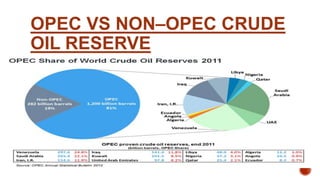
 Together, the 12 member-nations control nearly 80% of the world’s oil reserves, and 44% of the world’s
daily production—a powerful force used to manipulate oil prices around the world.
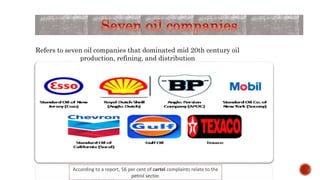
Refers to seven oil companies that dominated mid 20th century oil
production, refining, and distribution
According to a report, 56 per cent of cartel complaints relate to the
petrol sector.
5
OPEC VS NON–OPEC CRUDE
OIL RESERVE
MAIN PURPOSE &
OBJECTIVE OF OPEC
The Main purpose of OPEC is to coordinate and unify petroleum policies among Member
Countries to ensure a steady income to the producing countries, a steady supply of petroleum to
the consuming nations as well as a fair return of capital for investors in the petroleum industry
itself.
Main Objectives are
 Stable oil market, with reasonable prices and steady supplies to consumers
 OPEC was made to make sure that the price of the oil in the world market will be properly
controlled.
 Their main goal is to prevent harmful increase in price of oil in global market and make sure
that nations that produce oil have a fair profit
OPEC ACTING LIKE A
CARTEL
Quota Set by OPEC
 Production Ceiling set up was violated
 1985- Price Dropped from $ 28 to $ 12
 1990’s $30 per barrel
 1993 - $ 15 per Barrel
OPEC BASKET Price
 Price Data collected
 March 2000 – Set a price band mechanics in range of $ 22 -$ 28 per barrel
 Production adjustment on basket price
 Jan 2005 – Suspended price band mechanics
 Market was tight in its price band
 Unable to defend by cutting its production
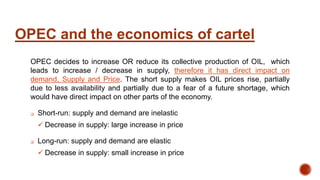
OPEC and the economics of cartel
OPEC decides to increase OR reduce its collective production of OIL, which
leads to increase / decrease in supply, therefore it has direct impact on
demand, Supply and Price. The short supply makes OIL prices rise, partially
due to less availability and partially due to a fear of a future shortage, which
would have direct impact on other parts of the economy.
 Short-run: supply and demand are inelastic
 Decrease in supply: large increase in price
 Long-run: supply and demand are elastic
 Decrease in supply: small increase in price
CHANGE IN DEMAND CURVE
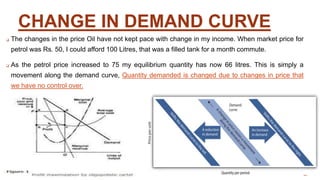
 The changes in the price Oil have not kept pace with change in my income. When market price for
petrol was Rs. 50, I could afford 100 Litres, that was a filled tank for a month commute.
 As the petrol price increased to 75 my equilibrium quantity has now 66 litres. This is simply a
movement along the demand curve, Quantity demanded is changed due to changes in price that
we have no control over.
OPEC – A CARTEL OR OLIGOPOLY
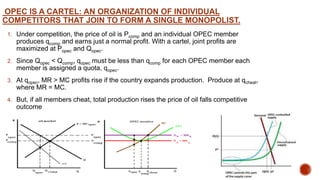
OPEC IS A CARTEL: AN ORGANIZATION OF INDIVIDUAL
COMPETITORS THAT JOIN TO FORM A SINGLE MONOPOLIST.
1. Under competition, the price of oil is Pcomp and an individual OPEC member
produces qcomp and earns just a normal profit. With a cartel, joint profits are
maximized at Popec and Qopec.
2. Since Qopec < Qcomp, qopec must be less than qcomp for each OPEC member each
member is assigned a quota, qopec.
3. At qopec, MR > MC profits rise if the country expands production. Produce at qcheat,
where MR = MC.
4. But, if all members cheat, total production rises the price of oil falls competitive
outcome
CONCLUSION
1. OPEC Still Exists today and still has considerable influence in determining the price
per barrel of petroleum by setting quotas, but their best days are behind them. The
cartel seems to understand that raising prices is easier in short run than in long run.
2. Non-OPEC nations such as Russia, Canada and Mexico have stripped the cartel of
its power to single-handedly manipulate the petroleum market
3. The World has benefited from the increased production of petroleum by Non-OPEC
nations and thus reduced their annual imports from the OPEC countries in recent
years
Opec  a case study

Opec a case study

  • 1.
    OLIGOPOLY - CARTEL PresentationBy- Avi Vani M.A.Economics.
  • 2.
    A Cartel isformal “agreement’’ among competing firms. It is a formal organization of producers and manufacturers that agree to fix prices, marketing, and production. Cartels usually occur in an oligopolistic industry. A group of parties, factions, or nations united in a common cause..  Firm Firms form a cartel so that they can raise  Profits
  • 3.
    OIL – LIFEBLOOD OF WORLD ECONOMY OIL - One of the life bloods of our World economy is oil. The impact of oil in today’s economy has been witness by consumers many times. We have seen how human spending and travel got affected as the price of oil fluctuates. In contrast almost all energies are generated using oil, to mention few; Cars, Trucks, railways, Plane, use oil in order to run their engine. Therefore if oil supply disturbed for one day we can imagine how the Indian economy can be affected greatly.
  • 4.
    OPEC - INTRODUCTION About OPEC (pronounced oh-peck) - Organization of the Petroleum Exporting Countries - Organization of the Petroleum Exporting Countries, established in Bagdad, Iraq in 1960. OPEC as a cartel, manipulate supply of oil in the market, in hopes of keeping prices, and profits, high.  It is comprised of 12 members – Algeria, Angola, Ecuador, Islamic Republic of Iran, Iraq, Kuwait, Socialist People’s Liberian Arab Jamahiriya, Nigeria, Qatar, Saudi Arabia, -United Arab Emirates and Venezuela with headquarters in Vienna, Austria. according to the official website.  Oil is the main marketable commodity and foreign exchange earner. Thus, for these countries, oil is the vital key to development – economic, social and political. Their oil revenues are used not only to expand their economic and industrial base, but also to provide their people with jobs, education, health care and a decent standard of living  Together, the 12 member-nations control nearly 80% of the world’s oil reserves, and 44% of the world’s daily production—a powerful force used to manipulate oil prices around the world.
  • 5.
    Refers to sevenoil companies that dominated mid 20th century oil production, refining, and distribution According to a report, 56 per cent of cartel complaints relate to the petrol sector. 5
  • 6.
    OPEC VS NON–OPECCRUDE OIL RESERVE
  • 7.
    MAIN PURPOSE & OBJECTIVEOF OPEC The Main purpose of OPEC is to coordinate and unify petroleum policies among Member Countries to ensure a steady income to the producing countries, a steady supply of petroleum to the consuming nations as well as a fair return of capital for investors in the petroleum industry itself. Main Objectives are  Stable oil market, with reasonable prices and steady supplies to consumers  OPEC was made to make sure that the price of the oil in the world market will be properly controlled.  Their main goal is to prevent harmful increase in price of oil in global market and make sure that nations that produce oil have a fair profit
  • 8.
    OPEC ACTING LIKEA CARTEL Quota Set by OPEC  Production Ceiling set up was violated  1985- Price Dropped from $ 28 to $ 12  1990’s $30 per barrel  1993 - $ 15 per Barrel OPEC BASKET Price  Price Data collected  March 2000 – Set a price band mechanics in range of $ 22 -$ 28 per barrel  Production adjustment on basket price  Jan 2005 – Suspended price band mechanics  Market was tight in its price band  Unable to defend by cutting its production
  • 9.
    OPEC and theeconomics of cartel OPEC decides to increase OR reduce its collective production of OIL, which leads to increase / decrease in supply, therefore it has direct impact on demand, Supply and Price. The short supply makes OIL prices rise, partially due to less availability and partially due to a fear of a future shortage, which would have direct impact on other parts of the economy.  Short-run: supply and demand are inelastic  Decrease in supply: large increase in price  Long-run: supply and demand are elastic  Decrease in supply: small increase in price
  • 10.
    CHANGE IN DEMANDCURVE  The changes in the price Oil have not kept pace with change in my income. When market price for petrol was Rs. 50, I could afford 100 Litres, that was a filled tank for a month commute.  As the petrol price increased to 75 my equilibrium quantity has now 66 litres. This is simply a movement along the demand curve, Quantity demanded is changed due to changes in price that we have no control over.
  • 11.
    OPEC – ACARTEL OR OLIGOPOLY
  • 12.
    OPEC IS ACARTEL: AN ORGANIZATION OF INDIVIDUAL COMPETITORS THAT JOIN TO FORM A SINGLE MONOPOLIST. 1. Under competition, the price of oil is Pcomp and an individual OPEC member produces qcomp and earns just a normal profit. With a cartel, joint profits are maximized at Popec and Qopec. 2. Since Qopec < Qcomp, qopec must be less than qcomp for each OPEC member each member is assigned a quota, qopec. 3. At qopec, MR > MC profits rise if the country expands production. Produce at qcheat, where MR = MC. 4. But, if all members cheat, total production rises the price of oil falls competitive outcome
  • 13.
    CONCLUSION 1. OPEC StillExists today and still has considerable influence in determining the price per barrel of petroleum by setting quotas, but their best days are behind them. The cartel seems to understand that raising prices is easier in short run than in long run. 2. Non-OPEC nations such as Russia, Canada and Mexico have stripped the cartel of its power to single-handedly manipulate the petroleum market 3. The World has benefited from the increased production of petroleum by Non-OPEC nations and thus reduced their annual imports from the OPEC countries in recent years