The Financial Model
     as a tool for management decision-making
           and attracting external investors

               You Ask – We Answer


© 2010
Why On Earth Do I Need a Financial Model?

 Whether you are seeking funding from investors or
 compiling a business plan to serve as a blueprint for
 managing and monitoring your business, it is imperative
 to make financial projections (a.k.a., a Financial Model).
 Such financial projections attract investors and serve as a
 guide to your future business decisions.
So.. Is It All About Numbers on a Spreadsheet?

 Creating financial projections for your start-up or an existing venture is
 both an art and a science. Investors want to see cold, hard numbers
 such as Internal Rate of Return (IRR), Earnings Before Interest, Tax
 Depreciation and Amortization (EBITDA). Yet, it is inherently
 difficult to predict your financial performance 3 or 5 years down the
 road particularly if you are attempting to raise seed capital in today’s
 economy. Regardless, short- and medium-term financial projections are
 required parts of your business plan if you want serious investors’
 attention.
But I have a Great Idea – Still They Want Me To
 Crunch Some Numbers?
We feel your pain - financial projections can be intimidating. However,
they are less a matter of mathematical aptitude and more a matter of
your knowledge of your business, the industry, and the market. Please
remember, there is a big difference between a Dream and a Business Idea.
In another words – investors want to be sure you know exactly what you
are doing and are fully capable of backing up your strategy with realistic
projections and market expectations. The sad truth – nobody is in a
position to finance your dream these days. On the bright side – we are
fully capable of transforming your dream into a business idea and
present it in the language accepted by the investment community to
increase your chances of a successful transaction.
How Do You Do It?
     Profits equals Sales minus Costs is an example of a very simple
    model for deriving projected profits from assumptions about
    future sales and costs.
    In practice, financial planning models are much more complex
    as they must accommodate multiple time periods (months,
    quarters and years) and handle hundreds of variables relating to
    sales, costs etc. The volume of data mounts up very quickly
    when each variable is multiplied by the time horizon, for
    example, by twelve months.
    By structuring key revenues and cost drivers and developing
    mathematical formulas, we are able to forecast Accounts
    Receivable (ARs) and Accounts Payable (APs) at any given
    period and ultimately calculate the bottom line and key
    investment metrics.
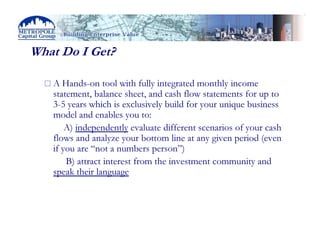
What Do I Get?

   A Hands-on tool with fully integrated monthly income
   statement, balance sheet, and cash flow statements for up to
   3-5 years which is exclusively build for your unique business
   model and enables you to:
       A) independently evaluate different scenarios of your cash
   flows and analyze your bottom line at any given period (even
   if you are “not a numbers person”)
       B) attract interest from the investment community and
   speak their language
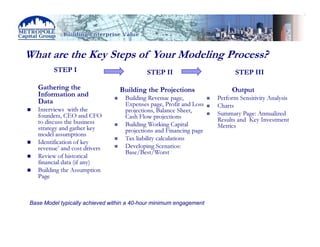
What are the Key Steps of Your Modeling Process?
         STEP I                            STEP II                        STEP III

   Gathering the                 Building the Projections                Output
   Information and                 Building Revenue page,           Perform Sensitivity Analysis
   Data                            Expenses page, Profit and Loss   Charts
   Interviews with the             projections, Balance Sheet,
   founders, CEO and CFO           Cash Flow projections            Summary Page: Annualized
   to discuss the business                                          Results and Key Investment
                                   Building Working Capital         Metrics
   strategy and gather key         projections and Financing page
   model assumptions
                                   Tax liability calculations
   Identification of key
   revenue’ and cost drivers       Developing Scenarios:
                                   Base/Best/Worst
   Review of historical
   financial data (if any)
   Building the Assumption
   Page


Base Model typically achieved within a 40-hour minimum engagement
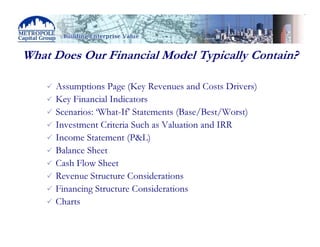
What Does Our Financial Model Typically Contain?

     Assumptions Page (Key Revenues and Costs Drivers)
     Key Financial Indicators
     Scenarios: ‘What-If’ Statements (Base/Best/Worst)
     Investment Criteria Such as Valuation and IRR
     Income Statement (P&L)
     Balance Sheet
     Cash Flow Sheet
     Revenue Structure Considerations
     Financing Structure Considerations
     Charts
What Are The Key Numbers Investors Will Be
Looking At In My Financial Model?
  Investors usually have several investment opportunities on their
   plate (especially these days) and in order to make the investment
   decision they have to size the current or potential financial
   strength of your company. The key numbers they would look at:
       EBITDA (Percentage)
       Revenue Growth
       Minimum and Maximum cash balances
       Equity/Debt needs to fund company
       Break-Even Point
       Net Working Capital
       Valuation as multiple of EBITDA
       IRR
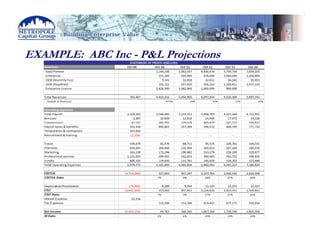
EXAMPLE: ABC Inc - P&L Projections
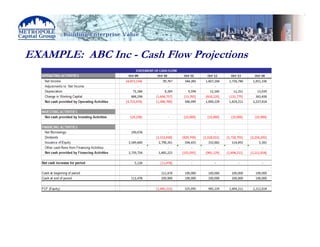
EXAMPLE: ABC Inc - Cash Flow Projections
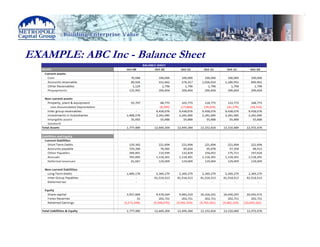
EXAMPLE: ABC Inc - Balance Sheet
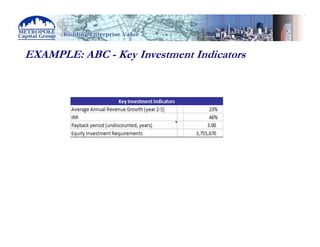
EXAMPLE: ABC - Key Investment Indicators
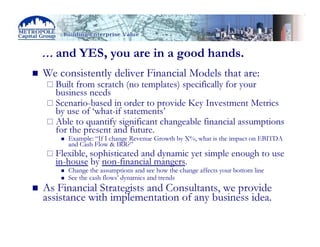
… and YES, you are in a good hands.
We consistently deliver Financial Models that are:
  Built from scratch (no templates) specifically for your
  business needs
  Scenario-based in order to provide Key Investment Metrics
  by use of ‘what-if statements’
  Able to quantify significant changeable financial assumptions
  for the present and future.
     Example: “If I change Revenue Growth by X%, what is the impact on EBITDA
     and Cash Flow & IRR?”
  Flexible, sophisticated and dynamic yet simple enough to use
  in-house by non-financial mangers.
     Change the assumptions and see how the change affects your bottom line
     See the cash flows’ dynamics and trends
As Financial Strategists and Consultants, we provide
assistance with implementation of any business idea.
Metropole Capital Group specializes in providing strategic
consulting and financial advisory services to small and medium-sized
businesses around the world at every stage of their business
development. MCG has established a captivating framework of
services helping client companies develop innovative business
strategies, assess their capital needs, determine financing options,
and successfully acquire start-up, working or growth capital. Our
core product is the Investment Solicitation Package which includes
a set of the documents necessary to present to the investment
community and includes: Business Plan, Financial Model,
Investment Power-Point Presentation and Investment/Offering
Memorandum.
                       THANK YOU!
                    www.metropolecapital.com

Financial Modeling Services Mcg

  • 1.
    The Financial Model as a tool for management decision-making and attracting external investors You Ask – We Answer © 2010
  • 2.
    Why On EarthDo I Need a Financial Model? Whether you are seeking funding from investors or compiling a business plan to serve as a blueprint for managing and monitoring your business, it is imperative to make financial projections (a.k.a., a Financial Model). Such financial projections attract investors and serve as a guide to your future business decisions.
  • 3.
    So.. Is ItAll About Numbers on a Spreadsheet? Creating financial projections for your start-up or an existing venture is both an art and a science. Investors want to see cold, hard numbers such as Internal Rate of Return (IRR), Earnings Before Interest, Tax Depreciation and Amortization (EBITDA). Yet, it is inherently difficult to predict your financial performance 3 or 5 years down the road particularly if you are attempting to raise seed capital in today’s economy. Regardless, short- and medium-term financial projections are required parts of your business plan if you want serious investors’ attention.
  • 4.
    But I havea Great Idea – Still They Want Me To Crunch Some Numbers? We feel your pain - financial projections can be intimidating. However, they are less a matter of mathematical aptitude and more a matter of your knowledge of your business, the industry, and the market. Please remember, there is a big difference between a Dream and a Business Idea. In another words – investors want to be sure you know exactly what you are doing and are fully capable of backing up your strategy with realistic projections and market expectations. The sad truth – nobody is in a position to finance your dream these days. On the bright side – we are fully capable of transforming your dream into a business idea and present it in the language accepted by the investment community to increase your chances of a successful transaction.
  • 5.
    How Do YouDo It? Profits equals Sales minus Costs is an example of a very simple model for deriving projected profits from assumptions about future sales and costs. In practice, financial planning models are much more complex as they must accommodate multiple time periods (months, quarters and years) and handle hundreds of variables relating to sales, costs etc. The volume of data mounts up very quickly when each variable is multiplied by the time horizon, for example, by twelve months. By structuring key revenues and cost drivers and developing mathematical formulas, we are able to forecast Accounts Receivable (ARs) and Accounts Payable (APs) at any given period and ultimately calculate the bottom line and key investment metrics.
  • 6.
    What Do IGet? A Hands-on tool with fully integrated monthly income statement, balance sheet, and cash flow statements for up to 3-5 years which is exclusively build for your unique business model and enables you to: A) independently evaluate different scenarios of your cash flows and analyze your bottom line at any given period (even if you are “not a numbers person”) B) attract interest from the investment community and speak their language
  • 7.
    What are theKey Steps of Your Modeling Process? STEP I STEP II STEP III Gathering the Building the Projections Output Information and Building Revenue page, Perform Sensitivity Analysis Data Expenses page, Profit and Loss Charts Interviews with the projections, Balance Sheet, founders, CEO and CFO Cash Flow projections Summary Page: Annualized to discuss the business Results and Key Investment Building Working Capital Metrics strategy and gather key projections and Financing page model assumptions Tax liability calculations Identification of key revenue’ and cost drivers Developing Scenarios: Base/Best/Worst Review of historical financial data (if any) Building the Assumption Page Base Model typically achieved within a 40-hour minimum engagement
  • 8.
    What Does OurFinancial Model Typically Contain? Assumptions Page (Key Revenues and Costs Drivers) Key Financial Indicators Scenarios: ‘What-If’ Statements (Base/Best/Worst) Investment Criteria Such as Valuation and IRR Income Statement (P&L) Balance Sheet Cash Flow Sheet Revenue Structure Considerations Financing Structure Considerations Charts
  • 9.
    What Are TheKey Numbers Investors Will Be Looking At In My Financial Model? Investors usually have several investment opportunities on their plate (especially these days) and in order to make the investment decision they have to size the current or potential financial strength of your company. The key numbers they would look at: EBITDA (Percentage) Revenue Growth Minimum and Maximum cash balances Equity/Debt needs to fund company Break-Even Point Net Working Capital Valuation as multiple of EBITDA IRR
  • 10.
    EXAMPLE: ABC Inc- P&L Projections
  • 11.
    EXAMPLE: ABC Inc- Cash Flow Projections
  • 12.
    EXAMPLE: ABC Inc- Balance Sheet
  • 13.
    EXAMPLE: ABC -Key Investment Indicators
  • 14.
    … and YES,you are in a good hands. We consistently deliver Financial Models that are: Built from scratch (no templates) specifically for your business needs Scenario-based in order to provide Key Investment Metrics by use of ‘what-if statements’ Able to quantify significant changeable financial assumptions for the present and future. Example: “If I change Revenue Growth by X%, what is the impact on EBITDA and Cash Flow & IRR?” Flexible, sophisticated and dynamic yet simple enough to use in-house by non-financial mangers. Change the assumptions and see how the change affects your bottom line See the cash flows’ dynamics and trends As Financial Strategists and Consultants, we provide assistance with implementation of any business idea.
  • 15.
    Metropole Capital Groupspecializes in providing strategic consulting and financial advisory services to small and medium-sized businesses around the world at every stage of their business development. MCG has established a captivating framework of services helping client companies develop innovative business strategies, assess their capital needs, determine financing options, and successfully acquire start-up, working or growth capital. Our core product is the Investment Solicitation Package which includes a set of the documents necessary to present to the investment community and includes: Business Plan, Financial Model, Investment Power-Point Presentation and Investment/Offering Memorandum. THANK YOU! www.metropolecapital.com