Oligopoly
Oligopoly Market Structure characterized by few sellers and interdependent price/output decisions Significant barriers to entry Product could be homogenous (similar) or differentiated Potential for economic profits in the long run Incentive for illegal price setting Competition can be vigorous among the few firms
Oligopoly may be Collusive or Non collusive Non collusive oligopoly-  cournot model Sweezy model  Collusive Oligopoly- Cartel Price leadership
The Cournot Model Assumptions:  Each firm assumes that its rival will continue to produce their current output level The two firms have constant marginal cost (and hence constant average cost: thus, both firms experience constant returns to scale).  For simplicity, we assume MC = 0 The market demand curve is given by:  P = a – b(Q1 + Q2)
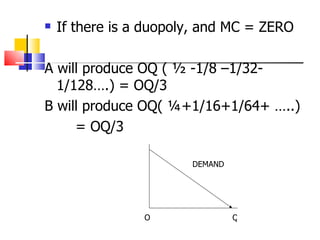
If there is a duopoly, and MC = ZERO A will produce OQ ( ½ -1/8 –1/32- 1/128….) = OQ/3 B will produce OQ( ¼+1/16+1/64+ …..) = OQ/3 O Q DEMAND
Suppose demand function is  P = 950 –Q MC = 50 COMPARE PERFECT COMPETITION, MONOPOLY AND DOUPOLY
SWEEZY MODEL – STICKY PRICES The model- There is a certain price above which if the firm raises its price, no one copies him. Below that price, if the firm reduces his price everyone copies him.  Hence there are two different elasticity on either side of this price. This causes a discontinuity in the demand curve and hence a gap in the MR Curve.
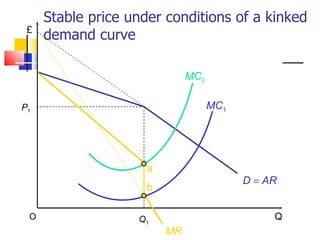
Stable price under conditions of a kinked demand curve £ Q O P 1 Q 1 D   AR MC 2 MC 1 MR a b
As shown in the diagram, the firm continues with the same price and output despite an increase in costs. Hence one can understand why prices remain sticky. The limitation of the model is that there is no identified price at which the kink will occur.
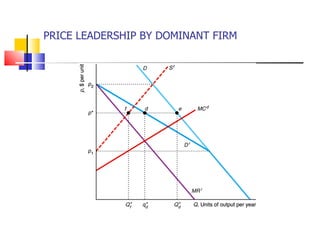
Price - leadership Dominant firm Low cost firm Barometric firm- a firm which has established itself as a good forecaster of economic changes.
PRICE LEADERSHIP BY DOMINANT FIRM
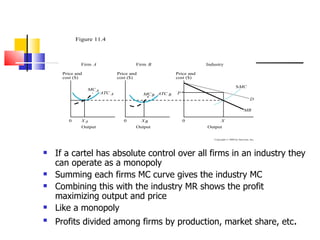
Cartels A cartel is an agreement between firms to restrict output and raise price The cartel tries to maximise joint profit    the ‘full cartel outcome’ Cartels aim at market sharing – loose cartel Joint profit is maximised by setting MR= MC1=MC2
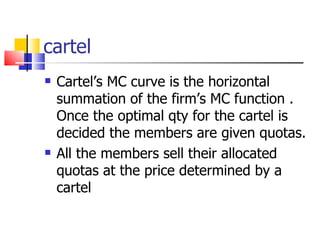
If a cartel has absolute control over all firms in an industry they can operate as a monopoly Summing each firms MC curve gives the industry MC Combining this with the industry MR shows the profit maximizing output and price Like a monopoly Profits divided among firms by production, market share, etc .
cartel Cartel’s MC curve is the horizontal summation of the firm’s MC function . Once the optimal qty for the cartel is decided the members are given quotas. All the members sell their allocated quotas at the price determined by a cartel
REASONS FOR FAILURE OF CARTELS : Mistakes in the estimation of market demand Errors in estimating MC Slow process of cartel negotiation “  cheating” on quotas Stickiness of negotiated price. Fear of govt interference Fear of entry Lack of freedom in innovation
Strategic Behavior &Game theory Strategic behavior refers to the plan of action of an oligopolist after taking into consideration all the possible reactions of the competitors as they compete for profits. Study of such behaviour is called game theory Every model has players, strategies and payoffs.
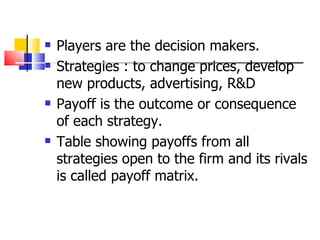
Players are the decision makers. Strategies : to change prices, develop new products, advertising, R&D Payoff is the outcome or consequence of each strategy. Table showing payoffs from all strategies open to the firm and its rivals is called payoff matrix.
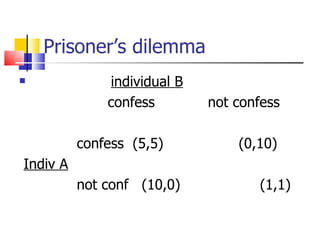
Prisoner’s dilemma individual B confess  not confess confess  (5,5)  (0,10) Indiv A   not conf  (10,0)  (1,1)
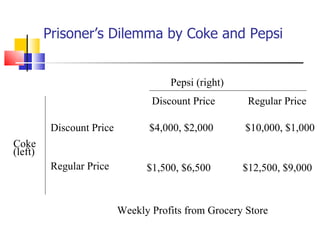
Prisoner’s Dilemma by Coke and Pepsi Coke Pepsi (right) Discount Price Regular Price Discount Price Regular Price $4,000, $2,000 $10,000, $1,000 $1,500, $6,500 $12,500, $9,000 (left) Weekly Profits from Grocery Store
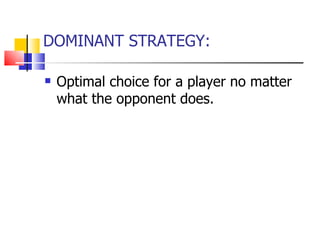
DOMINANT STRATEGY: Optimal choice for a player no matter what the opponent does.
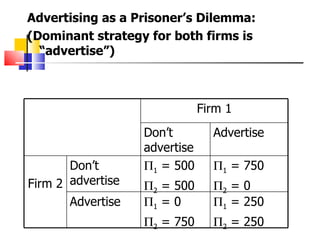
Advertising as a Prisoner’s Dilemma: (Dominant strategy for both firms is “advertise”) Firm 1 Don’t advertise Advertise Firm 2 Don’t advertise  1  = 500  2  = 500  1  = 750  2  = 0 Advertise  1  = 0  2  = 750  1  = 250  2  = 250
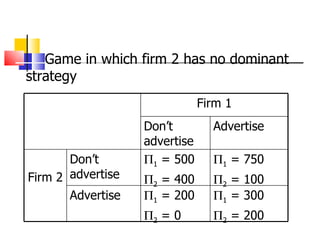
Game in which firm 2 has no dominant strategy Firm 1 Don’t advertise Advertise Firm 2 Don’t advertise  1  = 500  2  = 400  1  = 750  2  = 100 Advertise  1  = 200  2  = 0  1  = 300  2  = 200
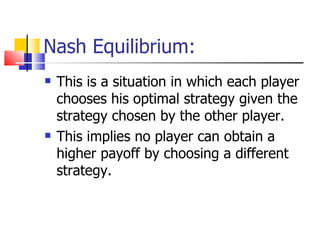
Nash Equilibrium: This is a situation in which each player chooses his optimal strategy given the strategy chosen by the other player. This implies no player can obtain a higher payoff by choosing a different strategy.
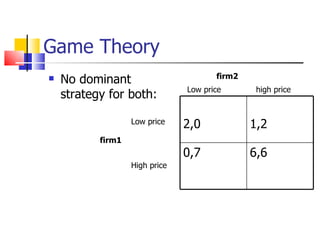
Game Theory No dominant strategy for both: Low price  high price Low price High price firm2 firm1 2,0 1,2 0,7 6,6
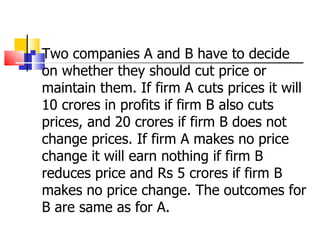
Two companies A and B have to decide on whether they should cut price or maintain them. If firm A cuts prices it will 10 crores in profits if firm B also cuts prices, and 20 crores if firm B does not change prices. If firm A makes no price change it will earn nothing if firm B reduces price and Rs 5 crores if firm B makes no price change. The outcomes for B are same as for A.
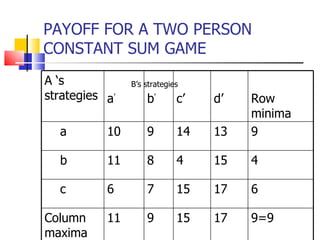
PAYOFF FOR A TWO PERSON CONSTANT SUM GAME B’s strategies A ‘s strategies a ’ b ’ c’ d’ Row minima a 10 9 14 13 9 b 11 8 4 15 4 c 6 7 15 17 6 Column maxima 11 9 15 17 9=9
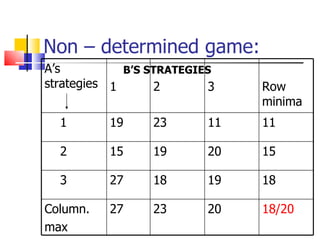
Non – determined game: B’S STRATEGIES A’s strategies 1 2 3 Row minima 1 19 23 11 11 2 15 19 20 15 3 27 18 19 18 Column. max 27 23 20 18/20
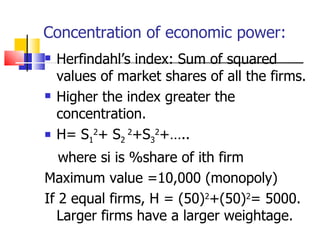
Concentration of economic power: Herfindahl’s index: Sum of squared values of market shares of all the firms. Higher the index greater the concentration. H= S 1 2 + S 2  2 +S 3 2 +….. where si is %share of ith firm  Maximum value =10,000 (monopoly) If 2 equal firms, H = (50) 2 +(50) 2 = 5000. Larger firms have a larger weightage.
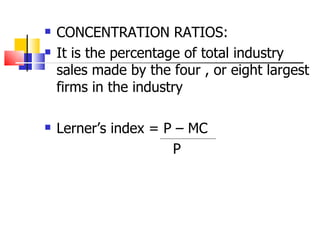
CONCENTRATION RATIOS: It is the percentage of total industry sales made by the four , or eight largest firms in the industry Lerner’s index = P – MC P
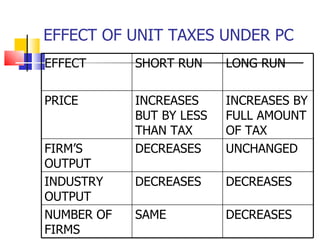
EFFECT OF UNIT TAXES UNDER PC EFFECT SHORT RUN LONG RUN PRICE INCREASES BUT BY LESS THAN TAX INCREASES BY FULL AMOUNT OF TAX FIRM’S OUTPUT DECREASES UNCHANGED INDUSTRY OUTPUT  DECREASES DECREASES NUMBER OF FIRMS SAME DECREASES
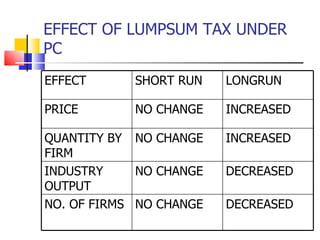
EFFECT OF LUMPSUM TAX UNDER PC EFFECT SHORT RUN LONGRUN PRICE NO CHANGE INCREASED QUANTITY BY FIRM NO CHANGE INCREASED INDUSTRY OUTPUT NO CHANGE DECREASED NO. OF FIRMS NO CHANGE DECREASED

Oligopoly

  • 1.
  • 2.
    Oligopoly Market Structurecharacterized by few sellers and interdependent price/output decisions Significant barriers to entry Product could be homogenous (similar) or differentiated Potential for economic profits in the long run Incentive for illegal price setting Competition can be vigorous among the few firms
  • 3.
    Oligopoly may beCollusive or Non collusive Non collusive oligopoly- cournot model Sweezy model Collusive Oligopoly- Cartel Price leadership
  • 4.
    The Cournot ModelAssumptions: Each firm assumes that its rival will continue to produce their current output level The two firms have constant marginal cost (and hence constant average cost: thus, both firms experience constant returns to scale). For simplicity, we assume MC = 0 The market demand curve is given by: P = a – b(Q1 + Q2)
  • 5.
    If there isa duopoly, and MC = ZERO A will produce OQ ( ½ -1/8 –1/32- 1/128….) = OQ/3 B will produce OQ( ¼+1/16+1/64+ …..) = OQ/3 O Q DEMAND
  • 6.
    Suppose demand functionis P = 950 –Q MC = 50 COMPARE PERFECT COMPETITION, MONOPOLY AND DOUPOLY
  • 7.
    SWEEZY MODEL –STICKY PRICES The model- There is a certain price above which if the firm raises its price, no one copies him. Below that price, if the firm reduces his price everyone copies him. Hence there are two different elasticity on either side of this price. This causes a discontinuity in the demand curve and hence a gap in the MR Curve.
  • 8.
    Stable price underconditions of a kinked demand curve £ Q O P 1 Q 1 D  AR MC 2 MC 1 MR a b
  • 9.
    As shown inthe diagram, the firm continues with the same price and output despite an increase in costs. Hence one can understand why prices remain sticky. The limitation of the model is that there is no identified price at which the kink will occur.
  • 10.
    Price - leadershipDominant firm Low cost firm Barometric firm- a firm which has established itself as a good forecaster of economic changes.
  • 11.
    PRICE LEADERSHIP BYDOMINANT FIRM
  • 12.
    Cartels A cartelis an agreement between firms to restrict output and raise price The cartel tries to maximise joint profit  the ‘full cartel outcome’ Cartels aim at market sharing – loose cartel Joint profit is maximised by setting MR= MC1=MC2
  • 13.
    If a cartelhas absolute control over all firms in an industry they can operate as a monopoly Summing each firms MC curve gives the industry MC Combining this with the industry MR shows the profit maximizing output and price Like a monopoly Profits divided among firms by production, market share, etc .
  • 14.
    cartel Cartel’s MCcurve is the horizontal summation of the firm’s MC function . Once the optimal qty for the cartel is decided the members are given quotas. All the members sell their allocated quotas at the price determined by a cartel
  • 15.
    REASONS FOR FAILUREOF CARTELS : Mistakes in the estimation of market demand Errors in estimating MC Slow process of cartel negotiation “ cheating” on quotas Stickiness of negotiated price. Fear of govt interference Fear of entry Lack of freedom in innovation
  • 16.
    Strategic Behavior &Gametheory Strategic behavior refers to the plan of action of an oligopolist after taking into consideration all the possible reactions of the competitors as they compete for profits. Study of such behaviour is called game theory Every model has players, strategies and payoffs.
  • 17.
    Players are thedecision makers. Strategies : to change prices, develop new products, advertising, R&D Payoff is the outcome or consequence of each strategy. Table showing payoffs from all strategies open to the firm and its rivals is called payoff matrix.
  • 18.
    Prisoner’s dilemma individualB confess not confess confess (5,5) (0,10) Indiv A not conf (10,0) (1,1)
  • 19.
    Prisoner’s Dilemma byCoke and Pepsi Coke Pepsi (right) Discount Price Regular Price Discount Price Regular Price $4,000, $2,000 $10,000, $1,000 $1,500, $6,500 $12,500, $9,000 (left) Weekly Profits from Grocery Store
  • 20.
    DOMINANT STRATEGY: Optimalchoice for a player no matter what the opponent does.
  • 21.
    Advertising as aPrisoner’s Dilemma: (Dominant strategy for both firms is “advertise”) Firm 1 Don’t advertise Advertise Firm 2 Don’t advertise  1 = 500  2 = 500  1 = 750  2 = 0 Advertise  1 = 0  2 = 750  1 = 250  2 = 250
  • 22.
    Game in whichfirm 2 has no dominant strategy Firm 1 Don’t advertise Advertise Firm 2 Don’t advertise  1 = 500  2 = 400  1 = 750  2 = 100 Advertise  1 = 200  2 = 0  1 = 300  2 = 200
  • 23.
    Nash Equilibrium: Thisis a situation in which each player chooses his optimal strategy given the strategy chosen by the other player. This implies no player can obtain a higher payoff by choosing a different strategy.
  • 24.
    Game Theory Nodominant strategy for both: Low price high price Low price High price firm2 firm1 2,0 1,2 0,7 6,6
  • 25.
    Two companies Aand B have to decide on whether they should cut price or maintain them. If firm A cuts prices it will 10 crores in profits if firm B also cuts prices, and 20 crores if firm B does not change prices. If firm A makes no price change it will earn nothing if firm B reduces price and Rs 5 crores if firm B makes no price change. The outcomes for B are same as for A.
  • 26.
    PAYOFF FOR ATWO PERSON CONSTANT SUM GAME B’s strategies A ‘s strategies a ’ b ’ c’ d’ Row minima a 10 9 14 13 9 b 11 8 4 15 4 c 6 7 15 17 6 Column maxima 11 9 15 17 9=9
  • 27.
    Non – determinedgame: B’S STRATEGIES A’s strategies 1 2 3 Row minima 1 19 23 11 11 2 15 19 20 15 3 27 18 19 18 Column. max 27 23 20 18/20
  • 28.
    Concentration of economicpower: Herfindahl’s index: Sum of squared values of market shares of all the firms. Higher the index greater the concentration. H= S 1 2 + S 2 2 +S 3 2 +….. where si is %share of ith firm Maximum value =10,000 (monopoly) If 2 equal firms, H = (50) 2 +(50) 2 = 5000. Larger firms have a larger weightage.
  • 29.
    CONCENTRATION RATIOS: Itis the percentage of total industry sales made by the four , or eight largest firms in the industry Lerner’s index = P – MC P
  • 30.
    EFFECT OF UNITTAXES UNDER PC EFFECT SHORT RUN LONG RUN PRICE INCREASES BUT BY LESS THAN TAX INCREASES BY FULL AMOUNT OF TAX FIRM’S OUTPUT DECREASES UNCHANGED INDUSTRY OUTPUT DECREASES DECREASES NUMBER OF FIRMS SAME DECREASES
  • 31.
    EFFECT OF LUMPSUMTAX UNDER PC EFFECT SHORT RUN LONGRUN PRICE NO CHANGE INCREASED QUANTITY BY FIRM NO CHANGE INCREASED INDUSTRY OUTPUT NO CHANGE DECREASED NO. OF FIRMS NO CHANGE DECREASED