PRISMS
By: Lim Zia Huei, Ee Yun Shan, Nabila Hanim, Zoe, Afiqah
Zariful, Kodaruth humairaa
WHAT ARE PRISMS?
● A solid object with identical ends.
● Has flat sides (no curves)
● Has a cross section.
HOW TO SOLVE PRISMS?
To solve prism we have to:
● Find out the surface area
(2 X Area of base + perimeter of base X H)
● Volume of the prism
● Area & Volume of Cross Section
TYPES OF PRISMS
● Triangular
● Rectangular
● Pentagonal Prism
● Hexagonal Prism
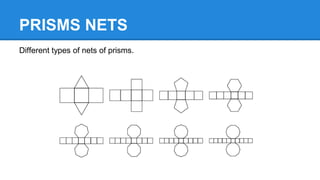
PRISMS NETS
Different types of nets of prisms.
REGULAR
It is a prism that has a regular Cross Section, with equal edge lengths and
equal angles.
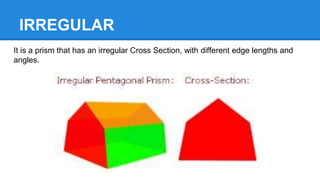
IRREGULAR
It is a prism that has an irregular Cross Section, with different edge lengths and
angles.
RIGHT VS OBLIQUE PRISMS
Right Prism: It is a geometric solid that has a polygon as its base and vertical
sides perpendicular to the base.
Oblique Prism: The joining edges and faces are not perpendicular to the base
faces.
SURFACE AREA
b = area of a base
p = perimeter of a base
h = height of the prism
Surface Area
= 2(½ X 8 X 3) + [(8+5+5) X 12]
= 240 cm2
Area = 2b + ph
VOLUME
b = area of base
h = height
Example:
Volume = (½ X 8 X 3) X 12
= 144 cm3
Volume = bh
EXAMPLE:
Area of cross-section
= (7x12) - (3x4)
= 84 - 12
= 72 m2
Volume of prism
= 72 x 5
= 360 m3
The diagram shows a cross-section of a cuboid after a cube is cut
out from it.
EXAMPLE:
Finding the volume of the oblique prism.
Volume of the oblique prism
= [ ½ x (8+4) x 9 ] x 15
= 54 x 15
= 810 cm2

Prisms presentation

  • 1.
    PRISMS By: Lim ZiaHuei, Ee Yun Shan, Nabila Hanim, Zoe, Afiqah Zariful, Kodaruth humairaa
  • 2.
    WHAT ARE PRISMS? ●A solid object with identical ends. ● Has flat sides (no curves) ● Has a cross section.
  • 3.
    HOW TO SOLVEPRISMS? To solve prism we have to: ● Find out the surface area (2 X Area of base + perimeter of base X H) ● Volume of the prism ● Area & Volume of Cross Section
  • 4.
    TYPES OF PRISMS ●Triangular ● Rectangular ● Pentagonal Prism ● Hexagonal Prism
  • 5.
    PRISMS NETS Different typesof nets of prisms.
  • 6.
    REGULAR It is aprism that has a regular Cross Section, with equal edge lengths and equal angles.
  • 7.
    IRREGULAR It is aprism that has an irregular Cross Section, with different edge lengths and angles.
  • 8.
    RIGHT VS OBLIQUEPRISMS Right Prism: It is a geometric solid that has a polygon as its base and vertical sides perpendicular to the base. Oblique Prism: The joining edges and faces are not perpendicular to the base faces.
  • 9.
    SURFACE AREA b =area of a base p = perimeter of a base h = height of the prism Surface Area = 2(½ X 8 X 3) + [(8+5+5) X 12] = 240 cm2 Area = 2b + ph
  • 10.
    VOLUME b = areaof base h = height Example: Volume = (½ X 8 X 3) X 12 = 144 cm3 Volume = bh
  • 11.
    EXAMPLE: Area of cross-section =(7x12) - (3x4) = 84 - 12 = 72 m2 Volume of prism = 72 x 5 = 360 m3 The diagram shows a cross-section of a cuboid after a cube is cut out from it.
  • 12.
    EXAMPLE: Finding the volumeof the oblique prism. Volume of the oblique prism = [ ½ x (8+4) x 9 ] x 15 = 54 x 15 = 810 cm2