ARC61303/ARC2224 Theories of Architecture and
Urbanism
Project 2: Comparative Analysis Essay
Zoe Low Li Mien
0319444
Tutor: Nicholas Ng
CONTENTS:
1
1. ESSAY 2
2. LIST OF CONTACT POINTS 10
Introduction:
2
Cities have their own contrasting approaches of making spaces for their people who are
inhabiting them. 2 streets of 2 cities that contribute to this idea are Nehru Bazar Road of Jaipur
in India and Jalan Besar of South Klang in Malaysia.
Nehru Bazar Road is situated close to the city center of Jaipur. The capital and the biggest city
of the rich Rajasthan state, one of the 3 Golden Triangles of Tourism along with Delhi and Agra.
A historical monumental city painted in pink known for its infamous urban grid layout that has
been planned precisely. The street within this beautiful city is a market street consisting of
horizontal rows of shophouses working in Rajasthan Style. Housing the commercialised shops
that sells street food, footwear, fashion, ornaments and many crafts.
Jalan Besar is located in South Klang, south of the historical Klang River. South Klang was
where origin of the Klang started. It grew from a village settlement to tin mining town dominated
by the Chinese and the British Colony. The street is comprised of shophouses constructed in a
random typology that vary in different functions. It leads to the oldest landmark of South Klang,
which is the KTM station where it historically transports the tin resource to Kuala Lumpur. This
road was adjusted to the deformed urban grid plan made by the Colonial British as the town was
growing fruitfully for its tin mining industry.
Although both streets are situated in the Asian Continent, they have their own methodologies of
creating spaces for the users to interact with. Nehru Bazar Street and Jalan Besar are
contrasting in terms of their environmental approaches.
Background:
Firstly, both streets have their own different roles to their cities. Nehru Bazar Road is fixated on
its purpose as a definite marketplace to Jaipur. Due to that, it results the street to have very
similar functions at every part of the place. All of these functions are mostly shopping and
commercialised based where the locals often sell their crafts and food. It is evident from the
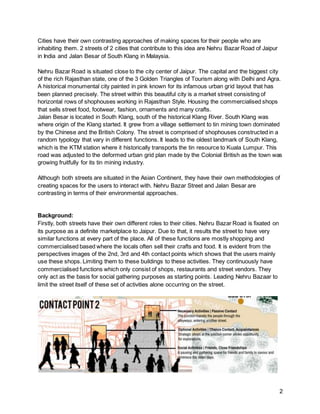
perspectives images of the 2nd, 3rd and 4th contact points which shows that the users mainly
use these shops. Limiting them to these buildings to these activities. They continuously have
commercialised functions which only consist of shops, restaurants and street vendors. They
only act as the basis for social gathering purposes as starting points. Leading Nehru Bazaar to
limit the street itself of these set of activities alone occurring on the street.
3
The 2nd Contact Point shows the people making use of the shops as gathering point
The 3rd Contact Point shows people walking through the streets. The 4th Contact Point shows the street
vendor in between the shophouses.
Whereas for Jalan Besar, the street lacks its role to its city as it presently has a variety of
different functions. It is based upon the usages of the shophouses and buildings surrounding the
street. The contact points are formed due to the buildings’ functional usage of food, travelling
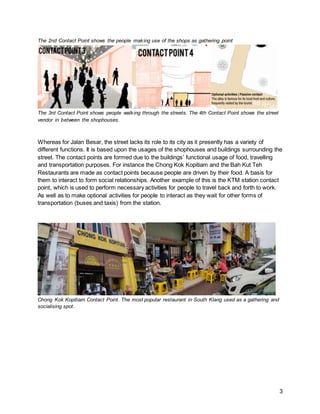
and transportation purposes. For instance the Chong Kok Kopitiam and the Bah Kut Teh
Restaurants are made as contact points because people are driven by their food. A basis for
them to interact to form social relationships. Another example of this is the KTM station contact
point, which is used to perform necessary activities for people to travel back and forth to work.
As well as to make optional activities for people to interact as they wait for other forms of
transportation (buses and taxis) from the station.
Chong Kok Kopitiam Contact Point. The most popular restaurant in South Klang used as a gathering and
socialising spot.
4
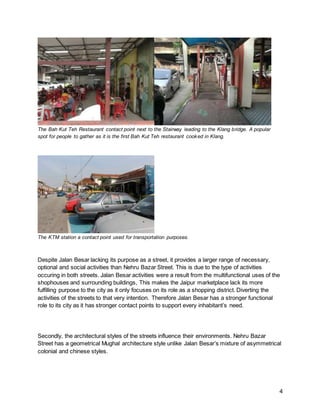
The Bah Kut Teh Restaurant contact point next to the Stairway leading to the Klang bridge. A popular
spot for people to gather as it is the first Bah Kut Teh restaurant cooked in Klang.
The KTM station a contact point used for transportation purposes.
Despite Jalan Besar lacking its purpose as a street, it provides a larger range of necessary,
optional and social activities than Nehru Bazar Street. This is due to the type of activities
occuring in both streets. Jalan Besar activities were a result from the multifunctional uses of the
shophouses and surrounding buildings, This makes the Jaipur marketplace lack its more
fulfilling purpose to the city as it only focuses on its role as a shopping district. Diverting the
activities of the streets to that very intention. Therefore Jalan Besar has a stronger functional
role to its city as it has stronger contact points to support every inhabitant’s need.
Secondly, the architectural styles of the streets influence their environments. Nehru Bazar
Street has a geometrical Mughal architecture style unlike Jalan Besar’s mixture of asymmetrical
colonial and chinese styles.
5
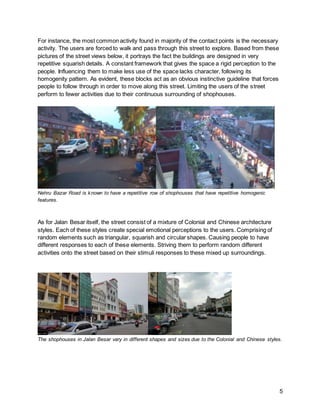
For instance, the most common activity found in majority of the contact points is the necessary
activity. The users are forced to walk and pass through this street to explore. Based from these
pictures of the street views below, it portrays the fact the buildings are designed in very
repetitive squarish details. A constant framework that gives the space a rigid perception to the
people. Influencing them to make less use of the space lacks character, following its
homogenity pattern. As evident, these blocks act as an obvious instinctive guideline that forces
people to follow through in order to move along this street. Limiting the users of the street
perform to fewer activities due to their continuous surrounding of shophouses.
Nehru Bazar Road is known to have a repetitive row of shophouses that have repetitive homogenic
features.
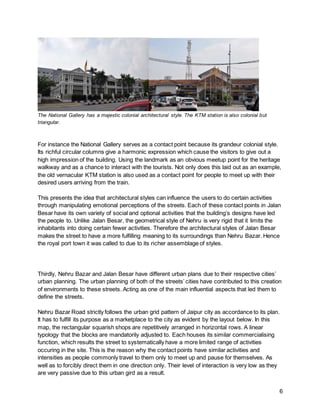
As for Jalan Besar itself, the street consist of a mixture of Colonial and Chinese architecture
styles. Each of these styles create special emotional perceptions to the users. Comprising of
random elements such as triangular, squarish and circular shapes. Causing people to have
different responses to each of these elements. Striving them to perform random different
activities onto the street based on their stimuli responses to these mixed up surroundings.
The shophouses in Jalan Besar vary in different shapes and sizes due to the Colonial and Chinese styles.
6
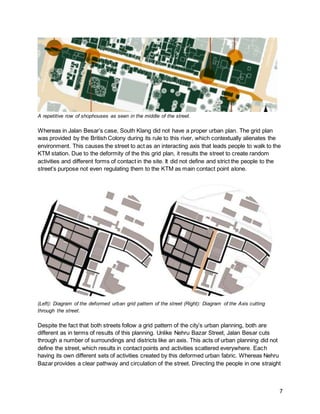
The National Gallery has a majestic colonial architectural style. The KTM station is also colonial but
triangular.
For instance the National Gallery serves as a contact point because its grandeur colonial style.
Its richful circular columns give a harmonic expression which cause the visitors to give out a
high impression of the building. Using the landmark as an obvious meetup point for the heritage
walkway and as a chance to interact with the tourists. Not only does this laid out as an example,
the old vernacular KTM station is also used as a contact point for people to meet up with their
desired users arriving from the train.
This presents the idea that architectural styles can influence the users to do certain activities
through manipulating emotional perceptions of the streets. Each of these contact points in Jalan
Besar have its own variety of social and optional activities that the building’s designs have led
the people to. Unlike Jalan Besar, the geometrical style of Nehru is very rigid that it limits the
inhabitants into doing certain fewer activities. Therefore the architectural styles of Jalan Besar
makes the street to have a more fulfilling meaning to its surroundings than Nehru Bazar. Hence
the royal port town it was called to due to its richer assemblage of styles.
Thirdly, Nehru Bazar and Jalan Besar have different urban plans due to their respective cities’
urban planning. The urban planning of both of the streets’ cities have contributed to this creation
of environments to these streets. Acting as one of the main influential aspects that led them to
define the streets.
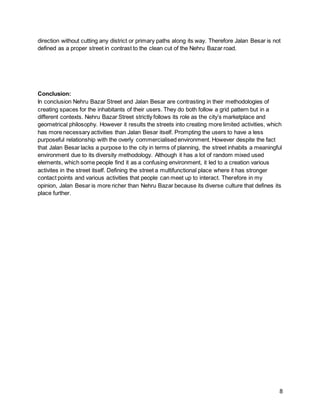
Nehru Bazar Road strictly follows the urban grid pattern of Jaipur city as accordance to its plan.
It has to fulfill its purpose as a marketplace to the city as evident by the layout below. In this
map, the rectangular squarish shops are repetitively arranged in horizontal rows. A linear
typology that the blocks are mandatorily adjusted to. Each houses its similar commercialising
function, which results the street to systematically have a more limited range of activities
occuring in the site. This is the reason why the contact points have similar activities and
intensities as people commonly travel to them only to meet up and pause for themselves. As
well as to forcibly direct them in one direction only. Their level of interaction is very low as they
are very passive due to this urban gird as a result.
7
A repetitive row of shophouses as seen in the middle of the street.
Whereas in Jalan Besar’s case, South Klang did not have a proper urban plan. The grid plan
was provided by the British Colony during its rule to this river, which contextually alienates the
environment. This causes the street to act as an interacting axis that leads people to walk to the
KTM station. Due to the deformity of the this grid plan, it results the street to create random
activities and different forms of contact in the site. It did not define and strict the people to the
street’s purpose not even regulating them to the KTM as main contact point alone.
(Left): Diagram of the deformed urban grid pattern of the street (Right): Diagram of the Axis cutting
through the street.
Despite the fact that both streets follow a grid pattern of the city’s urban planning, both are
different as in terms of results of this planning. Unlike Nehru Bazar Street, Jalan Besar cuts
through a number of surroundings and districts like an axis. This acts of urban planning did not
define the street, which results in contact points and activities scattered everywhere. Each
having its own different sets of activities created by this deformed urban fabric. Whereas Nehru
Bazar provides a clear pathway and circulation of the street. Directing the people in one straight
8
direction without cutting any district or primary paths along its way. Therefore Jalan Besar is not
defined as a proper street in contrast to the clean cut of the Nehru Bazar road.
Conclusion:
In conclusion Nehru Bazar Street and Jalan Besar are contrasting in their methodologies of
creating spaces for the inhabitants of their users. They do both follow a grid pattern but in a
different contexts. Nehru Bazar Street strictly follows its role as the city’s marketplace and
geometrical philosophy. However it results the streets into creating more limited activities, which
has more necessary activities than Jalan Besar itself. Prompting the users to have a less
purposeful relationship with the overly commercialised environment. However despite the fact
that Jalan Besar lacks a purpose to the city in terms of planning, the street inhabits a meaningful
environment due to its diversity methodology. Although it has a lot of random mixed used
elements, which some people find it as a confusing environment, it led to a creation various
activites in the street itself. Defining the street a multifunctional place where it has stronger
contact points and various activities that people can meet up to interact. Therefore in my
opinion, Jalan Besar is more richer than Nehru Bazar because its diverse culture that defines its
place further.
9
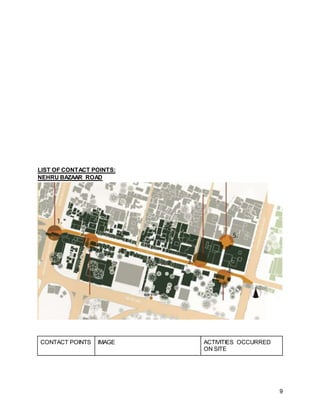
LIST OF CONTACT POINTS:
NEHRU BAZAAR ROAD
CONTACT POINTS IMAGE ACTIVITIES OCCURRED
ON SITE
10
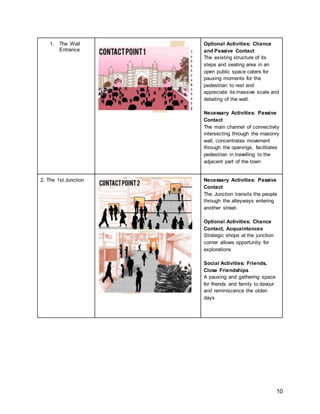
1. The Wall
Entrance
Optional Activities: Chance
and Passive Contact
The existing structure of its
steps and seating area in an
open public space caters for
pausing moments for the
pedestrian to rest and
appreciate its massive scale and
detailing of the wall.
Necessary Activities: Passive
Contact
The main channel of connectivity
intersecting through the masonry
wall, concentrates movement
through the openings, facilitates
pedestrian in travelling to the
adjacent part of the town
2. The 1st Junction Necessary Activities: Passive
Contact
The Junction transits the people
through the alleyways entering
another street.
Optional Activities: Chance
Contact, Acquaintances
Strategic shops at the junction
corner allows opportunity for
explorations
Social Activities: Friends,
Close Friendships
A pausing and gathering space
for friends and family to davour
and reminiscence the olden
days
11
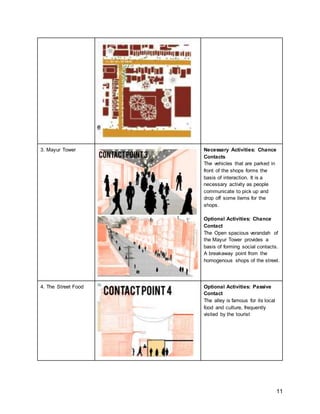
3. Mayur Tower Necessary Activities: Chance
Contacts
The vehicles that are parked in
front of the shops forms the
basis of interaction. It is a
necessary activity as people
communicate to pick up and
drop off some items for the
shops.
Optional Activities: Chance
Contact
The Open spacious verandah of
the Mayur Tower provides a
basis of forming social contacts.
A breakaway point from the
homogenous shops of the street.
4. The Street Food Optional Activities: Passive
Contact
The alley is famous for its local
food and culture, frequently
visited by the tourist
12
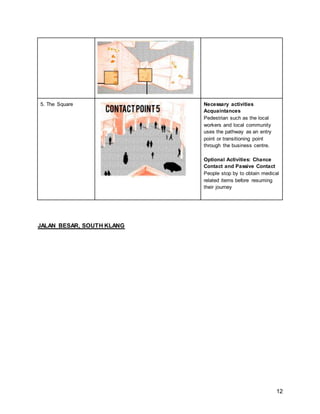
5. The Square Necessary activities
Acquaintances
Pedestrian such as the local
workers and local community
uses the pathway as an entry
point or transitioning point
through the business centre.
Optional Activities: Chance
Contact and Passive Contact
People stop by to obtain medical
related items before resuming
their journey
JALAN BESAR, SOUTH KLANG
13
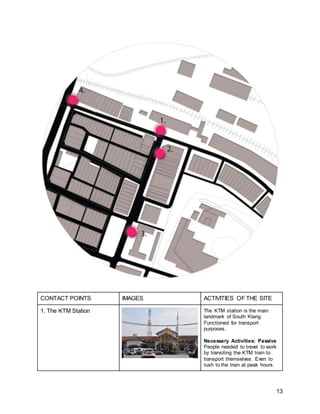
CONTACT POINTS IMAGES ACTIVITIES OF THE SITE
1. The KTM Station The KTM station is the main
landmark of South Klang.
Functioned for transport
purposes.
Necessary Activities: Passive
People needed to travel to work
by transiting the KTM train to
transport themselves. Even to
rush to the train at peak hours.
14
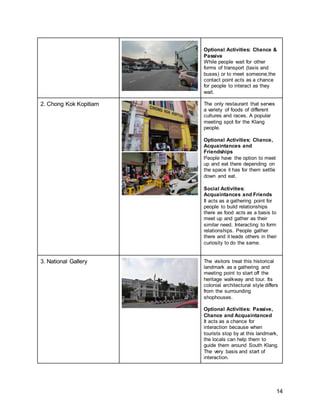
Optional Activities: Chance &
Passive
While people wait for other
forms of transport (taxis and
buses) or to meet someone,the
contact point acts as a chance
for people to interact as they
wait.
2. Chong Kok Kopitiam The only restaurant that serves
a variety of foods of different
cultures and races. A popular
meeting spot for the Klang
people.
Optional Activities: Chance,
Acquaintances and
Friendships
People have the option to meet
up and eat there depending on
the space it has for them settle
down and eat.
Social Activities:
Acquaintances and Friends
It acts as a gathering point for
people to build relationships
there as food acts as a basis to
meet up and gather as their
similar need. Interacting to form
relationships. People gather
there and it leads others in their
curiosity to do the same.
3. National Gallery The visitors treat this historical
landmark as a gathering and
meeting point to start off the
heritage walkway and tour. Its
colonial architectural style differs
from the surrounding
shophouses.
Optional Activities: Passive,
Chance and Acquaintanced
It acts as a chance for
interaction because when
tourists stop by at this landmark,
the locals can help them to
guide them around South Klang.
The very basis and start of
interaction.
15
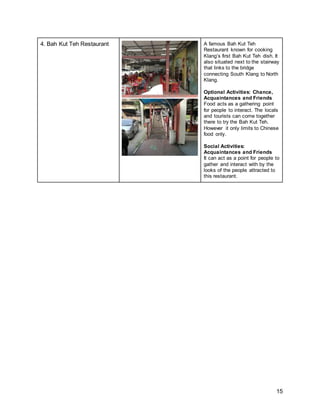
4. Bah Kut Teh Restaurant A famous Bah Kut Teh
Restaurant known for cooking
Klang’s first Bah Kut Teh dish. It
also situated next to the stairway
that links to the bridge
connecting South Klang to North
Klang.
Optional Activities: Chance,
Acquaintances and Friends
Food acts as a gathering point
for people to interact. The locals
and tourists can come together
there to try the Bah Kut Teh.
However it only limits to Chinese
food only.
Social Activities:
Acquaintances and Friends
It can act as a point for people to
gather and interact with by the
looks of the people attracted to
this restaurant.

Theories comparison essay

  • 1.
    ARC61303/ARC2224 Theories ofArchitecture and Urbanism Project 2: Comparative Analysis Essay Zoe Low Li Mien 0319444 Tutor: Nicholas Ng CONTENTS:
  • 2.
    1 1. ESSAY 2 2.LIST OF CONTACT POINTS 10 Introduction:
  • 3.
    2 Cities have theirown contrasting approaches of making spaces for their people who are inhabiting them. 2 streets of 2 cities that contribute to this idea are Nehru Bazar Road of Jaipur in India and Jalan Besar of South Klang in Malaysia. Nehru Bazar Road is situated close to the city center of Jaipur. The capital and the biggest city of the rich Rajasthan state, one of the 3 Golden Triangles of Tourism along with Delhi and Agra. A historical monumental city painted in pink known for its infamous urban grid layout that has been planned precisely. The street within this beautiful city is a market street consisting of horizontal rows of shophouses working in Rajasthan Style. Housing the commercialised shops that sells street food, footwear, fashion, ornaments and many crafts. Jalan Besar is located in South Klang, south of the historical Klang River. South Klang was where origin of the Klang started. It grew from a village settlement to tin mining town dominated by the Chinese and the British Colony. The street is comprised of shophouses constructed in a random typology that vary in different functions. It leads to the oldest landmark of South Klang, which is the KTM station where it historically transports the tin resource to Kuala Lumpur. This road was adjusted to the deformed urban grid plan made by the Colonial British as the town was growing fruitfully for its tin mining industry. Although both streets are situated in the Asian Continent, they have their own methodologies of creating spaces for the users to interact with. Nehru Bazar Street and Jalan Besar are contrasting in terms of their environmental approaches. Background: Firstly, both streets have their own different roles to their cities. Nehru Bazar Road is fixated on its purpose as a definite marketplace to Jaipur. Due to that, it results the street to have very similar functions at every part of the place. All of these functions are mostly shopping and commercialised based where the locals often sell their crafts and food. It is evident from the perspectives images of the 2nd, 3rd and 4th contact points which shows that the users mainly use these shops. Limiting them to these buildings to these activities. They continuously have commercialised functions which only consist of shops, restaurants and street vendors. They only act as the basis for social gathering purposes as starting points. Leading Nehru Bazaar to limit the street itself of these set of activities alone occurring on the street.
  • 4.
    3 The 2nd ContactPoint shows the people making use of the shops as gathering point The 3rd Contact Point shows people walking through the streets. The 4th Contact Point shows the street vendor in between the shophouses. Whereas for Jalan Besar, the street lacks its role to its city as it presently has a variety of different functions. It is based upon the usages of the shophouses and buildings surrounding the street. The contact points are formed due to the buildings’ functional usage of food, travelling and transportation purposes. For instance the Chong Kok Kopitiam and the Bah Kut Teh Restaurants are made as contact points because people are driven by their food. A basis for them to interact to form social relationships. Another example of this is the KTM station contact point, which is used to perform necessary activities for people to travel back and forth to work. As well as to make optional activities for people to interact as they wait for other forms of transportation (buses and taxis) from the station. Chong Kok Kopitiam Contact Point. The most popular restaurant in South Klang used as a gathering and socialising spot.
  • 5.
    4 The Bah KutTeh Restaurant contact point next to the Stairway leading to the Klang bridge. A popular spot for people to gather as it is the first Bah Kut Teh restaurant cooked in Klang. The KTM station a contact point used for transportation purposes. Despite Jalan Besar lacking its purpose as a street, it provides a larger range of necessary, optional and social activities than Nehru Bazar Street. This is due to the type of activities occuring in both streets. Jalan Besar activities were a result from the multifunctional uses of the shophouses and surrounding buildings, This makes the Jaipur marketplace lack its more fulfilling purpose to the city as it only focuses on its role as a shopping district. Diverting the activities of the streets to that very intention. Therefore Jalan Besar has a stronger functional role to its city as it has stronger contact points to support every inhabitant’s need. Secondly, the architectural styles of the streets influence their environments. Nehru Bazar Street has a geometrical Mughal architecture style unlike Jalan Besar’s mixture of asymmetrical colonial and chinese styles.
  • 6.
    5 For instance, themost common activity found in majority of the contact points is the necessary activity. The users are forced to walk and pass through this street to explore. Based from these pictures of the street views below, it portrays the fact the buildings are designed in very repetitive squarish details. A constant framework that gives the space a rigid perception to the people. Influencing them to make less use of the space lacks character, following its homogenity pattern. As evident, these blocks act as an obvious instinctive guideline that forces people to follow through in order to move along this street. Limiting the users of the street perform to fewer activities due to their continuous surrounding of shophouses. Nehru Bazar Road is known to have a repetitive row of shophouses that have repetitive homogenic features. As for Jalan Besar itself, the street consist of a mixture of Colonial and Chinese architecture styles. Each of these styles create special emotional perceptions to the users. Comprising of random elements such as triangular, squarish and circular shapes. Causing people to have different responses to each of these elements. Striving them to perform random different activities onto the street based on their stimuli responses to these mixed up surroundings. The shophouses in Jalan Besar vary in different shapes and sizes due to the Colonial and Chinese styles.
  • 7.
    6 The National Galleryhas a majestic colonial architectural style. The KTM station is also colonial but triangular. For instance the National Gallery serves as a contact point because its grandeur colonial style. Its richful circular columns give a harmonic expression which cause the visitors to give out a high impression of the building. Using the landmark as an obvious meetup point for the heritage walkway and as a chance to interact with the tourists. Not only does this laid out as an example, the old vernacular KTM station is also used as a contact point for people to meet up with their desired users arriving from the train. This presents the idea that architectural styles can influence the users to do certain activities through manipulating emotional perceptions of the streets. Each of these contact points in Jalan Besar have its own variety of social and optional activities that the building’s designs have led the people to. Unlike Jalan Besar, the geometrical style of Nehru is very rigid that it limits the inhabitants into doing certain fewer activities. Therefore the architectural styles of Jalan Besar makes the street to have a more fulfilling meaning to its surroundings than Nehru Bazar. Hence the royal port town it was called to due to its richer assemblage of styles. Thirdly, Nehru Bazar and Jalan Besar have different urban plans due to their respective cities’ urban planning. The urban planning of both of the streets’ cities have contributed to this creation of environments to these streets. Acting as one of the main influential aspects that led them to define the streets. Nehru Bazar Road strictly follows the urban grid pattern of Jaipur city as accordance to its plan. It has to fulfill its purpose as a marketplace to the city as evident by the layout below. In this map, the rectangular squarish shops are repetitively arranged in horizontal rows. A linear typology that the blocks are mandatorily adjusted to. Each houses its similar commercialising function, which results the street to systematically have a more limited range of activities occuring in the site. This is the reason why the contact points have similar activities and intensities as people commonly travel to them only to meet up and pause for themselves. As well as to forcibly direct them in one direction only. Their level of interaction is very low as they are very passive due to this urban gird as a result.
  • 8.
    7 A repetitive rowof shophouses as seen in the middle of the street. Whereas in Jalan Besar’s case, South Klang did not have a proper urban plan. The grid plan was provided by the British Colony during its rule to this river, which contextually alienates the environment. This causes the street to act as an interacting axis that leads people to walk to the KTM station. Due to the deformity of the this grid plan, it results the street to create random activities and different forms of contact in the site. It did not define and strict the people to the street’s purpose not even regulating them to the KTM as main contact point alone. (Left): Diagram of the deformed urban grid pattern of the street (Right): Diagram of the Axis cutting through the street. Despite the fact that both streets follow a grid pattern of the city’s urban planning, both are different as in terms of results of this planning. Unlike Nehru Bazar Street, Jalan Besar cuts through a number of surroundings and districts like an axis. This acts of urban planning did not define the street, which results in contact points and activities scattered everywhere. Each having its own different sets of activities created by this deformed urban fabric. Whereas Nehru Bazar provides a clear pathway and circulation of the street. Directing the people in one straight
  • 9.
    8 direction without cuttingany district or primary paths along its way. Therefore Jalan Besar is not defined as a proper street in contrast to the clean cut of the Nehru Bazar road. Conclusion: In conclusion Nehru Bazar Street and Jalan Besar are contrasting in their methodologies of creating spaces for the inhabitants of their users. They do both follow a grid pattern but in a different contexts. Nehru Bazar Street strictly follows its role as the city’s marketplace and geometrical philosophy. However it results the streets into creating more limited activities, which has more necessary activities than Jalan Besar itself. Prompting the users to have a less purposeful relationship with the overly commercialised environment. However despite the fact that Jalan Besar lacks a purpose to the city in terms of planning, the street inhabits a meaningful environment due to its diversity methodology. Although it has a lot of random mixed used elements, which some people find it as a confusing environment, it led to a creation various activites in the street itself. Defining the street a multifunctional place where it has stronger contact points and various activities that people can meet up to interact. Therefore in my opinion, Jalan Besar is more richer than Nehru Bazar because its diverse culture that defines its place further.
  • 10.
    9 LIST OF CONTACTPOINTS: NEHRU BAZAAR ROAD CONTACT POINTS IMAGE ACTIVITIES OCCURRED ON SITE
  • 11.
    10 1. The Wall Entrance OptionalActivities: Chance and Passive Contact The existing structure of its steps and seating area in an open public space caters for pausing moments for the pedestrian to rest and appreciate its massive scale and detailing of the wall. Necessary Activities: Passive Contact The main channel of connectivity intersecting through the masonry wall, concentrates movement through the openings, facilitates pedestrian in travelling to the adjacent part of the town 2. The 1st Junction Necessary Activities: Passive Contact The Junction transits the people through the alleyways entering another street. Optional Activities: Chance Contact, Acquaintances Strategic shops at the junction corner allows opportunity for explorations Social Activities: Friends, Close Friendships A pausing and gathering space for friends and family to davour and reminiscence the olden days
  • 12.
    11 3. Mayur TowerNecessary Activities: Chance Contacts The vehicles that are parked in front of the shops forms the basis of interaction. It is a necessary activity as people communicate to pick up and drop off some items for the shops. Optional Activities: Chance Contact The Open spacious verandah of the Mayur Tower provides a basis of forming social contacts. A breakaway point from the homogenous shops of the street. 4. The Street Food Optional Activities: Passive Contact The alley is famous for its local food and culture, frequently visited by the tourist
  • 13.
    12 5. The SquareNecessary activities Acquaintances Pedestrian such as the local workers and local community uses the pathway as an entry point or transitioning point through the business centre. Optional Activities: Chance Contact and Passive Contact People stop by to obtain medical related items before resuming their journey JALAN BESAR, SOUTH KLANG
  • 14.
    13 CONTACT POINTS IMAGESACTIVITIES OF THE SITE 1. The KTM Station The KTM station is the main landmark of South Klang. Functioned for transport purposes. Necessary Activities: Passive People needed to travel to work by transiting the KTM train to transport themselves. Even to rush to the train at peak hours.
  • 15.
    14 Optional Activities: Chance& Passive While people wait for other forms of transport (taxis and buses) or to meet someone,the contact point acts as a chance for people to interact as they wait. 2. Chong Kok Kopitiam The only restaurant that serves a variety of foods of different cultures and races. A popular meeting spot for the Klang people. Optional Activities: Chance, Acquaintances and Friendships People have the option to meet up and eat there depending on the space it has for them settle down and eat. Social Activities: Acquaintances and Friends It acts as a gathering point for people to build relationships there as food acts as a basis to meet up and gather as their similar need. Interacting to form relationships. People gather there and it leads others in their curiosity to do the same. 3. National Gallery The visitors treat this historical landmark as a gathering and meeting point to start off the heritage walkway and tour. Its colonial architectural style differs from the surrounding shophouses. Optional Activities: Passive, Chance and Acquaintanced It acts as a chance for interaction because when tourists stop by at this landmark, the locals can help them to guide them around South Klang. The very basis and start of interaction.
  • 16.
    15 4. Bah KutTeh Restaurant A famous Bah Kut Teh Restaurant known for cooking Klang’s first Bah Kut Teh dish. It also situated next to the stairway that links to the bridge connecting South Klang to North Klang. Optional Activities: Chance, Acquaintances and Friends Food acts as a gathering point for people to interact. The locals and tourists can come together there to try the Bah Kut Teh. However it only limits to Chinese food only. Social Activities: Acquaintances and Friends It can act as a point for people to gather and interact with by the looks of the people attracted to this restaurant.