MARKING AND
MARKING TOOLS
Presented by
Name: Irfan saudagar
Unit: Workshop tools
Date: 06-03-2023
PURPOSE OF MARKING
 To ensure that the correct amount of metal
is removed from the various faces so that
the correct shape is produced.
 To Provide lines which will serve as a guide
indicating that a correct size has been
reached
MARKING MEDIA
 Marking media, as metal is a hard material, so the
drawn lines are not clearly visible hence marking media
is used.
 In this way, the marking media is a material that is
applied on the surface on which marking has to be done
by marking tools so that the lines of marking can be
seen clearly.
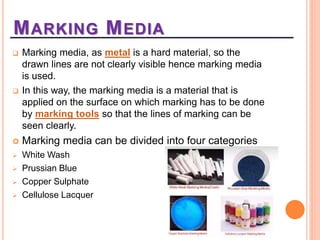
 Marking media can be divided into four categories
 White Wash
 Prussian Blue
 Copper Sulphate
 Cellulose Lacquer
METHOD OF MARKING MEDIA
 Datum line method
 Center line method
 Marking by Template
 Marking of Centre on round rod end
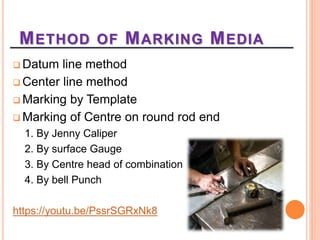
1. By Jenny Caliper
2. By surface Gauge
3. By Centre head of combination
4. By bell Punch
https://youtu.be/PssrSGRxNk8
JENNY CALIPER AND SURFACE GAUGE
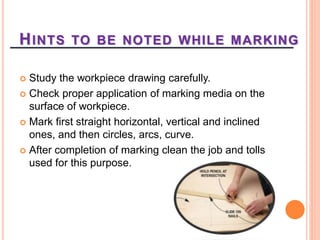
HINTS TO BE NOTED WHILE MARKING
 Study the workpiece drawing carefully.
 Check proper application of marking media on the
surface of workpiece.
 Mark first straight horizontal, vertical and inclined
ones, and then circles, arcs, curve.
 After completion of marking clean the job and tolls
used for this purpose.
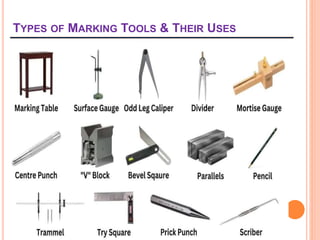
TYPES OF MARKING TOOLS & THEIR USES
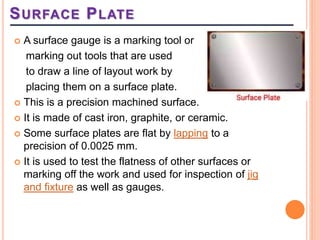
SURFACE PLATE
 A surface gauge is a marking tool or
marking out tools that are used
to draw a line of layout work by
placing them on a surface plate.
 This is a precision machined surface.
 It is made of cast iron, graphite, or ceramic.
 Some surface plates are flat by lapping to a
precision of 0.0025 mm.
 It is used to test the flatness of other surfaces or
marking off the work and used for inspection of jig
and fixture as well as gauges.
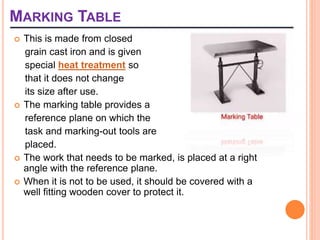
MARKING TABLE
 This is made from closed
grain cast iron and is given
special heat treatment so
that it does not change
its size after use.
 The marking table provides a
reference plane on which the
task and marking-out tools are
placed.
 The work that needs to be marked, is placed at a right
angle with the reference plane.
 When it is not to be used, it should be covered with a
well fitting wooden cover to protect it.
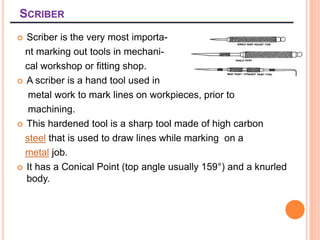
SCRIBER
 Scriber is the very most importa-
nt marking out tools in mechani-
cal workshop or fitting shop.
 A scriber is a hand tool used in
metal work to mark lines on workpieces, prior to
machining.
 This hardened tool is a sharp tool made of high carbon
steel that is used to draw lines while marking on a
metal job.
 It has a Conical Point (top angle usually 159°) and a knurled
body.
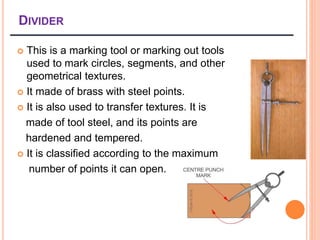
DIVIDER
 This is a marking tool or marking out tools
used to mark circles, segments, and other
geometrical textures.
 It made of brass with steel points.
 It is also used to transfer textures. It is
made of tool steel, and its points are
hardened and tempered.
 It is classified according to the maximum
number of points it can open.
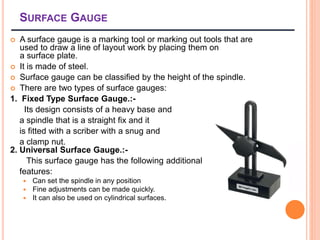
SURFACE GAUGE
 A surface gauge is a marking tool or marking out tools that are
used to draw a line of layout work by placing them on
a surface plate.
 It is made of steel.
 Surface gauge can be classified by the height of the spindle.
 There are two types of surface gauges:
1. Fixed Type Surface Gauge.:-
Its design consists of a heavy base and
a spindle that is a straight fix and it
is fitted with a scriber with a snug and
a clamp nut.
2. Universal Surface Gauge.:-
This surface gauge has the following additional
features:
 Can set the spindle in any position
 Fine adjustments can be made quickly.
 It can also be used on cylindrical surfaces.
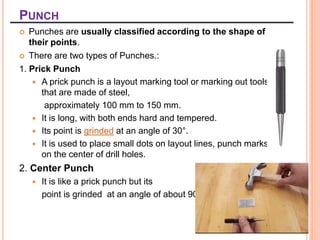
PUNCH
 Punches are usually classified according to the shape of
their points.
 There are two types of Punches.:
1. Prick Punch
 A prick punch is a layout marking tool or marking out tools
that are made of steel,
approximately 100 mm to 150 mm.
 It is long, with both ends hard and tempered.
 Its point is grinded at an angle of 30°.
 It is used to place small dots on layout lines, punch marks
on the center of drill holes.
2. Center Punch
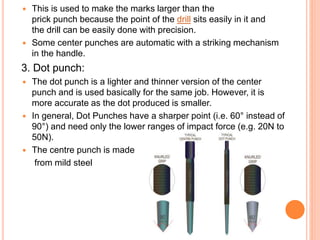
 It is like a prick punch but its
point is grinded at an angle of about 90 °.
 This is used to make the marks larger than the
prick punch because the point of the drill sits easily in it and
the drill can be easily done with precision.
 Some center punches are automatic with a striking mechanism
in the handle.
3. Dot punch:
 The dot punch is a lighter and thinner version of the center
punch and is used basically for the same job. However, it is
more accurate as the dot produced is smaller.
 In general, Dot Punches have a sharper point (i.e. 60° instead of
90°) and need only the lower ranges of impact force (e.g. 20N to
50N).
 The centre punch is made
from mild steel
V-BLOCK
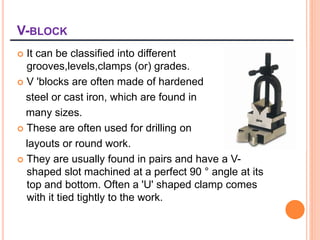
 It can be classified into different
grooves,levels,clamps (or) grades.
 V 'blocks are often made of hardened
steel or cast iron, which are found in
many sizes.
 These are often used for drilling on
layouts or round work.
 They are usually found in pairs and have a V-
shaped slot machined at a perfect 90 ° angle at its
top and bottom. Often a 'U' shaped clamp comes
with it tied tightly to the work.
ANGLE PLATE
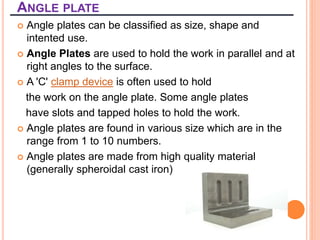
 Angle plates can be classified as size, shape and
intented use.
 Angle Plates are used to hold the work in parallel and at
right angles to the surface.
 A 'C' clamp device is often used to hold
the work on the angle plate. Some angle plates
have slots and tapped holes to hold the work.
 Angle plates are found in various size which are in the
range from 1 to 10 numbers.
 Angle plates are made from high quality material
(generally spheroidal cast iron)
TRY SQUARE
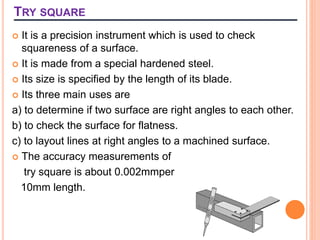
 It is a precision instrument which is used to check
squareness of a surface.
 It is made from a special hardened steel.
 Its size is specified by the length of its blade.
 Its three main uses are
a) to determine if two surface are right angles to each other.
b) to check the surface for flatness.
c) to layout lines at right angles to a machined surface.
 The accuracy measurements of
try square is about 0.002mmper
10mm length.

Machine Marking and Marking Tools.pptx

  • 1.
    MARKING AND MARKING TOOLS Presentedby Name: Irfan saudagar Unit: Workshop tools Date: 06-03-2023
  • 2.
    PURPOSE OF MARKING To ensure that the correct amount of metal is removed from the various faces so that the correct shape is produced.  To Provide lines which will serve as a guide indicating that a correct size has been reached
  • 3.
    MARKING MEDIA  Markingmedia, as metal is a hard material, so the drawn lines are not clearly visible hence marking media is used.  In this way, the marking media is a material that is applied on the surface on which marking has to be done by marking tools so that the lines of marking can be seen clearly.  Marking media can be divided into four categories  White Wash  Prussian Blue  Copper Sulphate  Cellulose Lacquer
  • 4.
    METHOD OF MARKINGMEDIA  Datum line method  Center line method  Marking by Template  Marking of Centre on round rod end 1. By Jenny Caliper 2. By surface Gauge 3. By Centre head of combination 4. By bell Punch https://youtu.be/PssrSGRxNk8
  • 5.
    JENNY CALIPER ANDSURFACE GAUGE
  • 6.
    HINTS TO BENOTED WHILE MARKING  Study the workpiece drawing carefully.  Check proper application of marking media on the surface of workpiece.  Mark first straight horizontal, vertical and inclined ones, and then circles, arcs, curve.  After completion of marking clean the job and tolls used for this purpose.
  • 7.
    TYPES OF MARKINGTOOLS & THEIR USES
  • 8.
    SURFACE PLATE  Asurface gauge is a marking tool or marking out tools that are used to draw a line of layout work by placing them on a surface plate.  This is a precision machined surface.  It is made of cast iron, graphite, or ceramic.  Some surface plates are flat by lapping to a precision of 0.0025 mm.  It is used to test the flatness of other surfaces or marking off the work and used for inspection of jig and fixture as well as gauges.
  • 9.
    MARKING TABLE  Thisis made from closed grain cast iron and is given special heat treatment so that it does not change its size after use.  The marking table provides a reference plane on which the task and marking-out tools are placed.  The work that needs to be marked, is placed at a right angle with the reference plane.  When it is not to be used, it should be covered with a well fitting wooden cover to protect it.
  • 10.
    SCRIBER  Scriber isthe very most importa- nt marking out tools in mechani- cal workshop or fitting shop.  A scriber is a hand tool used in metal work to mark lines on workpieces, prior to machining.  This hardened tool is a sharp tool made of high carbon steel that is used to draw lines while marking on a metal job.  It has a Conical Point (top angle usually 159°) and a knurled body.
  • 11.
    DIVIDER  This isa marking tool or marking out tools used to mark circles, segments, and other geometrical textures.  It made of brass with steel points.  It is also used to transfer textures. It is made of tool steel, and its points are hardened and tempered.  It is classified according to the maximum number of points it can open.
  • 12.
    SURFACE GAUGE  Asurface gauge is a marking tool or marking out tools that are used to draw a line of layout work by placing them on a surface plate.  It is made of steel.  Surface gauge can be classified by the height of the spindle.  There are two types of surface gauges: 1. Fixed Type Surface Gauge.:- Its design consists of a heavy base and a spindle that is a straight fix and it is fitted with a scriber with a snug and a clamp nut. 2. Universal Surface Gauge.:- This surface gauge has the following additional features:  Can set the spindle in any position  Fine adjustments can be made quickly.  It can also be used on cylindrical surfaces.
  • 13.
    PUNCH  Punches areusually classified according to the shape of their points.  There are two types of Punches.: 1. Prick Punch  A prick punch is a layout marking tool or marking out tools that are made of steel, approximately 100 mm to 150 mm.  It is long, with both ends hard and tempered.  Its point is grinded at an angle of 30°.  It is used to place small dots on layout lines, punch marks on the center of drill holes. 2. Center Punch  It is like a prick punch but its point is grinded at an angle of about 90 °.
  • 14.
     This isused to make the marks larger than the prick punch because the point of the drill sits easily in it and the drill can be easily done with precision.  Some center punches are automatic with a striking mechanism in the handle. 3. Dot punch:  The dot punch is a lighter and thinner version of the center punch and is used basically for the same job. However, it is more accurate as the dot produced is smaller.  In general, Dot Punches have a sharper point (i.e. 60° instead of 90°) and need only the lower ranges of impact force (e.g. 20N to 50N).  The centre punch is made from mild steel
  • 15.
    V-BLOCK  It canbe classified into different grooves,levels,clamps (or) grades.  V 'blocks are often made of hardened steel or cast iron, which are found in many sizes.  These are often used for drilling on layouts or round work.  They are usually found in pairs and have a V- shaped slot machined at a perfect 90 ° angle at its top and bottom. Often a 'U' shaped clamp comes with it tied tightly to the work.
  • 16.
    ANGLE PLATE  Angleplates can be classified as size, shape and intented use.  Angle Plates are used to hold the work in parallel and at right angles to the surface.  A 'C' clamp device is often used to hold the work on the angle plate. Some angle plates have slots and tapped holes to hold the work.  Angle plates are found in various size which are in the range from 1 to 10 numbers.  Angle plates are made from high quality material (generally spheroidal cast iron)
  • 17.
    TRY SQUARE  Itis a precision instrument which is used to check squareness of a surface.  It is made from a special hardened steel.  Its size is specified by the length of its blade.  Its three main uses are a) to determine if two surface are right angles to each other. b) to check the surface for flatness. c) to layout lines at right angles to a machined surface.  The accuracy measurements of try square is about 0.002mmper 10mm length.