PRISM (TRIANGULAR
AND TRAPEZIODAL)
GROUP 4
EDP CODE: 51946
MEMBERS:
CARAMBACAN, FRANCIS KYLE
ARIZALA, KENT JG
DELA TORRE, JERALD T.
MARFIL, KEN
SUMAYA, RHEDTNE BRYCE
HILIS, RJ V.
TORREMOCHA, JUMMAR
OBJECTIVE OF
PRISM
(TRIANGULAR
AND
TRAPEZOIDAL
At the end of this report the students should be able to:
• What is the History of Prism (Triangular and Trapezoidal)
• Define Prism (Triangular and Trapezoidal)
• Explain the Importance Prism (Triangular and Trapezoidal)
- Importance application of Triangular Prism and Trapezoidal
Prism
- How to calculate the Volume and Surface area of Triangular
Prism
- How to calculate the Volume and Surface area of Trapezoidal
Prism
Objectives:
I. OBJECTIVES
CARAMBACAN,
FRANCIS KYLE
HISTORY OF
TRIANGULAR AND
TRAPEZOIDAL PRISM
HISTORY
TRIANGULAR PRISM
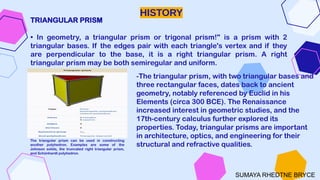
• In geometry, a triangular prism or trigonal prism!" is a prism with 2
triangular bases. If the edges pair with each triangle's vertex and if they
are perpendicular to the base, it is a right triangular prism. A right
triangular prism may be both semiregular and uniform.
.
The triangular prism can be used in constructing
another polyhedron. Examples are some of the
Johnson solids, the truncated right triangular prism,
and Schönhardt polyhedron.
-The triangular prism, with two triangular bases and
three rectangular faces, dates back to ancient
geometry, notably referenced by Euclid in his
Elements (circa 300 BCE). The Renaissance
increased interest in geometric studies, and the
17th-century calculus further explored its
properties. Today, triangular prisms are important
in architecture, optics, and engineering for their
structural and refractive qualities.
SUMAYA RHEDTNE BRYCE
HISTORY
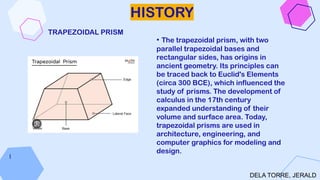
• The trapezoidal prism, with two
parallel trapezoidal bases and
rectangular sides, has origins in
ancient geometry. Its principles can
be traced back to Euclid's Elements
(circa 300 BCE), which influenced the
study of prisms. The development of
calculus in the 17th century
expanded understanding of their
volume and surface area. Today,
trapezoidal prisms are used in
architecture, engineering, and
computer graphics for modeling and
design.
l
DELA TORRE, JERALD
TRAPEZOIDAL PRISM
HISTORY
DELA TORRE AND
SUMAYA
Fuclid was the most prominent mathematician of Greco-
Roman antiquity, best known for his treatise on
geometry, the Elements.
"Ancient Civilizations"
Ancient civilizations like Egyptians, Babylonians,
and Greeks made important advanced geometry
through architectural feats, surveying methods,
and mathematical breakthroughs, laying the
groundwork for geometric principles.
"Euclidean Geometry"
Euclid, a Greek mathematician, formalized
geometry in his work "Elements" around 300
BCE, providing a systematic approach to
understanding geometric shapes and properties.
CARAMBACAN,
FRANCIS KYLE
DEFINITION OF
TRIANGULAR
AND TRAPEZOIDAL
PRISM
TRAINGULAR PRISM
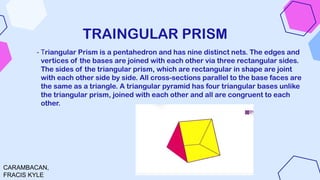
- Triangular Prism is a pentahedron and has nine distinct nets. The edges and
vertices of the bases are joined with each other via three rectangular sides.
The sides of the triangular prism, which are rectangular in shape are joint
with each other side by side. All cross-sections parallel to the base faces are
the same as a triangle. A triangular pyramid has four triangular bases unlike
the triangular prism, joined with each other and all are congruent to each
other.
CARAMBACAN,
FRANCIS KYLE
CARAMBACAN,
FRACIS KYLE
TRAPEZOIDAL PRISM
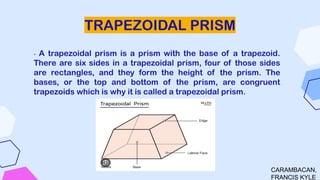
- A trapezoidal prism is a prism with the base of a trapezoid.
There are six sides in a trapezoidal prism, four of those sides
are rectangles, and they form the height of the prism. The
bases, or the top and bottom of the prism, are congruent
trapezoids which is why it is called a trapezoidal prism.
CARAMBACAN,
FRANCIS KYLE
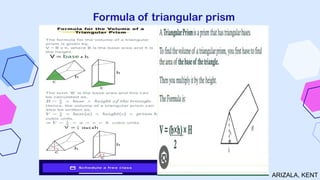
Formula of triangular prism
ARIZALA, KENT
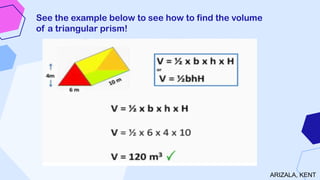
See the example below to see how to find the volume
of a triangular prism!
ARIZALA, KENT
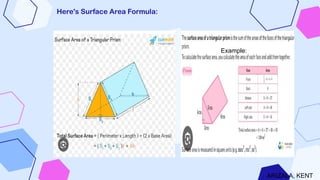
Here's Surface Area Formula:
Example:
ARIZALA, KENT
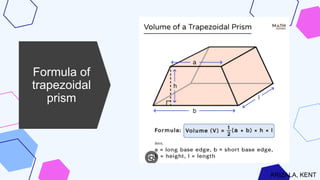
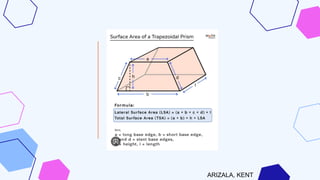
Formula of
trapezoidal
prism
ARIZALA, KENT
ARIZALA, KENT
Problem Solving
Or Statement
For triangular
and trapezoidal
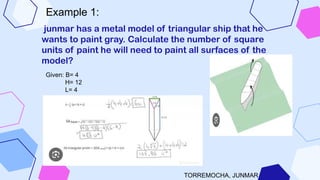
Example 1:
junmar has a metal model of triangular ship that he
wants to paint gray. Calculate the number of square
units of paint he will need to paint all surfaces of the
model?.
Given: B= 4
H= 12
L= 4
TORREMOCHA, JUNMAR
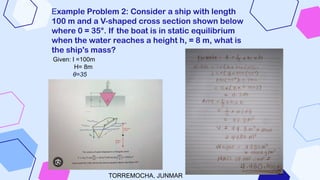
Example Problem 2: Consider a ship with length
100 m and a V-shaped cross section shown below
where 0 = 35°. If the boat is in static equilibrium
when the water reaches a height h, = 8 m, what is
the ship's mass?
Given: l =100m
H= 8m
θ=35
TORREMOCHA, JUNMAR
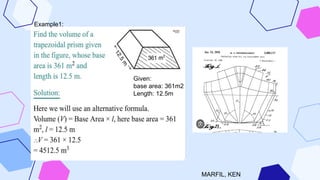
Example1:
Given:
base area: 361m2
Length: 12.5m
MARFIL, KEN
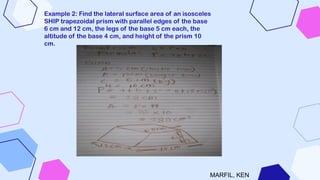
Example 2: Find the lateral surface area of an isosceles
SHIP trapezoidal prism with parallel edges of the base
6 cm and 12 cm, the legs of the base 5 cm each, the
altitude of the base 4 cm, and height of the prism 10
cm.
MARFIL, KEN
CONCLUSION
HILIS, RJ
V. REFERENCES
• https://www.cuemath.com/geometry/triangular-prism/
• https://en.wikipedia.org/wiki/Triangular_prism/
• https://www.cuemath.com/geometry/trapezoidal-prism/
• https://mathmonks.com/prism/trapezoidal-prism
• https://thirdspacelearning.com/gcse-maths/geometry-and-measure/surface-area-of-a-
triangular-prism/
REFERENCES
HILIS, RJ
THAT’S ALL,
THANK YOU!

Group4-PRESENTATION(1).pptxiehdheiohdhdhd

  • 1.
    PRISM (TRIANGULAR AND TRAPEZIODAL) GROUP4 EDP CODE: 51946 MEMBERS: CARAMBACAN, FRANCIS KYLE ARIZALA, KENT JG DELA TORRE, JERALD T. MARFIL, KEN SUMAYA, RHEDTNE BRYCE HILIS, RJ V. TORREMOCHA, JUMMAR
  • 2.
  • 3.
    At the endof this report the students should be able to: • What is the History of Prism (Triangular and Trapezoidal) • Define Prism (Triangular and Trapezoidal) • Explain the Importance Prism (Triangular and Trapezoidal) - Importance application of Triangular Prism and Trapezoidal Prism - How to calculate the Volume and Surface area of Triangular Prism - How to calculate the Volume and Surface area of Trapezoidal Prism Objectives: I. OBJECTIVES CARAMBACAN, FRANCIS KYLE
  • 4.
  • 5.
    HISTORY TRIANGULAR PRISM • Ingeometry, a triangular prism or trigonal prism!" is a prism with 2 triangular bases. If the edges pair with each triangle's vertex and if they are perpendicular to the base, it is a right triangular prism. A right triangular prism may be both semiregular and uniform. . The triangular prism can be used in constructing another polyhedron. Examples are some of the Johnson solids, the truncated right triangular prism, and Schönhardt polyhedron. -The triangular prism, with two triangular bases and three rectangular faces, dates back to ancient geometry, notably referenced by Euclid in his Elements (circa 300 BCE). The Renaissance increased interest in geometric studies, and the 17th-century calculus further explored its properties. Today, triangular prisms are important in architecture, optics, and engineering for their structural and refractive qualities. SUMAYA RHEDTNE BRYCE
  • 6.
    HISTORY • The trapezoidalprism, with two parallel trapezoidal bases and rectangular sides, has origins in ancient geometry. Its principles can be traced back to Euclid's Elements (circa 300 BCE), which influenced the study of prisms. The development of calculus in the 17th century expanded understanding of their volume and surface area. Today, trapezoidal prisms are used in architecture, engineering, and computer graphics for modeling and design. l DELA TORRE, JERALD TRAPEZOIDAL PRISM
  • 7.
    HISTORY DELA TORRE AND SUMAYA Fuclidwas the most prominent mathematician of Greco- Roman antiquity, best known for his treatise on geometry, the Elements. "Ancient Civilizations" Ancient civilizations like Egyptians, Babylonians, and Greeks made important advanced geometry through architectural feats, surveying methods, and mathematical breakthroughs, laying the groundwork for geometric principles. "Euclidean Geometry" Euclid, a Greek mathematician, formalized geometry in his work "Elements" around 300 BCE, providing a systematic approach to understanding geometric shapes and properties.
  • 8.
  • 9.
    TRAINGULAR PRISM - TriangularPrism is a pentahedron and has nine distinct nets. The edges and vertices of the bases are joined with each other via three rectangular sides. The sides of the triangular prism, which are rectangular in shape are joint with each other side by side. All cross-sections parallel to the base faces are the same as a triangle. A triangular pyramid has four triangular bases unlike the triangular prism, joined with each other and all are congruent to each other. CARAMBACAN, FRANCIS KYLE CARAMBACAN, FRACIS KYLE
  • 10.
    TRAPEZOIDAL PRISM - Atrapezoidal prism is a prism with the base of a trapezoid. There are six sides in a trapezoidal prism, four of those sides are rectangles, and they form the height of the prism. The bases, or the top and bottom of the prism, are congruent trapezoids which is why it is called a trapezoidal prism. CARAMBACAN, FRANCIS KYLE
  • 11.
    Formula of triangularprism ARIZALA, KENT
  • 12.
    See the examplebelow to see how to find the volume of a triangular prism! ARIZALA, KENT
  • 13.
    Here's Surface AreaFormula: Example: ARIZALA, KENT
  • 14.
  • 15.
  • 16.
    Problem Solving Or Statement Fortriangular and trapezoidal
  • 17.
    Example 1: junmar hasa metal model of triangular ship that he wants to paint gray. Calculate the number of square units of paint he will need to paint all surfaces of the model?. Given: B= 4 H= 12 L= 4 TORREMOCHA, JUNMAR
  • 18.
    Example Problem 2:Consider a ship with length 100 m and a V-shaped cross section shown below where 0 = 35°. If the boat is in static equilibrium when the water reaches a height h, = 8 m, what is the ship's mass? Given: l =100m H= 8m θ=35 TORREMOCHA, JUNMAR
  • 19.
  • 20.
    Example 2: Findthe lateral surface area of an isosceles SHIP trapezoidal prism with parallel edges of the base 6 cm and 12 cm, the legs of the base 5 cm each, the altitude of the base 4 cm, and height of the prism 10 cm. MARFIL, KEN
  • 21.
  • 22.
    V. REFERENCES • https://www.cuemath.com/geometry/triangular-prism/ •https://en.wikipedia.org/wiki/Triangular_prism/ • https://www.cuemath.com/geometry/trapezoidal-prism/ • https://mathmonks.com/prism/trapezoidal-prism • https://thirdspacelearning.com/gcse-maths/geometry-and-measure/surface-area-of-a- triangular-prism/ REFERENCES HILIS, RJ
  • 23.