PRINCIPLES OF SUTURING IN
SURGERY.
CONTENTS
 Introduction/Definition,
 Goals of suturing,
 Suture materials,
 Suture armamentarium,
 Principles of suturing,

 Suturing techniques,
 Knots,
 Suture removal & complications.
WHAT IS A SUTURE?
 “Suture” is a Latin word, meaning “sewing together”.
OR
 To Suture refers to using a material that is an artificial
fiber; to keep wound edges together until they hold
sufficiently well by themselves by natural fibre (collagen)
which is synthesized and woven into a stronger scar
later.
OR
 A surgical seam formed after joining two surfaces.
(Collins Dictionary)
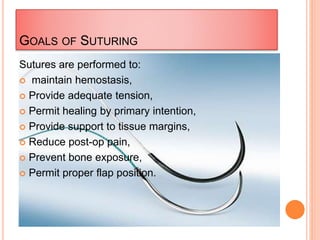
GOALS OF SUTURING
Sutures are performed to:
 maintain hemostasis,
 Provide adequate tension,
 Permit healing by primary intention,
 Provide support to tissue margins,
 Reduce post-op pain,
 Prevent bone exposure,
 Permit proper flap position.
REQUISITES OF AN IDEAL SUTURE
 Tensile Strength,
 Tissue Biocompatibility,
 Low Capillarity,
 Good Handling & Knotting properties,
 Sterilization without deterioration of properties
(most sutures available in packages are sterilized
by dry heat & ethylene oxide gas.).
 Non allergic & non carcinogenic,
 Its use should be possible in any surgery,
 Low cost,
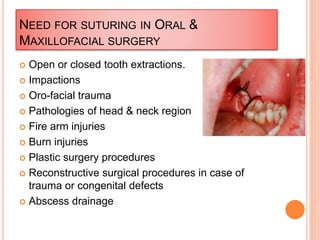
NEED FOR SUTURING IN ORAL &
MAXILLOFACIAL SURGERY
 Open or closed tooth extractions.
 Impactions
 Oro-facial trauma
 Pathologies of head & neck region
 Fire arm injuries
 Burn injuries
 Plastic surgery procedures
 Reconstructive surgical procedures in case of
trauma or congenital defects
 Abscess drainage
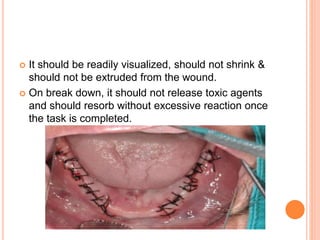
 It should be readily visualized, should not shrink &
should not be extruded from the wound.
 On break down, it should not release toxic agents
and should resorb without excessive reaction once
the task is completed.
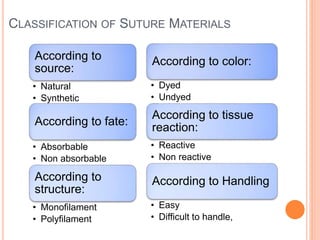
CLASSIFICATION OF SUTURE MATERIALS
According to
source:
• Natural
• Synthetic
According to fate:
• Absorbable
• Non absorbable
According to
structure:
• Monofilament
• Polyfilament
According to color:
• Dyed
• Undyed
According to tissue
reaction:
• Reactive
• Non reactive
According to Handling
• Easy
• Difficult to handle,
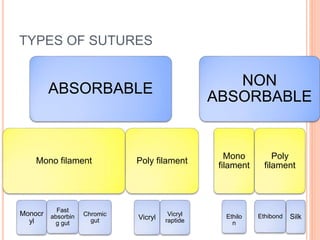
TYPES OF SUTURES
ABSORBABLE
Mono filament
Monocr
yl
Fast
absorbin
g gut
Chromic
gut
Poly filament
Vicryl Vicryl
raptide
NON
ABSORBABLE
Mono
filament
Ethilo
n
Poly
filament
Ethibond Silk
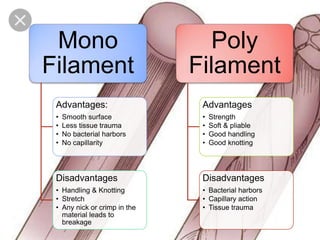
Mono
Filament
Advantages:
• Smooth surface
• Less tissue trauma
• No bacterial harbors
• No capillarity
Disadvantages
• Handling & Knotting
• Stretch
• Any nick or crimp in the
material leads to
breakage
Poly
Filament
Advantages
• Strength
• Soft & pliable
• Good handling
• Good knotting
Disadvantages
• Bacterial harbors
• Capillary action
• Tissue trauma
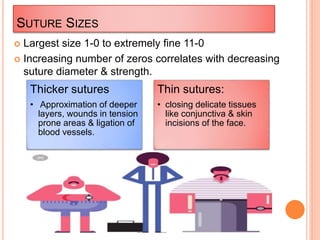
SUTURE SIZES
 Largest size 1-0 to extremely fine 11-0
 Increasing number of zeros correlates with decreasing
suture diameter & strength.
Thicker sutures
• Approximation of deeper
layers, wounds in tension
prone areas & ligation of
blood vessels.
Thin sutures:
• closing delicate tissues
like conjunctiva & skin
incisions of the face.
 Size is chosen to correlate with the tensile strength of the
tissue being sutured.
 Most commonly used in the oral cavity is the 3-0 black
silk.
 The size 3-0 has the appropriate amount of strength
 The poly filament nature of silk makes it easy to tie and
well tolerated by the patients soft tissues.
 The color makes it easy to see when the patient returns
for suture removal.
SUTURE NEEDLES
 Material: Stainless steel or Carbon steel.
 They are designed to lead the suture material through the
tissue with minimal injury.
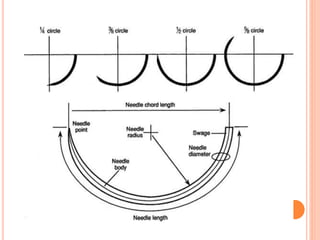
 Shape: usually a small half circle or three eighths-circle
suture needle.
 Tips:
Cutting needle:
• Passes through the
mucoperiosteum more easily as
compared with a tapered needle.
• The cutting portion extends about
one third of the needle, the
remaining portion is rounded.
Tapered needle:
• Used for more delicate tissues
e.g. in ocular or vascular surgery.
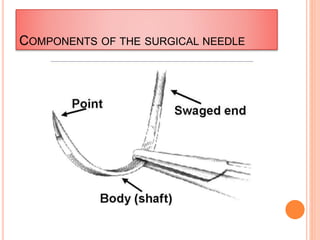
COMPONENTS OF THE SURGICAL NEEDLE
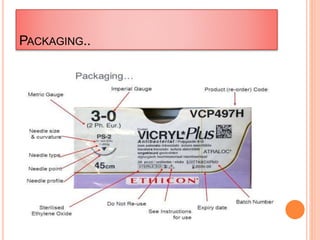
PACKAGING..
PRINCIPLES OF SUTURE SELECTION
The selection of suture material by a
surgeon must be based on a sound
knowledge of:
 Healing characteristics of the tissues
which are to be approximated,
 The physical &biological properties of
the sutures materials,
 The condition of the wound to be closed,
 The extent of the bodily tissues or
surgical wound to be sutured.
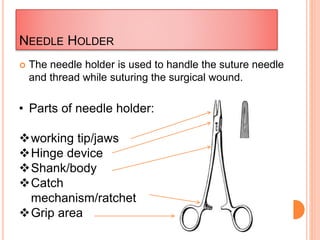
NEEDLE HOLDER
 The needle holder is used to handle the suture needle
and thread while suturing the surgical wound.
• Parts of needle holder:
working tip/jaws
Hinge device
Shank/body
Catch
mechanism/ratchet
Grip area
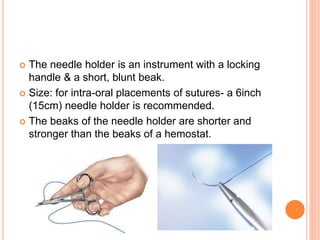
 The needle holder is an instrument with a locking
handle & a short, blunt beak.
 Size: for intra-oral placements of sutures- a 6inch
(15cm) needle holder is recommended.
 The beaks of the needle holder are shorter and
stronger than the beaks of a hemostat.
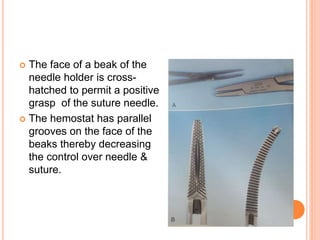
 The face of a beak of the
needle holder is cross-
hatched to permit a positive
grasp of the suture needle.
 The hemostat has parallel
grooves on the face of the
beaks thereby decreasing
the control over needle &
suture.
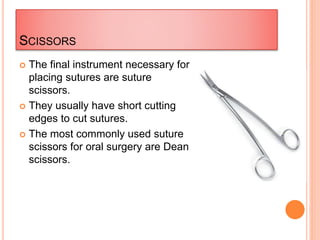
SCISSORS
 The final instrument necessary for
placing sutures are suture
scissors.
 They usually have short cutting
edges to cut sutures.
 The most commonly used suture
scissors for oral surgery are Dean
scissors.
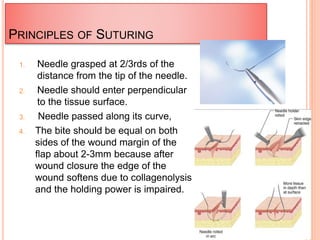
PRINCIPLES OF SUTURING
1. Needle grasped at 2/3rds of the
distance from the tip of the needle.
2. Needle should enter perpendicular
to the tissue surface.
3. Needle passed along its curve,
4. The bite should be equal on both
sides of the wound margin of the
flap about 2-3mm because after
wound closure the edge of the
wound softens due to collagenolysis
and the holding power is impaired.
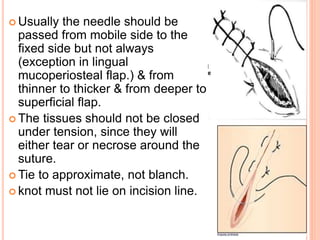
 Usually the needle should be
passed from mobile side to the
fixed side but not always
(exception in lingual
mucoperiosteal flap.) & from
thinner to thicker & from deeper to
superficial flap.
 The tissues should not be closed
under tension, since they will
either tear or necrose around the
suture.
 Tie to approximate, not blanch.
 knot must not lie on incision line.
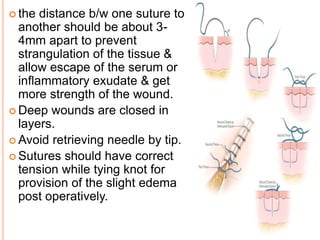
 the distance b/w one suture to
another should be about 3-
4mm apart to prevent
strangulation of the tissue &
allow escape of the serum or
inflammatory exudate & get
more strength of the wound.
 Deep wounds are closed in
layers.
 Avoid retrieving needle by tip.
 Sutures should have correct
tension while tying knot for
provision of the slight edema
post operatively.
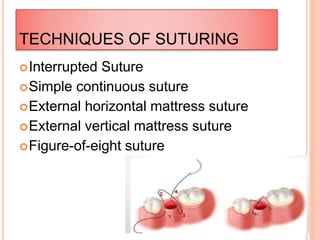
TECHNIQUES OF SUTURING
Interrupted Suture
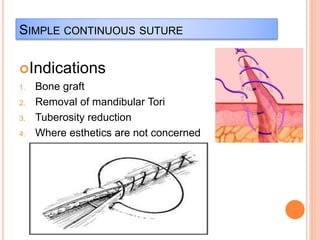
Simple continuous suture
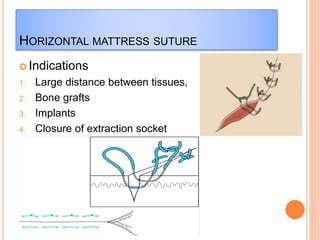
External horizontal mattress suture
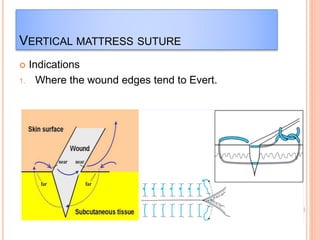
External vertical mattress suture
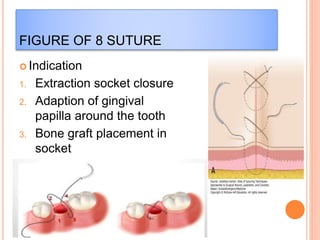
Figure-of-eight suture
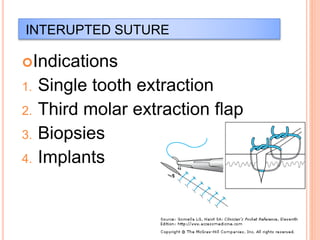
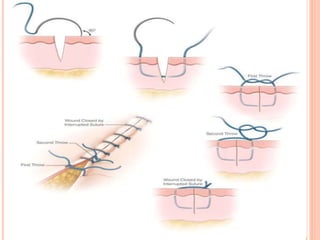
INTERUPTED SUTURE
Indications
1. Single tooth extraction
2. Third molar extraction flap
3. Biopsies
4. Implants
SIMPLE CONTINUOUS SUTURE
Indications
1. Bone graft
2. Removal of mandibular Tori
3. Tuberosity reduction
4. Where esthetics are not concerned
HORIZONTAL MATTRESS SUTURE
 Indications
1. Large distance between tissues,
2. Bone grafts
3. Implants
4. Closure of extraction socket
VERTICAL MATTRESS SUTURE
 Indications
1. Where the wound edges tend to Evert.
FIGURE OF 8 SUTURE
 Indication
1. Extraction socket closure
2. Adaption of gingival
papilla around the tooth
3. Bone graft placement in
socket
TYING THE KNOT..
No not this knot.
KNOTS
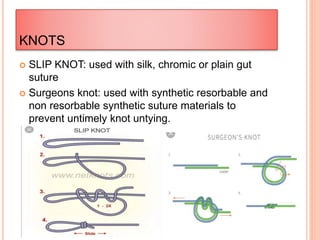
 SLIP KNOT: used with silk, chromic or plain gut
suture
 Surgeons knot: used with synthetic resorbable and
non resorbable synthetic suture materials to
prevent untimely knot untying.
STITCH REMOVAL
Intra oral
 mucoperiosteal closure
(without tension)= 5-7 days
 where there is tension
on the suture e.g. oro-antral
fistula= 7-10days
 A good guide is that as
soon as they begin to get
loose they should be taken
out.
SUTURE COMPLICATION
 Suture abscess
 Suture scaring or stitch mark
THANKYOU.

Principles of suturing in surgery

  • 1.
  • 2.
    CONTENTS  Introduction/Definition,  Goalsof suturing,  Suture materials,  Suture armamentarium,  Principles of suturing,  Suturing techniques,  Knots,  Suture removal & complications.
  • 3.
    WHAT IS ASUTURE?  “Suture” is a Latin word, meaning “sewing together”. OR  To Suture refers to using a material that is an artificial fiber; to keep wound edges together until they hold sufficiently well by themselves by natural fibre (collagen) which is synthesized and woven into a stronger scar later. OR  A surgical seam formed after joining two surfaces. (Collins Dictionary)
  • 4.
    GOALS OF SUTURING Suturesare performed to:  maintain hemostasis,  Provide adequate tension,  Permit healing by primary intention,  Provide support to tissue margins,  Reduce post-op pain,  Prevent bone exposure,  Permit proper flap position.
  • 5.
    REQUISITES OF ANIDEAL SUTURE  Tensile Strength,  Tissue Biocompatibility,  Low Capillarity,  Good Handling & Knotting properties,  Sterilization without deterioration of properties (most sutures available in packages are sterilized by dry heat & ethylene oxide gas.).  Non allergic & non carcinogenic,  Its use should be possible in any surgery,  Low cost,
  • 6.
    NEED FOR SUTURINGIN ORAL & MAXILLOFACIAL SURGERY  Open or closed tooth extractions.  Impactions  Oro-facial trauma  Pathologies of head & neck region  Fire arm injuries  Burn injuries  Plastic surgery procedures  Reconstructive surgical procedures in case of trauma or congenital defects  Abscess drainage
  • 7.
     It shouldbe readily visualized, should not shrink & should not be extruded from the wound.  On break down, it should not release toxic agents and should resorb without excessive reaction once the task is completed.
  • 8.
    CLASSIFICATION OF SUTUREMATERIALS According to source: • Natural • Synthetic According to fate: • Absorbable • Non absorbable According to structure: • Monofilament • Polyfilament According to color: • Dyed • Undyed According to tissue reaction: • Reactive • Non reactive According to Handling • Easy • Difficult to handle,
  • 9.
    TYPES OF SUTURES ABSORBABLE Monofilament Monocr yl Fast absorbin g gut Chromic gut Poly filament Vicryl Vicryl raptide NON ABSORBABLE Mono filament Ethilo n Poly filament Ethibond Silk
  • 10.
    Mono Filament Advantages: • Smooth surface •Less tissue trauma • No bacterial harbors • No capillarity Disadvantages • Handling & Knotting • Stretch • Any nick or crimp in the material leads to breakage Poly Filament Advantages • Strength • Soft & pliable • Good handling • Good knotting Disadvantages • Bacterial harbors • Capillary action • Tissue trauma
  • 11.
    SUTURE SIZES  Largestsize 1-0 to extremely fine 11-0  Increasing number of zeros correlates with decreasing suture diameter & strength. Thicker sutures • Approximation of deeper layers, wounds in tension prone areas & ligation of blood vessels. Thin sutures: • closing delicate tissues like conjunctiva & skin incisions of the face.
  • 12.
     Size ischosen to correlate with the tensile strength of the tissue being sutured.  Most commonly used in the oral cavity is the 3-0 black silk.  The size 3-0 has the appropriate amount of strength  The poly filament nature of silk makes it easy to tie and well tolerated by the patients soft tissues.  The color makes it easy to see when the patient returns for suture removal.
  • 13.
    SUTURE NEEDLES  Material:Stainless steel or Carbon steel.  They are designed to lead the suture material through the tissue with minimal injury.  Shape: usually a small half circle or three eighths-circle suture needle.  Tips: Cutting needle: • Passes through the mucoperiosteum more easily as compared with a tapered needle. • The cutting portion extends about one third of the needle, the remaining portion is rounded. Tapered needle: • Used for more delicate tissues e.g. in ocular or vascular surgery.
  • 14.
    COMPONENTS OF THESURGICAL NEEDLE
  • 16.
  • 17.
    PRINCIPLES OF SUTURESELECTION The selection of suture material by a surgeon must be based on a sound knowledge of:  Healing characteristics of the tissues which are to be approximated,  The physical &biological properties of the sutures materials,  The condition of the wound to be closed,  The extent of the bodily tissues or surgical wound to be sutured.
  • 18.
    NEEDLE HOLDER  Theneedle holder is used to handle the suture needle and thread while suturing the surgical wound. • Parts of needle holder: working tip/jaws Hinge device Shank/body Catch mechanism/ratchet Grip area
  • 19.
     The needleholder is an instrument with a locking handle & a short, blunt beak.  Size: for intra-oral placements of sutures- a 6inch (15cm) needle holder is recommended.  The beaks of the needle holder are shorter and stronger than the beaks of a hemostat.
  • 20.
     The faceof a beak of the needle holder is cross- hatched to permit a positive grasp of the suture needle.  The hemostat has parallel grooves on the face of the beaks thereby decreasing the control over needle & suture.
  • 21.
    SCISSORS  The finalinstrument necessary for placing sutures are suture scissors.  They usually have short cutting edges to cut sutures.  The most commonly used suture scissors for oral surgery are Dean scissors.
  • 22.
    PRINCIPLES OF SUTURING 1.Needle grasped at 2/3rds of the distance from the tip of the needle. 2. Needle should enter perpendicular to the tissue surface. 3. Needle passed along its curve, 4. The bite should be equal on both sides of the wound margin of the flap about 2-3mm because after wound closure the edge of the wound softens due to collagenolysis and the holding power is impaired.
  • 23.
     Usually theneedle should be passed from mobile side to the fixed side but not always (exception in lingual mucoperiosteal flap.) & from thinner to thicker & from deeper to superficial flap.  The tissues should not be closed under tension, since they will either tear or necrose around the suture.  Tie to approximate, not blanch.  knot must not lie on incision line.
  • 24.
     the distanceb/w one suture to another should be about 3- 4mm apart to prevent strangulation of the tissue & allow escape of the serum or inflammatory exudate & get more strength of the wound.  Deep wounds are closed in layers.  Avoid retrieving needle by tip.  Sutures should have correct tension while tying knot for provision of the slight edema post operatively.
  • 25.
    TECHNIQUES OF SUTURING InterruptedSuture Simple continuous suture External horizontal mattress suture External vertical mattress suture Figure-of-eight suture
  • 26.
    INTERUPTED SUTURE Indications 1. Singletooth extraction 2. Third molar extraction flap 3. Biopsies 4. Implants
  • 28.
    SIMPLE CONTINUOUS SUTURE Indications 1.Bone graft 2. Removal of mandibular Tori 3. Tuberosity reduction 4. Where esthetics are not concerned
  • 29.
    HORIZONTAL MATTRESS SUTURE Indications 1. Large distance between tissues, 2. Bone grafts 3. Implants 4. Closure of extraction socket
  • 30.
    VERTICAL MATTRESS SUTURE Indications 1. Where the wound edges tend to Evert.
  • 31.
    FIGURE OF 8SUTURE  Indication 1. Extraction socket closure 2. Adaption of gingival papilla around the tooth 3. Bone graft placement in socket
  • 32.
    TYING THE KNOT.. Nonot this knot.
  • 33.
    KNOTS  SLIP KNOT:used with silk, chromic or plain gut suture  Surgeons knot: used with synthetic resorbable and non resorbable synthetic suture materials to prevent untimely knot untying.
  • 34.
    STITCH REMOVAL Intra oral mucoperiosteal closure (without tension)= 5-7 days  where there is tension on the suture e.g. oro-antral fistula= 7-10days  A good guide is that as soon as they begin to get loose they should be taken out.
  • 36.
    SUTURE COMPLICATION  Sutureabscess  Suture scaring or stitch mark
  • 37.