Principles of Editing

Continuity and Discontinuity Editing; Temporal and Spatial
Classical Editing, Montage, Juxtaposition.
University of Calgary Drama 571
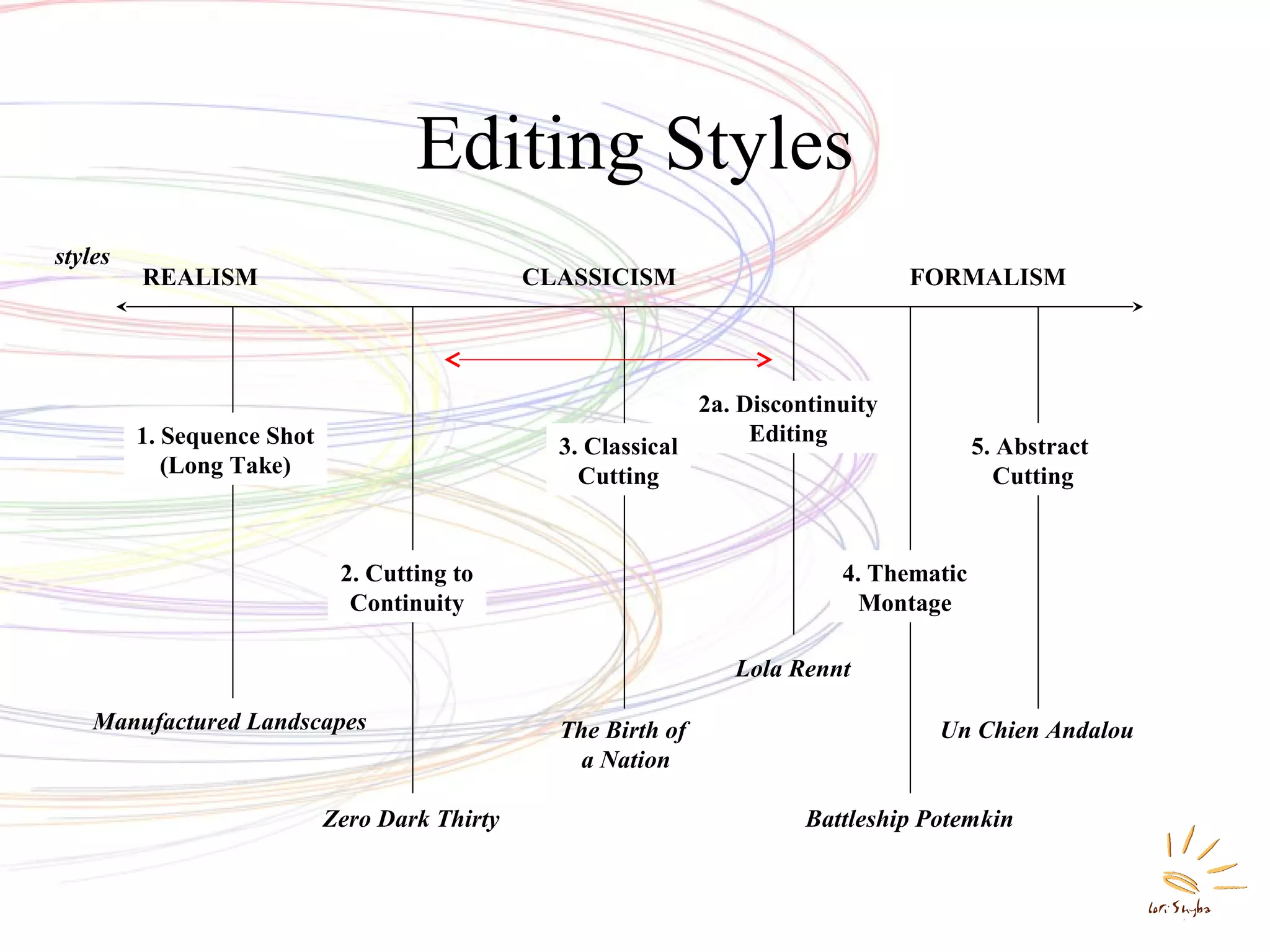
Editing Styles
styles

REALISM

CLASSICISM

1. Sequence Shot
(Long Take)

3. Classical
Cutting

2. Cutting to
Continuity

FORMALISM

2a. Discontinuity
Editing

5. Abstract
Cutting

4. Thematic
Montage
Lola Rennt

Manufactured Landscapes

Zero Dark Thirty

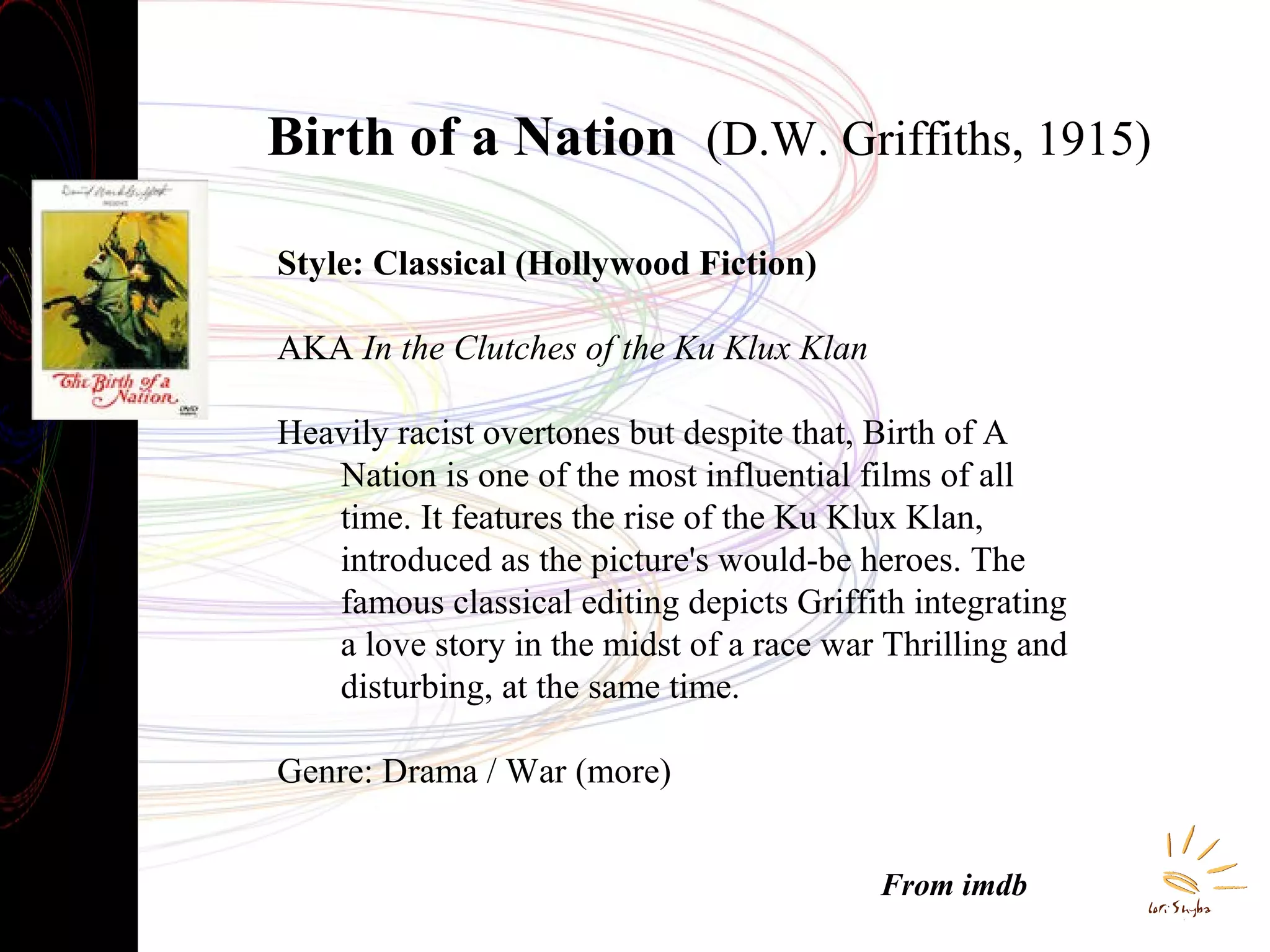
The Birth of
a Nation

Un Chien Andalou

Battleship Potemkin
Editing is an art (of rejection).
•

The basic building block of editing is the
“shot”(clip) and the fundamental tool is the “cut”
(blade).

•

Editing, the basic creative force of film, is the
process by which the editor combines and
coordinates individual shots into a cinematic whole.

•

“Art of rejection.” Not uncommon in Hollywood for
ratio of unused to used footage to be as high as 20 to
1. Apocalypse Now was 100 to 1.
Realism
The Long Take
The Sequence Shot
1. The Long Take (The Sequence Shot)
Sequence Shots contain no editing.
Early cinema relied entirely on “long-take” shot.
“Long Take” is not the same as “long shot.” A “take” is one run
of the camera that records a single shot.

Usually filmmakers use the long take selectively. One scene
will rely heavily on editing, another will be a long take. This
permits the director to associate certain aspects of narrative
form with different stylistic options (usually doco).
Example: Manufactured Landscapes
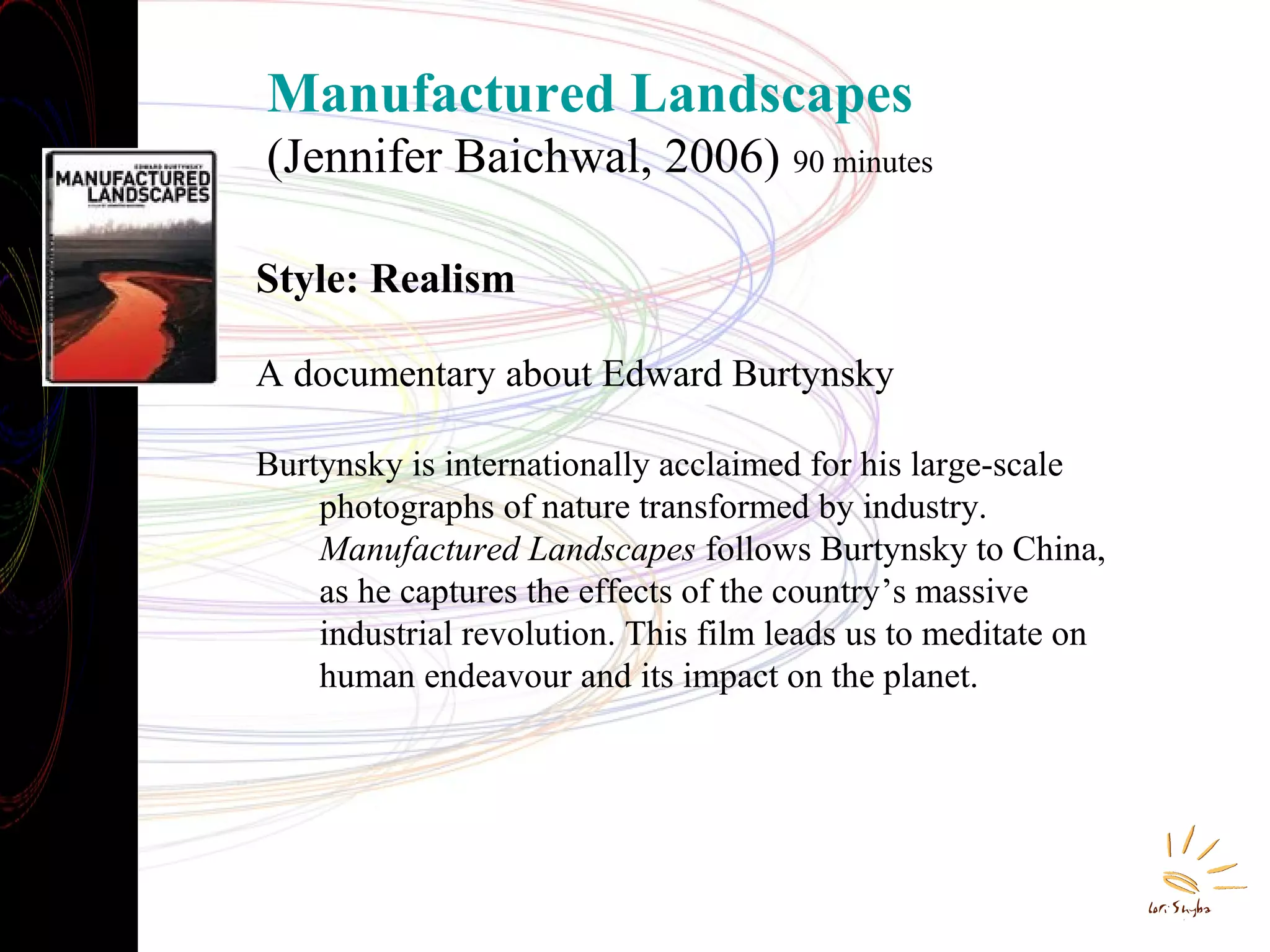
Manufactured Landscapes
(Jennifer Baichwal, 2006) 90 minutes
Style: Realism
A documentary about Edward Burtynsky
Burtynsky is internationally acclaimed for his large-scale
photographs of nature transformed by industry.
Manufactured Landscapes follows Burtynsky to China,
as he captures the effects of the country’s massive
industrial revolution. This film leads us to meditate on
human endeavour and its impact on the planet.
Classicism
Continuity Editing
Classical Editing
Discontinuity Editing
2. Continuity Editing
Temporal Continuity
Ellipses or “Cutting to Continuity” tries to preserve the
fluidity of an event without literally showing all of it.
Cause and effect relationships are clearly set forth.
For example, a 45-minute action might take ten seconds
of screen time yet nothing essential is left out.
“Unobtrusive condensation.”
Spatial Continuity
The 180 Degree Rule
Toward Interactivity …

2a. Dis-Continuity Editing
Temporal and Spatial Discontinuity
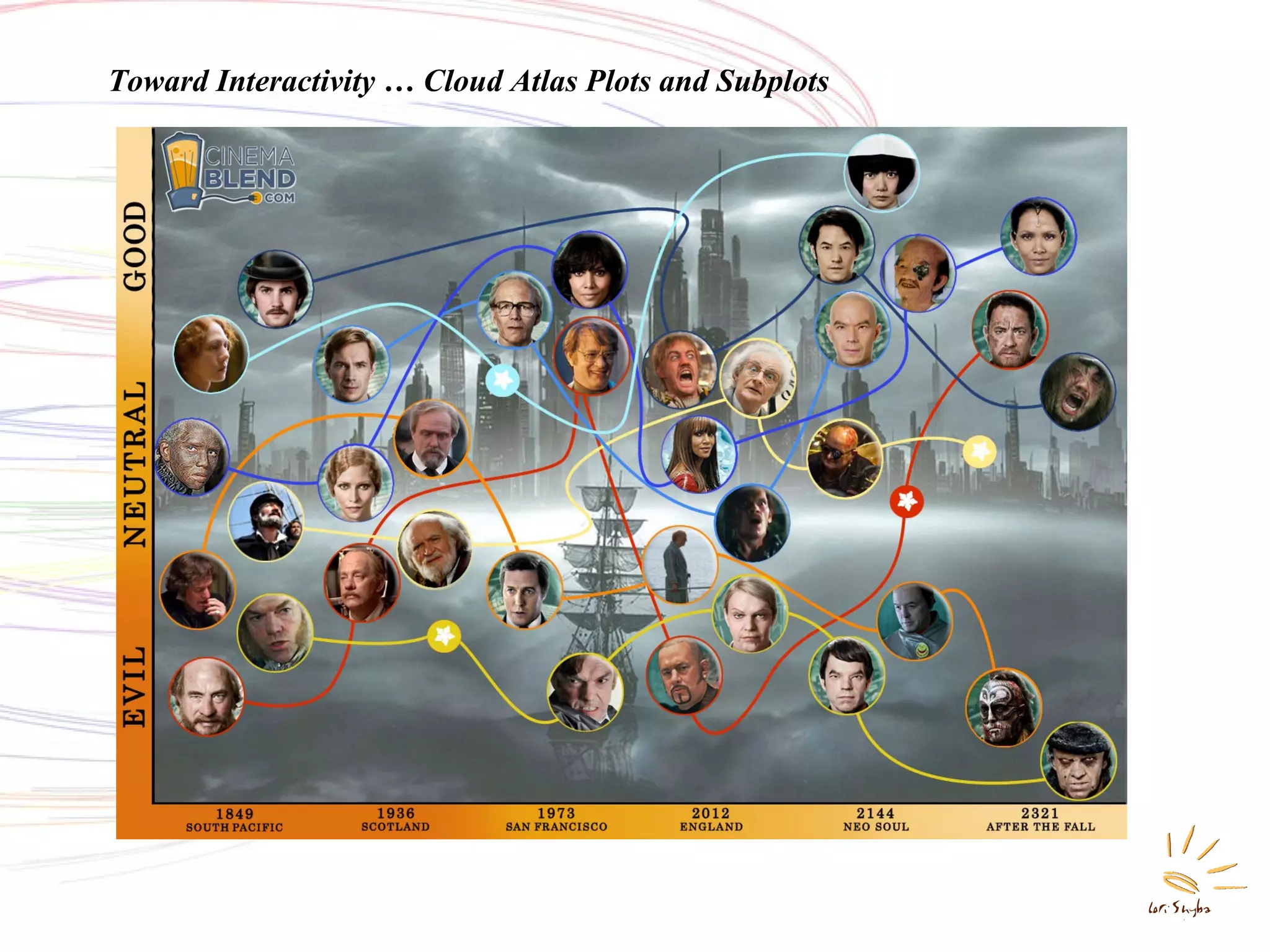
Storyline may weave several complex subplots
Film sequencing may jump around in time.
Flashbacks, flash forwards. (Eg. Cloud Atlas)
Spatial discontinuity suggests creative ways of
letting go of the 180 degree system.
Opens up action for creative uses as interactive
cinema or videogame narrative.
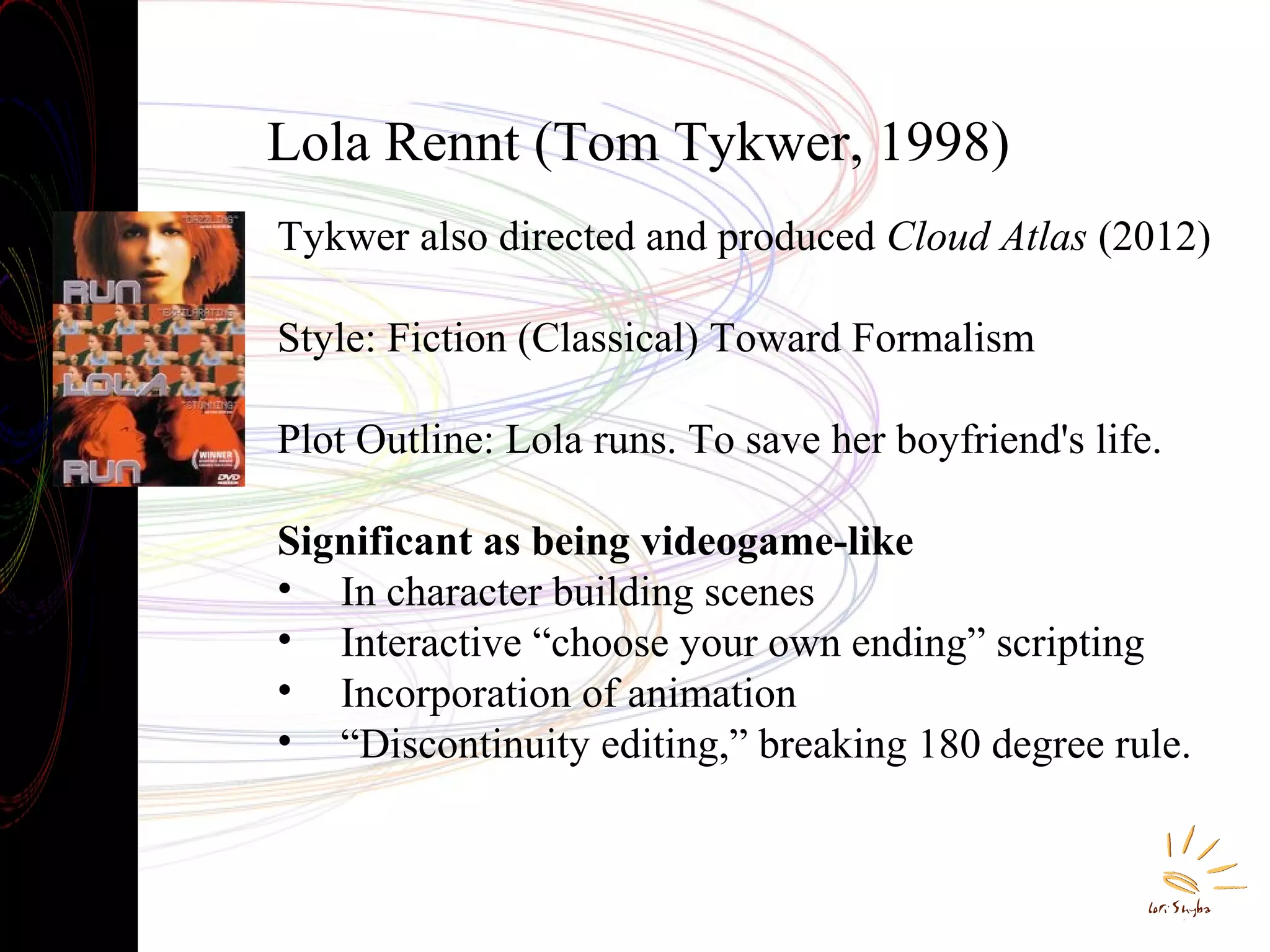
Lola Rennt (Tom Tykwer, 1998)
Tykwer also directed and produced Cloud Atlas (2012)
Style: Fiction (Classical) Toward Formalism
Plot Outline: Lola runs. To save her boyfriend's life.
Significant as being videogame-like
• In character building scenes
• Interactive “choose your own ending” scripting
• Incorporation of animation
• “Discontinuity editing,” breaking 180 degree rule.
Toward Interactivity … Cloud Atlas Plots and Subplots
Classical Editing -- DW Griffiths
Classical editing involves editing for dramatic intensity and
emotional emphasis rather than purely physical reasons.
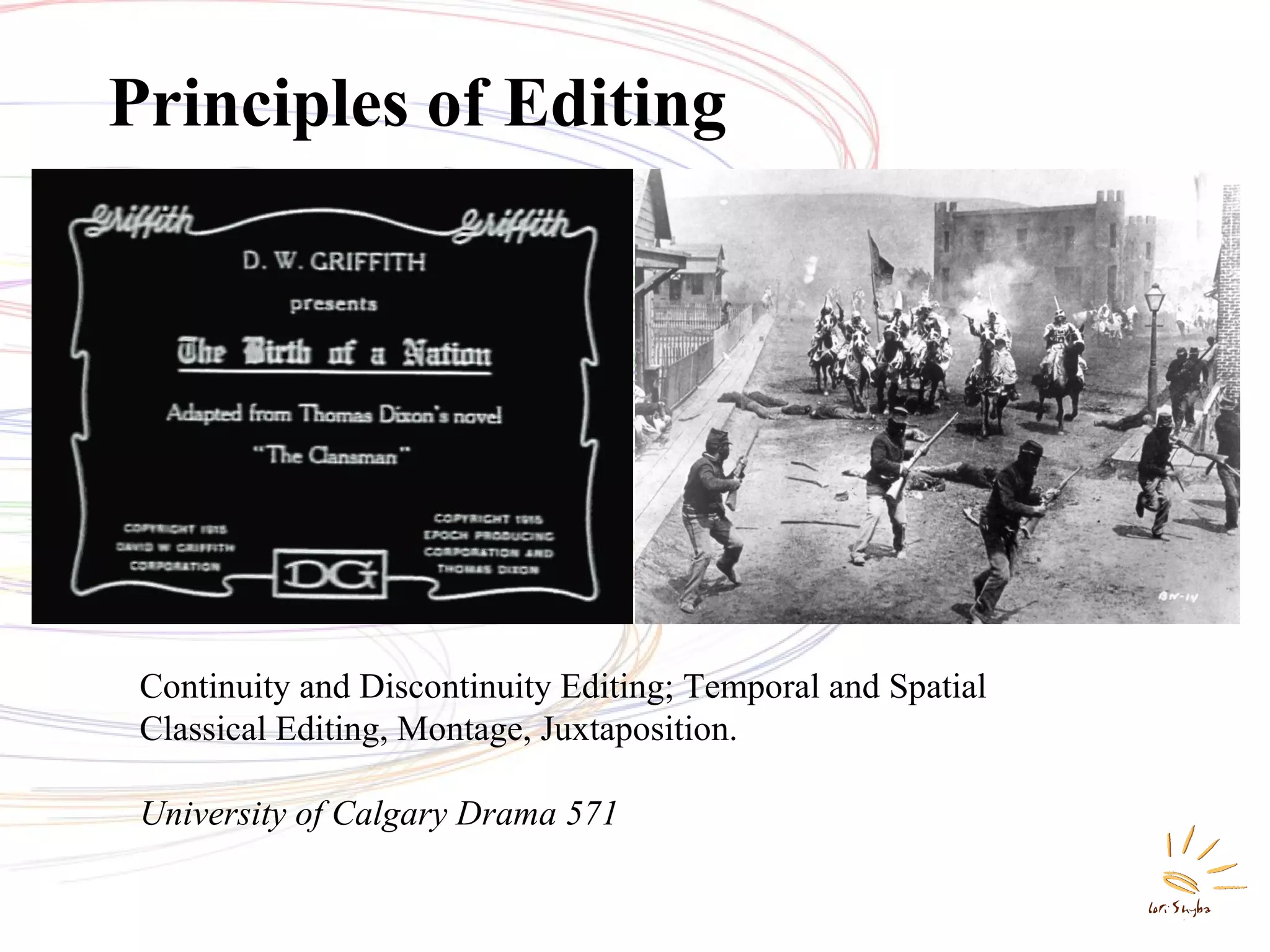
Birth of a Nation (2’48”) by carefully selecting and juxtaposing
long, medium, and close shots, Griffiths constantly shifted
the spectator’s point of view -- consolidating, connecting,
contrasting, paralleling and so on.
The space and time continuum is radically altered “Thematic
montage” that stress the association of ideas.
Also perfected the conventions of the chase making use of
parallel editing-- alternation of shots of one scene with a
different location.
Birth of a Nation (D.W. Griffiths, 1915)
Style: Classical (Hollywood Fiction)
AKA In the Clutches of the Ku Klux Klan
Heavily racist overtones but despite that, Birth of A
Nation is one of the most influential films of all
time. It features the rise of the Ku Klux Klan,
introduced as the picture's would-be heroes. The
famous classical editing depicts Griffith integrating
a love story in the midst of a race war Thrilling and
disturbing, at the same time.
Genre: Drama / War (more)
From imdb
Formalism
(Subjective/Abstract)
Montage
Juxtaposition
Editing Styles

Montage “to assemble”
•

Soviet formalist filmmaker Sergei Eisenstein was interested in
exploring general principles that could be applied to a variety of
apparently different forms of creative activity.

•

He believed the function of artists is to capture a dynamic collision
of opposites -- to incorporate dialectical conflicts not only in the
subject matter of art but its techniques and forms.

•

He felt cinema was most comprehensive of the arts — incorporates
visual conflicts of painting and photography, the kinetic conflicts
of dance, the tonal conflicts of music, the verbal conflicts of
language, and character and action conflicts of fiction and drama.

•

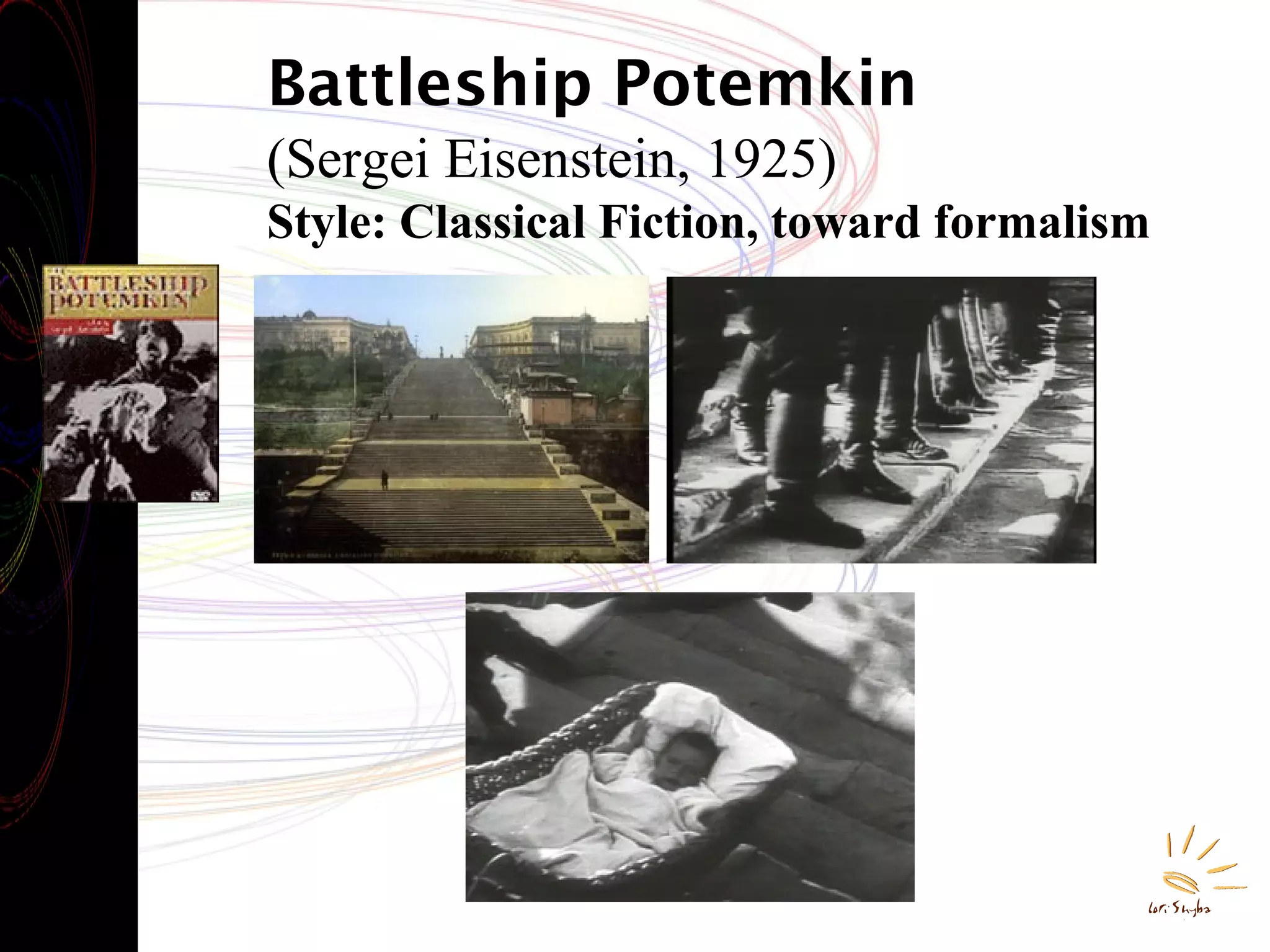
He placed special emphasis on the art of editing. Battleship
Potemkin was conceived as an editing construction and it is most
famous for “The Odessa Steps” scene.
Battleship Potemkin
(Sergei Eisenstein, 1925)
Style: Classical Fiction, toward formalism
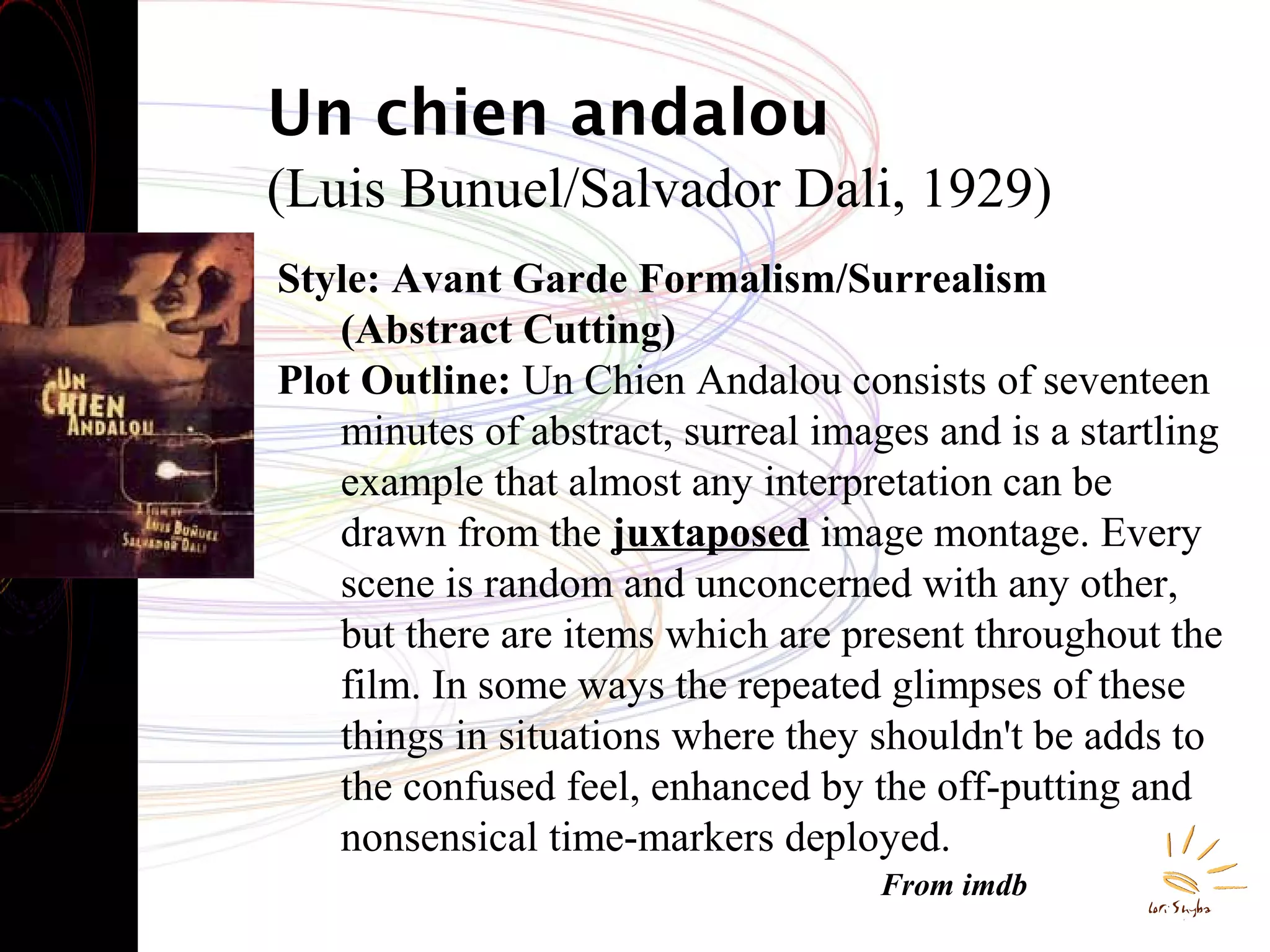
Un chien andalou
(Luis Bunuel/Salvador Dali, 1929)
Style: Avant Garde Formalism/Surrealism
(Abstract Cutting)
Plot Outline: Un Chien Andalou consists of seventeen
minutes of abstract, surreal images and is a startling
example that almost any interpretation can be
drawn from the juxtaposed image montage. Every
scene is random and unconcerned with any other,
but there are items which are present throughout the
film. In some ways the repeated glimpses of these
things in situations where they shouldn't be adds to
the confused feel, enhanced by the off-putting and
nonsensical time-markers deployed.
From imdb

Principles of Editing

  • 1.
    Principles of Editing Continuityand Discontinuity Editing; Temporal and Spatial Classical Editing, Montage, Juxtaposition. University of Calgary Drama 571
  • 2.
    Editing Styles styles REALISM CLASSICISM 1. SequenceShot (Long Take) 3. Classical Cutting 2. Cutting to Continuity FORMALISM 2a. Discontinuity Editing 5. Abstract Cutting 4. Thematic Montage Lola Rennt Manufactured Landscapes Zero Dark Thirty The Birth of a Nation Un Chien Andalou Battleship Potemkin
  • 3.
    Editing is anart (of rejection). • The basic building block of editing is the “shot”(clip) and the fundamental tool is the “cut” (blade). • Editing, the basic creative force of film, is the process by which the editor combines and coordinates individual shots into a cinematic whole. • “Art of rejection.” Not uncommon in Hollywood for ratio of unused to used footage to be as high as 20 to 1. Apocalypse Now was 100 to 1.
  • 4.
  • 5.
    1. The LongTake (The Sequence Shot) Sequence Shots contain no editing. Early cinema relied entirely on “long-take” shot. “Long Take” is not the same as “long shot.” A “take” is one run of the camera that records a single shot. Usually filmmakers use the long take selectively. One scene will rely heavily on editing, another will be a long take. This permits the director to associate certain aspects of narrative form with different stylistic options (usually doco). Example: Manufactured Landscapes
  • 6.
    Manufactured Landscapes (Jennifer Baichwal,2006) 90 minutes Style: Realism A documentary about Edward Burtynsky Burtynsky is internationally acclaimed for his large-scale photographs of nature transformed by industry. Manufactured Landscapes follows Burtynsky to China, as he captures the effects of the country’s massive industrial revolution. This film leads us to meditate on human endeavour and its impact on the planet.
  • 7.
  • 8.
    2. Continuity Editing TemporalContinuity Ellipses or “Cutting to Continuity” tries to preserve the fluidity of an event without literally showing all of it. Cause and effect relationships are clearly set forth. For example, a 45-minute action might take ten seconds of screen time yet nothing essential is left out. “Unobtrusive condensation.” Spatial Continuity The 180 Degree Rule
  • 9.
    Toward Interactivity … 2a.Dis-Continuity Editing Temporal and Spatial Discontinuity Storyline may weave several complex subplots Film sequencing may jump around in time. Flashbacks, flash forwards. (Eg. Cloud Atlas) Spatial discontinuity suggests creative ways of letting go of the 180 degree system. Opens up action for creative uses as interactive cinema or videogame narrative.
  • 10.
    Lola Rennt (TomTykwer, 1998) Tykwer also directed and produced Cloud Atlas (2012) Style: Fiction (Classical) Toward Formalism Plot Outline: Lola runs. To save her boyfriend's life. Significant as being videogame-like • In character building scenes • Interactive “choose your own ending” scripting • Incorporation of animation • “Discontinuity editing,” breaking 180 degree rule.
  • 11.
    Toward Interactivity …Cloud Atlas Plots and Subplots
  • 12.
    Classical Editing --DW Griffiths Classical editing involves editing for dramatic intensity and emotional emphasis rather than purely physical reasons. Birth of a Nation (2’48”) by carefully selecting and juxtaposing long, medium, and close shots, Griffiths constantly shifted the spectator’s point of view -- consolidating, connecting, contrasting, paralleling and so on. The space and time continuum is radically altered “Thematic montage” that stress the association of ideas. Also perfected the conventions of the chase making use of parallel editing-- alternation of shots of one scene with a different location.
  • 13.
    Birth of aNation (D.W. Griffiths, 1915) Style: Classical (Hollywood Fiction) AKA In the Clutches of the Ku Klux Klan Heavily racist overtones but despite that, Birth of A Nation is one of the most influential films of all time. It features the rise of the Ku Klux Klan, introduced as the picture's would-be heroes. The famous classical editing depicts Griffith integrating a love story in the midst of a race war Thrilling and disturbing, at the same time. Genre: Drama / War (more) From imdb
  • 14.
  • 15.
    Editing Styles Montage “toassemble” • Soviet formalist filmmaker Sergei Eisenstein was interested in exploring general principles that could be applied to a variety of apparently different forms of creative activity. • He believed the function of artists is to capture a dynamic collision of opposites -- to incorporate dialectical conflicts not only in the subject matter of art but its techniques and forms. • He felt cinema was most comprehensive of the arts — incorporates visual conflicts of painting and photography, the kinetic conflicts of dance, the tonal conflicts of music, the verbal conflicts of language, and character and action conflicts of fiction and drama. • He placed special emphasis on the art of editing. Battleship Potemkin was conceived as an editing construction and it is most famous for “The Odessa Steps” scene.
  • 16.
    Battleship Potemkin (Sergei Eisenstein,1925) Style: Classical Fiction, toward formalism
  • 17.
    Un chien andalou (LuisBunuel/Salvador Dali, 1929) Style: Avant Garde Formalism/Surrealism (Abstract Cutting) Plot Outline: Un Chien Andalou consists of seventeen minutes of abstract, surreal images and is a startling example that almost any interpretation can be drawn from the juxtaposed image montage. Every scene is random and unconcerned with any other, but there are items which are present throughout the film. In some ways the repeated glimpses of these things in situations where they shouldn't be adds to the confused feel, enhanced by the off-putting and nonsensical time-markers deployed. From imdb

Editor's Notes