Principles of
editing
§ History
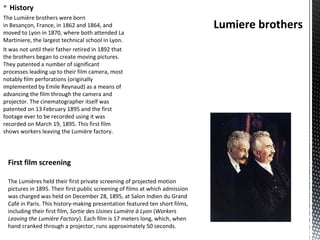
The Lumière brothers were born
in Besançon, France, in 1862 and 1864, and
moved to Lyon in 1870, where both attended La
Martiniere, the largest technical school in Lyon.
It was not until their father retired in 1892 that
the brothers began to create moving pictures.
They patented a number of significant
processes leading up to their film camera, most
notably film perforations (originally
implemented by Emile Reynaud) as a means of
advancing the film through the camera and
projector. The cinematographer itself was
patented on 13 February 1895 and the first
footage ever to be recorded using it was
recorded on March 19, 1895. This first film
shows workers leaving the Lumière factory.
Lumiere brothers
The Lumières held their first private screening of projected motion
pictures in 1895. Their first public screening of films at which admission
was charged was held on December 28, 1895, at Salon Indien du Grand
Café in Paris. This history-making presentation featured ten short films,
including their first film, Sortie des Usines Lumière à Lyon (Workers
Leaving the Lumière Factory). Each film is 17 meters long, which, when
hand cranked through a projector, runs approximately 50 seconds.
First film screening
§ History
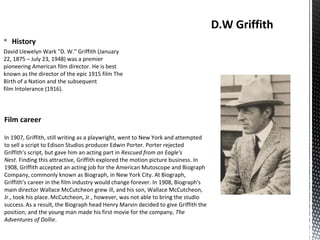
David Llewelyn Wark "D. W." Griffith (January
22, 1875 – July 23, 1948) was a premier
pioneering American film director. He is best
known as the director of the epic 1915 film The
Birth of a Nation and the subsequent
film Intolerance (1916).
D.W Griffith
Film career
In 1907, Griffith, still writing as a playwright, went to New York and attempted
to sell a script to Edison Studios producer Edwin Porter. Porter rejected
Griffith's script, but gave him an acting part in Rescued from an Eagle's
Nest. Finding this attractive, Griffith explored the motion picture business. In
1908, Griffith accepted an acting job for the American Mutoscope and Biograph
Company, commonly known as Biograph, in New York City. At Biograph,
Griffith's career in the film industry would change forever. In 1908, Biograph's
main director Wallace McCutcheon grew ill, and his son, Wallace McCutcheon,
Jr., took his place. McCutcheon, Jr., however, was not able to bring the studio
success. As a result, the Biograph head Henry Marvin decided to give Griffith the
position; and the young man made his first movie for the company, The
Adventures of Dollie.
§ History
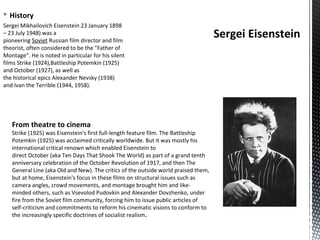
Sergei Mikhailovich Eisenstein 23 January 1898
– 23 July 1948) was a
pioneering Soviet Russian film director and film
theorist, often considered to be the "Father of
Montage". He is noted in particular for his silent
films Strike (1924),Battleship Potemkin (1925)
and October (1927), as well as
the historical epics Alexander Nevsky (1938)
and Ivan the Terrible (1944, 1958).
Sergei Eisenstein
From theatre to cinema
Strike (1925) was Eisenstein's first full-length feature film. The Battleship
Potemkin (1925) was acclaimed critically worldwide. But it was mostly his
international critical renown which enabled Eisenstein to
direct October (aka Ten Days That Shook The World) as part of a grand tenth
anniversary celebration of the October Revolution of 1917, and then The
General Line (aka Old and New). The critics of the outside world praised them,
but at home, Eisenstein's focus in these films on structural issues such as
camera angles, crowd movements, and montage brought him and like-
minded others, such as Vsevolod Pudovkin and Alexander Dovzhenko, under
fire from the Soviet film community, forcing him to issue public articles of
self-criticism and commitments to reform his cinematic visions to conform to
the increasingly specific doctrines of socialist realism.
§ History
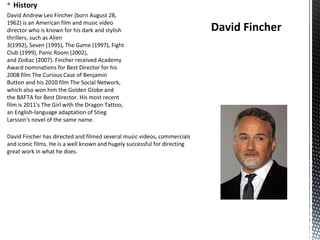
David Andrew Leo Fincher (born August 28,
1962) is an American film and music video
director who is known for his dark and stylish
thrillers, such as Alien
3(1992), Seven (1995), The Game (1997), Fight
Club (1999), Panic Room (2002),
and Zodiac (2007). Fincher received Academy
Award nominations for Best Director for his
2008 film The Curious Case of Benjamin
Button and his 2010 film The Social Network,
which also won him the Golden Globe and
the BAFTA for Best Director. His most recent
film is 2011's The Girl with the Dragon Tattoo,
an English-language adaptation of Stieg
Larsson's novel of the same name.
David Fincher
David Fincher has directed and filmed several music videos, commercials
and iconic films. He is a well known and hugely successful for directing
great work in what he does.
Principles of
editing
.2
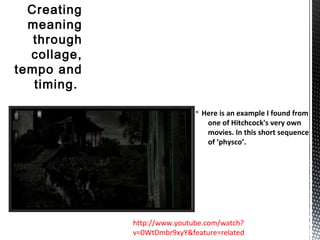
§ Here is an example I found from
one of Hitchcock's very own
movies. In this short sequence
of ‘physco’.
Creating
meaning
through
collage,
tempo and
timing.
http://www.youtube.com/watch?
v=0WtDmbr9xyY&feature=related
Temp
o
Tempo is usually supposed as Music . Tempo can be seen as the rhythm or beat
within a music field. Within terms of media tempo plays a huge part when
editing. I personally believe that music creates the scene it can make it or break
it. Music can change people views and emotions. Classic examples that are
always being used that you wouldn’t realize first time is sad slow depressing
music plays when the director wants you to feel sad/guilty in a scene. The tempo
of the music is deliberate and done to increase your involvement in the film.
Shot
transitions
There are several ways editors can change the tempo of any
sequence. One of which can be done by shot transitions which can
help create an effect on the audience.
Soft transitions are used quite a lot in reality TV programmes as
well as soap operas. These shot transitions make the scene run
more smoothly as it changes. This is sometimes known as a cut
from A to B. example:
http://www.youtube.com/watch?v=1qo2aREmHOc
§ Definition of Montage
The technique of combining in a single composition pictorial elements
from various sources, as parts of different photographs or fragments of
printing, either to give the illusion that the elements belonged together
originally or to allow each element to retain its separate identity as a
means of adding interest or meaning to the composition.
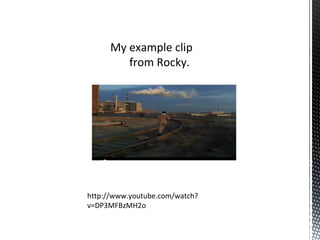
My example clip
from Rocky.
http://www.youtube.com/watch?
v=DP3MFBzMH2o
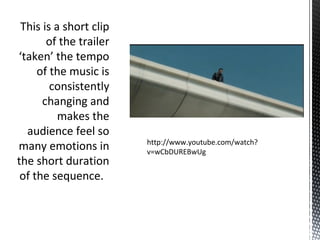
This is a short clip
of the trailer
‘taken’ the tempo
of the music is
consistently
changing and
makes the
audience feel so
many emotions in
the short duration
of the sequence.
http://www.youtube.com/watch?
v=wCbDUREBwUg
§ a synchronizing of the various parts of a production for
theatrical effect.
§ Timing creates dramatic effect for the audiences pure
entertainment and benefit.
§ Timing is one of the most important parts of editing. The
scene of shot wont fit right with voiceovers or SFX if it not
all synchronized in time. It will look unprofessional
otherwise.
Timing
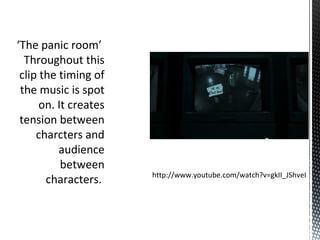
‘The panic room’
Throughout this
clip the timing of
the music is spot
on. It creates
tension between
charcters and
audience
between
characters. http://www.youtube.com/watch?v=gkII_JShveI
Story: Centred editing and the construction
of meaning
Editing and
spaces
In editing and camera techniques editing and spaces causes an effect of the
audiences perception of the film. One example you tend to see in every film
is cross cutting between this technique.
For example; If two people were stranded on a desert island having a
conversation we would see ELS and establishing shots almost every second.
This is done so the audience know where they are how far they are. This
makes the audience make up their mind on the matter, whereas if there two
people having a conversation in a café the camera man would most probably
use shorter shots using ECU mid shots and over shoulder shots mostly. To
emphasise that they're in a small crowded place. This also links with location
of setting.
§ Shot reverse shot is a shot type particularly used when a
conversation is happening. You see this in almost every soap
opera! It is good for TV series such as soap operas as during the
length of the show the audience understands the character a lot
more just from seeing shots of them over and over again.
§ In romantic films shot reverse shot is used between partners as it
allows the audience to see both emotions from the characters
expressing themselves.
§
§ This is an example of shot reverse shot
http://www.youtube.com/watch?v=QLkUHZ1qips
Shot reverse shot
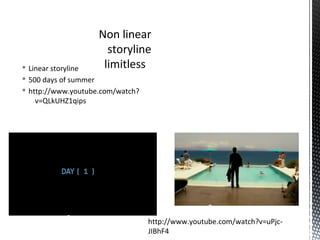
§ Linear storyline
§ 500 days of summer
§ http://www.youtube.com/watch?
v=QLkUHZ1qips
Non linear
storyline
limitless
http://www.youtube.com/watch?v=uPjc-
JIBhF4
Arranging the
order of events
Traditionally the arrangements of any film sequence is; intro,
beginning, middle, end.
In some movies these arrangements are slightly altered that are
done to help the audience understand the film script.
They are called linear and non linear narratives.
§ An eye line match is a camera shot
used to make the audience see
what the characters are seeing.
It’s good to use in action films,
and example of this could be if
someone was drunk. The camera
would change shot to exactly
what the character is seeing.
During post production editors
may alter the contrast and digital
effect to blurry.
Eye line match
§ A great example of a cut away
would be from the film ‘U turn’
by ‘Oliver Stone’.
§ A cutway changes the shot types
without loosing hold of a current
situation, which could be a
conversation. A cutaway could
be used when two or more
people are doing something
completely different but the
camera keep repeating each
scene.
Cutaways
Creating meaning
outside the story
§Continuity is the method of trimming
unnecesary footage from what
would be a very long shot and only
using the most key parts to keep the
movement of the film engaging and
thrilling . This also involves keeping
the visuals of the sequence
consistent at all times this may
include things such as; lighting,
props, wardrobe etc.
Continuity
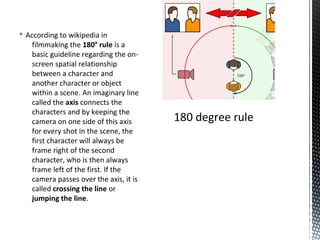
§ According to wikipedia in
filmmaking the 180° rule is a
basic guideline regarding the on-
screen spatial relationship
between a character and
another character or object
within a scene. An imaginary line
called the axis connects the
characters and by keeping the
camera on one side of this axis
for every shot in the scene, the
first character will always be
frame right of the second
character, who is then always
frame left of the first. If the
camera passes over the axis, it is
called crossing the line or
jumping the line.
180 degree rule
§ Soviet montage theory is an
approach to understanding and
creating cinema that relies
heavily upon editing
§ Eisenstein's view that "montage is
an idea that arises from the
collision of independent
thoughts" wherein "each
sequential element is perceived
not next to the other, but on top
of the other" has become most
widely accepted
Soviet montage

Principles of editing 2

  • 1.
  • 2.
    § History The Lumièrebrothers were born in Besançon, France, in 1862 and 1864, and moved to Lyon in 1870, where both attended La Martiniere, the largest technical school in Lyon. It was not until their father retired in 1892 that the brothers began to create moving pictures. They patented a number of significant processes leading up to their film camera, most notably film perforations (originally implemented by Emile Reynaud) as a means of advancing the film through the camera and projector. The cinematographer itself was patented on 13 February 1895 and the first footage ever to be recorded using it was recorded on March 19, 1895. This first film shows workers leaving the Lumière factory. Lumiere brothers The Lumières held their first private screening of projected motion pictures in 1895. Their first public screening of films at which admission was charged was held on December 28, 1895, at Salon Indien du Grand Café in Paris. This history-making presentation featured ten short films, including their first film, Sortie des Usines Lumière à Lyon (Workers Leaving the Lumière Factory). Each film is 17 meters long, which, when hand cranked through a projector, runs approximately 50 seconds. First film screening
  • 3.
    § History David LlewelynWark "D. W." Griffith (January 22, 1875 – July 23, 1948) was a premier pioneering American film director. He is best known as the director of the epic 1915 film The Birth of a Nation and the subsequent film Intolerance (1916). D.W Griffith Film career In 1907, Griffith, still writing as a playwright, went to New York and attempted to sell a script to Edison Studios producer Edwin Porter. Porter rejected Griffith's script, but gave him an acting part in Rescued from an Eagle's Nest. Finding this attractive, Griffith explored the motion picture business. In 1908, Griffith accepted an acting job for the American Mutoscope and Biograph Company, commonly known as Biograph, in New York City. At Biograph, Griffith's career in the film industry would change forever. In 1908, Biograph's main director Wallace McCutcheon grew ill, and his son, Wallace McCutcheon, Jr., took his place. McCutcheon, Jr., however, was not able to bring the studio success. As a result, the Biograph head Henry Marvin decided to give Griffith the position; and the young man made his first movie for the company, The Adventures of Dollie.
  • 4.
    § History Sergei MikhailovichEisenstein 23 January 1898 – 23 July 1948) was a pioneering Soviet Russian film director and film theorist, often considered to be the "Father of Montage". He is noted in particular for his silent films Strike (1924),Battleship Potemkin (1925) and October (1927), as well as the historical epics Alexander Nevsky (1938) and Ivan the Terrible (1944, 1958). Sergei Eisenstein From theatre to cinema Strike (1925) was Eisenstein's first full-length feature film. The Battleship Potemkin (1925) was acclaimed critically worldwide. But it was mostly his international critical renown which enabled Eisenstein to direct October (aka Ten Days That Shook The World) as part of a grand tenth anniversary celebration of the October Revolution of 1917, and then The General Line (aka Old and New). The critics of the outside world praised them, but at home, Eisenstein's focus in these films on structural issues such as camera angles, crowd movements, and montage brought him and like- minded others, such as Vsevolod Pudovkin and Alexander Dovzhenko, under fire from the Soviet film community, forcing him to issue public articles of self-criticism and commitments to reform his cinematic visions to conform to the increasingly specific doctrines of socialist realism.
  • 5.
    § History David AndrewLeo Fincher (born August 28, 1962) is an American film and music video director who is known for his dark and stylish thrillers, such as Alien 3(1992), Seven (1995), The Game (1997), Fight Club (1999), Panic Room (2002), and Zodiac (2007). Fincher received Academy Award nominations for Best Director for his 2008 film The Curious Case of Benjamin Button and his 2010 film The Social Network, which also won him the Golden Globe and the BAFTA for Best Director. His most recent film is 2011's The Girl with the Dragon Tattoo, an English-language adaptation of Stieg Larsson's novel of the same name. David Fincher David Fincher has directed and filmed several music videos, commercials and iconic films. He is a well known and hugely successful for directing great work in what he does.
  • 6.
  • 7.
    § Here isan example I found from one of Hitchcock's very own movies. In this short sequence of ‘physco’. Creating meaning through collage, tempo and timing. http://www.youtube.com/watch? v=0WtDmbr9xyY&feature=related
  • 8.
    Temp o Tempo is usuallysupposed as Music . Tempo can be seen as the rhythm or beat within a music field. Within terms of media tempo plays a huge part when editing. I personally believe that music creates the scene it can make it or break it. Music can change people views and emotions. Classic examples that are always being used that you wouldn’t realize first time is sad slow depressing music plays when the director wants you to feel sad/guilty in a scene. The tempo of the music is deliberate and done to increase your involvement in the film.
  • 9.
    Shot transitions There are severalways editors can change the tempo of any sequence. One of which can be done by shot transitions which can help create an effect on the audience. Soft transitions are used quite a lot in reality TV programmes as well as soap operas. These shot transitions make the scene run more smoothly as it changes. This is sometimes known as a cut from A to B. example: http://www.youtube.com/watch?v=1qo2aREmHOc
  • 10.
    § Definition ofMontage The technique of combining in a single composition pictorial elements from various sources, as parts of different photographs or fragments of printing, either to give the illusion that the elements belonged together originally or to allow each element to retain its separate identity as a means of adding interest or meaning to the composition.
  • 11.
    My example clip fromRocky. http://www.youtube.com/watch? v=DP3MFBzMH2o
  • 12.
    This is ashort clip of the trailer ‘taken’ the tempo of the music is consistently changing and makes the audience feel so many emotions in the short duration of the sequence. http://www.youtube.com/watch? v=wCbDUREBwUg
  • 13.
    § a synchronizingof the various parts of a production for theatrical effect. § Timing creates dramatic effect for the audiences pure entertainment and benefit. § Timing is one of the most important parts of editing. The scene of shot wont fit right with voiceovers or SFX if it not all synchronized in time. It will look unprofessional otherwise. Timing
  • 14.
    ‘The panic room’ Throughoutthis clip the timing of the music is spot on. It creates tension between charcters and audience between characters. http://www.youtube.com/watch?v=gkII_JShveI
  • 15.
    Story: Centred editingand the construction of meaning
  • 16.
    Editing and spaces In editingand camera techniques editing and spaces causes an effect of the audiences perception of the film. One example you tend to see in every film is cross cutting between this technique. For example; If two people were stranded on a desert island having a conversation we would see ELS and establishing shots almost every second. This is done so the audience know where they are how far they are. This makes the audience make up their mind on the matter, whereas if there two people having a conversation in a café the camera man would most probably use shorter shots using ECU mid shots and over shoulder shots mostly. To emphasise that they're in a small crowded place. This also links with location of setting.
  • 17.
    § Shot reverseshot is a shot type particularly used when a conversation is happening. You see this in almost every soap opera! It is good for TV series such as soap operas as during the length of the show the audience understands the character a lot more just from seeing shots of them over and over again. § In romantic films shot reverse shot is used between partners as it allows the audience to see both emotions from the characters expressing themselves. § § This is an example of shot reverse shot http://www.youtube.com/watch?v=QLkUHZ1qips Shot reverse shot
  • 18.
    § Linear storyline §500 days of summer § http://www.youtube.com/watch? v=QLkUHZ1qips Non linear storyline limitless http://www.youtube.com/watch?v=uPjc- JIBhF4
  • 19.
    Arranging the order ofevents Traditionally the arrangements of any film sequence is; intro, beginning, middle, end. In some movies these arrangements are slightly altered that are done to help the audience understand the film script. They are called linear and non linear narratives.
  • 20.
    § An eyeline match is a camera shot used to make the audience see what the characters are seeing. It’s good to use in action films, and example of this could be if someone was drunk. The camera would change shot to exactly what the character is seeing. During post production editors may alter the contrast and digital effect to blurry. Eye line match
  • 21.
    § A greatexample of a cut away would be from the film ‘U turn’ by ‘Oliver Stone’. § A cutway changes the shot types without loosing hold of a current situation, which could be a conversation. A cutaway could be used when two or more people are doing something completely different but the camera keep repeating each scene. Cutaways
  • 22.
  • 23.
    §Continuity is themethod of trimming unnecesary footage from what would be a very long shot and only using the most key parts to keep the movement of the film engaging and thrilling . This also involves keeping the visuals of the sequence consistent at all times this may include things such as; lighting, props, wardrobe etc. Continuity
  • 24.
    § According towikipedia in filmmaking the 180° rule is a basic guideline regarding the on- screen spatial relationship between a character and another character or object within a scene. An imaginary line called the axis connects the characters and by keeping the camera on one side of this axis for every shot in the scene, the first character will always be frame right of the second character, who is then always frame left of the first. If the camera passes over the axis, it is called crossing the line or jumping the line. 180 degree rule
  • 25.
    § Soviet montagetheory is an approach to understanding and creating cinema that relies heavily upon editing § Eisenstein's view that "montage is an idea that arises from the collision of independent thoughts" wherein "each sequential element is perceived not next to the other, but on top of the other" has become most widely accepted Soviet montage