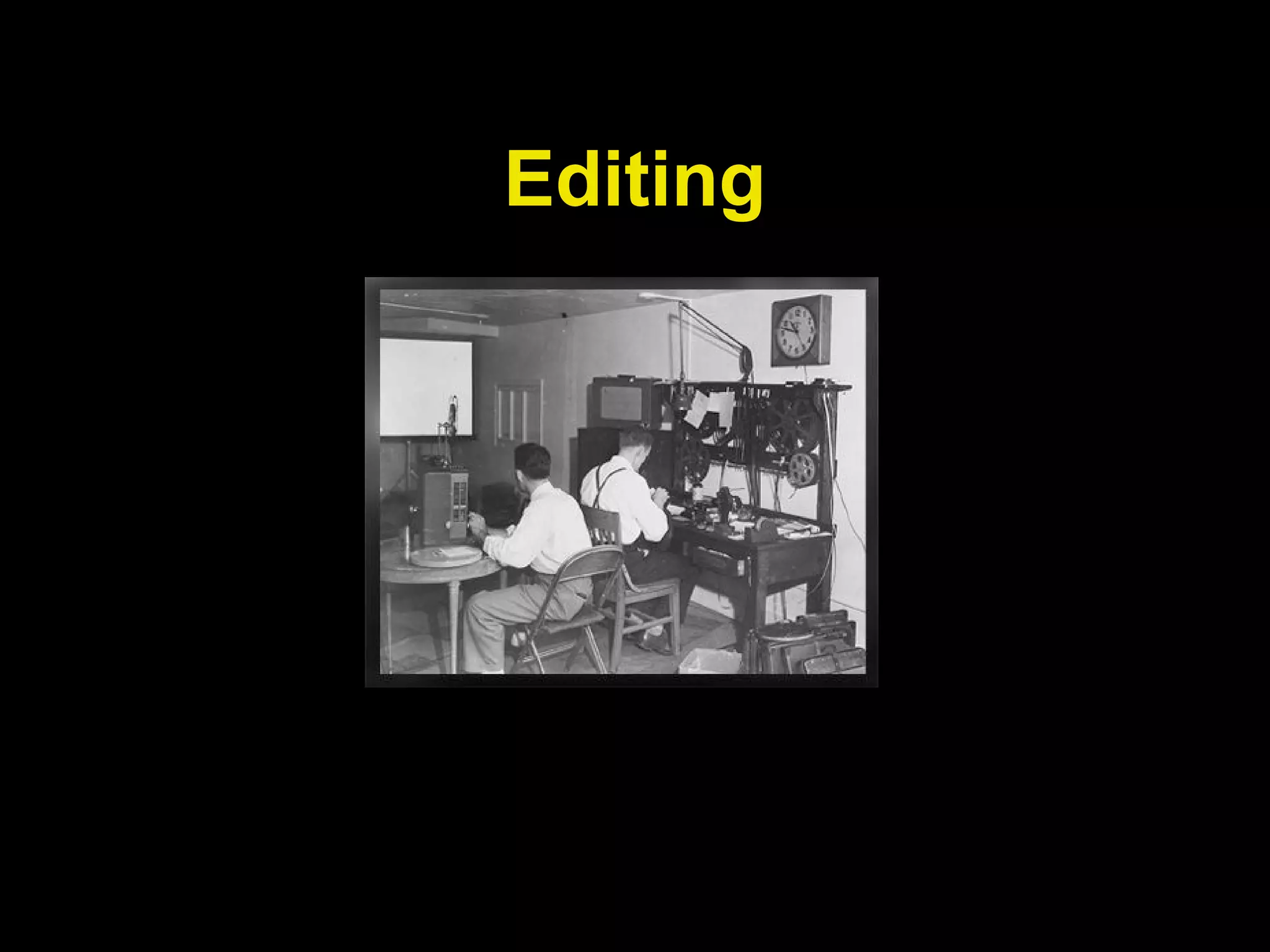
Editing
CUT
CUT
Is the joining of two separate shots
CUT
Is the joining of two separate shots
So that the first shot is instantaneously
replaced by the second
HISTORICAL AND AESTHETIC
DEVELOPMENTS IN EDITING
HISTORICAL AND AESTHETIC
DEVELOPMENTS IN EDITING
MID 1890s
HISTORICAL AND AESTHETIC
DEVELOPMENTS IN EDITING
MID 1890s
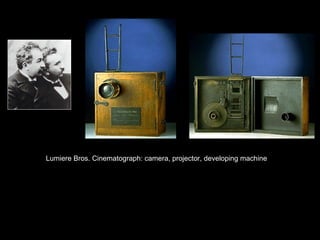
- Lumiere Brothers invented the Cinematograph
Lumiere Bros. Cinematograph: camera, projector, developing machine
HISTORICAL AND AESTHETIC
DEVELOPMENTS IN EDITING
MID 1890s
- Lumiere Brothers invented the Cinematograph
- Lumiere Bros. (Auguste & Louis) early films
contained no editing
HISTORICAL AND AESTHETIC
DEVELOPMENTS IN EDITING
MID 1890s
- Lumiere Brothers invented the Cinematograph
- Lumiere Bros. (Auguste & Louis) early films
contained no editing
- Single-shot recordings (sequence shots)
HISTORICAL AND AESTHETIC
DEVELOPMENTS IN EDITING
MID 1890s
- Lumiere Brothers invented the Cinematograph
- Lumiere Bros. (Auguste & Louis) early films
contained no editing
- Single-shot recordings (sequence shots)
- Lasted the duration of one roll of film (1-2 minutes)
HISTORICAL AND AESTHETIC
DEVELOPMENTS IN EDITING
MID 1890s
- Lumiere Brothers invented the Cinematograph
- Lumiere Bros. (Auguste & Louis) early films
contained no editing
- Single-shot recordings (sequence shots)
- Lasted the duration of one roll of film (1-2 minutes)
-The duration of the shots and the event were equal
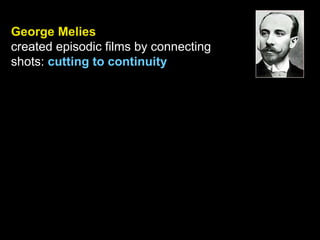
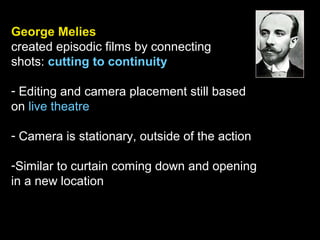
George Melies
created episodic films by connecting
shots: cutting to continuity
George Melies
created episodic films by connecting
shots: cutting to continuity
- Editing and camera placement still based
on live theatre
George Melies
created episodic films by connecting
shots: cutting to continuity
- Editing and camera placement still based
on live theatre
- Camera is stationary, outside of the action
George Melies
created episodic films by connecting
shots: cutting to continuity
- Editing and camera placement still based
on live theatre
- Camera is stationary, outside of the action
-Similar to curtain coming down and opening
in a new location
“Continuity cutting tries to preserve the
fluidity of an event without literally
showing all of it” (Giannetti)
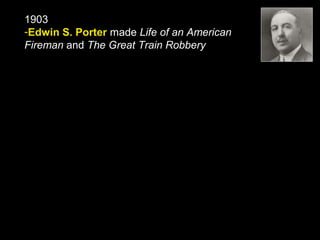
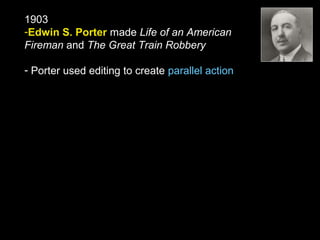
1903
-Edwin S. Porter made Life of an American
Fireman and The Great Train Robbery
1903
-Edwin S. Porter made Life of an American
Fireman and The Great Train Robbery
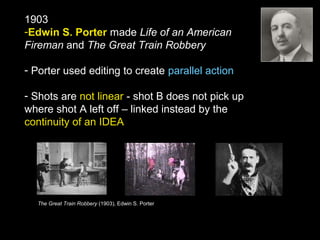
- Porter used editing to create parallel action
1903
-Edwin S. Porter made Life of an American
Fireman and The Great Train Robbery
- Porter used editing to create parallel action
- Shots are not linear - shot B does not pick up
where shot A left off – linked instead by the
continuity of an IDEA
The Great Train Robbery (1903), Edwin S. Porter
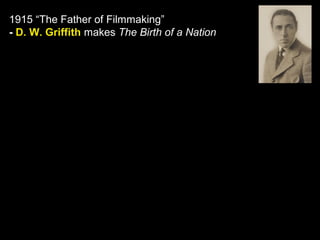
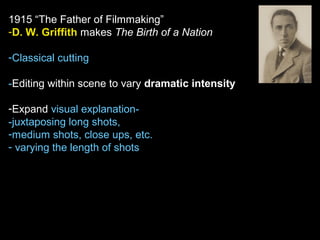
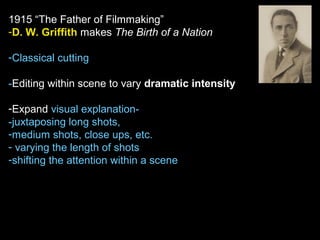
1915 “The Father of Filmmaking”
- D. W. Griffith makes The Birth of a Nation
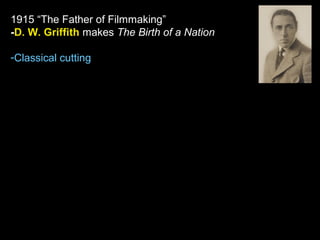
1915 “The Father of Filmmaking”
-D. W. Griffith makes The Birth of a Nation
-Classical cutting
1915 “The Father of Filmmaking”
-D. W. Griffith makes The Birth of a Nation
-Classical cutting
-Editing within scene to vary dramatic intensity
1915 “The Father of Filmmaking”
-D. W. Griffith makes The Birth of a Nation
-Classical cutting
-Editing within scene to vary dramatic intensity
-Expand visual explanation-
1915 “The Father of Filmmaking”
-D. W. Griffith makes The Birth of a Nation
-Classical cutting
-Editing within scene to vary dramatic intensity
-Expand visual explanation-
-juxtaposing long shots,
1915 “The Father of Filmmaking”
-D. W. Griffith makes The Birth of a Nation
-Classical cutting
-Editing within scene to vary dramatic intensity
-Expand visual explanation-
-juxtaposing long shots,
-medium shots, close ups, etc.
1915 “The Father of Filmmaking”
-D. W. Griffith makes The Birth of a Nation
-Classical cutting
-Editing within scene to vary dramatic intensity
-Expand visual explanation-
-juxtaposing long shots,
-medium shots, close ups, etc.
- varying the length of shots
1915 “The Father of Filmmaking”
-D. W. Griffith makes The Birth of a Nation
-Classical cutting
-Editing within scene to vary dramatic intensity
-Expand visual explanation-
-juxtaposing long shots,
-medium shots, close ups, etc.
- varying the length of shots
-shifting the attention within a scene
CONTINUITY EDITING:
CONTINUITY EDITING:
Designed to make editing INVISIBLE
CONTINUITY EDITING:
Designed to make editing INVISIBLE
- cutting on action: action begins in one shot and ends in
another
CONTINUITY EDITING:
Designed to make editing INVISIBLE
- cutting on action: action begins in one shot and ends in
another
- cutting on dialogue: motivated by whoever is
talking (or listening)
CONTINUITY EDITING:
Designed to make editing INVISIBLE
- cutting on action: action begins in one shot and ends in
another
- cutting on dialogue: motivated by whoever is
talking (or listening)
- cut on the glance: edit follows the eyes of a character
CONTINUITY EDITING:
Master shot: A long shot of the entire action without
cuts.
CONTINUITY EDITING:
Master shot: A long shot of the entire action without
cuts.
The action is then repeated a number to times using
medium shots, close ups, etc.
CONTINUITY EDITING:
Master shot: A long shot of the entire action without
cuts.
The action is then repeated a number to times using
medium shots, close ups, etc.
Without a master shot editors many not have
adequate footage
This end the 1st
part of the
editing lecture
• The slides after this will be covered in
the second week of editing.
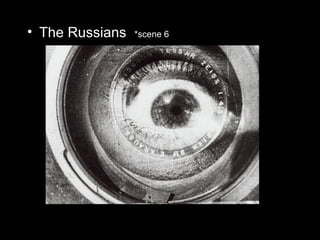
• The Russians *scene 6
Moscow Film School used film as
propaganda
Moscow Film School used film as
propaganda
Their editing style was in direct
opposition to American classical cutting
Moscow Film School used film as
propaganda
Their editing style was in direct
opposition to American classical cutting
Soviets believed that the power was in
the juxtaposition
Moscow Film School used film as
propaganda
Their editing style was in direct
opposition to American classical cutting
Soviets believed that the power was in
the juxtaposition
Cuts called attention to themselves
Moscow Film School used film as
propaganda
Their editing style was in direct
opposition to American classical cutting
Soviets believed that the power was in
the juxtaposition
Cuts called attention to themselves
The meaning was made in the edit
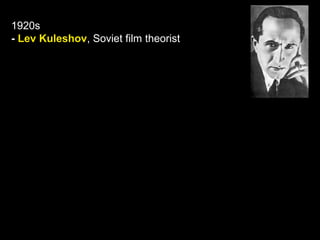
1920s
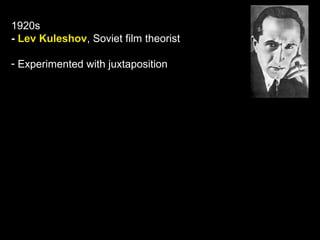
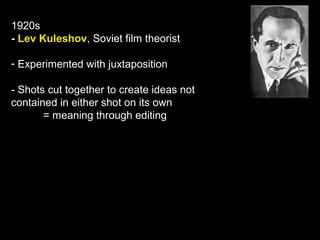
- Lev Kuleshov, Soviet film theorist
1920s
- Lev Kuleshov, Soviet film theorist
- Experimented with juxtaposition
1920s
- Lev Kuleshov, Soviet film theorist
- Experimented with juxtaposition
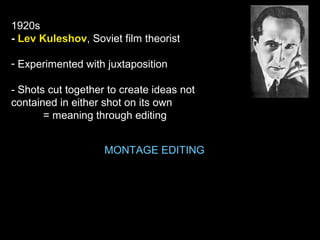
- Shots cut together to create ideas not
contained in either shot on its own
= meaning through editing
1920s
- Lev Kuleshov, Soviet film theorist
- Experimented with juxtaposition
- Shots cut together to create ideas not
contained in either shot on its own
= meaning through editing
MONTAGE EDITING
MONTAGE EDITING
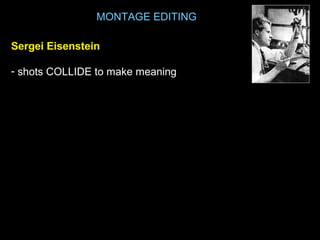
Sergei EisensteinSergei Eisenstein
- shots COLLIDE to make meaning
MONTAGE EDITING
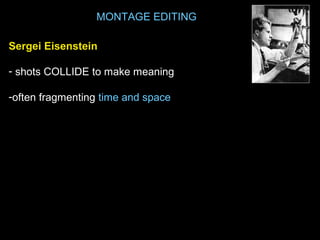
Sergei Eisenstein
- shots COLLIDE to make meaning
-often fragmenting time and space
MONTAGE EDITING
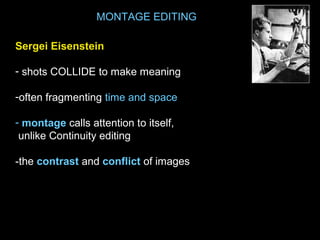
Sergei Eisenstein
- shots COLLIDE to make meaning
-often fragmenting time and space
- montage calls attention to itself,
unlike Continuity editing
-the contrast and conflict of images
SHORT ATTENTION SPAN:
MTV/30 SEC. COMMERCIAL INFLUENCES
SHORT ATTENTION SPAN:
MTV/30 SEC. COMMERCIAL INFLUENCES
- “MTV Generation” - grew up watching 30 second TV
commercials, and rapidly-edited music videos
SHORT ATTENTION SPAN:
MTV/30 SEC. COMMERCIAL INFLUENCES
- “MTV Generation” - grew up watching 30 second TV
commercials, and rapidly-edited music videos
- Shots often last a second or two (or less)

Editing Powerpoint

  • 1.
  • 2.
  • 3.
    CUT Is the joiningof two separate shots
  • 4.
    CUT Is the joiningof two separate shots So that the first shot is instantaneously replaced by the second
  • 5.
  • 6.
  • 7.
    HISTORICAL AND AESTHETIC DEVELOPMENTSIN EDITING MID 1890s - Lumiere Brothers invented the Cinematograph
  • 8.
    Lumiere Bros. Cinematograph:camera, projector, developing machine
  • 9.
    HISTORICAL AND AESTHETIC DEVELOPMENTSIN EDITING MID 1890s - Lumiere Brothers invented the Cinematograph - Lumiere Bros. (Auguste & Louis) early films contained no editing
  • 10.
    HISTORICAL AND AESTHETIC DEVELOPMENTSIN EDITING MID 1890s - Lumiere Brothers invented the Cinematograph - Lumiere Bros. (Auguste & Louis) early films contained no editing - Single-shot recordings (sequence shots)
  • 11.
    HISTORICAL AND AESTHETIC DEVELOPMENTSIN EDITING MID 1890s - Lumiere Brothers invented the Cinematograph - Lumiere Bros. (Auguste & Louis) early films contained no editing - Single-shot recordings (sequence shots) - Lasted the duration of one roll of film (1-2 minutes)
  • 12.
    HISTORICAL AND AESTHETIC DEVELOPMENTSIN EDITING MID 1890s - Lumiere Brothers invented the Cinematograph - Lumiere Bros. (Auguste & Louis) early films contained no editing - Single-shot recordings (sequence shots) - Lasted the duration of one roll of film (1-2 minutes) -The duration of the shots and the event were equal
  • 13.
    George Melies created episodicfilms by connecting shots: cutting to continuity
  • 14.
    George Melies created episodicfilms by connecting shots: cutting to continuity - Editing and camera placement still based on live theatre
  • 15.
    George Melies created episodicfilms by connecting shots: cutting to continuity - Editing and camera placement still based on live theatre - Camera is stationary, outside of the action
  • 16.
    George Melies created episodicfilms by connecting shots: cutting to continuity - Editing and camera placement still based on live theatre - Camera is stationary, outside of the action -Similar to curtain coming down and opening in a new location
  • 18.
    “Continuity cutting triesto preserve the fluidity of an event without literally showing all of it” (Giannetti)
  • 19.
    1903 -Edwin S. Portermade Life of an American Fireman and The Great Train Robbery
  • 20.
    1903 -Edwin S. Portermade Life of an American Fireman and The Great Train Robbery - Porter used editing to create parallel action
  • 21.
    1903 -Edwin S. Portermade Life of an American Fireman and The Great Train Robbery - Porter used editing to create parallel action - Shots are not linear - shot B does not pick up where shot A left off – linked instead by the continuity of an IDEA The Great Train Robbery (1903), Edwin S. Porter
  • 22.
    1915 “The Fatherof Filmmaking” - D. W. Griffith makes The Birth of a Nation
  • 23.
    1915 “The Fatherof Filmmaking” -D. W. Griffith makes The Birth of a Nation -Classical cutting
  • 24.
    1915 “The Fatherof Filmmaking” -D. W. Griffith makes The Birth of a Nation -Classical cutting -Editing within scene to vary dramatic intensity
  • 25.
    1915 “The Fatherof Filmmaking” -D. W. Griffith makes The Birth of a Nation -Classical cutting -Editing within scene to vary dramatic intensity -Expand visual explanation-
  • 26.
    1915 “The Fatherof Filmmaking” -D. W. Griffith makes The Birth of a Nation -Classical cutting -Editing within scene to vary dramatic intensity -Expand visual explanation- -juxtaposing long shots,
  • 27.
    1915 “The Fatherof Filmmaking” -D. W. Griffith makes The Birth of a Nation -Classical cutting -Editing within scene to vary dramatic intensity -Expand visual explanation- -juxtaposing long shots, -medium shots, close ups, etc.
  • 28.
    1915 “The Fatherof Filmmaking” -D. W. Griffith makes The Birth of a Nation -Classical cutting -Editing within scene to vary dramatic intensity -Expand visual explanation- -juxtaposing long shots, -medium shots, close ups, etc. - varying the length of shots
  • 29.
    1915 “The Fatherof Filmmaking” -D. W. Griffith makes The Birth of a Nation -Classical cutting -Editing within scene to vary dramatic intensity -Expand visual explanation- -juxtaposing long shots, -medium shots, close ups, etc. - varying the length of shots -shifting the attention within a scene
  • 30.
  • 31.
    CONTINUITY EDITING: Designed tomake editing INVISIBLE
  • 32.
    CONTINUITY EDITING: Designed tomake editing INVISIBLE - cutting on action: action begins in one shot and ends in another
  • 33.
    CONTINUITY EDITING: Designed tomake editing INVISIBLE - cutting on action: action begins in one shot and ends in another - cutting on dialogue: motivated by whoever is talking (or listening)
  • 34.
    CONTINUITY EDITING: Designed tomake editing INVISIBLE - cutting on action: action begins in one shot and ends in another - cutting on dialogue: motivated by whoever is talking (or listening) - cut on the glance: edit follows the eyes of a character
  • 35.
    CONTINUITY EDITING: Master shot:A long shot of the entire action without cuts.
  • 36.
    CONTINUITY EDITING: Master shot:A long shot of the entire action without cuts. The action is then repeated a number to times using medium shots, close ups, etc.
  • 37.
    CONTINUITY EDITING: Master shot:A long shot of the entire action without cuts. The action is then repeated a number to times using medium shots, close ups, etc. Without a master shot editors many not have adequate footage
  • 38.
    This end the1st part of the editing lecture • The slides after this will be covered in the second week of editing.
  • 39.
  • 40.
    Moscow Film Schoolused film as propaganda
  • 41.
    Moscow Film Schoolused film as propaganda Their editing style was in direct opposition to American classical cutting
  • 42.
    Moscow Film Schoolused film as propaganda Their editing style was in direct opposition to American classical cutting Soviets believed that the power was in the juxtaposition
  • 43.
    Moscow Film Schoolused film as propaganda Their editing style was in direct opposition to American classical cutting Soviets believed that the power was in the juxtaposition Cuts called attention to themselves
  • 44.
    Moscow Film Schoolused film as propaganda Their editing style was in direct opposition to American classical cutting Soviets believed that the power was in the juxtaposition Cuts called attention to themselves The meaning was made in the edit
  • 45.
    1920s - Lev Kuleshov,Soviet film theorist
  • 46.
    1920s - Lev Kuleshov,Soviet film theorist - Experimented with juxtaposition
  • 47.
    1920s - Lev Kuleshov,Soviet film theorist - Experimented with juxtaposition - Shots cut together to create ideas not contained in either shot on its own = meaning through editing
  • 48.
    1920s - Lev Kuleshov,Soviet film theorist - Experimented with juxtaposition - Shots cut together to create ideas not contained in either shot on its own = meaning through editing MONTAGE EDITING
  • 56.
    MONTAGE EDITING Sergei EisensteinSergeiEisenstein - shots COLLIDE to make meaning
  • 57.
    MONTAGE EDITING Sergei Eisenstein -shots COLLIDE to make meaning -often fragmenting time and space
  • 58.
    MONTAGE EDITING Sergei Eisenstein -shots COLLIDE to make meaning -often fragmenting time and space - montage calls attention to itself, unlike Continuity editing -the contrast and conflict of images
  • 59.
    SHORT ATTENTION SPAN: MTV/30SEC. COMMERCIAL INFLUENCES
  • 60.
    SHORT ATTENTION SPAN: MTV/30SEC. COMMERCIAL INFLUENCES - “MTV Generation” - grew up watching 30 second TV commercials, and rapidly-edited music videos
  • 61.
    SHORT ATTENTION SPAN: MTV/30SEC. COMMERCIAL INFLUENCES - “MTV Generation” - grew up watching 30 second TV commercials, and rapidly-edited music videos - Shots often last a second or two (or less)

Editor's Notes

  • #12 this would not have been enough to sustain interest in movies - it was more of a novelty at this point
  • #13 this would not have been enough to sustain interest in movies - it was more of a novelty at this point
  • #16 editing was similar to curtain coming down and opening up on a new location
  • #17 editing was similar to curtain coming down and opening up on a new location
  • #23 the beginning of cinema language as we now know it
  • #24 the beginning of cinema language as we now know it
  • #25 the beginning of cinema language as we now know it
  • #26 the beginning of cinema language as we now know it
  • #27 the beginning of cinema language as we now know it
  • #28 the beginning of cinema language as we now know it
  • #29 the beginning of cinema language as we now know it
  • #30 the beginning of cinema language as we now know it
  • #34 editing follows logically with our interest
  • #49 expression is the SAME but meaning changes
  • #50 expression is the SAME but meaning changes
  • #51 expression is the SAME but meaning changes
  • #52 expression is the SAME but meaning changes
  • #53 expression is the SAME but meaning changes
  • #57 action is FRACTURED
  • #58 action is FRACTURED
  • #59 action is FRACTURED