Sunil sharma
suraj karn prakash
susheel pal
t.aslam
d.thamotharan
Submitted by:
PrinciplesOfSelfAligning And
MethodsOfIncreasingRangeOf Regulation.
Department of manufacturing engineering
ANNAMALAI UNIVERSITY
BATCH’B’
Viii semester
INTRODUCTION
 A continuously variable transmission
(CVT) is a transmission that can change
steplessly through an infinite number of
effective gear ratios between maximum
and minimum values.
 This contrasts with other mechanical
transmissions that offer a fixed number of
gear ratios.
 The flexibility of a CVT allows the driving
shaft to maintain a constant angular
velocity over a range of output velocities.
3
ADVANTAGES
 This can provide better efficency than other
transmissions by enabling the operation to
run at its most efficient revolutions per
minute (RPM) for a range of operating
speeds.
 Alternatively it can be used to maximize the
performance of a machine by allowing the
machine to turn at the RPM at which it
produces peak power. This is typically
higher than the RPM that achieves peak
efficiency.
4
APPLICATIONS
 Many small tractors for home and garden
use have simple rubber belt CVTs
 Combine harvesters have CVTs. This
allows the operator to slow or accelerate as
needed to accommodate variations in
thickness of the crop.
 Some drill presses and milling machines
contain a pulley-based CVT where the
output shaft has a pair of manually-
adjustable conical pulley halves through
which a wide drive belt from the motor
loops.
5
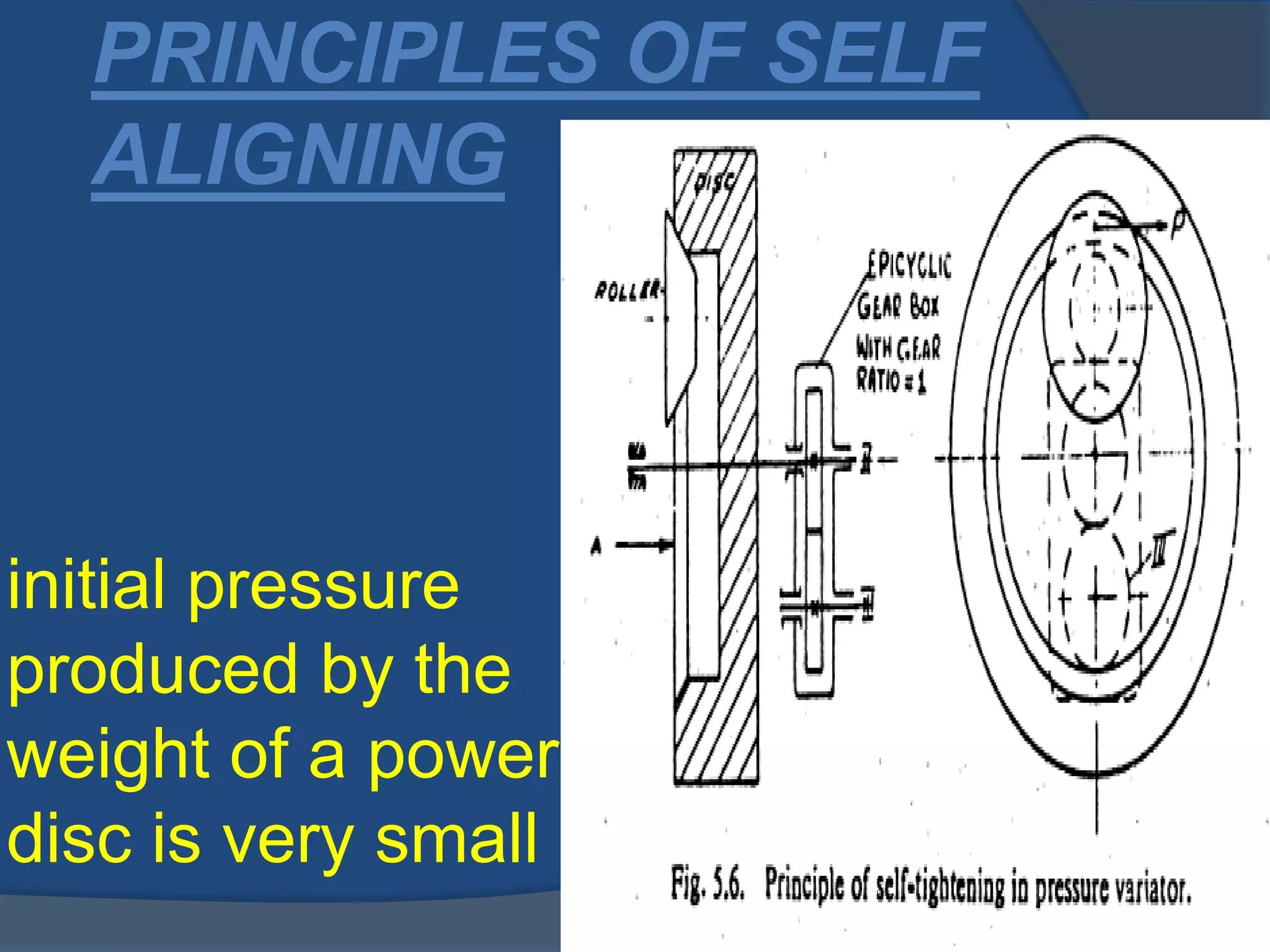
PRINCIPLES OF SELF
ALIGNING
initial pressure
produced by the
weight of a power
disc is very small
Let P= initial friction force produced between disc and roller
STEPLESS REGULATION
CAN BE CARRIED OUT BY
 ELECTRICAL SYSTEM
 ELECTRONIC SYSTEM
 HYDRAULIC SYSTEM
 MECHANICAL FRICTION DRIVE AND
PRESSURE VARIATOR
ADVANTAGES OF STEPLESS
REGULATION SYSTEM:
 No loss in speed
 Can arrange speed adjustment without
stopping machine.
 It reduces time losses and very useful in
automatic tool
 Hydraulic drive avoids speed fluctuation
methods of Increasing range of
regulation
1.BY USING MANY
VARIATORS
Only belt
drive and
gear drive
is used
CHARACTERISTICS
 Here we donot use the full possibility of
3 variators.
 Too many speeds can be repeated.
 The system is not very much used
because we donot get many number of
speed.
2.COMBINATION OF
VARIATORS WITH GEAR BOXES
CHARACTERISTICS
 Shaft 1st can have one constant speed.
 Shaft 2nd have a particular range of speeds.
 About shaft 3rd, three different speeds reduced
by gear ratios corresponding to any point on
2nd staff.
>>DIFFICULTIES
If the initial range is big then the ratio cant be
achieved as the gear box has its influence
3.VARIATORS WITH
EPICYCLIC MECHANISM:
>DISADVANTAGES
>complicated to manufacture.
>can not be used in high speed.
>low efficiency if high range is produced.
>used only in feed drives.
ACKNOWLEDGEMENT:
>Design of Machine Tools, Basu S.K., and
Pal D.K.
>Machine tool Design and Numerical
Control, Metha N.K.
>GOOGLE SEARCH ENGINE
THANK YOU

Principle of self aligning

  • 1.
    Sunil sharma suraj karnprakash susheel pal t.aslam d.thamotharan Submitted by: PrinciplesOfSelfAligning And MethodsOfIncreasingRangeOf Regulation. Department of manufacturing engineering ANNAMALAI UNIVERSITY BATCH’B’ Viii semester
  • 3.
    INTRODUCTION  A continuouslyvariable transmission (CVT) is a transmission that can change steplessly through an infinite number of effective gear ratios between maximum and minimum values.  This contrasts with other mechanical transmissions that offer a fixed number of gear ratios.  The flexibility of a CVT allows the driving shaft to maintain a constant angular velocity over a range of output velocities. 3
  • 4.
    ADVANTAGES  This canprovide better efficency than other transmissions by enabling the operation to run at its most efficient revolutions per minute (RPM) for a range of operating speeds.  Alternatively it can be used to maximize the performance of a machine by allowing the machine to turn at the RPM at which it produces peak power. This is typically higher than the RPM that achieves peak efficiency. 4
  • 5.
    APPLICATIONS  Many smalltractors for home and garden use have simple rubber belt CVTs  Combine harvesters have CVTs. This allows the operator to slow or accelerate as needed to accommodate variations in thickness of the crop.  Some drill presses and milling machines contain a pulley-based CVT where the output shaft has a pair of manually- adjustable conical pulley halves through which a wide drive belt from the motor loops. 5
  • 6.
    PRINCIPLES OF SELF ALIGNING initialpressure produced by the weight of a power disc is very small
  • 7.
    Let P= initialfriction force produced between disc and roller
  • 8.
    STEPLESS REGULATION CAN BECARRIED OUT BY  ELECTRICAL SYSTEM  ELECTRONIC SYSTEM  HYDRAULIC SYSTEM  MECHANICAL FRICTION DRIVE AND PRESSURE VARIATOR
  • 9.
    ADVANTAGES OF STEPLESS REGULATIONSYSTEM:  No loss in speed  Can arrange speed adjustment without stopping machine.  It reduces time losses and very useful in automatic tool  Hydraulic drive avoids speed fluctuation
  • 10.
    methods of Increasingrange of regulation 1.BY USING MANY VARIATORS Only belt drive and gear drive is used
  • 11.
    CHARACTERISTICS  Here wedonot use the full possibility of 3 variators.  Too many speeds can be repeated.  The system is not very much used because we donot get many number of speed.
  • 12.
  • 13.
    CHARACTERISTICS  Shaft 1stcan have one constant speed.  Shaft 2nd have a particular range of speeds.  About shaft 3rd, three different speeds reduced by gear ratios corresponding to any point on 2nd staff. >>DIFFICULTIES If the initial range is big then the ratio cant be achieved as the gear box has its influence
  • 14.
  • 15.
    >DISADVANTAGES >complicated to manufacture. >cannot be used in high speed. >low efficiency if high range is produced. >used only in feed drives.
  • 16.
    ACKNOWLEDGEMENT: >Design of MachineTools, Basu S.K., and Pal D.K. >Machine tool Design and Numerical Control, Metha N.K. >GOOGLE SEARCH ENGINE
  • 17.