Yeshwantrao Chavan College of Engineering
Wanadongri - Nagpur
Design and fabrication of Continuous Variable
Transmission(CVT)
Guide : Prof. N. J. Giradkar
Co-Guide: Asst. Prof. C. A. Mahatme
1. Sanket Jiwane
2. Rohit Meshram
3. Piyush Bhoyar
Project Group:
Objective:
• The main objective of project is to understand the working of cone
type CVT which offers a continuum of gear ratios between the fixed
desired limits . It includes the analysis of
1) Design of CVT.
2) Fabrication of CVT model.
3) Performance analysis and testing
Design and fabrication of Continuous Variable
Transmission (CVT)
Design and fabrication of Continuous Variable
Transmission(CVT)
Introduction:
What is a CVT?
A continuously variable transmission (CVT) is a type of transmission,
however, that allows an infinitely variable gear ratio change within a
finite range, thereby allowing the engine to continuously operate in its
most efficient or highest performance range, while the transmission
provides a continuously variable output to the load.
What is a cone type CVT?
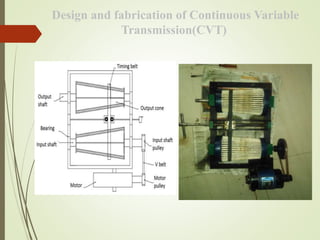
It is a type of continuous variable transmission, in which two cones are
parallelly connected by a belt, which gives us an infinite gear ratio
between minimum and maximum possible ratios.
Design and fabrication of Continuous Variable
Transmission(CVT)
SR NO. DESCRIPTION QTY MATERIAL
1. MOTOR 01 STD
2. BELT 01 STD
3. REDUCTION PULLEY 01 MS
4. INPUT & OUTPUT SHAFT 02 EN24
5. IP_LH BRG HOUSING 01 EN9
6. IP_RH_BRG HOUSING 01 EN9
7. OP_LH_BEARING HOUSING 01 EN9
8. OP_RH_BEARING HOUSING 01 EN9
9.
LH & RH_SCREW BEARING
HOUSING
02 EN9
10. SPEED ADJUSTER KNOB 01 EN9
11. SPEED ADJUSTER NUT 01 EN9
12. SPEED ADJUSTER SCREW 01 EN24
13. SPEED VARIATOR V-BELT 02 POLYMER
14. BELT HOLDER 02 EN9
15. BREARING 6003 ZZ 02 STD
16. BREARING 6004 ZZ 02 STD
17. FRAME 01 MS
18. BELT GUIDE PLATES 04 EN9
WORKING
 When the AC power supply is given to the motor, the setup
starts rotating. Initially the belt is in smaller diameter of driver
pulley and larger diameter of driven pulley. Driver pulley rpm
is constant throughout the end.
 Now driven pulley’s diameter has been reduced and driver
pulley’s diameter has been increased.
 Now driven pulley rpm. has been increased from before.
Similarly for every displacement of belt towards small
diameter of the driven pulley the rpm increases.
 According to principle of belt and pulleys, when larger pulley
rotates one revolution then smaller pulley rotates more
revolution based on its diameter.
SHIFTING MECHANISM:
The speed adjuster mechanism is in the form of a
screw and nut arrangement, where in the screw is
held in ball bearings at both ends and carries a nut on
which there is a mounting that holds the belt guide
mechanism in the form of free rotating rollers. The
screw carries the hand wheel at one end for speed
change.
Component Details
 Motor
 Motor is a single phase AC/DC motor, capacitor run three lead motor with the following
specifications:
 Power = 50watt
 Speed = 0 to 9000 rpm (variable)
 Input Cone Shaft
The input cone shaft is basically a sub assembly of the base shaft, two sprockets bar holder rings on
both side and the sprocket bars. The sprocket bars are solid round bars 5 mm diameter and 150
mm in length held in radial holes in the holder rings. Holder rings are keyed to the base shaft and
the sprocket bars are located on a radial pitch along the generators of the cone. The base shaft is
held in heavy duty ball bearings at the ends.
 Output Cone Shaft
The output cone shaft is basically a sub assembly of the base shaft, two sprockets bar holder rings
on both side and the sprocket bars. The sprocket bars are solid round bars 5 mm diameter held in
radial holes in the holder rings. Holder rings are keyed to the base shaft and the sprocket bars are
located on a radial pitch along the generators of the cone. The base shaft is held in heavy duty ball
bearings at either end.
 Open Belt Drive
Motor pulley is 35 mm diameter where as the input cone shaft pulley is 110 mm diameters. The
reduction ratio is thus 3.14 between the motor and input cone shaft. The power is transmitted by a
belt between the motor pulley and input cone shaft pulley.
 Input/output Bearing Housings
The input and output bearing housings hold the ball bearings for respective base shafts and they are
attached to the base frame.
 Transmission Belt
The transmission element of the cone CVT is Classical Synchronous belt with the Designation 322L050
and MB500-24.
 Speed Adjuster Mechanism
The speed adjuster mechanism is in the form of a screw and nut arrangement, where in the screw is
held in ball bearings at either ends and carries a nut which holds the belt guide mechanism in the
form of free rotating rollers. The screw carries the hand wheel at one end for speed change.
 Base Frame
Base frame is the structural element that supports the entire assembly of drive and the motor. Base
frame is 450 mm long and 245 mm broad.
Design of V –belt :
The belt backing and teeth are made up of strong
poly-chloroprene rubber , it protects the cords from
oil , grease , moisture etc. and also provides
bonding to the cords. The teeth are covered with a
wear resistant specially woven stretchable nylon
fabric.
1. Motor pulley diameter (d) = 35 mm
2. Input shaft pulley diameter (D) = 110 mm
3. Reduction ratio (D/d) = 110/35 =3.14
4. Co-efficient of friction (µ) = 0.30
From the design data book , length of belt is given
by the equation
L=2C+
𝜋(𝐷+𝑑)
2
+
𝐷−𝑑 (𝐷−𝑑)
4𝐶
The minimum centre is assumed to be 130 mm
Hence ,
Length of belt =498.96 mm
Hence standard belt nearer to above pitch length need to be selected. Thus
MB500 low power belt is selected for following specifications
Pitch length = 500 mm; Pitch = 4 mm.
Density of belt = 1150 kg/m3
Mass of belt per meter length= density *volume
= 1150*(20*500) *10-6
= 0.023 kg.
Now angle of wrap is given by-
a = 180-2sin−1
(
𝐷−𝑑
2𝐶
)
= 146.46= 2.55 rad
Also,
𝑒µ𝛼/ sin(40/2)
= 9.36
We have µ=0.30;
V =
πDN
60x1000
v = 16.49 m/s
From the design data book, we have,
𝑇1 − 𝑚𝑣 ∗ 𝑣
𝑇2 − 𝑚𝑣 ∗ 𝑣
= 𝑒µ𝛼/ sin(40/2)
𝑇1 − 𝑚𝑣 ∗ 𝑣
𝑇2 − 𝑚𝑣 ∗ 𝑣
= 9.36
mv2 = 0.023*16.492= 6.254N
So, T1- 9.36T2 = 64.79....... (1)
Also we have,
Power transmitted = (T1-T2)*v
50 = (T1-T2)*16.49
Therefore T1-T2 = 3.032 ............ (2)
Solving equations (1) and (2) simultaneously, we have
T1= 7.388N; T2=4.355 N; Power transmitted=50 W
Design of belt between pulleys
This belt is chosen as standard
timing belt i.e. PIX Extreme 322L050
Specifications of belt are as follow:
Pitch length = 32.25 inches or 819.5 mm
L- Type with pitch = 9.525 mm
Belt width = 0.5 inch or 12.7 mm
Number of tooth=86
Design of Shaft
Material selected-alloy steel EN24
Strength for Shaft material
Designation
Ultimate tensile Strength 900 (N/mm2)
Yield Strength 700 (N/mm2)
According to American Society of Mechanical Engineers
(ASME) code for design of shaft, the loads on most shafts in
connected machinery are not constant, it is necessary to make
proper allowance for permissible values of shear stress may be
calculated from various relations. the harmful effects of load
fluctuations. According to ASME code
fs max = 0.18 x f ult
= 0.18 × 900
fs max = 162 N/mm2
Also,
fs max = 0.3 x fyt
= 0.3 × 700
fs max = 210 N/mm2
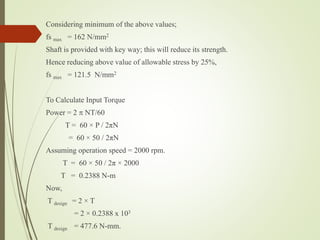
Considering minimum of the above values;
fs max = 162 N/mm2
Shaft is provided with key way; this will reduce its strength.
Hence reducing above value of allowable stress by 25%,
fs max = 121.5 N/mm2
To Calculate Input Torque
Power = 2  NT/60
T = 60 × P / 2πN
= 60 × 50 / 2πN
Assuming operation speed = 2000 rpm.
T = 60 × 50 / 2π × 2000
T = 0.2388 N-m
Now,
T design = 2 × T
= 2 × 0.2388 x 103
T design = 477.6 N-mm.
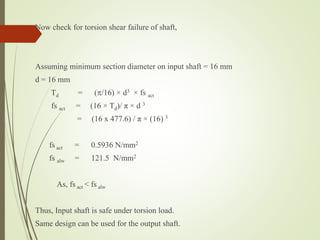
Now check for torsion shear failure of shaft,
Assuming minimum section diameter on input shaft = 16 mm
d = 16 mm
Td = (/16) × d3 × fs act
fs act = (16 × Td)/ π × d 3
= (16 x 477.6) / π × (16) 3
fs act = 0.5936 N/mm2
fs alw = 121.5 N/mm2
As, fs act < fs alw
Thus, Input shaft is safe under torsion load.
Same design can be used for the output shaft.
Design of cone
Material for bar = EN9 i.e. Alloy steel
Designation
Ultimate Tensile Strength, 600 N/Mm2
Yield Strength, 480 N/Mm2
EN 9
Length of bar = 150mm
Diameter of plate (D1) = 122mm
Pitch of belt (p) = 9.525mm
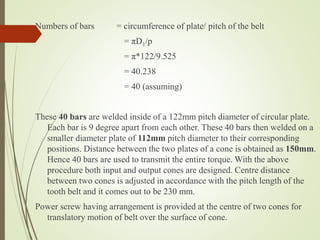
Numbers of bars = circumference of plate/ pitch of the belt
= πD1/p
= π*122/9.525
= 40.238
= 40 (assuming)
These 40 bars are welded inside of a 122mm pitch diameter of circular plate.
Each bar is 9 degree apart from each other. These 40 bars then welded on a
smaller diameter plate of 112mm pitch diameter to their corresponding
positions. Distance between the two plates of a cone is obtained as 150mm.
Hence 40 bars are used to transmit the entire torque. With the above
procedure both input and output cones are designed. Centre distance
between two cones is adjusted in accordance with the pitch length of the
tooth belt and it comes out to be 230 mm.
Power screw having arrangement is provided at the centre of two cones for
translatory motion of belt over the surface of cone.
For Left hand side
Shaft bearing will be subjected to purely medium radial
and axial loads; hence we shall use ball bearings for our
application. For this required bore is 17 mm.
Selecting Single Row deep groove ball bearing with following
specification
Bearing of
basic design
No (SKF)
d(bore)
in mm
D (outer
diameter)
in mm
B(width) Basic
capacity
Co
Dynamic
capacity
Cdyn
6003 17 35 10 3250 6370
P = X V Fr + Y F a
For our application F r =Belt Tension = T1 + T2 = 7.388+4.355 = 11.743 N
P = X Fr+ Y F a
The bearing is subjected to pure radial load
P = Fr
Max radial load = Fr = 11.743 N.
P= 11.743 N
•Calculation of dynamic load capacity of bearing
L=(C/P)n where n = 3 (for ball bearings)
The expected life of bearing = 600hrs
Now, average life of bearing = hrs*rpm*60
= 600*2000*60
= 720million revolution
Life of bearing = 720/5
= 144 million revolutions
144 = (C/11.743)3
C = 61.55 N
As the required dynamic load capacity of bearing is less than the rated
dynamic capacity of bearing, i.e. Creq < Cdyn
This will remain same for right hand side bearing of output shaft.
Selection of Right Hand Bearing Input Shaft
Shaft bearing will be subjected to purely medium
radial and axial loads; hence we shall use ball bearings
for our application. For this bore is 20 mm.
Selecting single row deep groove ball bearing with
specification
Bearing of
basic design
No (SKF)
d(bore)
in mm
D (outer
diameter)
in mm
B(width) Basic
capacity
Co
Dynamic
capacity
Cdyn
6004 20 42 12 5000 9500
P = X V Fr + Y F a
For our application F r =Belt Tension = T1 + T2 = 7.388+4.355 =
11.743 N
P = X Fr+ Y F a
The bearing is subjected to pure radial load. So,
P = Fr
Max radial load = Fr =11.743 N
P= 11.743 N
•Calculation of dynamic load capacity of bearing
L = (C/P)n, , where n= 3 (for ball bearings)
The expected life of bearing=600hrs
Now, average life of bearing = hrs*rpm*60 = 600*2000*60=
720million revolution
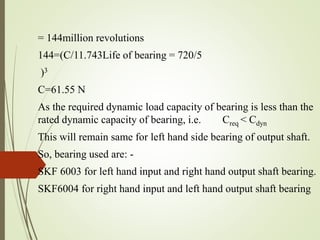
= 144million revolutions
144=(C/11.743Life of bearing = 720/5
)3
C=61.55 N
As the required dynamic load capacity of bearing is less than the
rated dynamic capacity of bearing, i.e. Creq < Cdyn
This will remain same for left hand side bearing of output shaft.
So, bearing used are: -
SKF 6003 for left hand input and right hand output shaft bearing.
SKF6004 for right hand input and left hand output shaft bearing
Processes used
Welding
Turning
Facing
Drilling
Boring
Slotting
Welding
1. In mounting 4 bearing housings on the frame.
2. In making base frame.
3. In mounting motor housing on the frame.
4. In welding sprocket bars to the disk.
5. In attaching handle to the speed adjusting
mechanism.
6. In welding the 2 larger pullies to the shaft.
Turning
1. In making two shaft of desired
dimension.
1. In reducing the lengths of both
shafts to the desired lengths.
Facing
Drilling
1. In drilling holes in plates holding the nut in
speed adjuster mechanism.
2. In drilling holes in 4 disks.
Boring
1. In enlarging the holes to desired
size.
Slotting
1. In making two slots in the frame
plates for fastening the movable
cones’ bearing housing on the
frame.
Advantages
Better fuel consumption than a regular
automatic transmission as the CVT keeps the
car in its optimum power range regardless of
speed.
There is improved acceleration due to the
lower power loss experienced.
Step less transmission. i.e., no need of clutch
Provides a smoother ride than automatic
transmission.
Easy to manufacture when compared to gear
drives.
FUTURE SCOPE
 Many small tractors for home and garden can
have this rubber belt CVTs.
 It can also be used in small cars like TATA Nano,
electric cars and hybrid vehicles.
 Cone CVTs can also be used in industrial
machines for variable speeds.
 In lathe machine.
Literature Survey:
Sr. No. Author Title of Paper
Name of
International
Journals /
International
Conference
Remarks/Findings
1. Kevin R. Lang Continuous
Variable
Transmission
International Journal
of Advanced
Engineering
Technology E-ISSN
0976-3945
IJAET/Vol.
In this paper ,we observed that
transmissions use the high shear
strength of viscous
fluids to transmit torque between an
input torus and an output
torus.
2. Mister
Transmission
Transmission
History
Mister Transmission
Expert 2013
Transmission Types and History of
Development
3. Reddy C.,
Pedduri S., Sistla
K.C.
Fabrication &
Analysis Of A
Continuously
Variable
Planetary
Transmission
System
International Journal
of Scientific &
Technology
Research October
2013 Edition .
: A continuously variable
transmission (CVT), in theory, has an
unlimited number of gear ratios
between the highest and lowest
settings. But most CVTs are
complex, expensive, have poor
efficiencies, and aren't scalable.
Literature Survey:
4. Norman H. Beachley
Andrew A. Frank
College of
Engineering
University of
Wisconsin, Madison
CONTINUOUSLY
VARIABLE
TRANSMISSIONS:
THEORY AND
PRACTICE
Available from
National Technical
Information Service
Springfield, Virginia
22161 ,
This report examines and compares the
five basic principles that can be used
in continuously variable transmission
(CVT) design; (1) hydrostatic; (2)
traction drive (V-belt and rolling
contact); (3) overrunning clutch; (4)
electric; and (5) multispeed gearbox
with slipping clutch.
5 Mayur R. Mogre Comparative Study
between Automatic
and
Manual
Transmission Car
International
Conference on
Mechanical,
Automobile and
Biodiesel
Engineering
(ICMABE'2012)
Oct. 6-7, 2012 Dubai
(UAE)
Helps in understanding the difference
between Automatic and Manual
Transmission system .

Final year project

  • 1.
    Yeshwantrao Chavan Collegeof Engineering Wanadongri - Nagpur Design and fabrication of Continuous Variable Transmission(CVT) Guide : Prof. N. J. Giradkar Co-Guide: Asst. Prof. C. A. Mahatme 1. Sanket Jiwane 2. Rohit Meshram 3. Piyush Bhoyar Project Group:
  • 2.
    Objective: • The mainobjective of project is to understand the working of cone type CVT which offers a continuum of gear ratios between the fixed desired limits . It includes the analysis of 1) Design of CVT. 2) Fabrication of CVT model. 3) Performance analysis and testing Design and fabrication of Continuous Variable Transmission (CVT)
  • 3.
    Design and fabricationof Continuous Variable Transmission(CVT) Introduction: What is a CVT? A continuously variable transmission (CVT) is a type of transmission, however, that allows an infinitely variable gear ratio change within a finite range, thereby allowing the engine to continuously operate in its most efficient or highest performance range, while the transmission provides a continuously variable output to the load. What is a cone type CVT? It is a type of continuous variable transmission, in which two cones are parallelly connected by a belt, which gives us an infinite gear ratio between minimum and maximum possible ratios.
  • 4.
    Design and fabricationof Continuous Variable Transmission(CVT)
  • 5.
    SR NO. DESCRIPTIONQTY MATERIAL 1. MOTOR 01 STD 2. BELT 01 STD 3. REDUCTION PULLEY 01 MS 4. INPUT & OUTPUT SHAFT 02 EN24 5. IP_LH BRG HOUSING 01 EN9 6. IP_RH_BRG HOUSING 01 EN9 7. OP_LH_BEARING HOUSING 01 EN9 8. OP_RH_BEARING HOUSING 01 EN9 9. LH & RH_SCREW BEARING HOUSING 02 EN9 10. SPEED ADJUSTER KNOB 01 EN9 11. SPEED ADJUSTER NUT 01 EN9 12. SPEED ADJUSTER SCREW 01 EN24 13. SPEED VARIATOR V-BELT 02 POLYMER 14. BELT HOLDER 02 EN9 15. BREARING 6003 ZZ 02 STD 16. BREARING 6004 ZZ 02 STD 17. FRAME 01 MS 18. BELT GUIDE PLATES 04 EN9
  • 6.
    WORKING  When theAC power supply is given to the motor, the setup starts rotating. Initially the belt is in smaller diameter of driver pulley and larger diameter of driven pulley. Driver pulley rpm is constant throughout the end.  Now driven pulley’s diameter has been reduced and driver pulley’s diameter has been increased.  Now driven pulley rpm. has been increased from before. Similarly for every displacement of belt towards small diameter of the driven pulley the rpm increases.  According to principle of belt and pulleys, when larger pulley rotates one revolution then smaller pulley rotates more revolution based on its diameter.
  • 7.
    SHIFTING MECHANISM: The speedadjuster mechanism is in the form of a screw and nut arrangement, where in the screw is held in ball bearings at both ends and carries a nut on which there is a mounting that holds the belt guide mechanism in the form of free rotating rollers. The screw carries the hand wheel at one end for speed change.
  • 8.
    Component Details  Motor Motor is a single phase AC/DC motor, capacitor run three lead motor with the following specifications:  Power = 50watt  Speed = 0 to 9000 rpm (variable)  Input Cone Shaft The input cone shaft is basically a sub assembly of the base shaft, two sprockets bar holder rings on both side and the sprocket bars. The sprocket bars are solid round bars 5 mm diameter and 150 mm in length held in radial holes in the holder rings. Holder rings are keyed to the base shaft and the sprocket bars are located on a radial pitch along the generators of the cone. The base shaft is held in heavy duty ball bearings at the ends.  Output Cone Shaft The output cone shaft is basically a sub assembly of the base shaft, two sprockets bar holder rings on both side and the sprocket bars. The sprocket bars are solid round bars 5 mm diameter held in radial holes in the holder rings. Holder rings are keyed to the base shaft and the sprocket bars are located on a radial pitch along the generators of the cone. The base shaft is held in heavy duty ball bearings at either end.
  • 9.
     Open BeltDrive Motor pulley is 35 mm diameter where as the input cone shaft pulley is 110 mm diameters. The reduction ratio is thus 3.14 between the motor and input cone shaft. The power is transmitted by a belt between the motor pulley and input cone shaft pulley.  Input/output Bearing Housings The input and output bearing housings hold the ball bearings for respective base shafts and they are attached to the base frame.  Transmission Belt The transmission element of the cone CVT is Classical Synchronous belt with the Designation 322L050 and MB500-24.  Speed Adjuster Mechanism The speed adjuster mechanism is in the form of a screw and nut arrangement, where in the screw is held in ball bearings at either ends and carries a nut which holds the belt guide mechanism in the form of free rotating rollers. The screw carries the hand wheel at one end for speed change.  Base Frame Base frame is the structural element that supports the entire assembly of drive and the motor. Base frame is 450 mm long and 245 mm broad.
  • 10.
    Design of V–belt : The belt backing and teeth are made up of strong poly-chloroprene rubber , it protects the cords from oil , grease , moisture etc. and also provides bonding to the cords. The teeth are covered with a wear resistant specially woven stretchable nylon fabric. 1. Motor pulley diameter (d) = 35 mm 2. Input shaft pulley diameter (D) = 110 mm 3. Reduction ratio (D/d) = 110/35 =3.14 4. Co-efficient of friction (µ) = 0.30 From the design data book , length of belt is given by the equation L=2C+ 𝜋(𝐷+𝑑) 2 + 𝐷−𝑑 (𝐷−𝑑) 4𝐶 The minimum centre is assumed to be 130 mm
  • 11.
    Hence , Length ofbelt =498.96 mm Hence standard belt nearer to above pitch length need to be selected. Thus MB500 low power belt is selected for following specifications Pitch length = 500 mm; Pitch = 4 mm.
  • 12.
    Density of belt= 1150 kg/m3 Mass of belt per meter length= density *volume = 1150*(20*500) *10-6 = 0.023 kg. Now angle of wrap is given by- a = 180-2sin−1 ( 𝐷−𝑑 2𝐶 ) = 146.46= 2.55 rad Also, 𝑒µ𝛼/ sin(40/2) = 9.36 We have µ=0.30; V = πDN 60x1000 v = 16.49 m/s From the design data book, we have, 𝑇1 − 𝑚𝑣 ∗ 𝑣 𝑇2 − 𝑚𝑣 ∗ 𝑣 = 𝑒µ𝛼/ sin(40/2) 𝑇1 − 𝑚𝑣 ∗ 𝑣 𝑇2 − 𝑚𝑣 ∗ 𝑣 = 9.36
  • 13.
    mv2 = 0.023*16.492=6.254N So, T1- 9.36T2 = 64.79....... (1) Also we have, Power transmitted = (T1-T2)*v 50 = (T1-T2)*16.49 Therefore T1-T2 = 3.032 ............ (2) Solving equations (1) and (2) simultaneously, we have T1= 7.388N; T2=4.355 N; Power transmitted=50 W
  • 14.
    Design of beltbetween pulleys This belt is chosen as standard timing belt i.e. PIX Extreme 322L050 Specifications of belt are as follow: Pitch length = 32.25 inches or 819.5 mm L- Type with pitch = 9.525 mm Belt width = 0.5 inch or 12.7 mm Number of tooth=86
  • 15.
    Design of Shaft Materialselected-alloy steel EN24 Strength for Shaft material Designation Ultimate tensile Strength 900 (N/mm2) Yield Strength 700 (N/mm2)
  • 16.
    According to AmericanSociety of Mechanical Engineers (ASME) code for design of shaft, the loads on most shafts in connected machinery are not constant, it is necessary to make proper allowance for permissible values of shear stress may be calculated from various relations. the harmful effects of load fluctuations. According to ASME code fs max = 0.18 x f ult = 0.18 × 900 fs max = 162 N/mm2 Also, fs max = 0.3 x fyt = 0.3 × 700 fs max = 210 N/mm2
  • 17.
    Considering minimum ofthe above values; fs max = 162 N/mm2 Shaft is provided with key way; this will reduce its strength. Hence reducing above value of allowable stress by 25%, fs max = 121.5 N/mm2 To Calculate Input Torque Power = 2  NT/60 T = 60 × P / 2πN = 60 × 50 / 2πN Assuming operation speed = 2000 rpm. T = 60 × 50 / 2π × 2000 T = 0.2388 N-m Now, T design = 2 × T = 2 × 0.2388 x 103 T design = 477.6 N-mm.
  • 18.
    Now check fortorsion shear failure of shaft, Assuming minimum section diameter on input shaft = 16 mm d = 16 mm Td = (/16) × d3 × fs act fs act = (16 × Td)/ π × d 3 = (16 x 477.6) / π × (16) 3 fs act = 0.5936 N/mm2 fs alw = 121.5 N/mm2 As, fs act < fs alw Thus, Input shaft is safe under torsion load. Same design can be used for the output shaft.
  • 19.
    Design of cone Materialfor bar = EN9 i.e. Alloy steel Designation Ultimate Tensile Strength, 600 N/Mm2 Yield Strength, 480 N/Mm2 EN 9 Length of bar = 150mm Diameter of plate (D1) = 122mm Pitch of belt (p) = 9.525mm
  • 20.
    Numbers of bars= circumference of plate/ pitch of the belt = πD1/p = π*122/9.525 = 40.238 = 40 (assuming) These 40 bars are welded inside of a 122mm pitch diameter of circular plate. Each bar is 9 degree apart from each other. These 40 bars then welded on a smaller diameter plate of 112mm pitch diameter to their corresponding positions. Distance between the two plates of a cone is obtained as 150mm. Hence 40 bars are used to transmit the entire torque. With the above procedure both input and output cones are designed. Centre distance between two cones is adjusted in accordance with the pitch length of the tooth belt and it comes out to be 230 mm. Power screw having arrangement is provided at the centre of two cones for translatory motion of belt over the surface of cone.
  • 21.
    For Left handside Shaft bearing will be subjected to purely medium radial and axial loads; hence we shall use ball bearings for our application. For this required bore is 17 mm. Selecting Single Row deep groove ball bearing with following specification Bearing of basic design No (SKF) d(bore) in mm D (outer diameter) in mm B(width) Basic capacity Co Dynamic capacity Cdyn 6003 17 35 10 3250 6370
  • 22.
    P = XV Fr + Y F a For our application F r =Belt Tension = T1 + T2 = 7.388+4.355 = 11.743 N P = X Fr+ Y F a The bearing is subjected to pure radial load P = Fr Max radial load = Fr = 11.743 N. P= 11.743 N •Calculation of dynamic load capacity of bearing L=(C/P)n where n = 3 (for ball bearings) The expected life of bearing = 600hrs Now, average life of bearing = hrs*rpm*60 = 600*2000*60 = 720million revolution Life of bearing = 720/5 = 144 million revolutions 144 = (C/11.743)3 C = 61.55 N As the required dynamic load capacity of bearing is less than the rated dynamic capacity of bearing, i.e. Creq < Cdyn This will remain same for right hand side bearing of output shaft.
  • 23.
    Selection of RightHand Bearing Input Shaft Shaft bearing will be subjected to purely medium radial and axial loads; hence we shall use ball bearings for our application. For this bore is 20 mm. Selecting single row deep groove ball bearing with specification Bearing of basic design No (SKF) d(bore) in mm D (outer diameter) in mm B(width) Basic capacity Co Dynamic capacity Cdyn 6004 20 42 12 5000 9500
  • 24.
    P = XV Fr + Y F a For our application F r =Belt Tension = T1 + T2 = 7.388+4.355 = 11.743 N P = X Fr+ Y F a The bearing is subjected to pure radial load. So, P = Fr Max radial load = Fr =11.743 N P= 11.743 N •Calculation of dynamic load capacity of bearing L = (C/P)n, , where n= 3 (for ball bearings) The expected life of bearing=600hrs Now, average life of bearing = hrs*rpm*60 = 600*2000*60= 720million revolution
  • 25.
    = 144million revolutions 144=(C/11.743Lifeof bearing = 720/5 )3 C=61.55 N As the required dynamic load capacity of bearing is less than the rated dynamic capacity of bearing, i.e. Creq < Cdyn This will remain same for left hand side bearing of output shaft. So, bearing used are: - SKF 6003 for left hand input and right hand output shaft bearing. SKF6004 for right hand input and left hand output shaft bearing
  • 26.
  • 27.
    Welding 1. In mounting4 bearing housings on the frame. 2. In making base frame. 3. In mounting motor housing on the frame. 4. In welding sprocket bars to the disk. 5. In attaching handle to the speed adjusting mechanism. 6. In welding the 2 larger pullies to the shaft.
  • 28.
    Turning 1. In makingtwo shaft of desired dimension. 1. In reducing the lengths of both shafts to the desired lengths. Facing
  • 29.
    Drilling 1. In drillingholes in plates holding the nut in speed adjuster mechanism. 2. In drilling holes in 4 disks. Boring 1. In enlarging the holes to desired size.
  • 30.
    Slotting 1. In makingtwo slots in the frame plates for fastening the movable cones’ bearing housing on the frame.
  • 31.
    Advantages Better fuel consumptionthan a regular automatic transmission as the CVT keeps the car in its optimum power range regardless of speed. There is improved acceleration due to the lower power loss experienced. Step less transmission. i.e., no need of clutch Provides a smoother ride than automatic transmission. Easy to manufacture when compared to gear drives.
  • 32.
    FUTURE SCOPE  Manysmall tractors for home and garden can have this rubber belt CVTs.  It can also be used in small cars like TATA Nano, electric cars and hybrid vehicles.  Cone CVTs can also be used in industrial machines for variable speeds.  In lathe machine.
  • 33.
    Literature Survey: Sr. No.Author Title of Paper Name of International Journals / International Conference Remarks/Findings 1. Kevin R. Lang Continuous Variable Transmission International Journal of Advanced Engineering Technology E-ISSN 0976-3945 IJAET/Vol. In this paper ,we observed that transmissions use the high shear strength of viscous fluids to transmit torque between an input torus and an output torus. 2. Mister Transmission Transmission History Mister Transmission Expert 2013 Transmission Types and History of Development 3. Reddy C., Pedduri S., Sistla K.C. Fabrication & Analysis Of A Continuously Variable Planetary Transmission System International Journal of Scientific & Technology Research October 2013 Edition . : A continuously variable transmission (CVT), in theory, has an unlimited number of gear ratios between the highest and lowest settings. But most CVTs are complex, expensive, have poor efficiencies, and aren't scalable.
  • 34.
    Literature Survey: 4. NormanH. Beachley Andrew A. Frank College of Engineering University of Wisconsin, Madison CONTINUOUSLY VARIABLE TRANSMISSIONS: THEORY AND PRACTICE Available from National Technical Information Service Springfield, Virginia 22161 , This report examines and compares the five basic principles that can be used in continuously variable transmission (CVT) design; (1) hydrostatic; (2) traction drive (V-belt and rolling contact); (3) overrunning clutch; (4) electric; and (5) multispeed gearbox with slipping clutch. 5 Mayur R. Mogre Comparative Study between Automatic and Manual Transmission Car International Conference on Mechanical, Automobile and Biodiesel Engineering (ICMABE'2012) Oct. 6-7, 2012 Dubai (UAE) Helps in understanding the difference between Automatic and Manual Transmission system .