Presentation on Prime Lending Rate
                     (PLR)


Presented to              Presented by
Dr Ranjit Singh           Sujoy Kumar Paul
Asst.Professor            (03)
DBA-JNSMS                 Biplab dey       (34)
                          Sanjeeb Paul     (18)
                          Janmajit Debnath
                          (13)
                          Dhruba Debnath
                          (43)
 Prime rate or prime lending rate is a term
 applied in many countries to a reference
 interest rate used by banks. The term
 originally indicated the rate of interest at
 which banks lent to favoured customers, i.e.,
 those with high credibility, though this is no
 longer always the case. Some variable
 interest rates may be expressed as a
 percentage above or below prime rate.
 The BPLR was seen as a reference rate and
  was to be computed taking into
  consideration (i) cost of funds; (ii)
  operational expenses; and (ii) a minimum
  margin to cover regulatory requirements of
  provisioning and capital charge, and profit
  margin.
 Banks are free to fix benchmark PRIME
  LENLIND RATE BPLR for credit limits through
  the banking regulation act, and the reserve
  bank of India act
 The prime rate is used often as an index in
 calculating rate changes to adjustable rate
 mortgages (ARM) and other variable rate
 short term loans. Many credit cards and
 home equity lines of credit with variable
 interest rates have their rate specified as the
 prime rate (index) plus a fixed value
 commonly called the spread or margin.
 October  1994 Lending rates for loans with
  credit limits of over Rs. 2 lakh deregulated.
  Banks were required to declare their Prime
  lending rates (PLRs).
 October 1997 For term loans of 3 years and
  above, separate Prime Term Lending Rates
  (PTLRs) were required to be announced by
  banks.
 April 1998 PLR converted as a ceiling rate on
  loans up to Rs.2 lakh.
 April 1999 Tenor-linked Prime Lending Rates
  (TPLRs) introduced.
 October 1999 Banks were given flexibility to
  charge interest rates without reference to
  the PLR in respect of certain categories of
  loans/credit.
 April 2000 Banks allowed to charge
  fixed/floating rate on their lending for credit
  limit of over Rs.2 lakh.
 April 2001 The PLR ceased to be the floor
  rate for loans above Rs. 2 lakh.
  Commercial banks allowed to lend at sub-PLR
  rate for loans above Rs.2 lakh.
 April 2002 A system of collection of
  additional information from banks on the (a)
  maximum and minimum interest rates on
  advances charged by the banks; and (b)
  range of interest rates with large value of
  business and disseminating through the
  Reserve Bank‟s website was introduced.
 April 2003 The Reserve Bank advised banks to
  announce a benchmark PLR (BPLR) with the
  approval of their boards. The system of
  tenor-linked PLR discontinued.
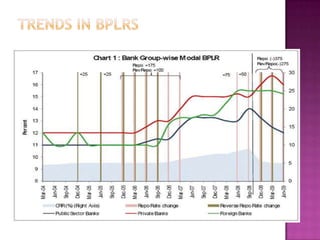
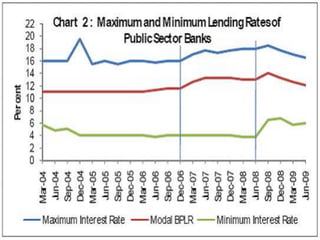
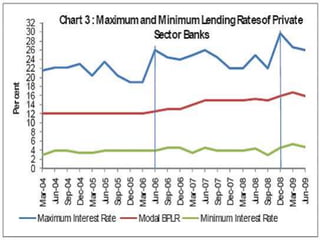
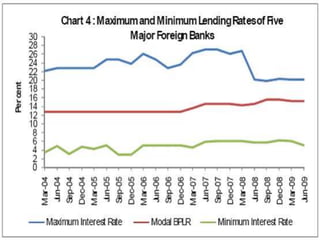
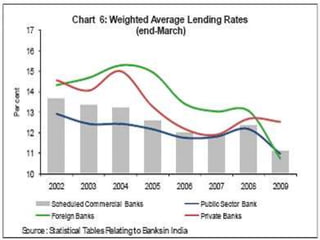
 Over  the years, because of competitive
  pressures banks have increasingly resorted to
  financing of various categories of borrowers
  at sub-BPLR rates such as corporates, housing
  and retail sector.
 The major share of sub-BPLR lending was of
  longer term loans (above 3 years), whereas
  in respect of private sector banks and foreign
  banks, the major share of sub-BPLR loans
  was in the form of consumer credit.
 Given the large proportion of sub-BPLR
  lending by the banking system, concerns
  have been raised on the transparency aspect
  of computation of BPLRs by banks.
 As components of the BPLR are determined
  by the bank itself.
 Another  issue that is often raised is the
  asymmetric downward stickiness of the
  BPLRs. This not only raises an issue of equity
  but also results in poor transmission of
  monetary policy in credit markets.
 The major reasons for downward stickiness is
  the large share of deposits contracted at high
  rates in the past.
 TheBPLR system based on the average costs
 incurred by banks on fund-based business
 actually reflects the break-even cost for
 banks and does not represent “prime
 lending” rate in the usual sense of the term
 at which banks accommodate their highly
 rated/most creditworthy borrowers.
 Mumbai, July, 7: State Bank of India (SBI) The
 largest bank of Asia, has revised the
 benchmark prime lending rate, base rate and
 deposit rates upwards to follow the rate
 hikes announced by RBI in its last policy
 review.

 SBIhas revised the Benchmark Prime Lending
 Rate and Base Rate upwards by 25 bps in
 anticipation of rising interest rate in coming
 months.
   The bank has informed BSE that it has
    revised the Benchmark Prime Lending Rate
    by 25 bps from 14.00% p.a. to 14.25% p.a.

   State Bank of India has also informed BSE
    that the Bank has revised the Base Rate
    upwards by 25 bps from 9.25% p.a. to 9.50%
                       p.a.

   SBI revises upwards the 'Deposit Rates' up to
    100 bps means by 1 percent in some
    maturities, effective from July 11, 2011.All
    the changes are effective from July 11, 2011.
   The new rate hike by the country's leading lender will
    increase the EMI of home, Auto, Personal, and other
    advances as well.

   SBI has also decided to waive the penalty for
    premature withdrawal of deposits up to 90 days for
    retail depositors. At the same time it has decreased
    penalty to 0.50 percent from 1 percent for premature
    withdrawal of other deposits beyond 90 days.

   Last week, several banks, including major private
    lender ICICI Bank, Canara Bank , Bank of Baroda,
    IOB, Dena, have already raised their lending rates by
    25 bps.
 The Reserve Bank has received several
 representations on the arbitrariness of
 resetting the lending rates on loans and the
 benchmark rates used for pricing floating
 rate products. Many banks charge lending
 rates with reference to benchmarks which
 are internal and non-transparent.
 In addition, provisions on conditional
  resetting interest rates are placed as „force
  majeure’ in loan covenants thereby making
  the terms of contract non-transparent for
  the borrower. This practice has added further
  opaqueness in the setting of lending rates
  since the re-pricing is generally arbitrary and
  not with reference to a transparent publicly
  known benchmarks.
PRIME LENDING RATE

PRIME LENDING RATE

  • 1.
    Presentation on PrimeLending Rate (PLR) Presented to Presented by Dr Ranjit Singh Sujoy Kumar Paul Asst.Professor (03) DBA-JNSMS Biplab dey (34) Sanjeeb Paul (18) Janmajit Debnath (13) Dhruba Debnath (43)
  • 2.
     Prime rateor prime lending rate is a term applied in many countries to a reference interest rate used by banks. The term originally indicated the rate of interest at which banks lent to favoured customers, i.e., those with high credibility, though this is no longer always the case. Some variable interest rates may be expressed as a percentage above or below prime rate.
  • 3.
     The BPLRwas seen as a reference rate and was to be computed taking into consideration (i) cost of funds; (ii) operational expenses; and (ii) a minimum margin to cover regulatory requirements of provisioning and capital charge, and profit margin.  Banks are free to fix benchmark PRIME LENLIND RATE BPLR for credit limits through the banking regulation act, and the reserve bank of India act
  • 4.
     The primerate is used often as an index in calculating rate changes to adjustable rate mortgages (ARM) and other variable rate short term loans. Many credit cards and home equity lines of credit with variable interest rates have their rate specified as the prime rate (index) plus a fixed value commonly called the spread or margin.
  • 5.
     October 1994 Lending rates for loans with credit limits of over Rs. 2 lakh deregulated. Banks were required to declare their Prime lending rates (PLRs).  October 1997 For term loans of 3 years and above, separate Prime Term Lending Rates (PTLRs) were required to be announced by banks.
  • 6.
     April 1998PLR converted as a ceiling rate on loans up to Rs.2 lakh.  April 1999 Tenor-linked Prime Lending Rates (TPLRs) introduced.  October 1999 Banks were given flexibility to charge interest rates without reference to the PLR in respect of certain categories of loans/credit.
  • 7.
     April 2000Banks allowed to charge fixed/floating rate on their lending for credit limit of over Rs.2 lakh.  April 2001 The PLR ceased to be the floor rate for loans above Rs. 2 lakh. Commercial banks allowed to lend at sub-PLR rate for loans above Rs.2 lakh.
  • 8.
     April 2002A system of collection of additional information from banks on the (a) maximum and minimum interest rates on advances charged by the banks; and (b) range of interest rates with large value of business and disseminating through the Reserve Bank‟s website was introduced.  April 2003 The Reserve Bank advised banks to announce a benchmark PLR (BPLR) with the approval of their boards. The system of tenor-linked PLR discontinued.
  • 14.
     Over the years, because of competitive pressures banks have increasingly resorted to financing of various categories of borrowers at sub-BPLR rates such as corporates, housing and retail sector.  The major share of sub-BPLR lending was of longer term loans (above 3 years), whereas in respect of private sector banks and foreign banks, the major share of sub-BPLR loans was in the form of consumer credit.
  • 15.
     Given thelarge proportion of sub-BPLR lending by the banking system, concerns have been raised on the transparency aspect of computation of BPLRs by banks.  As components of the BPLR are determined by the bank itself.
  • 16.
     Another issue that is often raised is the asymmetric downward stickiness of the BPLRs. This not only raises an issue of equity but also results in poor transmission of monetary policy in credit markets.  The major reasons for downward stickiness is the large share of deposits contracted at high rates in the past.
  • 17.
     TheBPLR systembased on the average costs incurred by banks on fund-based business actually reflects the break-even cost for banks and does not represent “prime lending” rate in the usual sense of the term at which banks accommodate their highly rated/most creditworthy borrowers.
  • 19.
     Mumbai, July,7: State Bank of India (SBI) The largest bank of Asia, has revised the benchmark prime lending rate, base rate and deposit rates upwards to follow the rate hikes announced by RBI in its last policy review.  SBIhas revised the Benchmark Prime Lending Rate and Base Rate upwards by 25 bps in anticipation of rising interest rate in coming months.
  • 20.
    The bank has informed BSE that it has revised the Benchmark Prime Lending Rate by 25 bps from 14.00% p.a. to 14.25% p.a.  State Bank of India has also informed BSE that the Bank has revised the Base Rate upwards by 25 bps from 9.25% p.a. to 9.50% p.a.  SBI revises upwards the 'Deposit Rates' up to 100 bps means by 1 percent in some maturities, effective from July 11, 2011.All the changes are effective from July 11, 2011.
  • 21.
    The new rate hike by the country's leading lender will increase the EMI of home, Auto, Personal, and other advances as well.  SBI has also decided to waive the penalty for premature withdrawal of deposits up to 90 days for retail depositors. At the same time it has decreased penalty to 0.50 percent from 1 percent for premature withdrawal of other deposits beyond 90 days.  Last week, several banks, including major private lender ICICI Bank, Canara Bank , Bank of Baroda, IOB, Dena, have already raised their lending rates by 25 bps.
  • 22.
     The ReserveBank has received several representations on the arbitrariness of resetting the lending rates on loans and the benchmark rates used for pricing floating rate products. Many banks charge lending rates with reference to benchmarks which are internal and non-transparent.
  • 23.
     In addition,provisions on conditional resetting interest rates are placed as „force majeure’ in loan covenants thereby making the terms of contract non-transparent for the borrower. This practice has added further opaqueness in the setting of lending rates since the re-pricing is generally arbitrary and not with reference to a transparent publicly known benchmarks.