असर (ASR)
Financial Inclusion
Financial Inclusion is the process of ensuring access to appropriate financial products
and services needed by all sections of the society in general and vulnerable groups
such as weaker sections and low income groups in particular at an affordable cost in a
fair and transparent manner by mainstream institutional players.
(RBI)
“The process of ensuring access to financial services and timely and adequate credit
where needed by vulnerable groups such as weaker sections and low income groups at
an affordable cost” - The Committee on Financial Inclusion
(Chairman: Dr. C. Rangarajan, 2008)
* Financial Inclusion should include access to financial products and
services like,
* Bank accounts – check in account
* Immediate Credit
* Savings products
* Remittances & Payment services
* Insurance – Healthcare
* Mortgage
* Financial advisory services
* Entrepreneurial credit
Financial Inclusion - Scope
Financial Inclusion – Who are
these People?
* Underprivileged section in rural and urban areas like, Farmers, small vendors,
etc.
* Agricultural and Industrial Labourers
* People engaged in un-organised sectors
* Unemployed
* Women
* Children
* Old people
* Physically challenged people
Financial Inclusion – Steps Taken
1. Co-operative Movement
2. Setting up of State Bank of India
3. Lead Bank Scheme
4. RRBs
5. Service Area Approach
6. Self Help Groups
What Are RBI‘s Contribution
1. No-Frill Accounts
2. Overdraft in Saving Bank Accounts
3. BC Model
4. KYC Guidelines
5. Liberalized branch expansion
6. Liberalized policy for ATM
7. Introducing technology products and services
8. Pre-Paid cards, Mobile Banking etc.
9. Allowing RRBs’ / Co-operative banks to sell Insurance and Financial
Products
10. Financial Literacy Program
11. Creation of Special Funds
12. 431 districts identified by the SLBC for 100 per cent financial inclusion
across various States/UTs and the target in 204 districts of 21 States and 7
UTs has reportedly been achieved
Reasons Financial Inclusion in India
is Important
Financial inclusion of the unbanked masses is a critical step that requires
political will, bureaucratic support and constant pressure by the RBI. It is
expected to unleash the hugely untapped potential of the bottom-of-pyramid
section of Indian economy.
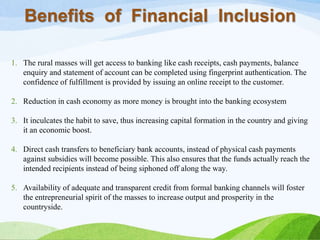
Benefits of Financial Inclusion
1. The rural masses will get access to banking like cash receipts, cash payments, balance
enquiry and statement of account can be completed using fingerprint authentication. The
confidence of fulfillment is provided by issuing an online receipt to the customer.
2. Reduction in cash economy as more money is brought into the banking ecosystem
3. It inculcates the habit to save, thus increasing capital formation in the country and giving
it an economic boost.
4. Direct cash transfers to beneficiary bank accounts, instead of physical cash payments
against subsidies will become possible. This also ensures that the funds actually reach the
intended recipients instead of being siphoned off along the way.
5. Availability of adequate and transparent credit from formal banking channels will foster
the entrepreneurial spirit of the masses to increase output and prosperity in the
countryside.
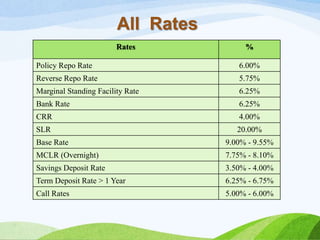
All Rates
Rates %
Policy Repo Rate 6.00%
Reverse Repo Rate 5.75%
Marginal Standing Facility Rate 6.25%
Bank Rate 6.25%
CRR 4.00%
SLR 20.00%
Base Rate 9.00% - 9.55%
MCLR (Overnight) 7.75% - 8.10%
Savings Deposit Rate 3.50% - 4.00%
Term Deposit Rate > 1 Year 6.25% - 6.75%
Call Rates 5.00% - 6.00%
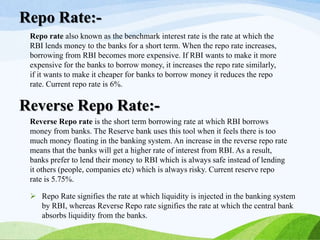
Repo rate also known as the benchmark interest rate is the rate at which the
RBI lends money to the banks for a short term. When the repo rate increases,
borrowing from RBI becomes more expensive. If RBI wants to make it more
expensive for the banks to borrow money, it increases the repo rate similarly,
if it wants to make it cheaper for banks to borrow money it reduces the repo
rate. Current repo rate is 6%.
Repo Rate:-
Reverse Repo rate is the short term borrowing rate at which RBI borrows
money from banks. The Reserve bank uses this tool when it feels there is too
much money floating in the banking system. An increase in the reverse repo rate
means that the banks will get a higher rate of interest from RBI. As a result,
banks prefer to lend their money to RBI which is always safe instead of lending
it others (people, companies etc) which is always risky. Current reserve repo
rate is 5.75%.
Reverse Repo Rate:-
 Repo Rate signifies the rate at which liquidity is injected in the banking system
by RBI, whereas Reverse Repo rate signifies the rate at which the central bank
absorbs liquidity from the banks.
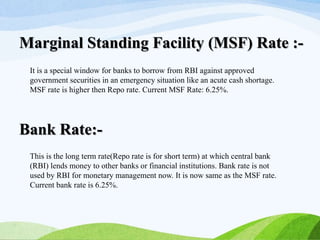
It is a special window for banks to borrow from RBI against approved
government securities in an emergency situation like an acute cash shortage.
MSF rate is higher then Repo rate. Current MSF Rate: 6.25%.
Marginal Standing Facility (MSF) Rate :-
This is the long term rate(Repo rate is for short term) at which central bank
(RBI) lends money to other banks or financial institutions. Bank rate is not
used by RBI for monetary management now. It is now same as the MSF rate.
Current bank rate is 6.25%.
Bank Rate:-
Banks in India are required to hold a certain proportion of their deposits in the
form of cash. However Banks don't hold these as cash with themselves, they
deposit such cash(aka currency chests) with Reserve Bank of India , which is
considered as equivalent to holding cash with themselves. This minimum ratio
(that is the part of the total deposits to be held as cash) is stipulated by the RBI and
is known as the CRR or Cash Reserve Ratio.
When a bank's deposits increase by Rs100, and if the cash reserve ratio is 9%, the
banks will have to hold Rs. 9 with RBI and the bank will be able to use only Rs 91
for investments and lending, credit purpose. Therefore, higher the ratio, the lower
is the amount that banks will be able to use for lending and investment. This
power of Reserve bank of India to reduce the lendable amount by increasing the
CRR, makes it an instrument in the hands of a central bank through which it can
control the amount that banks lend. Thus, it is a tool used by RBI to control
liquidity in the banking system.
Cash Reserve Ratio (CRR):-
Every bank is required to maintain at the close of business every day, a minimum
proportion of their Net Demand and Time Liabilities as liquid assets in the form of
cash, gold and un-encumbered approved securities. The ratio of liquid assets to
demand and time liabilities is known as Statutory Liquidity Ratio (SLR). RBI is
empowered to increase this ratio up to 40%. An increase in SLR also restricts the
bank's leverage position to pump more money into the economy.
Net Demand Liabilities - Bank accounts from which you can withdraw your
money at any time like your savings accounts and current account.
Time Liabilities - Bank accounts where you cannot immediately withdraw your
money but have to wait for certain period. e.g. Fixed deposit accounts.
Statutory Liquidity Ratio (SLR):-
If the CRR is high, banks have to keep more money with RBI and also the cost to
the banks will be higher. As a result you have to pay a higher rate of interest on
your borrowings from the banks. On the other hand, if RBI cuts the CRR, the cost
to banks come down and if banks reduce their basic lending rate/ base rate, then
your cost to borrowing also comes down i.e. banks reduces the interest rate on
your borrowings.
Impact of CRR:-
If the SLR increases, it restricts the bank’s lending capacity and helps in
controlling the inflation by soaking the liquidity from the market. Consequently,
banks will have less money available to lend, and they will charge higher interest
rates on loans to keep up their profit margin.
Impact of SLR:-
Base rate is the minimum rate set by the Reserve Bank of India below which
banks are not allowed to lend to its customers.
Base rate is decided in order to enhance transparency in the credit market and
ensure that banks pass on the lower cost of fund to their customers.
Base Rate:-
Marginal Cost of Funds Based Lending Rate(MCLR) is a new methodology of
setting the lending rate by commercial banks. Earlier Base Rate System was used.
Base Rate System is the minimum rate set by the Reserve Bank of India below
which banks are not allowed to lend to its customers.
MCLR:-
Inter bank borrowing rate - Interest Rate paid by the banks for lending and
borrowing funds with maturity period ranging from one day to 14 days. Call
money market deals with extremely short term lending between banks themselves.
After Lehman Brothers went bankrupt Call Rate sky rocketed to such an insane
level that banks stopped lending to other banks.
Call Rates:-
Financial Inclusion and All Rates

Financial Inclusion and All Rates

  • 1.
  • 2.
    Financial Inclusion Financial Inclusionis the process of ensuring access to appropriate financial products and services needed by all sections of the society in general and vulnerable groups such as weaker sections and low income groups in particular at an affordable cost in a fair and transparent manner by mainstream institutional players. (RBI) “The process of ensuring access to financial services and timely and adequate credit where needed by vulnerable groups such as weaker sections and low income groups at an affordable cost” - The Committee on Financial Inclusion (Chairman: Dr. C. Rangarajan, 2008)
  • 3.
    * Financial Inclusionshould include access to financial products and services like, * Bank accounts – check in account * Immediate Credit * Savings products * Remittances & Payment services * Insurance – Healthcare * Mortgage * Financial advisory services * Entrepreneurial credit Financial Inclusion - Scope
  • 4.
    Financial Inclusion –Who are these People? * Underprivileged section in rural and urban areas like, Farmers, small vendors, etc. * Agricultural and Industrial Labourers * People engaged in un-organised sectors * Unemployed * Women * Children * Old people * Physically challenged people
  • 5.
    Financial Inclusion –Steps Taken 1. Co-operative Movement 2. Setting up of State Bank of India 3. Lead Bank Scheme 4. RRBs 5. Service Area Approach 6. Self Help Groups
  • 6.
    What Are RBI‘sContribution 1. No-Frill Accounts 2. Overdraft in Saving Bank Accounts 3. BC Model 4. KYC Guidelines 5. Liberalized branch expansion 6. Liberalized policy for ATM 7. Introducing technology products and services 8. Pre-Paid cards, Mobile Banking etc. 9. Allowing RRBs’ / Co-operative banks to sell Insurance and Financial Products 10. Financial Literacy Program 11. Creation of Special Funds 12. 431 districts identified by the SLBC for 100 per cent financial inclusion across various States/UTs and the target in 204 districts of 21 States and 7 UTs has reportedly been achieved
  • 7.
    Reasons Financial Inclusionin India is Important Financial inclusion of the unbanked masses is a critical step that requires political will, bureaucratic support and constant pressure by the RBI. It is expected to unleash the hugely untapped potential of the bottom-of-pyramid section of Indian economy.
  • 8.
    Benefits of FinancialInclusion 1. The rural masses will get access to banking like cash receipts, cash payments, balance enquiry and statement of account can be completed using fingerprint authentication. The confidence of fulfillment is provided by issuing an online receipt to the customer. 2. Reduction in cash economy as more money is brought into the banking ecosystem 3. It inculcates the habit to save, thus increasing capital formation in the country and giving it an economic boost. 4. Direct cash transfers to beneficiary bank accounts, instead of physical cash payments against subsidies will become possible. This also ensures that the funds actually reach the intended recipients instead of being siphoned off along the way. 5. Availability of adequate and transparent credit from formal banking channels will foster the entrepreneurial spirit of the masses to increase output and prosperity in the countryside.
  • 9.
    All Rates Rates % PolicyRepo Rate 6.00% Reverse Repo Rate 5.75% Marginal Standing Facility Rate 6.25% Bank Rate 6.25% CRR 4.00% SLR 20.00% Base Rate 9.00% - 9.55% MCLR (Overnight) 7.75% - 8.10% Savings Deposit Rate 3.50% - 4.00% Term Deposit Rate > 1 Year 6.25% - 6.75% Call Rates 5.00% - 6.00%
  • 10.
    Repo rate alsoknown as the benchmark interest rate is the rate at which the RBI lends money to the banks for a short term. When the repo rate increases, borrowing from RBI becomes more expensive. If RBI wants to make it more expensive for the banks to borrow money, it increases the repo rate similarly, if it wants to make it cheaper for banks to borrow money it reduces the repo rate. Current repo rate is 6%. Repo Rate:- Reverse Repo rate is the short term borrowing rate at which RBI borrows money from banks. The Reserve bank uses this tool when it feels there is too much money floating in the banking system. An increase in the reverse repo rate means that the banks will get a higher rate of interest from RBI. As a result, banks prefer to lend their money to RBI which is always safe instead of lending it others (people, companies etc) which is always risky. Current reserve repo rate is 5.75%. Reverse Repo Rate:-  Repo Rate signifies the rate at which liquidity is injected in the banking system by RBI, whereas Reverse Repo rate signifies the rate at which the central bank absorbs liquidity from the banks.
  • 11.
    It is aspecial window for banks to borrow from RBI against approved government securities in an emergency situation like an acute cash shortage. MSF rate is higher then Repo rate. Current MSF Rate: 6.25%. Marginal Standing Facility (MSF) Rate :- This is the long term rate(Repo rate is for short term) at which central bank (RBI) lends money to other banks or financial institutions. Bank rate is not used by RBI for monetary management now. It is now same as the MSF rate. Current bank rate is 6.25%. Bank Rate:-
  • 12.
    Banks in Indiaare required to hold a certain proportion of their deposits in the form of cash. However Banks don't hold these as cash with themselves, they deposit such cash(aka currency chests) with Reserve Bank of India , which is considered as equivalent to holding cash with themselves. This minimum ratio (that is the part of the total deposits to be held as cash) is stipulated by the RBI and is known as the CRR or Cash Reserve Ratio. When a bank's deposits increase by Rs100, and if the cash reserve ratio is 9%, the banks will have to hold Rs. 9 with RBI and the bank will be able to use only Rs 91 for investments and lending, credit purpose. Therefore, higher the ratio, the lower is the amount that banks will be able to use for lending and investment. This power of Reserve bank of India to reduce the lendable amount by increasing the CRR, makes it an instrument in the hands of a central bank through which it can control the amount that banks lend. Thus, it is a tool used by RBI to control liquidity in the banking system. Cash Reserve Ratio (CRR):-
  • 13.
    Every bank isrequired to maintain at the close of business every day, a minimum proportion of their Net Demand and Time Liabilities as liquid assets in the form of cash, gold and un-encumbered approved securities. The ratio of liquid assets to demand and time liabilities is known as Statutory Liquidity Ratio (SLR). RBI is empowered to increase this ratio up to 40%. An increase in SLR also restricts the bank's leverage position to pump more money into the economy. Net Demand Liabilities - Bank accounts from which you can withdraw your money at any time like your savings accounts and current account. Time Liabilities - Bank accounts where you cannot immediately withdraw your money but have to wait for certain period. e.g. Fixed deposit accounts. Statutory Liquidity Ratio (SLR):-
  • 14.
    If the CRRis high, banks have to keep more money with RBI and also the cost to the banks will be higher. As a result you have to pay a higher rate of interest on your borrowings from the banks. On the other hand, if RBI cuts the CRR, the cost to banks come down and if banks reduce their basic lending rate/ base rate, then your cost to borrowing also comes down i.e. banks reduces the interest rate on your borrowings. Impact of CRR:- If the SLR increases, it restricts the bank’s lending capacity and helps in controlling the inflation by soaking the liquidity from the market. Consequently, banks will have less money available to lend, and they will charge higher interest rates on loans to keep up their profit margin. Impact of SLR:-
  • 15.
    Base rate isthe minimum rate set by the Reserve Bank of India below which banks are not allowed to lend to its customers. Base rate is decided in order to enhance transparency in the credit market and ensure that banks pass on the lower cost of fund to their customers. Base Rate:- Marginal Cost of Funds Based Lending Rate(MCLR) is a new methodology of setting the lending rate by commercial banks. Earlier Base Rate System was used. Base Rate System is the minimum rate set by the Reserve Bank of India below which banks are not allowed to lend to its customers. MCLR:- Inter bank borrowing rate - Interest Rate paid by the banks for lending and borrowing funds with maturity period ranging from one day to 14 days. Call money market deals with extremely short term lending between banks themselves. After Lehman Brothers went bankrupt Call Rate sky rocketed to such an insane level that banks stopped lending to other banks. Call Rates:-