Interest Rate Policy
on Advances
Introduction:
 Since 1977, interest rates on advances have been
deregulated in a phased manner and RBI had given
freedom to banks to fix the rates.
 In deregulation regime, the Banks decide the rate they will
charge for giving out loans. They set a benchmark below
which they will not lend and that incorporates the cost that
the bank has to incur to give out the loan. Over and above
this benchmark, banks also charge “Spread” which varies
across categories based on the risk perused in the account.
This spread usually higher for riskier loans like unsecured
loans and lower for less risky loans. The key part being, that
these bench mark rates were decided by individual banks
keeping their cost model in mind.
 Benchmark Prime Lending Rate (BPLR) BPLR is the
interest rate at which commercial banks charge their
customers who are most credit worthy. It was introduced
in the year 2003. This was the internal benchmark rate,
used to determine the interest rates on advances/loans
sanctioned up to June 30, 2010.
 Base Rate system was introduced w.e.f 1st July 2010 by
RBI. It is the rate below which the individual banks can
not lend.
 Marginal Cost of funds based lending rates (MCLR) was
introduced w.e.f 01.04.2016 for interest rates on Advances.
MCLR is closely linked to the actual deposit rates and is
calculated based on four components: the marginal cost of
funds, negative carry on account of cash reserve ratio,
operating costs and tenor premium.
 Accordingly w.e.f 01.04.2016, all Rupee loans sanctioned and
credit limits renewed are to be priced with reference to the
minimum 5 benchmarks- Overnight MCLR, 1 Month-MCLR, 3
Month-MCLR, 6 Month-MCLR & 1-Year MCLR. In addition to
the above, banks shall have the option of publishing MCLR of
any other longer maturity. “3 year MCLR” has also been
introduced w.e.f 10.01.2020, which is applicable initially for
“Co-origination by Banks and NBFCs for lending to priority
sector”.
Bench mark contd...
 Hence, rate of interests are internally
benchmarked rate of interests.
 Though interest rates have been deregulated with
the Bank’s fixing their own benchmark interests like
MCLR and Base rate, there are some special
category of loans like loans falling under the
category or DRI, Staff loans etc., in which the
Banks still finance below the bench mark rate of
interest.
Bench mark contd...
 To make the transmission of monetary policy more effective, and the
benchmark ROI more transparent, RBI has introduced External
Benchmarking ROI in lending to few sectors from 1st October, 2019.
 In terms of RBI guidelines, “All new floating rate personal or retail loans
(housing, auto, etc.) and floating rate loans to Micro and Small Enterprises
extended by banks from October 01, 2019 and floating rate loans to
Medium Enterprises from April 01, 2020 shall be benchmarked to one of
the external benchmark (i) Reserve Bank of India policy repo rate (ii)
Government of India 3-Months Treasury Bill yield published by the
Financial Benchmarks India Private Ltd (FBIL) (iii) Government of India 6-
Months Treasury Bill yield published by the FBIL (iv) Any other benchmark
market interest rate published by the FBIL” It has further been stated that
“Banks are free to offer such external benchmark linked loans to other
types of borrowers as well”. Our bank has introduced Repo Based
Lending rates (RBLR) w.e.f 1st October, 2019 in a phased manner.
Bench mark contd...
 Adoption of multiple benchmarks by the same bank
will not be allowed within a loan category. For
example, a bank cannot link some retail loans to repo
rates and other retail loans to Treasury Bill. This has
been done to ensure transparency, standardization
and ease of understanding of loan products by
borrowers.
Bench mark contd...
MARGINAL COST OF FUND BASED LENDING RATES (MCLR)
 W.e.f. 01.04.2016, all Rupee loans sanctioned and credit
limits renewed are to be priced with reference to the minimum
5 benchmarks- Overnight MCLR, 1 Month-MCLR, 3 Month-
MCLR, 6 Month-MCLR & 1-Year MCLR.
 In addition to the above, “3 year MCLR” has also been
introduced w.e.f 10.01.2020, which is applicable initially for
Co-origination by Banks and NBFCs for lending to priority
sector.
 MCLR comprises of -
Marginal cost of funds;
Negative carry on account of CRR;
Operating costs;
Tenor Premium.
 The various components of MCLR are as under -
Rate of Interest = Applicable MCLR + Business
Strategy spread (BSS) + Credit Risk Premium (CRP) #
# since tenor premium is already taken into account while
calculating MCLR, no other component to be added over
and above these three components like tenor premium etc.
 The periodical adoption of MCLR effective from 1st day of
every month, as approved by the ALCO is advised to the
branches every month.
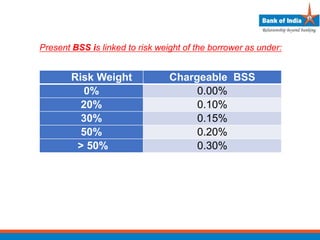
Risk Weight Chargeable BSS
0% 0.00%
20% 0.10%
30% 0.15%
50% 0.20%
> 50% 0.30%
Present BSS is linked to risk weight of the borrower as under:
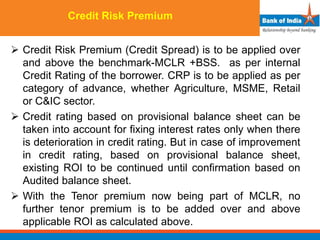
Credit Risk Premium
 Credit Risk Premium (Credit Spread) is to be applied over
and above the benchmark-MCLR +BSS. as per internal
Credit Rating of the borrower. CRP is to be applied as per
category of advance, whether Agriculture, MSME, Retail
or C&IC sector.
 Credit rating based on provisional balance sheet can be
taken into account for fixing interest rates only when there
is deterioration in credit rating. But in case of improvement
in credit rating, based on provisional balance sheet,
existing ROI to be continued until confirmation based on
Audited balance sheet.
 With the Tenor premium now being part of MCLR, no
further tenor premium is to be added over and above
applicable ROI as calculated above.
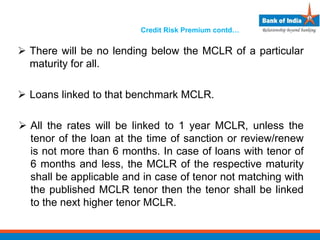
Credit Risk Premium contd…
 There will be no lending below the MCLR of a particular
maturity for all.
 Loans linked to that benchmark MCLR.
 All the rates will be linked to 1 year MCLR, unless the
tenor of the loan at the time of sanction or review/renew
is not more than 6 months. In case of loans with tenor of
6 months and less, the MCLR of the respective maturity
shall be applicable and in case of tenor not matching with
the published MCLR tenor then the tenor shall be linked
to the next higher tenor MCLR.
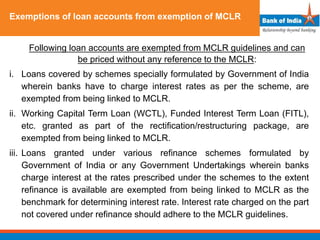
Exemptions of loan accounts from exemption of MCLR
Following loan accounts are exempted from MCLR guidelines and can
be priced without any reference to the MCLR:
i. Loans covered by schemes specially formulated by Government of India
wherein banks have to charge interest rates as per the scheme, are
exempted from being linked to MCLR.
ii. Working Capital Term Loan (WCTL), Funded Interest Term Loan (FITL),
etc. granted as part of the rectification/restructuring package, are
exempted from being linked to MCLR.
iii. Loans granted under various refinance schemes formulated by
Government of India or any Government Undertakings wherein banks
charge interest at the rates prescribed under the schemes to the extent
refinance is available are exempted from being linked to MCLR as the
benchmark for determining interest rate. Interest rate charged on the part
not covered under refinance should adhere to the MCLR guidelines.
Exemptions contd…
iv. Advances to banks’ depositors against their own deposits.
v. Advances to banks’ own employees including retired
employees.
vi. Advances granted to the Chief Executive Officer / Whole Time
Directors.
vii. Loans linked to a market determined external benchmark.
viii. Fixed rate loans granted by banks above 3 years. However, in
case of Fixed rate loans granted by banks upto 3 years OR
hybrid loans where the interest rates are partly fixed and partly
floating, interest rate on the floating portion should adhere to the
MCLR guidelines.
ix. Loans linked to external benchmark are exempted from linkage
to MCLR. All PSU borrowers with external rating of AAA may be
linked to external benchmark rates on a case to case basis.
Repo Based Lending Rates (RBLR)
 Interest rate on advances linked to External Benchmark
has been introduced by RBI w.e.f 1st October, 2019, as
RBI observed that the transmission of policy rate changes
to the lending rate of banks under the current MCLR
framework has not been satisfactory.
 Our bank has introduced Repo Based Lending rates
(RBLR) w.e.f 1st October, 2019, with Reserve Bank of India
Policy Repo rate being the external benchmark.
 The components of RBLR are - Reserve Bank of India
Policy Repo rate + Mark up.
 Applicable ROI = RBLR + Business Strategy
Discount/Premium +CRP.
RBLR contd…
 Repo rate is the rate at which the Central Bank of a country
(Reserve Bank of India in case of India) lends money to
commercial banks in the event of any shortfall of funds.
“Repo rate” is advised from time to time by RBI, which is
determined based on the assessment of the macroeconomic
condition and with the aim to keep Consumer Price Index
(CPI) inflation in control i.e near 4 per cent presently.
 Mark up will be computed and published by Risk Management
Department, once in every three months or from time to time
as decided by ALCO. However, Mark Up will be reset after
three years for a specific account. The first reset will be three
years from the date of first disbursement and subsequent
reset will be every three years from the date of last reset.
 Business Strategy discount/premium: This component
will be computed and published by Risk Management
Department on quarterly basis, or as decided by ALCO.
However the Business Strategy discount/premium will be
reset in a particular account only after three years from the
date of first disbursement and subsequent reset will be
every three years from the date of last reset.
 Repo Based Lending Rates(RBLR) in our bank have been
introduced in Retail Loans & MSME advances w.e.f
01.10.2019.
 Food & Agro processing units under Agriculture sector are
also linked to RBLR w.e.f 29.08.2020.
RBLR contd…
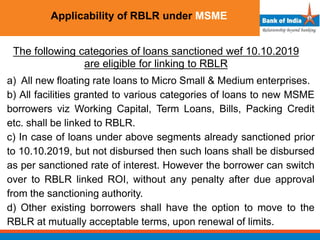
Applicability of RBLR under MSME
The following categories of loans sanctioned wef 10.10.2019
are eligible for linking to RBLR
a) All new floating rate loans to Micro Small & Medium enterprises.
b) All facilities granted to various categories of loans to new MSME
borrowers viz Working Capital, Term Loans, Bills, Packing Credit
etc. shall be linked to RBLR.
c) In case of loans under above segments already sanctioned prior
to 10.10.2019, but not disbursed then such loans shall be disbursed
as per sanctioned rate of interest. However the borrower can switch
over to RBLR linked ROI, without any penalty after due approval
from the sanctioning authority.
d) Other existing borrowers shall have the option to move to the
RBLR at mutually acceptable terms, upon renewal of limits.
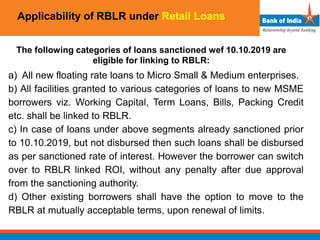
Applicability of RBLR under Retail Loans
The following categories of loans sanctioned wef 10.10.2019 are
eligible for linking to RBLR:
a) All new floating rate loans to Micro Small & Medium enterprises.
b) All facilities granted to various categories of loans to new MSME
borrowers viz. Working Capital, Term Loans, Bills, Packing Credit
etc. shall be linked to RBLR.
c) In case of loans under above segments already sanctioned prior
to 10.10.2019, but not disbursed then such loans shall be disbursed
as per sanctioned rate of interest. However the borrower can switch
over to RBLR linked ROI, without any penalty after due approval
from the sanctioning authority.
d) Other existing borrowers shall have the option to move to the
RBLR at mutually acceptable terms, upon renewal of limits.
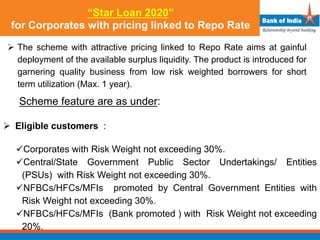
“Star Loan 2020”
for Corporates with pricing linked to Repo Rate
 The scheme with attractive pricing linked to Repo Rate aims at gainful
deployment of the available surplus liquidity. The product is introduced for
garnering quality business from low risk weighted borrowers for short
term utilization (Max. 1 year).
Scheme feature are as under:
 Eligible customers :
Corporates with Risk Weight not exceeding 30%.
Central/State Government Public Sector Undertakings/ Entities
(PSUs) with Risk Weight not exceeding 30%.
NFBCs/HFCs/MFIs promoted by Central Government Entities with
Risk Weight not exceeding 30%.
NFBCs/HFCs/MFIs (Bank promoted ) with Risk Weight not exceeding
20%.
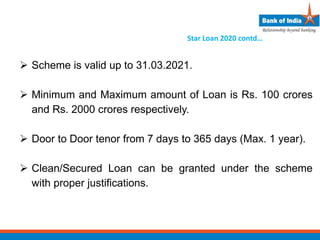
 Scheme is valid up to 31.03.2021.
 Minimum and Maximum amount of Loan is Rs. 100 crores
and Rs. 2000 crores respectively.
 Door to Door tenor from 7 days to 365 days (Max. 1 year).
 Clean/Secured Loan can be granted under the scheme
with proper justifications.
Star Loan 2020 contd…
 Purpose :
 Any bona fide business purpose.
 Strengthening of Net Working Capital(NWC).
 Repayment of high cost debt availed from other Banks.
 To our existing borrowers for urgent/unforeseen
reasons/purposes like surge in orders/urgent payments like
duties, advances to suppliers, administrative expenses etc.
 Short term loan within term loan granted, pending full tie
up/financial closure/joint documentation to enable the
company to roll out the project so as to be in a position to
complete the project well in time.
 Pricing : Pricing linked to floating Repo Rate, as advised by
RBI from time to time
Star Loan 2020 contd…
Important Points regarding
charging of Penal Interest
As per Interest Rate Policy, penal interest to be charged
as under:
i. No penal interest should be charged for advance
accounts upto the sanctioned limit of Rs.25,000/-.
ii. Maximum penal interest that can be levied in an
account is 2% p.a. covering all types of default
concurrently and should be charged on the
outstanding balance and not on sanctioned limit.
Important Points regarding charging of Penal Interest contd…
iii. The aberrations for which penal interest can be levied are as under :
 For the period of overdue interest / instalment in respect of Term Loans and
over-drawings above the drawing power / limit in Fund Based Working
Capital accounts on account of interest / devolvement of Letters of Credit /
Bank Guarantee, insufficient stocks and receivables, etc. (the penal interest
is charged on the overdue amount only i.e. amount over and above the
drawing limit in the account).
 Non-submission of various statements (stock/book-debts, QIS etc) and
financial data (Balance Sheet, CMA etc.) Irregularities in accounts and
default in repayment of loan.
 Non-submission of review / renewal data at least one month prior to due
date.
 Non-obtention of External credit risk rating from agency approved by RBI.
 Default in complying with terms of sanction.
The penal interest should be levied with discretion and selectively within the
said guidelines. It should act as a corrective measure rather than a punitive
action.
Vital points in the Interest rate policy
1. All existing and new Micro & Small enterprises account
with limit up to Rs. 1 Cr and covered under CGTMSE
guarantee will be eligible for a concession of 0.50% on the
applicable rate.
2. In respect of accounts rated by any of the following
external; credit rating agencies like SMERA, ONICRA, Dun
& Bradstreet, CRISIL, CARE, ICRA, FITCH, Brickwork
Ratings – concession in the ROI to the extent of 0.50% in
respect of units obtaining highest and second highest
rating and to the extent of 0.25% in respect of units
obtaining third highest rating are being allowed.
Vital points contd…
3. In respect of women beneficiaries financed under
Priyadarshini Yojana for various purposes.
a) 0.50% less than the applicable rate for the limits upto Rs
50,000/-
b)1% less than applicable rates for limits above Rs 50,000/-
4. In the cases of borrower who are eligible for one or more
concessions pointed out in point 1 to 3 above, the
concession in ROI should not exceed 1.50%.
Vital points contd…
5. The above general concessions are not applicable in
Schematic loans.
6. For determining the limit slab under which the
account will fall, the aggregate exposure on account
of both fund based limit & non fund based limit should
be considered.
Thank You

Interest rate policy on advances.pptx

  • 1.
  • 2.
    Introduction:  Since 1977,interest rates on advances have been deregulated in a phased manner and RBI had given freedom to banks to fix the rates.  In deregulation regime, the Banks decide the rate they will charge for giving out loans. They set a benchmark below which they will not lend and that incorporates the cost that the bank has to incur to give out the loan. Over and above this benchmark, banks also charge “Spread” which varies across categories based on the risk perused in the account. This spread usually higher for riskier loans like unsecured loans and lower for less risky loans. The key part being, that these bench mark rates were decided by individual banks keeping their cost model in mind.
  • 3.
     Benchmark PrimeLending Rate (BPLR) BPLR is the interest rate at which commercial banks charge their customers who are most credit worthy. It was introduced in the year 2003. This was the internal benchmark rate, used to determine the interest rates on advances/loans sanctioned up to June 30, 2010.  Base Rate system was introduced w.e.f 1st July 2010 by RBI. It is the rate below which the individual banks can not lend.
  • 4.
     Marginal Costof funds based lending rates (MCLR) was introduced w.e.f 01.04.2016 for interest rates on Advances. MCLR is closely linked to the actual deposit rates and is calculated based on four components: the marginal cost of funds, negative carry on account of cash reserve ratio, operating costs and tenor premium.  Accordingly w.e.f 01.04.2016, all Rupee loans sanctioned and credit limits renewed are to be priced with reference to the minimum 5 benchmarks- Overnight MCLR, 1 Month-MCLR, 3 Month-MCLR, 6 Month-MCLR & 1-Year MCLR. In addition to the above, banks shall have the option of publishing MCLR of any other longer maturity. “3 year MCLR” has also been introduced w.e.f 10.01.2020, which is applicable initially for “Co-origination by Banks and NBFCs for lending to priority sector”. Bench mark contd...
  • 5.
     Hence, rateof interests are internally benchmarked rate of interests.  Though interest rates have been deregulated with the Bank’s fixing their own benchmark interests like MCLR and Base rate, there are some special category of loans like loans falling under the category or DRI, Staff loans etc., in which the Banks still finance below the bench mark rate of interest. Bench mark contd...
  • 6.
     To makethe transmission of monetary policy more effective, and the benchmark ROI more transparent, RBI has introduced External Benchmarking ROI in lending to few sectors from 1st October, 2019.  In terms of RBI guidelines, “All new floating rate personal or retail loans (housing, auto, etc.) and floating rate loans to Micro and Small Enterprises extended by banks from October 01, 2019 and floating rate loans to Medium Enterprises from April 01, 2020 shall be benchmarked to one of the external benchmark (i) Reserve Bank of India policy repo rate (ii) Government of India 3-Months Treasury Bill yield published by the Financial Benchmarks India Private Ltd (FBIL) (iii) Government of India 6- Months Treasury Bill yield published by the FBIL (iv) Any other benchmark market interest rate published by the FBIL” It has further been stated that “Banks are free to offer such external benchmark linked loans to other types of borrowers as well”. Our bank has introduced Repo Based Lending rates (RBLR) w.e.f 1st October, 2019 in a phased manner. Bench mark contd...
  • 7.
     Adoption ofmultiple benchmarks by the same bank will not be allowed within a loan category. For example, a bank cannot link some retail loans to repo rates and other retail loans to Treasury Bill. This has been done to ensure transparency, standardization and ease of understanding of loan products by borrowers. Bench mark contd...
  • 8.
    MARGINAL COST OFFUND BASED LENDING RATES (MCLR)  W.e.f. 01.04.2016, all Rupee loans sanctioned and credit limits renewed are to be priced with reference to the minimum 5 benchmarks- Overnight MCLR, 1 Month-MCLR, 3 Month- MCLR, 6 Month-MCLR & 1-Year MCLR.  In addition to the above, “3 year MCLR” has also been introduced w.e.f 10.01.2020, which is applicable initially for Co-origination by Banks and NBFCs for lending to priority sector.  MCLR comprises of - Marginal cost of funds; Negative carry on account of CRR; Operating costs; Tenor Premium.
  • 9.
     The variouscomponents of MCLR are as under - Rate of Interest = Applicable MCLR + Business Strategy spread (BSS) + Credit Risk Premium (CRP) # # since tenor premium is already taken into account while calculating MCLR, no other component to be added over and above these three components like tenor premium etc.  The periodical adoption of MCLR effective from 1st day of every month, as approved by the ALCO is advised to the branches every month.
  • 10.
    Risk Weight ChargeableBSS 0% 0.00% 20% 0.10% 30% 0.15% 50% 0.20% > 50% 0.30% Present BSS is linked to risk weight of the borrower as under:
  • 11.
    Credit Risk Premium Credit Risk Premium (Credit Spread) is to be applied over and above the benchmark-MCLR +BSS. as per internal Credit Rating of the borrower. CRP is to be applied as per category of advance, whether Agriculture, MSME, Retail or C&IC sector.  Credit rating based on provisional balance sheet can be taken into account for fixing interest rates only when there is deterioration in credit rating. But in case of improvement in credit rating, based on provisional balance sheet, existing ROI to be continued until confirmation based on Audited balance sheet.  With the Tenor premium now being part of MCLR, no further tenor premium is to be added over and above applicable ROI as calculated above.
  • 12.
    Credit Risk Premiumcontd…  There will be no lending below the MCLR of a particular maturity for all.  Loans linked to that benchmark MCLR.  All the rates will be linked to 1 year MCLR, unless the tenor of the loan at the time of sanction or review/renew is not more than 6 months. In case of loans with tenor of 6 months and less, the MCLR of the respective maturity shall be applicable and in case of tenor not matching with the published MCLR tenor then the tenor shall be linked to the next higher tenor MCLR.
  • 13.
    Exemptions of loanaccounts from exemption of MCLR Following loan accounts are exempted from MCLR guidelines and can be priced without any reference to the MCLR: i. Loans covered by schemes specially formulated by Government of India wherein banks have to charge interest rates as per the scheme, are exempted from being linked to MCLR. ii. Working Capital Term Loan (WCTL), Funded Interest Term Loan (FITL), etc. granted as part of the rectification/restructuring package, are exempted from being linked to MCLR. iii. Loans granted under various refinance schemes formulated by Government of India or any Government Undertakings wherein banks charge interest at the rates prescribed under the schemes to the extent refinance is available are exempted from being linked to MCLR as the benchmark for determining interest rate. Interest rate charged on the part not covered under refinance should adhere to the MCLR guidelines.
  • 14.
    Exemptions contd… iv. Advancesto banks’ depositors against their own deposits. v. Advances to banks’ own employees including retired employees. vi. Advances granted to the Chief Executive Officer / Whole Time Directors. vii. Loans linked to a market determined external benchmark. viii. Fixed rate loans granted by banks above 3 years. However, in case of Fixed rate loans granted by banks upto 3 years OR hybrid loans where the interest rates are partly fixed and partly floating, interest rate on the floating portion should adhere to the MCLR guidelines. ix. Loans linked to external benchmark are exempted from linkage to MCLR. All PSU borrowers with external rating of AAA may be linked to external benchmark rates on a case to case basis.
  • 15.
    Repo Based LendingRates (RBLR)  Interest rate on advances linked to External Benchmark has been introduced by RBI w.e.f 1st October, 2019, as RBI observed that the transmission of policy rate changes to the lending rate of banks under the current MCLR framework has not been satisfactory.  Our bank has introduced Repo Based Lending rates (RBLR) w.e.f 1st October, 2019, with Reserve Bank of India Policy Repo rate being the external benchmark.  The components of RBLR are - Reserve Bank of India Policy Repo rate + Mark up.  Applicable ROI = RBLR + Business Strategy Discount/Premium +CRP.
  • 16.
    RBLR contd…  Reporate is the rate at which the Central Bank of a country (Reserve Bank of India in case of India) lends money to commercial banks in the event of any shortfall of funds. “Repo rate” is advised from time to time by RBI, which is determined based on the assessment of the macroeconomic condition and with the aim to keep Consumer Price Index (CPI) inflation in control i.e near 4 per cent presently.  Mark up will be computed and published by Risk Management Department, once in every three months or from time to time as decided by ALCO. However, Mark Up will be reset after three years for a specific account. The first reset will be three years from the date of first disbursement and subsequent reset will be every three years from the date of last reset.
  • 17.
     Business Strategydiscount/premium: This component will be computed and published by Risk Management Department on quarterly basis, or as decided by ALCO. However the Business Strategy discount/premium will be reset in a particular account only after three years from the date of first disbursement and subsequent reset will be every three years from the date of last reset.  Repo Based Lending Rates(RBLR) in our bank have been introduced in Retail Loans & MSME advances w.e.f 01.10.2019.  Food & Agro processing units under Agriculture sector are also linked to RBLR w.e.f 29.08.2020. RBLR contd…
  • 18.
    Applicability of RBLRunder MSME The following categories of loans sanctioned wef 10.10.2019 are eligible for linking to RBLR a) All new floating rate loans to Micro Small & Medium enterprises. b) All facilities granted to various categories of loans to new MSME borrowers viz Working Capital, Term Loans, Bills, Packing Credit etc. shall be linked to RBLR. c) In case of loans under above segments already sanctioned prior to 10.10.2019, but not disbursed then such loans shall be disbursed as per sanctioned rate of interest. However the borrower can switch over to RBLR linked ROI, without any penalty after due approval from the sanctioning authority. d) Other existing borrowers shall have the option to move to the RBLR at mutually acceptable terms, upon renewal of limits.
  • 19.
    Applicability of RBLRunder Retail Loans The following categories of loans sanctioned wef 10.10.2019 are eligible for linking to RBLR: a) All new floating rate loans to Micro Small & Medium enterprises. b) All facilities granted to various categories of loans to new MSME borrowers viz. Working Capital, Term Loans, Bills, Packing Credit etc. shall be linked to RBLR. c) In case of loans under above segments already sanctioned prior to 10.10.2019, but not disbursed then such loans shall be disbursed as per sanctioned rate of interest. However the borrower can switch over to RBLR linked ROI, without any penalty after due approval from the sanctioning authority. d) Other existing borrowers shall have the option to move to the RBLR at mutually acceptable terms, upon renewal of limits.
  • 20.
    “Star Loan 2020” forCorporates with pricing linked to Repo Rate  The scheme with attractive pricing linked to Repo Rate aims at gainful deployment of the available surplus liquidity. The product is introduced for garnering quality business from low risk weighted borrowers for short term utilization (Max. 1 year). Scheme feature are as under:  Eligible customers : Corporates with Risk Weight not exceeding 30%. Central/State Government Public Sector Undertakings/ Entities (PSUs) with Risk Weight not exceeding 30%. NFBCs/HFCs/MFIs promoted by Central Government Entities with Risk Weight not exceeding 30%. NFBCs/HFCs/MFIs (Bank promoted ) with Risk Weight not exceeding 20%.
  • 21.
     Scheme isvalid up to 31.03.2021.  Minimum and Maximum amount of Loan is Rs. 100 crores and Rs. 2000 crores respectively.  Door to Door tenor from 7 days to 365 days (Max. 1 year).  Clean/Secured Loan can be granted under the scheme with proper justifications. Star Loan 2020 contd…
  • 22.
     Purpose : Any bona fide business purpose.  Strengthening of Net Working Capital(NWC).  Repayment of high cost debt availed from other Banks.  To our existing borrowers for urgent/unforeseen reasons/purposes like surge in orders/urgent payments like duties, advances to suppliers, administrative expenses etc.  Short term loan within term loan granted, pending full tie up/financial closure/joint documentation to enable the company to roll out the project so as to be in a position to complete the project well in time.  Pricing : Pricing linked to floating Repo Rate, as advised by RBI from time to time Star Loan 2020 contd…
  • 23.
    Important Points regarding chargingof Penal Interest As per Interest Rate Policy, penal interest to be charged as under: i. No penal interest should be charged for advance accounts upto the sanctioned limit of Rs.25,000/-. ii. Maximum penal interest that can be levied in an account is 2% p.a. covering all types of default concurrently and should be charged on the outstanding balance and not on sanctioned limit.
  • 24.
    Important Points regardingcharging of Penal Interest contd… iii. The aberrations for which penal interest can be levied are as under :  For the period of overdue interest / instalment in respect of Term Loans and over-drawings above the drawing power / limit in Fund Based Working Capital accounts on account of interest / devolvement of Letters of Credit / Bank Guarantee, insufficient stocks and receivables, etc. (the penal interest is charged on the overdue amount only i.e. amount over and above the drawing limit in the account).  Non-submission of various statements (stock/book-debts, QIS etc) and financial data (Balance Sheet, CMA etc.) Irregularities in accounts and default in repayment of loan.  Non-submission of review / renewal data at least one month prior to due date.  Non-obtention of External credit risk rating from agency approved by RBI.  Default in complying with terms of sanction. The penal interest should be levied with discretion and selectively within the said guidelines. It should act as a corrective measure rather than a punitive action.
  • 25.
    Vital points inthe Interest rate policy 1. All existing and new Micro & Small enterprises account with limit up to Rs. 1 Cr and covered under CGTMSE guarantee will be eligible for a concession of 0.50% on the applicable rate. 2. In respect of accounts rated by any of the following external; credit rating agencies like SMERA, ONICRA, Dun & Bradstreet, CRISIL, CARE, ICRA, FITCH, Brickwork Ratings – concession in the ROI to the extent of 0.50% in respect of units obtaining highest and second highest rating and to the extent of 0.25% in respect of units obtaining third highest rating are being allowed.
  • 26.
    Vital points contd… 3.In respect of women beneficiaries financed under Priyadarshini Yojana for various purposes. a) 0.50% less than the applicable rate for the limits upto Rs 50,000/- b)1% less than applicable rates for limits above Rs 50,000/- 4. In the cases of borrower who are eligible for one or more concessions pointed out in point 1 to 3 above, the concession in ROI should not exceed 1.50%.
  • 27.
    Vital points contd… 5.The above general concessions are not applicable in Schematic loans. 6. For determining the limit slab under which the account will fall, the aggregate exposure on account of both fund based limit & non fund based limit should be considered.
  • 28.