BANK PRODUCTS
Bank Products 
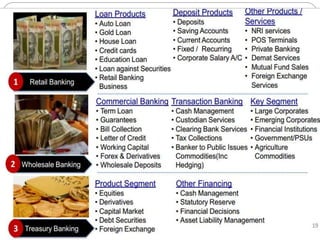
 Banking products have evolved from the traditional loans 
& deposits to a large variety of offerings. 
 Bank products range 
 from wholesale or corporate products to retail products 
 from fund based to fee-based 
 from domestic to foreign
Commercial/ Wholesale Credit
Commercial Credit 
 The credit granted by a bank can be funded or non funded 
credit. 
 Funded credit involves a flow of funds from the bank to the 
borrower ex: cash credit, demand loans, overdraft, bill 
purchased and discounted 
 While non funded credit doesn’t not Ex: guarantees and 
letter of credit 
 Cash credit is provided with limit no maturity and can be 
drawn at will by the borrower but demand loan has granted 
with maturity & lump sum amount is paid & repayable in 
lump sum at maturity or installment
Cash Credit & Working Capital Demand 
Loans 
Working Capital Finance 
 Working Capital facilities are provided to finance the day-to-day 
business requirements. Funding requirements are 
structured to finance procurement of raw materials/stores 
and payment towards manufacturing costs and other 
overheads. 
The Bank offers a combination of operative cash credit and 
working capital demand loan to meet the domestic working 
capital requirements of our clients. 
Short Term Finance 
 The Bank offers short-term loans for a period ranging from 3 
months to 12 months to sound corporate for meeting their 
specific short-term working capital requirements. The funds 
are provided with interest rates either linked to our 
BPLR(Benchmark Prime Lending Rate-14.5%) or at a base
Bill Purchase & Discounting 
• Discounting bill :Letter of credit is an instrument issued in the 
favor of the seller by the buyer bank assuring that payment will be 
made after certain timer frame depending upon the terms and 
conditions agreed, ranging from 30-120 days 
• Now when the seller receives the letter of credit through bank, 
seller prepares the documents and presents the same to the bank. 
The most important element in the same is the bill of exchange 
which is used to negotiate a letter of credit. Seller discounts that 
bill of exchange with the bank and gets money. 
• Now it is seller's bank responsibility to send documents and bill of 
exchange to buyer's bank for onward forwarding to the buyer for 
the acceptance and the buyer finally, accepts bill of exchange 
drawn by the seller on buyer's bank because he has opened that 
LC. Buyers bank than get that signed bill of exchange from the 
buyer as guarantee and release payment to the sellers bank and
Bill Purchase & Discounting 
• Bill Discounting is a process in which you can get instant cash on 
the purchases or credit sales made by you. If you have made 
purchase with your suppliers you can pay them instantly by getting 
discounted your purchase bill, for which you need to show the 
documents which authenticates the transaction done by you like 
trade invoices challans, truck receipts/railway receipts, bill of lading 
etc. Similarly if you have made any credit sales you can get instant 
money by getting discounted your sales bill. 
• BILLS PURCHASED, in trade finance, allows a seller to obtain 
financing and receive immediate funds in exchange for a sales 
document not drawn under a letter of credit. The bank will send the 
sales documents to the buyers bank on behalf of the seller. 
“In case of the bill purchase, the bill is purchased and that in case of 
bill discounting the bank is only financing against the said bill”
Overdraft 
• This facility is basically for Current Account holder in a bank 
can be sanctioned an overdraft facility. 
• An overdraft occurs when money is withdrawn from 
a bank account and the available balance goes below zero. In 
this situation the account is said to be "overdrawn". If there 
is a prior agreement with the account provider for an 
overdraft, and the amount overdrawn is within the authorized 
overdraft limit, then interest is normally charged at the 
agreed rate. If the negative balance exceeds the agreed 
terms, then additional fees may be charged and higher 
interest rates may apply.
Term Loans 
 A loan from a bank for a specific amount that has a specified 
repayment schedule and a floating interest rate. Term loans 
almost always mature between one and 10. 
 For example many banks have term-loan programs that can 
offer small businesses the cash they need to operate from 
month to month. Often a small business will use the cash 
from a term loan to purchase fixed assets such as 
equipment used in its production process. 
 Base Rate is 10-10.5% 
 Lending Rate: Base Rate+ spread(2% approx depend upon 
customer credit worthiness)
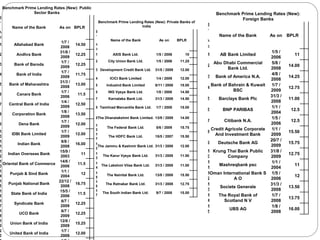
Benchmark Prime Lending Rates (New): Public 
Sector Banks 
S 
r 
. 
N 
o 
Name of the Bank As on BPLR 
1 Allahabad Bank 
1/7 / 
2008 
14.50 
2 Andhra Bank 
31/8 / 
2009 
12.25 
3 Bank of Baroda 
1/7 / 
2009 
12.25 
4 Bank of India 
1/7 / 
2009 
11.75 
5 Bank of Maharashtra 
31/3 / 
2008 
13.00 
6 Canara Bank 
1/7 / 
2006 
11.5 
7 Central Bank of India 
1/4 / 
2009 
12.50 
8 Corporation Bank 
1/8 / 
2008 
13.50 
9 Dena Bank 
1/7 / 
2009 
12.00 
1 
0 
IDBI Bank Limited 
1/7 / 
2009 
12.00 
1 
1 
Indian Bank 
8/8 / 
2008 
16.00 
1 
2 
Indian Overseas Bank 
15/9 / 
2003 
11 
1 
3 
Oriental Bank of Commerce 
14/6 / 
2006 
11.5 
1 
4 
Punjab & Sind Bank 
1/1 / 
2004 
12 
1 
5 
Punjab National Bank 
22/12 / 
2008 
16.75 
1 
6 
State Bank of India 
15/5 / 
2006 
11.5 
1 
7 
Syndicate Bank 
6/7 / 
2009 
12.25 
1 
8 
UCO Bank 
6/7 / 
2009 
12.25 
1 
9 
Union Bank of India 
12/6 / 
2009 
15.25 
2 
0 
United Bank of India 
1/7 / 
2009 
12.00 
2 
1/5 / 
Benchmark Prime Lending Rates (New): Private Banks of 
India 
S 
r 
. 
N 
o 
Name of the Bank As on BPLR 
1 AXIS Bank Ltd. 1/5 / 2006 10 
2 City Union Bank Ltd. 1/5 / 2006 11.25 
3 Development Credit Bank Ltd. 31/5 / 2009 12.00 
4 ICICI Bank Limited 1/4 / 2009 12.00 
5 IndusInd Bank Limited 6/11 / 2008 15.00 
6 ING Vysya Bank Ltd. 1/8 / 2008 14.50 
7 Karnataka Bank Ltd. 31/3 / 2008 14.50 
8 Tamilnad Mercantile Bank Ltd. 1/7 / 2008 15.00 
9The Dhanalakshmi Bank Limited. 13/9 / 2009 14.00 
1 
0 
The Federal Bank Ltd. 5/6 / 2009 15.75 
1 
1 
The HDFC Bank Ltd. 15/5 / 2007 15.50 
1 
2 
The Jammu & Kashmir Bank Ltd. 31/3 / 2008 12.00 
1 
3 
The Karur Vysya Bank Ltd. 31/3 / 2008 11.50 
1 
4 
The Lakshmi Vilas Bank Ltd. 31/3 / 2008 11.00 
1 
5 
The Nainital Bank Ltd. 13/8 / 2008 15.50 
1 
6 
The Ratnakar Bank Ltd. 31/3 / 2008 12.75 
1 
7 
The South Indian Bank Ltd. 9/7 / 2008 15.00 
Benchmark Prime Lending Rates (New): 
Foreign Banks 
S 
r 
. 
N 
o 
Name of the Bank As on BPLR 
1 AB Bank Limited 
1/5 / 
2006 
11 
2 
Abu Dhabi Commercial 
Bank Ltd. 
5/8 / 
2008 
14.00 
3 Bank of America N.A. 
4/8 / 
2008 
14.25 
4 
Bank of Bahrain & Kuwait 
BSC 
1/7 / 
2009 
12.75 
5 Barclays Bank Plc 
31/3 / 
2008 
11.00 
6 BNP PARIBAS 
1/1 / 
2004 
12.5 
7 Citibank N.A. 
1/5 / 
2006 
12.5 
8 
Credit Agricole Corporate 
And Investment Bank 
1/1 / 
2009 
15.50 
9 Deutsche Bank AG 
20/7 / 
2009 
15.75 
1 
0 
Krung Thai Bank Public 
Company 
31/8 / 
2009 
12.75 
1 
1 
Mashreqbank psc 
1/1 / 
2004 
11 
1 
2 
Oman International Bank S 
A O 
1/5 / 
2006 
12 
1 
3 
Societe Generale 
31/3 / 
2008 
13.50 
1 
4 
The Royal Bank of 
Scotland N V 
1/7 / 
2008 
13.75 
1 
5 
UBS AG 
1/8 / 
2008 
16.00
Retail Credit
Retail Credit 
 Credit given to a customer by a retailer for the payment of 
purchases. Retail credit can be granted either through outside credit 
cards such as Visa, MasterCard, and American Express or through 
retailer-generated credit cards. In-house credit cards encourage 
store loyalty. 
 Retail credit facilities lend funds to consumers wishing to 
purchase high ticket items but are short on capital. Thus, retail 
credit facilities may enable a greater number of consumers access 
to a retailer's goods. Retail credit facilities give the option of 
consuming now or consuming in the future. Higher interest rates 
may be acceptable to some consumers, depending on the 
consumers' unique consumption utilities. The risk of default is a 
factor that determines the interest rate that retail credit facilities 
charge.
Credit Cards & Housing 
Finance 
Banks with a net worth of 100 crore can undertake credit card 
business 
 A credit card is a payment card issued to users as a system 
of payment. It allows the cardholder to pay for goods and services 
based on the holder's promise to pay for them. The issuer of the 
card creates a revolving account and grants a line of credit to 
the consumer from which the user can borrow money for payment 
to a merchant or as a cash advance to the user. 
 “The purpose of a housing finance (10% )system is to provide the 
funds which home-buyers need to purchase their homes and also 
for repairs to existing properties. Loan upto 15 lakh for 
construction, loan upto 1 lakh in rural & semi urban areas, 2lakh in 
urban for repair
Deposits
Current Accounts 
 Current bank account is opened by businessmen who have 
a number of regular transactions with the bank, both 
deposits and withdrawals. It is also known as Demand 
Deposit. No interest is given on current account balance 
 Current account can be opened in co-operative bank 
and commercial bank. Incurrent account, amount can be 
deposited and withdrawn at any time without giving any 
notice. It is also suitable for making payments to creditors by 
using cheques. Cheques received from customers can be 
deposited in this account for collection.
Saving Account 
 Savings accounts are accounts maintained by 
retail financial institutions that pay interest (saving deposit 
rate: 4% approx). The withdrawal from a saving account are 
limited in number and amount. 
 These accounts let customers set aside a portion of their 
liquid assets while earning a monetary return. For the bank, 
money in a savings account may not be callable 
immediately and the interest on a saving account balance is 
calculated on the minimum balance in the account between 
10th and last day of month again as per RBI guidelines
Deposits 
 Term Deposit(8-9.25%): A deposit held at a financial 
institution that has a fixed term. These are generally short-term 
with maturities ranging anywhere from a month to a 
few years. Minimum maturity 7days. When a term deposit is 
purchased, the lender (the customer) understands that the 
money can only be withdrawn after the term has ended or 
by giving a predetermined number of days notice. 
 Certificate of Deposits: A savings certificate entitling the 
bearer to receive interest. A CD bears a maturity date, a 
specified fixed interest rate and can be issued in any 
denomination. CDs are generally issued by commercial 
banks and are insured by the FDIC(Federal Deposit 
Insurance Corporation). The term of a CD generally ranges 
from one month to five years. Minimum amount of CD is 
1lakh & in multiple of 1lakh thereafter
Non Resident Deposits 
 Types of accounts which can be maintained by an 
NRI / PIO in India: 
 Non-Resident Ordinary Rupee Account (NRO Account) 
 Non-Resident (External) Rupee Account (NRE Account) 
 Foreign Currency Non Resident (Bank) Account – FCNR 
(B) Account. It covers term deposits in pound sterling, 
US dollar, Canadian Dollar, Euros. Maturity of FCNR is 5 
years and interest is paid within the ceiling rate of 
LIBOR or SWAP rates of respective currency 
 
FCNR_Deposit_Rates_August_2012.xls
Fee Based Products
Letter of Credit 
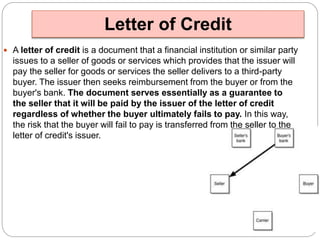
 A letter of credit is a document that a financial institution or similar party 
issues to a seller of goods or services which provides that the issuer will 
pay the seller for goods or services the seller delivers to a third-party 
buyer. The issuer then seeks reimbursement from the buyer or from the 
buyer's bank. The document serves essentially as a guarantee to 
the seller that it will be paid by the issuer of the letter of credit 
regardless of whether the buyer ultimately fails to pay. In this way, 
the risk that the buyer will fail to pay is transferred from the seller to the 
letter of credit's issuer.
Bank Guarantees 
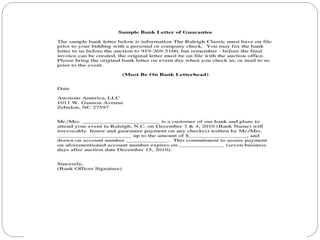
 A guarantee from a lending institution ensuring that the liabilities 
of a debtor will be met. In other words, if the debtor fails to settle 
a debt, the bank will cover it. 
 A bank guarantee enables the customer (debtor) to acquire 
goods, buy equipment, or draw down loans, and thereby expand 
business activity. This facility is basically for existing customer 
using credit facilities with bank & supported by cash margins 
 While issuing financial guarantee, bank ensure that the customer 
is in a position to reimburse the bank, in case bank is required to 
make the payment under the guarantee.
Thanks

Session 2,3

  • 1.
  • 2.
    Bank Products Banking products have evolved from the traditional loans & deposits to a large variety of offerings.  Bank products range  from wholesale or corporate products to retail products  from fund based to fee-based  from domestic to foreign
  • 4.
  • 5.
    Commercial Credit The credit granted by a bank can be funded or non funded credit.  Funded credit involves a flow of funds from the bank to the borrower ex: cash credit, demand loans, overdraft, bill purchased and discounted  While non funded credit doesn’t not Ex: guarantees and letter of credit  Cash credit is provided with limit no maturity and can be drawn at will by the borrower but demand loan has granted with maturity & lump sum amount is paid & repayable in lump sum at maturity or installment
  • 6.
    Cash Credit &Working Capital Demand Loans Working Capital Finance  Working Capital facilities are provided to finance the day-to-day business requirements. Funding requirements are structured to finance procurement of raw materials/stores and payment towards manufacturing costs and other overheads. The Bank offers a combination of operative cash credit and working capital demand loan to meet the domestic working capital requirements of our clients. Short Term Finance  The Bank offers short-term loans for a period ranging from 3 months to 12 months to sound corporate for meeting their specific short-term working capital requirements. The funds are provided with interest rates either linked to our BPLR(Benchmark Prime Lending Rate-14.5%) or at a base
  • 7.
    Bill Purchase &Discounting • Discounting bill :Letter of credit is an instrument issued in the favor of the seller by the buyer bank assuring that payment will be made after certain timer frame depending upon the terms and conditions agreed, ranging from 30-120 days • Now when the seller receives the letter of credit through bank, seller prepares the documents and presents the same to the bank. The most important element in the same is the bill of exchange which is used to negotiate a letter of credit. Seller discounts that bill of exchange with the bank and gets money. • Now it is seller's bank responsibility to send documents and bill of exchange to buyer's bank for onward forwarding to the buyer for the acceptance and the buyer finally, accepts bill of exchange drawn by the seller on buyer's bank because he has opened that LC. Buyers bank than get that signed bill of exchange from the buyer as guarantee and release payment to the sellers bank and
  • 8.
    Bill Purchase &Discounting • Bill Discounting is a process in which you can get instant cash on the purchases or credit sales made by you. If you have made purchase with your suppliers you can pay them instantly by getting discounted your purchase bill, for which you need to show the documents which authenticates the transaction done by you like trade invoices challans, truck receipts/railway receipts, bill of lading etc. Similarly if you have made any credit sales you can get instant money by getting discounted your sales bill. • BILLS PURCHASED, in trade finance, allows a seller to obtain financing and receive immediate funds in exchange for a sales document not drawn under a letter of credit. The bank will send the sales documents to the buyers bank on behalf of the seller. “In case of the bill purchase, the bill is purchased and that in case of bill discounting the bank is only financing against the said bill”
  • 9.
    Overdraft • Thisfacility is basically for Current Account holder in a bank can be sanctioned an overdraft facility. • An overdraft occurs when money is withdrawn from a bank account and the available balance goes below zero. In this situation the account is said to be "overdrawn". If there is a prior agreement with the account provider for an overdraft, and the amount overdrawn is within the authorized overdraft limit, then interest is normally charged at the agreed rate. If the negative balance exceeds the agreed terms, then additional fees may be charged and higher interest rates may apply.
  • 10.
    Term Loans A loan from a bank for a specific amount that has a specified repayment schedule and a floating interest rate. Term loans almost always mature between one and 10.  For example many banks have term-loan programs that can offer small businesses the cash they need to operate from month to month. Often a small business will use the cash from a term loan to purchase fixed assets such as equipment used in its production process.  Base Rate is 10-10.5%  Lending Rate: Base Rate+ spread(2% approx depend upon customer credit worthiness)
  • 11.
    Benchmark Prime LendingRates (New): Public Sector Banks S r . N o Name of the Bank As on BPLR 1 Allahabad Bank 1/7 / 2008 14.50 2 Andhra Bank 31/8 / 2009 12.25 3 Bank of Baroda 1/7 / 2009 12.25 4 Bank of India 1/7 / 2009 11.75 5 Bank of Maharashtra 31/3 / 2008 13.00 6 Canara Bank 1/7 / 2006 11.5 7 Central Bank of India 1/4 / 2009 12.50 8 Corporation Bank 1/8 / 2008 13.50 9 Dena Bank 1/7 / 2009 12.00 1 0 IDBI Bank Limited 1/7 / 2009 12.00 1 1 Indian Bank 8/8 / 2008 16.00 1 2 Indian Overseas Bank 15/9 / 2003 11 1 3 Oriental Bank of Commerce 14/6 / 2006 11.5 1 4 Punjab & Sind Bank 1/1 / 2004 12 1 5 Punjab National Bank 22/12 / 2008 16.75 1 6 State Bank of India 15/5 / 2006 11.5 1 7 Syndicate Bank 6/7 / 2009 12.25 1 8 UCO Bank 6/7 / 2009 12.25 1 9 Union Bank of India 12/6 / 2009 15.25 2 0 United Bank of India 1/7 / 2009 12.00 2 1/5 / Benchmark Prime Lending Rates (New): Private Banks of India S r . N o Name of the Bank As on BPLR 1 AXIS Bank Ltd. 1/5 / 2006 10 2 City Union Bank Ltd. 1/5 / 2006 11.25 3 Development Credit Bank Ltd. 31/5 / 2009 12.00 4 ICICI Bank Limited 1/4 / 2009 12.00 5 IndusInd Bank Limited 6/11 / 2008 15.00 6 ING Vysya Bank Ltd. 1/8 / 2008 14.50 7 Karnataka Bank Ltd. 31/3 / 2008 14.50 8 Tamilnad Mercantile Bank Ltd. 1/7 / 2008 15.00 9The Dhanalakshmi Bank Limited. 13/9 / 2009 14.00 1 0 The Federal Bank Ltd. 5/6 / 2009 15.75 1 1 The HDFC Bank Ltd. 15/5 / 2007 15.50 1 2 The Jammu & Kashmir Bank Ltd. 31/3 / 2008 12.00 1 3 The Karur Vysya Bank Ltd. 31/3 / 2008 11.50 1 4 The Lakshmi Vilas Bank Ltd. 31/3 / 2008 11.00 1 5 The Nainital Bank Ltd. 13/8 / 2008 15.50 1 6 The Ratnakar Bank Ltd. 31/3 / 2008 12.75 1 7 The South Indian Bank Ltd. 9/7 / 2008 15.00 Benchmark Prime Lending Rates (New): Foreign Banks S r . N o Name of the Bank As on BPLR 1 AB Bank Limited 1/5 / 2006 11 2 Abu Dhabi Commercial Bank Ltd. 5/8 / 2008 14.00 3 Bank of America N.A. 4/8 / 2008 14.25 4 Bank of Bahrain & Kuwait BSC 1/7 / 2009 12.75 5 Barclays Bank Plc 31/3 / 2008 11.00 6 BNP PARIBAS 1/1 / 2004 12.5 7 Citibank N.A. 1/5 / 2006 12.5 8 Credit Agricole Corporate And Investment Bank 1/1 / 2009 15.50 9 Deutsche Bank AG 20/7 / 2009 15.75 1 0 Krung Thai Bank Public Company 31/8 / 2009 12.75 1 1 Mashreqbank psc 1/1 / 2004 11 1 2 Oman International Bank S A O 1/5 / 2006 12 1 3 Societe Generale 31/3 / 2008 13.50 1 4 The Royal Bank of Scotland N V 1/7 / 2008 13.75 1 5 UBS AG 1/8 / 2008 16.00
  • 12.
  • 13.
    Retail Credit Credit given to a customer by a retailer for the payment of purchases. Retail credit can be granted either through outside credit cards such as Visa, MasterCard, and American Express or through retailer-generated credit cards. In-house credit cards encourage store loyalty.  Retail credit facilities lend funds to consumers wishing to purchase high ticket items but are short on capital. Thus, retail credit facilities may enable a greater number of consumers access to a retailer's goods. Retail credit facilities give the option of consuming now or consuming in the future. Higher interest rates may be acceptable to some consumers, depending on the consumers' unique consumption utilities. The risk of default is a factor that determines the interest rate that retail credit facilities charge.
  • 14.
    Credit Cards &Housing Finance Banks with a net worth of 100 crore can undertake credit card business  A credit card is a payment card issued to users as a system of payment. It allows the cardholder to pay for goods and services based on the holder's promise to pay for them. The issuer of the card creates a revolving account and grants a line of credit to the consumer from which the user can borrow money for payment to a merchant or as a cash advance to the user.  “The purpose of a housing finance (10% )system is to provide the funds which home-buyers need to purchase their homes and also for repairs to existing properties. Loan upto 15 lakh for construction, loan upto 1 lakh in rural & semi urban areas, 2lakh in urban for repair
  • 15.
  • 16.
    Current Accounts Current bank account is opened by businessmen who have a number of regular transactions with the bank, both deposits and withdrawals. It is also known as Demand Deposit. No interest is given on current account balance  Current account can be opened in co-operative bank and commercial bank. Incurrent account, amount can be deposited and withdrawn at any time without giving any notice. It is also suitable for making payments to creditors by using cheques. Cheques received from customers can be deposited in this account for collection.
  • 17.
    Saving Account Savings accounts are accounts maintained by retail financial institutions that pay interest (saving deposit rate: 4% approx). The withdrawal from a saving account are limited in number and amount.  These accounts let customers set aside a portion of their liquid assets while earning a monetary return. For the bank, money in a savings account may not be callable immediately and the interest on a saving account balance is calculated on the minimum balance in the account between 10th and last day of month again as per RBI guidelines
  • 18.
    Deposits  TermDeposit(8-9.25%): A deposit held at a financial institution that has a fixed term. These are generally short-term with maturities ranging anywhere from a month to a few years. Minimum maturity 7days. When a term deposit is purchased, the lender (the customer) understands that the money can only be withdrawn after the term has ended or by giving a predetermined number of days notice.  Certificate of Deposits: A savings certificate entitling the bearer to receive interest. A CD bears a maturity date, a specified fixed interest rate and can be issued in any denomination. CDs are generally issued by commercial banks and are insured by the FDIC(Federal Deposit Insurance Corporation). The term of a CD generally ranges from one month to five years. Minimum amount of CD is 1lakh & in multiple of 1lakh thereafter
  • 19.
    Non Resident Deposits  Types of accounts which can be maintained by an NRI / PIO in India:  Non-Resident Ordinary Rupee Account (NRO Account)  Non-Resident (External) Rupee Account (NRE Account)  Foreign Currency Non Resident (Bank) Account – FCNR (B) Account. It covers term deposits in pound sterling, US dollar, Canadian Dollar, Euros. Maturity of FCNR is 5 years and interest is paid within the ceiling rate of LIBOR or SWAP rates of respective currency  FCNR_Deposit_Rates_August_2012.xls
  • 20.
  • 21.
    Letter of Credit  A letter of credit is a document that a financial institution or similar party issues to a seller of goods or services which provides that the issuer will pay the seller for goods or services the seller delivers to a third-party buyer. The issuer then seeks reimbursement from the buyer or from the buyer's bank. The document serves essentially as a guarantee to the seller that it will be paid by the issuer of the letter of credit regardless of whether the buyer ultimately fails to pay. In this way, the risk that the buyer will fail to pay is transferred from the seller to the letter of credit's issuer.
  • 22.
    Bank Guarantees A guarantee from a lending institution ensuring that the liabilities of a debtor will be met. In other words, if the debtor fails to settle a debt, the bank will cover it.  A bank guarantee enables the customer (debtor) to acquire goods, buy equipment, or draw down loans, and thereby expand business activity. This facility is basically for existing customer using credit facilities with bank & supported by cash margins  While issuing financial guarantee, bank ensure that the customer is in a position to reimburse the bank, in case bank is required to make the payment under the guarantee.
  • 24.