TEXT INFORMATION
MANAGEMENT SYSTEM (TIMS)
By: Shankul Kumar
SGSPS, Institute of Pharmacy, Akola
1
OBEJECTIVES
Main objective of Text Information
Management System is to encourage the:
 Process of Writing
 Reviewing
 Auditing
 Approving
 Publishing the pharmaceutical text reports.
2
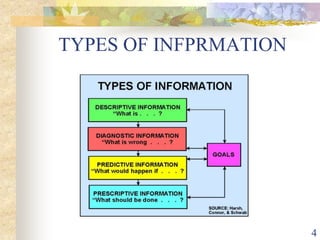
Management information system
 Management information system refers to
the processing of information through
computers and other intelligent devices to
manage and support managerial decisions
within an oraganization.
L.Kahari 3
TYPES OF INFPRMATION
4
Text information Management system
 Text : Word or, group of words
 Information: processed data or fact
 Management: an art to make the things
done with proper resource at correct cost,
place and schedule.
 System: to store the data & facts
5
6
Text information Management system
The name "text information management system"
is not as widely used as the name "laboratory
information management system." Nevertheless,
a text document management system is essential
in preclinical development because huge
numbers of text documents and other related
information such as images, drawings, and
photographs are generated in the area. All these
documents and information are considered
intellectual property and require protection and
easy access.
Text information Management system
 Text information management systems help
the pharmaceutical Industry to improve
efficiency in managing business –critical text
documents.
 The objective of an information retrieval
system is to organise and store large amounts
of text so that information can be retrieved
from the repositories in response to users
information requests.
7
Text information Management system
 Text information management systems
deals with bibliographic documents, legal
documents, official memos, patient records
& case history, letters, correspondences,
complete text articles and books and so on.
8
TIMS: documentation requirements in
preclinical development
 In preclinical development, the GMP/GLP
regulations are enforced not only for scientific
data but also for text documents. This section
discusses several types of controlled text
documents used in preclinical development.
Most of these documents are managed by the
fully validated TIMS.
9
TIMS: documentation requirements in preclinical
development
 In pre-clinical development, these (Product
specification documents and analytical test
methods) are important documents and they
evolve along with the development phases.
Drug substances and products for clinical
trials are tested based on these documents,
and so are the stability samples.
10
TIMS: documentation requirements in preclinical
development
 It is critical to ensure that the analyst will
perform the right tests against the right
specifications with the correct version of the
test method. Therefore a mechanism must be
in place to control these documents. This can
be done manually or with TIMS.
11
TIMS: documentation requirements in preclinical
development
Most of these documents are managed by fully
validated TIMS:
 SOP
 Research report
 Laboratory data
 Product specification & Analytical Tests
12
BENEFITS OF TIMS
 Save time and energy
 Faster method of report generation
 Ensure accuracy Improve efficiency in managing
critical data
 Strict security & reduce paper work
13
REFERENCES
 Stephen B. Harsh ,MANAGEMENT INFORMATION
SYSTEMS,Department of Agricultural Economics ,Michigan
State University.
 Goyal Munish, Arora Varun, Shah S.K. Theory cum Practical
Computer Application In Pharmacy, PV Books, Edition 2018,
Page no. 93-94.
14
The End
Thank you all for
listening

Text Information Manaegement System.pptx

  • 1.
    TEXT INFORMATION MANAGEMENT SYSTEM(TIMS) By: Shankul Kumar SGSPS, Institute of Pharmacy, Akola 1
  • 2.
    OBEJECTIVES Main objective ofText Information Management System is to encourage the:  Process of Writing  Reviewing  Auditing  Approving  Publishing the pharmaceutical text reports. 2
  • 3.
    Management information system Management information system refers to the processing of information through computers and other intelligent devices to manage and support managerial decisions within an oraganization. L.Kahari 3
  • 4.
  • 5.
    Text information Managementsystem  Text : Word or, group of words  Information: processed data or fact  Management: an art to make the things done with proper resource at correct cost, place and schedule.  System: to store the data & facts 5
  • 6.
    6 Text information Managementsystem The name "text information management system" is not as widely used as the name "laboratory information management system." Nevertheless, a text document management system is essential in preclinical development because huge numbers of text documents and other related information such as images, drawings, and photographs are generated in the area. All these documents and information are considered intellectual property and require protection and easy access.
  • 7.
    Text information Managementsystem  Text information management systems help the pharmaceutical Industry to improve efficiency in managing business –critical text documents.  The objective of an information retrieval system is to organise and store large amounts of text so that information can be retrieved from the repositories in response to users information requests. 7
  • 8.
    Text information Managementsystem  Text information management systems deals with bibliographic documents, legal documents, official memos, patient records & case history, letters, correspondences, complete text articles and books and so on. 8
  • 9.
    TIMS: documentation requirementsin preclinical development  In preclinical development, the GMP/GLP regulations are enforced not only for scientific data but also for text documents. This section discusses several types of controlled text documents used in preclinical development. Most of these documents are managed by the fully validated TIMS. 9
  • 10.
    TIMS: documentation requirementsin preclinical development  In pre-clinical development, these (Product specification documents and analytical test methods) are important documents and they evolve along with the development phases. Drug substances and products for clinical trials are tested based on these documents, and so are the stability samples. 10
  • 11.
    TIMS: documentation requirementsin preclinical development  It is critical to ensure that the analyst will perform the right tests against the right specifications with the correct version of the test method. Therefore a mechanism must be in place to control these documents. This can be done manually or with TIMS. 11
  • 12.
    TIMS: documentation requirementsin preclinical development Most of these documents are managed by fully validated TIMS:  SOP  Research report  Laboratory data  Product specification & Analytical Tests 12
  • 13.
    BENEFITS OF TIMS Save time and energy  Faster method of report generation  Ensure accuracy Improve efficiency in managing critical data  Strict security & reduce paper work 13
  • 14.
    REFERENCES  Stephen B.Harsh ,MANAGEMENT INFORMATION SYSTEMS,Department of Agricultural Economics ,Michigan State University.  Goyal Munish, Arora Varun, Shah S.K. Theory cum Practical Computer Application In Pharmacy, PV Books, Edition 2018, Page no. 93-94. 14
  • 15.
    The End Thank youall for listening