1
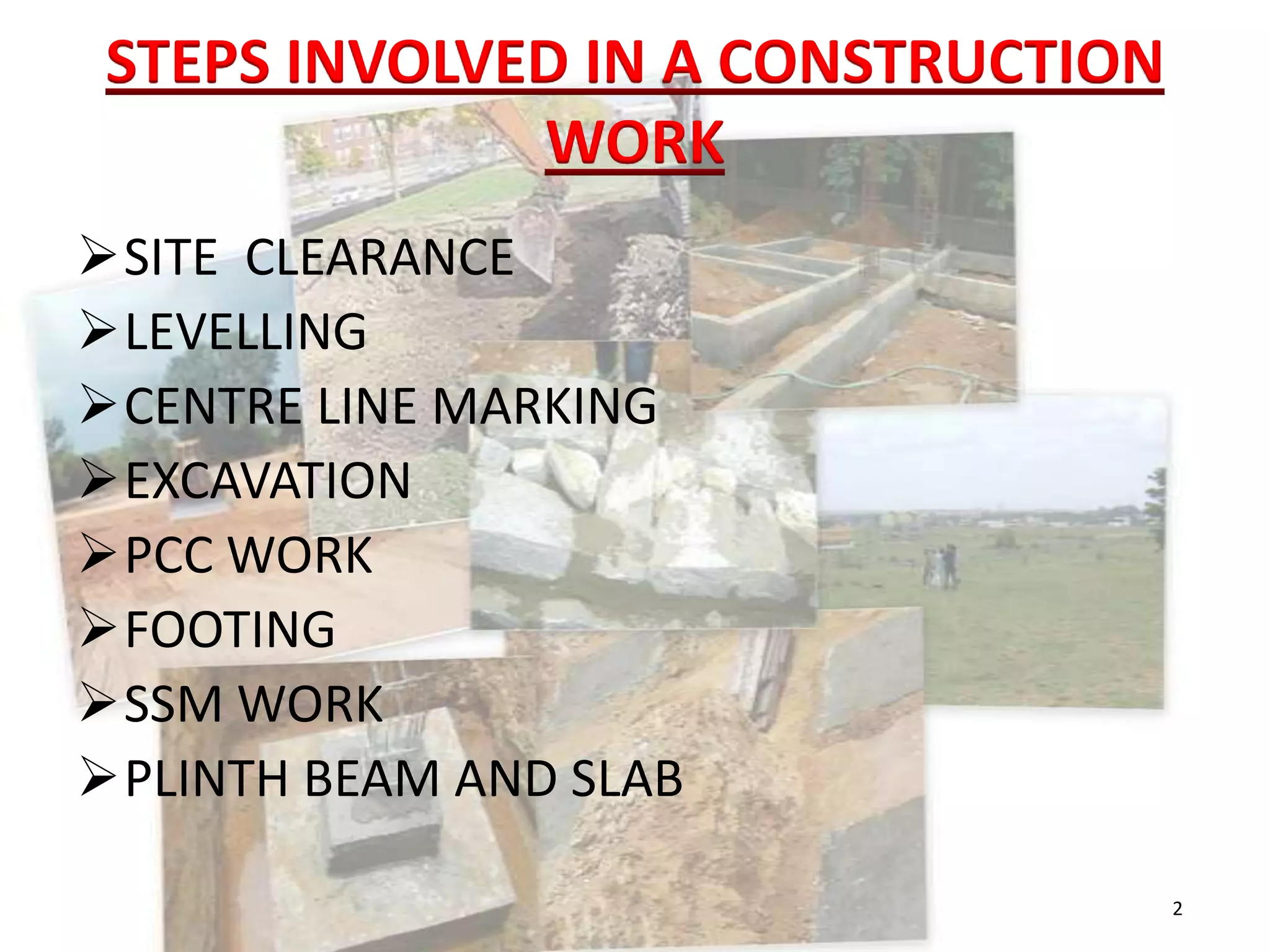
STEPS INVOLVED IN A CONSTRUCTION
              WORK
SITE CLEARANCE
LEVELLING
CENTRE LINE MARKING
EXCAVATION
PCC WORK
FOOTING
SSM WORK
PLINTH BEAM AND SLAB

                                    2
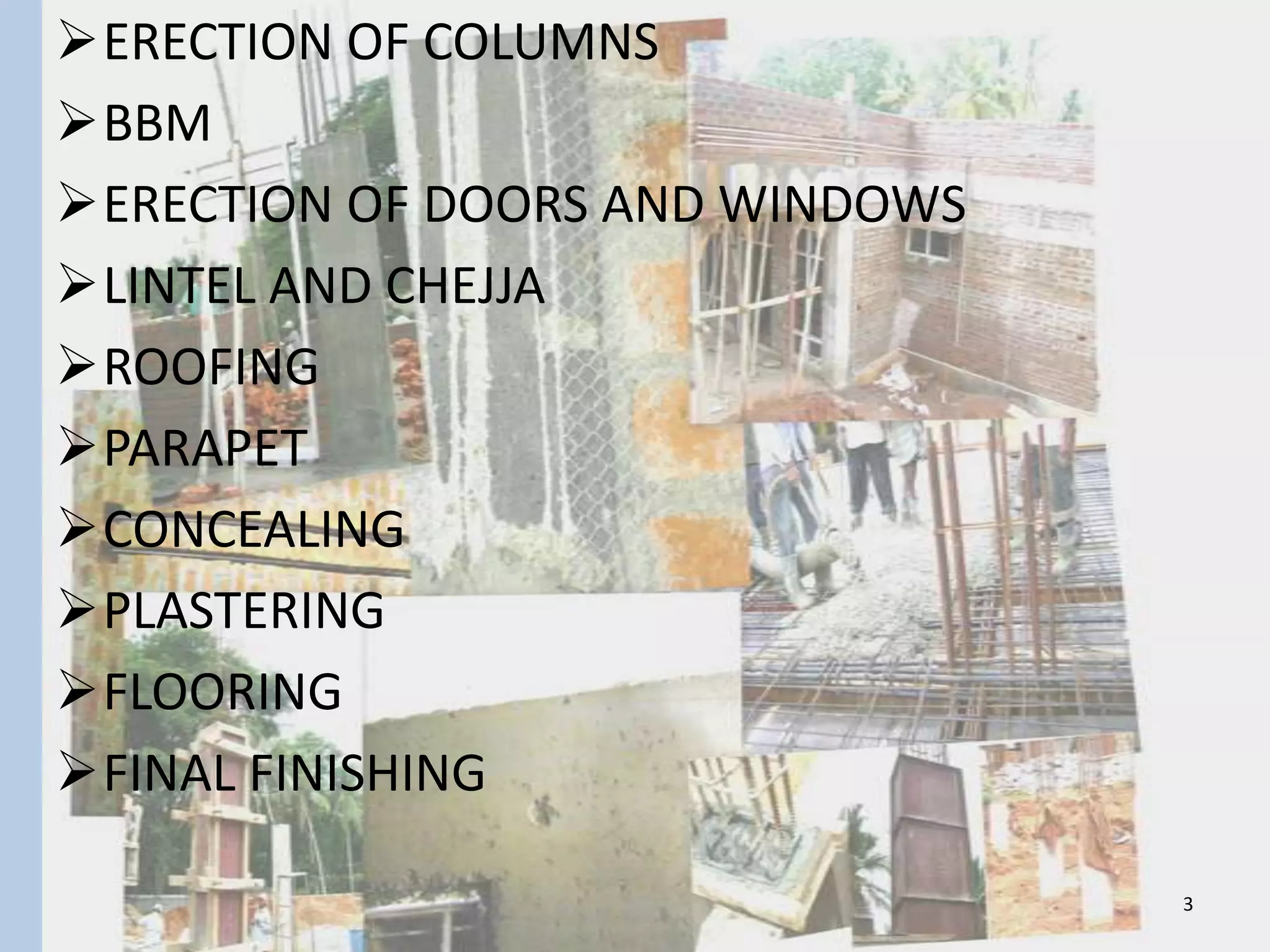
ERECTION OF COLUMNS
BBM
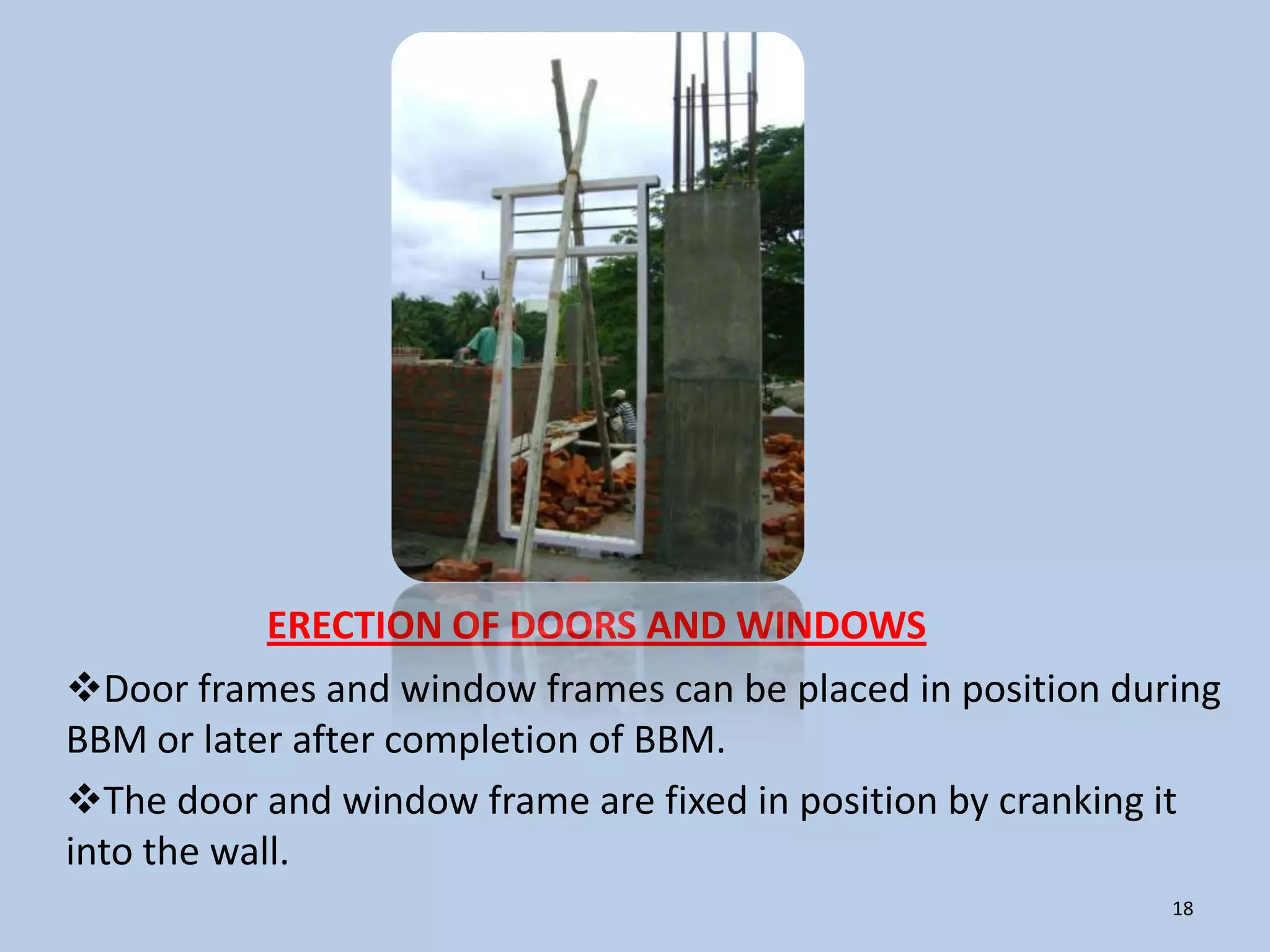
ERECTION OF DOORS AND WINDOWS
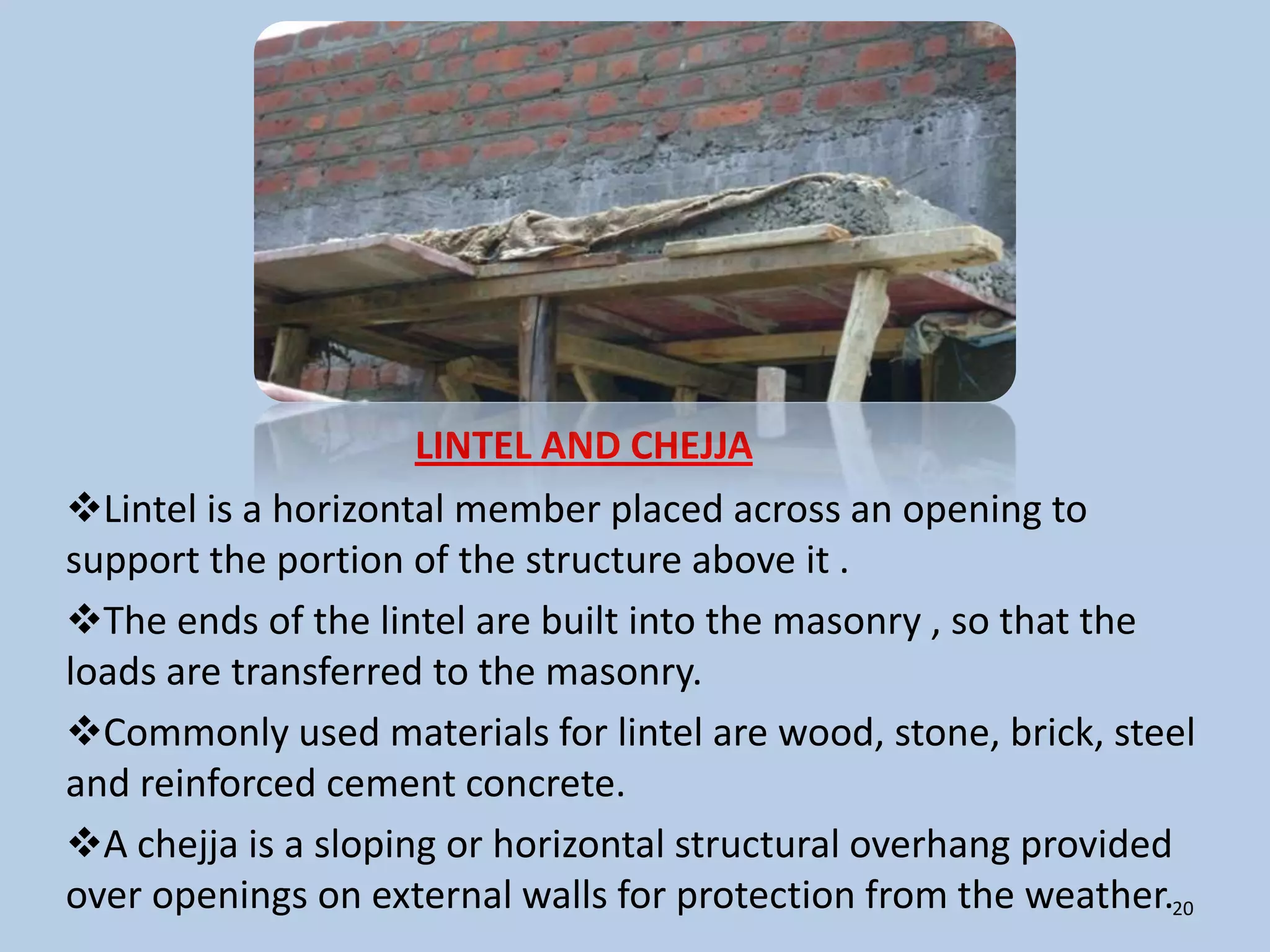
LINTEL AND CHEJJA
ROOFING
PARAPET
CONCEALING
PLASTERING
FLOORING
FINAL FINISHING

                                 3
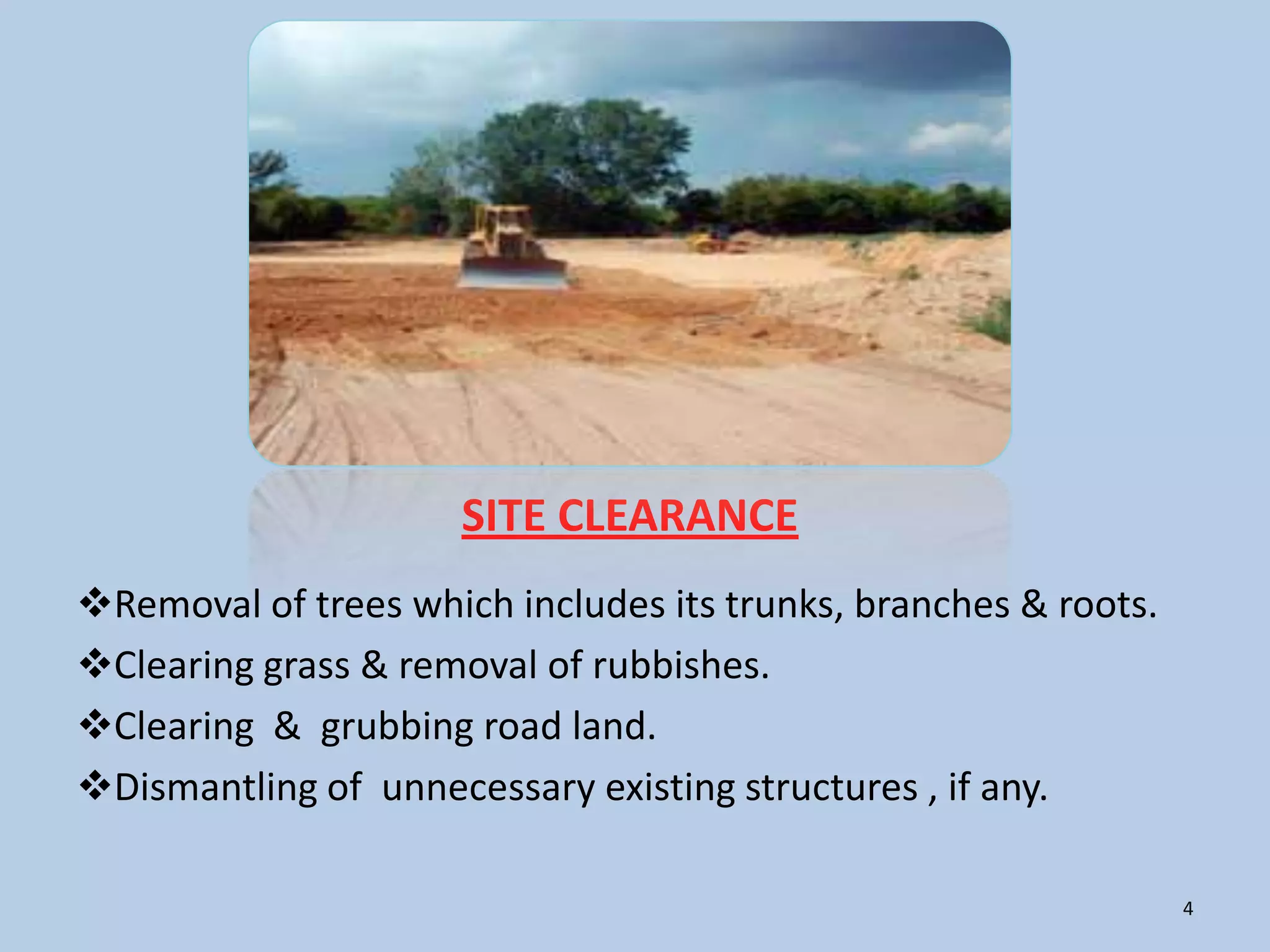
SITE CLEARANCE
Removal of trees which includes its trunks, branches & roots.
Clearing grass & removal of rubbishes.
Clearing & grubbing road land.
Dismantling of unnecessary existing structures , if any.

                                                                 4
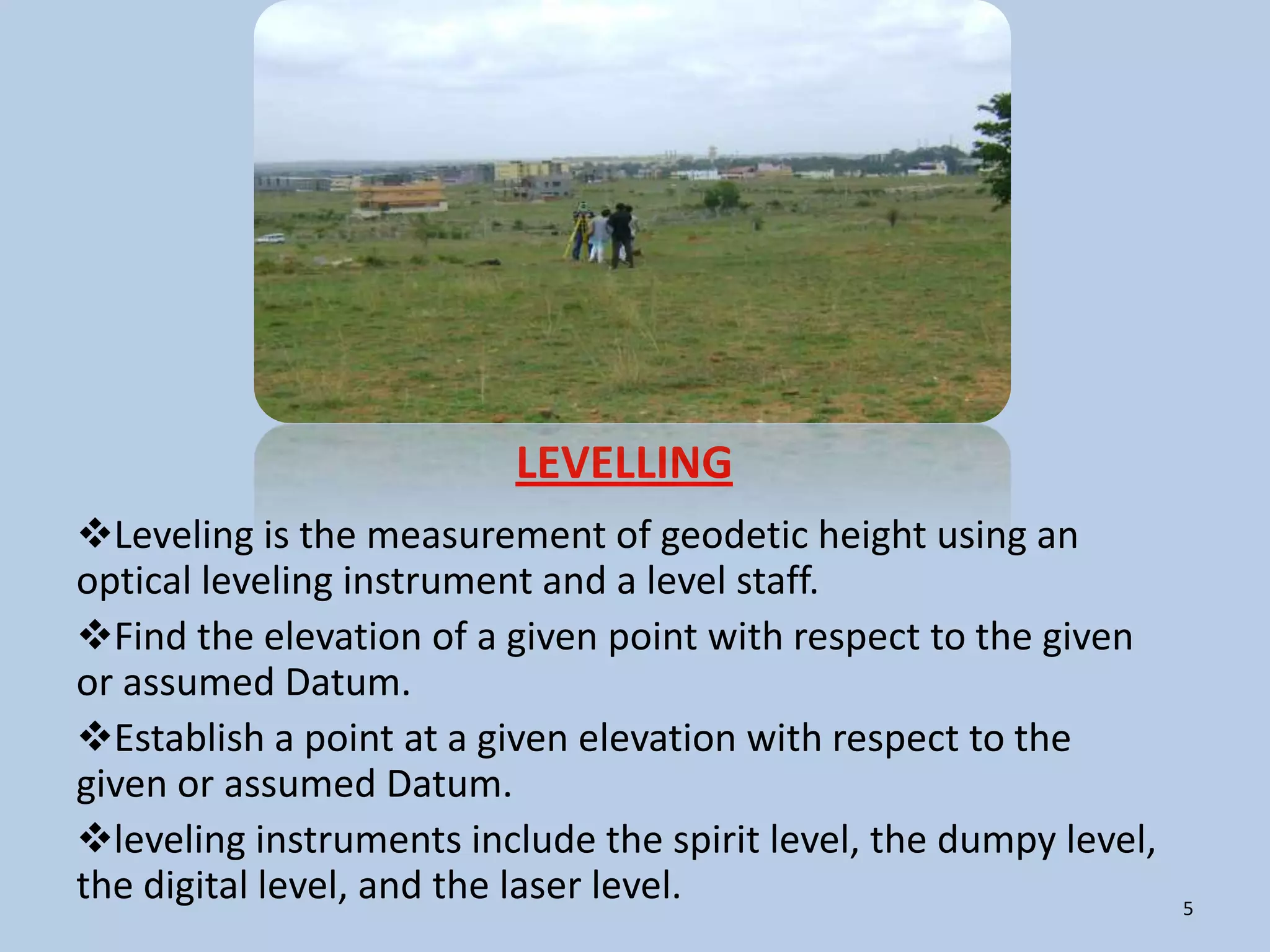
LEVELLING
Leveling is the measurement of geodetic height using an
optical leveling instrument and a level staff.
Find the elevation of a given point with respect to the given
or assumed Datum.
Establish a point at a given elevation with respect to the
given or assumed Datum.
leveling instruments include the spirit level, the dumpy level,
the digital level, and the laser level.                            5
CENTRE LINE MARKING
The base line has to be established with the help of offsets
taken based on the existing road or building.
The centre line is marked based on the base line.
This centre line should be transferred to Burjis and be kept up
to the completion of foundation work.


                                                                   6
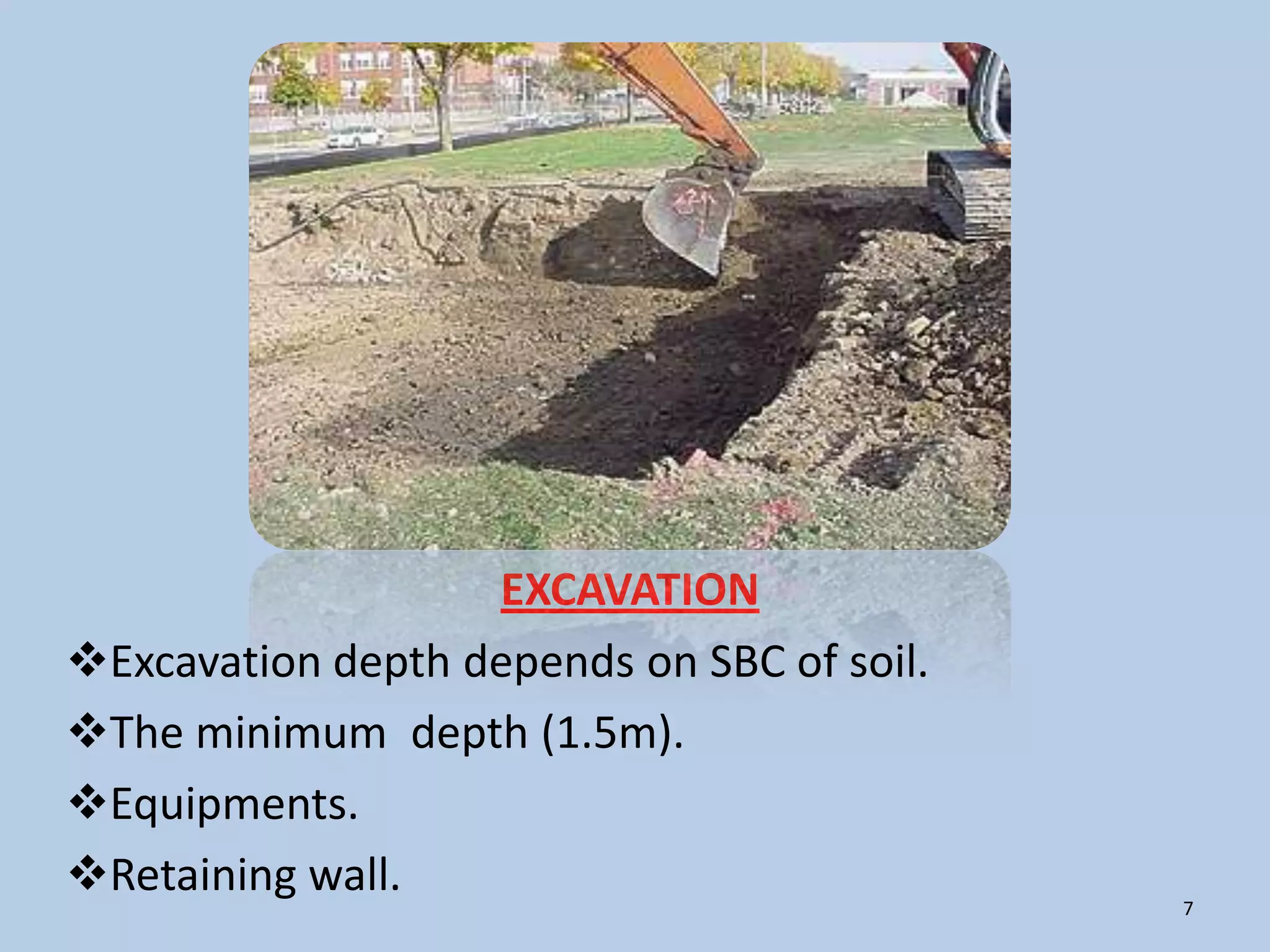
EXCAVATION
Excavation depth depends on SBC of soil.
The minimum depth (1.5m).
Equipments.
Retaining wall.
                                            7
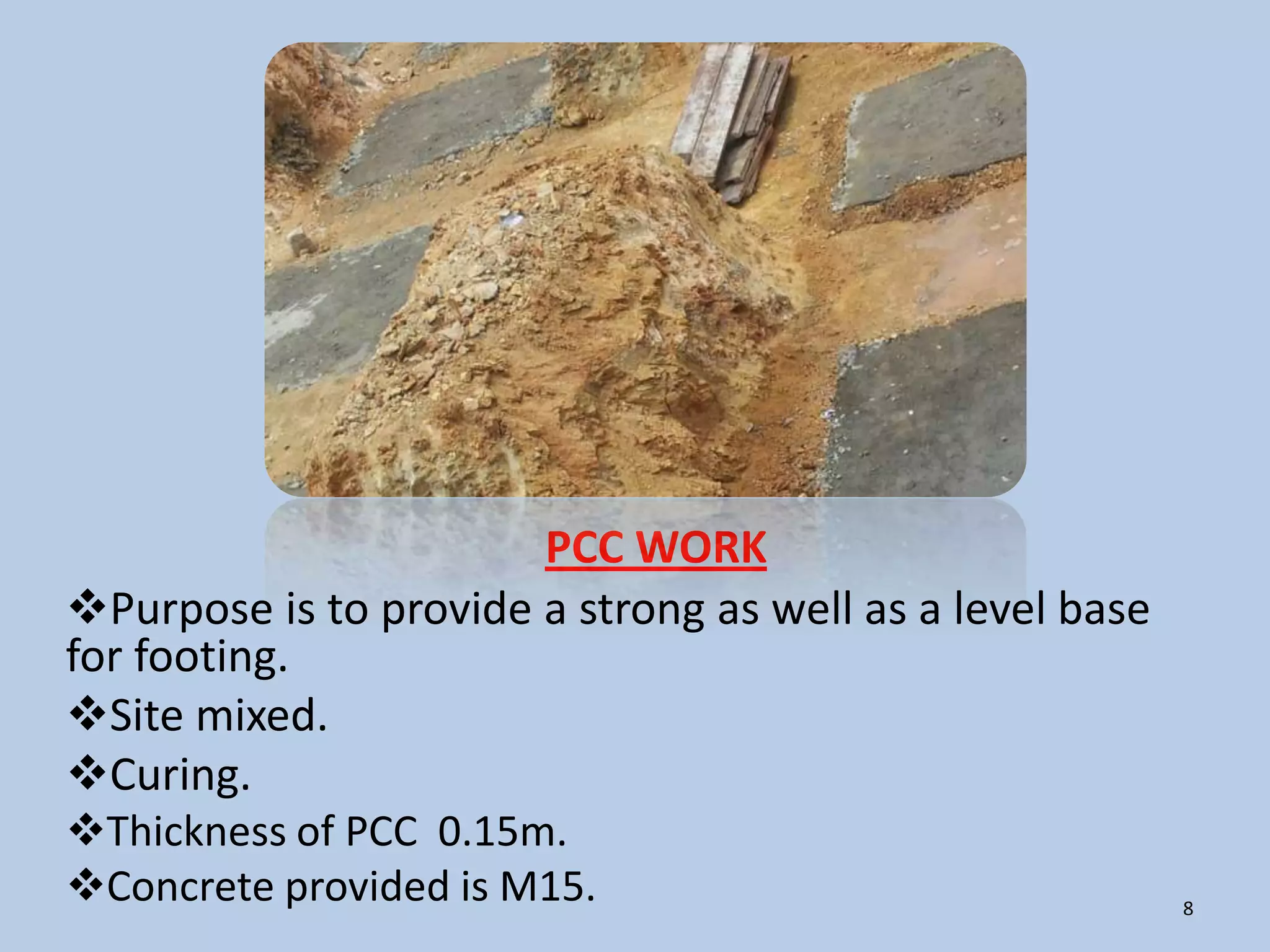
PCC WORK
Purpose is to provide a strong as well as a level base
for footing.
Site mixed.
Curing.
Thickness of PCC 0.15m.
Concrete provided is M15.                                8
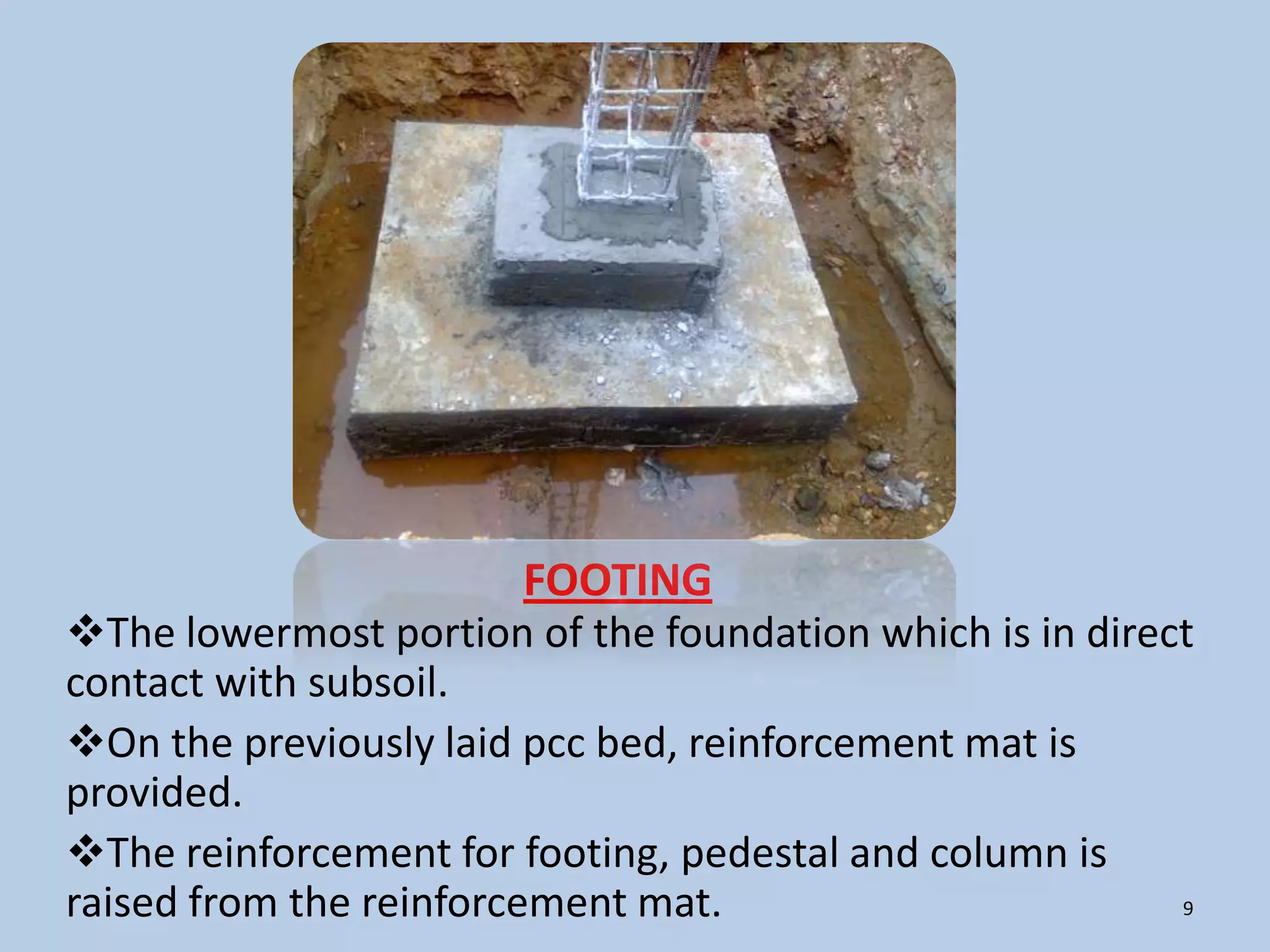
FOOTING
The lowermost portion of the foundation which is in direct
contact with subsoil.
On the previously laid pcc bed, reinforcement mat is
provided.
The reinforcement for footing, pedestal and column is
raised from the reinforcement mat.                        9
Concrete provided is M20.
Pedestal is provided when the depth of footing is high
 and to make the work economical.
The depth of footing mainly depends on the safe
 bearing capacity of soil and height of the building.
Different types of shallow footing
    -simple footing.
    -stepped footing.
    -single footing.


                                                      10
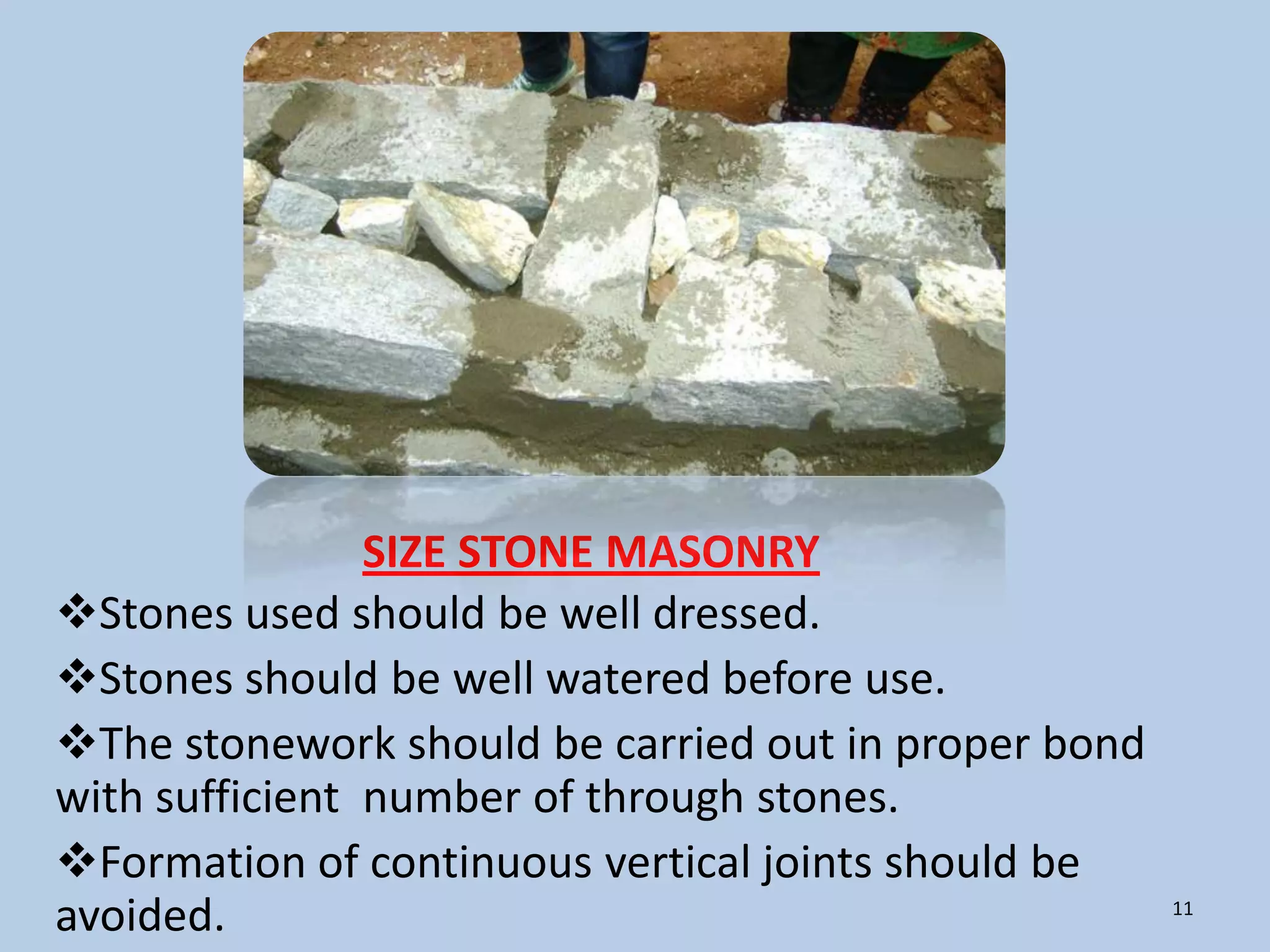
SIZE STONE MASONRY
Stones used should be well dressed.
Stones should be well watered before use.
The stonework should be carried out in proper bond
with sufficient number of through stones.
Formation of continuous vertical joints should be
avoided.                                              11
The stone masonry should comply with the
 requirements of the specification of work.
The mortar proportion used should be of quality and
 proportion specified.
Chips, small pieces of broken stones should not be used.
It should be carried out as per line and level.
After construction, SSM has to be well watered for 1-2
 weeks.


                                                     12
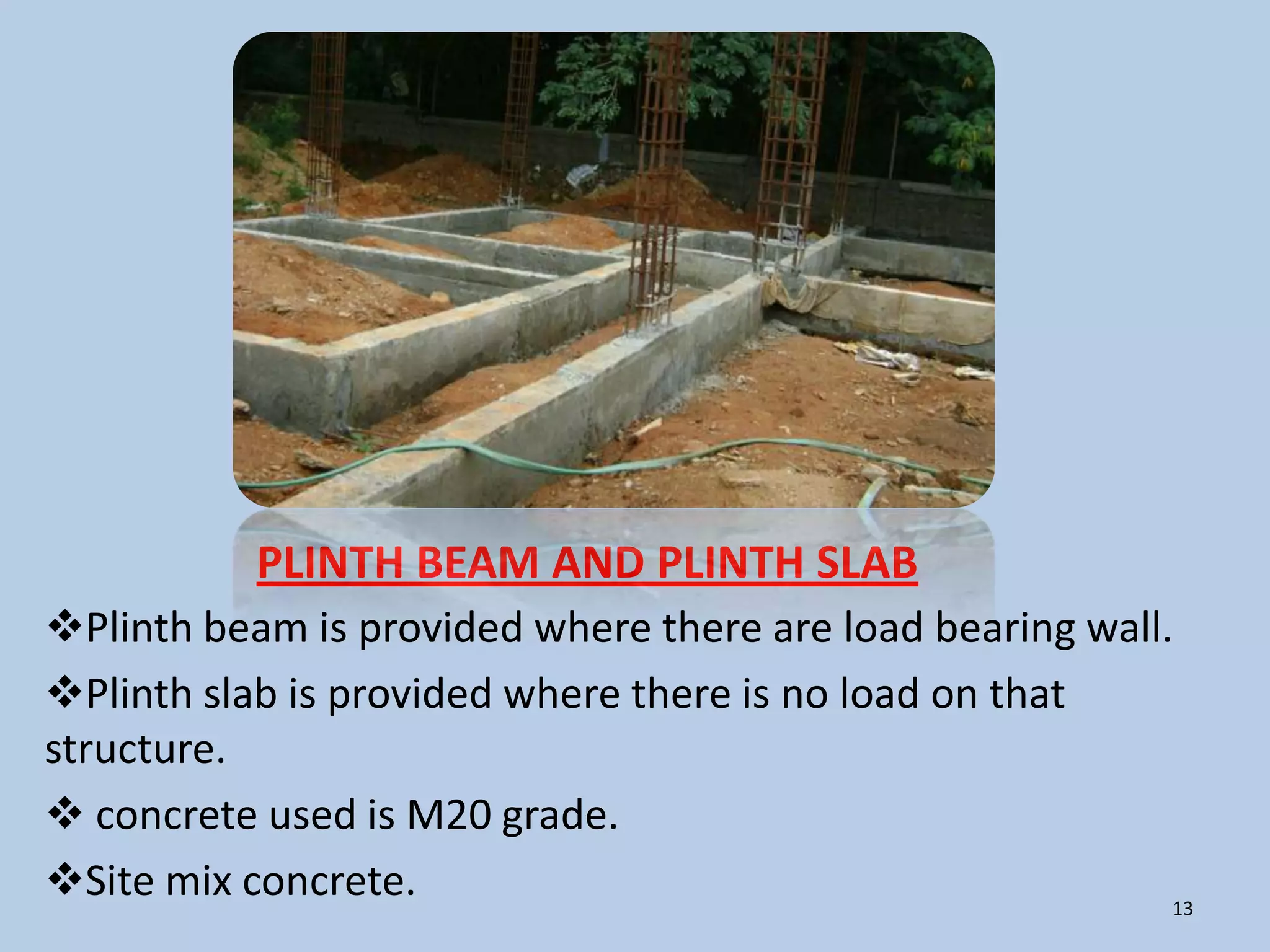
PLINTH BEAM AND PLINTH SLAB
Plinth beam is provided where there are load bearing wall.
Plinth slab is provided where there is no load on that
structure.
 concrete used is M20 grade.
Site mix concrete.                                        13
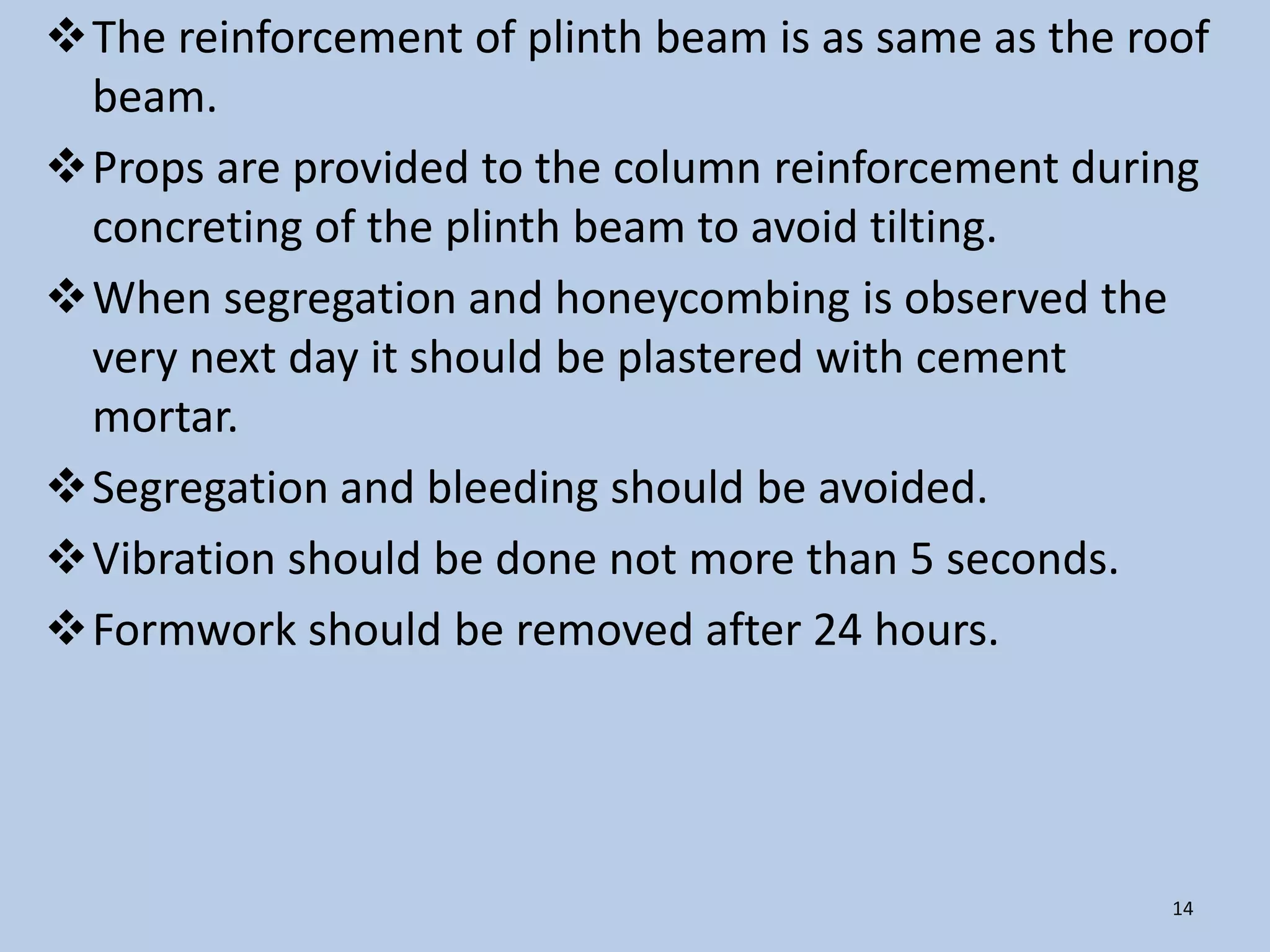
The reinforcement of plinth beam is as same as the roof
 beam.
Props are provided to the column reinforcement during
 concreting of the plinth beam to avoid tilting.
When segregation and honeycombing is observed the
 very next day it should be plastered with cement
 mortar.
Segregation and bleeding should be avoided.
Vibration should be done not more than 5 seconds.
Formwork should be removed after 24 hours.


                                                      14
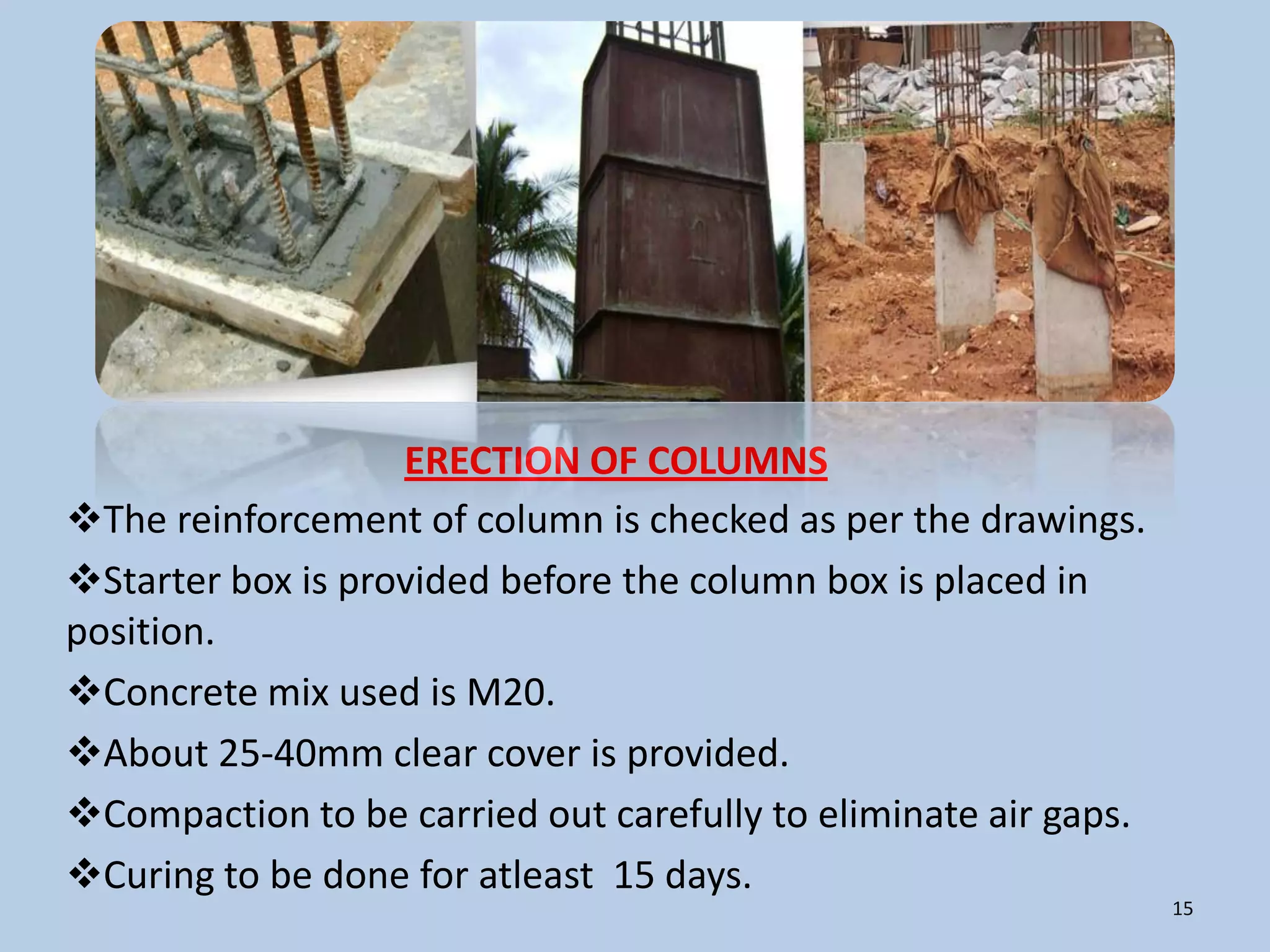
ERECTION OF COLUMNS
The reinforcement of column is checked as per the drawings.
Starter box is provided before the column box is placed in
position.
Concrete mix used is M20.
About 25-40mm clear cover is provided.
Compaction to be carried out carefully to eliminate air gaps.
Curing to be done for atleast 15 days.
                                                                 15
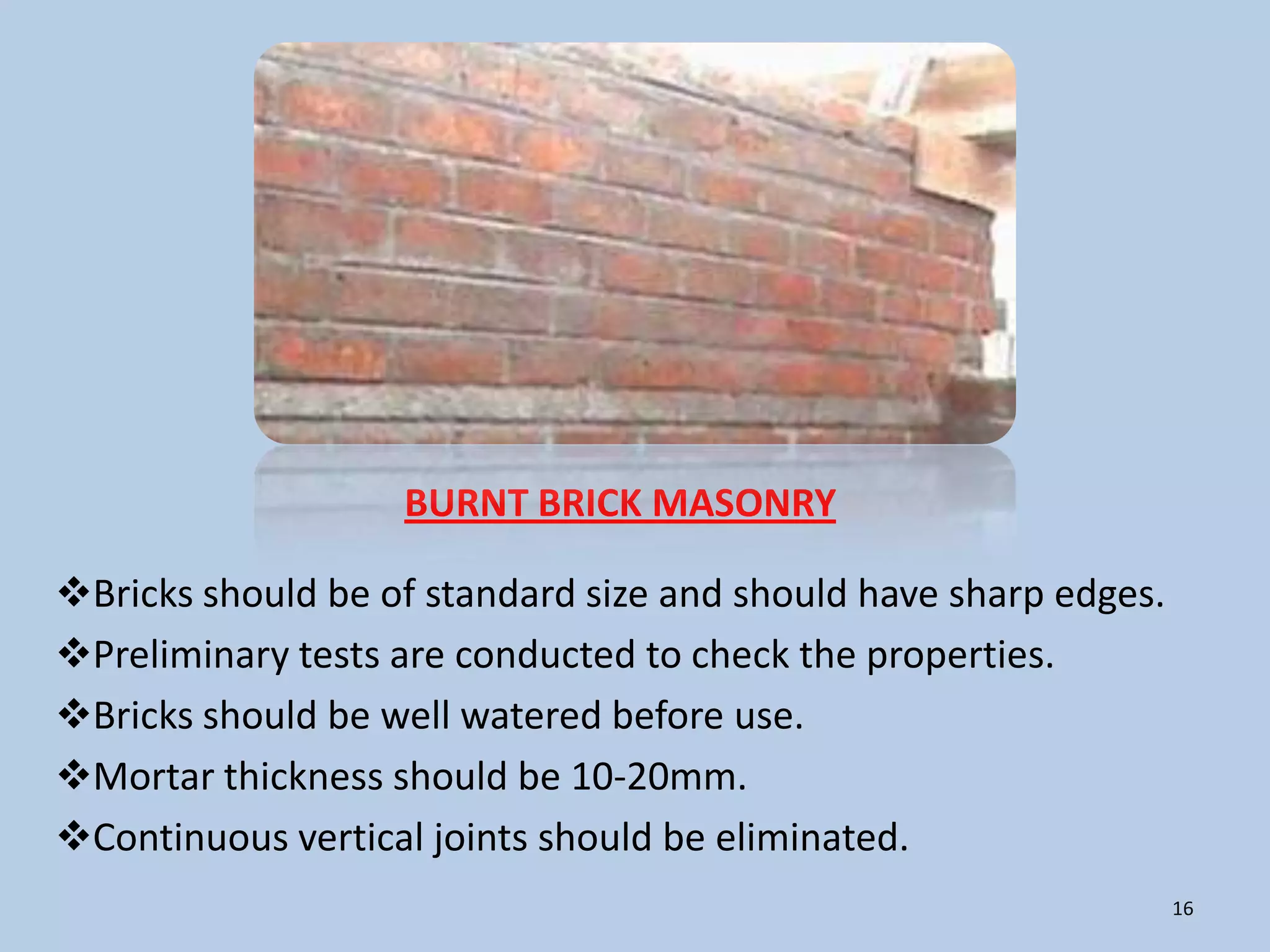
BURNT BRICK MASONRY

Bricks should be of standard size and should have sharp edges.
Preliminary tests are conducted to check the properties.
Bricks should be well watered before use.
Mortar thickness should be 10-20mm.
Continuous vertical joints should be eliminated.
                                                                  16
 Minimum construction height of brick masonry should not
  exceed 1m.
 It is carried out as per line and level.
 Brick bats should be avoided as far as possible.
 The mortar proportion used should be of quality and
  proportion specified.
 Type of brick bond mainly depends on the thickness of
  wall and the purpose for which it is built.


                                                       17
ERECTION OF DOORS AND WINDOWS
Door frames and window frames can be placed in position during
BBM or later after completion of BBM.
The door and window frame are fixed in position by cranking it
into the wall.
                                                            18
 The width of the door should be .4 to .6 times the height
  of the door.
 The height of the door should be a minimum of
  (width+1.2m).
 The size of the window depends upon the size of room.
 The doors are located at a distance of about 200mm
  from the corner of the room.
 Materials used for windows and doors are wood, glass,
  plywood and metal.
 The shutters for doors and windows are provided after
  internal and external plastering.


                                                          19
LINTEL AND CHEJJA
Lintel is a horizontal member placed across an opening to
support the portion of the structure above it .
The ends of the lintel are built into the masonry , so that the
loads are transferred to the masonry.
Commonly used materials for lintel are wood, stone, brick, steel
and reinforced cement concrete.
A chejja is a sloping or horizontal structural overhang provided
over openings on external walls for protection from the weather.20
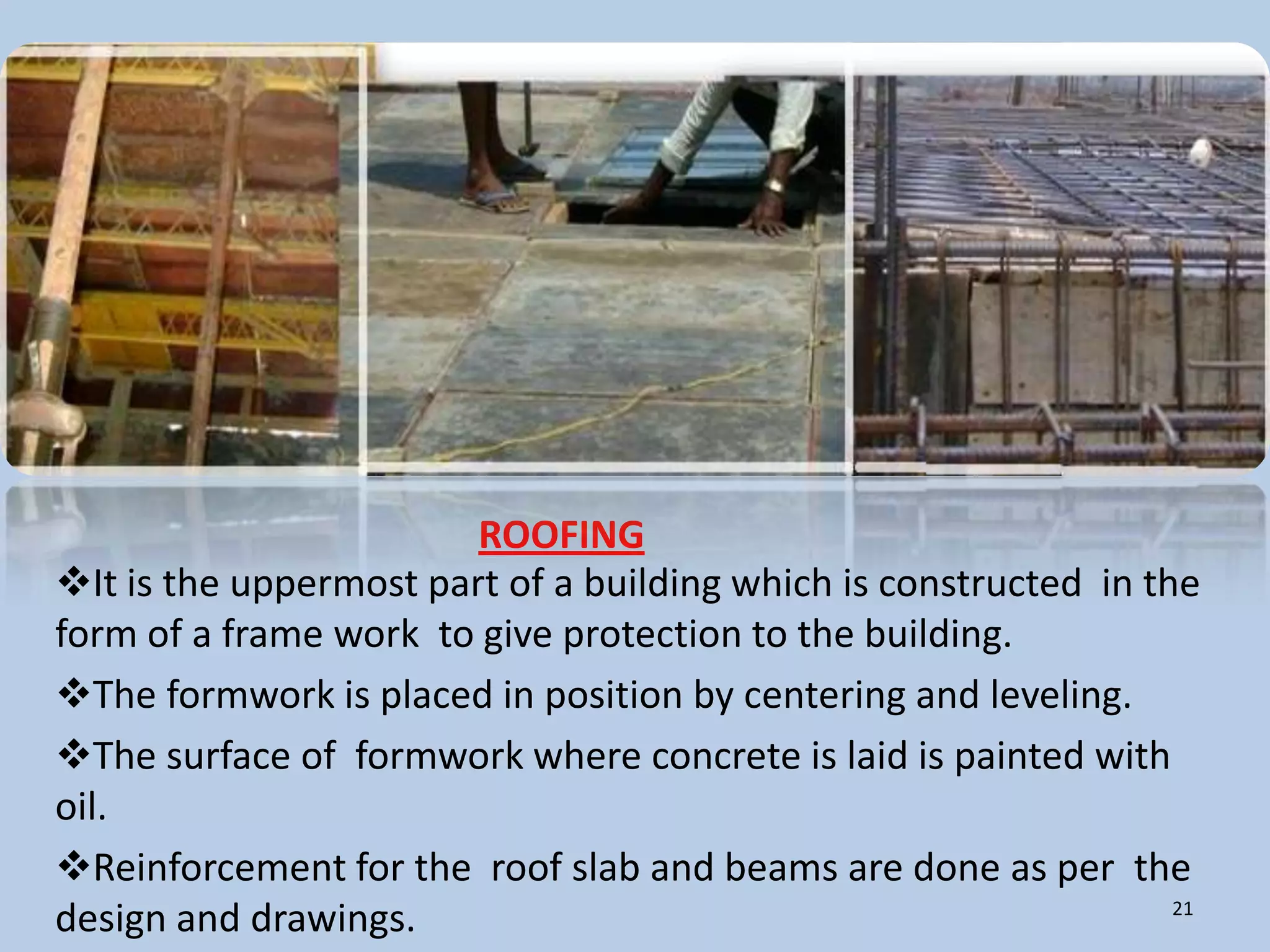
ROOFING
It is the uppermost part of a building which is constructed in the
form of a frame work to give protection to the building.
The formwork is placed in position by centering and leveling.
The surface of formwork where concrete is laid is painted with
oil.
Reinforcement for the roof slab and beams are done as per the
                                                                  21
design and drawings.
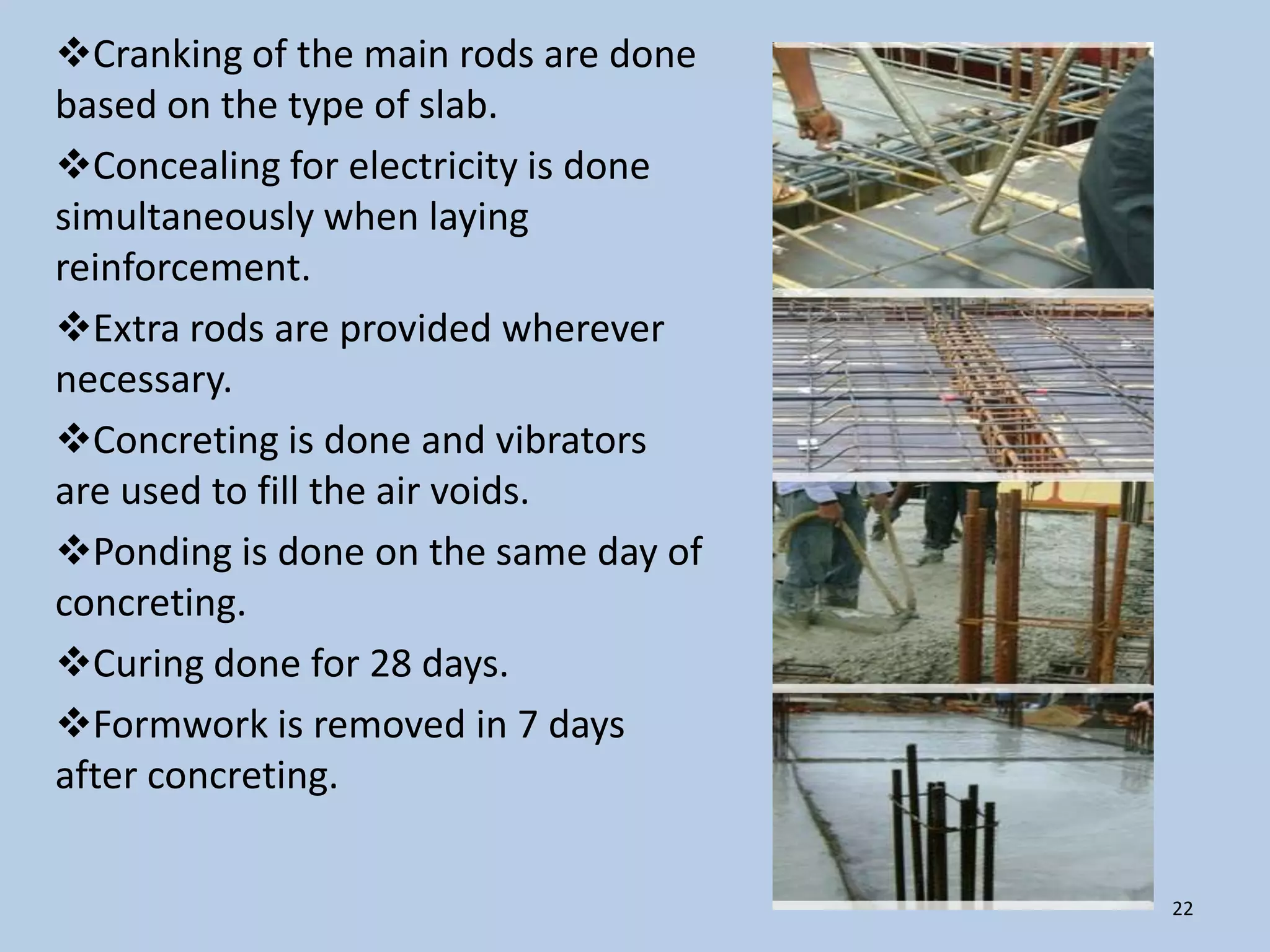
Cranking of the main rods are done
based on the type of slab.
Concealing for electricity is done
simultaneously when laying
reinforcement.
Extra rods are provided wherever
necessary.
Concreting is done and vibrators
are used to fill the air voids.
Ponding is done on the same day of
concreting.
Curing done for 28 days.
Formwork is removed in 7 days
after concreting.

                                      22
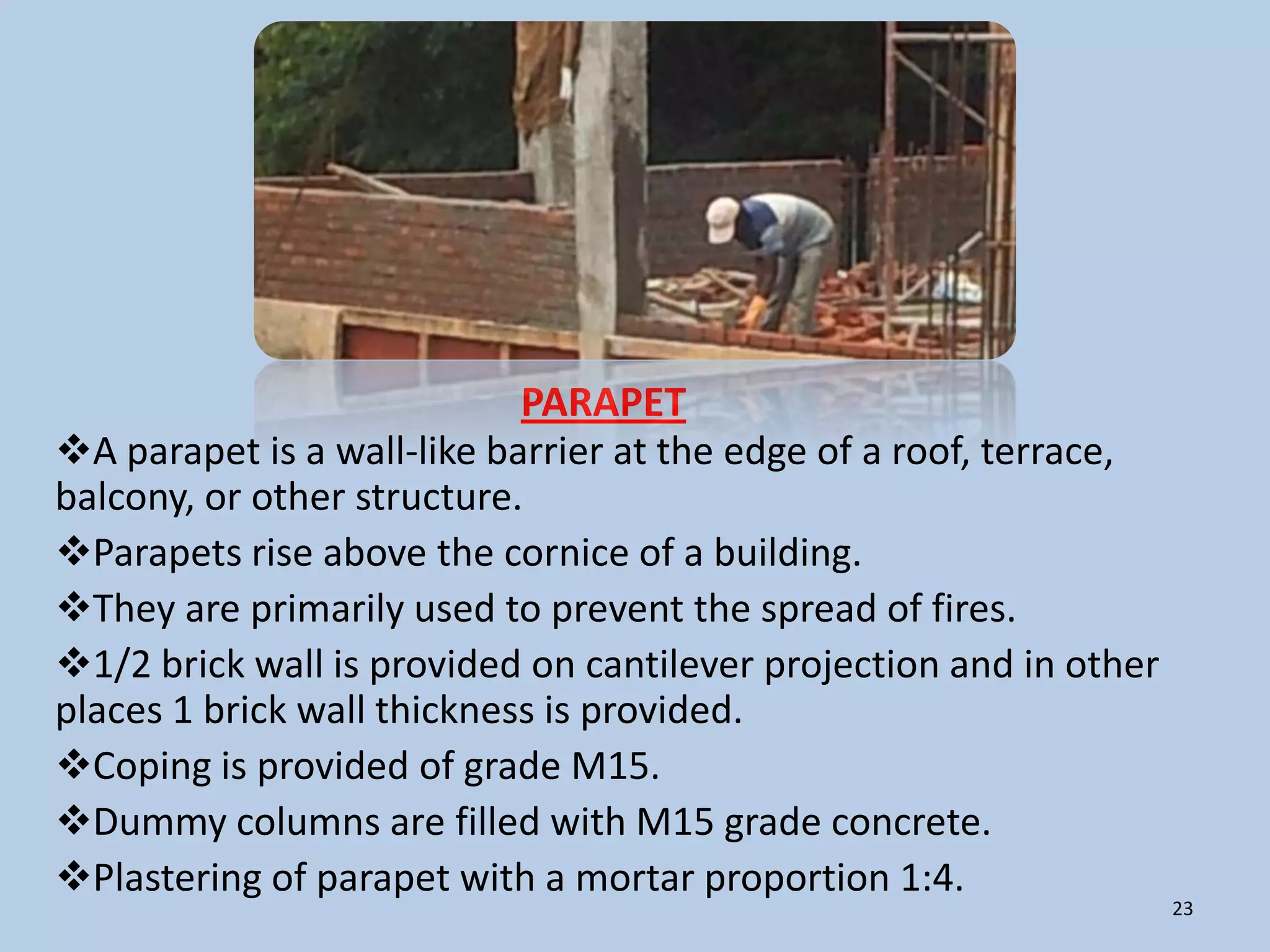
PARAPET
A parapet is a wall-like barrier at the edge of a roof, terrace,
balcony, or other structure.
Parapets rise above the cornice of a building.
They are primarily used to prevent the spread of fires.
1/2 brick wall is provided on cantilever projection and in other
places 1 brick wall thickness is provided.
Coping is provided of grade M15.
Dummy columns are filled with M15 grade concrete.
Plastering of parapet with a mortar proportion 1:4.
                                                                    23
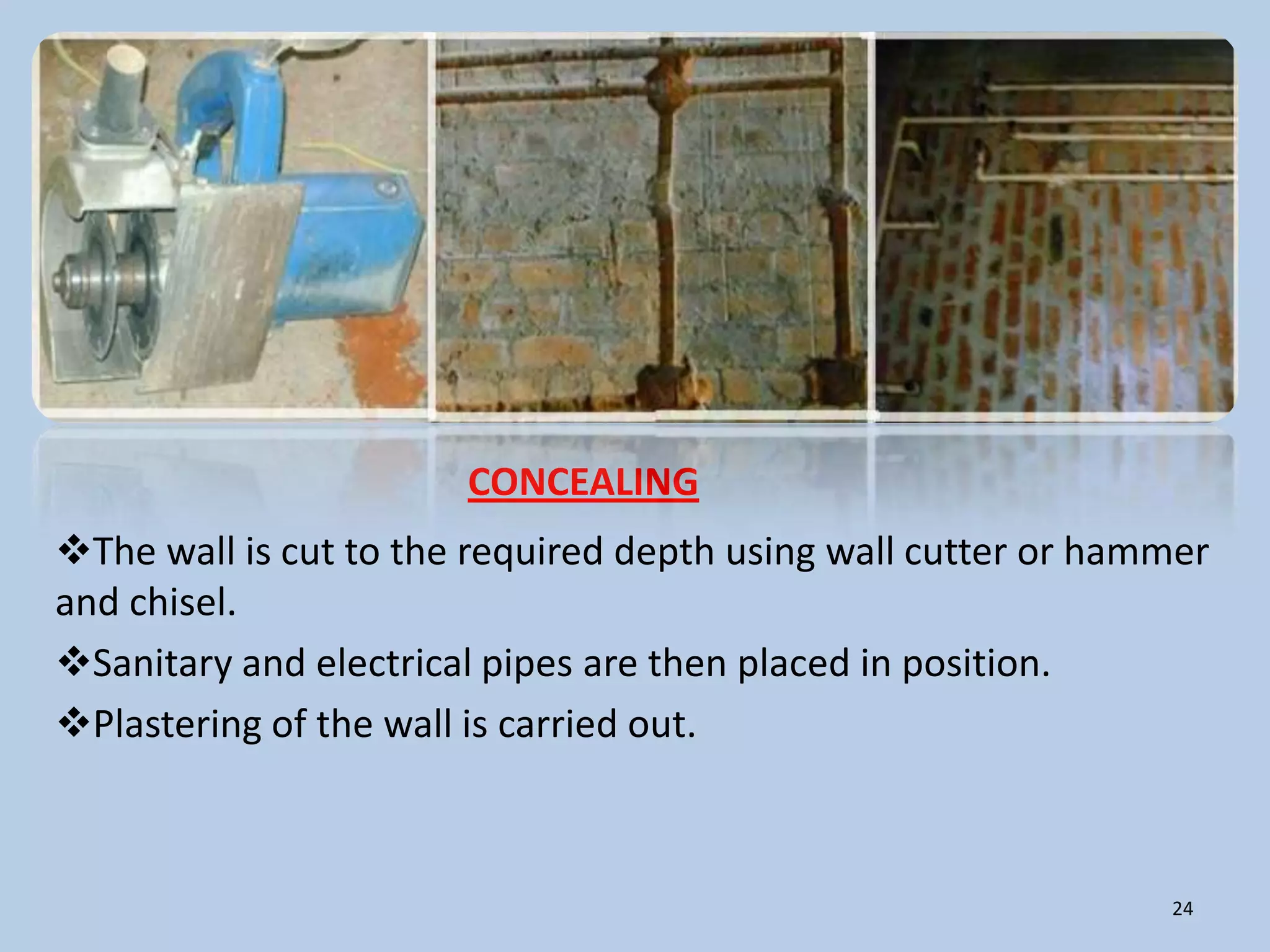
CONCEALING
The wall is cut to the required depth using wall cutter or hammer
and chisel.
Sanitary and electrical pipes are then placed in position.
Plastering of the wall is carried out.


                                                               24
PLASTERING
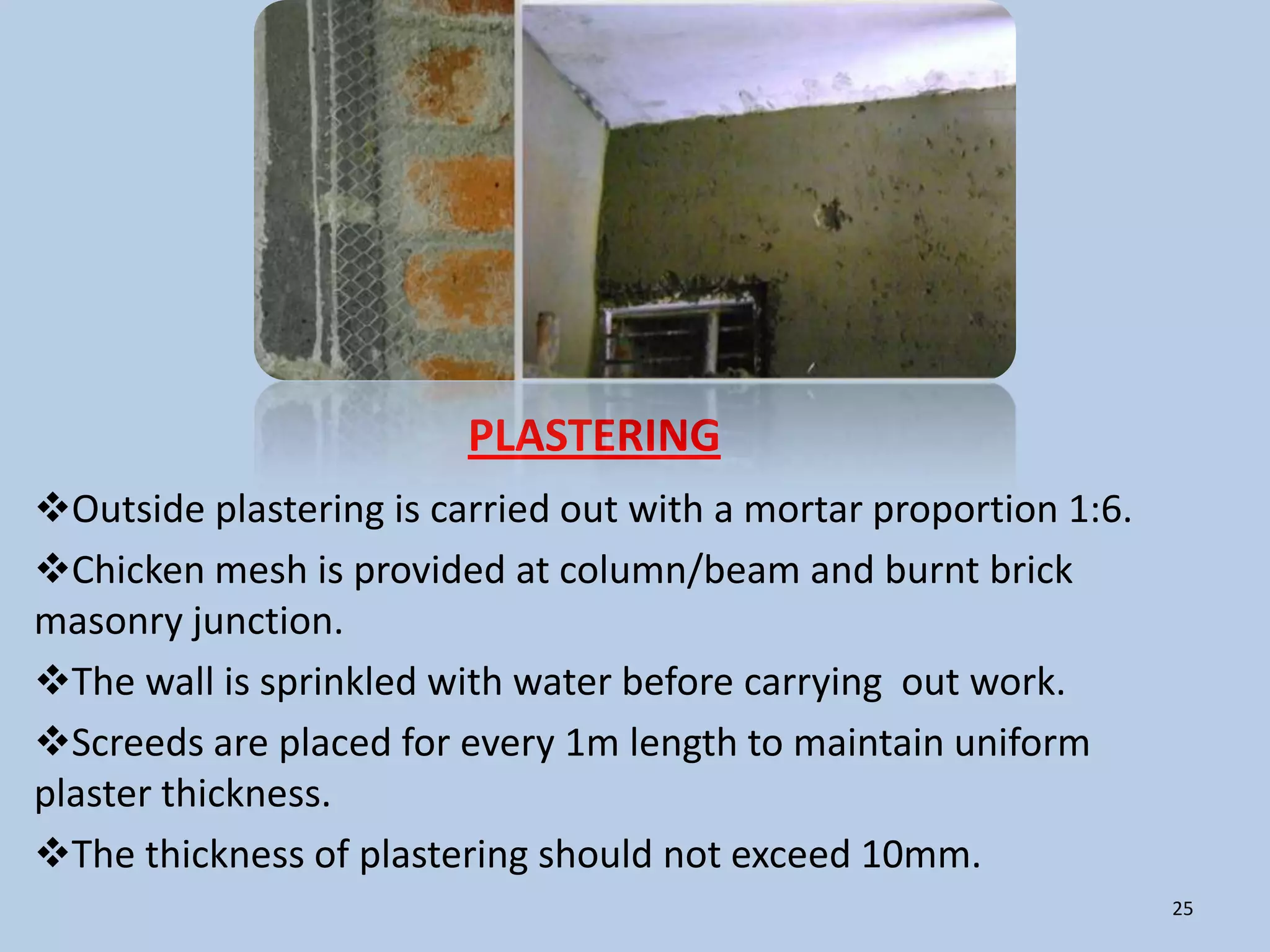
Outside plastering is carried out with a mortar proportion 1:6.
Chicken mesh is provided at column/beam and burnt brick
masonry junction.
The wall is sprinkled with water before carrying out work.
Screeds are placed for every 1m length to maintain uniform
plaster thickness.
The thickness of plastering should not exceed 10mm.
                                                                   25
KARNATAKA POLICE ACADEMY AUDITORIUM


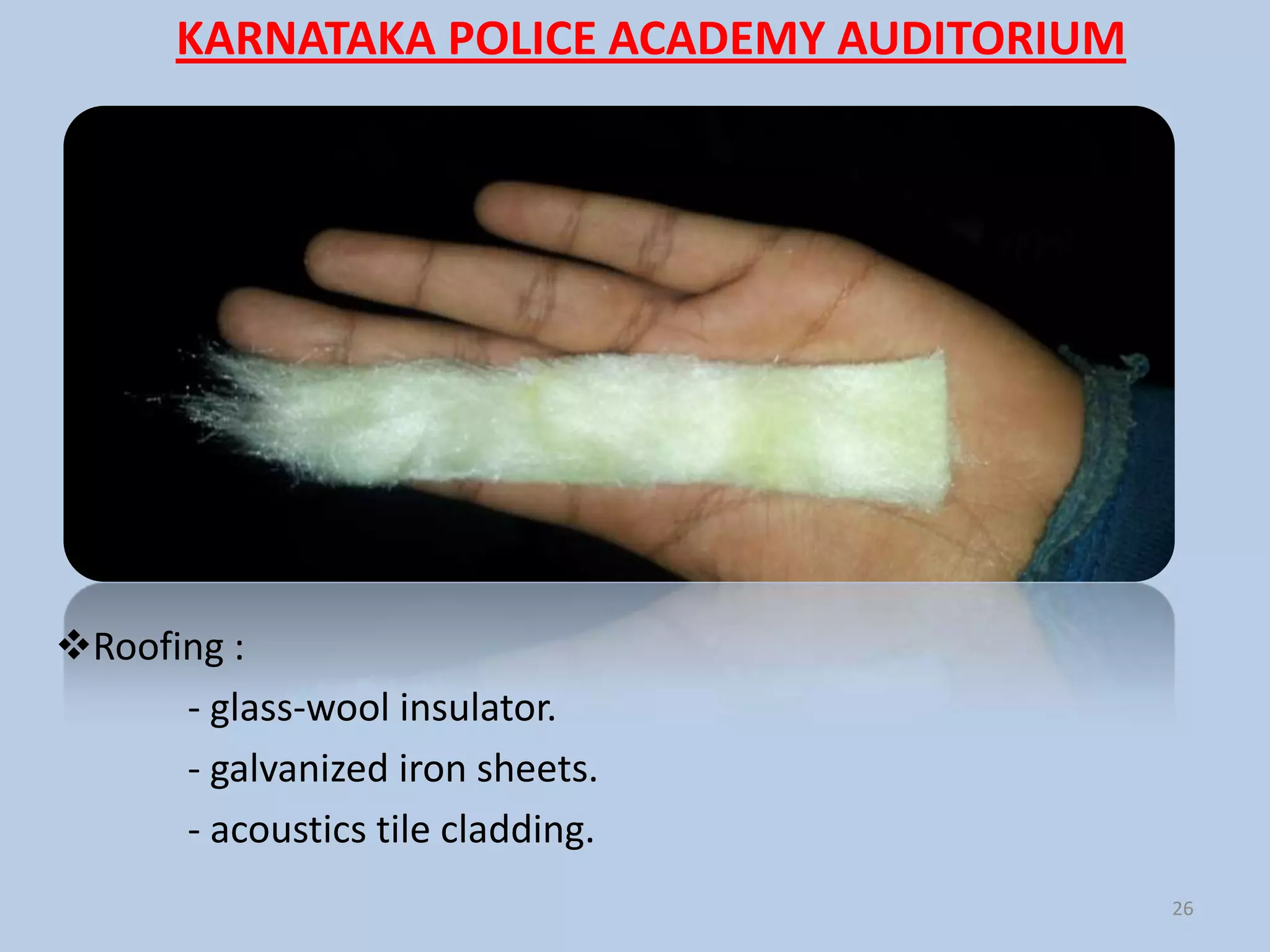
Roofing :
      - glass-wool insulator.
      - galvanized iron sheets.
      - acoustics tile cladding.
                                             26
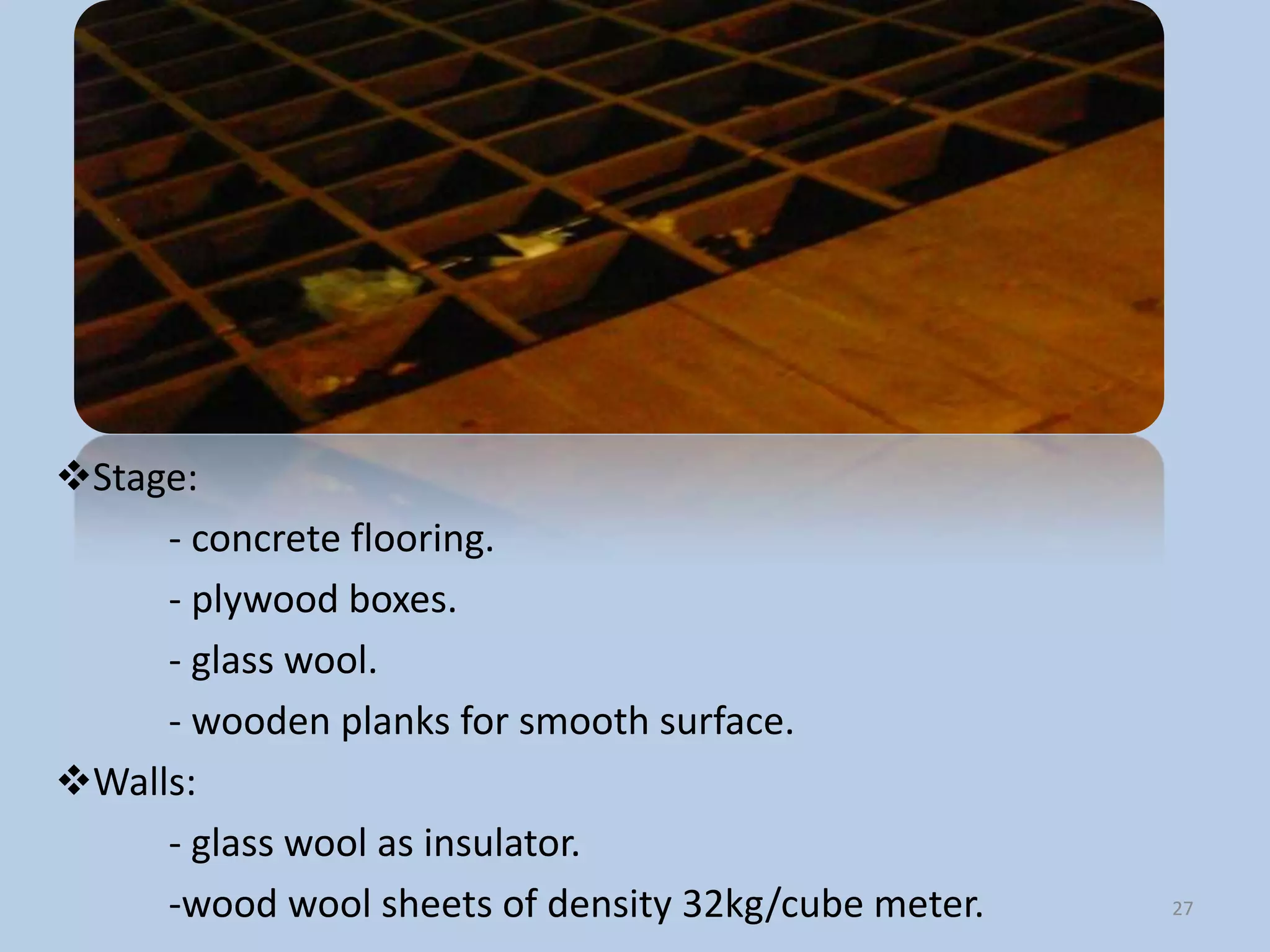
Stage:
     - concrete flooring.
     - plywood boxes.
     - glass wool.
     - wooden planks for smooth surface.
Walls:
     - glass wool as insulator.
     -wood wool sheets of density 32kg/cube meter.   27
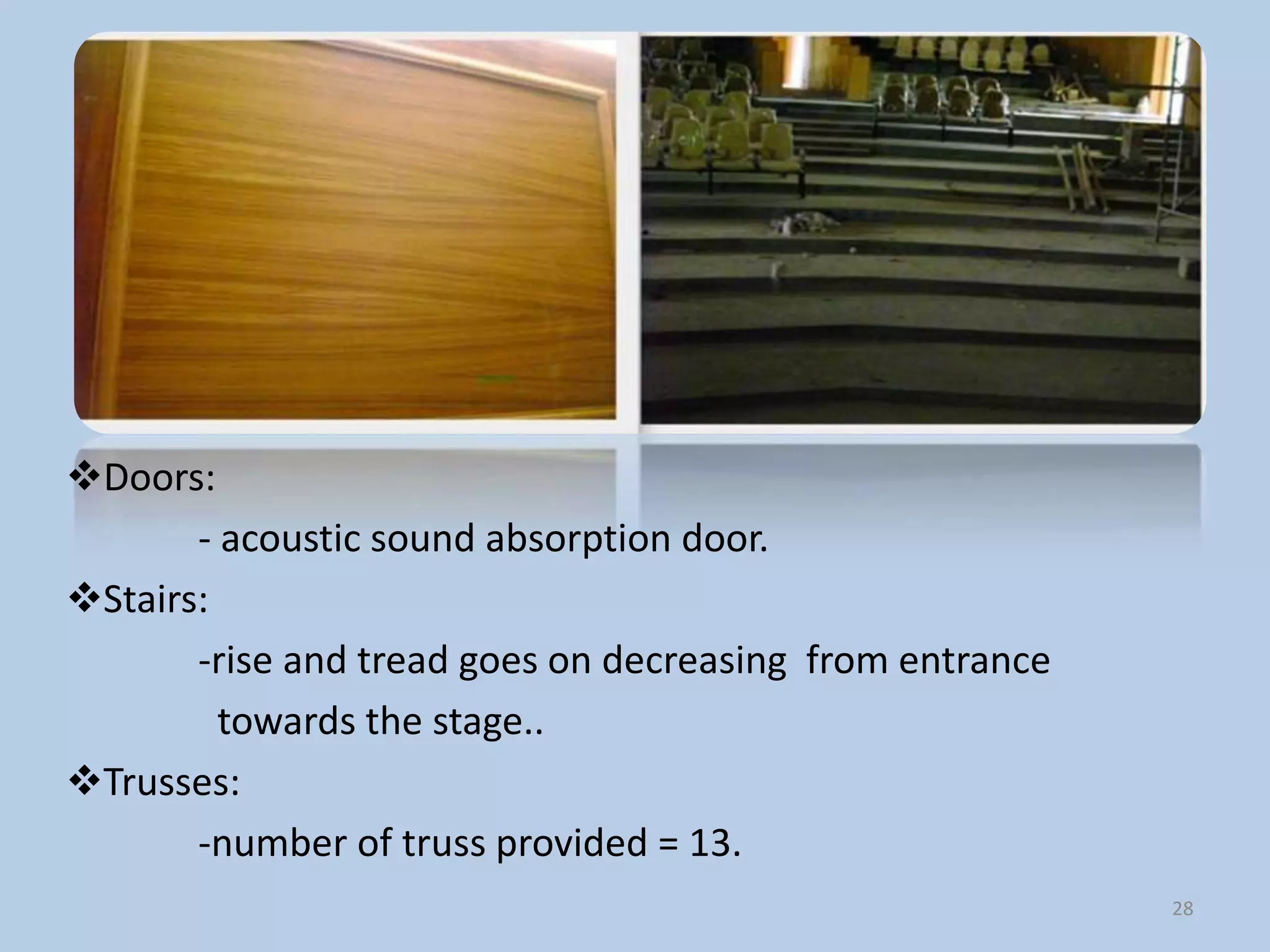
Doors:
       - acoustic sound absorption door.
Stairs:
       -rise and tread goes on decreasing from entrance
         towards the stage..
Trusses:
       -number of truss provided = 13.
                                                          28
Lift is provided with 4 big springs at bottom and depth of
  spring being 1m.
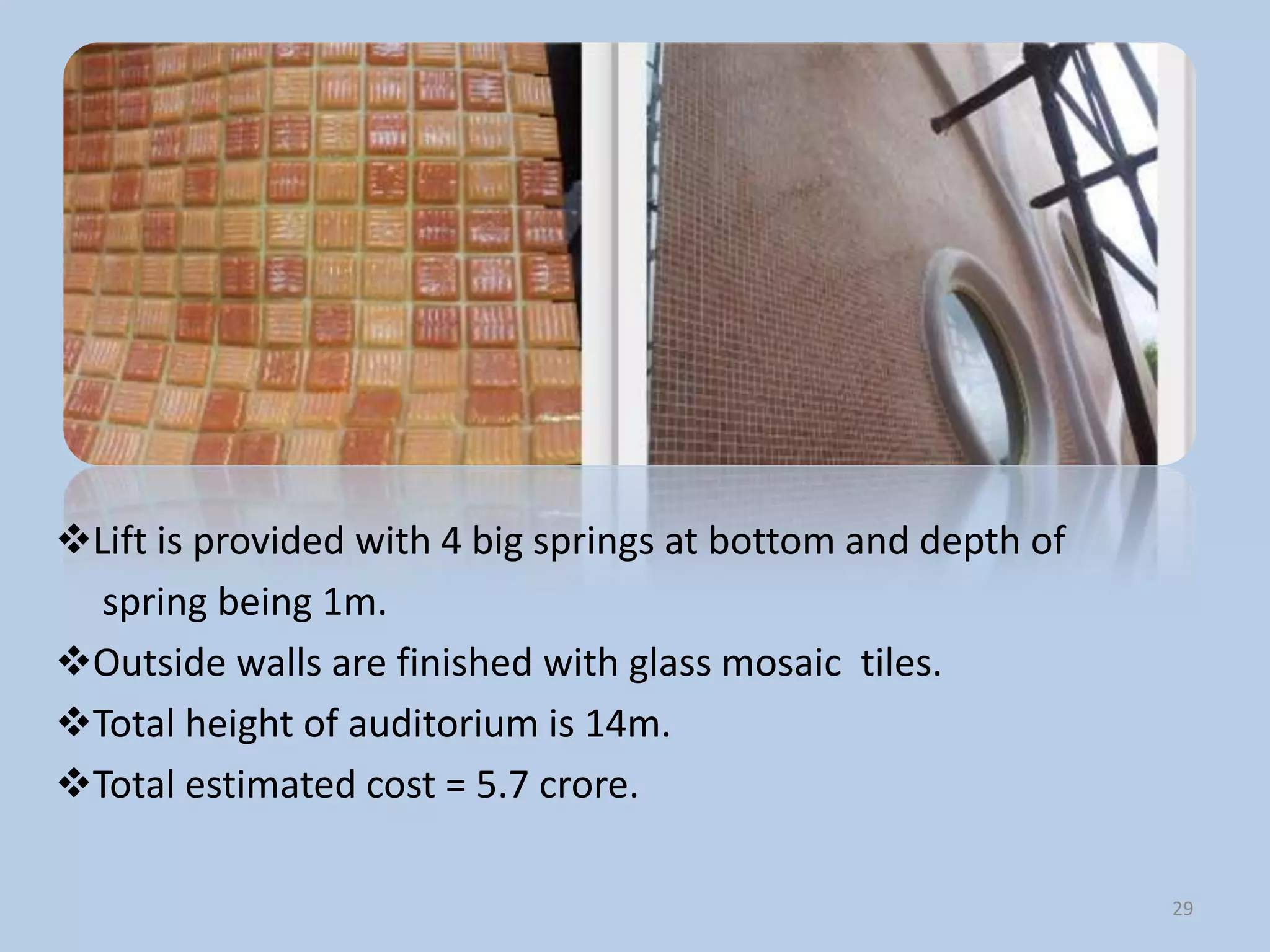
Outside walls are finished with glass mosaic tiles.
Total height of auditorium is 14m.
Total estimated cost = 5.7 crore.

                                                              29
READY MIX CONCRETE
 RMC is a specialized material in which the cement
  aggregates and other ingredients are weigh-batched at a
  plant in a central mixer or truck mixer, before delivery to the
  construction site in a condition ready for placing by the
  builder.
 Thus, `fresh' concrete is manufactured in a plant away from
  the construction site and transported within the requisite
  journey time.
 The RMC supplier provides two services, firstly one of
  processing the materials for making fresh concrete and
  secondly, of transporting a product within a short time.


                                                              30
HISTORY
The first concrete mixed off site and delivered to a construction
site was effectively done in Baltimore, United States in 1913
just before the First World War.
The first concept of transit mixer was also born in 1926 in the
United States.
In 1939, the first RMC plant was installed in United Kingdom and in
1933 first specifications on RMC was published in United Kingdom.
The first concept of transit mixer was also born in 1926 in the
United States.
In 1939, the first RMC plant was installed in United Kingdom and in
1933 first specifications on RMC was published in United Kingdom.
In India RMC was first initially was used in 1950 during the
construction sites of Dams like Bhakra Nangal, Koyna.

                                                                31
 RMC was first fully established in Pune in the year 1991 by
  private companies which was close later.
 RMC was successfully established sometime after 1994 in
  India.
 As per the available record upto 2003, there are around
  76RMC plant in 17 cities with a total capacity of around3875
  CuM/hr, producing 3.8 million CuM of concrete per year.

TYPES OF BATCHING PLANTS :
 Centrally Mixed Concrete or Wet batch mixer
 Truck mixed concrete or Dry batch concrete plant


                                                                 32
BATCHING AND MIXING PLANTS

Storage of Materials
i) Cement :
• Cement is generally stored in silos.
•The loading of cement is done with the help of pneumatic blower
systems.
                                                              33
ii) Water :
• Water is generally stored in tanks located close to the plant. It
is accurately measured by a water gauge and microprocessor
controlled system.
• The modern plants have new electronic MFM 85moisture
recorders.
iii) Aggregates :
•The aggregates are stored above the batching and mixing
elements, in one or more silos.
•As the aggregates are stored in silos it is relatively easy to
protect the aggregates from very low temperature in winter
period.
•A storage capacity of upto 1500 CuM is possible.

                                                                34
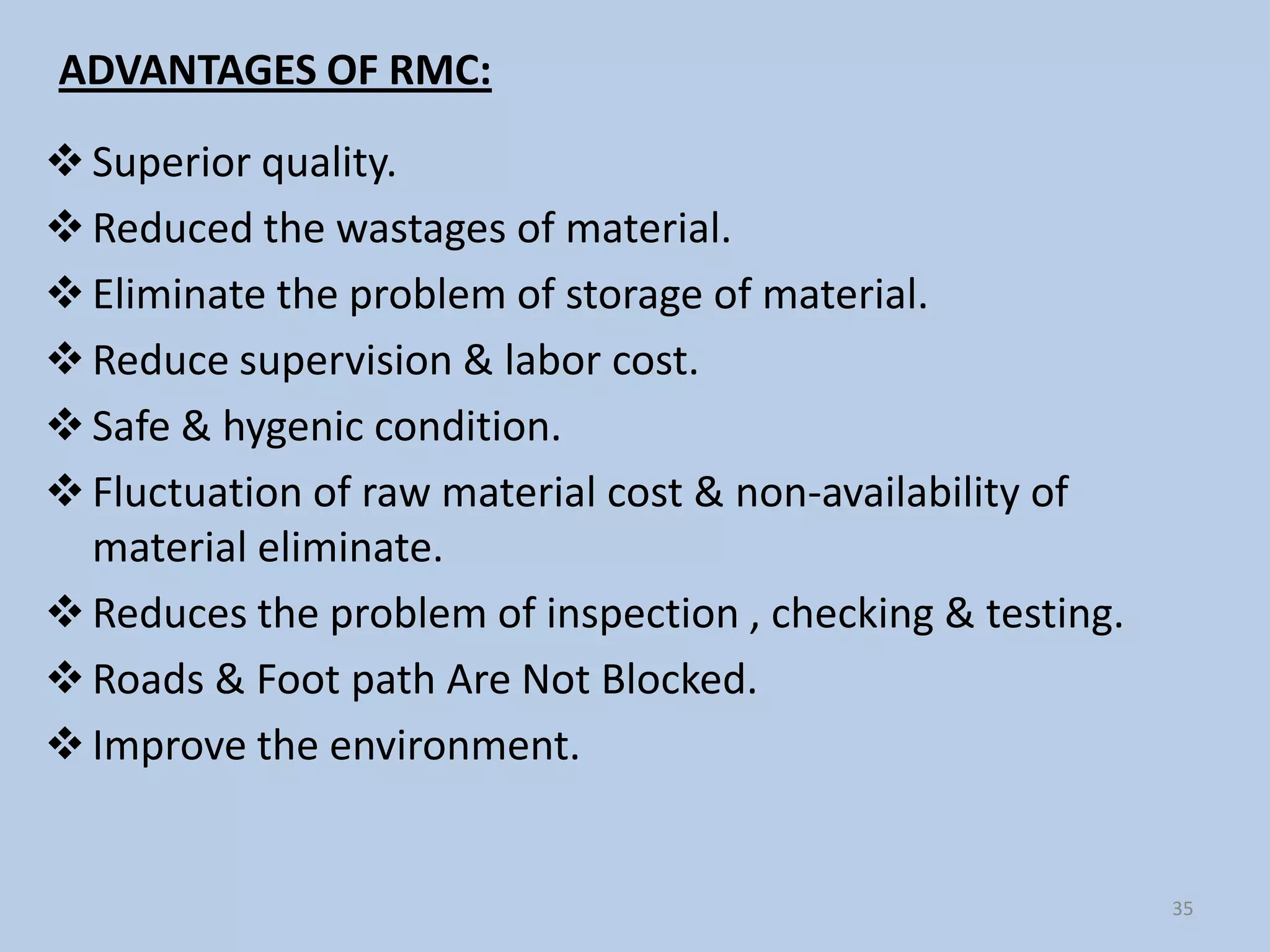
ADVANTAGES OF RMC:

 Superior quality.
 Reduced the wastages of material.
 Eliminate the problem of storage of material.
 Reduce supervision & labor cost.
 Safe & hygenic condition.
 Fluctuation of raw material cost & non-availability of
  material eliminate.
 Reduces the problem of inspection , checking & testing.
 Roads & Foot path Are Not Blocked.
 Improve the environment.


                                                            35
d) TRANSPORTATION EQUIPMENT - TRANSIT MIXER :
 Normal capacity - 4 to 12 CuM.
Hydraulic Drive of Mixer Separate engine or driven by
   truck engine Water tank capacity - 192 to 2000 litres.
Mixer trucks –
• Twin axles for 4 CuM capacity.
• Three axles for 6 to 7 CuM capacity.
• three/four axles for 8 to 10 CuM capacity.
• Semi trailer truck for 10 to 12 CuM.


                                                            36
PRESENT CONSTRAINTS FACED BY RMC:
 High Cost
 Delayed payments and long credit by consumers
 RMC plants in cities are not permitted to be installed in
  residential zones.
 High cost of the plant and equipment results in high capital
  costs.
 Bad quality of roads and traffic congestion and intermittent
  signals often delay the deliveries in metros.
 Availability of trained and skilled manpower for operations
  and maintenance of plant and equipment.
 Delays in placing, compacting and finishing at consumer‘
  send causes delays in unloading of transit mixer and
  stiffening of the concrete mix.
 Quality of formwork and its adequacy.
                                                            37
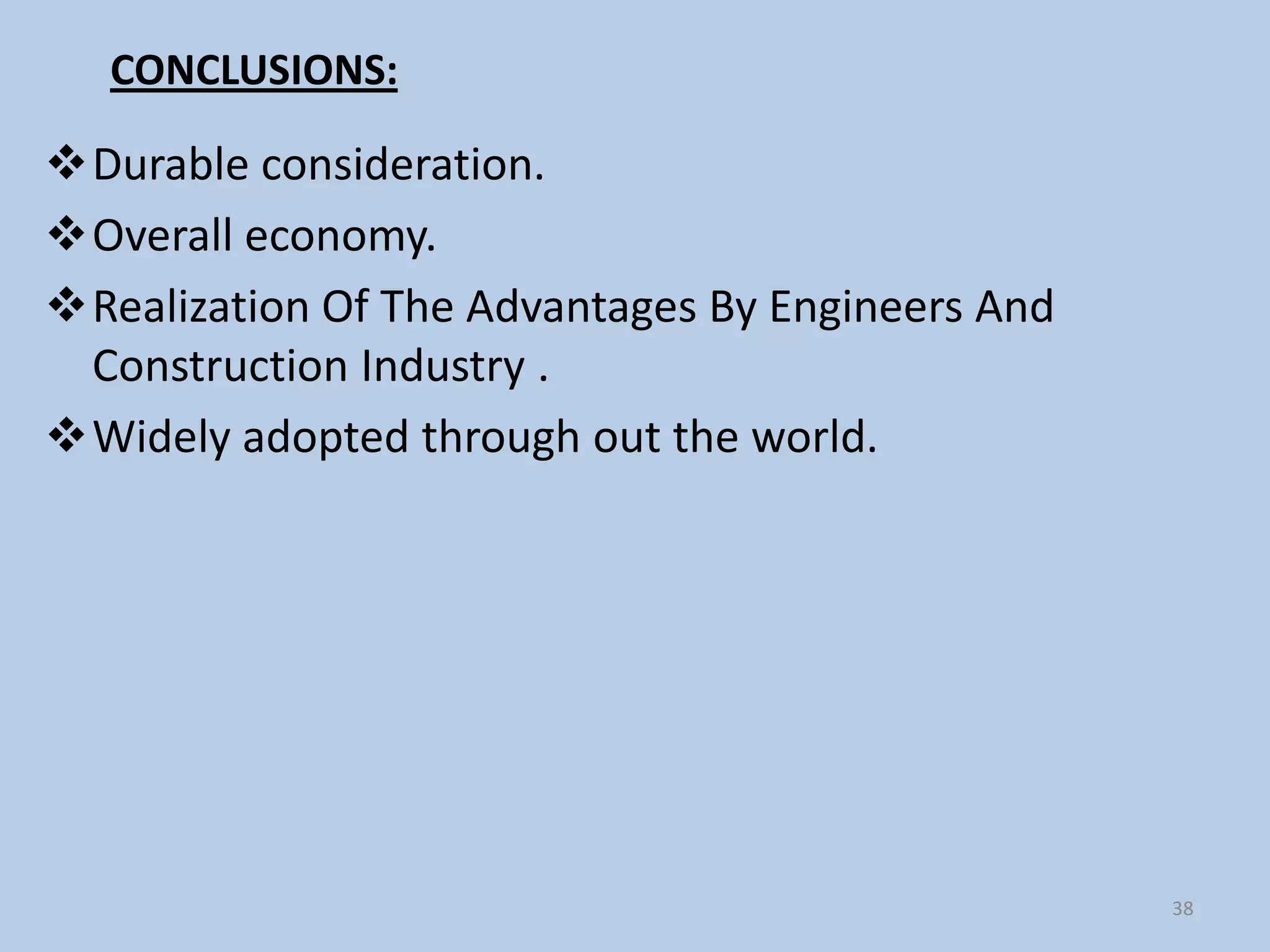
CONCLUSIONS:

Durable consideration.
Overall economy.
Realization Of The Advantages By Engineers And
 Construction Industry .
Widely adopted through out the world.


                                                  38
39

construction study project sjce ctm

  • 1.
  • 2.
    STEPS INVOLVED INA CONSTRUCTION WORK SITE CLEARANCE LEVELLING CENTRE LINE MARKING EXCAVATION PCC WORK FOOTING SSM WORK PLINTH BEAM AND SLAB 2
  • 3.
    ERECTION OF COLUMNS BBM ERECTIONOF DOORS AND WINDOWS LINTEL AND CHEJJA ROOFING PARAPET CONCEALING PLASTERING FLOORING FINAL FINISHING 3
  • 4.
    SITE CLEARANCE Removal oftrees which includes its trunks, branches & roots. Clearing grass & removal of rubbishes. Clearing & grubbing road land. Dismantling of unnecessary existing structures , if any. 4
  • 5.
    LEVELLING Leveling is themeasurement of geodetic height using an optical leveling instrument and a level staff. Find the elevation of a given point with respect to the given or assumed Datum. Establish a point at a given elevation with respect to the given or assumed Datum. leveling instruments include the spirit level, the dumpy level, the digital level, and the laser level. 5
  • 6.
    CENTRE LINE MARKING Thebase line has to be established with the help of offsets taken based on the existing road or building. The centre line is marked based on the base line. This centre line should be transferred to Burjis and be kept up to the completion of foundation work. 6
  • 7.
    EXCAVATION Excavation depth dependson SBC of soil. The minimum depth (1.5m). Equipments. Retaining wall. 7
  • 8.
    PCC WORK Purpose isto provide a strong as well as a level base for footing. Site mixed. Curing. Thickness of PCC 0.15m. Concrete provided is M15. 8
  • 9.
    FOOTING The lowermost portionof the foundation which is in direct contact with subsoil. On the previously laid pcc bed, reinforcement mat is provided. The reinforcement for footing, pedestal and column is raised from the reinforcement mat. 9
  • 10.
    Concrete provided isM20. Pedestal is provided when the depth of footing is high and to make the work economical. The depth of footing mainly depends on the safe bearing capacity of soil and height of the building. Different types of shallow footing -simple footing. -stepped footing. -single footing. 10
  • 11.
    SIZE STONE MASONRY Stonesused should be well dressed. Stones should be well watered before use. The stonework should be carried out in proper bond with sufficient number of through stones. Formation of continuous vertical joints should be avoided. 11
  • 12.
    The stone masonryshould comply with the requirements of the specification of work. The mortar proportion used should be of quality and proportion specified. Chips, small pieces of broken stones should not be used. It should be carried out as per line and level. After construction, SSM has to be well watered for 1-2 weeks. 12
  • 13.
    PLINTH BEAM ANDPLINTH SLAB Plinth beam is provided where there are load bearing wall. Plinth slab is provided where there is no load on that structure.  concrete used is M20 grade. Site mix concrete. 13
  • 14.
    The reinforcement ofplinth beam is as same as the roof beam. Props are provided to the column reinforcement during concreting of the plinth beam to avoid tilting. When segregation and honeycombing is observed the very next day it should be plastered with cement mortar. Segregation and bleeding should be avoided. Vibration should be done not more than 5 seconds. Formwork should be removed after 24 hours. 14
  • 15.
    ERECTION OF COLUMNS Thereinforcement of column is checked as per the drawings. Starter box is provided before the column box is placed in position. Concrete mix used is M20. About 25-40mm clear cover is provided. Compaction to be carried out carefully to eliminate air gaps. Curing to be done for atleast 15 days. 15
  • 16.
    BURNT BRICK MASONRY Bricksshould be of standard size and should have sharp edges. Preliminary tests are conducted to check the properties. Bricks should be well watered before use. Mortar thickness should be 10-20mm. Continuous vertical joints should be eliminated. 16
  • 17.
     Minimum constructionheight of brick masonry should not exceed 1m.  It is carried out as per line and level.  Brick bats should be avoided as far as possible.  The mortar proportion used should be of quality and proportion specified.  Type of brick bond mainly depends on the thickness of wall and the purpose for which it is built. 17
  • 18.
    ERECTION OF DOORSAND WINDOWS Door frames and window frames can be placed in position during BBM or later after completion of BBM. The door and window frame are fixed in position by cranking it into the wall. 18
  • 19.
     The widthof the door should be .4 to .6 times the height of the door.  The height of the door should be a minimum of (width+1.2m).  The size of the window depends upon the size of room.  The doors are located at a distance of about 200mm from the corner of the room.  Materials used for windows and doors are wood, glass, plywood and metal.  The shutters for doors and windows are provided after internal and external plastering. 19
  • 20.
    LINTEL AND CHEJJA Lintelis a horizontal member placed across an opening to support the portion of the structure above it . The ends of the lintel are built into the masonry , so that the loads are transferred to the masonry. Commonly used materials for lintel are wood, stone, brick, steel and reinforced cement concrete. A chejja is a sloping or horizontal structural overhang provided over openings on external walls for protection from the weather.20
  • 21.
    ROOFING It is theuppermost part of a building which is constructed in the form of a frame work to give protection to the building. The formwork is placed in position by centering and leveling. The surface of formwork where concrete is laid is painted with oil. Reinforcement for the roof slab and beams are done as per the 21 design and drawings.
  • 22.
    Cranking of themain rods are done based on the type of slab. Concealing for electricity is done simultaneously when laying reinforcement. Extra rods are provided wherever necessary. Concreting is done and vibrators are used to fill the air voids. Ponding is done on the same day of concreting. Curing done for 28 days. Formwork is removed in 7 days after concreting. 22
  • 23.
    PARAPET A parapet isa wall-like barrier at the edge of a roof, terrace, balcony, or other structure. Parapets rise above the cornice of a building. They are primarily used to prevent the spread of fires. 1/2 brick wall is provided on cantilever projection and in other places 1 brick wall thickness is provided. Coping is provided of grade M15. Dummy columns are filled with M15 grade concrete. Plastering of parapet with a mortar proportion 1:4. 23

  • 24.
    CONCEALING The wall iscut to the required depth using wall cutter or hammer and chisel. Sanitary and electrical pipes are then placed in position. Plastering of the wall is carried out. 24
  • 25.
    PLASTERING Outside plastering iscarried out with a mortar proportion 1:6. Chicken mesh is provided at column/beam and burnt brick masonry junction. The wall is sprinkled with water before carrying out work. Screeds are placed for every 1m length to maintain uniform plaster thickness. The thickness of plastering should not exceed 10mm. 25
  • 26.
    KARNATAKA POLICE ACADEMYAUDITORIUM Roofing : - glass-wool insulator. - galvanized iron sheets. - acoustics tile cladding. 26
  • 27.
    Stage: - concrete flooring. - plywood boxes. - glass wool. - wooden planks for smooth surface. Walls: - glass wool as insulator. -wood wool sheets of density 32kg/cube meter. 27
  • 28.
    Doors: - acoustic sound absorption door. Stairs: -rise and tread goes on decreasing from entrance towards the stage.. Trusses: -number of truss provided = 13. 28
  • 29.
    Lift is providedwith 4 big springs at bottom and depth of spring being 1m. Outside walls are finished with glass mosaic tiles. Total height of auditorium is 14m. Total estimated cost = 5.7 crore. 29
  • 30.
    READY MIX CONCRETE RMC is a specialized material in which the cement aggregates and other ingredients are weigh-batched at a plant in a central mixer or truck mixer, before delivery to the construction site in a condition ready for placing by the builder.  Thus, `fresh' concrete is manufactured in a plant away from the construction site and transported within the requisite journey time.  The RMC supplier provides two services, firstly one of processing the materials for making fresh concrete and secondly, of transporting a product within a short time. 30
  • 31.
    HISTORY The first concretemixed off site and delivered to a construction site was effectively done in Baltimore, United States in 1913 just before the First World War. The first concept of transit mixer was also born in 1926 in the United States. In 1939, the first RMC plant was installed in United Kingdom and in 1933 first specifications on RMC was published in United Kingdom. The first concept of transit mixer was also born in 1926 in the United States. In 1939, the first RMC plant was installed in United Kingdom and in 1933 first specifications on RMC was published in United Kingdom. In India RMC was first initially was used in 1950 during the construction sites of Dams like Bhakra Nangal, Koyna. 31
  • 32.
     RMC wasfirst fully established in Pune in the year 1991 by private companies which was close later.  RMC was successfully established sometime after 1994 in India.  As per the available record upto 2003, there are around 76RMC plant in 17 cities with a total capacity of around3875 CuM/hr, producing 3.8 million CuM of concrete per year. TYPES OF BATCHING PLANTS :  Centrally Mixed Concrete or Wet batch mixer  Truck mixed concrete or Dry batch concrete plant 32
  • 33.
    BATCHING AND MIXINGPLANTS Storage of Materials i) Cement : • Cement is generally stored in silos. •The loading of cement is done with the help of pneumatic blower systems. 33
  • 34.
    ii) Water : •Water is generally stored in tanks located close to the plant. It is accurately measured by a water gauge and microprocessor controlled system. • The modern plants have new electronic MFM 85moisture recorders. iii) Aggregates : •The aggregates are stored above the batching and mixing elements, in one or more silos. •As the aggregates are stored in silos it is relatively easy to protect the aggregates from very low temperature in winter period. •A storage capacity of upto 1500 CuM is possible. 34
  • 35.
    ADVANTAGES OF RMC: Superior quality.  Reduced the wastages of material.  Eliminate the problem of storage of material.  Reduce supervision & labor cost.  Safe & hygenic condition.  Fluctuation of raw material cost & non-availability of material eliminate.  Reduces the problem of inspection , checking & testing.  Roads & Foot path Are Not Blocked.  Improve the environment. 35
  • 36.
    d) TRANSPORTATION EQUIPMENT- TRANSIT MIXER :  Normal capacity - 4 to 12 CuM. Hydraulic Drive of Mixer Separate engine or driven by truck engine Water tank capacity - 192 to 2000 litres. Mixer trucks – • Twin axles for 4 CuM capacity. • Three axles for 6 to 7 CuM capacity. • three/four axles for 8 to 10 CuM capacity. • Semi trailer truck for 10 to 12 CuM. 36
  • 37.
    PRESENT CONSTRAINTS FACEDBY RMC:  High Cost  Delayed payments and long credit by consumers  RMC plants in cities are not permitted to be installed in residential zones.  High cost of the plant and equipment results in high capital costs.  Bad quality of roads and traffic congestion and intermittent signals often delay the deliveries in metros.  Availability of trained and skilled manpower for operations and maintenance of plant and equipment.  Delays in placing, compacting and finishing at consumer‘ send causes delays in unloading of transit mixer and stiffening of the concrete mix.  Quality of formwork and its adequacy. 37
  • 38.
    CONCLUSIONS: Durable consideration. Overall economy. RealizationOf The Advantages By Engineers And Construction Industry . Widely adopted through out the world. 38
  • 39.