








Crypto-Asset
predictions, challenges
and crazy ideas using
deep learning
Agenda
❖ A gentle introduction to predictions in capital markets
❖ Prediction In crypto assets
❖ Myths and realities of crypto asset predictions
❖ Time series vs. deep learning architectures
❖ Some ideas to explore
INTRODUCING
Predictions are the holy grail of machine
intelligence applied to financial markets…
INTRODUCING
Predictions focus on forecasting the
performance of one or a group of assets based
on a specific set of attributes….
INTRODUCING
There are two main schools of thought to
approach asset predictions in capital markets…
Asset-Based Factor-Based
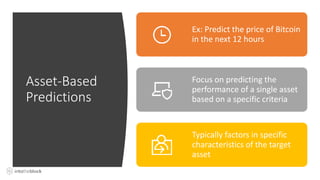
Asset-Based
Predictions
Ex: Predict the price of Bitcoin
in the next 12 hours
Focus on predicting the
performance of a single asset
based on a specific criteria
Typically factors in specific
characteristics of the target
asset
8
Asset-Based Predictions
Pros
• Rich models based on the specific characteristics of an asset
• Possible to achieve high levels of accuracy during short periods of
time
• Simpler to retrain and validate
Cons
• Exposure to a single asset within a market
• Hard to assemble in cohesive portfolios
• Becomes challenging to combine different predictions as part of
portfolios
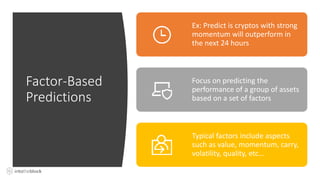
Factor-Based
Predictions
Ex: Predict is cryptos with strong
momentum will outperform in
the next 24 hours
Focus on predicting the
performance of a group of assets
based on a set of factors
Typical factors include aspects
such as value, momentum, carry,
volatility, quality, etc…
10
Factor-Based Predictions
Pros
• Minimum exposure to a single asset within a market
• Ability to formulate sophisticated thesis across an entire portfolio
• Exposure to non-correlated factors and hedging models
Cons
• Prediction models need to ignore unique characteristics of a
given asset
• Prediction models might miss unique investment opportunities in
a specific asset within the portfolio
Price Predictions in Crypto Assets
12
Benefits and Challenges of Predictive Models for
Crypto Assets
Benefits
• Asymmetrical opportunity to uncover alpha generating strategies
• Unique data sources
• Irrational market with massive potential upsides
Challenges
• Small and inaccurate datasets
• Fake volumes and wash trading
• Lack of labeled datasets
• Limited non-correlated factors
• Inability to leverage existing quant models
• Black swan events
• Irrational markets
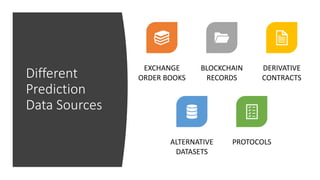
Different
Prediction
Data Sources
EXCHANGE
ORDER BOOKS
BLOCKCHAIN
RECORDS
DERIVATIVE
CONTRACTS
ALTERNATIVE
DATASETS
PROTOCOLS
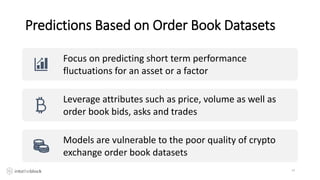
Predictions Based on Order Book Datasets
14
Focus on predicting short term performance
fluctuations for an asset or a factor
Leverage attributes such as price, volume as well as
order book bids, asks and trades
Models are vulnerable to the poor quality of crypto
exchange order book datasets
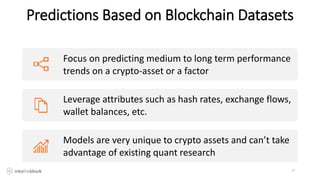
Predictions Based on Blockchain Datasets
15
Focus on predicting medium to long term performance
trends on a crypto-asset or a factor
Leverage attributes such as hash rates, exchange flows,
wallet balances, etc.
Models are very unique to crypto assets and can’t take
advantage of existing quant research
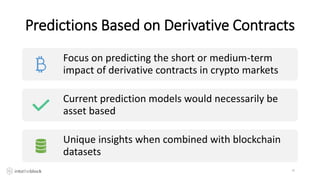
Predictions Based on Derivative Contracts
16
Focus on predicting the short or medium-term
impact of derivative contracts in crypto markets
Current prediction models would necessarily be
asset based
Unique insights when combined with blockchain
datasets
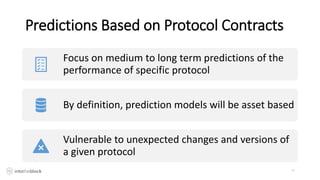
Predictions Based on Protocol Contracts
17
Focus on medium to long term predictions of the
performance of specific protocol
By definition, prediction models will be asset based
Vulnerable to unexpected changes and versions of
a given protocol
Predictions Based on Alternative Asset Datasets
18
Focus on short term predictions based on sources like
Twitter, Telegram, News, etc.
Leverage natural language understanding techniques to
extract information from text data sources.
Largely used as a complement to more sophisticated
prediction models
20
The Super Predictor Myth
Myth
• A single attribute can predict the price of a crypto
asset
• Ex: NVT score can predict the price of Bitcoin….
Reality
• Most prediction models require a combination of
many factors
21
The Super Model Myth
Myth
• A single model can predict the price of a crypto asset
across different market conditions
• Ex: A model based on technical that can regularly predict
the price of Bitcoin
Reality
• Most models only work under specific market conditions
and they tend to overfit for those
22
The Price-Volume Myth
Myth
• All characteristics of a crypto asset are captured in
price and volume sentiment
Reality
• Blockchchain and derivatives datasets offer unique
insights about crypto assets that are impossible to
capture in price and volume models
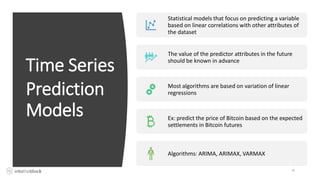
Predictive Model Approaches: Time Series vs. Machine Learning
Time Series
Prediction
Models
24
Statistical models that focus on predicting a variable
based on linear correlations with other attributes of
the dataset
The value of the predictor attributes in the future
should be known in advance
Most algorithms are based on variation of linear
regressions
Ex: predict the price of Bitcoin based on the expected
settlements in Bitcoin futures
Algorithms: ARIMA, ARIMAX, VARMAX
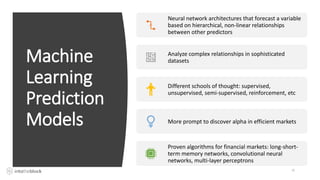
Machine
Learning
Prediction
Models
25
Neural network architectures that forecast a variable
based on hierarchical, non-linear relationships
between other predictors
Analyze complex relationships in sophisticated
datasets
Different schools of thought: supervised,
unsupervised, semi-supervised, reinforcement, etc
More prompt to discover alpha in efficient markets
Proven algorithms for financial markets: long-short-
term memory networks, convolutional neural
networks, multi-layer perceptrons
INTRODUCING
IntoTheBlock Predictions: Democratize machine
learning predictions for crypto-assets for the
mainstream investor
27
What we are doing? : Building a series of
deep learning models based on different
datasets: order book, futures, blockchain
data
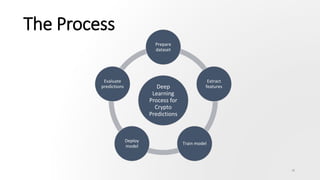
The Process
28
Deep
Learning
Process for
Crypto
Predictions
Prepare
dataset
Extract
features
Train model
Deploy
model
Evaluate
predictions
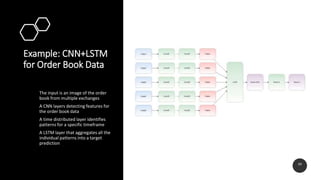
Example: CNN+LSTM
for Order Book Data
• The input is an image of the order
book from multiple exchanges
• A CNN layers detecting features for
the order book data
• A time distributed layer identifies
patterns for a specific timeframe
• A LSTM layer that aggregates all the
individual patterns into a target
prediction
29
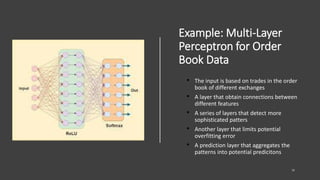
Example: Multi-Layer
Perceptron for Order
Book Data
• The input is based on trades in the order
book of different exchanges
• A layer that obtain connections between
different features
• A series of layers that detect more
sophisticated patters
• Another layer that limits potential
overfitting error
• A prediction layer that aggregates the
patterns into potential predicitons
31
Summary
● Crypto assets offer a blank canvas for prediction models
● There are different data sources of predictions for crypto assets: order
book, futures, blockchain, alternative …
● The two main schools of thought for prediction are : time series and
machine/deep learning
● ITB is working on prediction models for crypto assets based on deep
learning
INTRODUCING
Jesus Rodriguez
jr@intotheblock.io
medium.com/@jrodthoughts
intotheblock.com
Thank You!

Price PRedictions for Crypto-Assets Using Deep Learning

  • 1.
  • 2.
    Agenda ❖ A gentleintroduction to predictions in capital markets ❖ Prediction In crypto assets ❖ Myths and realities of crypto asset predictions ❖ Time series vs. deep learning architectures ❖ Some ideas to explore
  • 3.
    INTRODUCING Predictions are theholy grail of machine intelligence applied to financial markets…
  • 4.
    INTRODUCING Predictions focus onforecasting the performance of one or a group of assets based on a specific set of attributes….
  • 5.
    INTRODUCING There are twomain schools of thought to approach asset predictions in capital markets…
  • 6.
  • 7.
    Asset-Based Predictions Ex: Predict theprice of Bitcoin in the next 12 hours Focus on predicting the performance of a single asset based on a specific criteria Typically factors in specific characteristics of the target asset
  • 8.
    8 Asset-Based Predictions Pros • Richmodels based on the specific characteristics of an asset • Possible to achieve high levels of accuracy during short periods of time • Simpler to retrain and validate Cons • Exposure to a single asset within a market • Hard to assemble in cohesive portfolios • Becomes challenging to combine different predictions as part of portfolios
  • 9.
    Factor-Based Predictions Ex: Predict iscryptos with strong momentum will outperform in the next 24 hours Focus on predicting the performance of a group of assets based on a set of factors Typical factors include aspects such as value, momentum, carry, volatility, quality, etc…
  • 10.
    10 Factor-Based Predictions Pros • Minimumexposure to a single asset within a market • Ability to formulate sophisticated thesis across an entire portfolio • Exposure to non-correlated factors and hedging models Cons • Prediction models need to ignore unique characteristics of a given asset • Prediction models might miss unique investment opportunities in a specific asset within the portfolio
  • 11.
    Price Predictions inCrypto Assets
  • 12.
    12 Benefits and Challengesof Predictive Models for Crypto Assets Benefits • Asymmetrical opportunity to uncover alpha generating strategies • Unique data sources • Irrational market with massive potential upsides Challenges • Small and inaccurate datasets • Fake volumes and wash trading • Lack of labeled datasets • Limited non-correlated factors • Inability to leverage existing quant models • Black swan events • Irrational markets
  • 13.
  • 14.
    Predictions Based onOrder Book Datasets 14 Focus on predicting short term performance fluctuations for an asset or a factor Leverage attributes such as price, volume as well as order book bids, asks and trades Models are vulnerable to the poor quality of crypto exchange order book datasets
  • 15.
    Predictions Based onBlockchain Datasets 15 Focus on predicting medium to long term performance trends on a crypto-asset or a factor Leverage attributes such as hash rates, exchange flows, wallet balances, etc. Models are very unique to crypto assets and can’t take advantage of existing quant research
  • 16.
    Predictions Based onDerivative Contracts 16 Focus on predicting the short or medium-term impact of derivative contracts in crypto markets Current prediction models would necessarily be asset based Unique insights when combined with blockchain datasets
  • 17.
    Predictions Based onProtocol Contracts 17 Focus on medium to long term predictions of the performance of specific protocol By definition, prediction models will be asset based Vulnerable to unexpected changes and versions of a given protocol
  • 18.
    Predictions Based onAlternative Asset Datasets 18 Focus on short term predictions based on sources like Twitter, Telegram, News, etc. Leverage natural language understanding techniques to extract information from text data sources. Largely used as a complement to more sophisticated prediction models
  • 20.
    20 The Super PredictorMyth Myth • A single attribute can predict the price of a crypto asset • Ex: NVT score can predict the price of Bitcoin…. Reality • Most prediction models require a combination of many factors
  • 21.
    21 The Super ModelMyth Myth • A single model can predict the price of a crypto asset across different market conditions • Ex: A model based on technical that can regularly predict the price of Bitcoin Reality • Most models only work under specific market conditions and they tend to overfit for those
  • 22.
    22 The Price-Volume Myth Myth •All characteristics of a crypto asset are captured in price and volume sentiment Reality • Blockchchain and derivatives datasets offer unique insights about crypto assets that are impossible to capture in price and volume models
  • 23.
    Predictive Model Approaches:Time Series vs. Machine Learning
  • 24.
    Time Series Prediction Models 24 Statistical modelsthat focus on predicting a variable based on linear correlations with other attributes of the dataset The value of the predictor attributes in the future should be known in advance Most algorithms are based on variation of linear regressions Ex: predict the price of Bitcoin based on the expected settlements in Bitcoin futures Algorithms: ARIMA, ARIMAX, VARMAX
  • 25.
    Machine Learning Prediction Models 25 Neural network architecturesthat forecast a variable based on hierarchical, non-linear relationships between other predictors Analyze complex relationships in sophisticated datasets Different schools of thought: supervised, unsupervised, semi-supervised, reinforcement, etc More prompt to discover alpha in efficient markets Proven algorithms for financial markets: long-short- term memory networks, convolutional neural networks, multi-layer perceptrons
  • 26.
    INTRODUCING IntoTheBlock Predictions: Democratizemachine learning predictions for crypto-assets for the mainstream investor
  • 27.
    27 What we aredoing? : Building a series of deep learning models based on different datasets: order book, futures, blockchain data
  • 28.
  • 29.
    Example: CNN+LSTM for OrderBook Data • The input is an image of the order book from multiple exchanges • A CNN layers detecting features for the order book data • A time distributed layer identifies patterns for a specific timeframe • A LSTM layer that aggregates all the individual patterns into a target prediction 29
  • 30.
    Example: Multi-Layer Perceptron forOrder Book Data • The input is based on trades in the order book of different exchanges • A layer that obtain connections between different features • A series of layers that detect more sophisticated patters • Another layer that limits potential overfitting error • A prediction layer that aggregates the patterns into potential predicitons
  • 31.
    31 Summary ● Crypto assetsoffer a blank canvas for prediction models ● There are different data sources of predictions for crypto assets: order book, futures, blockchain, alternative … ● The two main schools of thought for prediction are : time series and machine/deep learning ● ITB is working on prediction models for crypto assets based on deep learning
  • 32.