Blockchain in the Enterprise:
Lessons from the Trenches
Invector Labs
About Invector Labs
• Bringing deep-tech to the enterprise
• Focused on groundbreaking technology trends:
• Artificial intelligence
• Blockchain technologies
• Internet of things
• Cybersecurity
• Advanced cloud computing
• ….
• http://invectorlabs.com
Agenda
• Blockchain in the enterprise: Challenges
• Permissioned blockchain platforms
• Permissioned blockchain runtimes
• Permissioned blockchain stacks
Key Challenges of Real World Blockchain
Solutions…
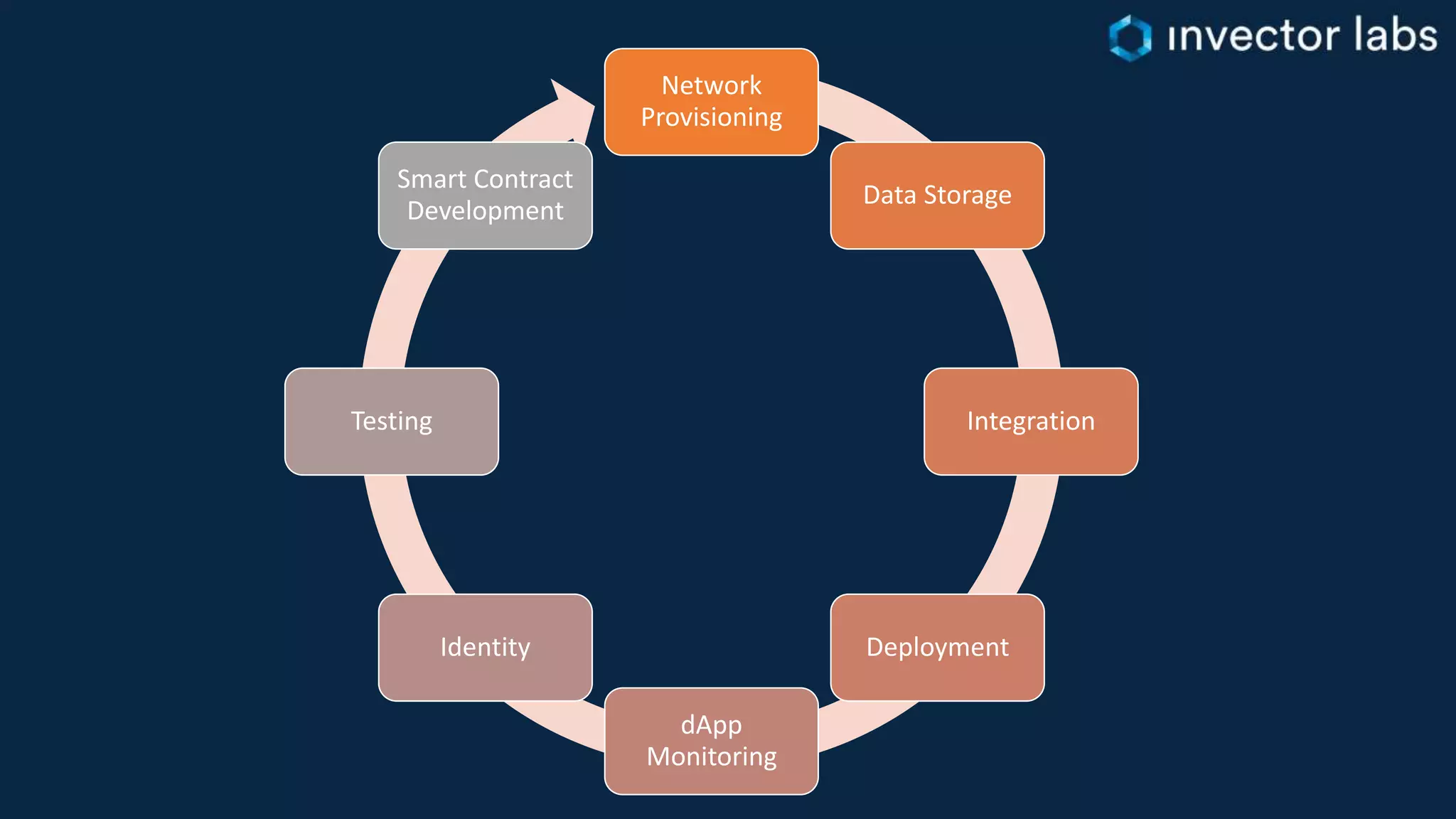
Network
Provisioning
Data Storage
Integration
Deployment
dApp
Monitoring
Identity
Testing
Smart Contract
Development
Key Decisions
Selecting a
Blockchain
Platform
Selecting a
Blockchain
Runtime
Selecting a
Complementary
Technology Stack
Selecting a Blockchain Platform…
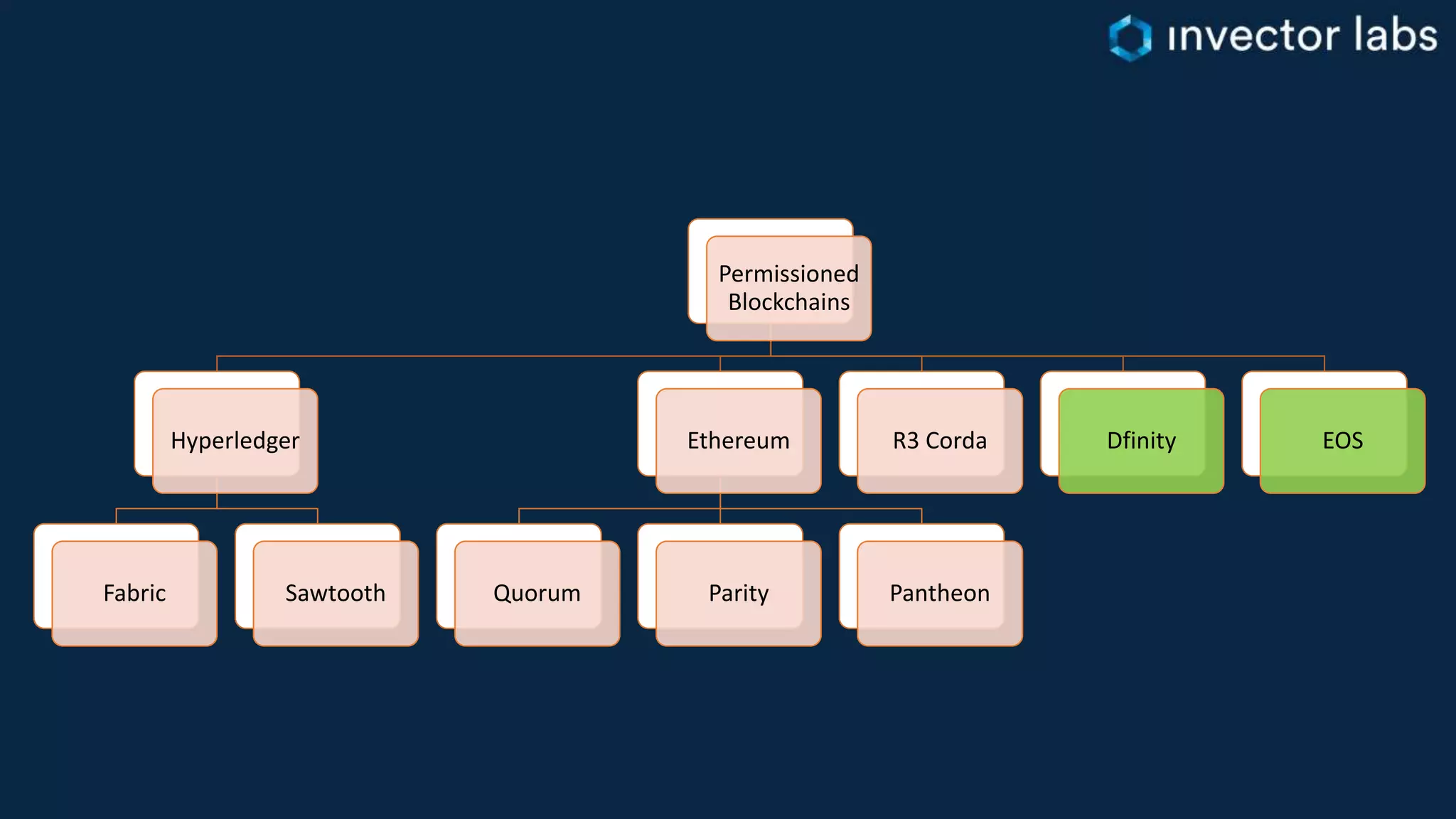
Permissioned
Blockchains
Hyperledger
Fabric Sawtooth
Ethereum
Quorum Parity Pantheon
R3 Corda Dfinity EOS
Selecting a Blockchain Platform…
Hyperledger Fabric
Key Capabilities
• Based on the open source Hyperledger implementation
• Supports smart contracts via chaincode and containers(Java, Go, NodeJS)
• Identity and privacy based protocols
• Networks can be segmented in channels
• Advanced toolset with products like Composer
Strengths
• Integration with external systems
• Solutions portfolio
• Partner community
Weaknesses
• Smart contract model
• Toolset for app lifecyle management
• Lack of support for public blockchain topologies
Hyperledger Sawtooth
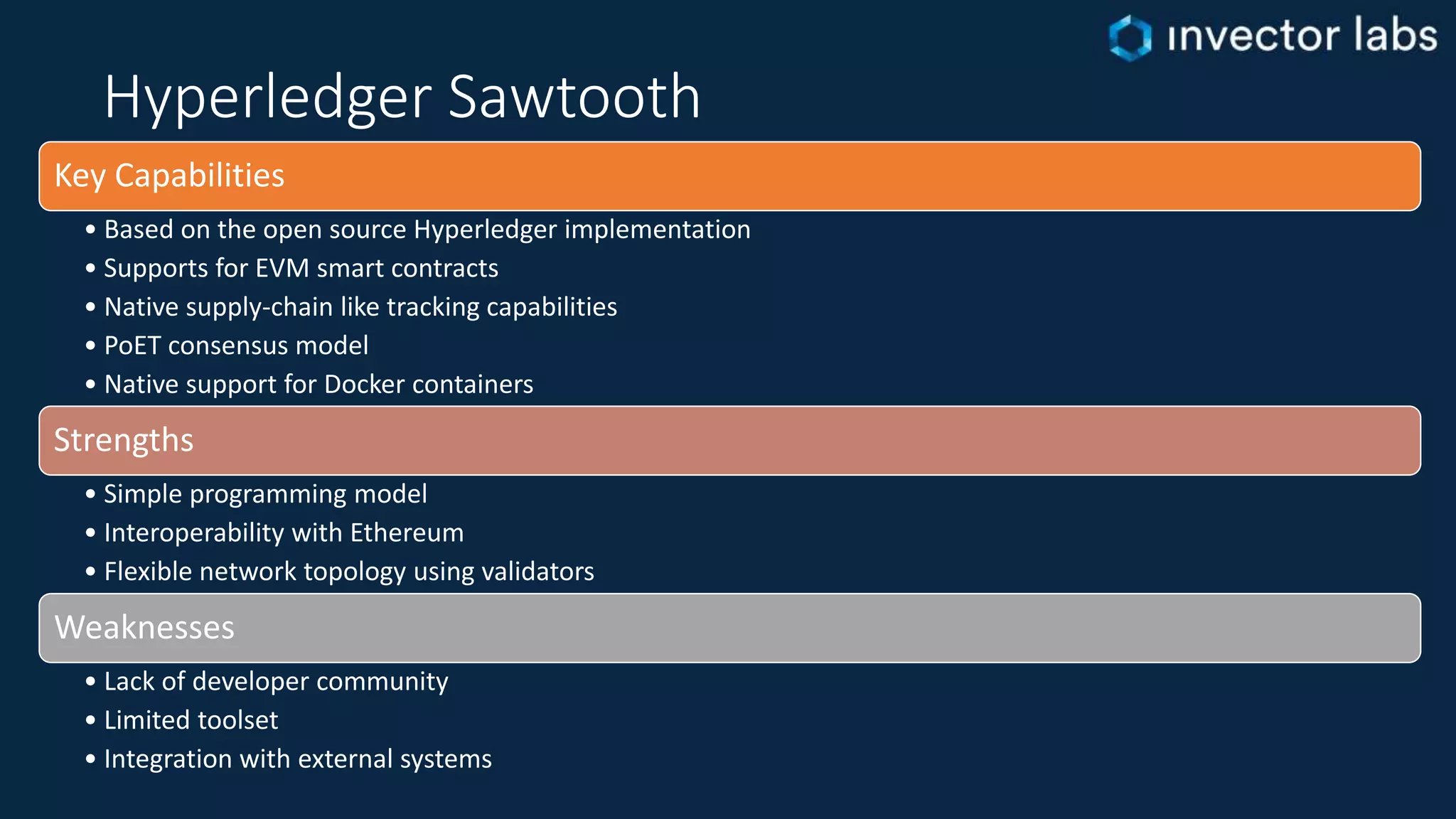
Key Capabilities
• Based on the open source Hyperledger implementation
• Supports for EVM smart contracts
• Native supply-chain like tracking capabilities
• PoET consensus model
• Native support for Docker containers
Strengths
• Simple programming model
• Interoperability with Ethereum
• Flexible network topology using validators
Weaknesses
• Lack of developer community
• Limited toolset
• Integration with external systems
Quorum
Key Capabilities
• Permissioned version of the Ethereum blockchain
• Various consensus mechanisms(Raft and Istanbul BFT implementations)
• Privacy protocols based on zk-SNARKs
• Support for private smart contracts
• Access control policies
Strengths
• Ethereum interoperability
• Privacy
• Deployment and configuration
Weaknesses
• Small core development team and community
• Integration with external systems
• Management toolset
Parity
Key Capabilities
• Integration with both permissioned and public versions of Ethereum
• Support for side chains
• IPFS supports
• Messaging capabilities
• Privacy using secret stores
Strengths
• Ethereum interoperability
• Developer friendliness
• Tollset
Weaknesses
• Small core development team and community
• Integration with external systems
• Management toolset
Pantheon
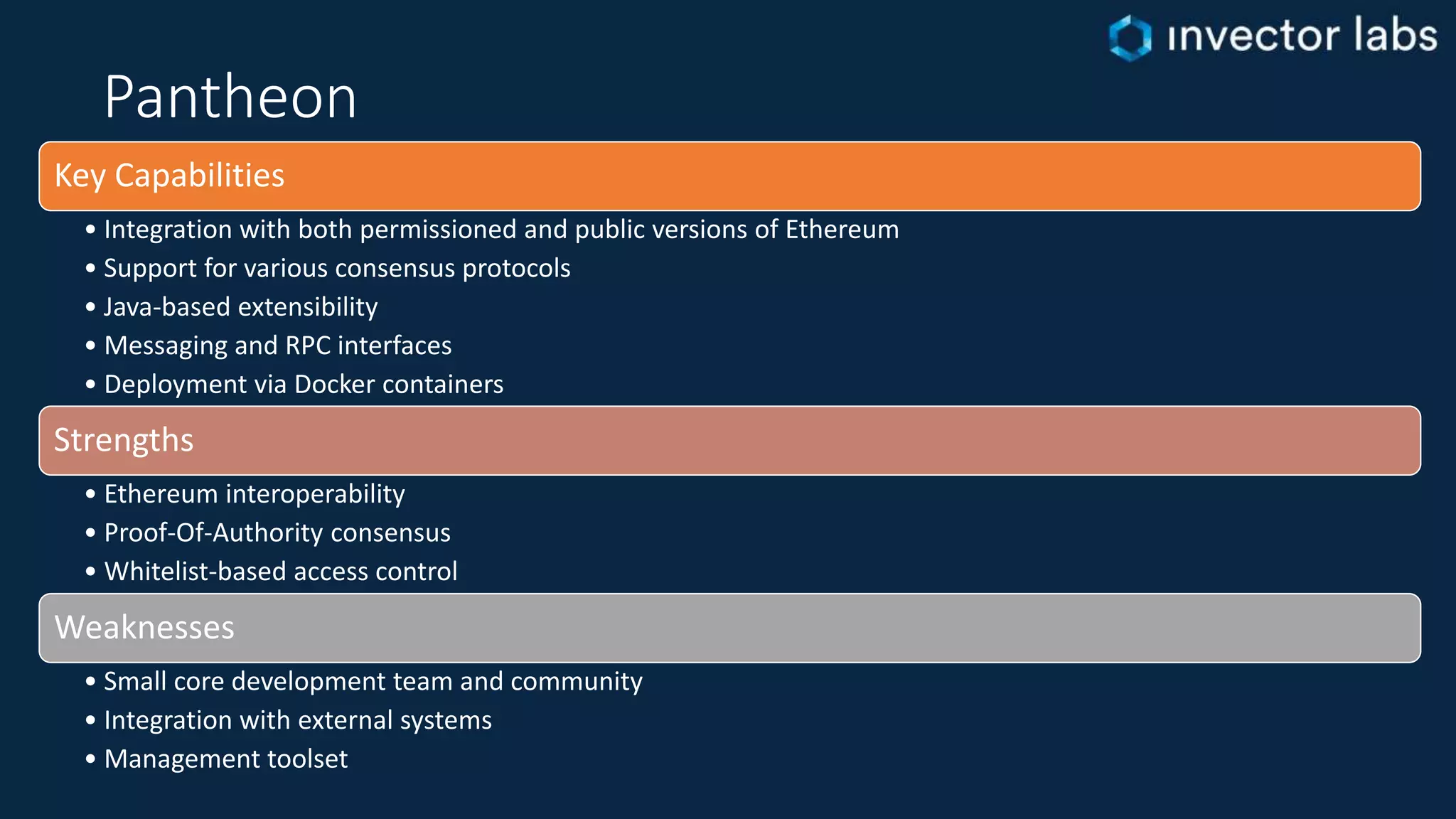
Key Capabilities
• Integration with both permissioned and public versions of Ethereum
• Support for various consensus protocols
• Java-based extensibility
• Messaging and RPC interfaces
• Deployment via Docker containers
Strengths
• Ethereum interoperability
• Proof-Of-Authority consensus
• Whitelist-based access control
Weaknesses
• Small core development team and community
• Integration with external systems
• Management toolset
Corda
Key Capabilities
• Identity and access control via certificates
• Support for transaction workflows via the flow framework
• Integration with external systems via Oracles
• Application encapsulation via CorDApps
• Private node databases using Vaults
Strengths
• Privacy and access control
• Network topologies
• Workflow automation
Weaknesses
• Limited smart contract support
• Integration with external systems
• Small developer community
Selecting a Blockchain Runtime…
Blockchain
Runtimes
On-Premise
Default
Platform
Networks
Cloud
Azure
Blockchain
AWS
Blockchain
Kaleido IBM BlockApps
Azure Blockchain as a Service
Key Capabilities
• Support for different blockchains
• Integration with popular development frameworks
• Deployment and app lifecycle management
• Integration with Azure services
• Identity and access control
Strengths
• Tooling
• DApp lifecycle management
Weaknesses
• Limited smart contract support
• Integration with external systems
• Small developer community
AWS Blockchain as a Service
Key Capabilities
• Integration with AWS Services
• Identity and access control
• Integration with Quantum ledger
• Rapid provisioning
• Support for Hyperledger Fabric and Ethereum
Strengths
• AWS developer and partner communities
• Integration with external services
• Identity and access control
Weaknesses
• Small number of supported blockchain runtimes
• Limited tooling
• Basic integration with blockchain development tools and frameworks
IBM Blockchain Cloud
Key Capabilities
• Robust support for Hyperledger Fabric
• Integration with Bluemix services
• DevOps and automation processes
• Identity and access control
• Monitoring
Strengths
• Scalable Hyperledger Fabric topologies
• Privacy and security
• Fabric development workflow
Weaknesses
• No support for other blockchain runtimes
• Limited developer community
• Lack of support for open source blockchain development frameworks and tools
Kaleido
Key Capabilities
• Support for different variations of Ethereum blockchains
• Integration with open source enterprise systems and services
• Blockchain first capabilities like wallets or block explorers
• Integration with IPFS
• Native support for AWS
Strengths
• Native blockchain components
• Development tools and interfaces
• Rapid provisioning and deployment
Weaknesses
• Lack of support for non-Ethereum blockchains
• Small developer and partner communities
BlockApps
Key Capabilities
• Rapid Dapp development process
• Messaging interfaces via Kafka
• Compatibility with the EVM
• Monitoring tools
• Simple REST APIs
Strengths
• Simple Dapp lifecycle
• Docker support
• Toolset
Weaknesses
• Lack of support for non-EVM runtimes
• Limited developer and partner communities
• Very limited integration with external systems, security and other enterprise critical features
Selecting a Development Stack…
Relevant
Blockchain
Stacks
Integration
ChainLink Oraclize
Testing
Truffle
Corda Testing
Tools
Ganache
Hyperledger
Composer
Storage
IPFS BigChainDB Swarm
Data Access
TheGraph
Security &
Privacy
Ursa AZTEC
Monitoring
Hyperledger
Caliper
Integration
• Connecting to mainstream line of
business systems
• On-demand and scheduled execution
• Integration with data storage systems
• Bidirectional communication
Technology
Blockchain
Support
Implementing
Custom
Line of Business
Integration
IPFS/Swarm
Integration
On-Demand and
Scheduled Activation
ChainLink 6 8 6 8 8
Oraclize 4 5 4 6 5
Azure Enterprise Smart Contracts 6 5 6 6 5
Aetirnity 4 4 5 4 4
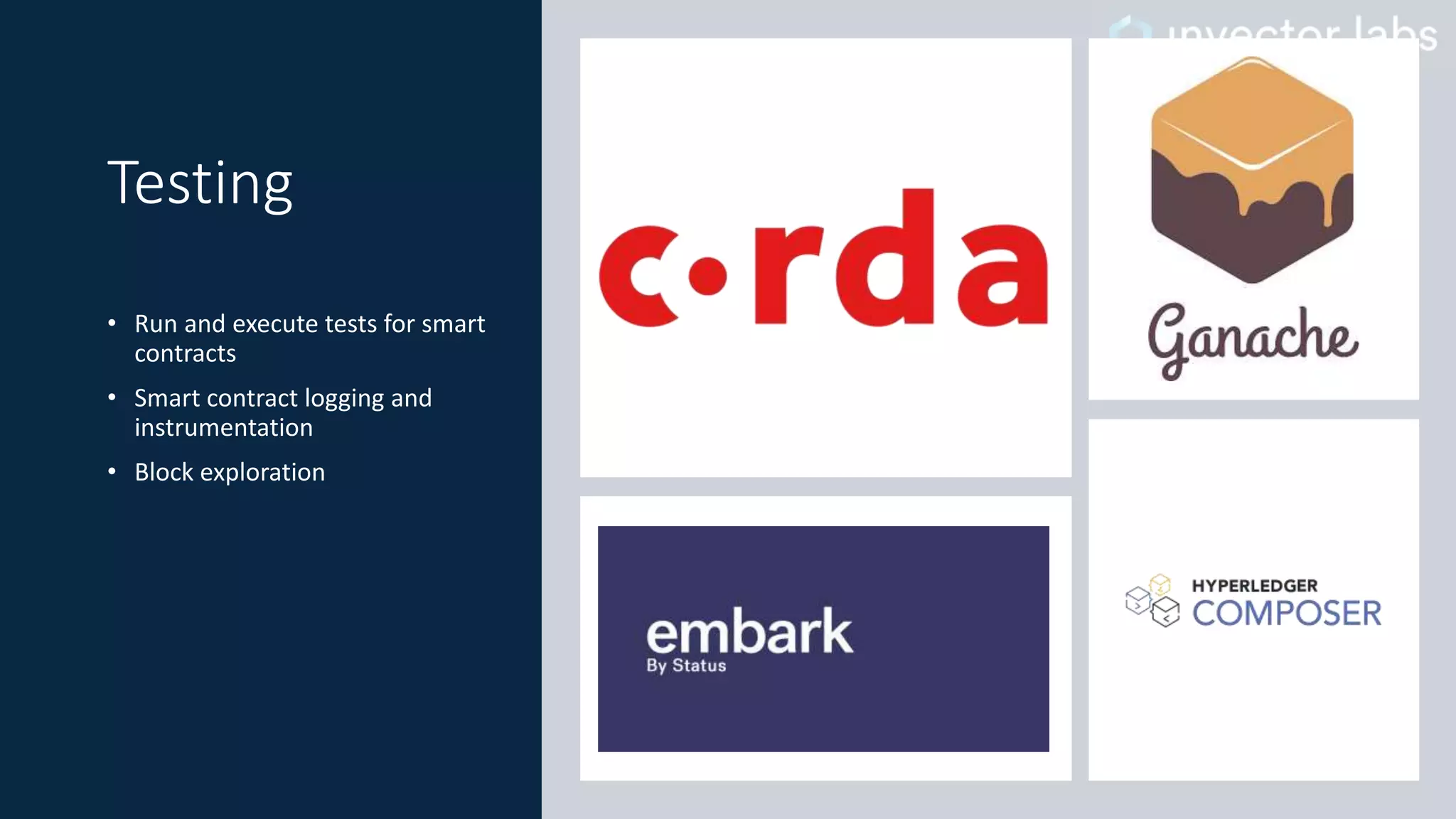
Testing
• Run and execute tests for smart
contracts
• Smart contract logging and
instrumentation
• Block exploration
Technology
Test
Creation
Automated
Test Execution
Smart Contract
Instrumentation Block Explorer
Hyperledger Composer 5 4 2 2
Corda Testing 6 7 6 4
Ganache 8 8 7 7
Ether Tester 8 8 5 4
Data Access
• Querying blockchain data on-
demand
• Interact with blockchains via APIs
• Map blockchain data to queryable
attributes
Technology
Querying
Smart
Contract Data
Execute Complex
Queries
Interact with
Blockchain Data via
APIs
Add Semantic Info to
Smart Contracts
The Graph 8 6 7 6
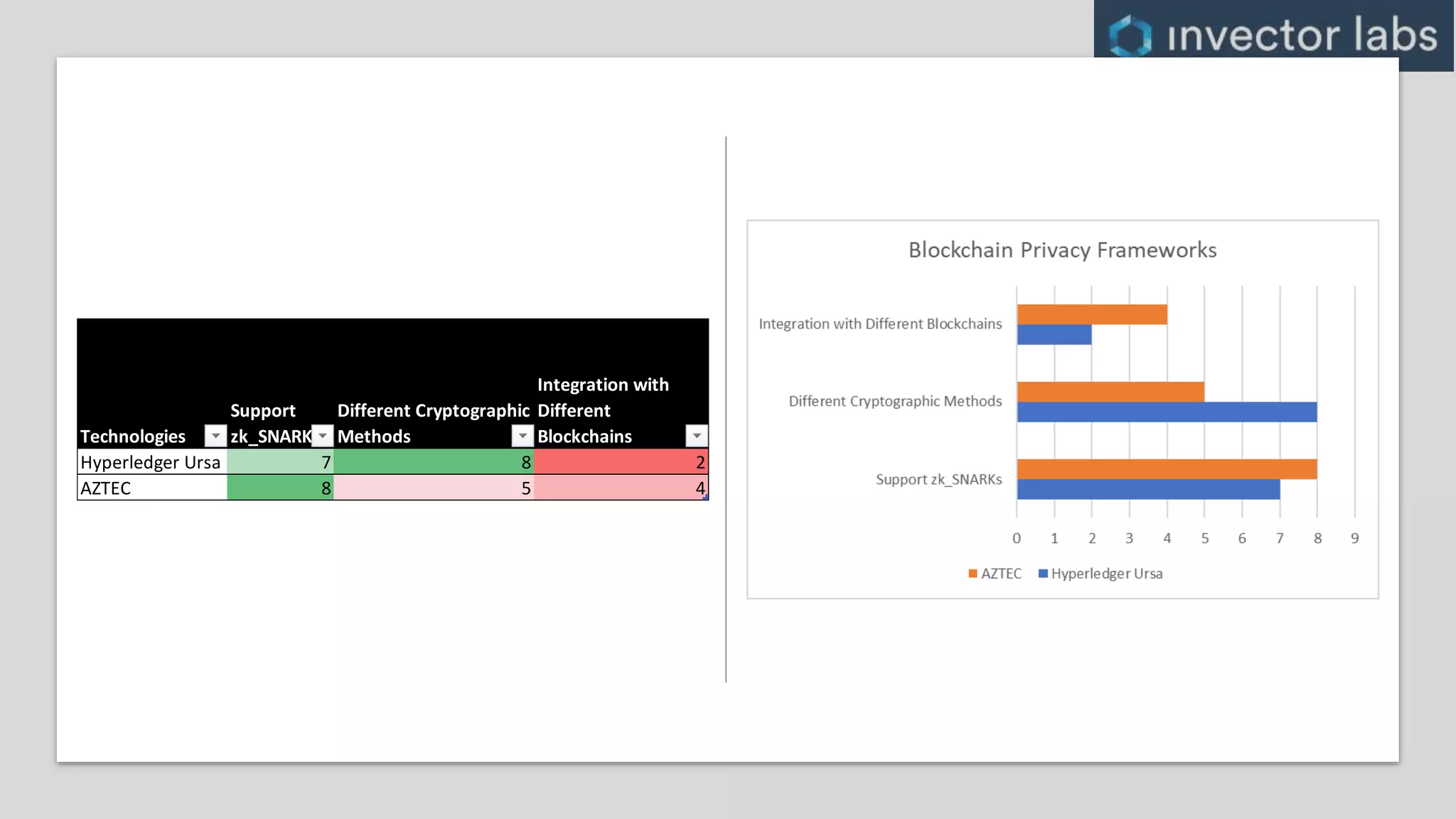
Security and Privacy
• Ability to perform computations over encrypted data
• Hide specific aspects of blockchain transactions
• Use different privacy and encryption models in blockchain data
Technologies
Support
zk_SNARKs
Different Cryptographic
Methods
Integration with
Different
Blockchains
Hyperledger Ursa 7 8 2
AZTEC 8 5 4
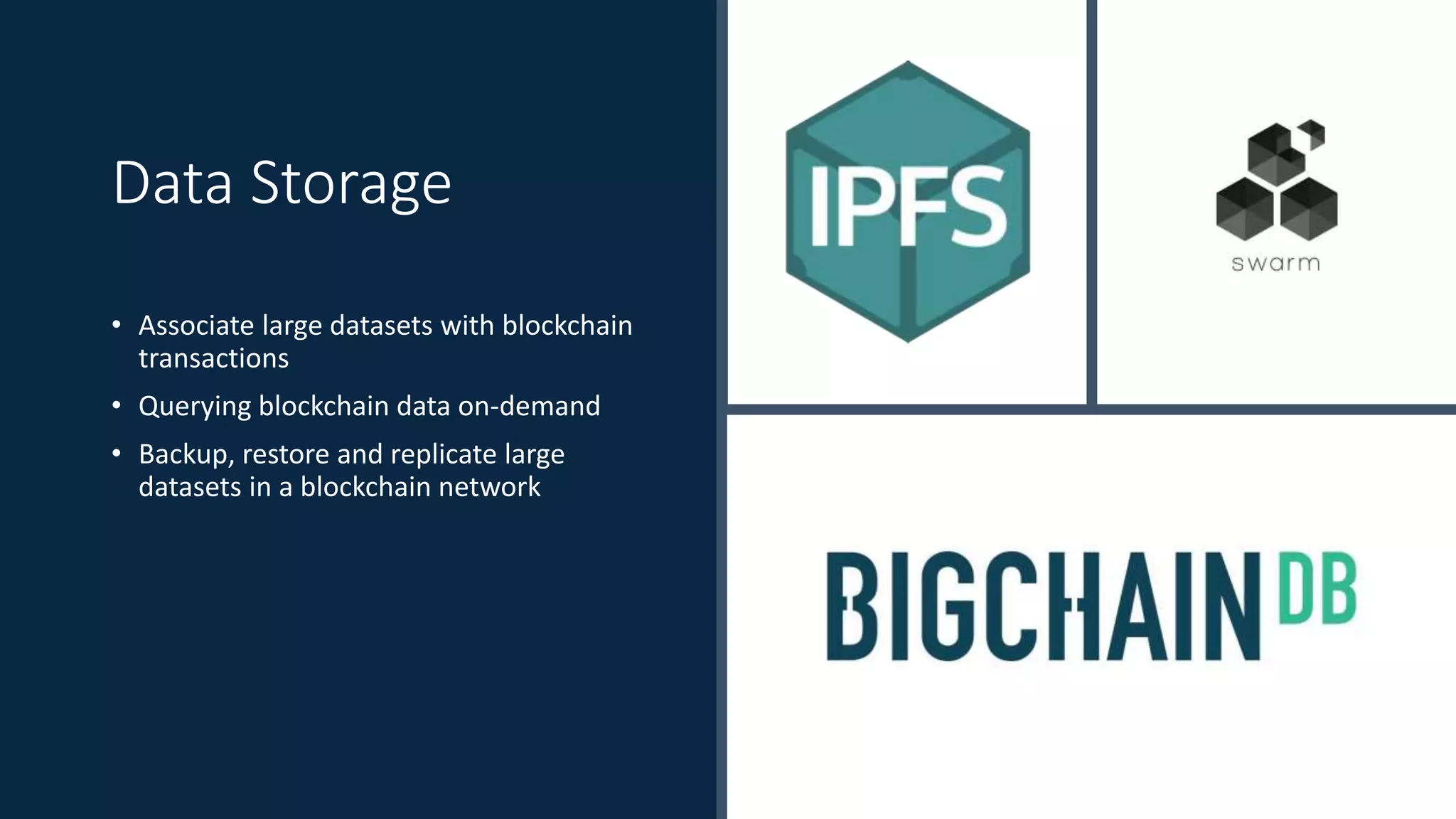
Data Storage
• Associate large datasets with blockchain
transactions
• Querying blockchain data on-demand
• Backup, restore and replicate large
datasets in a blockchain network
Technologies
Unstructured Data
Storage
Semi-structured Data
Storage Immutability Data Querying Scalability
IPFS 9 8 9 5 8
Swarm 7 7 9 5 7
BigChainDB 8 8 8 8 7
Quentum Ledger 7 8 9 8 6
Summary
• The permissioned blockchain ecosystem is really crowded
• When establishing a blockchain strategies organizations should
consider the following steps:
• Select a blockchain platform
• Select a blockchain runtime
• Select complementary technology stacks
• Start small…iterate
Thanks!

Blockchain in the enterprise

  • 1.
    Blockchain in theEnterprise: Lessons from the Trenches Invector Labs
  • 2.
    About Invector Labs •Bringing deep-tech to the enterprise • Focused on groundbreaking technology trends: • Artificial intelligence • Blockchain technologies • Internet of things • Cybersecurity • Advanced cloud computing • …. • http://invectorlabs.com
  • 3.
    Agenda • Blockchain inthe enterprise: Challenges • Permissioned blockchain platforms • Permissioned blockchain runtimes • Permissioned blockchain stacks
  • 4.
    Key Challenges ofReal World Blockchain Solutions…
  • 5.
  • 6.
    Key Decisions Selecting a Blockchain Platform Selectinga Blockchain Runtime Selecting a Complementary Technology Stack
  • 7.
  • 8.
  • 9.
  • 10.
    Hyperledger Fabric Key Capabilities •Based on the open source Hyperledger implementation • Supports smart contracts via chaincode and containers(Java, Go, NodeJS) • Identity and privacy based protocols • Networks can be segmented in channels • Advanced toolset with products like Composer Strengths • Integration with external systems • Solutions portfolio • Partner community Weaknesses • Smart contract model • Toolset for app lifecyle management • Lack of support for public blockchain topologies
  • 11.
    Hyperledger Sawtooth Key Capabilities •Based on the open source Hyperledger implementation • Supports for EVM smart contracts • Native supply-chain like tracking capabilities • PoET consensus model • Native support for Docker containers Strengths • Simple programming model • Interoperability with Ethereum • Flexible network topology using validators Weaknesses • Lack of developer community • Limited toolset • Integration with external systems
  • 12.
    Quorum Key Capabilities • Permissionedversion of the Ethereum blockchain • Various consensus mechanisms(Raft and Istanbul BFT implementations) • Privacy protocols based on zk-SNARKs • Support for private smart contracts • Access control policies Strengths • Ethereum interoperability • Privacy • Deployment and configuration Weaknesses • Small core development team and community • Integration with external systems • Management toolset
  • 13.
    Parity Key Capabilities • Integrationwith both permissioned and public versions of Ethereum • Support for side chains • IPFS supports • Messaging capabilities • Privacy using secret stores Strengths • Ethereum interoperability • Developer friendliness • Tollset Weaknesses • Small core development team and community • Integration with external systems • Management toolset
  • 14.
    Pantheon Key Capabilities • Integrationwith both permissioned and public versions of Ethereum • Support for various consensus protocols • Java-based extensibility • Messaging and RPC interfaces • Deployment via Docker containers Strengths • Ethereum interoperability • Proof-Of-Authority consensus • Whitelist-based access control Weaknesses • Small core development team and community • Integration with external systems • Management toolset
  • 15.
    Corda Key Capabilities • Identityand access control via certificates • Support for transaction workflows via the flow framework • Integration with external systems via Oracles • Application encapsulation via CorDApps • Private node databases using Vaults Strengths • Privacy and access control • Network topologies • Workflow automation Weaknesses • Limited smart contract support • Integration with external systems • Small developer community
  • 16.
  • 17.
  • 18.
    Azure Blockchain asa Service Key Capabilities • Support for different blockchains • Integration with popular development frameworks • Deployment and app lifecycle management • Integration with Azure services • Identity and access control Strengths • Tooling • DApp lifecycle management Weaknesses • Limited smart contract support • Integration with external systems • Small developer community
  • 19.
    AWS Blockchain asa Service Key Capabilities • Integration with AWS Services • Identity and access control • Integration with Quantum ledger • Rapid provisioning • Support for Hyperledger Fabric and Ethereum Strengths • AWS developer and partner communities • Integration with external services • Identity and access control Weaknesses • Small number of supported blockchain runtimes • Limited tooling • Basic integration with blockchain development tools and frameworks
  • 20.
    IBM Blockchain Cloud KeyCapabilities • Robust support for Hyperledger Fabric • Integration with Bluemix services • DevOps and automation processes • Identity and access control • Monitoring Strengths • Scalable Hyperledger Fabric topologies • Privacy and security • Fabric development workflow Weaknesses • No support for other blockchain runtimes • Limited developer community • Lack of support for open source blockchain development frameworks and tools
  • 21.
    Kaleido Key Capabilities • Supportfor different variations of Ethereum blockchains • Integration with open source enterprise systems and services • Blockchain first capabilities like wallets or block explorers • Integration with IPFS • Native support for AWS Strengths • Native blockchain components • Development tools and interfaces • Rapid provisioning and deployment Weaknesses • Lack of support for non-Ethereum blockchains • Small developer and partner communities
  • 22.
    BlockApps Key Capabilities • RapidDapp development process • Messaging interfaces via Kafka • Compatibility with the EVM • Monitoring tools • Simple REST APIs Strengths • Simple Dapp lifecycle • Docker support • Toolset Weaknesses • Lack of support for non-EVM runtimes • Limited developer and partner communities • Very limited integration with external systems, security and other enterprise critical features
  • 23.
  • 24.
    Relevant Blockchain Stacks Integration ChainLink Oraclize Testing Truffle Corda Testing Tools Ganache Hyperledger Composer Storage IPFSBigChainDB Swarm Data Access TheGraph Security & Privacy Ursa AZTEC Monitoring Hyperledger Caliper
  • 25.
    Integration • Connecting tomainstream line of business systems • On-demand and scheduled execution • Integration with data storage systems • Bidirectional communication
  • 26.
    Technology Blockchain Support Implementing Custom Line of Business Integration IPFS/Swarm Integration On-Demandand Scheduled Activation ChainLink 6 8 6 8 8 Oraclize 4 5 4 6 5 Azure Enterprise Smart Contracts 6 5 6 6 5 Aetirnity 4 4 5 4 4
  • 27.
    Testing • Run andexecute tests for smart contracts • Smart contract logging and instrumentation • Block exploration
  • 28.
    Technology Test Creation Automated Test Execution Smart Contract InstrumentationBlock Explorer Hyperledger Composer 5 4 2 2 Corda Testing 6 7 6 4 Ganache 8 8 7 7 Ether Tester 8 8 5 4
  • 29.
    Data Access • Queryingblockchain data on- demand • Interact with blockchains via APIs • Map blockchain data to queryable attributes
  • 30.
    Technology Querying Smart Contract Data Execute Complex Queries Interactwith Blockchain Data via APIs Add Semantic Info to Smart Contracts The Graph 8 6 7 6
  • 31.
    Security and Privacy •Ability to perform computations over encrypted data • Hide specific aspects of blockchain transactions • Use different privacy and encryption models in blockchain data
  • 32.
  • 33.
    Data Storage • Associatelarge datasets with blockchain transactions • Querying blockchain data on-demand • Backup, restore and replicate large datasets in a blockchain network
  • 34.
    Technologies Unstructured Data Storage Semi-structured Data StorageImmutability Data Querying Scalability IPFS 9 8 9 5 8 Swarm 7 7 9 5 7 BigChainDB 8 8 8 8 7 Quentum Ledger 7 8 9 8 6
  • 35.
    Summary • The permissionedblockchain ecosystem is really crowded • When establishing a blockchain strategies organizations should consider the following steps: • Select a blockchain platform • Select a blockchain runtime • Select complementary technology stacks • Start small…iterate
  • 36.