ECONOMICS OF DUMPING
AND CONDITIONS TO
IMPOSE ANTI-DUMPING
DUTIES
Presented By:
SAKSHI VARSHNEY
NIKITA MANGAL
Contents
 What is Dumping?
 Advantages and Disadvantages of Dumping
 Types of Dumping
 Objectives of Dumping
 Effects of Dumping
 What is Anti-Dumping?
 Anti-Dumping measures
 Conditions to impose Anti-Dumping Duties
 Effect of Anti-Dumping Laws
 Conclusion
DUMPING
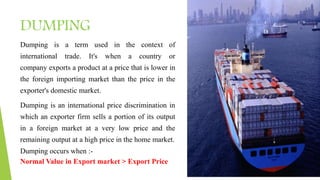
Dumping is a term used in the context of
international trade. It's when a country or
company exports a product at a price that is lower in
the foreign importing market than the price in the
exporter's domestic market.
Dumping is an international price discrimination in
which an exporter firm sells a portion of its output
in a foreign market at a very low price and the
remaining output at a high price in the home market.
Dumping occurs when :-
Normal Value in Export market > Export Price
Advantages of Dumping
 Ability to permeate a market
 Willing to take losses
 Attack on other country’s industry
Disadvantages of Dumping
 Expensive to maintain
 Retaliation by trade partner
 Censure by international trade organizations
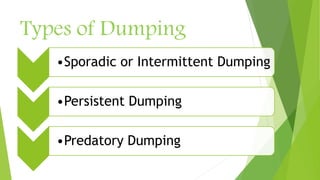
Types of Dumping
•Sporadic or Intermittent Dumping
•Persistent Dumping
•Predatory Dumping
Objectives of Dumping
To Find a Place in the Foreign Market
To Sell Surplus Commodity
Expansion of Industry
New Trade Relations
Effects of Dumping
Effects on Importing country: Depends on
i) The period of dumping
ii) Nature of product
iii) Aim of Dumping
 Effects on exporting country
 Sellers dump commodities to another countries – lack of
commodities in their home country – leads to increase in price
and loss in consumer surplus.
 If Monopolist increase production and produce more – marginal
cost falls – leads to decrease in price and consumers benefit.
 More production will lead to increase in demand of inputs –
expanding means of employment.
 Earning more foreign currency – balance of trade improves.
ANTI-DUMPING
Anti-dumping is a measure to rectify the situation arising out of the dumping of goods
and its trade distortive effect. An anti-dumping duty is a protectionist tariff that a
domestic government imposes on foreign imports that it believes are priced below fair
market value.
Thus, the purpose of anti-dumping duty is to rectify the trade distortive effect of dumping
and re-establish fair trade.
The use of anti-dumping measure as an instrument of fair competition is permitted by the
WTO. It provides relief to the domestic industry against the injury caused by dumping.
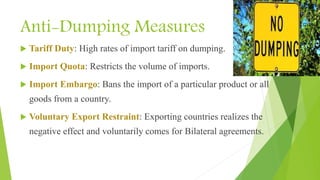
Anti-Dumping Measures
 Tariff Duty: High rates of import tariff on dumping.
 Import Quota: Restricts the volume of imports.
 Import Embargo: Bans the import of a particular product or all
goods from a country.
 Voluntary Export Restraint: Exporting countries realizes the
negative effect and voluntarily comes for Bilateral agreements.
Conditions for Imposing Anti-Dumping Duties
Sufficient evidence to the effect that-
 There is dumping
 There is injury
 There is a casual link between the dumping and the injury, that is to say, that the dumped
imports have caused the alleged injury.
 Otherwise; if there is dumping but no injury then, no duty can be imposed.
And for some nations:
 Community Interest
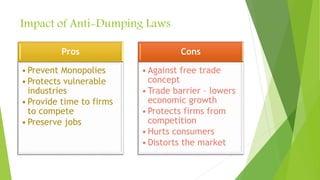
Impact of Anti-Dumping Laws
Pros
•Prevent Monopolies
•Protects vulnerable
industries
•Provide time to firms
to compete
•Preserve jobs
Cons
•Against free trade
concept
•Trade barrier – lowers
economic growth
•Protects firms from
competition
•Hurts consumers
•Distorts the market
Conclusion
 As explained above, it can be observed that adopting anti-dumping measures can harm
the country rather than providing benefit .
 According to Article IV of GATT 1984, which now forms part of the World Trade
Organization (WTO), a country can adopt anti-dumping measures only if the dumped
imports “injure” the industry of the country.
 Or it will also be regarded as dumped if the export price of the commodity is less than
its comparable price for final consumption in the exporting county. Under these
situations, the importing country can impose anti-dumping duty, provided the margin of
dumping is more than 2% of the export price or is more than 7% of the dumped import.
THANK
YOU

dumping and conditons for anti-dumping

  • 1.
    ECONOMICS OF DUMPING ANDCONDITIONS TO IMPOSE ANTI-DUMPING DUTIES Presented By: SAKSHI VARSHNEY NIKITA MANGAL
  • 2.
    Contents  What isDumping?  Advantages and Disadvantages of Dumping  Types of Dumping  Objectives of Dumping  Effects of Dumping  What is Anti-Dumping?  Anti-Dumping measures  Conditions to impose Anti-Dumping Duties  Effect of Anti-Dumping Laws  Conclusion
  • 3.
    DUMPING Dumping is aterm used in the context of international trade. It's when a country or company exports a product at a price that is lower in the foreign importing market than the price in the exporter's domestic market. Dumping is an international price discrimination in which an exporter firm sells a portion of its output in a foreign market at a very low price and the remaining output at a high price in the home market. Dumping occurs when :- Normal Value in Export market > Export Price
  • 4.
    Advantages of Dumping Ability to permeate a market  Willing to take losses  Attack on other country’s industry Disadvantages of Dumping  Expensive to maintain  Retaliation by trade partner  Censure by international trade organizations
  • 5.
    Types of Dumping •Sporadicor Intermittent Dumping •Persistent Dumping •Predatory Dumping
  • 6.
    Objectives of Dumping ToFind a Place in the Foreign Market To Sell Surplus Commodity Expansion of Industry New Trade Relations
  • 7.
    Effects of Dumping Effectson Importing country: Depends on i) The period of dumping ii) Nature of product iii) Aim of Dumping
  • 8.
     Effects onexporting country  Sellers dump commodities to another countries – lack of commodities in their home country – leads to increase in price and loss in consumer surplus.  If Monopolist increase production and produce more – marginal cost falls – leads to decrease in price and consumers benefit.  More production will lead to increase in demand of inputs – expanding means of employment.  Earning more foreign currency – balance of trade improves.
  • 9.
    ANTI-DUMPING Anti-dumping is ameasure to rectify the situation arising out of the dumping of goods and its trade distortive effect. An anti-dumping duty is a protectionist tariff that a domestic government imposes on foreign imports that it believes are priced below fair market value. Thus, the purpose of anti-dumping duty is to rectify the trade distortive effect of dumping and re-establish fair trade. The use of anti-dumping measure as an instrument of fair competition is permitted by the WTO. It provides relief to the domestic industry against the injury caused by dumping.
  • 10.
    Anti-Dumping Measures  TariffDuty: High rates of import tariff on dumping.  Import Quota: Restricts the volume of imports.  Import Embargo: Bans the import of a particular product or all goods from a country.  Voluntary Export Restraint: Exporting countries realizes the negative effect and voluntarily comes for Bilateral agreements.
  • 11.
    Conditions for ImposingAnti-Dumping Duties Sufficient evidence to the effect that-  There is dumping  There is injury  There is a casual link between the dumping and the injury, that is to say, that the dumped imports have caused the alleged injury.  Otherwise; if there is dumping but no injury then, no duty can be imposed. And for some nations:  Community Interest
  • 12.
    Impact of Anti-DumpingLaws Pros •Prevent Monopolies •Protects vulnerable industries •Provide time to firms to compete •Preserve jobs Cons •Against free trade concept •Trade barrier – lowers economic growth •Protects firms from competition •Hurts consumers •Distorts the market
  • 13.
    Conclusion  As explainedabove, it can be observed that adopting anti-dumping measures can harm the country rather than providing benefit .  According to Article IV of GATT 1984, which now forms part of the World Trade Organization (WTO), a country can adopt anti-dumping measures only if the dumped imports “injure” the industry of the country.  Or it will also be regarded as dumped if the export price of the commodity is less than its comparable price for final consumption in the exporting county. Under these situations, the importing country can impose anti-dumping duty, provided the margin of dumping is more than 2% of the export price or is more than 7% of the dumped import.
  • 14.