Price	Discrimination
GCE	A-LEVEL	&	IB ECONOMICS
Lesson	Structure
◦Price	Discrimination
◦ Definition	&	Concept
◦ 1st Degree	Price	Discrimination
◦ 2nd Degree	Price	Discrimination
◦ Examples
◦ 3rd Degree	Price	Discrimination
◦ Examples	&	Diagram
◦ Summary	&	Evaluation
What	is	Price	Discrimination?
Price	discrimination	occurs	when	firms	are	able	to	charge	consumers	different	
prices	for	the	same	product.
There	are	3	types:	1st degree,	2nd degree	and	3rd degree.	
3rd Degree	is	mostly	mentioned	in	the	IB	specification.
Why	do	you	think	firms	price	discriminate?
Why	Price	Discrimination?
- Higher	profits	and	revenues
◦ Higher	producer	surplus	and	revenues
- Improved	cash	flow
◦ More	money	flowing	into	the	business
- Monetize/utilise	spare	capacity	of	the	firm
◦ E.g.	HK	cinemas	charging	less	for	early	movies	to	monetize	existing	capital
When	do	you	think	firms	are	able	to	price	discriminate?
Conditions	for	Price	Discrimination
Price	discrimination	requires	the	following	to	work:
- Firms	need	to	have	some	degree	of	market	power	(allowing	them	to	set	prices)
◦ Monopoly,	monopolistic	competition/oligopoly	due	to	differentiated	products
- The	firm	needs	to	have	separable	consumer	groups	and	ensure	no	reselling	of	the	
product	occurs
◦ E.g.	By	age,	income,	taste	...
- The	consumers	need	to	have	different	price	elasticities (PED)	for	the	same	product	
◦ This	means	varying	degrees	of	need	for	the	same	good,	so	a	higher	price	can	be	charged	to	
consumers	with	less	elastic	PEDs
First	Degree	Price	Discrimination
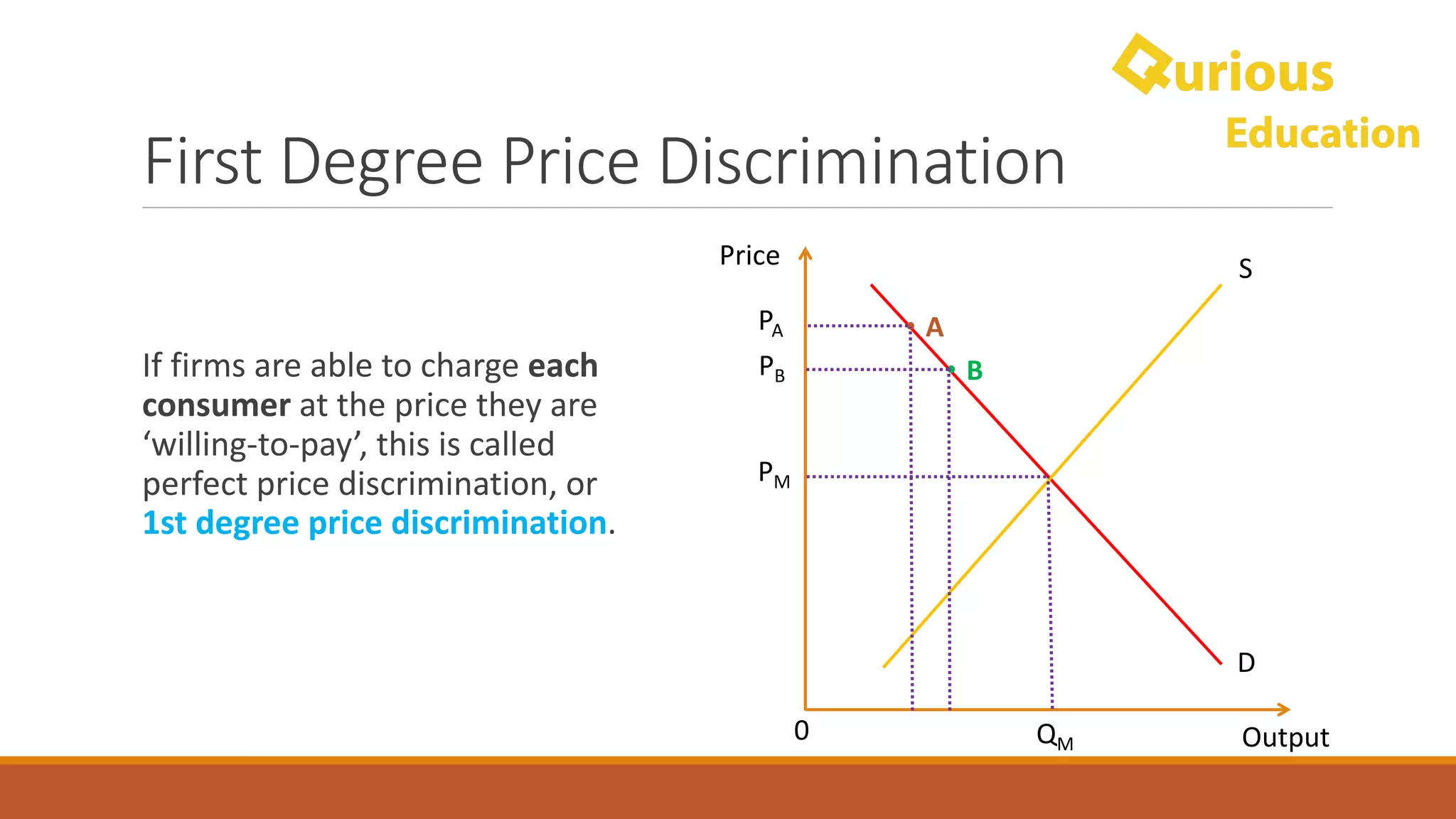
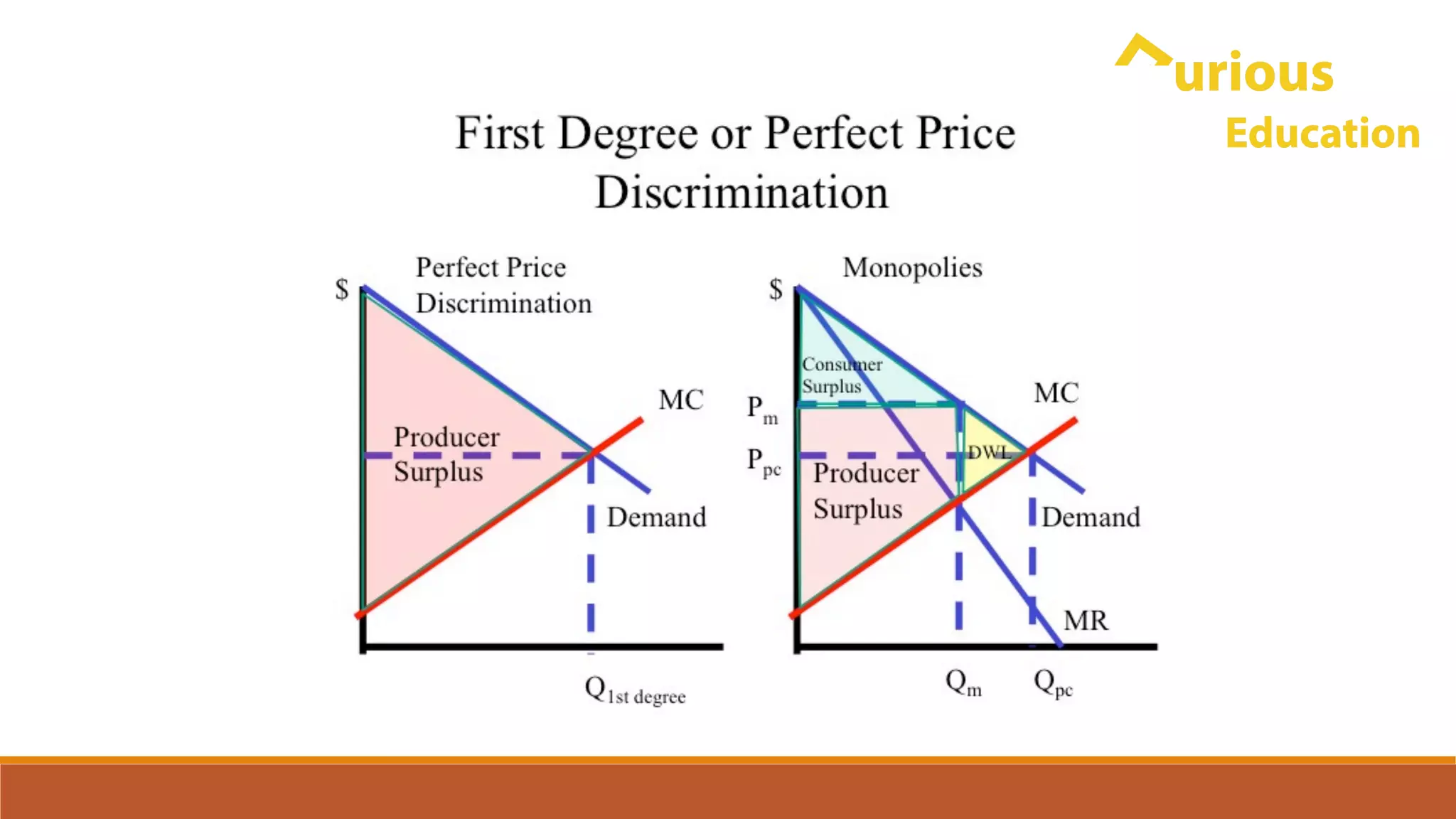
If	firms	are	able	to	charge	each	
consumer	at	the	price	they	are	
‘willing-to-pay’,	this	is	called	
perfect	price	discrimination,	or	
1st	degree	price	discrimination.
D
Output
PM
0
S
QM
Price
• A
• B
PA
PB
Second	Degree	Price	Discrimination
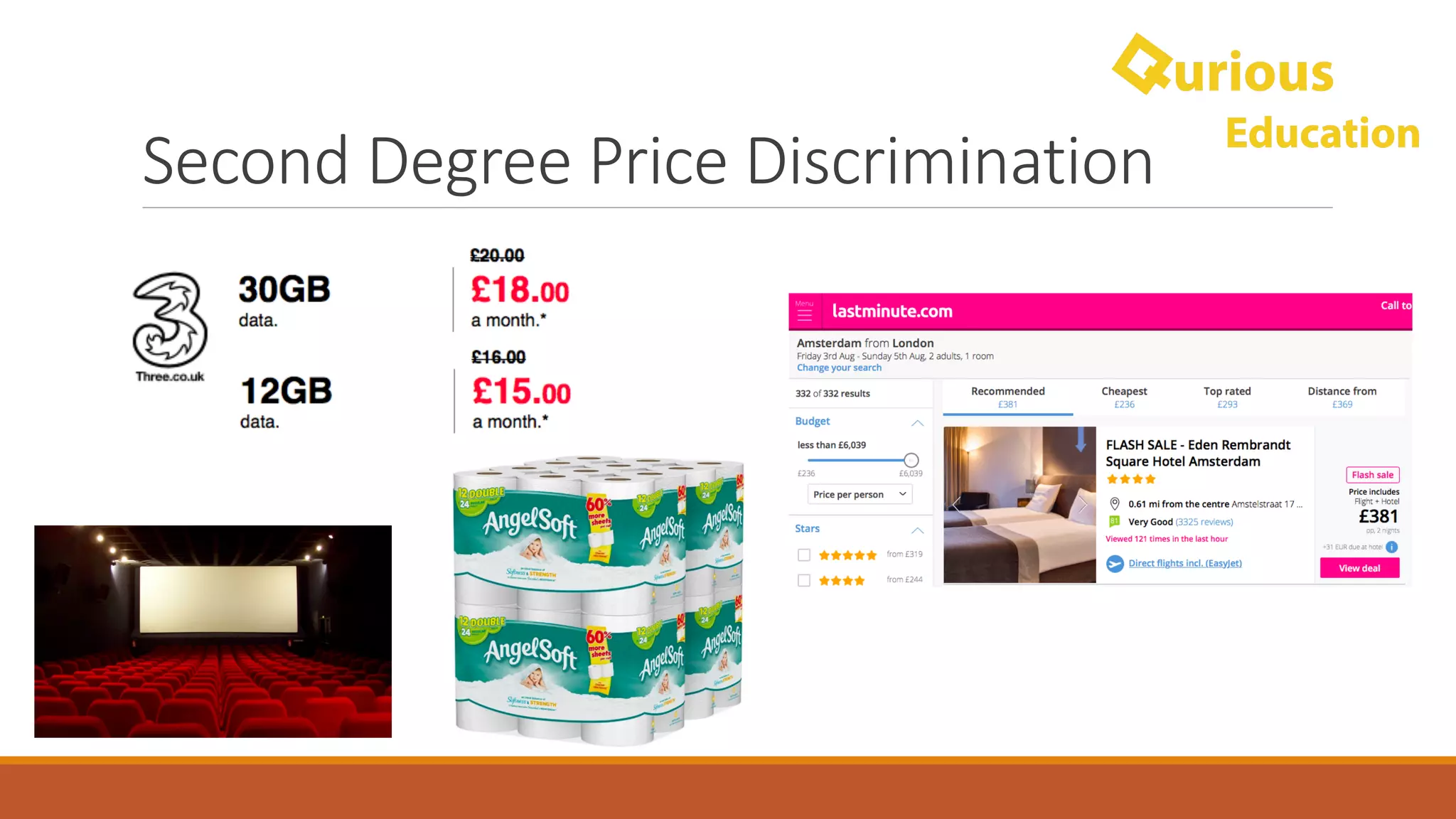
2nd	degree	price	discrimination	means	to	adjust	prices	according	to	quantity	
purchased,	or	by	time	of	purchase.
i.e.	cheaper	price	when	buying	in	bulk	or	different	prices	at	different	times	of	
year
What	do	you	think	are	some	examples	of	second	degree	price	discrimination?
Second	Degree	Price	Discrimination
Third	Degree	Price	Discrimination
3rd	degree	price	discrimination	means	to	differentiate	prices	according	to	
different	consumer	groups/segments.	
E.g.	by	age,	income,	taste,	geography...
What	do	you	think	are	some	examples	of	third	degree	price	discrimination?
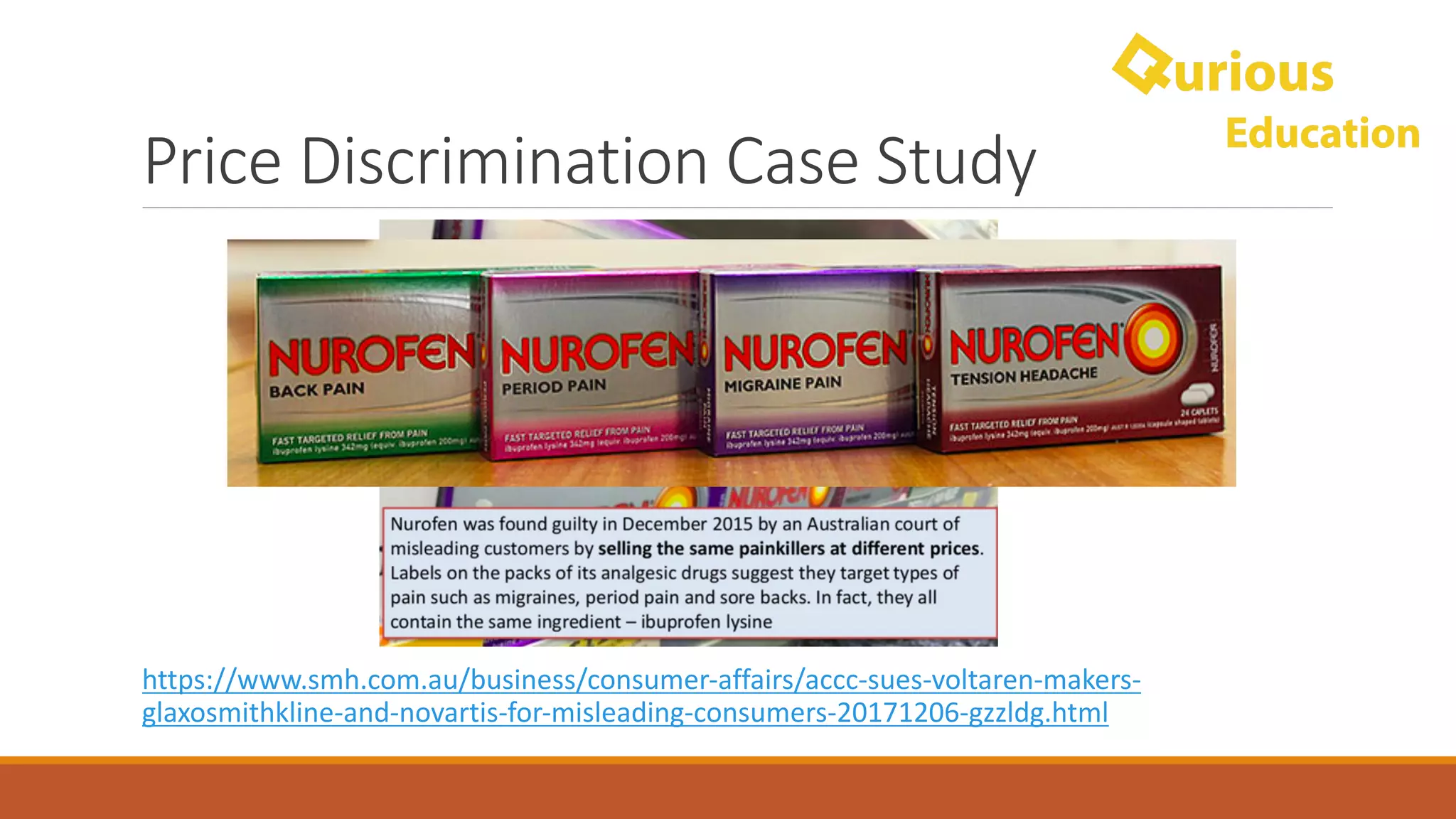
Price	Discrimination	Case	Study
https://www.smh.com.au/business/consumer-affairs/accc-sues-voltaren-makers-
glaxosmithkline-and-novartis-for-misleading-consumers-20171206-gzzldg.html
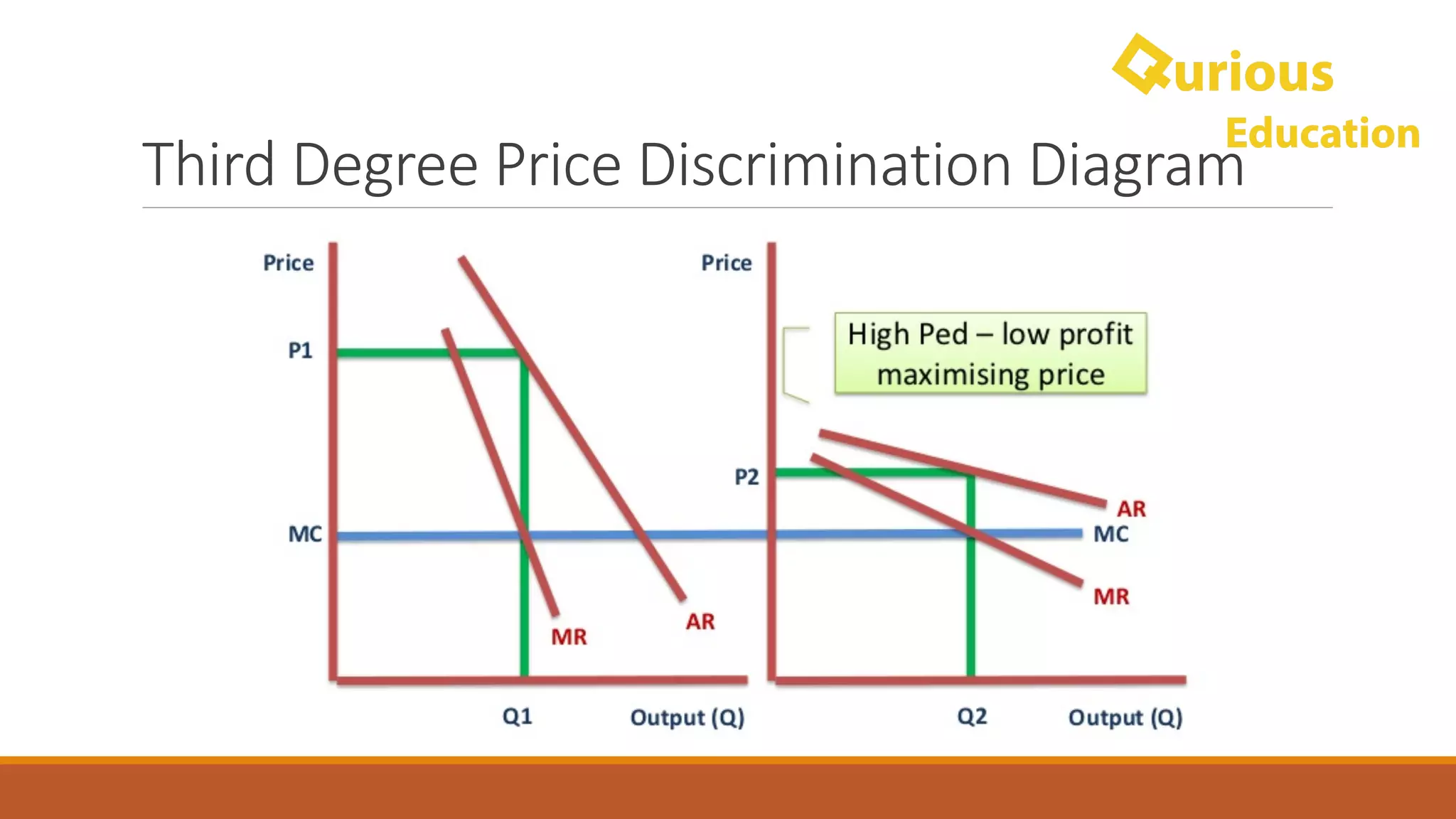
Third	Degree	Price	Discrimination	Diagram
Price	Discrimination	Evaluation
Advantages	for	the	firm:
- Consumer	surplus	eliminated	– higher	revenue	
from	sales
- Producer	produces	more	– economies	of	scale,	
lowering	average	costs	and	prices
- In	the	elastic	market,	competitors	may	be	
driven	out	– the	firm	undercuts	them	by	using	
revenue	from	inelastic	market	to	lower	elastic	
prices.
- Makes	use	of	spare	capacity
- May	increase	research	and	development
Advantages	to	the	consumers:
- Consumers	of	the	elastic	sector	find	prices	more	
affordable
- Increasing	total	output	makes	products	more	
available	to	more	consumers
Disadvantages	to	the	consumers:
- Any	previous	consumer	surplus	is	lost
- Consumers	with	inelastic	demand	may	have	to	pay	
more	– exploitation
- Increase	revenue	and	competitive	behaviour may	
allow	a	firm	to	gain	monopoly	power.

Price Discrimination Notes - A-level & IB Economics