Price and Output Determination: Monopoly
Learning Outcomes
Upon completing this section, the student should be able to:
 Describe the conditions that lead to a monopoly market.
 Describe and illustrate long-monopoly equilibrium.
 Differentiate between prefect competition and monopoly.
 Appreciate the relationship between elasticity and monopoly
 Describe the conditions for the existence of price discrimination.
 Distinguish between the various forms of price discrimination.
 Calculate profit maximizing levels of output and price in
monopoly.
What is a Monopoly?
 The term monopoly derived from the Greek monos, alone or
one.
 Monopoly is a type of market structure in which there is only
one producer or seller.
 A single producer controls the entire output of a particular
commodity.
Why might Monopolies arise?
1. State monopoly: A government may create a statutory or legal monopoly giving a certain
body the sole right to supply a particular good or provide a certain service. The Act which
creates the monopoly places a legal restriction on competition. In Ireland, the government has
granted monopolistic powers to ESB, Telecom Eireann etc, Mobile Phone Licence to Esat Digifone.
2. Control of critical resources: A particular firm may have exclusive access to the only
source of supply of the raw materials necessary for the production of a certain commodity.
Mining firms would be examples of this type of monopoly.
3. Capital intensive monopoly: Certain industries require such a large investment of capital
in plant and equipment that any form of competition from potential rivals is completely
discouraged e.g. aircraft manufacturing, ship-building, steel firms etc.
4. Legal restriction: A firm which develops or invents a new product or process can use the
law of patents, franchise, copyright etc. to obtain the sole right of manufacture of the product
or use of the process. Pfizer – Viagra
5. Trade Agreements: All the firms within a certain industry, may by agreement, adopt
completely uniform policies on price and output. This type of agreement effectively creates a
monopoly. (OPEC on Oil production).
Assumptions governing a Monopoly
• Price Setter: There is only one firm in the entire industry and it has
complete control over price.
• Barriers to Entry: No other firm can enter the industry even if it wants to
i.e. there is no freedom of entry to the industry- cost being the main
barrier to entry.
• Profit Maximiser: The monopolist aims to maximise profit.
• In a monopoly situation the equilibrium of the individual firm is the
equilibrium of the industry because the entire industry is made up of just
one firm.
• A monopolist can selects either the price or the output but not both
Monopoly – Long-Run Equilibrium
Price/cost
Q - Output
D = AR
MR
MC
q(mon)
P(mon)
AC
Super
normal
Profits
AC not
minimised
MR = MC
AR > AC
P <>AC
Monopoly versus Perfect Competition
Price/cost
Q - Output
D = AR
MR
Lr-MC
q(mon)
P(mon)
Lr-AC
Super
normal
Profits
AC not
minimised
Monopolist
Higher prices and lower outputs
Supernormal profits in the L-R
AC not minimised
q(pc)
P(pc)
P = D = AR = MR
Monopoly versus Perfect Competition
 When monopoly and perfect competition are compared under the
same conditions, we find that the monopolist, when in equilibrium,
produces a lower and sells it a higher price than the perfectly
competitive firm.
 the perfectly competitive firm produces q(pc) at a price p(pc), the
individual firm is a price taker.
 The monopolist produces q(mon) at p(mon). Thus the monopolist
produces at higher prices and a lower output.
 The monopolist earns supernormal profits earned in the long-
run and in monopoly Average Costs are not minimised.
 Comparing monopoly and perfect competition (video) is unrealistic
because perfect competition in its pure form rarely exists.
Price Elasticity and Monopoly
 Marginal revenue is a function of price elasticity,
)
1
1
(
p
E
P
MR 

•A profit maximising monopolist produces a quantity where MR =
MC, so by substitution
)
1
1
(
p
E
P
MC 

In monopoly P will be greater than MC. For example if Ep = -2,
)
2
1
1
(


 P
MC MC = 0.5P, so P = 2MC.
Note: a monopolist will never operate in the area of the demand curve where demand is
price inelastic
Price Discrimination
 It is the practice of charging different people different prices for the
same goods or services.
 When price discrimination is engaged in for the purpose of reducing
competition, as, for instance, through tying the lower prices to the
purchase of other goods or services, it constitutes a violation of
Antitrust Acts.
 Price discrimination also occurs when it costs more to supply one
customer than it does another, and yet the supplier charges both the
same price.
Conditions for Price Discrimination
 There must be some degree of market power
 Separate markets must be identified.
 Consumers should be largely ignorant of any PD.
 There should be a different price elasticity for the same good
among consumers.
 No opportunities for arbitrage - The buyer cannot re-sell.
 This usually entails using one or more means of preventing any
resale, keeping the different price groups separate, making price
comparisons difficult, or restricting pricing information.
 Price discrimination is thus very common in services, where resale
is not possible; an example is student discounts at cinema.
 The degree of PD must be so small that consumers are not affected
by it.
Ways to Separate Customers
 Geography: when the prices in the Rural and Urban differ.
 Income: when Economic Associations charges more to
professors than students.
 Gender:
 Age: when kids get in at lower prices for movies
 Time: when prices differ by day ( Cinema have reduces prices on
Mondays) or season (Hotel rates)
First Degree Price Discrimination
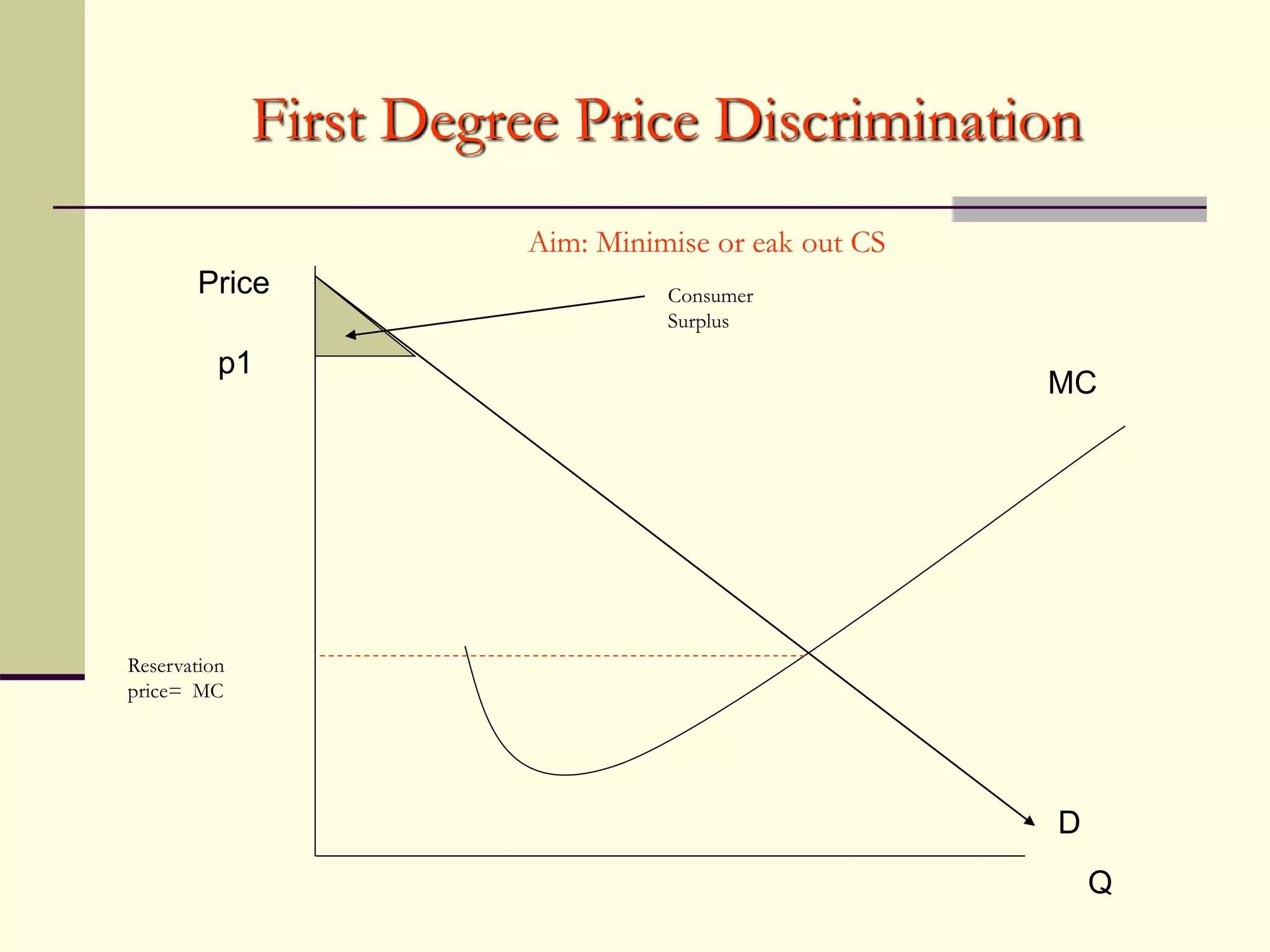
 This type of price discrimination is primarily theoretical because it
requires the seller of a good or service to know the absolute
maximum price that every consumer is willing to pay.
 It is true that consumers have different price elasticities, but the
seller is not concerned with such.
 The seller is concerned with the maximum willingness to pay
(WTP) of each customer.
 By knowing the maximum WTP, the seller is able to absorb the
entire market surplus, thus taking all consumer surplus and
transforming it into revenues.
First Degree Price Discrimination
Price
Q
D
MC
Reservation
price= MC
p1
Consumer
Surplus
Aim: Minimise or eak out CS
Second Degree Price Discrimination
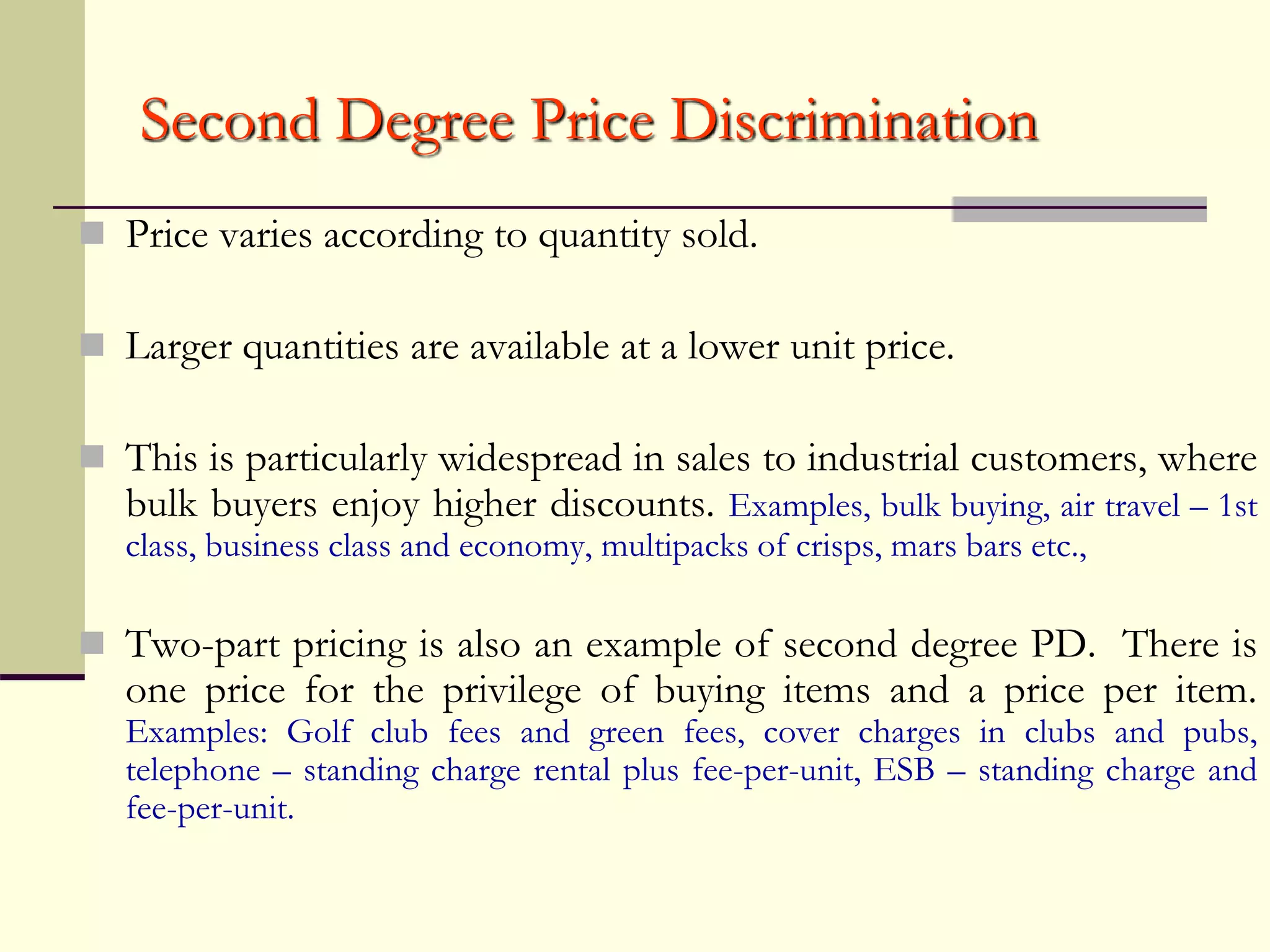
 Price varies according to quantity sold.
 Larger quantities are available at a lower unit price.
 This is particularly widespread in sales to industrial customers, where
bulk buyers enjoy higher discounts. Examples, bulk buying, air travel – 1st
class, business class and economy, multipacks of crisps, mars bars etc.,
 Two-part pricing is also an example of second degree PD. There is
one price for the privilege of buying items and a price per item.
Examples: Golf club fees and green fees, cover charges in clubs and pubs,
telephone – standing charge rental plus fee-per-unit, ESB – standing charge and
fee-per-unit.
Second Degree Price Discrimination
Price
Q
D
MC
Economy Price
Reduced Price
5 7 units
Standard Price
1
The Price depends on the quantity you buy
2-Part Pricing
Find optimal cover charge if P=4.50-Q and MC = 0.50?
Price = 4.50
Q
D
MC
MC = €0.50
4 Pints
0.50 = 4.50-Q
Q = 4 (pints)
At P = €0.50 you buy 4 pints
Max cover charge = CS
CS = ½ (4*4) = €8
Optimal Cover charge = €8
Consumer
Surplus
Third Degree Price Discrimination
 The monopolist sells output to different people for different prices.
 Every unit of output sold to a person is the same price. - students, pensioners,
and female concessions.
 Third degree PD is based on the fact that there are different classes of
consumer with different price elasticity of demand, and it is possible to divide
consumers into different classes and charge the different classes different prices.
 The supplier(s) of a market where this type of discrimination is exhibited are
capable of differentiating between consumer classes. Examples of this
differentiation are student or senior "discounts".
 A student or a senior consumer will have a different willingness to pay than an
average consumer, where the WTP is presumably lower because of budget
constraints.
 The supplier sets a lower price for that consumer because the student or senior
has a more elastic price elasticity of demand
 The supplier is once again capable of capturing more market surplus than would
be possible without price discrimination.
Third Degree Price Discrimination
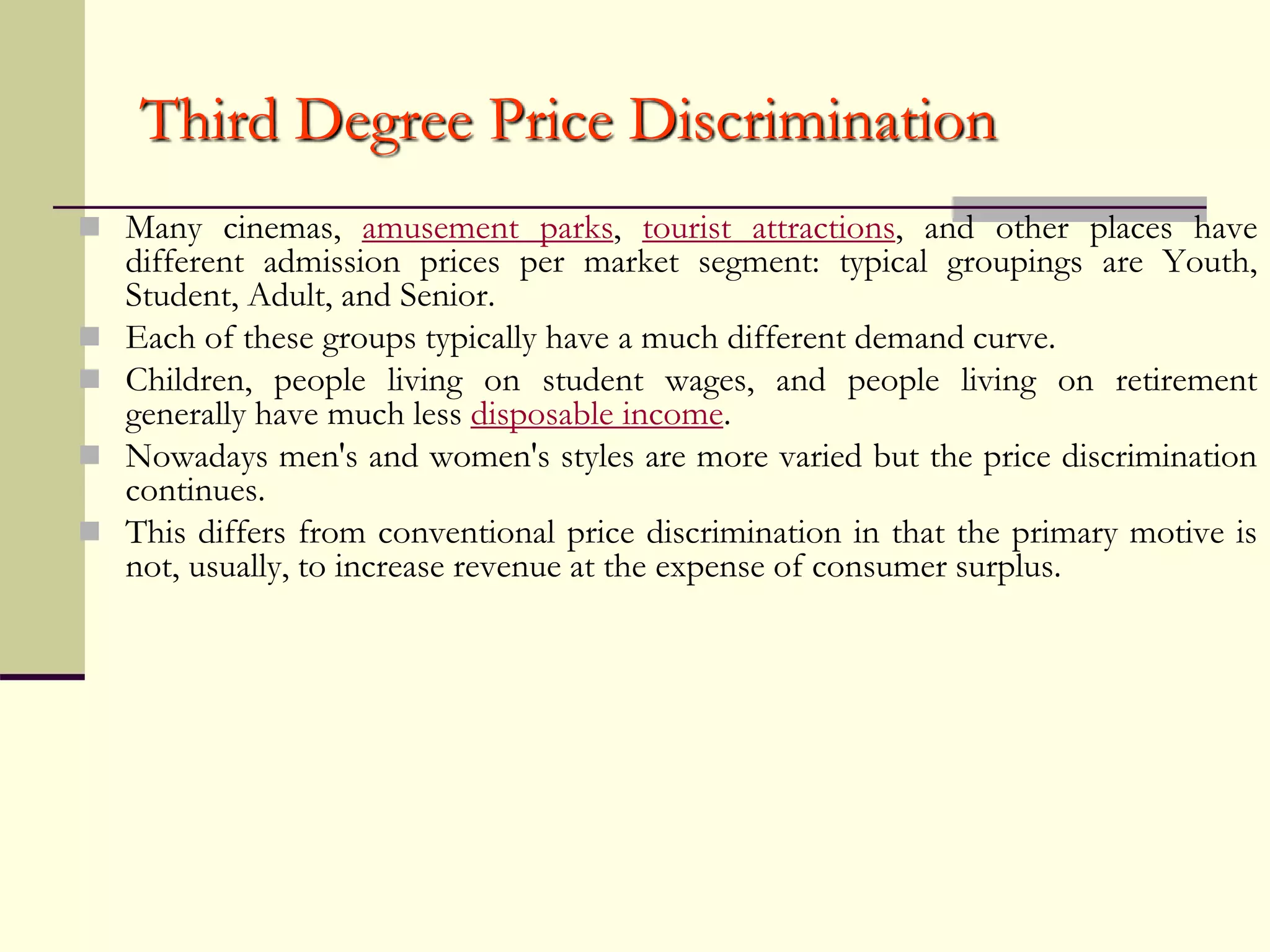
 Many cinemas, amusement parks, tourist attractions, and other places have
different admission prices per market segment: typical groupings are Youth,
Student, Adult, and Senior.
 Each of these groups typically have a much different demand curve.
 Children, people living on student wages, and people living on retirement
generally have much less disposable income.
 Nowadays men's and women's styles are more varied but the price discrimination
continues.
 This differs from conventional price discrimination in that the primary motive is
not, usually, to increase revenue at the expense of consumer surplus.
3rd Degree PD
Domestic and Export Demand for Irish Butter
MC
Domestic price
Export
price
Domestic
market
Export
market
Domestic + Export
market
•Different price elasticities of demand exist for Irish butter.
•Higher prices are available in the domestic market as few substitutes are available.
•However, on the export mark lower prices are obtained as we have to compete with our trading
partners on the export market.
•The composite demand curve shows the combined domestic plus export market.
Other Forms of Price Discrimination
 Inter-temporal Pricing: If at peak rush hour, the toll is
higher than at the off-peak, we are using different prices at
different time periods. The peak toll can encourage shifting
travel patterns to off-peak times or discourage some
commuting altogether. Inter-temporal pricing appears more
frequently than one thinks. Example- night rate electricity is
cheaper, peak versus off-peak phone charges.
 Bundling: McDonalds sells Extra Value Meals, as a bundle
of [burger, fries, and a soft drink] for less than it sells them
separately. Selling both bundles and items separately is
mixed bundling.
Other Forms of Price Discrimination
 Skimming: Price declines over time. Those who wish to get it first pays the
highest price, others are willing to wait. Examples: Hardcover & Paperback Books,
New electrical, computer products, the new Iphone.
 Prestige Pricing: Some products distinguish themselves by being noticeably
expensive. Mercedes, Audi, or BMW, Cartier jewelry. The price is itself a way to
distinguish the product from others Prestige Pricing is the practice of charging a
high price to enhance its perceived value. However, the firms typically have to
spend a great deal in promotional activities to convince customers that the
product is prestigious.
Control of monopolies
and the Promotion of Competition
 Most monopolies which existed in Ireland in the past arose as a result of the
establishment of semi-state bodies in those industries in which the Irish
Government felt that such a monopoly was appropriate and in the public
interest.
 In many cases this involved the exploitation of natural resources or the provision
of services which the private sector was reluctant to provide.
 However in recent years the Irish Government, in accordance with EU policy,
has undertaken major market deregulation and liberalisation, and now many
semi-state companies which previously operated as monopolies have been
exposed to competition.
 This has come about either through privatisation (e.g. Eircom, Aer Lingus, Irish
Life) or through the granting of licences to competitors (e.g. TV3).
Sample Questions
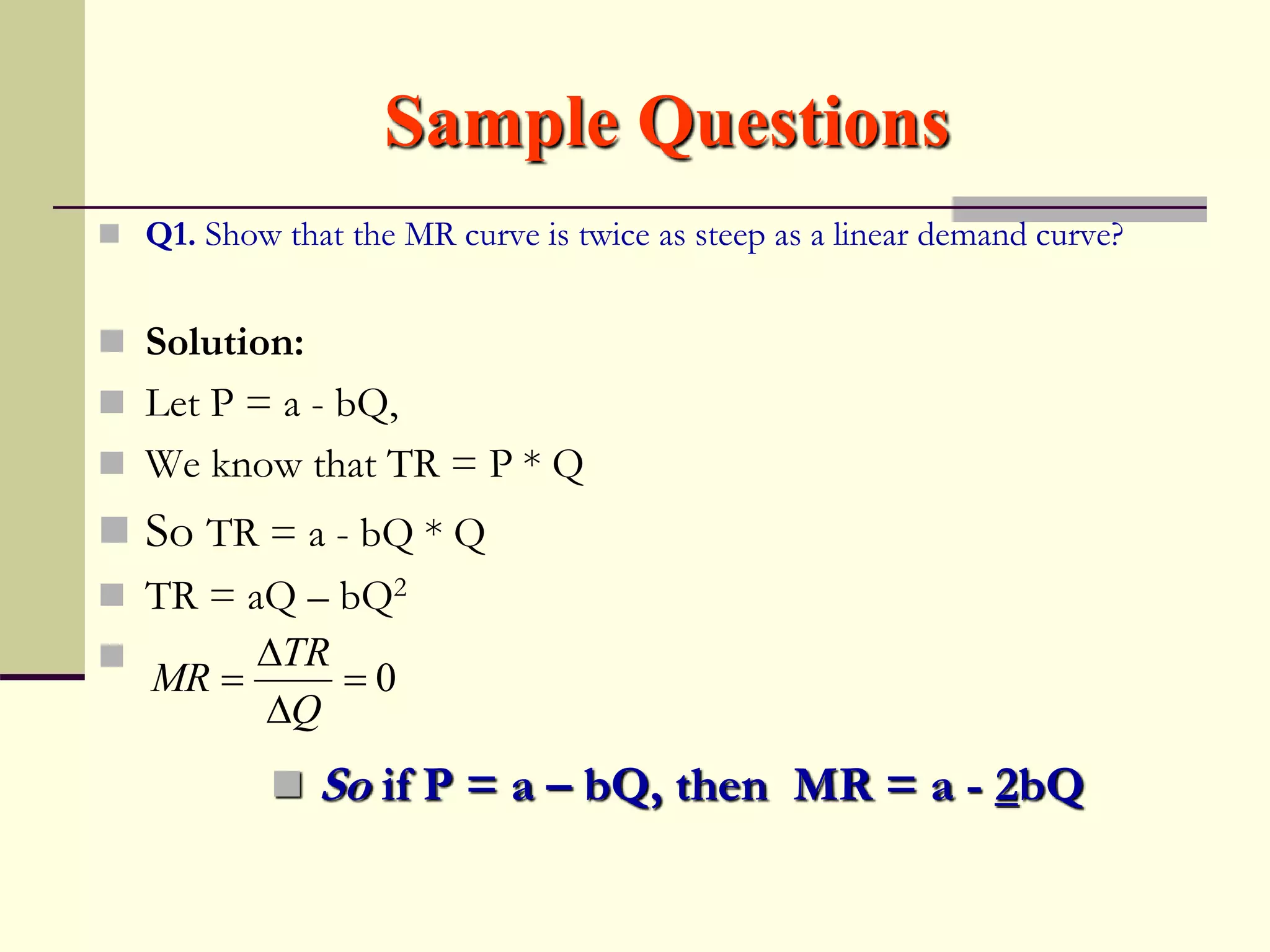
 Q1. Show that the MR curve is twice as steep as a linear demand curve?
 Solution:
 Let P = a - bQ,
 We know that TR = P * Q
 So TR = a - bQ * Q
 TR = aQ – bQ2

 So if P = a – bQ, then MR = a - 2bQ
0




Q
TR
MR
Sample Questions
 Q2: Suppose the demand curve is estimated to be: P = 140 - 3Q, MC = 4 + 2Q. Find
(a) the monopoly price and (b) the profit maximising level of output?
 Solution:
 The slope of the MR is twice as steep as the linear demand curve P = 140 - 3Q, so
MR = 140 – 6Q,
 A monopolist produces where MR = MC.
 Therefore 140 – 6Q = 4 + 2Q, so 136 = 8Q.
(a) Therefore the monopoly profit maximising level of output is Q =17.
 To find the monopoly price, substitute Q = 17 into the demand curve.
 We find that P = 140-3(17) = 89.
(b) Therefore the monopoly price at profit maximising level of output is P = 89.
Sample Questions
 Q3: If P = 100 - Q, and MC = 20. Find (a) the profit maximising level of
output and (b) the monopoly price?
 Solution:
 Find the where MR = MC
 TR = PQ = (100 – Q)Q = 100Q – Q2.
 (b) Qmonopoly = 40.
(a) Therefore the monopoly profit maximising level of output is Q =40.
 To find the monopoly price, substitute Q = 40 into the demand curve.
 Pmonopoly P = 100 –Q, so = 100 - 40 = 60 .
(b) Therefore the monopoly price at profit maximising level of output is P = 60.
Sample Questions
Q4: A monopolist has the following Total Cost function: TC = 10 + 5Q, the price
elasticity of demand has been estimated to be -2 [Ep = -2].
 Estimate the monopoly price?
 Solution:
 So p =
 If demand is more price elastic i.e. Ep = -2 then
Then p =
5




Q
TC
MC )
2
1
1
(
5


 P
)
1
1
(
p
E
P
MC 

unit
/
10
€
5
.
0
5

)
4
1
1
(
5


 P
unit
/
67
.
6
€
75
.
0
5

Sample Questions
Q5: The demand for Nike sportswear can be expressed as follows:
Log Q = -1.5 Log P + 1.3 Log Y where Q = quantity demanded of Nike sportswear, P =
Price and Y = income. If the marginal cost of a Nike sweatshirt is €20, the optimal
monopoly price of the sweatshirt is:
 €20.
 €17.
 €60.
 None of the above.
 Solution

 So 20 = P(0.333333)
Then p = 60
)
1
1
(
p
E
P
MC 
 )
5
.
1
1
1
(
20


 P
Recall: The above are double log functions: the powers, or the number before the logs are the
elasticities, -1.5 = price elasticity of demand and 1.3 = income elasticity of demand.
Sample Questions
Q6: The demand for Nike sportswear can be expressed as follows:
Log Q = -1.5 Log P + 1.3 Log Y where Q = quantity demanded of Nike
sportswear, P = Price and Y = income. From the expression Nike
sportswear can be considered as an:
1. A normal good that is price inelastic.
2. An inferior good that is price elastic.
3. A normal good that is price elastic.
4. None of the above.
 Solution: It’s a normal good as it has a positive income elasticity (+1.3), its
price elastic as its EP = -1.5
Recall: The above are double log functions: the powers, or the number before the logs are the
elasticities, -1.5 = price elasticity of demand and 1.3 = income elasticity of demand.
Sample Questions
Q7: : If Ep = - 3 and MC = 100. Calculate the monopoly price? If the elasticity
increases to Ep = -5 , how does this change affect the price?
 Solution
)
1
1
(
p
E
P
MC 

Note: When the optimal monopoly price falls to €125, the more price elastic is the demand. The
more price elastic is the demand the closer the price is to its MC.
)
3
1
1
(
100


 P
unit
/
150
€
6667
.
0
100
 Monopoly Price = €150/unit
then
If Ep increases to – 5 then )
5
1
1
(
100


 P = €125/unit
Sample Questions
Q8: Liverpool FC practices third degree price discrimination as it charges €60 per ticket for Students
with an ID card for entry to its Premiership matches and €80 for non-students. Liverpool FC has
estimated that the price elasticity of demand for non-student groups is –2.
 Calculate the price elasticity of demand for students.
 Describe second-degree price discrimination. Support your answer with a typical example.
(Students) Other Groups
MR = P (1 + 1/Ep) = MR = P (1 + 1/Ep)
60 (1 + 1/ Ep) = 80 (1 + 1 / -2)
60 (1 + 1/ Ep) = 40
(1 + 1/ Ep) = 40/60 = 0.6667
1/ Ep = 0.667 – 1 = -0.3333
Ep = -3 = 1/-0.33333 =
Note: Ped for students = -3, students are more price sensitive for Liverpool match tickets
Sample Questions
Q9: If the TC = 100Q – 3Q2 + 2Q3, the marginal cost (MC) at an
output of Q = 5 is:
 Solution
1. 100.
2. 90.
3. 220.
4. None of the above.
0




Q
TC
MC
MC = 100 – 6Q + 6Q2 :
Substitute 5 instead of Q so MC = 100 – 6(5) + 6(5)2 = 220
Recall our Learning Outcomes
You should now be able to:
 Describe the conditions that lead to a monopoly market.
 Describe and illustrate long-monopoly equilibrium.
 Differentiate between prefect competition and monopoly.
 Appreciate the relationship between elasticity and monopoly
 Describe the conditions for the existence of price discrimination.
 Distinguish between the various forms of price discrimination.
 Calculate profit maximizing levels of output and price in
monopoly.

Monopoly Market.ppt

  • 1.
    Price and OutputDetermination: Monopoly
  • 2.
    Learning Outcomes Upon completingthis section, the student should be able to:  Describe the conditions that lead to a monopoly market.  Describe and illustrate long-monopoly equilibrium.  Differentiate between prefect competition and monopoly.  Appreciate the relationship between elasticity and monopoly  Describe the conditions for the existence of price discrimination.  Distinguish between the various forms of price discrimination.  Calculate profit maximizing levels of output and price in monopoly.
  • 3.
    What is aMonopoly?  The term monopoly derived from the Greek monos, alone or one.  Monopoly is a type of market structure in which there is only one producer or seller.  A single producer controls the entire output of a particular commodity.
  • 4.
    Why might Monopoliesarise? 1. State monopoly: A government may create a statutory or legal monopoly giving a certain body the sole right to supply a particular good or provide a certain service. The Act which creates the monopoly places a legal restriction on competition. In Ireland, the government has granted monopolistic powers to ESB, Telecom Eireann etc, Mobile Phone Licence to Esat Digifone. 2. Control of critical resources: A particular firm may have exclusive access to the only source of supply of the raw materials necessary for the production of a certain commodity. Mining firms would be examples of this type of monopoly. 3. Capital intensive monopoly: Certain industries require such a large investment of capital in plant and equipment that any form of competition from potential rivals is completely discouraged e.g. aircraft manufacturing, ship-building, steel firms etc. 4. Legal restriction: A firm which develops or invents a new product or process can use the law of patents, franchise, copyright etc. to obtain the sole right of manufacture of the product or use of the process. Pfizer – Viagra 5. Trade Agreements: All the firms within a certain industry, may by agreement, adopt completely uniform policies on price and output. This type of agreement effectively creates a monopoly. (OPEC on Oil production).
  • 5.
    Assumptions governing aMonopoly • Price Setter: There is only one firm in the entire industry and it has complete control over price. • Barriers to Entry: No other firm can enter the industry even if it wants to i.e. there is no freedom of entry to the industry- cost being the main barrier to entry. • Profit Maximiser: The monopolist aims to maximise profit. • In a monopoly situation the equilibrium of the individual firm is the equilibrium of the industry because the entire industry is made up of just one firm. • A monopolist can selects either the price or the output but not both
  • 6.
    Monopoly – Long-RunEquilibrium Price/cost Q - Output D = AR MR MC q(mon) P(mon) AC Super normal Profits AC not minimised MR = MC AR > AC P <>AC
  • 7.
    Monopoly versus PerfectCompetition Price/cost Q - Output D = AR MR Lr-MC q(mon) P(mon) Lr-AC Super normal Profits AC not minimised Monopolist Higher prices and lower outputs Supernormal profits in the L-R AC not minimised q(pc) P(pc) P = D = AR = MR
  • 8.
    Monopoly versus PerfectCompetition  When monopoly and perfect competition are compared under the same conditions, we find that the monopolist, when in equilibrium, produces a lower and sells it a higher price than the perfectly competitive firm.  the perfectly competitive firm produces q(pc) at a price p(pc), the individual firm is a price taker.  The monopolist produces q(mon) at p(mon). Thus the monopolist produces at higher prices and a lower output.  The monopolist earns supernormal profits earned in the long- run and in monopoly Average Costs are not minimised.  Comparing monopoly and perfect competition (video) is unrealistic because perfect competition in its pure form rarely exists.
  • 9.
    Price Elasticity andMonopoly  Marginal revenue is a function of price elasticity, ) 1 1 ( p E P MR   •A profit maximising monopolist produces a quantity where MR = MC, so by substitution ) 1 1 ( p E P MC   In monopoly P will be greater than MC. For example if Ep = -2, ) 2 1 1 (    P MC MC = 0.5P, so P = 2MC. Note: a monopolist will never operate in the area of the demand curve where demand is price inelastic
  • 10.
    Price Discrimination  Itis the practice of charging different people different prices for the same goods or services.  When price discrimination is engaged in for the purpose of reducing competition, as, for instance, through tying the lower prices to the purchase of other goods or services, it constitutes a violation of Antitrust Acts.  Price discrimination also occurs when it costs more to supply one customer than it does another, and yet the supplier charges both the same price.
  • 11.
    Conditions for PriceDiscrimination  There must be some degree of market power  Separate markets must be identified.  Consumers should be largely ignorant of any PD.  There should be a different price elasticity for the same good among consumers.  No opportunities for arbitrage - The buyer cannot re-sell.  This usually entails using one or more means of preventing any resale, keeping the different price groups separate, making price comparisons difficult, or restricting pricing information.  Price discrimination is thus very common in services, where resale is not possible; an example is student discounts at cinema.  The degree of PD must be so small that consumers are not affected by it.
  • 12.
    Ways to SeparateCustomers  Geography: when the prices in the Rural and Urban differ.  Income: when Economic Associations charges more to professors than students.  Gender:  Age: when kids get in at lower prices for movies  Time: when prices differ by day ( Cinema have reduces prices on Mondays) or season (Hotel rates)
  • 13.
    First Degree PriceDiscrimination  This type of price discrimination is primarily theoretical because it requires the seller of a good or service to know the absolute maximum price that every consumer is willing to pay.  It is true that consumers have different price elasticities, but the seller is not concerned with such.  The seller is concerned with the maximum willingness to pay (WTP) of each customer.  By knowing the maximum WTP, the seller is able to absorb the entire market surplus, thus taking all consumer surplus and transforming it into revenues.
  • 14.
    First Degree PriceDiscrimination Price Q D MC Reservation price= MC p1 Consumer Surplus Aim: Minimise or eak out CS
  • 15.
    Second Degree PriceDiscrimination  Price varies according to quantity sold.  Larger quantities are available at a lower unit price.  This is particularly widespread in sales to industrial customers, where bulk buyers enjoy higher discounts. Examples, bulk buying, air travel – 1st class, business class and economy, multipacks of crisps, mars bars etc.,  Two-part pricing is also an example of second degree PD. There is one price for the privilege of buying items and a price per item. Examples: Golf club fees and green fees, cover charges in clubs and pubs, telephone – standing charge rental plus fee-per-unit, ESB – standing charge and fee-per-unit.
  • 16.
    Second Degree PriceDiscrimination Price Q D MC Economy Price Reduced Price 5 7 units Standard Price 1 The Price depends on the quantity you buy
  • 17.
    2-Part Pricing Find optimalcover charge if P=4.50-Q and MC = 0.50? Price = 4.50 Q D MC MC = €0.50 4 Pints 0.50 = 4.50-Q Q = 4 (pints) At P = €0.50 you buy 4 pints Max cover charge = CS CS = ½ (4*4) = €8 Optimal Cover charge = €8 Consumer Surplus
  • 18.
    Third Degree PriceDiscrimination  The monopolist sells output to different people for different prices.  Every unit of output sold to a person is the same price. - students, pensioners, and female concessions.  Third degree PD is based on the fact that there are different classes of consumer with different price elasticity of demand, and it is possible to divide consumers into different classes and charge the different classes different prices.  The supplier(s) of a market where this type of discrimination is exhibited are capable of differentiating between consumer classes. Examples of this differentiation are student or senior "discounts".  A student or a senior consumer will have a different willingness to pay than an average consumer, where the WTP is presumably lower because of budget constraints.  The supplier sets a lower price for that consumer because the student or senior has a more elastic price elasticity of demand  The supplier is once again capable of capturing more market surplus than would be possible without price discrimination.
  • 19.
    Third Degree PriceDiscrimination  Many cinemas, amusement parks, tourist attractions, and other places have different admission prices per market segment: typical groupings are Youth, Student, Adult, and Senior.  Each of these groups typically have a much different demand curve.  Children, people living on student wages, and people living on retirement generally have much less disposable income.  Nowadays men's and women's styles are more varied but the price discrimination continues.  This differs from conventional price discrimination in that the primary motive is not, usually, to increase revenue at the expense of consumer surplus.
  • 20.
    3rd Degree PD Domesticand Export Demand for Irish Butter MC Domestic price Export price Domestic market Export market Domestic + Export market •Different price elasticities of demand exist for Irish butter. •Higher prices are available in the domestic market as few substitutes are available. •However, on the export mark lower prices are obtained as we have to compete with our trading partners on the export market. •The composite demand curve shows the combined domestic plus export market.
  • 21.
    Other Forms ofPrice Discrimination  Inter-temporal Pricing: If at peak rush hour, the toll is higher than at the off-peak, we are using different prices at different time periods. The peak toll can encourage shifting travel patterns to off-peak times or discourage some commuting altogether. Inter-temporal pricing appears more frequently than one thinks. Example- night rate electricity is cheaper, peak versus off-peak phone charges.  Bundling: McDonalds sells Extra Value Meals, as a bundle of [burger, fries, and a soft drink] for less than it sells them separately. Selling both bundles and items separately is mixed bundling.
  • 22.
    Other Forms ofPrice Discrimination  Skimming: Price declines over time. Those who wish to get it first pays the highest price, others are willing to wait. Examples: Hardcover & Paperback Books, New electrical, computer products, the new Iphone.  Prestige Pricing: Some products distinguish themselves by being noticeably expensive. Mercedes, Audi, or BMW, Cartier jewelry. The price is itself a way to distinguish the product from others Prestige Pricing is the practice of charging a high price to enhance its perceived value. However, the firms typically have to spend a great deal in promotional activities to convince customers that the product is prestigious.
  • 23.
    Control of monopolies andthe Promotion of Competition  Most monopolies which existed in Ireland in the past arose as a result of the establishment of semi-state bodies in those industries in which the Irish Government felt that such a monopoly was appropriate and in the public interest.  In many cases this involved the exploitation of natural resources or the provision of services which the private sector was reluctant to provide.  However in recent years the Irish Government, in accordance with EU policy, has undertaken major market deregulation and liberalisation, and now many semi-state companies which previously operated as monopolies have been exposed to competition.  This has come about either through privatisation (e.g. Eircom, Aer Lingus, Irish Life) or through the granting of licences to competitors (e.g. TV3).
  • 24.
    Sample Questions  Q1.Show that the MR curve is twice as steep as a linear demand curve?  Solution:  Let P = a - bQ,  We know that TR = P * Q  So TR = a - bQ * Q  TR = aQ – bQ2   So if P = a – bQ, then MR = a - 2bQ 0     Q TR MR
  • 25.
    Sample Questions  Q2:Suppose the demand curve is estimated to be: P = 140 - 3Q, MC = 4 + 2Q. Find (a) the monopoly price and (b) the profit maximising level of output?  Solution:  The slope of the MR is twice as steep as the linear demand curve P = 140 - 3Q, so MR = 140 – 6Q,  A monopolist produces where MR = MC.  Therefore 140 – 6Q = 4 + 2Q, so 136 = 8Q. (a) Therefore the monopoly profit maximising level of output is Q =17.  To find the monopoly price, substitute Q = 17 into the demand curve.  We find that P = 140-3(17) = 89. (b) Therefore the monopoly price at profit maximising level of output is P = 89.
  • 26.
    Sample Questions  Q3:If P = 100 - Q, and MC = 20. Find (a) the profit maximising level of output and (b) the monopoly price?  Solution:  Find the where MR = MC  TR = PQ = (100 – Q)Q = 100Q – Q2.  (b) Qmonopoly = 40. (a) Therefore the monopoly profit maximising level of output is Q =40.  To find the monopoly price, substitute Q = 40 into the demand curve.  Pmonopoly P = 100 –Q, so = 100 - 40 = 60 . (b) Therefore the monopoly price at profit maximising level of output is P = 60.
  • 27.
    Sample Questions Q4: Amonopolist has the following Total Cost function: TC = 10 + 5Q, the price elasticity of demand has been estimated to be -2 [Ep = -2].  Estimate the monopoly price?  Solution:  So p =  If demand is more price elastic i.e. Ep = -2 then Then p = 5     Q TC MC ) 2 1 1 ( 5    P ) 1 1 ( p E P MC   unit / 10 € 5 . 0 5  ) 4 1 1 ( 5    P unit / 67 . 6 € 75 . 0 5 
  • 28.
    Sample Questions Q5: Thedemand for Nike sportswear can be expressed as follows: Log Q = -1.5 Log P + 1.3 Log Y where Q = quantity demanded of Nike sportswear, P = Price and Y = income. If the marginal cost of a Nike sweatshirt is €20, the optimal monopoly price of the sweatshirt is:  €20.  €17.  €60.  None of the above.  Solution   So 20 = P(0.333333) Then p = 60 ) 1 1 ( p E P MC   ) 5 . 1 1 1 ( 20    P Recall: The above are double log functions: the powers, or the number before the logs are the elasticities, -1.5 = price elasticity of demand and 1.3 = income elasticity of demand.
  • 29.
    Sample Questions Q6: Thedemand for Nike sportswear can be expressed as follows: Log Q = -1.5 Log P + 1.3 Log Y where Q = quantity demanded of Nike sportswear, P = Price and Y = income. From the expression Nike sportswear can be considered as an: 1. A normal good that is price inelastic. 2. An inferior good that is price elastic. 3. A normal good that is price elastic. 4. None of the above.  Solution: It’s a normal good as it has a positive income elasticity (+1.3), its price elastic as its EP = -1.5 Recall: The above are double log functions: the powers, or the number before the logs are the elasticities, -1.5 = price elasticity of demand and 1.3 = income elasticity of demand.
  • 30.
    Sample Questions Q7: :If Ep = - 3 and MC = 100. Calculate the monopoly price? If the elasticity increases to Ep = -5 , how does this change affect the price?  Solution ) 1 1 ( p E P MC   Note: When the optimal monopoly price falls to €125, the more price elastic is the demand. The more price elastic is the demand the closer the price is to its MC. ) 3 1 1 ( 100    P unit / 150 € 6667 . 0 100  Monopoly Price = €150/unit then If Ep increases to – 5 then ) 5 1 1 ( 100    P = €125/unit
  • 31.
    Sample Questions Q8: LiverpoolFC practices third degree price discrimination as it charges €60 per ticket for Students with an ID card for entry to its Premiership matches and €80 for non-students. Liverpool FC has estimated that the price elasticity of demand for non-student groups is –2.  Calculate the price elasticity of demand for students.  Describe second-degree price discrimination. Support your answer with a typical example. (Students) Other Groups MR = P (1 + 1/Ep) = MR = P (1 + 1/Ep) 60 (1 + 1/ Ep) = 80 (1 + 1 / -2) 60 (1 + 1/ Ep) = 40 (1 + 1/ Ep) = 40/60 = 0.6667 1/ Ep = 0.667 – 1 = -0.3333 Ep = -3 = 1/-0.33333 = Note: Ped for students = -3, students are more price sensitive for Liverpool match tickets
  • 32.
    Sample Questions Q9: Ifthe TC = 100Q – 3Q2 + 2Q3, the marginal cost (MC) at an output of Q = 5 is:  Solution 1. 100. 2. 90. 3. 220. 4. None of the above. 0     Q TC MC MC = 100 – 6Q + 6Q2 : Substitute 5 instead of Q so MC = 100 – 6(5) + 6(5)2 = 220
  • 33.
    Recall our LearningOutcomes You should now be able to:  Describe the conditions that lead to a monopoly market.  Describe and illustrate long-monopoly equilibrium.  Differentiate between prefect competition and monopoly.  Appreciate the relationship between elasticity and monopoly  Describe the conditions for the existence of price discrimination.  Distinguish between the various forms of price discrimination.  Calculate profit maximizing levels of output and price in monopoly.