Principles of Management of
Ambiguous Genitalia
By
Dr Badmus A. M
Outline
• Definition/Introduction
• Human sexual Differentiation
• Gonadal development
• Classification of Ambiguous genitalia
• Epidemiology
• Principle of Management
• Clinical Presentation
• Diagnosis
 History
 Examination
 Investigation
 Definitive management
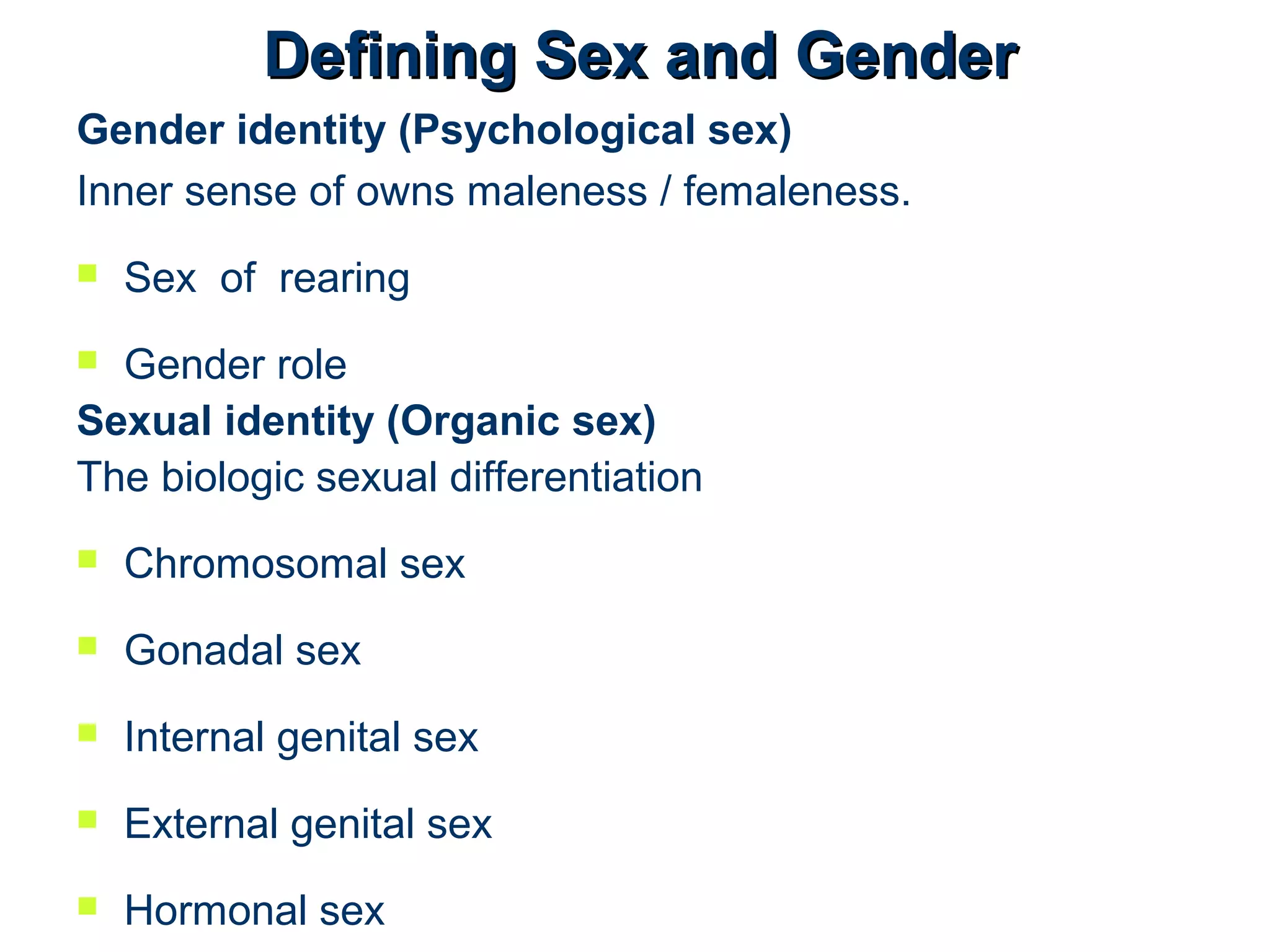
Defining Sex and GenderDefining Sex and Gender
Gender identity (Psychological sex)
Inner sense of owns maleness / femaleness.
 Sex of rearing
 Gender role
Sexual identity (Organic sex)
The biologic sexual differentiation
 Chromosomal sex
 Gonadal sex
 Internal genital sex
 External genital sex
 Hormonal sex
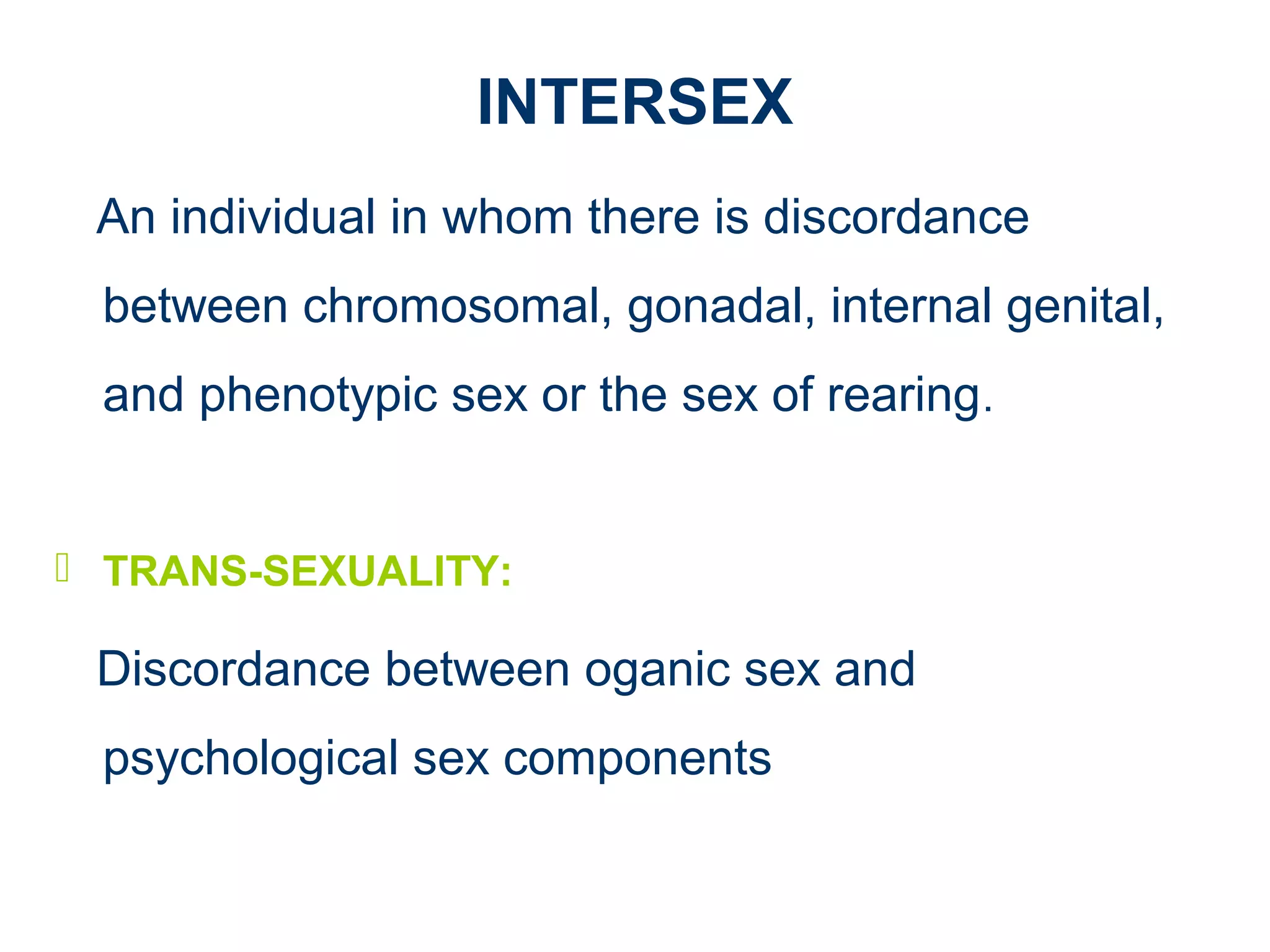
INTERSEX
An individual in whom there is discordance
between chromosomal, gonadal, internal genital,
and phenotypic sex or the sex of rearing.
 TRANS-SEXUALITY:
Discordance between oganic sex and
psychological sex components
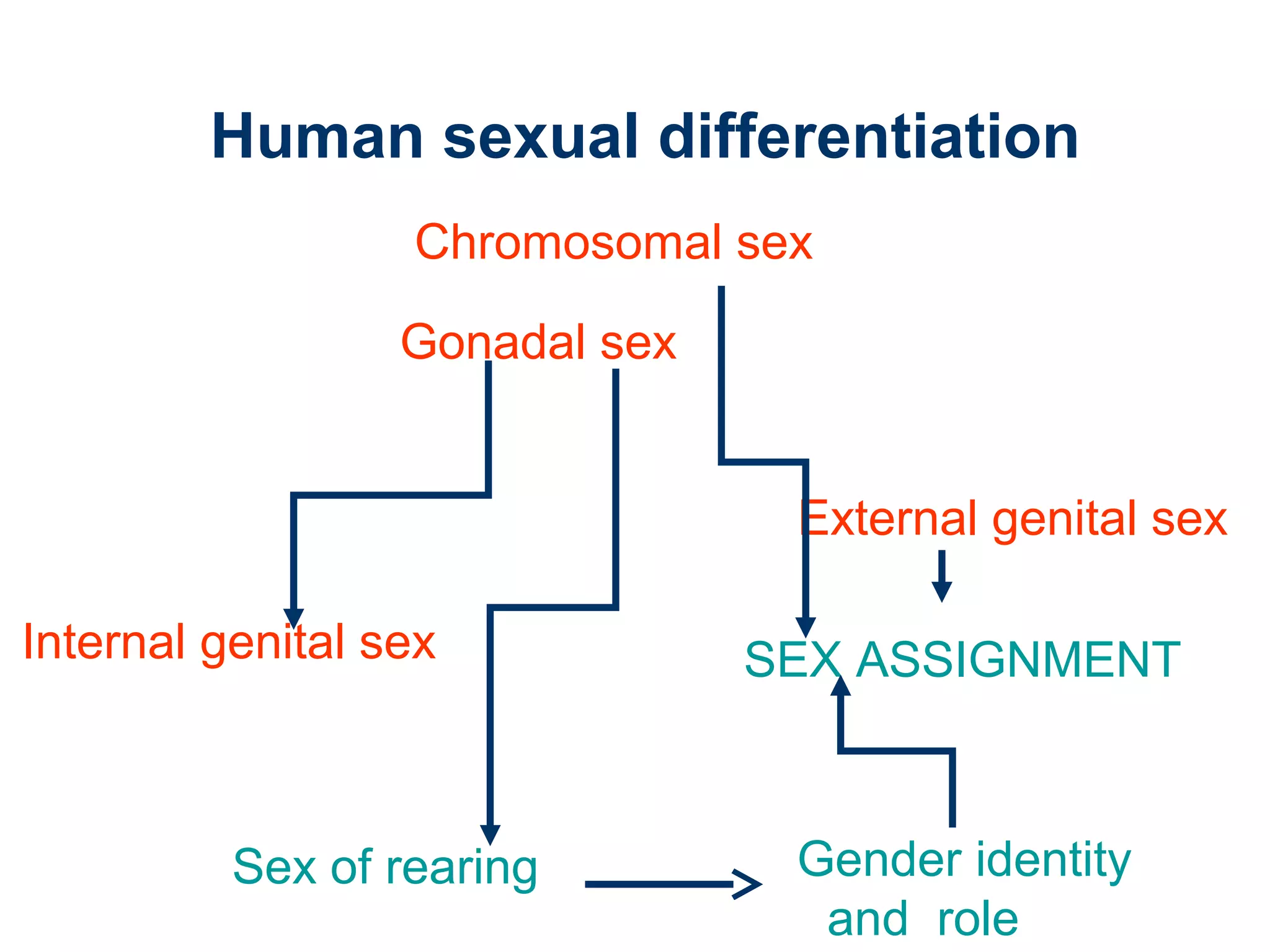
Human sexual differentiation
Chromosomal sex
Gonadal sex
External genital sex
Internal genital sex SEX ASSIGNMENT
Gender identity
and role
Sex of rearing
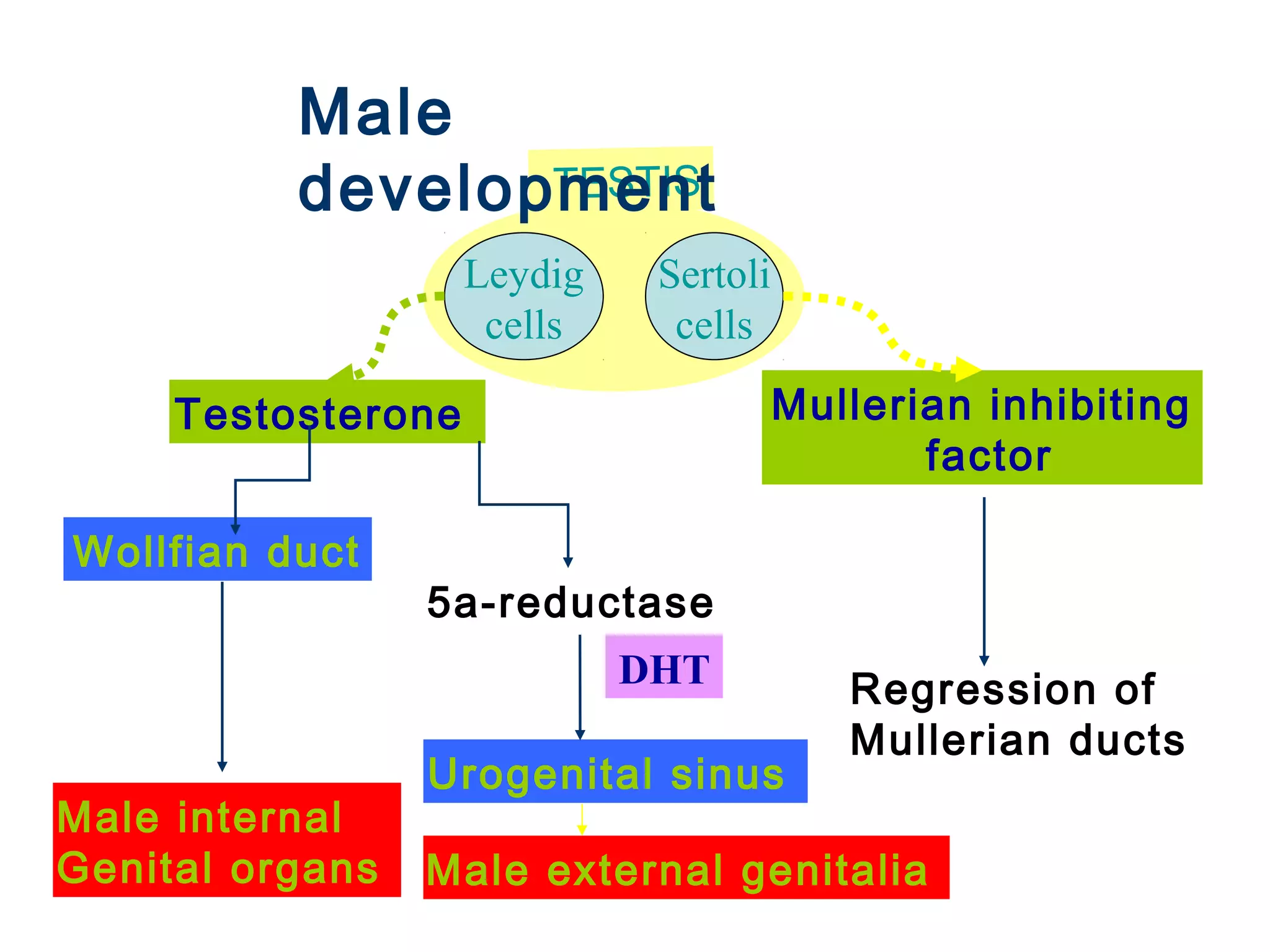
Leydig
cells
Sertoli
cells
Testosterone Mullerian inhibiting
factor
Wollfian duct
5a-reductase
Urogenital sinus
Regression of
Mullerian ducts
Male external genitalia
Male internal
Genital organs
DHT
TESTIS
Male
development
Urogenital sinus
Female external genitalia
. Lower part of vagina
OVARY
Mullerian
ducts
Female internal genital
Organs
. Most of upper vagina
. Cervix and uoterus
. Fallopian tubes
Neutral
Development
Absence of androgen exposure
Female
development
Epidemiology
• A conservative estimate is that 1 in 2000
children born will be affected by an
intersex condition.
 98 % of affected babies are due to
congenital adrenal hyperplasia
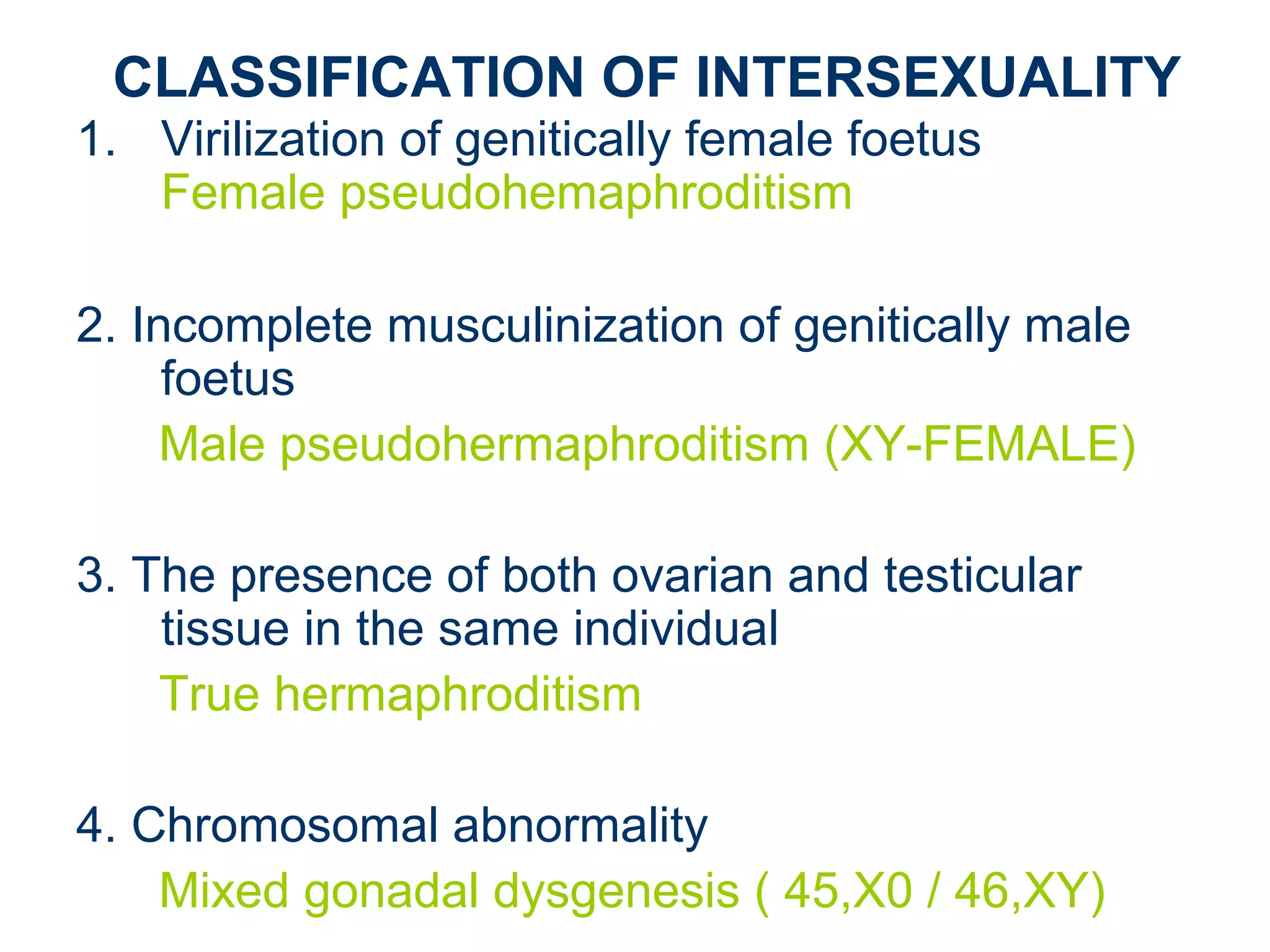
CLASSIFICATION OF INTERSEXUALITY
1. Virilization of genitically female foetus
Female pseudohemaphroditism
2. Incomplete musculinization of genitically male
foetus
Male pseudohermaphroditism (XY-FEMALE)
3. The presence of both ovarian and testicular
tissue in the same individual
True hermaphroditism
4. Chromosomal abnormality
Mixed gonadal dysgenesis ( 45,X0 / 46,XY)
Drugs with Androgenic side effects
ingested during pregnancy
• Testosterone
• Synthetic progestins
• Danocrine
• Diazoxide
• Minoxidil
• Phenetoin sodium
• Streptomycin
• Penicillamine
Principle of Management
• Clinical presentation
• Diagnosis
• History
• Examination
• Investigation
• Protocol of Management
• Sex assignment
• Surgical Consideration
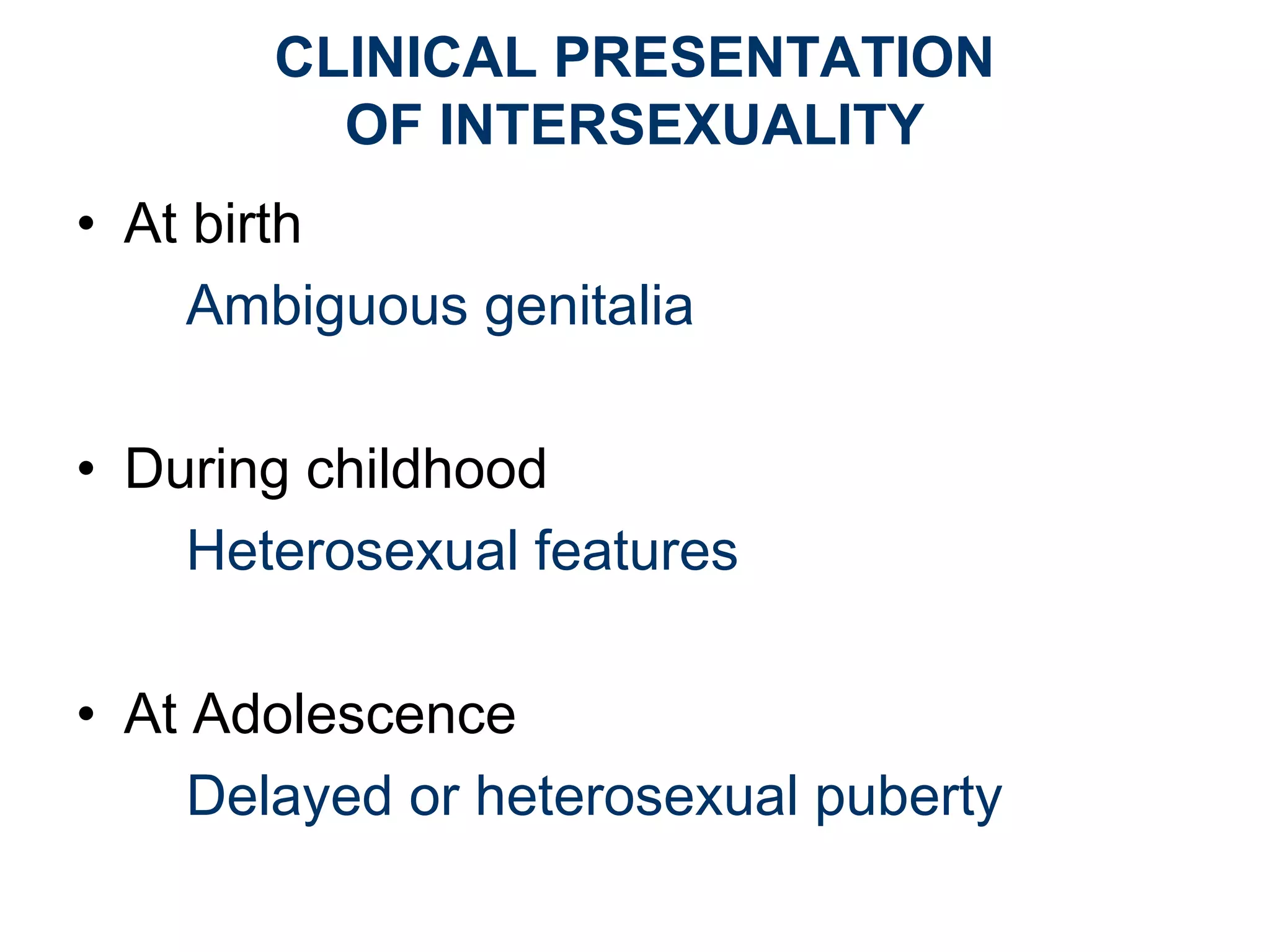
CLINICAL PRESENTATION
OF INTERSEXUALITY
• At birth
Ambiguous genitalia
• During childhood
Heterosexual features
• At Adolescence
Delayed or heterosexual puberty
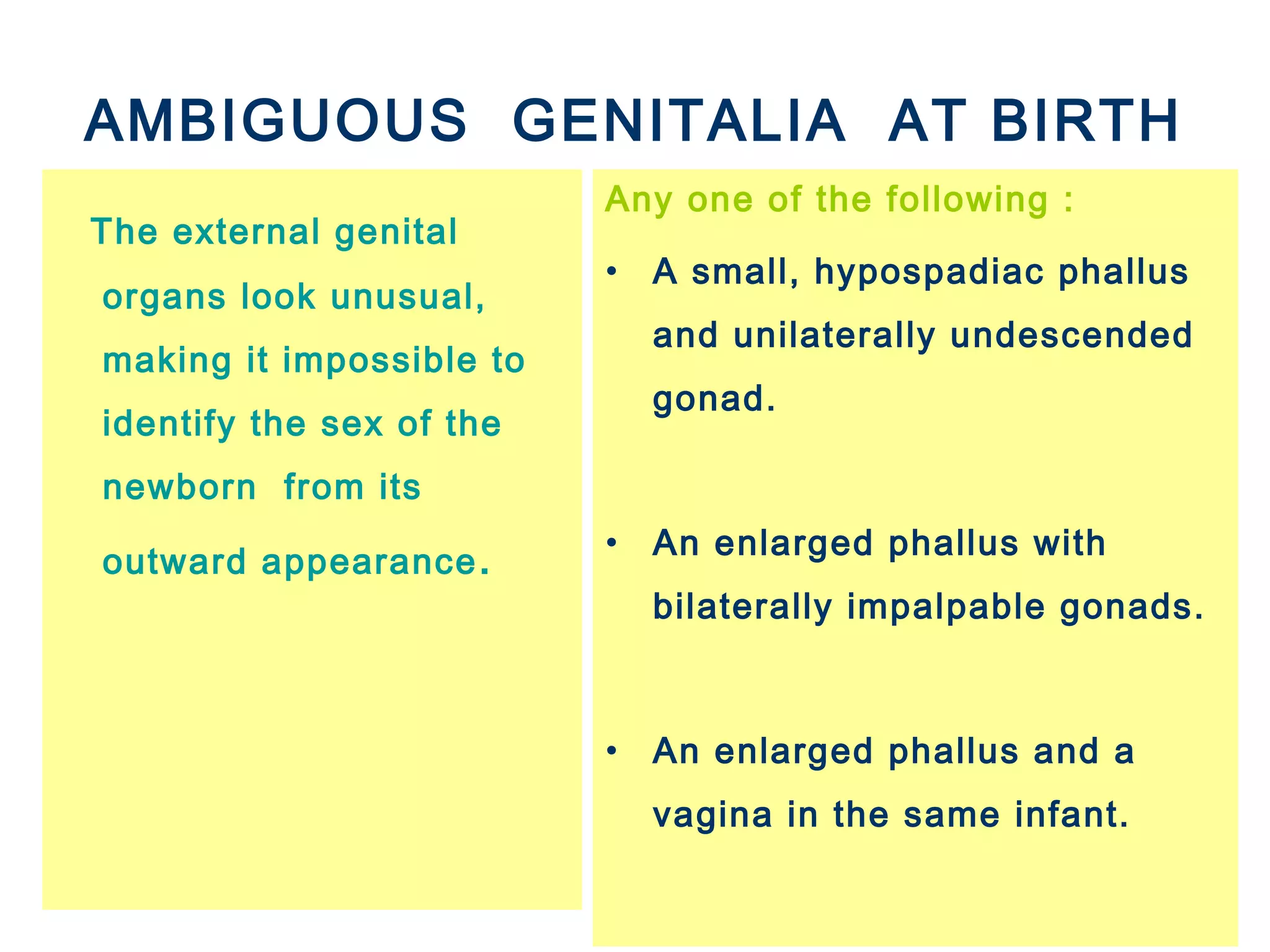
AMBIGUOUS GENITALIA AT BIRTH
The external genital
organs look unusual,
making it impossible to
identify the sex of the
newborn from its
outward appearance.
Any one of the following :
• A small, hypospadiac phallus
and unilaterally undescended
gonad.
• An enlarged phallus with
bilaterally impalpable gonads.
• An enlarged phallus and a
vagina in the same infant.
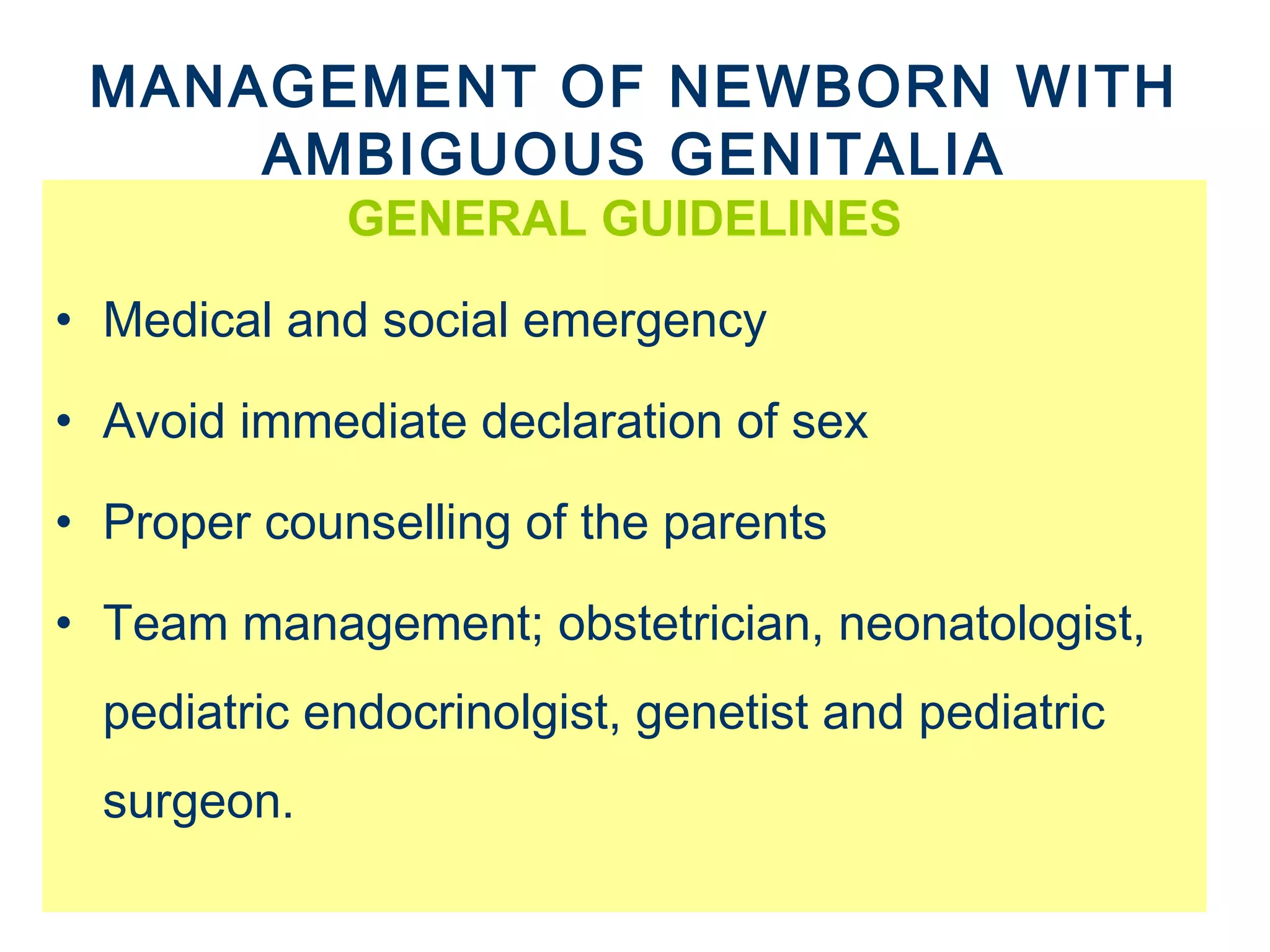
MANAGEMENT OF NEWBORN WITH
AMBIGUOUS GENITALIA
GENERAL GUIDELINES
• Medical and social emergency
• Avoid immediate declaration of sex
• Proper counselling of the parents
• Team management; obstetrician, neonatologist,
pediatric endocrinolgist, genetist and pediatric
surgeon.
MANAGEMENT OF NEWBORN WITH
AMBIGUOUS GENITALIA
DIAGNOSIS
• History : pregnancy; family
• Detailed examination : abdomen; pelvis; external genitalia;
urethral and anal openings.
Federman’s rule:
A palpable gonad below the inguinal ligament is a testes
until proven otherwise
MANAGEMENT OF NEWBORN WITH
AMBIGUOUS GENITALIA
Investigations
• Rule out cong. Adrenal hyperplasia:
Serum electrolytes; 17-OHP level and urinary levels of 17-
ketosteroids
• Karyotype ( buccal smear; blood)
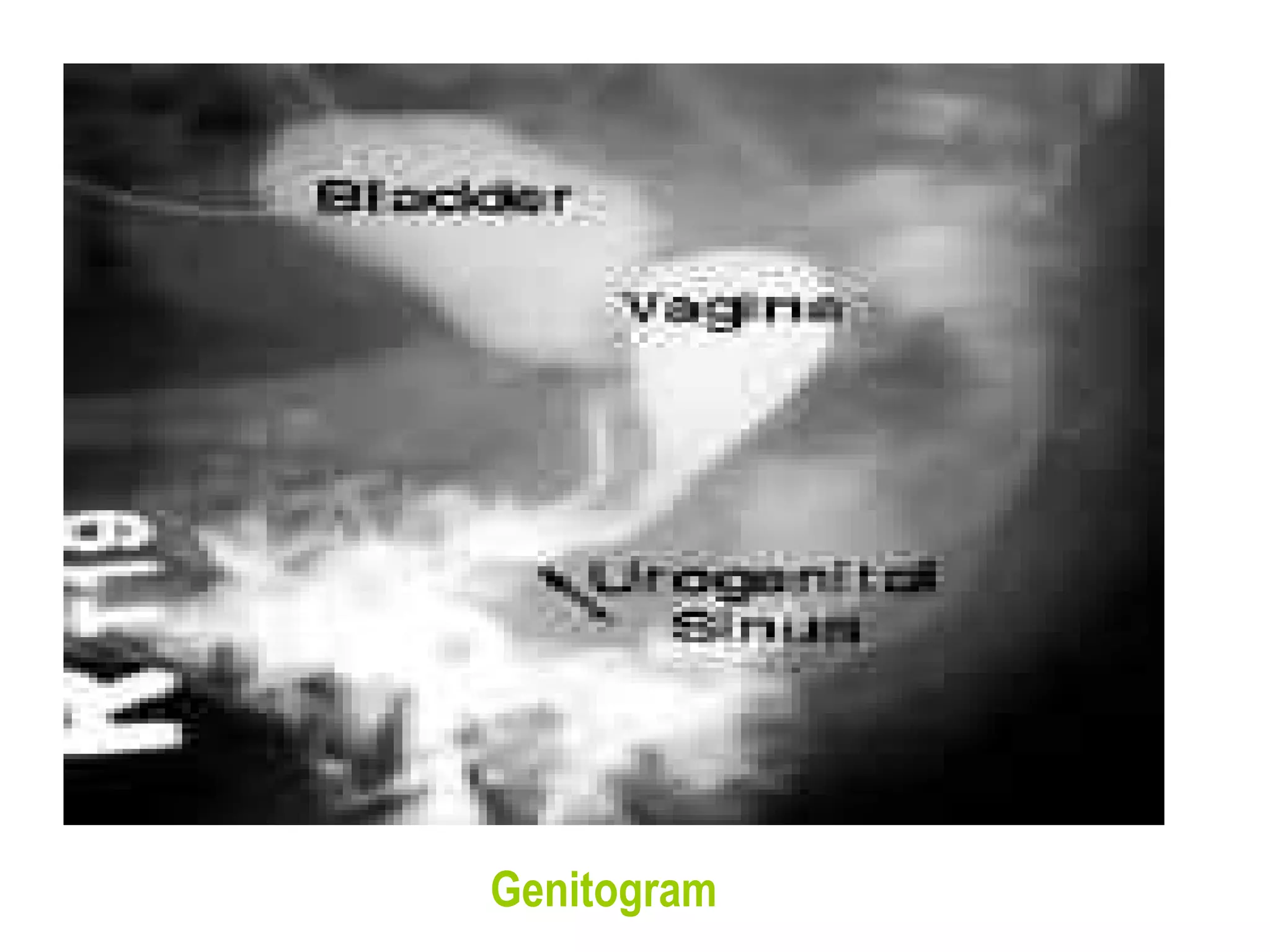
• Pelvic US and sometimes MRI or Genitogram
• Skin biopsy; fibroblast culture to measure 5 α-reductase activity or
dihydrotestosterone binding
• Laparoscopy
• Gonadal biopsy (laparotomy)
A PROTOCOL FOR INVESTIGATIONA PROTOCOL FOR INVESTIGATION
OF A NEWBORN WITH AMBIGUOUSOF A NEWBORN WITH AMBIGUOUS
GENITALIAGENITALIA
Karyotype all
Palpable gonad
YESNO
CAH Sreen
Positive
- US / MRI
-?
Negative
. Biochemical profile
. US / MRI /? genitogram
. ? Gonadal biopsy
Genitogram
Sex Assignment
General guidelines
• Sex assignment should be decided after
detailed assessment, investigations and
accurate diagnosis
• Complete gender assignment by age 18
months
Sex assignment
• Male gender assignment :
- stretched phallus > 2 cm
- erectile tissue
- lack of severe hypospadias
• Female gender assignment :
- inadequate phallus
- cervix and uterus present
In difficult cases; sex assignment should be
to the sex which can be surgically made to be
adequate for coitus
SURGICAL CONSIDERATIONS
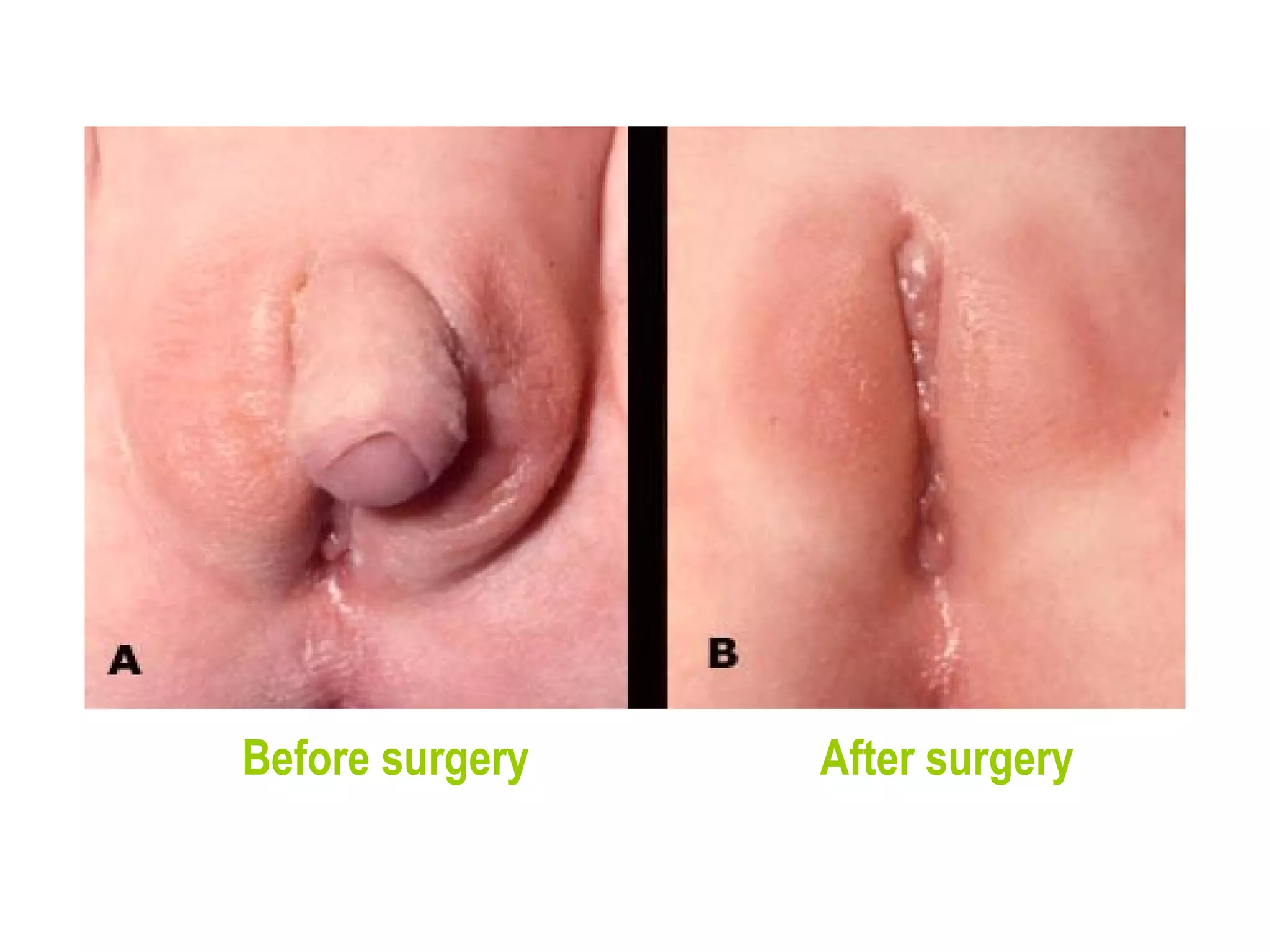
• Phallic / clitoral reduction if the assigned sex is
female, before 3 years of age
• Removal of intra-abdominal gonads / streaks in
newborns carrying Y chromosome
• Vaginal construction / repair is better performed
around puberty
Before surgery After surgery
Concluding remarks on
Management of newborn with genital ambiguity
 It is important to approach the treatment of children
with this disorder in a systematic fashion.
 Parents should be kept informed during the
evaluation to help them understand the embryologic
anomaly that led to their child's genital ambiguity.
Endocrine supplementation should be
instituted when necessary.
A pediatric surgeon should be actively
involved in assigning the child's sex of
rearing as well as performing any necessary
reconstructive surgery.
INTERSEXUALITY PRESENTING AT
ADOLESCENCE
Primary amenorrhea
- Complete androgen
insesitivity (TFS)
- Congenital anorchia
( early testicular regression
syndrome)
- Complete leydig-cell
agenesis
- Some forms of enzymatic
testicular failure
Ambiguous genitalia
• Neglected congenital adrenal
hyperplasia
• Mixed gonadal dysgenesis
• Partial androgen resistance
• Congenital anorchia ( Late )
• Testicular enzymatic failure
• Leydig cell agenesis
( incomplete)
• True hermaphrotidism
MANAGEMENT OF INTERSEXUALITY
PRESENTING AT ADOLESCENCE
• Cortisol replacement therapy and ? Corrective
surgery in CAH
• Corrective surgery in drug induced cliteromegally
• In almost all other instances (XY- FEMALE), whatever
the diagnosis is to Maintain the gender role as female
• In some cases of enzymatic testicular defects or 5 ∝
-reductase deficiency :
Some May seek to change the gender role
INTERSEXUALITY PRESENTING
AT ADOLESCENCE
Surgical aspects of management
•Clitoral reduction
•Removal of gonads in the presence of Y
chromosome
•Vaginal repair and construction
Before surgery After surgery
GONADECTOM
Y
VAGINAL CREATION
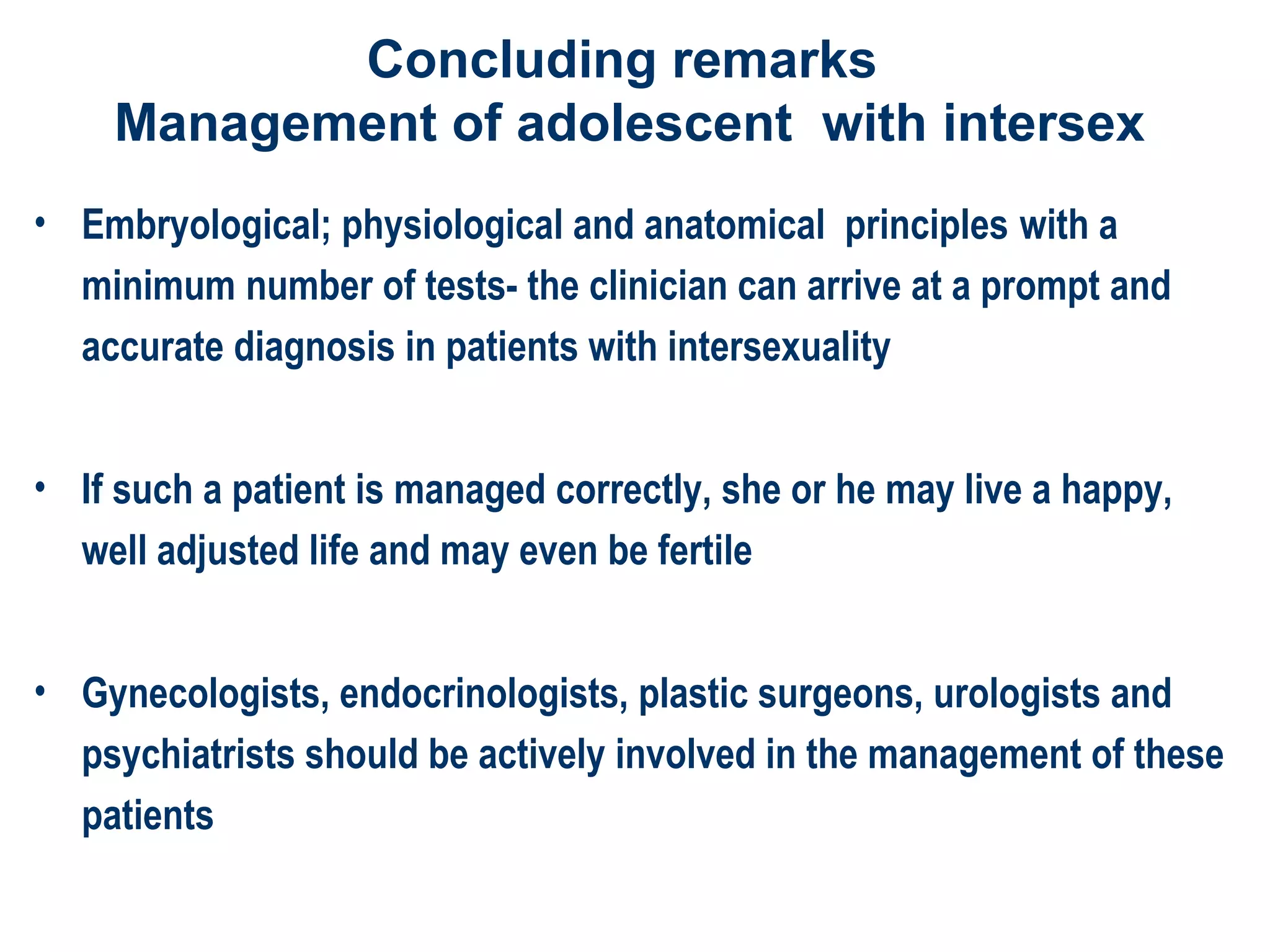
Vaginal dilatation
McIndoe Vaginoplasty
Colovaginoplasty
Concluding remarks
Management of adolescent with intersex
• Embryological; physiological and anatomical principles with a
minimum number of tests- the clinician can arrive at a prompt and
accurate diagnosis in patients with intersexuality
• If such a patient is managed correctly, she or he may live a happy,
well adjusted life and may even be fertile
• Gynecologists, endocrinologists, plastic surgeons, urologists and
psychiatrists should be actively involved in the management of these
patients
Ambiguous genitalia presentation

Ambiguous genitalia presentation

  • 1.
    Principles of Managementof Ambiguous Genitalia By Dr Badmus A. M
  • 2.
    Outline • Definition/Introduction • Humansexual Differentiation • Gonadal development • Classification of Ambiguous genitalia • Epidemiology • Principle of Management • Clinical Presentation • Diagnosis  History  Examination  Investigation  Definitive management
  • 3.
    Defining Sex andGenderDefining Sex and Gender Gender identity (Psychological sex) Inner sense of owns maleness / femaleness.  Sex of rearing  Gender role Sexual identity (Organic sex) The biologic sexual differentiation  Chromosomal sex  Gonadal sex  Internal genital sex  External genital sex  Hormonal sex
  • 4.
    INTERSEX An individual inwhom there is discordance between chromosomal, gonadal, internal genital, and phenotypic sex or the sex of rearing.  TRANS-SEXUALITY: Discordance between oganic sex and psychological sex components
  • 5.
    Human sexual differentiation Chromosomalsex Gonadal sex External genital sex Internal genital sex SEX ASSIGNMENT Gender identity and role Sex of rearing
  • 6.
    Leydig cells Sertoli cells Testosterone Mullerian inhibiting factor Wollfianduct 5a-reductase Urogenital sinus Regression of Mullerian ducts Male external genitalia Male internal Genital organs DHT TESTIS Male development
  • 7.
    Urogenital sinus Female externalgenitalia . Lower part of vagina OVARY Mullerian ducts Female internal genital Organs . Most of upper vagina . Cervix and uoterus . Fallopian tubes Neutral Development Absence of androgen exposure Female development
  • 8.
    Epidemiology • A conservativeestimate is that 1 in 2000 children born will be affected by an intersex condition.  98 % of affected babies are due to congenital adrenal hyperplasia
  • 9.
    CLASSIFICATION OF INTERSEXUALITY 1.Virilization of genitically female foetus Female pseudohemaphroditism 2. Incomplete musculinization of genitically male foetus Male pseudohermaphroditism (XY-FEMALE) 3. The presence of both ovarian and testicular tissue in the same individual True hermaphroditism 4. Chromosomal abnormality Mixed gonadal dysgenesis ( 45,X0 / 46,XY)
  • 10.
    Drugs with Androgenicside effects ingested during pregnancy • Testosterone • Synthetic progestins • Danocrine • Diazoxide • Minoxidil • Phenetoin sodium • Streptomycin • Penicillamine
  • 11.
    Principle of Management •Clinical presentation • Diagnosis • History • Examination • Investigation • Protocol of Management • Sex assignment • Surgical Consideration
  • 12.
    CLINICAL PRESENTATION OF INTERSEXUALITY •At birth Ambiguous genitalia • During childhood Heterosexual features • At Adolescence Delayed or heterosexual puberty
  • 13.
    AMBIGUOUS GENITALIA ATBIRTH The external genital organs look unusual, making it impossible to identify the sex of the newborn from its outward appearance. Any one of the following : • A small, hypospadiac phallus and unilaterally undescended gonad. • An enlarged phallus with bilaterally impalpable gonads. • An enlarged phallus and a vagina in the same infant.
  • 14.
    MANAGEMENT OF NEWBORNWITH AMBIGUOUS GENITALIA GENERAL GUIDELINES • Medical and social emergency • Avoid immediate declaration of sex • Proper counselling of the parents • Team management; obstetrician, neonatologist, pediatric endocrinolgist, genetist and pediatric surgeon.
  • 15.
    MANAGEMENT OF NEWBORNWITH AMBIGUOUS GENITALIA DIAGNOSIS • History : pregnancy; family • Detailed examination : abdomen; pelvis; external genitalia; urethral and anal openings. Federman’s rule: A palpable gonad below the inguinal ligament is a testes until proven otherwise
  • 16.
    MANAGEMENT OF NEWBORNWITH AMBIGUOUS GENITALIA Investigations • Rule out cong. Adrenal hyperplasia: Serum electrolytes; 17-OHP level and urinary levels of 17- ketosteroids • Karyotype ( buccal smear; blood) • Pelvic US and sometimes MRI or Genitogram • Skin biopsy; fibroblast culture to measure 5 α-reductase activity or dihydrotestosterone binding • Laparoscopy • Gonadal biopsy (laparotomy)
  • 17.
    A PROTOCOL FORINVESTIGATIONA PROTOCOL FOR INVESTIGATION OF A NEWBORN WITH AMBIGUOUSOF A NEWBORN WITH AMBIGUOUS GENITALIAGENITALIA Karyotype all Palpable gonad YESNO CAH Sreen Positive - US / MRI -? Negative . Biochemical profile . US / MRI /? genitogram . ? Gonadal biopsy
  • 18.
  • 19.
    Sex Assignment General guidelines •Sex assignment should be decided after detailed assessment, investigations and accurate diagnosis • Complete gender assignment by age 18 months
  • 20.
    Sex assignment • Malegender assignment : - stretched phallus > 2 cm - erectile tissue - lack of severe hypospadias • Female gender assignment : - inadequate phallus - cervix and uterus present In difficult cases; sex assignment should be to the sex which can be surgically made to be adequate for coitus
  • 21.
    SURGICAL CONSIDERATIONS • Phallic/ clitoral reduction if the assigned sex is female, before 3 years of age • Removal of intra-abdominal gonads / streaks in newborns carrying Y chromosome • Vaginal construction / repair is better performed around puberty
  • 22.
  • 23.
    Concluding remarks on Managementof newborn with genital ambiguity  It is important to approach the treatment of children with this disorder in a systematic fashion.  Parents should be kept informed during the evaluation to help them understand the embryologic anomaly that led to their child's genital ambiguity.
  • 24.
    Endocrine supplementation shouldbe instituted when necessary. A pediatric surgeon should be actively involved in assigning the child's sex of rearing as well as performing any necessary reconstructive surgery.
  • 25.
    INTERSEXUALITY PRESENTING AT ADOLESCENCE Primaryamenorrhea - Complete androgen insesitivity (TFS) - Congenital anorchia ( early testicular regression syndrome) - Complete leydig-cell agenesis - Some forms of enzymatic testicular failure Ambiguous genitalia • Neglected congenital adrenal hyperplasia • Mixed gonadal dysgenesis • Partial androgen resistance • Congenital anorchia ( Late ) • Testicular enzymatic failure • Leydig cell agenesis ( incomplete) • True hermaphrotidism
  • 26.
    MANAGEMENT OF INTERSEXUALITY PRESENTINGAT ADOLESCENCE • Cortisol replacement therapy and ? Corrective surgery in CAH • Corrective surgery in drug induced cliteromegally • In almost all other instances (XY- FEMALE), whatever the diagnosis is to Maintain the gender role as female • In some cases of enzymatic testicular defects or 5 ∝ -reductase deficiency : Some May seek to change the gender role
  • 27.
    INTERSEXUALITY PRESENTING AT ADOLESCENCE Surgicalaspects of management •Clitoral reduction •Removal of gonads in the presence of Y chromosome •Vaginal repair and construction
  • 28.
  • 29.
  • 30.
  • 31.
  • 32.
  • 35.
  • 36.
    Concluding remarks Management ofadolescent with intersex • Embryological; physiological and anatomical principles with a minimum number of tests- the clinician can arrive at a prompt and accurate diagnosis in patients with intersexuality • If such a patient is managed correctly, she or he may live a happy, well adjusted life and may even be fertile • Gynecologists, endocrinologists, plastic surgeons, urologists and psychiatrists should be actively involved in the management of these patients