
Dr.Shahzad A.Daula
Director
Sanabil Health Services Lahore
The main principles of limiting disease are:
1. Prevention: Abolition or reduction in
the incidence of disease
2. Avoidance: Keeping clear of the risk
factors
3. Protection: Limiting the spread of
disease (by immunization)
Prevention
• Actions aimed at eradicating,
eliminating or minimizing the impact of
disease and disability, or if none of
these are feasible, retarding the
progress of the disease and disability
.
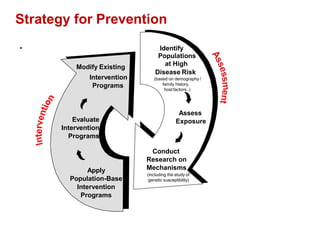
Strategy for Prevention
Assess
Exposure
Identify
Populations
at High
Disease Risk
(based on demography /
family history,
hostfactors..)
Conduct
Research on
Mechanisms
(including the study of
genetic susceptibility)
Apply
Population-Base
Intervention
Programs
Evaluate
Intervention
Programs
Modify Existing
Intervention
Programs
Levels of Prevention
1.Primordial prevention
2.Primary prevention
3.Secondary prevention
4. Tertiary prevention
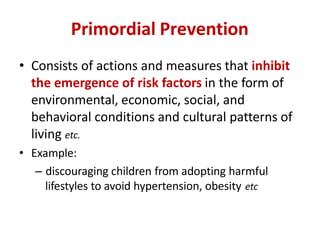
Primordial Prevention
• Consists of actions and measures that inhibit
the emergence of risk factors in the form of
environmental, economic, social, and
behavioral conditions and cultural patterns of
living etc.
• Example:
– discouraging children from adopting harmful
lifestyles to avoid hypertension, obesity etc
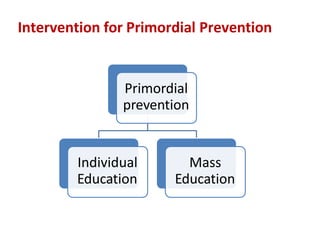
Intervention for Primordial Prevention
Primordial
prevention
Individual
Education
Mass
Education
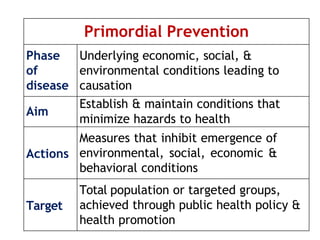
Primordial Prevention
Phase
of
disease
Underlying economic, social, &
environmental conditions leading to
causation
Aim
Establish & maintain conditions that
minimize hazards to health
Actions
Measures that inhibit emergence of
environmental, social, economic &
behavioral conditions
Target
Total population or targeted groups,
achieved through public health policy &
health promotion
Primary Prevention
• Actions taken prior to the onset of disease,
which remove the possibility that the disease
will ever occur
• It signifies intervention in the pre-
pathogenesis phase of a disease or health
problem
• Primary prevention may be accomplished by
measures of “Health Promotion” and
“Specific Protection”
Health promotion is the process of enabling
people to increase control over & improve their
health
1.Health promotion involves the population as a whole
in the context of their everyday life, rather than
focusing on people at risk for specific diseases
2.Health promotion is directed towards action on the
causes or determinants of health
3.Health promotion aims particularly at effective &
concrete public participation
Health Promotion (Cont’d)
4. Health promotion combines diverse but
complementary methods or approaches,
including communication, education, legislation,
fiscal measures, organizational change,
community development, and spontaneous local
activities against health hazards
5. While health promotion is basically an activity in
the health and social fields, and not a medical
service, health professionals – particularly in
PHC – have an important role in nurturing &
enabling health promotion
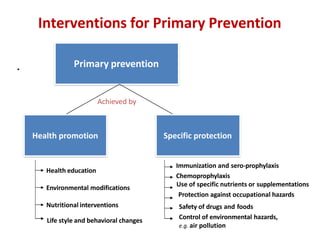
Interventions for Primary Prevention
. Primary prevention
Specific protectionHealth promotion
Achieved by
Health education
Environmental modifications
Nutritional interventions
Life style and behavioral changes
Immunization and sero-prophylaxis
Chemoprophylaxis
Use of specific nutrients or supplementations
Protection against occupational hazards
Safety of drugs and foods
Control of environmental hazards,
e.g. air pollution
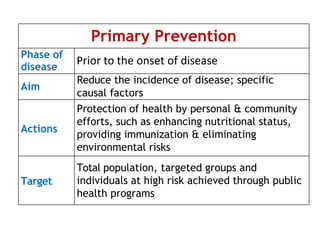
Primary Prevention
Phase of
disease
Prior to the onset of disease
Aim
Reduce the incidence of disease; specific
causal factors
Actions
Protection of health by personal & community
efforts, such as enhancing nutritional status,
providing immunization & eliminating
environmental risks
Target
Total population, targeted groups and
individuals at high risk achieved through public
health programs
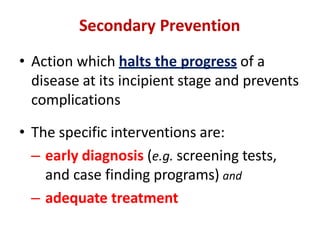
Secondary Prevention
• Action which halts the progress of a
disease at its incipient stage and prevents
complications
• The specific interventions are:
– early diagnosis (e.g. screening tests,
and case finding programs) and
– adequate treatment
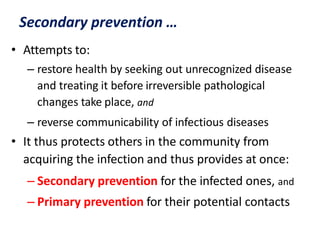
Secondary prevention …
• Attempts to:
– restore health by seeking out unrecognized disease
and treating it before irreversible pathological
changes take place, and
– reverse communicability of infectious diseases
• It thus protects others in the community from
acquiring the infection and thus provides at once:
– Secondary prevention for the infected ones, and
– Primary prevention for their potential contacts
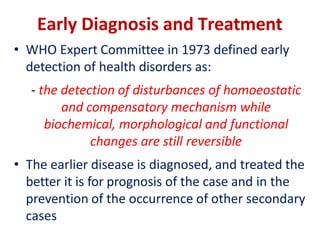
Early Diagnosis and Treatment
• WHO Expert Committee in 1973 defined early
detection of health disorders as:
- the detection of disturbances of homoeostatic
and compensatory mechanism while
biochemical, morphological and functional
changes are still reversible
• The earlier disease is diagnosed, and treated the
better it is for prognosis of the case and in the
prevention of the occurrence of other secondary
cases
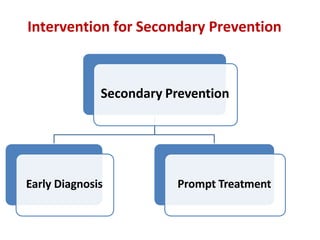
Secondary Prevention
Early Diagnosis Prompt Treatment
Intervention for Secondary Prevention
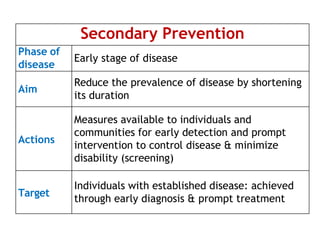
Secondary Prevention
Phase of
disease
Early stage of disease
Aim
Reduce the prevalence of disease by shortening
its duration
Actions
Measures available to individuals and
communities for early detection and prompt
intervention to control disease & minimize
disability (screening)
Target
Individuals with established disease: achieved
through early diagnosis & prompt treatment
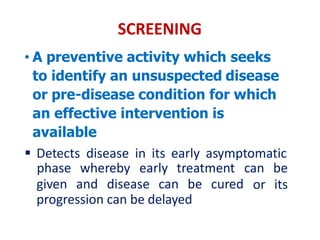
SCREENING
• A preventive activity which seeks
to identify an unsuspected disease
or pre-disease condition for which
an effective intervention is
available
 Detects disease in its early asymptomatic
given and disease can be cured
phase whereby early treatment can be
or its
progression can be delayed
SCREENING—AIMS & OBJECTIVES
• Screening is carried out in the hope
that earlier diagnosis and subsequent
treatment favourably alters the natural
history of disease in a significant
proportion of those who are identified
as ‘positive’
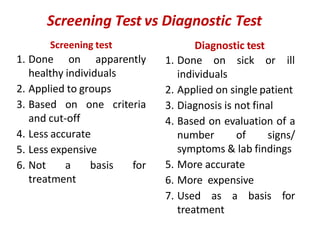
Screening Test vs Diagnostic Test
criteria
Screening test
1. Done on apparently
healthy individuals
2. Applied to groups
3. Based on one
and cut-off
4. Less accurate
5. Less expensive
6. Not a basis for
treatment
Diagnostic test
1. Done on sick or ill
individuals
2. Applied on single patient
3. Diagnosis is not final
4. Based on evaluation of a
number of signs/
symptoms & lab findings
5. More accurate
6. More expensive
7. Used as a basis for
treatment
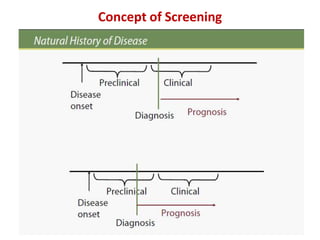
Concept of Screening
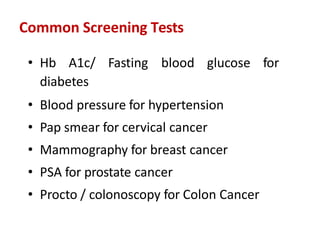
Common Screening Tests
• Hb A1c/ Fasting blood glucose for
diabetes
• Blood pressure for hypertension
• Pap smear for cervical cancer
• Mammography for breast cancer
• PSA for prostate cancer
• Procto / colonoscopy for Colon Cancer
Criteria for choosing a screening test
A. DISEASE
a) Significant burden of disease
b) Detectable and long preclinical stage of disease
c) Adequately understood natural history of
disease
d) Appropriate test available for early detection of
disease
e) Facilities for diagnosis of disease
f) Early detection of disease has outcome benefit
g) Effective treatment available for disease
B. SCREENING TEST:
Must satisfy the criteria:
a. Acceptability
b. Repeatability
c. Validity
d. Others (rapid, inexpensive, simple, safe and
easy to administer)
Criteria for choosing a screening test ..
• The limitation of freedom of movement of
such, persons or domestic animals exposed
to communicable diseases for a period of
time not longer than the largest usual
incubation period of the disease in such
manner as to prevent effective contact
with those not so exposed
Quarantine
Tertiary Prevention
• All measures available to reduce or limit
impairments and disabilities, and to promote
patients’ adjustment to irremediable
conditions when the disease process has
advanced beyond its early stages
• It is used when the disease process has
advanced beyond its early stages
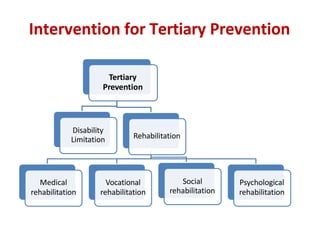
Intervention for Tertiary Prevention
Tertiary
Prevention
Disability
Limitation Rehabilitation
Medical
rehabilitation
Vocational
rehabilitation
Social
rehabilitation
Psychological
rehabilitation
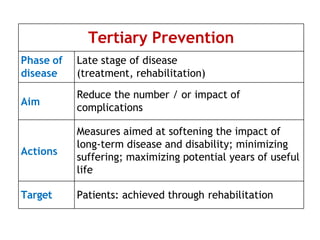
Tertiary Prevention
Phase of
disease
Late stage of disease
(treatment, rehabilitation)
Aim
Reduce the number / or impact of
complications
Actions
Measures aimed at softening the impact of
long-term disease and disability; minimizing
suffering; maximizing potential years of useful
life
Target Patients: achieved through rehabilitation
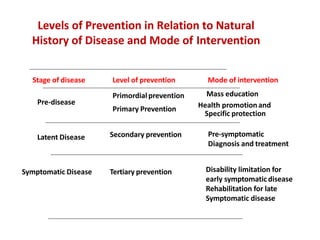
Levels of Prevention in Relation to Natural
History of Disease and Mode of Intervention
Stage of disease Level of prevention Mode of intervention
Pre-disease
Latent Disease Secondary prevention Pre-symptomatic
Diagnosis and treatment
Symptomatic Disease Tertiary prevention Disability limitation for
early symptomatic disease
Rehabilitation for late
Symptomatic disease
Primordialprevention
Primary Prevention
Mass education
Health promotionand
Specific protection
A new term infrequently used:
Quaternary: to mitigate or avoid the results of the
unintended, unnecessary or excessive
interventions – preventing adverse events
• Quaternary prevention include actions to
identify a patient at risk of
medicalization/overmedicalisation, and to
protect him from unnecessary medical
invasion, and to suggest interventions, which
are acceptable
• WHO Patient Safety Initiative
33
Preventive Interventions
• Take into account the diverse diseases causal
factors, considering its biological,
psychological and socio-cultural components
• Actions must focus, with preference, at the
level of public health instead of the individual
level
• A combination of strategies
1. Eradication
2. Control
3. Elimination
Disease Control
Ongoing operations aimed at reducing:
a. The incidence of disease
b. The duration of disease and consequently
the risk of transmission
c. The effects of infection, including both the
physical and psychosocial complications
d. The financial burden to the community
• TB, AIDS, Hepatitis Control Programs
Disease Eradication
• Eradication literally means to "tear out by roots“
“Termination of all transmission of infection by
extermination of the infectious agent through
surveillance and containment”
• Eradication is an absolute process, an "all or none"
phenomenon, restricted to termination of an
infection from the whole world
• Implies that disease will no longer occur in a
population
• To-date, only one disease has been eradicated,
smallpox
Disease Elimination
• An intermediate goal between control
and eradication
• Interruption of transmission of disease,
as for example, elimination of malaria,
measles and diphtheria from large
geographic regions or areas
• Regional elimination is now seen as an
important precursor of eradication
Vertical Program
• A single program of health services for
community
• Expanded Program of Immunization (EPI)
• The staff of this service is only concerned
with the immunization project
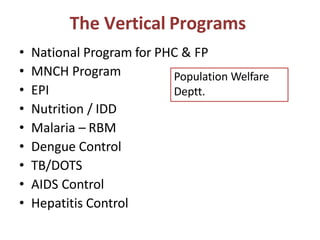
The Vertical Programs
• National Program for PHC & FP
• MNCH Program
• EPI
• Nutrition / IDD
• Malaria – RBM
• Dengue Control
• TB/DOTS
• AIDS Control
• Hepatitis Control
Population Welfare
Deptt.
Horizontal Program
• A health service delivery program which
covers the two dimensions of health, personal
and community health
• Most often the vertical programs are merged
into existing health facilities in which case it
becomes a horizontal program
• In principle the concept is that of integration
41

Prevention Levels to Control Disease

  • 1.
  • 2.
    The main principlesof limiting disease are: 1. Prevention: Abolition or reduction in the incidence of disease 2. Avoidance: Keeping clear of the risk factors 3. Protection: Limiting the spread of disease (by immunization)
  • 3.
    Prevention • Actions aimedat eradicating, eliminating or minimizing the impact of disease and disability, or if none of these are feasible, retarding the progress of the disease and disability
  • 4.
    . Strategy for Prevention Assess Exposure Identify Populations atHigh Disease Risk (based on demography / family history, hostfactors..) Conduct Research on Mechanisms (including the study of genetic susceptibility) Apply Population-Base Intervention Programs Evaluate Intervention Programs Modify Existing Intervention Programs
  • 5.
    Levels of Prevention 1.Primordialprevention 2.Primary prevention 3.Secondary prevention 4. Tertiary prevention
  • 6.
    Primordial Prevention • Consistsof actions and measures that inhibit the emergence of risk factors in the form of environmental, economic, social, and behavioral conditions and cultural patterns of living etc. • Example: – discouraging children from adopting harmful lifestyles to avoid hypertension, obesity etc
  • 7.
    Intervention for PrimordialPrevention Primordial prevention Individual Education Mass Education
  • 8.
    Primordial Prevention Phase of disease Underlying economic,social, & environmental conditions leading to causation Aim Establish & maintain conditions that minimize hazards to health Actions Measures that inhibit emergence of environmental, social, economic & behavioral conditions Target Total population or targeted groups, achieved through public health policy & health promotion
  • 9.
    Primary Prevention • Actionstaken prior to the onset of disease, which remove the possibility that the disease will ever occur • It signifies intervention in the pre- pathogenesis phase of a disease or health problem • Primary prevention may be accomplished by measures of “Health Promotion” and “Specific Protection”
  • 10.
    Health promotion isthe process of enabling people to increase control over & improve their health 1.Health promotion involves the population as a whole in the context of their everyday life, rather than focusing on people at risk for specific diseases 2.Health promotion is directed towards action on the causes or determinants of health 3.Health promotion aims particularly at effective & concrete public participation
  • 11.
    Health Promotion (Cont’d) 4.Health promotion combines diverse but complementary methods or approaches, including communication, education, legislation, fiscal measures, organizational change, community development, and spontaneous local activities against health hazards 5. While health promotion is basically an activity in the health and social fields, and not a medical service, health professionals – particularly in PHC – have an important role in nurturing & enabling health promotion
  • 12.
    Interventions for PrimaryPrevention . Primary prevention Specific protectionHealth promotion Achieved by Health education Environmental modifications Nutritional interventions Life style and behavioral changes Immunization and sero-prophylaxis Chemoprophylaxis Use of specific nutrients or supplementations Protection against occupational hazards Safety of drugs and foods Control of environmental hazards, e.g. air pollution
  • 13.
    Primary Prevention Phase of disease Priorto the onset of disease Aim Reduce the incidence of disease; specific causal factors Actions Protection of health by personal & community efforts, such as enhancing nutritional status, providing immunization & eliminating environmental risks Target Total population, targeted groups and individuals at high risk achieved through public health programs
  • 15.
    Secondary Prevention • Actionwhich halts the progress of a disease at its incipient stage and prevents complications • The specific interventions are: – early diagnosis (e.g. screening tests, and case finding programs) and – adequate treatment
  • 16.
    Secondary prevention … •Attempts to: – restore health by seeking out unrecognized disease and treating it before irreversible pathological changes take place, and – reverse communicability of infectious diseases • It thus protects others in the community from acquiring the infection and thus provides at once: – Secondary prevention for the infected ones, and – Primary prevention for their potential contacts
  • 17.
    Early Diagnosis andTreatment • WHO Expert Committee in 1973 defined early detection of health disorders as: - the detection of disturbances of homoeostatic and compensatory mechanism while biochemical, morphological and functional changes are still reversible • The earlier disease is diagnosed, and treated the better it is for prognosis of the case and in the prevention of the occurrence of other secondary cases
  • 18.
    Secondary Prevention Early DiagnosisPrompt Treatment Intervention for Secondary Prevention
  • 19.
    Secondary Prevention Phase of disease Earlystage of disease Aim Reduce the prevalence of disease by shortening its duration Actions Measures available to individuals and communities for early detection and prompt intervention to control disease & minimize disability (screening) Target Individuals with established disease: achieved through early diagnosis & prompt treatment
  • 20.
    SCREENING • A preventiveactivity which seeks to identify an unsuspected disease or pre-disease condition for which an effective intervention is available  Detects disease in its early asymptomatic given and disease can be cured phase whereby early treatment can be or its progression can be delayed
  • 21.
    SCREENING—AIMS & OBJECTIVES •Screening is carried out in the hope that earlier diagnosis and subsequent treatment favourably alters the natural history of disease in a significant proportion of those who are identified as ‘positive’
  • 22.
    Screening Test vsDiagnostic Test criteria Screening test 1. Done on apparently healthy individuals 2. Applied to groups 3. Based on one and cut-off 4. Less accurate 5. Less expensive 6. Not a basis for treatment Diagnostic test 1. Done on sick or ill individuals 2. Applied on single patient 3. Diagnosis is not final 4. Based on evaluation of a number of signs/ symptoms & lab findings 5. More accurate 6. More expensive 7. Used as a basis for treatment
  • 23.
  • 24.
    Common Screening Tests •Hb A1c/ Fasting blood glucose for diabetes • Blood pressure for hypertension • Pap smear for cervical cancer • Mammography for breast cancer • PSA for prostate cancer • Procto / colonoscopy for Colon Cancer
  • 25.
    Criteria for choosinga screening test A. DISEASE a) Significant burden of disease b) Detectable and long preclinical stage of disease c) Adequately understood natural history of disease d) Appropriate test available for early detection of disease e) Facilities for diagnosis of disease f) Early detection of disease has outcome benefit g) Effective treatment available for disease
  • 26.
    B. SCREENING TEST: Mustsatisfy the criteria: a. Acceptability b. Repeatability c. Validity d. Others (rapid, inexpensive, simple, safe and easy to administer) Criteria for choosing a screening test ..
  • 27.
    • The limitationof freedom of movement of such, persons or domestic animals exposed to communicable diseases for a period of time not longer than the largest usual incubation period of the disease in such manner as to prevent effective contact with those not so exposed Quarantine
  • 28.
    Tertiary Prevention • Allmeasures available to reduce or limit impairments and disabilities, and to promote patients’ adjustment to irremediable conditions when the disease process has advanced beyond its early stages • It is used when the disease process has advanced beyond its early stages
  • 29.
    Intervention for TertiaryPrevention Tertiary Prevention Disability Limitation Rehabilitation Medical rehabilitation Vocational rehabilitation Social rehabilitation Psychological rehabilitation
  • 30.
    Tertiary Prevention Phase of disease Latestage of disease (treatment, rehabilitation) Aim Reduce the number / or impact of complications Actions Measures aimed at softening the impact of long-term disease and disability; minimizing suffering; maximizing potential years of useful life Target Patients: achieved through rehabilitation
  • 32.
    Levels of Preventionin Relation to Natural History of Disease and Mode of Intervention Stage of disease Level of prevention Mode of intervention Pre-disease Latent Disease Secondary prevention Pre-symptomatic Diagnosis and treatment Symptomatic Disease Tertiary prevention Disability limitation for early symptomatic disease Rehabilitation for late Symptomatic disease Primordialprevention Primary Prevention Mass education Health promotionand Specific protection
  • 33.
    A new terminfrequently used: Quaternary: to mitigate or avoid the results of the unintended, unnecessary or excessive interventions – preventing adverse events • Quaternary prevention include actions to identify a patient at risk of medicalization/overmedicalisation, and to protect him from unnecessary medical invasion, and to suggest interventions, which are acceptable • WHO Patient Safety Initiative 33
  • 34.
    Preventive Interventions • Takeinto account the diverse diseases causal factors, considering its biological, psychological and socio-cultural components • Actions must focus, with preference, at the level of public health instead of the individual level • A combination of strategies 1. Eradication 2. Control 3. Elimination
  • 35.
    Disease Control Ongoing operationsaimed at reducing: a. The incidence of disease b. The duration of disease and consequently the risk of transmission c. The effects of infection, including both the physical and psychosocial complications d. The financial burden to the community • TB, AIDS, Hepatitis Control Programs
  • 36.
    Disease Eradication • Eradicationliterally means to "tear out by roots“ “Termination of all transmission of infection by extermination of the infectious agent through surveillance and containment” • Eradication is an absolute process, an "all or none" phenomenon, restricted to termination of an infection from the whole world • Implies that disease will no longer occur in a population • To-date, only one disease has been eradicated, smallpox
  • 37.
    Disease Elimination • Anintermediate goal between control and eradication • Interruption of transmission of disease, as for example, elimination of malaria, measles and diphtheria from large geographic regions or areas • Regional elimination is now seen as an important precursor of eradication
  • 38.
    Vertical Program • Asingle program of health services for community • Expanded Program of Immunization (EPI) • The staff of this service is only concerned with the immunization project
  • 39.
    The Vertical Programs •National Program for PHC & FP • MNCH Program • EPI • Nutrition / IDD • Malaria – RBM • Dengue Control • TB/DOTS • AIDS Control • Hepatitis Control Population Welfare Deptt.
  • 40.
    Horizontal Program • Ahealth service delivery program which covers the two dimensions of health, personal and community health • Most often the vertical programs are merged into existing health facilities in which case it becomes a horizontal program • In principle the concept is that of integration
  • 41.