




Introduction and
History of Community
Medicine
Dr.Shahzad A.Daula
MID (UOL) M.Phil. Public Health (Pb)
Defnition
Branch of medicine which deals
with the preventive, promotive,
and curative health services
through organized community
efforts.
Community
A group of people who have common
characters.
• Can be defined by location, race,
ethnicity, age, occupation, interest in
particular problemgrs or outcomes or
common bonds.
Community Medicine or Public Health?
Term use interchangeably
UK----Community Medicine
US----Public Health
What is Public Health?
Public Health is the science
and art of preventing disease,
prolonging life, and promoting
health through organized
efforts of society (WHO 1988)

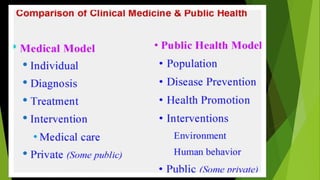
Public Health Approach
Public Health Model Medical Model
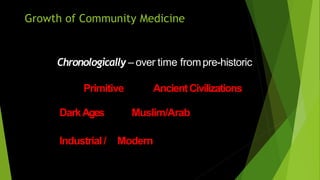
Growth of Community Medicine
Chronologically – over time frompre-historic
Primitive AncientCivilizations
DarkAges Muslim/Arab
Industrial/ Modern
4
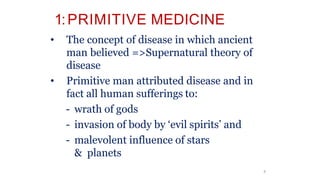
1:PRIMITIVE MEDICINE
• The concept of disease in which ancient
man believed =>Supernatural theory of
disease
• Primitive man attributed disease and in
fact all human sufferings to:
- wrath of gods
- invasion of body by ‘evil spirits’ and
- malevolent influence of stars
& planets
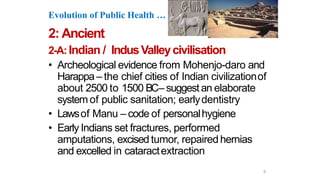
Evolution of Public Health …
2: Ancient
2-A: Indian / IndusValleycivilisation
• Archeological evidence from Mohenjo-daro and
Harappa– the chief cities of Indian civilizationof
about 2500 to 1500 BC– suggest an elaborate
system of public sanitation; earlydentistry
• Lawsof Manu – code of personalhygiene
• Early Indians set fractures, performed
amputations, excised tumor, repaired hernias
and excelled in cataractextraction
6
Evolution of Public Health …
2-B:Egyptiancivilisation (3300BC onward)
• Egyptians postulated that diseasewasdue
to absorption from the intestine of
harmful substanceswhich gaverise to
putrefactionof blood and formation of pus
diseaseswere treated with cathartics,
enema,blood-letting and awide range of
drugs
7
Evolution of Public Health …
2-C:Greekcivilisation (c 460- 136BC – golden
period)
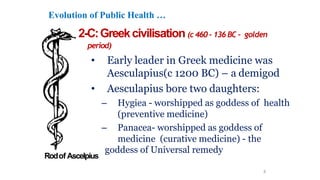
• Early leader in Greek medicine was
Aesculapius(c 1200 BC) – a demigod
• Aesculapius bore two daughters:
– Hygiea - worshipped as goddess of health
(preventive medicine)
– Panacea- worshipped as goddess of
medicine (curative medicine) - the
goddess of Universal remedy
8
Rodof Ascelpius
Greek contribution to health
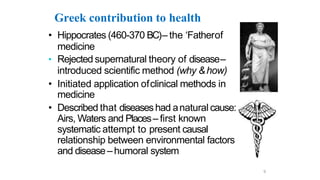
• Hippocrates (460-370 BC)– the ‘Fatherof
medicine
• Rejected supernatural theory of disease–
introduced scientific method (why &how)
• Initiated application ofclinical methods in
medicine
• Described that diseaseshad anatural cause:
Airs, Waters and Places– first known
systematic attempt to present causal
relationship between environmental factors
and disease– humoral system
9
Evolution of Public Health …
2-D: Romancivilisation (100BC – 300AD)
• Romans borrowed their medicine mainly from
Greeks
• By the 1st century the centre of civilization
shifted to Rome
• They had a keen sense of sanitation –
11
Maintenance of health by control of diet and
hygiene
Galen (130-205AD) - Disease is due to predisposing,
exciting and environmental factors
(Epidemiological triad) – his teachings remained
unquestioned for 1400years
12
Roman contribution to health …
13
3: Middle Ages(500-1500AD)
• With the fall of the Roman empire, the medical
schools established in Roman times also
disappeared
• The practice of medicine reverted back to primitive
medicine dominated by superstition and dogma
• It was regarded as immoral to see one's body;
consequently, people seldom bathed
• Dissection of the human body was prohibited –
consequently there was no progress of medicine
• This period is therefore called the "Dark
Ages of Medicine“
4: Arab/Muslim contribution
1. Early 7th century – collecting and translating the
medical knowledge of the Greeks, Persians,
andIndians
2. Saljuqs(Tughril,Alip Arsalan) established hospitals.
Thestaff comprised physician, surgeons and
attendants served and nursedsick
3. Many physicians,Arabs aswell asnon-Arabs,
contributed to themedicine:
– Physicians like Al-Razi, or Razes(841 – 926 AD), and
Ibn-Sina, known as Avicenna (980 – 1037 AD) were
pioneers in the medicalfields
15
Muslim contribution to health …
• TheMuslim physicians, following Galen’s
tradition’ highlighted six ‘non-naturals’
composing hygiene
1. Air (or environment)
2. Food& drink
3. Sleeping and waking
4. Movement & rest
5. Retention & evacuation
6. Mental emotions – “passions of thesoul”
Healthy People in Healthy Community

Introduction To Community Medicine

  • 1.
    Introduction and History ofCommunity Medicine Dr.Shahzad A.Daula MID (UOL) M.Phil. Public Health (Pb)
  • 2.
    Defnition Branch of medicinewhich deals with the preventive, promotive, and curative health services through organized community efforts.
  • 3.
    Community A group ofpeople who have common characters. • Can be defined by location, race, ethnicity, age, occupation, interest in particular problemgrs or outcomes or common bonds.
  • 4.
    Community Medicine orPublic Health? Term use interchangeably UK----Community Medicine US----Public Health
  • 5.
    What is PublicHealth? Public Health is the science and art of preventing disease, prolonging life, and promoting health through organized efforts of society (WHO 1988) 
  • 6.
    Public Health Approach PublicHealth Model Medical Model
  • 9.
    Growth of CommunityMedicine Chronologically – over time frompre-historic Primitive AncientCivilizations DarkAges Muslim/Arab Industrial/ Modern
  • 10.
    4 1:PRIMITIVE MEDICINE • Theconcept of disease in which ancient man believed =>Supernatural theory of disease • Primitive man attributed disease and in fact all human sufferings to: - wrath of gods - invasion of body by ‘evil spirits’ and - malevolent influence of stars & planets
  • 11.
    Evolution of PublicHealth … 2: Ancient 2-A: Indian / IndusValleycivilisation • Archeological evidence from Mohenjo-daro and Harappa– the chief cities of Indian civilizationof about 2500 to 1500 BC– suggest an elaborate system of public sanitation; earlydentistry • Lawsof Manu – code of personalhygiene • Early Indians set fractures, performed amputations, excised tumor, repaired hernias and excelled in cataractextraction 6
  • 12.
    Evolution of PublicHealth … 2-B:Egyptiancivilisation (3300BC onward) • Egyptians postulated that diseasewasdue to absorption from the intestine of harmful substanceswhich gaverise to putrefactionof blood and formation of pus diseaseswere treated with cathartics, enema,blood-letting and awide range of drugs 7
  • 13.
    Evolution of PublicHealth … 2-C:Greekcivilisation (c 460- 136BC – golden period) • Early leader in Greek medicine was Aesculapius(c 1200 BC) – a demigod • Aesculapius bore two daughters: – Hygiea - worshipped as goddess of health (preventive medicine) – Panacea- worshipped as goddess of medicine (curative medicine) - the goddess of Universal remedy 8 Rodof Ascelpius
  • 14.
    Greek contribution tohealth • Hippocrates (460-370 BC)– the ‘Fatherof medicine • Rejected supernatural theory of disease– introduced scientific method (why &how) • Initiated application ofclinical methods in medicine • Described that diseaseshad anatural cause: Airs, Waters and Places– first known systematic attempt to present causal relationship between environmental factors and disease– humoral system 9
  • 15.
    Evolution of PublicHealth … 2-D: Romancivilisation (100BC – 300AD) • Romans borrowed their medicine mainly from Greeks • By the 1st century the centre of civilization shifted to Rome • They had a keen sense of sanitation – 11
  • 16.
    Maintenance of healthby control of diet and hygiene Galen (130-205AD) - Disease is due to predisposing, exciting and environmental factors (Epidemiological triad) – his teachings remained unquestioned for 1400years 12 Roman contribution to health …
  • 17.
    13 3: Middle Ages(500-1500AD) •With the fall of the Roman empire, the medical schools established in Roman times also disappeared • The practice of medicine reverted back to primitive medicine dominated by superstition and dogma • It was regarded as immoral to see one's body; consequently, people seldom bathed • Dissection of the human body was prohibited – consequently there was no progress of medicine • This period is therefore called the "Dark Ages of Medicine“
  • 18.
    4: Arab/Muslim contribution 1.Early 7th century – collecting and translating the medical knowledge of the Greeks, Persians, andIndians 2. Saljuqs(Tughril,Alip Arsalan) established hospitals. Thestaff comprised physician, surgeons and attendants served and nursedsick 3. Many physicians,Arabs aswell asnon-Arabs, contributed to themedicine: – Physicians like Al-Razi, or Razes(841 – 926 AD), and Ibn-Sina, known as Avicenna (980 – 1037 AD) were pioneers in the medicalfields 15
  • 19.
    Muslim contribution tohealth … • TheMuslim physicians, following Galen’s tradition’ highlighted six ‘non-naturals’ composing hygiene 1. Air (or environment) 2. Food& drink 3. Sleeping and waking 4. Movement & rest 5. Retention & evacuation 6. Mental emotions – “passions of thesoul”
  • 21.
    Healthy People inHealthy Community