Stresses in Pressure
Vessels
MAE 322 Review
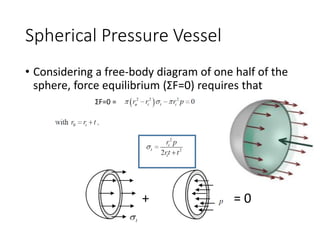
Spherical Pressure Vessel
• Considering a free-body diagram of one half of the
sphere, force equilibrium (ΣF=0) requires that
+ = 0
ΣF=0 =
Thin Walled Vessels (spherical)
• If the ratio of the inside radius to the wall thickness
is greater than 10:1 (ri/t ≥ 10) , it can be shown that
the maximum normal stress is no more than 5
percent greater than the average normal stress.
• Therefore, a vessel can be classified as thin walled if
the ratio of the inside radius to the wall thickness is
greater than about 10:1 (ri/t ≥ 10)
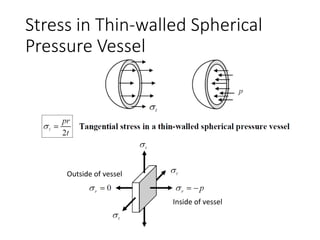
Stress in Thin-walled Spherical
Pressure Vessel
Inside of vessel
Outside of vessel
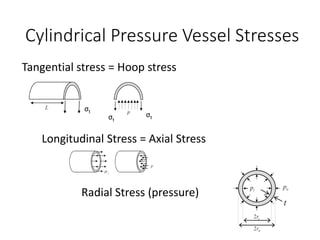
Cylindrical Pressure Vessel Stresses
Tangential stress = Hoop stress
Longitudinal Stress = Axial Stress
Radial Stress (pressure)
σt
σt
σt
Stresses in Pressurized Cylinders
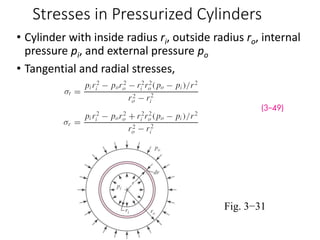
• Cylinder with inside radius ri, outside radius ro, internal
pressure pi, and external pressure po
• Tangential and radial stresses,
Fig. 3−31
Stresses in Pressurized Cylinders
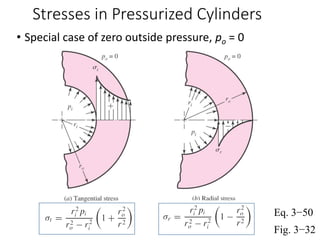
• Special case of zero outside pressure, po = 0
Fig. 3−32
Eq. 3−50
Stresses in Pressurized Cylinders
• If ends are closed, then longitudinal stresses also exist
Shigley’s Mechanical
Engineering Design
ri/t ≥ 10
Thin-Walled Vessels
• Cylindrical pressure vessel with wall thickness 1/10 or
less of the radius
• Radial stress is quite small compared to tangential
stress
• Average tangential stress
• Maximum tangential stress
• Longitudinal stress (if ends are closed)
Shigley’s Mechanical
Engineering Design
ri/t ≥ 10
𝜎𝑡 =
𝑝𝑟
𝑡
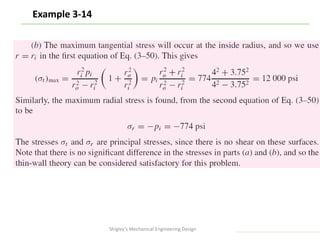
Example 3-14
Shigley’s Mechanical Engineering Design
Example 3-14
Shigley’s Mechanical Engineering Design
Stresses in Rotating Rings
• Rotating rings, such as flywheels, blowers, disks, etc.
• Tangential and radial stresses are similar to thick-walled
pressure cylinders, except caused by inertial forces
• Conditions:
• Outside radius is large compared with thickness (>10:1)
• Thickness is constant
• Stresses are constant over the thickness
• Stresses are
Shigley’s Mechanical
Engineering Design
Press and Shrink Fits
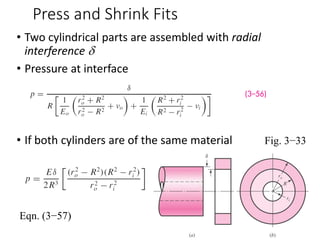
• Two cylindrical parts are assembled with radial
interference d
• Pressure at interface
• If both cylinders are of the same material Fig. 3−33
Eqn. (3−57)
Press and Shrink Fits
• Eq. (3-49) for pressure cylinders applies
• For the inner member, po = p and pi = 0
• For the outer member, po = 0 and pi = p
Shigley’s Mechanical
Engineering Design

PressureVesselsreviewMAE322.pdf

  • 1.
  • 2.
    Spherical Pressure Vessel •Considering a free-body diagram of one half of the sphere, force equilibrium (ΣF=0) requires that + = 0 ΣF=0 =
  • 3.
    Thin Walled Vessels(spherical) • If the ratio of the inside radius to the wall thickness is greater than 10:1 (ri/t ≥ 10) , it can be shown that the maximum normal stress is no more than 5 percent greater than the average normal stress. • Therefore, a vessel can be classified as thin walled if the ratio of the inside radius to the wall thickness is greater than about 10:1 (ri/t ≥ 10)
  • 4.
    Stress in Thin-walledSpherical Pressure Vessel Inside of vessel Outside of vessel
  • 5.
    Cylindrical Pressure VesselStresses Tangential stress = Hoop stress Longitudinal Stress = Axial Stress Radial Stress (pressure) σt σt σt
  • 6.
    Stresses in PressurizedCylinders • Cylinder with inside radius ri, outside radius ro, internal pressure pi, and external pressure po • Tangential and radial stresses, Fig. 3−31
  • 7.
    Stresses in PressurizedCylinders • Special case of zero outside pressure, po = 0 Fig. 3−32 Eq. 3−50
  • 8.
    Stresses in PressurizedCylinders • If ends are closed, then longitudinal stresses also exist Shigley’s Mechanical Engineering Design ri/t ≥ 10
  • 9.
    Thin-Walled Vessels • Cylindricalpressure vessel with wall thickness 1/10 or less of the radius • Radial stress is quite small compared to tangential stress • Average tangential stress • Maximum tangential stress • Longitudinal stress (if ends are closed) Shigley’s Mechanical Engineering Design ri/t ≥ 10 𝜎𝑡 = 𝑝𝑟 𝑡
  • 10.
  • 11.
  • 12.
    Stresses in RotatingRings • Rotating rings, such as flywheels, blowers, disks, etc. • Tangential and radial stresses are similar to thick-walled pressure cylinders, except caused by inertial forces • Conditions: • Outside radius is large compared with thickness (>10:1) • Thickness is constant • Stresses are constant over the thickness • Stresses are Shigley’s Mechanical Engineering Design
  • 13.
    Press and ShrinkFits • Two cylindrical parts are assembled with radial interference d • Pressure at interface • If both cylinders are of the same material Fig. 3−33 Eqn. (3−57)
  • 14.
    Press and ShrinkFits • Eq. (3-49) for pressure cylinders applies • For the inner member, po = p and pi = 0 • For the outer member, po = 0 and pi = p Shigley’s Mechanical Engineering Design