Designation: E 384 – 99
Standard Test Method for
Microindentation Hardness of Materials1
This standard is issued under the fixed designation E 384; the number immediately following the designation indicates the year of
original adoption or, in the case of revision, the year of last revision. A number in parentheses indicates the year of last reapproval. A
superscript epsilon (e) indicates an editorial change since the last revision or reapproval.
This standard has been approved for use by agencies of the Department of Defense.
1. Scope
1.1 This test method covers determination of the microin-
dentation hardness of materials, the verification of microinden-
tation hardness testing machines, and the calibration of stan-
dardized test blocks.
1.2 This test method covers microindentation tests made
with Knoop and Vickers indenters under test forces in the range
from 1 to 1000 gf (9.8 3 10–3
to 9.8 N).
1.3 This test method includes an analysis of the possible
sources of errors that can occur during microindentation testing
and how these factors affect the accuracy, repeatability, and
reproducibility of test results.
NOTE 1—While Committee E-4 is primarily concerned with metals, the
test procedures described are applicable to other materials.
1.4 This standard does not purport to address all of the
safety concerns, if any, associated with its use. It is the
responsibility of the user of this standard to establish appro-
priate safety and health practices and determine the applica-
bility of regulatory limitations prior to use.
2. Referenced Documents
2.1 ASTM Standards:
C 1326 Test Method for Knoop Indentation Hardness of
Advanced Ceramics2
C 1327 Test Method for Vickers Indentation Hardness of
Advanced Ceramics2
E 3 Methods of Preparation of Metallographic Specimens3
E 7 Terminology Relating to Metallography3
E 122 Practice for Choice of Sample Size to Estimate the
Average Quality for a Lot or Process4
E 140 Test Method for Hardness Conversion Tables for
Metals3
E 175 Terminology of Microscopy5
E 691 Practice for Conducting an Interlaboratory Study to
Determine the Precision of a Test Method4
E 766 Practice for Calibrating the Magnification of a Scan-
ning Electron Microscope3
3. Terminology
3.1 Definitions—For definitions of terms used in this test
method, see Terminology E 7.
3.2 Definitions of Terms Specific to This Standard:
3.2.1 calibrating, v—determining the values of the signifi-
cant parameters by comparison with values indicated by a
reference instrument or by a set of reference standards.
3.2.2 Knoop hardness number, HK, n—an expression of
hardness obtained by dividing the force applied to the Knoop
indenter by the projected area of the permanent impression
made by the indenter.
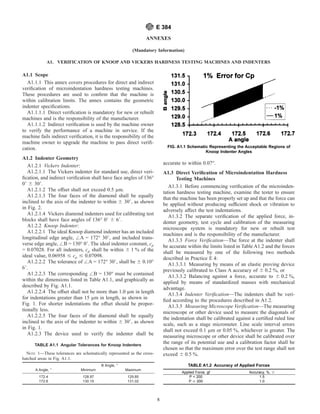
3.2.3 Knoop indenter, n—a rhombic-based pyramidal-
shaped diamond indenter with edge angles of / A = 172° 308
and / B = 130° 08 (see Fig. 1).
3.2.4 microindentation hardness test, n—a hardness test
using a calibrated machine to force a diamond indenter of
specific geometry into the surface of the material being
evaluated, in which the test forces range from 1 to 1000 gf (9.8
3 10–3
to 9.8 N), and the indentation diagonal, or diagonals are
measured with a light microscope after load removal; for any
microindentation hardness test, it is assumed that the indenta-
tion does not undergo elastic recovery after force removal.
NOTE 2—Use of the term microhardness should be avoided because it
implies that the hardness, rather than the force or the indentation size, is
very low.
3.2.5 verifying, v—checking or testing the instrument to
assure conformance with the specification.
3.2.6 Vickers hardness number, HV, n—an expression of
hardness obtained by dividing the force applied to a Vickers
indenter by the surface area of the permanent impression made
by the indenter.
3.2.7 Vickers indenter, n—a square-based pyramidal-shaped
diamond indenter with face angles of 136° (see Fig. 2).
3.3 Formulae—The formulae presented in 3.3.1-3.3.4 for
calculating microindentation hardness are based upon an ideal
tester. The measured value of the microindentation hardness of
a material is subjected to several sources of errors. Based on Eq
1-9, variations in the applied force, geometrical variations
between diamond indenters, and human errors in measuring
indentation lengths can affect the calculated material hardness.
The amount of error each of these parameters has on the
1
This test method is under the jurisdiction of ASTM Committee E-4 on
Metallography and is the direct responsibility of Subcommittee E04.05 on Micro-
hardness.
Current edition approved Nov. 10, 1999. Published March 2000. Originally
published as E 384 – 69. Last previous edition E 384 – 89.
2
Annual Book of ASTM Standards, Vol 15.01.
3
Annual Book of ASTM Standards, Vol 03.01.
4
Annual Book of ASTM Standards, Vol 14.02.
5
Annual Book of ASTM Standards, Vol 14.01.
1
Copyright © ASTM, 100 Barr Harbor Drive, West Conshohocken, PA 19428-2959, United States.
calculated value of a microindentation measurement is dis-
cussed in Section 10.
3.3.1 For Knoop hardness tests, in practice, test loads are in
grams-force and indentation diagonals are in micrometres. The
Knoop hardness number is calculated using the following:
HK 5 1.000 3 103
3 ~P/Ap! 5 1.000 3 103
3 P/~cp 3 d2
! (1)
or
HK 5 14229 3 P/d2
(2)
cp 5
tan S/ B
2 D
2 tan S/ A
2 D
(3)
where:
P = force, gf,
d = length of long diagonal, µm,
Ap = projected area of indentation, µm2
,
/ A = included longitudinal edge angle, 172° 308,
/ B = included transverse edge angle, 130° 08 (see Fig. 1),
and
cp = indenter constant relating projected area of the
indentation to the square of the length of the long
diagonal, ideally 0.07028.
NOTE 3—HK values for a 1-gf (9.8 3 10–3
N) test are contained in
Appendix X5. To obtain HK values when other test forces are employed,
multiply the HK value from Table X5.1 for the d value by the actual test
force, g.
FIG. 1 Knoop Indenter
FIG. 2 Vickers Indenter
E 384
2
3.3.2 The Knoop hardness, kgf/mm2
is determined as fol-
lows:
HK 5 14.229 3 P1/d1
2
(4)
where:
P1 = force, kgf, and
d1 = length of long diagonal, mm.
3.3.3 The Knoop hardness reported with units of GPa is
determined as follows:
HK 5 0.014229 3 P2/d2
2
(5)
where:
P2 = force, N, and
d2 = length of the long diagonal of the indentation, mm.
3.3.4 For the Vickers hardness test, in practice, test loads are
in grams-force and indentation diagonals are in micrometres.
The Vickers hardness number is calculated as follows:
HV 5 1.000 3 103
3 P/As 5 2.000 3 103
3 P sin~a/2!/d2
(6)
or
HV 5 1854.4 3 P/d2
(7)
where:
P = force, gf,
As = surface area of the indentation, µm2
,
d = mean diagonal length of the indentation, µm, and
a = face angle of the indenter, 136° 08 (see Fig. 2).
NOTE 4—HV numbers for a 1-gf (9.8 3 10–3
N) test load are contained
in Appendix X5. To obtain HV values when other test forces are
employed, multiply the HV value from Table X5.2 for the d value by the
actual test force, g.
3.3.5 The Vickers hardness, kgf/mm2
is determined as fol-
lows:
HV 5 1.8544 3 P1/d1
2
(8)
where:
P1 = force, kgf, and
d1 = length of long diagonal, mm.
3.3.6 The Vickers hardness reported with units of GPa is
determined as follows:
HV 5 0.0018544 3 P2/d2
2
(9)
where:
P2 = force, N, and
d2 = length of the long diagonal of the indentation, mm.
4. Summary of Test Method
4.1 In this test method, a hardness number is determined
based on the formation of a very small indentation by appli-
cation of a relatively low force, in comparison to ordinary
indentation hardness tests.
4.2 A Knoop or Vickers indenter, made from diamond of
specific geometry is pressed into the test specimen surface
under an applied force in the range of 1 to 1000 gf using a test
machine specifically designed for such work.
4.3 The size of the indentation is measured using a light
microscope equipped with a filar type eyepiece, or other type
of measuring device (see Terminology E 175).
4.4 The Knoop hardness number is based upon the force
divided by the projected area of the indentation. The Vickers
hardness number is based upon the force divided by the surface
area of the indentation.
4.5 It is assumed that elastic recovery does not occur when
the indenter is removed after the loading cycle, that is, it is
assumed that the indentation retains the shape of the indenter
after the force is removed. In Knoop testing, it is assumed that
the ratio of the long diagonal to the short diagonal of the
impression is the same (see 7.1.4) as for the indenter.
5. Significance and Use
5.1 Hardness tests have been found to be very useful for
materials evaluation, quality control of manufacturing pro-
cesses and research and development efforts. Hardness, al-
though empirical in nature, can be correlated to tensile strength
for many metals, and is an indicator of wear resistance and
ductility.
5.2 Microindentation tests extend hardness testing to mate-
rials too thin or too small for macroindentation tests. Microin-
dentation tests allow specific phases or constituents and regions
or gradients too small for macroindentation testing to be
evaluated.
5.3 Because the microindentation hardness will reveal hard-
ness variations that may exist within a material, a single test
value may not be representative of the bulk hardness.
6. Apparatus
6.1 Test Machine—The test machine must support the test
specimen and control the movement of the indenter into the
specimen under a preselected test force, and should have a light
optical microscope to select the desired test location and to
measure the size of the indentation produced by the test. The
plane of the surface of the test specimen must be perpendicular
to the axis of the indenter and the direction of the force
application. The plane of the test surface of test specimen must
be level in order to obtain usable information.
6.1.1 Force Application—The test machine shall be capable
of applying the following forces:
6.1.1.1 The time from the initial application of the force
until the full test force is reached shall not exceed 10 s.
6.1.1.2 The indenter shall contact the specimen at a velocity
between 15 and 70 µm/s.
6.1.1.3 The full test force shall be applied for 10 to 15 s
unless otherwise specified.
6.1.1.4 For some applications it may be necessary to apply
the test force for longer times. In these instances the tolerance
for the time of the applied force is 6 2 s.
6.1.2 Vibration Control—During the entire test cycle, the
test machine should be protected from shock or vibration. To
minimize vibrations, the operator should avoid contacting the
machine in any manner during the entire test cycle.
6.2 Vickers Indenter—The Vickers indenter usually pro-
duces a geometrically similar indentation at all test forces.
Except for tests at very low forces that produce indentations
with diagonals smaller than about 25 µm, the hardness number
will be essentially the same as produced by Vickers machines
with test forces greater than 1 kgf, as long as the material being
tested is reasonably homogeneous. For isotropic materials, the
two diagonals of a Vickers indentation are equal in size.
E 384
3
6.2.1 The ideal Vickers indenter is a highly polished,
pointed, square-based pyramidal diamond with face angles of
136° 08. The effect that geometrical variations of these angles
have on the measured values of Vickers hardness are discussed
in Section 10.
6.2.2 The four faces of the Vickers indenter shall be equally
inclined to the axis of the indenter (within 6 308) and shall
meet at a sharp point. The line of junction between opposite
faces (offset) shall be not more than 0.5 µm in length as shown
in Fig. 2.
6.3 Knoop Indenter—The Knoop indenter does not produce
a geometrically similar indentation as a function of test force.
Consequently, the Knoop hardness will vary with test force.
Due to its rhombic shape, the indentation depth is shallower for
a Knoop indentation compared to a Vickers indentation under
identical test conditions. The two diagonals of a Knoop
indentation are markedly different. Ideally, the long diagonal is
7.114 times longer than the short diagonal, but this ratio is
influenced by elastic recovery. Thus, the Knoop indenter is
very useful for evaluating hardness gradients or thin coatings.
6.3.1 The Knoop indenter is a highly polished, pointed,
rhombic-based, pyramidal diamond. The ideal included longi-
tudinal edge angles are 172° 308 and 130° 08. The ideal
indenter constant, cp, is 0.07028. The effect that geometrical
variations of these angles have on the measured values of
Knoop hardness are discussed in Section 10.
6.3.2 The four faces of the Knoop indenter shall be equally
inclined to the axis of the indenter (within 6 308) and shall
meet at a sharp point. The line of junction between opposite
faces (offset) shall be not more than 1.0 µm in length for
indentations greater than 20 µm in length, as shown in Fig. 1.
For shorter indentations the offset should be proportionately
less.
6.3.3 Indenters should be examined periodically and re-
placed if they become worn, dulled, chipped, cracked or
separated from the mounting material.
6.4 Measuring Equipment—The test machine’s measuring
device should report the diagonal lengths in 0.1 µm increments
for indentations with diagonals from 1 to 200 µm.
NOTE 5—This is the reported length and not the resolution of the
system used for performing the measurements. As an example, if a length
of 200 µm corresponds to 300 filar units or pixels, the corresponding
calibration constant would be 200/300 = 0.66666667. This value would be
used to compute diagonal lengths, but the reported length would only be
reported to the nearest 0.1 µm.
6.4.1 The optical portion of the measuring device should
have Köhler illumination (see Appendix X1).
6.4.2 To obtain maximum resolution, the measuring micro-
scope should have adjustable illumination intensity, adjustable
alignment and aperture and field diaphragms.
6.4.3 Magnifications should be provided so that the diago-
nal can be enlarged to greater than 25 % but less than 75 % of
the field width.
7. Test Specimen
7.1 For optimum accuracy of measurement, the test should
be performed on a flat specimen with a polished or otherwise
suitably prepared surface. The surface must be free of any
defects that could affect the indentation or the subsequent
measurement of the diagonals. Conducting tests on non-planar
surfaces is not recommended. Results will be affected even in
the case of the Knoop test where the radius of curvature is in
the direction of the short diagonal.
7.1.1 In all tests, the indentation perimeter, and the inden-
tation tips in particular, must be clearly defined in the micro-
scope field of view.
7.1.2 The specimen surface should not be etched before
making an indentation. Etched surfaces can obscure the edge of
the indentation, making an accurate measurement of the size of
the indentation difficult. However, when determining the mi-
croindentation hardness of an isolated phase or constituent, a
light etch can be used to delineate the object of interest. The
quality of the required surface finish can vary with the forces
and magnifications used in microindentation hardness testing.
The lighter the force and the smaller the indentation size, the
more critical is the surface preparation. Some materials are
more sensitive to preparation-induced damage than others.
7.1.3 Due to the small size of the indentations, special
precautions must be taken during specimen preparation. It is
well known that improper polishing can alter test results.
Specimen preparation must remove any damage introduced
during these steps, either due to excessive heating or cold
work, for example.
7.1.4 Specimen preparation should be performed in accor-
dance with Methods E 3.
7.2 In some instances, it is necessary to mount the specimen
for convenience in preparation. When mounting is required, the
specimen must be adequately supported by the mounting
medium so that the specimen does not move during force
application, that is, avoid the use of polymeric mounting
compounds that creep under the indenter force.
8. Procedure
8.1 Turn on the illumination system and power for the tester.
8.2 Select the desired indenter. Refer to the manufacturer’s
instruction manual if it is necessary to change indenters.
Occasionally clean the indenter with a cotton swab and
alcohol. Avoid creating static charges during cleaning.
8.3 Place the specimen on the stage or in the stage clamps,
so that the specimen surface is perpendicular to the indenter
axis.
8.4 Focus the measuring microscope with a low power
objective so that the specimen surface can be observed.
8.5 Adjust the light intensity and adjust the apertures for
optimum resolution and contrast.
8.6 Select the area desired for hardness determination.
Before applying the force, make a final focus using the
measuring objective or the highest magnification objective
available.
8.7 Adjust the tester so that the indenter is in the proper
place for force application. Select the desired force.
8.8 Activate the tester so that the indenter is automatically
lowered and makes contact with the specimen for the normally
required time period. Then, remove the force either manually
or automatically.
8.9 After the force is removed, switch to the measuring
mode, and select the proper objective lens. Focus the image,
adjust the light intensity if necessary, and adjust the apertures
E 384
4
for maximum resolution and contrast.
8.10 Examine the indentation for its position relative to the
desired location and for its symmetry.
8.10.1 If the indentation did not occur at the desired spot,
the tester is out of alignment. Consult the manufacturer’s
instruction manual for the proper procedure to produce align-
ment. Make another indentation and recheck the indentation
location. Readjust and repeat as necessary.
8.10.2 For a Knoop indentation, if one half of the long
diagonal is greater than 10 % longer than the other, or if both
ends of the indentation are not in sharp focus, the test specimen
surface may not be perpendicular to the indenter axis. Check
the specimen alignment and make another test.
8.10.3 For a Vickers indentation, if one half of either
diagonal is more than 5 % longer than the other half of that
diagonal, or if the four corners of the indentation are not in
sharp focus, the test surface may not be perpendicular to the
indenter axis. Check the specimen alignment and make another
test.
8.10.4 If the diagonal legs are unequal as described in 8.10.2
or 8.10.3, rotate the specimen 90° and make another indenta-
tion in an untested region. If the nonsymmetrical aspect of the
indentations has rotated 90°, then the specimen surface is not
perpendicular to the indenter axis. If the nonsymmetrical
nature of the indentation remains in the same orientation, check
the indenter for misalignment or damage.
8.10.5 Some materials may have nonsymmetrical indenta-
tions even if the indenter and the specimen surface are
perfectly aligned. Tests on single crystals or on textured
materials may produce such results. When this occurs, check
the alignment using a test specimen, such as a standard, known
to produce uniformly shaped indentations.
8.10.6 Brittle materials such as ceramics may crack as a
result of being indented. Specific details for testing ceramics
are contained in Test Methods C 1326 and C 1327.
8.11 Measure the long diagonal of a Knoop indentation, or
both diagonals of a Vickers indentation, in accordance with the
manufacturer’s instruction manual.
8.11.1 Determine the length of the long diagonal of a Knoop
indentation or both diagonals of a Vickers indentation to within
0.1 µm (see 6.3). For the Vickers indentations, average the two
diagonal length measurements.
8.12 Compute the Knoop or Vickers hardness number using
the appropriate equation in Section 3 or Table X5.1 or Table
X5.2, respectively. Table X5.1 and Table X5.2 show the Knoop
or Vickers hardness for indentations with diagonal lengths
from 1 to 200.9 µm using 1 gf. If the force was not 1 gf,
multiply the value from Table X5.1 or Table X5.2 by the actual
gram-force value to obtain the correct hardness number.
8.13 Generally, more then one indentation is made on a test
specimen. Ensure that the spacing between indentations is
large enough so that adjacent tests do not interfere with each
other. The minimum recommended spacing between tests is
illustrated in Fig. 3.
9. Report
9.1 Report the following information:
9.1.1 The test results, the number of tests, and, where
appropriate, the mean and standard deviation of the tests,
9.1.2 Test force,
FIG. 3 Closest Permitted Spacing for Knoop and Vickers Indentations
E 384
5
9.1.3 Magnification, and
9.1.4 Any unusual conditions encountered during the test.
9.2 The symbols HK for Knoop hardness, and HV for
Vickers hardness, shall be used with the reported numerical
values.
9.2.1 The preferred method of reporting microindentation
hardness test results in accordance with this standard is for the
system of units consisting of force expressed as gram force.
For example, if the Knoop hardness was 400 using a 100 gf
force, it would be expressed as 400 HK 100 gf. For nonstand-
ard dwell times, other than 10 to 15 s, the hardness would be
reported as 400 HK 100 gf/22 s. In this case, 22 s would be the
actual time of load application.
9.2.2 Alternative methods of denoting the microindentation
hardness values can include 400 HK 0.1 in accordance with
ISO for forces expressed in kilogram force, and 3.92 GPa for
the SI system of units.
10. Precision and Bias 6
10.1 The precision and bias of microindentation hardness
measurements depend on strict adherence to the stated test
procedure and are influenced by instrumental and material
factors and indentation measurement errors.
10.2 The consistency of agreement for repeated tests on the
same material is dependent on the homogeneity of the material,
reproducibility of the hardness tester, and consistent, careful
measurement of the indents by a competent operator.
10.3 Instrumental factors that can affect test results include:
accuracy of loading; inertia effects; speed of loading; vibra-
tions; the angle of indentation; lateral movement of the
indenter or specimen; indentation and indenter shape devia-
tions.
10.3.1 Vibrations during indenting will produce larger in-
dentations with the influence of vibrations becoming larger as
the force decreases (1, 2).7
10.3.2 The angle between the indenter and specimen surface
should be within 2° of perpendicular. Greater amounts of tilting
produce nonuniform indentations and invalid test results.
10.4 Material factors that can affect test results include:
specimen homogeneity, orientation or texture effects; improper
specimen preparation; low specimen surface reflectivity; trans-
parency of the specimen.
10.4.1 Residual deformation from mechanical polishing
must be removed, particularly for low-force testing.
10.4.2 Distortion of the indentation shape due to either
crystallographic or microstructural texture influences diagonal
lengths and the validity of the calculated hardness.
10.4.3 Plastic deformation during indentation can produce
ridging around the indentation periphery that will affect diago-
nal measurement accuracy.
10.4.4 Testing of etched surfaces, depending on the extent
of etching, can produce results that are different from those
obtained on unetched surfaces (1).
10.5 Measurement errors that can affect test results include:
inaccurate calibration of the measuring device; inadequate
resolving power of the objective; insufficient magnification;
operator bias in sizing the indentations; poor image quality;
nonuniform illumination.
10.5.1 The accuracy of microindentation hardness testing is
strongly influenced by the accuracy to which the indentations
can be measured.
10.5.2 The error in measuring the diagonals increases as the
numerical aperture of the measuring objective decreases (3, 4).
10.5.3 Bias is introduced if the operator consistently under-
sizes or oversizes the indentations.
10.6 Some of the factors that affect test results produce
systematic errors that influence all test results while others
primarily influence low-force test results (5). Some of these
problems occur continually, others may occur in an undefined,
sporadic manner. Low force hardness tests are influenced by
these factors to a greater extent than high force tests.
10.7 For both the Vickers and Knoop hardness tests, the
calculated microindentation hardness is a function of three
variables: force, indenter geometry and diagonal measurement.
Total differentials of the equations used to calculate the
microindentation hardness can be used to evaluate the effect
variations in these parameters can cause.
10.7.1 Vickers—using Eq 6, the total differential for the
Vickers hardness number is:
dV 5 S] V
] PDdP 1 S] V
]d Ddd 1 S] V
] aDda (10)
and
S] V
] PD5 2 3 103
3 d–2
3 sin Sa
2D (11)
S] V
] dD5 –4 3 103
3 P 3 d–3
sin Sa
2D (12)
S] V
] aD5 103
3 P 3 d–2
cos Sa
2D (13)
Thus, for a material having a hardness of 500 HV when
tested with a 500 gf force, d = 43.06 µm, a = 136°, and
sin Sa
2D= 0.927184.
10.7.1.1 Consider introducing a 1 % error into the hardness
of the material through an error in either the applied force, the
indenter constant or the measured diagonal length. In this case,
the hardness would be HV8 = 505 or dV = 5. Using Eq 11-13,
the corresponding errors in the various parameters are as
shown in Table 1. Thus a 1 % change in P or a 2.09 % error in
a creates a 1 % error in the Vickers hardness number. How-
ever, only a 0.5 % error in the measured diagonal is needed to
create a 1 % error in Vickers hardness. Furthermore, this
analysis indicates that the calculated Vickers hardness number
is not strongly influenced by errors in the angle of the indenter.
10.7.2 Knoop—Similarly, using Eq 1, it follows that:
dK 5 S] K
]P DdP 1 S] K
] cp
Ddcp 1 S] K
] d Ddd (14)
103
cp d2 dP 1
103
P
cp
2
d2 dcp 1
–2 3 103
P
cp d3 dd (15)
6
Supporting data have been filed at ASTM Headquarters. Request RR:E-04-
1004.
7
The boldface numbers in parentheses refer to the list of references at the end of
this standard.
E 384
6
and since the indenter has two different angles, A and B,
dcp 5 S] cp
] A DdA 1 S] cp
]B DdB (16)
S ] cp
] / AD5
–tan S/ B
2 D
4 sin2
S/A
2 D
(17)
and
S ] cp
] / BD5
cot S/ A
2 D
4 cos2
S/ B
2 D
(18)
10.7.2.1 Using the differentials cited in 10.7.2, for the
Knoop test at various forces, for a 1 % error in hardness that is,
KH8 = 505 or dK = 5, the corresponding errors in the force,
diagonal measurement and indenter angle are as shown in
Table 2. From this analysis it follows that 1 % error in P creates
a 1 % error in HK, 0.5 % error in the measured diagonal creates
a 1 % error in HK, and 1 % error in c creates a 1 % error in HK.
10.7.2.2 Since the indenter constant is composed of terms
from two different angles, either a 48 39 error in /A, or a 268
209 error in /B produces a 1 % error in HK. Unlike the
Vickers indenter, the calculated Knoop hardness number is
very strongly influenced by small errors in the two angles of
the indenter. The A angle, 172° 308 009, is the most sensitive of
these parameters. The actual value of cp for each indenter can
be calculated using the certified A and B angles provided by the
indenter manufacturer. This will enhance the accuracy of the
test measurements.
10.8 An interlaboratory test program was conducted in
accordance with Practice E 691 to develop information regard-
ing the precision, repeatability, and reproducibility of the
measurement of Knoop and Vickers indentations. The test
forces were 25, 50, 100, 200, 500, and 1000 gf on three ferrous
and four nonferrous specimens (6, 7). Twelve laboratories
measured the indentations, five of each type at each force on
each sample. Additional details of this study are given in
Appendix X3.
10.8.1 Tests of the three ferrous specimens revealed that
nine laboratories produced similar measurements while two
laboratories consistently undersized the indentations and one
laboratory consistently oversized the indentations. These latter
results were most pronounced as the force decreased and
specimen hardness increased (that is, as the diagonal size
decreased) and were observed for both Vickers and Knoop
indentations. Results for the lower hardness nonferrous inden-
tations produced better agreement. However, none of the
laboratories that obtained higher or lower results on the ferrous
specimens measured the nonferrous indentations.
10.8.2 Repeatability Interval—The difference due to test
error between two test results in the same laboratory on the
same material increases with increasing specimen hardness and
with decreasing test force (see X3.4.4).
10.8.3 Reproducibility Interval—The difference in test re-
sults on the same material tested in different laboratories
increased with increasing specimen hardness and with decreas-
ing test force (see X3.4.5).
10.8.4 The within-laboratory and between-laboratory preci-
sion values improved as specimen hardness decreased and test
force increased. The repeatability interval and reproducibility
interval were generally larger than the precision estimate,
particularly at low test forces and high specimen hardnesses.
11. Conversion to Other Hardness Scales or Tensile
Strength Values
11.1 There is no generally accepted method for accurate
conversion of Knoop or Vickers hardness numbers to other
hardness scales or tensile strength values. Such conversions are
limited in scope and should be used with caution, except for
special cases where a reliable basis for the conversion has been
obtained by comparison tests. Refer to Test Method E 140 for
hardness conversion tables for metals.
12. Keywords
12.1 hardness; Knoop; microindentation; Vickers
TABLE 1 Vickers Hardness Analysis—1 % Error
1 % Error
Force, gf Diagonal, µm D P, gm D Diagonal, µm D Angle, °
10 6.090 0.100 –0.030 2.836
20 8.612 0.200 –0.043 2.836
50 13.617 0.499 –0.068 2.836
100 19.258 0.999 –0.096 2.836
200 27.235 1.998 –0.136 2.836
500 43.062 4.994 –0.215 2.836
1000 60.899 9.988 –0.304 2.836
2° 508 249
TABLE 2 Knoop Hardness Analysis—1 % Error
1 % Error
Force, gm Diagonal, µm D P gm
D diagonal,
µm
D A, ° D B, °
10 16.87 0.10 –0.08 0.075 0.439
20 23.86 0.20 –0.12 0.075 0.439
50 37.72 0.50 –0.19 0.075 0.439
100 53.35 1.00 –0.27 0.075 0.439
200 75.45 2.00 –0.38 0.075 0.439
500 119.29 5.00 –0.60 0.075 0.439
1000 168.71 10.00 –0.84 0.075 0.439
48 309 268 209
E 384
7
ANNEXES
(Mandatory Information)
A1. VERIFICATION OF KNOOP AND VICKERS HARDNESS TESTING MACHINES AND INDENTERS
A1.1 Scope
A1.1.1 This annex covers procedures for direct and indirect
verification of microindentation hardness testing machines.
These procedures are used to confirm that the machine is
within calibration limits. The annex contains the geometric
indenter specifications.
A1.1.1.1 Direct verification is mandatory for new or rebuilt
machines and is the responsibility of the manufacturer.
A1.1.1.2 Indirect verification is used by the machine owner
to verify the performance of a machine in service. If the
machine fails indirect verification, it is the responsibility of the
machine owner to upgrade the machine to pass direct verifi-
cation.
A1.2 Indenter Geometry
A1.2.1 Vickers Indenter:
A1.2.1.1 The Vickers indenter for standard use, direct veri-
fication, and indirect verification shall have face angles of 136°
08 6 308.
A1.2.1.2 The offset shall not exceed 0.5 µm.
A1.2.1.3 The four faces of the diamond shall be equally
inclined to the axis of the indenter to within 6 308, as shown
in Fig. 2.
A1.2.1.4 Vickers diamond indenters used for calibrating test
blocks shall have face angles of 136° 08 6 68.
A1.2.2 Knoop Indenter:
A1.2.2.1 The ideal Knoop diamond indenter has an included
longitudinal edge angle, /A = 172° 308, and included trans-
verse edge angle, /B = 130° 08. The ideal indenter constant, cp
= 0.07028. For all indenters, cp shall be within 6 1 % of the
ideal value, 0.06958 # cp # 0.07098.
A1.2.2.2 The tolerance of /A = 172° 308, shall be 6 0.10°
68.
A1.2.2.3 The corresponding /B = 130° must be contained
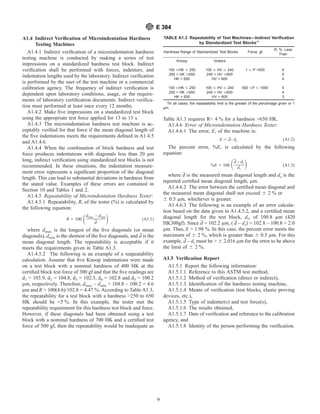
within the dimensions listed in Table A1.1, and graphically as
described by Fig. A1.1.
A1.2.2.4 The offset shall not be more than 1.0 µm in length
for indentations greater than 15 µm in length, as shown in
Fig. 1. For shorter indentations the offset should be propor-
tionally less.
A1.2.2.5 The four faces of the diamond shall be equally
inclined to the axis of the indenter to within 6 308, as shown
in Fig. 1.
A1.2.3 The device used to verify the indenter shall be
accurate to within 0.07°.
A1.3 Direct Verification of Microindentation Hardness
Testing Machines
A1.3.1 Before commencing verification of the microinden-
tation hardness testing machine, examine the tester to ensure
that the machine has been properly set up and that the force can
be applied without producing sufficient shock or vibration to
adversely affect the test indentations.
A1.3.2 The separate verification of the applied force, in-
denter geometry, test cycle and calibration of the measuring
microscope system is mandatory for new or rebuilt test
machines and is the responsibility of the manufacturer.
A1.3.3 Force Verification—The force at the indenter shall
be accurate within the limits listed in Table A1.2 and the forces
shall be measured by one of the following two methods
described in Practice E 4:
A1.3.3.1 Measuring by means of an elastic proving device
previously calibrated to Class A accuracy of 6 0.2 %, or
A1.3.3.2 Balancing against a force, accurate to 6 0.2 %,
applied by means of standardized masses with mechanical
advantage.
A1.3.4 Indenter Verification—The indenters shall be veri-
fied according to the procedures described in A1.2.
A1.3.5 Measuring Microscope Verification—The measuring
microscope or other device used to measure the diagonals of
the indentation shall be calibrated against a certified ruled line
scale, such as a stage micrometer. Line scale interval errors
shall not exceed 0.1 µm or 0.05 %, whichever is greater. The
measuring microscope or other device shall be calibrated over
the range of its potential use and a calibration factor shall be
chosen so that the maximum error over the test range shall not
exceed 6 0.5 %.
TABLE A1.1 Angular Tolerances for Knoop Indenters
NOTE 1—These tolerances are schematically represented as the cross-
hatched areas in Fig. A1.1.
B Angle, °
A Angle, ° Minimum Maximum
172.4 128.97 129.85
172.6 130.15 131.02
FIG. A1.1 Schematic Representing the Acceptable Regions of
Knoop Indenter Angles
TABLE A1.2 Accuracy of Applied Forces
Applied Force, gf Accuracy, %, 6
P < 200 1.5
P $ 200 1.0
E 384
8
A1.4 Indirect Verification of Microindentation Hardness
Testing Machines
A1.4.1 Indirect verification of a microindentation hardness
testing machine is conducted by making a series of test
impressions on a standardized hardness test block. Indirect
verification shall be performed with forces, indenters, and
indentation lengths used by the laboratory. Indirect verification
is performed by the user of the test machine or a commercial
calibration agency. The frequency of indirect verification is
dependent upon laboratory conditions, usage, or the require-
ments of laboratory certification documents. Indirect verifica-
tion must performed at least once every 12 months.
A1.4.2 Make five impressions on a standardized test block
using the appropriate test force applied for 13 to 15 s.
A1.4.3 The microindentation hardness test machine is ac-
ceptably verified for that force if the mean diagonal length of
the five indentations meets the requirements defined in A1.4.5
and A1.4.6.
A1.4.4 When the combination of block hardness and test
force produces indentations with diagonals less than 20 µm
long, indirect verification using standardized test blocks is not
recommended. In these situations, the indentation measure-
ment error represents a significant proportion of the diagonal
length. This can lead to substantial deviations in hardness from
the stated value. Examples of these errors are contained in
Section 10 and Tables 1 and 2.
A1.4.5 Repeatability of Microindentation Hardness Tester:
A1.4.5.1 Repeatability, R, of the tester (%) is calculated by
the following equation:
R 5 100 Sdmax – dmin
d D (A1.1)
where dmax is the longest of the five diagonals (or mean
diagonals), dmin is the shortest of the five diagonals, and d is the
mean diagonal length. The repeatability is acceptable if it
meets the requirements given in Table A1.3.
A1.4.5.2 The following is an example of a reapeatability
calculation. Assume that five Knoop indentations were made
on a test block with a nominal hardness of 400 HK at the
certified block test force of 300 gf and that the five readings are
d1 = 103.9, d2 = 104.8, d3 = 102.3, d4 = 102.8 and d5 = 100.2
µm, respectively. Therefore, dmax – dmin = 104.8 – 100.2 = 4.6
µm and R = 100(4.6)/102.8 = 4.47 %. According to Table A1.3,
the repeatability for a test block with a hardness >250 to 650
HK should be <5 %. In this example, the tester met the
repeatability requirement for this hardness test block and force.
However, if these diagonals had been obtained using a test
block with a nominal hardness of 700 HK and a certified test
force of 500 gf, then the repeatability would be inadequate as
Table A1.3 requires R< 4 % for a hardness >650 HK.
A1.4.6 Error of Microindentation Hardness Tester:
A1.4.6.1 The error, E, of the machine is:
E 5 d– ds (A1.2)
The percent error, %E, is calculated by the following
equation:
%E 5 100 Sd – ds
ds
D (A1.3)
where d is the measured mean diagonal length and ds is the
reported certified mean diagonal length, µm.
A1.4.6.2 The error between the certified mean diagonal and
the measured mean diagonal shall not exceed 6 2 % or
6 0.5 µm, whichever is greater.
A1.4.6.3 The following is an example of an error calcula-
tion based on the data given in A1.4.5.2, and a certified mean
diagonal length for the test block, ds, of 100.8 µm (420
HK300gf). Since d = 102.2 µm, ( d – ds) = 102.8 – 100.8 = 2.0
µm. Thus, E = 1.98 %. In this case, the percent error meets the
maximum of 6 2 %, which is greater than 6 0.5 µm. For this
example, d – ds must be > 6 2.016 µm for the error to be above
the limit of 6 2 %.
A1.5 Verification Report
A1.5.1 Report the following information:
A1.5.1.1 Reference to this ASTM test method,
A1.5.1.2 Method of verification (direct or indirect),
A1.5.1.3 Identification of the hardness testing machine,
A1.5.1.4 Means of verification (test blocks, elastic proving
devices, etc.),
A1.5.1.5 Type of indenter(s) and test force(s),
A1.5.1.6 The results obtained,
A1.5.1.7 Date of verification and reference to the calibration
agency, and
A1.5.1.8 Identity of the person performing the verification.
TABLE A1.3 Repeatability of Test Machines—Indirect Verification
by Standardized Test BlocksA
Hardness Range of Standardized Test Blocks Force, gf
R, %, Less
Than
Knoop Vickers
100 #HK # 250 100 # HV # 240 1 # P <500 6
250 < HK #650 240 < HV #600 5
HK > 650 HV > 600 4
100 #HK # 250 100 # HV # 240 500 #P # 1000 5
250 < HK #650 240 < HV #600 4
HK > 650 HV > 600 3
A
In all cases, the repeatability limit is the greater of the percentage given or 1
µm.
E 384
9
A2. CALIBRATION OF STANDARDIZED HARDNESS TEST BLOCKS FOR MICROINDENTATION HARDNESS TEST
MACHINES
A2.1 Scope
A2.1.1 This annex describes the calibration of standardized
hardness test blocks used to verify microindentation hardness
test machines. The standardizing machine shall meet the direct
verification method described in A1.3.
A2.2 Test Block Manufacture
A2.2.1 The test block thickness shall be greater than twenty
times the depth of the indentation made with the certified test
force.
A2.2.2 The test block material and manufacturing processes
shall be chosen to produce the required degree of homogeneity,
structural stability and uniformity of hardness at the prepared
surface.
A2.2.3 Ferromagnetic test blocks shall be demagnetized by
the manufacturer and shall be maintained in that condition by
the user.
A2.2.4 The test block support surface shall have a finely
ground surface finish. The maximum deviation from flatness of
the test and support surfaces shall not exceed 5 µm. The
maximum error in parallelism shall not exceed 10 µm in 50
mm.
A2.2.5 The test block test surface shall be polished accord-
ing to the procedures in Methods E 3 to yield the true
microstructure, free from scratches that would interfere with
production of the impression or measurement of the impression
diagonal(s). The mean, centerline average, surface roughness
height measurement of the test surface shall not exceed 0.1 µm
(4 µin.).
A2.2.6 Repolishing of the test block will invalidate the
standardization and is not recommended. Cleaning of the
polished test block surface is often required in normal usage
but must not alter the hardness or quality of the polished test
surface.
A2.3 Test Block Standardization Procedure
A2.3.1 Certification of the hardness test blocks shall be
performed with a microindentation hardness test machine that
has been verified by the direct method. Direct verification of
this machine must be performed at least once every 12 months,
as described in A1.3.
A2.3.2 Test Cycle:
A2.3.2.1 The time from the first contact between the in-
denter and the test specimen until the full test force is applied
shall be within 5 and 7 s.
A2.3.2.2 The full test force shall be applied from 13 to 15 s.
A2.3.3 Make five groups of impressions, each containing
five impressions, where one group is in the center of each of
the four quadrants of the block and the fifth group is in the
center of the test block.
A2.3.4 Adjust the illumination for the measuring system to
produce uniform intensity over the field of view and optimum
contrast between the impressions and the block surface (see
6.4.1, 6.4.2, and Appendix X1).
A2.3.5 Measure the Knoop diagonal length, or average
Vickers diagonal length of each of the twenty-five impressions.
Record the data by group and by block. It is recommended that
each indentation be measured by two observers (compare test
results by rater).
A2.4 Repeatability of the Standardized Test Block
A2.4.1 Calculate the mean and standard deviation of the
diagonals, or average diagonals, for the five indentations in
each of the five groups.
A2.4.2 The repeatability, R, of the impression size and,
therefore, of the hardness, is calculated in the manner described
in A1.4.5.1 by Eq A1.1. Calculate the mean of all 25 measured
diagonals, or average diagonals, d̄, and determine dmax and
dmin, the longest and shortest of the 25 measurements, respec-
tively. R is a measure of the hardness homogeneity of the test
block, although R is influenced by all of the variables that
affect the repeatability of microindentation test results.
A2.4.3 Table A2.1 lists the required maximum R values for
test blocks by indenter type, test force range and hardness
range. The measured R value must be less than these limits for
it to be considered sufficiently uniform enough in hardness to
function as a standardized test block.
A2.5 Marking
A2.5.1 Each block shall be marked with an appropriate
identifying serial number, the name or mark of the supplier and
the thickness of the block or an identification mark on the test
surface.
A2.6 Certification of Standardized Test Block
A2.6.1 The certificate accompanying each standardized
hardness test block shall include the following information:
arithmetic mean and standard deviation of the twenty-five
impression diagonals, the corresponding hardness value, the
test force, serial number of the test block, name of the
manufacturer and certifying organization, magnification used,
and the date.
TABLE A2.1 Repeatability of Diagonal Measurements for
Standardized Test Block CertificationA
Hardness Range of Standardized Test Blocks Force, gf
R, %, Less
Than
Knoop Vickers
100 #HK # 250 100 # HV # 240 1 # P <500 5
250 < HK #650 240 < HV #600 4
HK > 650 HV > 600 3
100 #HK # 250 100 # HV # 240 500 #P # 1000 4
250 < HK #650 240 < HV #600 3
HK > 650 HV > 600 2
A
In all cases, the repeatability limit is the greater of the percentage given or 1
µm.
E 384
10
APPENDIXES
(Nonmandatory Information)
X1. ADJUSTMENT OF KÖHLER ILLUMINATION SYSTEMS
X1.1 While some optical systems are permanently aligned,
others have means for minor adjustments. To gain the utmost in
resolution, the operator should make the following adjust-
ments:
X1.1.1 Focus the surface of a flat polished specimen to
critical sharpness.
X1.1.2 Center the illumination source.
X1.1.3 Centrally align field and aperture diaphragms.
X1.1.4 Open the field diaphragm so that it just disappears
from the field of view.
X1.1.5 Remove the eyepiece and examine the rear focal
plane of the objective. If all the components are in their proper
places, the source of illumination and the aperture diaphragm
will appear in sharp focus.
X1.1.6 Full-aperture diaphragm is preferred for maximum
resolving power. If glare is excessive, reduce the aperture, but
never use less than the 3⁄4 opening since resolution would be
decreased and diffraction phenomena could lead to false
measurements.
X1.1.7 If the light is too strong for eye comfort, reduce the
intensity by the use of an appropriate neutral density filter or
rheostat control.
X2. CORRELATION OF MICROINDENTATION HARDNESS TEST DATA BETWEEN LABORATORIES
X2.1 Scope
X2.1.1 This procedure provides guidance in the comparison
of microindentation hardness test data from two or more
laboratories.
X2.2 Correlation Procedure
X2.2.1 All laboratories shall first establish that their test
equipment conforms to the requirements in Test Method E 384.
X2.2.2 The specimens shall be taken from adjoining areas
of the larger specimen prior to being sent to the cooperating
laboratories for specimen preparation and testing.
X2.2.3 The specimens shall be prepared for microindenta-
tion hardness by two or more laboratories using essentially the
same procedures. If the specimens are capable of being
prepared as metallographic specimens, established ASTM
procedures shall be maintained uniformly among the laborato-
ries as follows:
X2.2.3.1 The same surfaces shall be exposed for the micro-
indentation hardness test. This is to ensure that grain direction,
if a characteristic, is taken into consideration.
X2.2.3.2 The surface preparation of the specimens shall be
in accordance with Methods E 3.
X2.2.4 All laboratories shall calibrate the optics of their test
apparatus with the same stage micrometer.
X2.2.5 The indentations shall be oriented the same way
relative to grain direction in order to avoid differences in
results arising from this factor.
X2.2.6 The method of measuring the indentations shall be
established prior to making the tests. It shall be the most
accurate method as described by the equipment manufacturer.
X2.2.7 A minimum number of indentations shall be estab-
lished. This shall conform to acceptable statistical methods of
analysis, in accordance with Practice E 122.
X2.2.8 Each test specimen shall be indented and measured
by the laboratory having prepared it, then sent with the data for
testing in the other laboratory or laboratories.
X2.2.8.1 After the specimens have been exchanged, each
laboratory shall measure and record the indentations applied by
the originating laboratory in a manner identical to the initial
measurements.
X2.2.8.2 Each laboratory shall then repeat the indentation
and measuring procedures, as performed in X2.2.5 and X2.2.6,
before sending the data and specimen to the remaining labo-
ratory or laboratories.
X2.2.8.3 Each laboratory shall determine a set of microin-
dentation hardness values from the specimen they prepared, as
well as sets of values they obtained by indenting and measuring
specimens prepared by the other laboratory or laboratories.
X2.2.9 All data shall then be analyzed by the same accept-
able statistical methods to establish the limits of agreement that
are attainable between the two laboratories. As a minimum, the
following statistical data shall be evolved:
X2.2.9.1 Mean, X,
X2.2.9.2 Standard deviation, s, and
X2.2.9.3 Standard error of the mean, s/X.
X2.3 Referee
X2.3.1 If the laboratories cannot establish an acceptable
correlation through this procedure, it will be necessary to
introduce an independent laboratory to act as the referee.
E 384
11
X3. RESULTS OF INTERLABORATORY TEST OF THE MEASUREMENT OF MICROINDENTATIONS
X3.1 Introduction
X3.1.1 This interlaboratory test program was conducted to
develop precision and bias estimates for the measurement of
both Knoop and Vickers indentations using forces of 25 to
1000 gf for ferrous and nonferrous specimens covering a wide
range of hardness.
X3.2 Scope
X3.2.1 This interlaboratory test program provides informa-
tion on the measurement of the same indentations by different
laboratories according to the procedures of Practice E 691.
X3.3 Procedure
X3.3.1 Five indentations were made under controlled con-
ditions at each force (25, 50, 100, 200, 500, and 1000 gf), with
both Knoop and Vickers indenters using three ferrous and four
nonferrous specimens.
X3.3.2 Twelve laboratories measured the indentations on
the ferrous specimens and the nonferrous specimens. Two
laboratories measured the hardnesses of both groups.
X3.3.3 Each laboratory used the same stage micrometer to
calibrate their measuring device.
X3.3.4 Results were tabulated and analyzed in accordance
with Practice E 691.
X3.4 Results
X3.4.1 For the three ferrous specimens, results from nine
laboratories showed general agreement as to the diagonal sizes.
Two other laboratories consistently undersized the indentations
(higher hardness) and one laboratory consistently oversized the
indentations (lower hardness). This bias was observed with
both Vickers and Knoop indentations sized by these laborato-
ries with the degree of bias increasing as the indentation size
decreased and the specimen hardness increased. Test on the
four nonferrous specimens produced general agreement, but
none of the three laboratories that produced biased results for
the ferrous specimens measured the nonferrous specimens.
X3.4.2 For the Vickers test data, the calculated hardness
increased with increasing force and then became reasonably
constant. This trend was apparent in the data from the nine
consistent laboratories (ferrous specimens) and for the labora-
tory that oversized the indentations. The two laboratories that
consistently undersized the Vickers indentations exhibited
substantial data scatter for the tests with forces of less than
100 gf. However for higher forces, their indentation measure-
ments were relatively constant. The force at which the hardness
became relatively constant increased with increasing specimen
hardness. For specimens below about 300 HV, there was
relatively little difference in HV over the test force range.
X3.4.3 For the Knoop test data, most of the laboratories
agreed that the hardness decreased continually with increasing
test force and then became reasonably constant. However, the
two laboratories that exhibited outlier data for the ferrous
specimens did show the opposite trend; this is quite unusual.
The difference in HK values between low forces and high
forces increased with increasing specimen hardness. For speci-
mens with hardnesses below about 300 HK, the difference in
hardness was quite small over the test force range.
X3.4.4 Repeatability Interval—The difference due to test
error between two test results in the laboratory on the same
material was calculated using the (Sr)j values, the pooled
within-laboratory standard deviation. (Sr)j increased with di-
agonal size and the relationship varied for each material and
test type. Table X3.1 lists regression equations that show the
relationship between (Sr)j and the diagonal length, µm. The
repeatability interval I (r)j, was calculated based on the
relationships in Table X3.1. Because the repeatability intervals
are also a function of diagonal length, regression equations
were also calculated, Table X3.2. The repeatability intervals, in
terms of Knoop and Vickers values for ferrous and nonferrous
specimens, are shown in Figs. X3.1-X3.4.
TABLE X3.1 Relationship Between Diagonal Length and (Sr)j, the
Pooled Within–Laboratory Standard Deviation
Material Test Regression Equation
Correlation
Coefficient
Ferrous Vickers (Sr)j = 0.231 + 0.00284 d̄1 0.535
Ferrous Knoop (Sr)j = 0.216 + 0.006 d̄1 0.823
Nonferrous Vickers (Sr)j = 0.373 + 0.008 d̄1 0.862
Nonferrous Knoop (Sr)j = 0.057 + 0.0177 d̄1 0.8196
TABLE X3.2 Relationship Between the Diagonal Length and (Ir)j,
the Repeatability Interval
Material Test Regression Equation
Ferrous Vickers (Ir)j = 0.653 + 0.008 d̄1
Ferrous Knoop (Ir)j = 0.614 + 0.017 d̄1
Nonferrous Vickers (Ir)j = 1.0556 + 0.0226 d̄1
Nonferrous Knoop (Ir)j = 0.161 + 0.05 d̄1
E 384
12
X3.4.5 Reproducibility Interval—The difference in test re-
sults on the same material in different laboratories was calcu-
lated using the (SR)j values, the between-laboratory estimate of
precision. (SR)j increased with diagonal size and the relation-
ship varied for each material and test type. Table X3.3 lists the
regression equations that show the relationship between (SR)j
and the diagonal length, µm. The reproducibility intervals (IR)j,
were calculated based on the relationships shown in Table
X3.3. Because the reproducibility intervals are also a function
of diagonal length, regression equations were also calculated,
Table X3.4. The reproducibility intervals, in terms of Knoop
and Vickers values for the ferrous and nonferrous specimens,
are shown in Figs. X3.1-X3.4.
X3.4.6 The within-laboratory and between-laboratory pre-
cision values were calculated from (Vr (%))j and (VL (%))j
which are the coefficients of variation for within-laboratory and
between-laboratory tests. Both are a function of the length of
the diagonal. The within-laboratory and between-laboratory
precision values were relatively similar for both Vickers and
Knoop test data, either ferrous or nonferrous. In general, the
repeatability intervals and reproducibility intervals were larger
than the precision estimates, particularly at low test forces and
high specimen hardnesses.
FIG. X3.1 Repeatability and Reproducibility Intervals in Terms of Vickers Hardness (6) for the Ferrous Samples as a Function of Test
Load and Specimen Hardness
FIG. X3.2 Repeatability and Reproducibility Intervals in Terms of Knoop Hardness (6) for the Ferrous Samples as a Function of Test
Load and Specimen Hardness
E 384
13
FIG. X3.3 Repeatability and Reproducibility Intervals in Terms of Vickers Hardness (6) for the Nonferrous Samples as a Function of
Test Load and Specimen Hardness
FIG. X3.4 Repeatability and Reproducibility Intervals in Terms of Knoop Hardness (6) for the Nonferrous Samples as a Function of Test
Load and Specimen Hardness
E 384
14
X4. RECOMMENDATIONS FOR LIGHT FORCE MICROINDENTATION HARDNESS TESTING
X4.1 Introduction
X4.1.1 Microindentation hardness of materials can be de-
termined using a variety of loads to force the indenter into the
test piece. Testing is considered to be light force when the force
in use produces indentations with a diagonal length of less than
20 µm. Both Knoop and Vickers hardness numbers increase in
proportion to the inverse of the square of the indentation
diagonal length, Eq 2 and 7. Thus, hardness numbers obtained
from indentations with diagonals measuring less than 20 µm
are much more sensitive to variations of a few tenths of a
micrometre in the actual or measured length of the diagonals
than hardness numbers obtained by measuring larger indenta-
tions, Eq 12 and 16. Creation of valid indentations, and the
accurate measurement of their diagonals, becomes even more
imperative as the indentations become smaller. For example,
consider a material with a Vickers hardness of 500, Table 1. For
a force of 100 gf, the diagonal length would be 19.258 µm. To
maintain an error of 6 1 %, the accuracy of the diagonal
measurement must be # 0.096 µm. Similarly for a material
with a Knoop hardness of 500, when tested with a 20 gf force,
the ideal diagonal length would be 23.86 µm, Table 2. To
maintain an error of 6 1 %, the accuracy of the diagonal
measurement has to be # 0.12 µm. Measurements to this level
of accuracy are impossible to achieve by optical microscopy.
Because of the inherent difficulties involved in obtaining and
measuring indentations with diagonals less than 20 µm, and the
increasing effect of possible indentation or measurement er-
rors, light force microindentation hardness testing requires
precautions in addition to those normally necessary. Small
indentations may be due to high test piece hardness or the use
of light forces. In either case, some of the concerns involved
with obtaining accurate hardness results are addressed in this
appendix.
X4.2 Scope
X4.2.1 These recommendations provide guidance and sug-
gest additional precautions for microindentation hardness test-
ing when the measured diagonals of indentations are less than
20 µm.
X4.3 Environment:
X4.3.1 Vibration:
X4.3.1.1 Vibration of the microindentation hardness tester
during a light force test can cause a large percentage increase
in the measured diagonals. Reasonable accuracy and precision
can only be achieved when the test instrument is isolated from
vibration as much as possible during testing. Use of an
isolation table or isolation platform is mandatory. Airborne
vibrations in the vicinity of the test instrument, such as air
currents and loud noises, are to be avoided.
X4.3.1.2 It is recommended that test instruments not be
located above the ground floor of the building due to the
increase in vibration usually experienced by the upper floors.
Test instruments should be located in areas away from machin-
ery that may cause low (<20 Hz) frequency vibrations, since
low frequencies are more easily transmitted through isolation
tables and platforms.
X4.3.2 Level—Microindentation hardness testers must be
level in order to obtain usable information. Errors due to minor
unleveling become more important as the forces become
lighter.
X4.3.3 Temperature—Control of the temperature of the
specimen, testing instrumentation, and surrounding area should
be considered. It is recommended that these temperatures be
maintained at 23 6 3°C. As the length of the measured
diagonal becomes smaller, it may be necessary to increase
control of temperature to reduce variability.
X4.4 Specimens
X4.4.1 Specimen Preparation:
X4.4.1.1 Usually, test pieces require mounting. Care must
be taken to ensure that the specimens are well supported in the
mounting material, and that the surface to be tested can be
placed into the test instrument such that it will be normal to
both the loading and optical axes.
X4.4.1.2 The surface properties of the test specimen must
TABLE X3.3 Relationship Between Diagonal Length and (SR)j,
the Between-Laboratory Estimate of Precision
Material Test Regression Equation
Correlation
Coefficient
Ferrous Vickers (SR)j = 0.31 + 0.004 d̄1 0.747
Ferrous Knoop (SR)j = 0.333 + 0.007 d̄1 0.899
Nonferrous Vickers (SR)j = 0.357 + 0.0156 d̄1 0.8906
Nonferrous Knoop (SR)j = 0.378 + 0.0177 d̄1 0.8616
TABLE X3.4 Relationship Between the Diagonal Length and (IR)j,
the Repeatability Interval
Material Test Regression Equation
Ferrous Vickers (IR)j = 0.877 + 0.0113 d̄1
Ferrous Knoop (IR)j = 0.946 + 0.0198 d̄1
Nonferrous Vickers (IR)j = 1.0103 + 0.0441 d̄1
Nonferrous Knoop (IR)j = 1.07 + 0.05 d̄1
E 384
15
not be altered due to specimen preparation. Metallographic
polishing, when applicable, should be performed using ac-
cepted techniques known to minimize the deformed layer
remaining on the surface of the specimen. Light etching
followed by light repolishing may be used to further decrease
the thickness of any deformed layer. Electropolishing can
provide surfaces essentially free of deformation due to prepa-
ration. Areas to be tested must appear flat in the field of focus
of the microscope used to measure the diagonals of the
indentations.
X4.4.1.3 The surfaces to be tested should be as clean as
possible. Care must be taken to avoid surface contaminants that
may be absorbed into the surfaces of some materials such as
polymers or ceramics.
X4.4.2 Microstructure of Specimen—If the microstructure
of the material test piece is on the same size scale as the
indentation diagonal length, an increase in the variability of the
hardness data should be expected. Indentations placed within a
single grain will experience resistance to deformation some-
what dependent on the orientation of that grain to the test
surface. Since these orientations are normally random, vari-
ability of results is increased. Indentation diagonal lengths can
vary depending upon the number of grain boundaries trans-
versed by the indentation. Multiphase material systems will
provide indentation diagonal lengths that may be proportional
to the volume percentage of each phase included within the
volume of deformation caused by the indentation. In the above
cases, an increase in the number of measurements taken will be
necessary to provide meaningful results.
X4.5 Instruments
X4.5.1 Magnification of Microscope—Classic microinden-
tation hardness testers make use of optics that provide magni-
fications of up to 800X. Higher magnifications are recom-
mended when performing light force testing. Specimens may
be removed from the test instrument following the indentation
operation, and the diagonals of the indentations measured
using a separate high quality light (or SEM measurements, see
4.7.1) microscope capable of providing higher magnifications.
X4.5.2 Optical Quality of Microscope—Use of highly cor-
rected objectives with numerical apertures of 0.9 or greater is
recommended. Use of dark field illumination or differential
interference contrast may improve the contrast of the image
and also enhance the users ability to detect the ends of the
indentations.
X4.5.3 Diagonal Measuring Device—The measurement
technique and the devices used to perform the measurements
should be capable of discerning differences in length of 0.1 µm
or less. In some cases, it may be preferable to obtain a
photomicrograph of the indentation first, and measure the
length of the diagonal as seen in the photomicrograph. In all
cases, calibration of magnifications and measuring devices is
necessary.
X4.5.4 Accuracy of Forces—Often, small indentation di-
agonal lengths are the result of the use of very light forces, in
many cases less than 10 g. Force accuracy of 6 1 % is required
in accordance with A3.2. For light forces, this requires that no
oils, dust, or other minor contaminants be present. For ex-
ample, when using a force of 2.0 g, contaminants with a total
mass of more than 0.02 g render the results of the test invalid,
Eq 11.
X4.5.5 Loading Rates—When using light forces, the impact
of the indenter on the surface of the test piece can cause
significant inaccuracies to occur. Use of the slowest loading
rate available for each instrument is recommended.
X4.5.6 Indenters—Greater repeatability, accuracy, and pre-
cision may be obtained by the careful selection of indenters.
Verification of the included angles of the faces, the degree of
mismatch at the vertex, and the sharpness of the edges are
appropriate criteria for the selection of indenters. Using the
manufacturer’s certification, the exact indenter constant should
be calculated and used to minimize errors, Eq 13, Eq 17 and Eq
18.
X4.6 Measurement of Indentations
X4.6.1 Indentations that do not appear symmetrical should
not be considered valid for diagonal measurement. A difference
in symmetry greater than 10 % should be addressed with
concern. If consistently asymmetrical indentations are ob-
tained, the alignment of the specimen to the indenter should be
adjusted. If the problem persists, the microindentation hardness
instrument should be serviced by a qualified technician.
X4.7 Scanning Electron Microscope
X4.7.1 Measurement of indentation diagonals using a scan-
ning electron microscope is possible. However, careful cali-
bration of the SEM photographic image at the exact magnifi-
cation to be used is essential. For these measurements, the
specimen should be perpendicular to the beam, that is, the tilt
angle should be 0°. The accelerating voltage, and other
parameters should remain as they were for calibration. (The
SEM should be calibrated in both the X and Y directions; refer
to Practice E 766. Indentations to be measured should not
extend to the periphery of the SEM field of view, as the video
signal can be distorted at the edges of the video monitor.
X4.8 Video and Automatic Measuring Systems
X4.8.1 Typical video or computerized measuring systems
lack the necessary resolution for obtaining acceptable results
when indentation diagonal lengths are less than 20 µm. Loss of
resolution within the digitized image can cause a substantial
decrease in the accuracy of the measurement. Extremely high
resolution video cameras and monitors, when appropriately
assembled into a measuring system, may be capable of
resolution sufficient to provide accurate results.
E 384
16
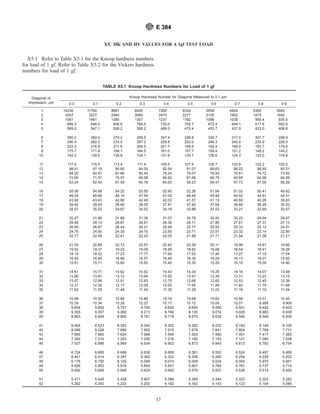
X5. HK AND HV VALUES FOR A 1gf TEST LOAD
X5.1 Refer to Table X5.1 for the Knoop hardness numbers
for load of 1 gf. Refer to Table X5.2 for the Vickers hardness
numbers for load of 1 gf.
TABLE X5.1 Knoop Hardness Numbers for Load of 1 gf
Diagonal of
Impression, µm
Knoop Hardness Number for Diagonal Measured to 0.1 µm
0.0 0.1 0.2 0.3 0.4 0.5 0.6 0.7 0.8 0.9
1 14230 11760 9881 8420 7260 6324 5558 4924 4392 3942
2 3557 3227 2940 2690 2470 2277 2105 1952 1815 1692
3 1581 1481 1390 1307 1231 1162 1098 1039 985.4 935.5
4 889.3 846.5 806.6 769.5 735.0 702.7 672.4 644.1 617.6 592.6
5 569.2 547.1 526.2 506.2 488.0 470.4 453.7 437.9 423.0 408.8
6 395.2 382.4 370.2 358.5 347.4 336.8 326.7 317.0 307.7 298.9
7 290.4 282.3 274.5 267.0 259.8 253.0 246.3 240.0 233.9 228.0
8 222.3 216.9 211.6 206.5 201.7 196.9 192.4 188.0 183.7 179.6
9 175.7 171.8 168.1 164.5 161.0 157.7 154.4 151.2 148.2 145.2
10 142.3 139.5 136.8 134.1 131.6 129.1 126.6 124.3 122.0 119.8
11 117.6 115.5 113.4 111.4 109.5 107.6 105.7 103.9 102.2 100.5
12 98.81 97.19 95.60 94.05 92.54 91.07 89.63 88.22 86.85 85.51
13 84.20 82.91 81.66 80.44 79.24 78.07 76.93 75.81 74.72 73.65
14 72.60 71.57 70.57 69.58 68.62 67.68 66.75 65.85 64.96 64.09
15 63.24 62.40 61.59 60.78 60.00 59.23 58.47 57.73 57.00 56.28
16 55.58 54.89 54.22 53.55 52.90 52.26 51.64 51.02 50.41 49.82
17 49.24 48.66 48.10 47.54 47.00 46.46 45.94 45.42 44.91 44.41
18 43.92 43.43 42.96 42.49 42.03 41.57 41.13 40.69 40.26 39.83
19 39.42 39.00 38.60 38.20 37.81 37.42 37.04 36.66 36.29 35.93
20 35.57 35.22 34.87 34.53 34.19 33.86 33.53 33.21 32.89 32.57
21 32.27 31.96 31.66 31.36 31.07 30.78 30.50 30.22 29.94 29.67
22 29.40 29.13 28.87 28.61 28.36 28.11 27.86 27.61 27.37 27.13
23 26.90 26.67 26.44 26.21 25.99 25.77 25.55 25.33 25.12 24.91
24 24.70 24.50 24.30 24.10 23.90 23.71 23.51 23.32 23.14 22.95
25 22.77 22.59 22.41 22.23 22.05 21.88 21.71 21.54 21.38 21.21
26 21.05 20.89 20.73 20.57 20.42 20.26 20.11 19.96 19.81 19.66
27 19.52 19.37 19.23 19.09 18.95 18.82 18.68 18.54 18.41 18.28
28 18.15 18.02 17.23 17.77 17.64 17.52 17.40 17.27 17.15 17.04
29 16.92 16.80 16.89 16.57 16.46 16.35 16.24 16.13 16.01 15.92
30 15.81 15.71 15.60 15.60 15.40 15.30 15.20 15.10 15.00 14.90
31 14.81 14.71 14.62 14.52 14.43 14.34 14.25 14.16 14.07 13.98
32 13.90 13.81 13.72 13.64 13.55 13.47 13.39 13.31 13.23 13.15
33 13.07 12.99 12.91 12.83 12.75 12.68 12.60 12.53 12.45 12.38
34 12.31 12.24 12.17 12.09 12.02 11.95 11.89 11.82 11.75 11.68
35 11.62 11.55 11.48 11.42 11.35 11.29 11.23 11.16 11.10 11.04
36 10.98 10.92 10.86 10.80 10.74 10.68 10.62 10.56 10.51 10.45
37 10.39 10.34 10.28 10.23 10.17 10.12 10.06 10.01 9.958 9.906
38 9.854 9.802 9.751 9.700 9.650 9.600 9.550 9.501 9.452 9.403
39 9.355 9.307 9.260 9.213 9.166 9.120 9.074 9.028 8.983 8.938
40 8.893 8.849 8.805 8.761 8.718 8.675 8.632 8.590 8.548 8.506
41 8.465 8.423 8.383 8.342 8.302 8.262 8.222 8.183 8.144 8.105
42 8.066 8.028 7.990 7.952 7.915 7.878 7.841 7.804 7.768 7.731
43 7.695 7.660 7.624 7.589 7.554 7.520 7.485 7.451 7.417 7.383
44 7.350 7.316 7.283 7.250 7.218 7.185 7.153 7.121 7.090 7.058
45 7.027 6.996 6.965 6.934 6.903 6.873 6.843 6.813 6.783 6.754
46 6.724 6.695 6.666 6.638 6.609 6.581 6.552 6.524 6.497 6.469
47 6.441 6.414 6.387 6.360 6.333 6.306 6.280 6.254 6.228 6.202
48 6.176 6.150 6.125 6.099 6.074 6.049 6.024 6.000 5.975 5.951
49 5.926 5.902 5.878 5.854 5.831 5.807 5.784 5.761 5.737 5.714
50 5.692 5.669 5.646 5.624 5.602 5.579 5.557 5.536 5.514 5.492
51 5.471 5.449 5.428 5.407 5.386 5.365 5.344 5.323 5.303 5.282
52 5.262 5.242 5.222 5.202 5.182 5.162 5.143 5.123 5.104 5.085
E 384
17
TABLE X5.1 Continued
Diagonal of
Impression, µm
Knoop Hardness Number for Diagonal Measured to 0.1 µm
0.0 0.1 0.2 0.3 0.4 0.5 0.6 0.7 0.8 0.9
53 5.065 5.046 5.027 5.009 4.990 4.971 4.953 4.934 4.916 4.898
54 4.880 4.082 4.844 4.826 4.808 4.790 4.773 4.756 4.738 4.721
55 4.704 4.687 4.670 4.653 4.636 4.619 4.603 4.586 4.570 4.554
56 4.537 4.521 4.505 4.489 4.473 4.457 4.442 4.426 4.410 4.395
57 4.379 4.364 4.349 4.334 4.319 4.304 4.289 4.274 4.259 4.244
58 4.230 4.215 4.201 4.188 4.172 4.158 4.144 4.129 4.115 4.102
59 4.088 4.074 4.060 4.046 4.033 4.019 4.006 3.992 3.070 3.966
60 3.952 3.939 3.926 3.913 3.900 3.887 3.875 3.862 3.849 3.837
61 3.824 3.811 3.799 3.787 3.774 3.762 3.750 3.738 3.726 3.714
62 3.702 3.690 3.678 3.666 3.654 3.643 3.631 3.619 3.608 3.596
63 3.585 3.574 3.562 3.551 3.540 3.529 3.518 3.507 3.496 3.485
64 3.474 3.463 3.452 3.442 3.431 3.420 3.410 3.399 3.389 3.378
65 3.368 3.357 3.347 3.337 3.327 3.317 3.306 3.296 3.286 3.276
66 3.267 3.257 3.247 3.237 3.227 3.218 3.208 3.198 3.189 3.179
67 3.170 3.160 3.151 3.142 3.132 3.123 3.114 3.105 3.095A
† 3.086
68 3.077 3.068 3.059 3.050 3.041 3.032 3.024 3.015 3.006 2.997
69 2.989 2.980 2.971 2.963 2.954 2.946 2.937 2.929 2.921 2.912
70 2.904 2.896 2.887 2.879 2.871 2.863 2.855 2.846 2.839 2.831
71 2.823 2.815 2.807 2.799 2.791 2.783 2.776 2.768 2.760 2.752
72 2.745 2.737 2.730 2.722 2.715 2.707 2.700 2.692 2.685 2.677
73 2.670 2.663 2.656 2.648 2.641 2.634 2.627 2.620 2.613 2.605
74 2.598 2.591 2.584 2.577 2.571 2.564 2.557 2.550 2.543 2.536
75 2.530 2.523 2.516 2.509 2.503 2.496 2.490 2.483 2.476 2.470
76 2.463 2.457 2.451 2.444 2.438 2.431 2.425 2.419 2.412 2.406
77 2.400 2.394 2.387 2.381 2..375 2.369 2.363 2.357 2.351 2.345
78 2.339 2.333 2.327 2.321 2.315 2.309 2.303 2.297 2.292 2.286
79 2.280 2.274 2.268 2.263 2.257 2.251 2.246 2.240 2.234 2.229
80 2.223 2.218 2.212 2.207 2.201 2.196 2.190 2.185 2.179 2.174
81 2.169 2.163 2.158 2.153 2.147 2.142 2.137 2.132 2.127 2.121
82 2.116 2.111 2.106 2.101 2.096 2.091 2.086 2.080 2.075 2.070
83 2.065 2.060 2.056 2.051 2.046 2.041 2.036 2.031 2.026 2.021
84 2.017 2.012 2.077 2.002 1.998 1.993 1.988 1.983 1.979 1.974
85 1.969 1.965 1.960 1.956 1.951 1.946 1.942 1.937 1.933 1.928
86 1.924 1.919 1.915 1.911 1.906 1.902 1.897 1.893 1.889 1.884
87 1.880 1.876 1.871 1.867 1.863 1.858 1.854 1.850 1.846 1.842
88 1.837 1.833 1.829 1.825 1.821 1.817 1.813 1.809 1.804 1.800
89 1.796 1.792 1.788 1.784 1.780 1.776 1.772 1.768 1.765 1.761
90 1.757 1.753 1.749 1.745 1.741 1.737 1.733 1.730 1.726 1.722
91 1.718 1.715 1.711 1.707 1.703 1.700 1.696 1.692 1.688 1.685
92 1.681 1.677 1.674 1.670 1.667 1.663 1.659 1.656 1.652 1.649
93 1.654 1.642 1.638 1.635 1.631 1.628 1.624 1.621 1.617 1.614
94 1.610 1.607 1.604 1.600 1.597 1.593 1.590 1.587 1.583 1.580
95 1.577 1.573 1.570 1.567 1.563 1.560 1.557 1.554 1.550 1.547
96 1.544 1.541 1.538 1.534 1.531 1.528 1.525 1.522 1.519 1.515
97 1.512 1.509 1.506 1.503 1.500 1.497 1.494 1.491 1.488 1.485
98 1.482 1.479 1.476 1.473 1.470 1.467 1.464 1.461 1.458 1.455
99 1.452 1.449 1.446 1.443 1.440 1.437 1.434 1.431 1.429 1.426
100 1.423 1.420 1.417 1.413 1.412 1.409 1.406 1.403 1.400 1.398
101 1.395 1.392 1.389 1.387 1.384 1.381 1.378 1.376 1.373 1.370
102 1.368 1.365 1.362 1.360 1.357 1.354 1.352 1.349 1.346 1.344
103 1.341 1.339 1.336 1.333 1.331 1.328 1.326 1.323 1.321 1.318
104 1.316 1.313 1.311 1.308 1.305 1.303 1.301 1.298 1.296 1.293
105 1.291 1.288 1.286 1.283 1.281 1.278 1.276 1.274 1.271 1.269
106 1.266 1.264 1.262 1.259 1.257 1.255 1.252 1.250 1.247 1.245
107 1.243 1.240 1.238 1.236 1.234 1.231 1.229 1.227 1.224 1.222
108 1.220 1.218 1.215 1.213 1.211 1.209 1.206 1.204 1.202 1.200
109 1.198 1.195 1.193 1.191 1.189 1.187 1.185 1.182 1.180 1.178
110 1.176 1.174 1.172 1.170 1.167 1.165 1.163 1.161 1.159 1.157
111 1.155 1.153 1.151 1.149 1.147 1.145 1.142 1.140 1.138 1.136
112 1.134 1.132 1.130 1.128 1.126 1.124 1.122 1.120 1.118 1.116
113 1.114 1.112 1.110 1.108 1.106 1.105 1.103 1.101 1.099 1.097
E 384
18
TABLE X5.1 Continued
Diagonal of
Impression, µm
Knoop Hardness Number for Diagonal Measured to 0.1 µm
0.0 0.1 0.2 0.3 0.4 0.5 0.6 0.7 0.8 0.9
114 1.095 1.093 1.091 1.089 1.087 1.085 1.083 1.082 1.080 1.078
115 1.076 1.074 1.072 1.070 1.068 1.067 1.065 1.063 1.161 1.059
116 1.057 1.056 1.054 1.052 1.050 1.048 1.047 1.045 1.043 1.041
117 1.039 1.038 1.036 1.034 1.032 1.031 1.029 1.027 1.025 1.024
118 1.022 1.020 1.018 1.017 1.015 1.013 1.012 1.010 1.008 1.006
119 1.005 1.003 1.001 0.9998 0.9981 0.9964 0.9947 0.9931 0.9914 0.9898
120 0.9881 0.9865 0.9848 0.9832 0.9816 0.9799 0.9783 0.9767 0.9751 0.9735
121 0.9719 0.9703 0.9687 0.9671 0.9655 0.9639 0.9623 0.9607 0.9591 0.9576
122 0.9560 0.9544 0.9529 0.9513 0.9498 0.9482 0.9467 0.9451 0.9436 0.9420
123 0.9405 0.9390 0.9375 0.9359 0.9344 0.9329 0.9314 0.9299 0.9284 0.9269
124 0.9254 0.9239 0.9224 0.9209 0.9195 0.9180 0.9165 0.9150 0.9136 0.9121
125 0.9107 0.9092 0.9078 0.9063 0.9049 0.9034 0.9020 0.9005 0.8991 0.8977
126 0.8963 0.8948 0.8934 0.8920 0.8906 0.8892 0.8878 0.8864 0.8850 0.8836
127 0.8822 0.8808 0.8794 0.8780 0.8767 0.8753 0.8739 0.8726 0.8712 0.8698
128 0.8685 0.8671 0.8658 0.8644 0.8631 0.8617 0.8604 0.8591 0.8577 0.8564
129 0.8551 0.8537 0.8524 0.8511 0.8498 0.8485 0.8472 0.8459 0.8446 0.8433
130 0.8420 0.8407 0.8394 0.8381 0.8368 0.8355 0.8343 0.8330 0.8317 0.8304
131 0.8291 0.8279 0.8266 0.8254 0.8241 0.8229 0.8216 0.8204 0.8191 0.8179
132 0.8166 0.8154 0.8142 0.8129 0.8117 0.8105 0.8093 0.8080 0.8068 0.8056
133 0.8044 0.8032 0.8020 0.8008 0.7996 0.7984 0.7972 0.7960 0.7948 0.7936
134 0.7924 0.7913 0.7901 0.7889 0.7877 0.7866 0.7854 0.7842 0.7831 0.7819
135 0.7807 0.7796 0.7784 0.7773 0.7761 0.7750 0.7738 0.7727 0.7716 0.7704
136 0.7693 0.7682 0.7670 0.7659 0.7648 0.7637 0.7626 0.7614 0.7603 0.7592
137 0.7581 0.7570 0.7559 0.7548 0.7537 0.7526 0.7515 0.7504 0.7493 0.7483
138 0.8044 0.8032 0.8020 0.8008 0.7996 0.7984 0.7972 0.7960 0.7948 0.7936
139 0.7365 0.7354 0.7343 0.7333 0.7322 0.7312 0.7301 0.7291 0.7281 0.7270
140 0.7260 0.7249 0.7239 0.7229 0.7218 0.7208 0.7198 0.7188 0.7177 0.7167
141 0.7157 0.7147 0.7137 0.7127 0.7117 0.7107 0.7097 0.7087 0.7077 0.7067
142 0.7057 0.7047 0.7037 0.7027 0.7017 0.7007 0.6997 0.6988 0.6978 0.6968
143 0.6958 0.6949 0.6939 0.6929 0.6920 0.6910 0.6900 0.6891 0.6881 0.6872
144 0.6862 0.6852 0.6843 0.6834 0.6824 0.6815 0.6805 0.6796 0.6786 0.6777
145 0.6768 0.6758 0.6749 0.6740 0.6731 0.6721 0.6712 0.6703 0.6694 0.6684
146 0.6675 0.6666 0.6657 0.6648 0.6639 0.6630 0.6621 0.6612 0.6603 0.6594
147 0.6585 0.6576 0.6567 0.6558 0.6549 0.6540 0.6531 0.6523 0.6514 0.6505
148 0.6496 0.6487 0.6479 0.6470 0.6461 0.6452 0.6444 0.6435 0.6426 0.6418
149 0.6409 0.6401 0.6392 0.6383 0.6375 0.6366 0.6358 0.6349 0.6341 0.6332
150 0.6324 0.6316 0.6307 0.6299 0.6290 0.6282 0.6274 0.6265 0.6257 0.6249
151 0.6241 0.6232 0.6224 0.6216 0.6208 0.6199 0.6191 0.6183 0.6175 0.6167
152 0.6159 0.6151 0.6143 0.6134 0.6126 0.6118 0.6110 0.6102 0.6094 0.6086
153 0.6078 0.6071 0.6063 0.6055 0.6047 0.6039 0.6031 0.6023 0.6015 0.6008
154 0.6000 0.5992 0.5984 0.5976 0.5969 0.5961 0.5953 0.5946 0.5938 0.5930
155 0.5923 0.5915 0.5907 0.5900 0.5892 0.5885 0.5877 0.5869 0.5862 0.5854
156 0.5847 0.5839 0.5832 0.5825 0.5817 0.5810 0.5802 0.5795 0.5787 0.5780
157 0.5773 0.5765 0.5758 0.5751 0.5743 0.5736 0.5729 0.5722 0.5714 0.5707
158 0.5700 0.5693 0.5685 0.5678 0.5671 0.5664 0.5657 0.5650 0.5643 0.5635
159 0.5628 0.5621 0.5614 0.5607 0.5600 0.5593 0.5586 0.5579 0.5572 0.5565
160 0.5558 0.5551 0.5544 0.5537 0.5531 0.5524 0.5517 0.5510 0.5503 0.5496
161 0.5489 0.5483 0.5476 0.5469 0.5462 0.5455 0.5449 0.5442 0.5435 0.5429
162 0.5422 0.5415 0.5408 0.5402 0.5395 0.5389 0.5382 0.5375 0.5369 0.5362
163 0.5356 0.5349 0.5342 0.5336 0.5329 0.5323 0.5316 0.5310 0.5303 0.5297
164 0.5290 0.5284 0.5278 0.5271 0.5265 0.5258 0.5252 0.5246 0.5239 0.5233
165 0.5226 0.5220 0.5214 0.5208 0.5201 0.5195 0.5189 0.5182 0.5176 0.5170
166 0.5164 0.5157 0.5151 0.5145 0.5139 0.5133 0.5127 0.5120 0.5114 0.5108
167 0.5102 0.5096 0.5090 0.5084 0.5078 0.5072 0.5066 0.5060 0.5054 0.5047
168 0.5041 0.5035 0.5030 0.5024 0.5018 0.5012 0.5006 0.5000 0.4994 0.4988
169 0.4982 0.4976 0.4970 0.4964 0.4959 0.4953 0.4947 0.4941 0.4935 0.4929
170 0.4924 0.4918 0.4912 0.4906 0.4900 0.4895 0.4889 0.4883 0.4878 0.4872
171 0.4866 0.4860 0.4855 0.4849 0.4843 0.4838 0.4832 0.4827 0.4821 0.4815
172 0.4810 0.4804 0.4799 0.4793 0.4787 0.4782 0.4776 0.4771 0.4765 0.4760
173 0.4754 0.4749 0.4743 0.4738 0.4732 0.4727 0.4721 0.4716 0.4711 0.4705
174 0.4700 0.4694 0.4689 0.4684 0.4678 0.4673 0.4668 0.4662 0.4657 0.4652
E 384
19
TABLE X5.1 Continued
Diagonal of
Impression, µm
Knoop Hardness Number for Diagonal Measured to 0.1 µm
0.0 0.1 0.2 0.3 0.4 0.5 0.6 0.7 0.8 0.9
175 0.4646 0.4641 0.4636 0.4630 0.4625 0.4620 0.4615 0.4609 0.4604 0.4599
176 0.4594 0.4588 0.4583 0.4578 0.4573 0.4568 0.4562 0.4557 0.4552 0.4547
177 0.4542 0.4537 0.4532 0.4526 0.4521 0.4516 0.4511 0.4506 0.4501 0.4496
178 0.4491 0.4486 0.4481 0.4476 0.4471 0.4466 0.4461 0.4456 0.4451 0.4446
179 0.4441 0.4436 0.4431 0.4426 0.4421 0.4416 0.4411 0.4406 0.4401 0.4397
180 0.4392 0.4387 0.4382 0.4377 0.4372 0.4367 0.4363 0.4358 0.4353 0.4348
181 0.4343 0.4339 0.4334 0.4329 0.4324 0.4319 0.4315 0.4310 0.4305 0.4300
182 0.4296 0.4291 0.4286 0.4282 0.4277 0.4272 0.4268 0.4263 0.4258 0.4254
183 0.4249 0.4244 0.4240 0.4235 0.4230 0.4226 0.4221 0.4217 0.4212 0.4207
184 0.4203 0.4198 0.4194 0.4189 0.4185 0.4180 0.4176 0.4171 0.4167 0.4162
185 0.4158 0.4153 0.4149 0.4144 0.4140 0.4135 0.4131 0.4126 0.4122 0.4117
186 0.4113 0.4109 0.4104 0.4100 0.4095 0.4091 0.4087 0.4082 0.4078 0.4073
187 0.4069 0.4065 0.4060 0.4056 0.4052 0.4047 0.4043 0.4039 0.4034 0.4030
188 0.4026 0.4022 0.4017 0.4013 0.4009 0.4005 0.4000 0.3996 0.3992 0.3988
189 0.3983 0.3979 0.3975 0.3971 0.3967 0.3962 0.3958 0.3954 0.3950 0.3946
190 0.3942 0.3937 0.3933 0.3929 0.3925 0.3921 0.3917 0.3913 0.3909 0.3905
191 0.3900 0.3896 0.3892 0.3888 0.3884 0.3880 0.3876 0.3872 0.3868 0.3864
192 0.3860 0.3856 0.3852 0.3848 0.3844 0.3840 0.3836 0.3832 0.3828 0.3824
193 0.3820 0.3816 0.3812 0.3808 0.3804 0.3800 0.3796 0.3792 0.3789 0.3785
194 0.3781 0.3777 0.3773 0.3769 0.3765 0.3761 0.3757 0.3754 0.3750 0.3746
195 0.3742 0.3738 0.3734 0.3731 0.3727 0.3723 0.3719 0.3715 0.3712 0.3708
196 0.3704 0.3700 0.3696 0.3693 0.3689 0.3685 0.3681 0.3678 0.3674 0.3670
197 0.3663 0.3663 0.3659 0.3655 0.3652 0.3648 0.3644 0.3641 0.3637 0.3633
198 0.3630 0.3626 0.3622 0.3619 0.3615 0.3611 0.3608 0.3604 0.3600 0.3597
199 0.3593 0.3590 0.3586 0.3582 0.3579 0.3575 0.3572 0.3568 0.3564 0.3561
200 0.3557 0.3554 0.3550 0.3547 0.3543 0.3540 0.3536 0.3533 0.3529 0.3525
A
† Corrected.
TABLE X5.2 Vickers Hardness Numbers for Load of 1 gf
Diagonal of
Impression, µm
Vickers Hardness Number for Diagonal Measured to 0.1 µm
0.0 0.1 0.2 0.3 0.4 0.5 0.6 0.7 0.8 0.9
1 1854.6 1533.5 1288 1097.5 946.1 824.2 724.4 641.6 572.3 513.7
2 463.0 420.0 383.1 350.3 321.9 296.7 274.3 254.4 236.5 220.5
3 206.9 193.3 181.1 170.3 160.4 151.4 143.1 135.5 128.4 121.9
4 115.17 110.29 105.58 100.01 95.78 91.57 87.64 83.95 80.48 77.23
5 74 71 68 66 63.59 61.30 59.13 57.07 55.12 53.27
6 51.51 49.83 48.24 46.72 45.27 43.89 42.57 41.31 40.10 38.95
7 37.84 36.79 35.77 34.80 33.86 32.97 32.10 31.28 30.48 29.71
8 28.97 28.26 27.58 26.92 26.28 25.67 25.07 24.50 23.95 23.41
9 22.89 22.39 21.91 21.44 20.99 20.55 20.12 19.71 19.31 18.92
10 18.54 18.18 17.82 17.48 17.14 16.82 16.50 16.20 15.90 15.61
11 15.33 15.05 14.78 14.52 14.27 14.02 13.78 13.55 13.32 13.09
12 12.88 12.67 12.46 12.26 12.06 11.87 11.68 11.50 11.32 11.14
13 10.97 10.81 10.64 10.48 10.33 10.17 10.03 9.880 9.737 9.598
14 9.461 9.327 9.196 9.068 8.943 8.820 8.699 8.581 8.466 8.353
15 8.242 8.133 8.026 7.922 7.819 7.718 7.620 7.523 7.428 7.335
16 7.244 7.154 7.066 6.979 6.895 6.811 6.729 6.649 6.570 6.493
17 6.416 6.342 6.268 6.196 6.125 6.055 5.986 5.919 5.853 5.787
18 5.723 5.660 5.598 5.537 5.477 5.418 5.360 5.303 5.247 5.191
19 5.137 5.083 5.030 4.978 4.927 4.877 4.827 4.778 4.730 4.683
20 4.636 4.590 4.545 4.500 4.456 4.413 4.370 4.328 4.286 4.245
21 4.205 4.165 4.126 4.087 4.049 4.012 3.975 3.938 3.902 3.866
22 3.831 3.797 3.763 3.729 3.696 3.663 3.631 3.599 3.587 3.536
23 3.505 3.475 3.445 3.416 3.387 3.358 3.329 3.301 3.274 3.246
24 3.219 3.193 3.166 3.140 3.115 3.089 3.064 3.039 3.015 2.991
25 2.967 2.943 2.920 2.897 2.874 2.852 2.830 2.808 2.786 2.764
E 384
20
TABLE X5.2 Continued
Diagonal of
Impression, µm
Vickers Hardness Number for Diagonal Measured to 0.1 µm
0.0 0.1 0.2 0.3 0.4 0.5 0.6 0.7 0.8 0.9
26 2.743 2.722 2.701 2.681 2.661 2.641 2.621 2.601 2.582 2.563
27 2.544 2.525 2.506 2.488 2.470 2.452 2.434 2.417 2.399 2.382
28 2.365 2.348 2.332 2.315 2.299 2.283 2.267 2.251 2.236 2.220
29 2.205 2.190 2.175 2.160 2.145 2.131 2.116 2.102 2.088 2.074
30 2.060 2.047 2.033 2.020 2.007 1.993 1.980 1.968 1.955 1.942
31 1.930 1.917 1.905 1.893 1.881 1.869 1.857 1.845 1.834 1.822
32 1.811 1.800 1.788 1.777 1.766 1.756 1.745 1.734 1.724 1.713
33 1.703 1.693 1.682 1.672 1.662 1.652 1.643 1.633 1.623 1.614
34 1.604 1.595 1.585 1.576 1.567 1.558 1.549 1.540 1.531 1.522
35 1.514 1.505 1.497 1.488 1.480 1.471 1.463 1.455 1.447 1.439
36 1.431 1.423 1.415 1.407 1.400 1.392 1.384 1.377 1.369 1.362
37 1.355 1.347 1.340 1.333 1.326 1.319 1.312 1.305 1.298 1.291
38 1.284 1.277 1.271 1.264 1.258 1.251 1.245 1.238 1.232 1.225
39 1.219 1.213 1.207 1.201 1.195 1.189 1.183 1.177 1.171 1.165
40 1.159 1.153 1.147 1.142 1.136 1.131 1.125 1.119 1.114 1.109
41 1.103 1.098 1.092 1.087 1.082 1.077 1.072 1.066 1.061 1.056
42 1.051 1.046 1.041 1.036 1.031 1.027 1.022 1.017 1.012 1.008
43 0.003 0.9983 0.9936 0.9891 0.9845 0.9800 0.9755 0.9710 0.9666 0.9622
44 0.9578 0.9535 0.9492 0.9449 0.9407 0.9364 0.9322 0.9281 0.9239 0.9198
45 0.9157 0.9117 0.9077 0.9036 0.8997 0.8957 0.8918 0.8879 0.8840 0.8802
46 0.8764 0.8726 0.8688 0.8650 0.8613 0.8576 0.8539 0.8503 0.8467 0.8430
47 0.8395 0.8359 0.8324 0.8288 0.8254 0.8219 0.8184 0.8150 0.8116 0.8082
48 0.8048 0.8015 0.7982 0.7949 0.7916 0.7883 0.7851 0.7819 0.7787 0.7755
49 0.7723 0.7692 0.7661 0.7630 0.7599 0.7568 0.7538 0.7507 0.7477 0.7447
50 0.7417 0.7388 0.7359 0.7329 0.7300 0.7271 0.7243 0.7214 0.7186 0.7158
51 0.7129 0.7102 0.7074 0.7046 0.7019 0.6992 0.6965 0.6938 0.6911 0.6884
52 0.6858 0.6832 0.6805 0.6779 0.6754 0.6728 0.6702 0.6677 0.6652 0.6627
53 0.6602 0.6577 0.6552 0.6527 0.6503 0.6479 0.6455 0.6431 0.6407 0.6383
54 0.6359 0.6336 0.6312 0.6289 0.6266 0.6243 0.6220 0.6198 0.6175 0.6153
55 0.6130 0.6108 0.6086 0.6064 0.6042 0.6020 0.5999 0.5977 0.5956 0.5934
56 0.5913 0.5892 0.5871 0.5850 0.5830 0.5809 0.5788 0.5768 0.5748 0.5728
57 0.5708 0.5688 0.5668 0.5648 0.5628 0.5609 0.5589 0.5570 0.5551 0.5531
58 0.5512 0.5493 0.5475 0.5456 0.5437 0.5419 0.5400 0.5382 0.5363 0.5345
59 0.5327 0.5309 0.5291 0.5273 0.5256 0.5238 0.5220 0.5203 0.5186 0.5168
60 0.5151 0.5134 0.5117 0.5100 0.5083 0.5066 0.5050 0.5033 0.5016 0.5000
61 0.4984 0.4967 0.4951 0.4935 0.4919 0.4903 0.4887 0.4871 0.4855 0.4840
62 0.4824 0.4809 0.4793 0.4778 0.4762 0.4747 0.4732 0.4717 0.4702 0.4687
63 0.4672 0.4657 0.4643 0.4628 0.4613 0.4599 0.4584 0.4570 0.4556 0.4541
64 0.4527 0.4513 0.4499 0.4485 0.4471 0.4457 0.4444 0.4430 0.4416 0.4403
65 0.4389 0.4376 0.4362 0.4349 0.4336 0.4322 0.4309 0.4296 0.4283 0.4270
66 0.4257 0.4244 0.4231 0.4219 0.4206 0.4193 0.4181 0.4168 0.4156 0.4143
67 0.4131 0.4119 0.4106 0.4094 0.4082 0.4070 0.4058 0.4046 0.4034 0.4022
68 0.4010 0.3999 0.3987 0.3975 0.3964 0.3952 0.3941 0.3929 0.3918 0.3906
69 0.3895 0.3884 0.3872 0.3861 0.3850 0.3839 0.3828 0.3817 0.3806 0.3795
70 0.3784 0.3774 0.3763 0.3752 0.3742 0.3731 0.3720 0.3710 0.3699 0.3689
71 0.3679 0.3668 0.3658 0.3648 0.3638 0.3627 0.3617 0.3607 0.3597 0.3587
72 0.3577 0.3567 0.3557 0.3548 0.3538 0.3528 0.3518 0.3509 0.3499 0.3489
73 0.3480 0.3470 0.3461 0.3451 0.3442 0.3433 0.3423 0.3414 0.3405 0.3396
74 0.3386 0.3377 0.3368 0.3359 0.3350 0.3341 0.3332 0.3323 0.3314 0.3305
75 0.3297 0.3288 0.3279 0.3270 0.3262 0.3253 0.3245 0.3236 0.3227 0.3219
76 0.3211 0.3202 0.3194 0.3185 0.3177 0.3169 0.3160 0.3152 0.3144 0.3136
77 0.3128 0.3120 0.3111 0.3103 0.3095 0.3087 0.3079 0.3072 0.3064 0.3056
78 0.3048 0.3040 0.3032 0.3025 0.3017 0.3009 0.3002 0.2994 0.2986 0.2979
79 0.2971 0.2964 0.2956 0.2949 0.2941 0.2934 0.2927 0.2919 0.2912 0.2905
80 0.2897 0.2890 0.2883 0.2876 0.2869 0.2862 0.2855 0.2847 0.2840 0.2833
81 0.2826 0.2819 0.2812 0.2806 0.2799 0.2792 0.2785 0.2778 0.2771 0.2765
82 0.2758 0.2751 0.2744 0.2738 0.2731 0.2725 0.2718 0.2711 0.2705 0.2698
83 0.2692 0.2685 0.2697 0.2672 0.2666 0.2660 0.2653 0.2647 0.2641 0.2634
84 0.2628 0.2622 0.2616 0.2609 0.2603 0.2597 0.2591 0.2585 0.2579 0.2573
85 0.2567 0.2561 0.2555 0.2549 0.2543 0.2537 0.2531 0.2525 0.2519 0.2513
86 0.2507 0.2501 0.2496 0.2490 0.2484 0.2478 0.2473 0.2467 0.2461 0.2456
E 384
21
TABLE X5.2 Continued
Diagonal of
Impression, µm
Vickers Hardness Number for Diagonal Measured to 0.1 µm
0.0 0.1 0.2 0.3 0.4 0.5 0.6 0.7 0.8 0.9
87 0.2450 0.2444 0.2439 0.2433 0.2428 0.2422 0.2417 0.2411 0.2406 0.2400
88 0.2395 0.2389 0.2384 0.2378 0.2373 0.2368 0.2362 0.2357 0.2352 0.2346
89 0.2341 0.2336 0.2331 0.2325 0.2320 0.2315 0.2310 0.2305 0.2300 0.2294
90 0.2289 0.2284 0.2279 0.2274 0.2269 0.2264 0.2259 0.2254 0.2249 0.2244
91 0.2239 0.2234 0.2230 0.2225 0.2220 0.2215 0.2210 0.2205 0.2200 0.2196
92 0.2191 0.2186 0.2181 0.2177 0.2172 0.2167 0.2163 0.2158 0.2153 0.2149
93 0.2144 0.2139 0.2135 0.2130 0.2126 0.2121 0.2117 0.2112 0.2108 0.2103
94 0.2099 0.2094 0.2090 0.2085 0.2081 0.2077 0.2072 0.2068 0.2063 0.2059
95 0.2055 0.2050 0.2046 0.2042 0.2038 0.2033 0.2029 0.2025 0.2021 0.2016
96 0.2012 0.2008 0.2004 0.2000 0.1995 0.1991 0.1987 0.1983 0.1979 0.1975
97 0.1971 0.1967 0.1963 0.1959 0.1955 0.1951 0.1947 0.1943 0.1939 0.1935
98 0.1931 0.1927 0.1923 0.1919 0.1915 0.1911 0.1907 0.1904 0.1900 0.1896
99 0.1892 0.1888 0.1884 0.1881 0.1877 0.1873 0.1869 0.1866 0.1862 0.1858
100 0.1854 0.1851 0.1847 0.1843 0.1840 0.1836 0.1832 0.1829 0.1825 0.1821
101 0.1818 0.1814 0.1811 0.1807 0.1804 0.1800 0.1796 0.1793 0.1789 0.1786
102 0.1782 0.1779 0.1775 0.1772 0.1769 0.1765 0.1762 0.1758 0.1755 0.1751
103 0.1748 0.1745 0.1741 0.1738 0.1734 0.1731 0.1728 0.1724 0.1721 0.1718
104 0.1715 0.1711 0.1708 0.1705 0.1701 0.1698 0.1695 0.1692 0.1688 0.1685
105 0.1682 0.1679 0.1676 0.1672 0.1669 0.1666 0.1663 0.1660 0.1657 0.1654
106 0.1650 0.1647 0.1644 0.1641 0.1638 0.1635 0.1632 0.1629 0.1626 0.1623
107 0.1620 0.1617 0.1614 0.1611 0.1608 0.1605 0.1602 0.1599 0.1596 0.1593
108 0.1590 0.1587 0.1584 0.1581 0.1578 0.1575 0.1572 0.1569 0.1567 0.1564
109 0.1561 0.1556 0.1555 0.1552 0.1549 0.1547 0.1544 0.1541 0.1538 0.1535
110 0.1533 0.1530 0.1527 0.1524 0.1521 0.1519 0.1516 0.1513 0.1511 0.1508
111 0.1505 0.1502 0.1500 0.1497 0.1494 0.1492 0.1489 0.1486 0.1484 0.1481
112 0.1478 0.1476 0.1473 0.1470 0.1468 0.1465 0.1463 0.1460 0.1457 0.1455
113 0.1452 0.1450 0.1447 0.1445 0.1442 0.1440 0.1437 0.1434 0.1432 0.1429
114 0.1427 0.1424 0.1422 0.1419 0.1417 0.1414 0.1412 0.1410 0.1407 0.1405
115 0.1402 0.1400 0.1397 0.1395 0.1393 0.1390 0.1388 0.1385 0.1383 0.1381
116 0.1378 0.1376 0.1373 0.1371 0.1369 0.1366 0.1364 0.1362 0.1359 0.1357
117 0.1355 0.1352 0.1350 0.1348 0.1345 0.1343 0.1341 0.1339 0.1336 0.1334
118 0.1332 0.1330 0.1327 0.1325 0.1323 0.1321 0.1318 0.1316 0.1314 0.1312
119 0.1310 0.1307 0.1305 0.1303 0.1301 0.1299 0.1296 0.1294 0.1292 0.1290
120 0.1288 0.1286 0.1284 0.1281 0.1279 0.1277 0.1275 0.1273 0.1271 0.1269
121 0.1267 0.1265 0.1262 0.1260 0.1258 0.1256 0.1254 0.1252 0.1250 0.1248
122 0.1246 0.1244 0.1242 0.1240 0.1238 0.1236 0.1234 0.1232 0.1230 0.1228
123 0.1226 0.1224 0.1222 0.1220 0.1218 0.1216 0.1214 0.1212 0.1210 0.1208
124 0.1206 0.1204 0.1202 0.1200 0.1198 0.1196 0.1194 0.1193 0.1191 0.1189
125 0.1187 0.1185 0.1183 0.1181 0.1179 0.1177 0.1176 0.1174 0.1172 0.1170
126 0.1168 0.1166 0.1164 0.1163 0.1161 0.1159 0.1157 0.1155 0.1153 0.1152
127 0.1150 0.1148 0.1146 0.1144 0.1143 0.1141 0.1139 0.1137 0.1135 0.1134
128 0.1132 0.1130 0.1128 0.1127 0.1125 0.1123 0.1121 0.1120 0.1118 0.1116
129 0.1114 0.1113 0.1111 0.1109 0.1108 0.1106 0.1104 0.1102 0.1101 0.1099
130 0.1097 0.1096 0.1094 0.1092 0.1091 0.1089 0.1087 0.1086 0.1084 0.1082
131 0.1081 0.1079 0.1077 0.1076 0.1074 0.1072 0.1071 0.1069 0.1068 0.1066
132 0.1064 0.1063 0.1061 0.1059 0.1058 0.1056 0.1055 0.1053 0.1052 0.1050
133 0.1048 0.1047 0.1045 0.1044 0.1042 0.1041 0.1039 0.1037 0.1036 0.1034
134 0.1033 0.1031 0.1030 0.1028 0.1027 0.1025 0.1024 0.1022 0.1021 0.1019
135 0.1018 0.1016 0.1015 0.1013 0.1012 0.1010 0.1009 0.1007 0.1006 0.1004
136 0.1003 0.1001 0.1000 0.0998 0.0997 0.0995 0.0994 0.0992 0.0991 0.0989
137 0.0988 0.0987 0.0985 0.0984 0.0982 0.0981 0.0979 0.0978 0.0977 0.0975
138 0.0974 0.0972 0.0971 0.0970 0.0968 0.0967 0.0965 0.0964 0.0963 0.0961
139 0.0960 0.0958 0.0957 0.0956 0.0954 0.0953 0.0952 0.0950 0.0949 0.0948
140 0.0946 0.0945 0.0943 0.0942 0.0941 0.0939 0.0938 0.0937 0.0935 0.0934
141 0.0933 0.0931 0.0930 0.0929 0.0928 0.0926 0.0925 0.0924 0.0922 0.0921
142 0.0920 0.0918 0.0917 0.0916 0.0915 0.0913 0.0912 0.0911 0.0909 0.0908
143 0.0907 0.0906 0.0904 0.0903 0.0902 0.0901 0.0899 0.0898 0.0897 0.0896
144 0.0894 0.0893 0.0892 0.0891 0.0889 0.0888 0.0887 0.0886 0.0884 0.0883
145 0.0882 0.0881 0.0880 0.0878 0.0877 0.0876 0.0875 0.0874 0.0872 0.0871
146 0.0870 0.0869 0.0868 0.0866 0.0865 0.0864 0.0863 0.0862 0.0861 0.0859
147 0.0858 0.0857 0.0856 0.0855 0.0854 0.0852 0.0851 0.0850 0.0849 0.0848
E 384
22
TABLE X5.2 Continued
Diagonal of
Impression, µm
Vickers Hardness Number for Diagonal Measured to 0.1 µm
0.0 0.1 0.2 0.3 0.4 0.5 0.6 0.7 0.8 0.9
148 0.0847 0.0845 0.0844 0.0843 0.0842 0.0841 0.0840 0.0839 0.0838 0.0836
149 0.0835 0.0834 0.0833 0.0832 0.0831 0.0830 0.0829 0.0828 0.0826 0.0825
150 0.0824 0.0823 0.0822 0.0821 0.0820 0.0819 0.0818 0.0817 0.0815 0.0814
151 0.0813 0.0812 0.0811 0.0810 0.0809 0.0808 0.0807 0.0806 0.0805 0.0804
152 0.0803 0.0802 0.0801 0.0800 0.0798 0.0797 0.0796 0.0795 0.0794 0.0793
153 0.0792 0.0791 0.0790 0.0789 0.0788 0.0787 0.0786 0.0785 0.0784 0.0783
154 0.0782 0.0781 0.0780 0.0779 0.0778 0.0777 0.0776 0.0775 0.0774 0.0773
155 0.0772 0.0771 0.0770 0.0769 0.0768 0.0767 0.0766 0.0765 0.0764 0.0763
156 0.0762 0.0761 0.0760 0.0759 0.0758 0.0757 0.0756 0.0755 0.0754 0.0753
157 0.0752 0.0751 0.0750 0.0749 0.0749 0.0748 0.0747 0.0746 0.0745 0.0744
158 0.0743 0.0742 0.0741 0.0740 0.0739 0.0738 0.0737 0.0736 0.0735 0.0734
159 0.0734 0.0733 0.0732 0.0731 0.0730 0.0729 0.0728 0.0727 0.0726 0.0725
160 0.0724 0.0724 0.0723 0.0722 0.0721 0.0720 0.0719 0.0718 0.0717 0.0716
161 0.0715 0.0715 0.0714 0.0713 0.0712 0.0711 0.0710 0.0709 0.0708 0.0708
162 0.0707 0.0706 0.0705 0.0704 0.0703 0.0702 0.0701 0.0701 0.0700 0.0699
163 0.0698 0.0697 0.0696 0.0695 0.0695 0.0694 0.0693 0.0692 0.0691 0.0690
164 0.0690 0.0689 0.0688 0.0687 0.0686 0.0685 0.0684 0.0684 0.0683 0.0682
165 0.0681 0.0680 0.0680 0.0679 0.0678 0.0677 0.0676 0.0675 0.0675 0.0674
166 0.0673 0.0672 0.0671 0.0671 0.0670 0.0669 0.0668 0.0667 0.0667 0.0666
167 0.0665 0.0664 0.0663 0.0663 0.0662 0.0661 0.0660 0.0659 0.0659 0.0658
168 0.0657 0.0656 0.0656 0.0655 0.0654 0.0653 0.0652 0.0652 0.0651 0.0650
169 0.0649 0.0649 0.0648 0.0647 0.0646 0.0645 0.0645 0.0644 0.0643 0.0642
170 0.0642 0.0641 0.0640 0.0639 0.0639 0.0638 0.0637 0.0636 0.0636 0.0635
171 0.0634 0.0633 0.0633 0.0632 0.0631 0.0631 0.0630 0.0629 0.0628 0.0628
172 0.0627 0.0626 0.0625 0.0625 0.0624 0.0623 0.0623 0.0622 0.0621 0.0620
173 0.0620 0.0619 0.0618 0.0617 0.0617 0.0616 0.0615 0.0615 0.0614 0.0613
174 0.0613 0.0612 0.0611 0.0610 0.0610 0.0609 0.0608 0.0608 0.0607 0.0606
175 0.0606 0.0605 0.0604 0.0603 0.0603 0.0602 0.0601 0.0601 0.0600 0.0559
176 0.0599 0.0598 0.0597 0.0597 0.0596 0.0595 0.0595 0.0594 0.0593 0.0593
177 0.0592 0.0591 0.0591 0.0590 0.0589 0.0589 0.0588 0.0587 0.0587 0.0586
178 0.0585 0.0585 0.0584 0.0583 0.0583 0.0582 0.0581 0.0581 0.0580 0.0579
179 0.0579 0.0578 0.0578 0.0577 0.0576 0.0576 0.0575 0.0574 0.0574 0.0573
180 0.0572 0.0572 0.0571 0.0570 0.0570 0.0569 0.0569 0.0568 0.0567 0.0567
181 0.0566 0.0565 0.0565 0.0564 0.0564 0.0563 0.0562 0.0562 0.0561 0.0560
182 0.0560 0.0559 0.0559 0.0558 0.0557 0.0557 0.0556 0.0556 0.0555 0.0554
183 0.0554 0.0553 0.0553 0.0552 0.0551 0.0551 0.0550 0.0550 0.0549 0.0548
184 0.0548 0.0547 0.0547 0.0546 0.0545 0.0545 0.0544 0.0544 0.0543 0.0542
185 0.0542 0.0541 0.0541 0.0540 0.0540 0.0539 0.0538 0.0538 0.0537 0.0537
186 0.0536 0.0535 0.0535 0.0534 0.0534 0.0533 0.0533 0.0532 0.0531 0.0531
187 0.0530 0.0530 0.0529 0.0529 0.0528 0.0528 0.0527 0.0526 0.0526 0.0525
188 0.0525 0.0524 0.0524 0.0523 0.0522 0.0522 0.0521 0.0521 0.0520 0.0520
189 0.0519 0.0519 0.0518 0.0518 0.0517 0.0516 0.0516 0.0515 0.0515 0.0514
190 0.0514 0.0513 0.0513 0.0512 0.0512 0.0511 0.0510 0.0510 0.0509 0.0509
191 0.0508 0.0508 0.0507 0.0507 0.0506 0.0506 0.0505 0.0505 0.0504 0.0504
192 0.0503 0.0503 0.0502 0.0502 0.0501 0.0500 0.0500 0.0499 0.0499 0.0498
193 0.0498 0.0497 0.0497 0.0496 0.0496 0.0495 0.0495 0.0494 0.0494 0.0493
194 0.0493 0.0492 0.0492 0.0491 0.0491 0.0490 0.0490 0.0489 0.0489 0.0488
195 0.0488 0.0487 0.0487 0.0486 0.0486 0.0485 0.0485 0.0484 0.0484 0.0483
196 0.0483 0.0482 0.0482 0.0481 0.0481 0.0480 0.0480 0.0479 0.0479 0.0478
197 0.0478 0.0477 0.0477 0.0476 0.0476 0.0475 0.0475 0.0474 0.0474 0.0474
198 0.0473 0.0473 0.0472 0.0472 0.0471 0.0471 0.0470 0.0470 0.0469 0.0469
199 0.0468 0.0468 0.0467 0.0467 0.0466 0.0466 0.0465 0.0465 0.0465 0.0464
200 0.0464 0.0463 0.0463 0.0462 0.0462 0.0461 0.0461 0.0460 0.0460 0.0459
E 384
23
X6. REVISIONS
X6.1 This document is a complete revision of E 384–89
(Reapproved 1997). Hence, a listing of changes will not be
made. Any future changes made to E 384 will be contained in
this appendix.
REFERENCES
(1) Campbell, R.F., et al., “A New Design of Microhardness Tester and
Some Factors Affecting the Diamond Pyramid Hardness Number at
Light Loads,” Trans. ASM, Vol 40, 1948, pp. 954-982.
(2) Kennedy, R.G., and Marrotte, N.W., “The Effect of Vibration on
Microhardness Testing,” Materials Research and Standards, Vol 9,
November 1969, pp. 18-23.
(3) Brown, A.R.G., and Ineson, E., “Experimental Survey of Low-Load
Hardness Testing Instruments,” Journal of the Iron and Steel Inst., Vol
169, 1951, pp. 376-388.
(4) Thibault, N.W., and Nyquist, H.L., “The Measured Knoop Hardness of
Hard Substances and Factors Affecting Its Determination,” Trans.
ASM, Vol 38, 1947, pp. 271-330.
(5) Tarasov, L.P., and Thibault, N.W., “Determination of Knoop Hardness
Numbers Independent of Load,” Trans. ASM, Vol 38, 1947, pp.
331-353.
(6) Vander Voort, G.P., “Results of an ASTM E04 Round Robin on the
Precision and Bias of Measurements of Microindentation Hardness,”
Factors that Affect the Precision of Mechanical Tests, ASTM STP 1025,
ASTM, Philadelphia, 1989, pp. 3-39.
(7) Vander Voort, G.F., “Operator Errors In the Measurement of Microin-
dentation Hardness,” Accreditation Practices for Inspections, Tests,
and Laboratories, ASTM STP 1057, ASTM, Philadelphia, 1989, pp.
47-77.
The American Society for Testing and Materials takes no position respecting the validity of any patent rights asserted in connection
with any item mentioned in this standard. Users of this standard are expressly advised that determination of the validity of any such
patent rights, and the risk of infringement of such rights, are entirely their own responsibility.
This standard is subject to revision at any time by the responsible technical committee and must be reviewed every five years and
if not revised, either reapproved or withdrawn. Your comments are invited either for revision of this standard or for additional standards
and should be addressed to ASTM Headquarters. Your comments will receive careful consideration at a meeting of the responsible
technical committee, which you may attend. If you feel that your comments have not received a fair hearing you should make your
views known to the ASTM Committee on Standards, at the address shown below.
This standard is copyrighted by ASTM, 100 Barr Harbor Drive, PO Box C700, West Conshohocken, PA 19428-2959, United States.
Individual reprints (single or multiple copies) of this standard may be obtained by contacting ASTM at the above address or at
610-832-9585 (phone), 610-832-9555 (fax), or service@astm.org (e-mail); or through the ASTM website (www.astm.org).
E 384
24

Standard_Test_Method_for_Microindentatio.pdf

  • 1.
    Designation: E 384– 99 Standard Test Method for Microindentation Hardness of Materials1 This standard is issued under the fixed designation E 384; the number immediately following the designation indicates the year of original adoption or, in the case of revision, the year of last revision. A number in parentheses indicates the year of last reapproval. A superscript epsilon (e) indicates an editorial change since the last revision or reapproval. This standard has been approved for use by agencies of the Department of Defense. 1. Scope 1.1 This test method covers determination of the microin- dentation hardness of materials, the verification of microinden- tation hardness testing machines, and the calibration of stan- dardized test blocks. 1.2 This test method covers microindentation tests made with Knoop and Vickers indenters under test forces in the range from 1 to 1000 gf (9.8 3 10–3 to 9.8 N). 1.3 This test method includes an analysis of the possible sources of errors that can occur during microindentation testing and how these factors affect the accuracy, repeatability, and reproducibility of test results. NOTE 1—While Committee E-4 is primarily concerned with metals, the test procedures described are applicable to other materials. 1.4 This standard does not purport to address all of the safety concerns, if any, associated with its use. It is the responsibility of the user of this standard to establish appro- priate safety and health practices and determine the applica- bility of regulatory limitations prior to use. 2. Referenced Documents 2.1 ASTM Standards: C 1326 Test Method for Knoop Indentation Hardness of Advanced Ceramics2 C 1327 Test Method for Vickers Indentation Hardness of Advanced Ceramics2 E 3 Methods of Preparation of Metallographic Specimens3 E 7 Terminology Relating to Metallography3 E 122 Practice for Choice of Sample Size to Estimate the Average Quality for a Lot or Process4 E 140 Test Method for Hardness Conversion Tables for Metals3 E 175 Terminology of Microscopy5 E 691 Practice for Conducting an Interlaboratory Study to Determine the Precision of a Test Method4 E 766 Practice for Calibrating the Magnification of a Scan- ning Electron Microscope3 3. Terminology 3.1 Definitions—For definitions of terms used in this test method, see Terminology E 7. 3.2 Definitions of Terms Specific to This Standard: 3.2.1 calibrating, v—determining the values of the signifi- cant parameters by comparison with values indicated by a reference instrument or by a set of reference standards. 3.2.2 Knoop hardness number, HK, n—an expression of hardness obtained by dividing the force applied to the Knoop indenter by the projected area of the permanent impression made by the indenter. 3.2.3 Knoop indenter, n—a rhombic-based pyramidal- shaped diamond indenter with edge angles of / A = 172° 308 and / B = 130° 08 (see Fig. 1). 3.2.4 microindentation hardness test, n—a hardness test using a calibrated machine to force a diamond indenter of specific geometry into the surface of the material being evaluated, in which the test forces range from 1 to 1000 gf (9.8 3 10–3 to 9.8 N), and the indentation diagonal, or diagonals are measured with a light microscope after load removal; for any microindentation hardness test, it is assumed that the indenta- tion does not undergo elastic recovery after force removal. NOTE 2—Use of the term microhardness should be avoided because it implies that the hardness, rather than the force or the indentation size, is very low. 3.2.5 verifying, v—checking or testing the instrument to assure conformance with the specification. 3.2.6 Vickers hardness number, HV, n—an expression of hardness obtained by dividing the force applied to a Vickers indenter by the surface area of the permanent impression made by the indenter. 3.2.7 Vickers indenter, n—a square-based pyramidal-shaped diamond indenter with face angles of 136° (see Fig. 2). 3.3 Formulae—The formulae presented in 3.3.1-3.3.4 for calculating microindentation hardness are based upon an ideal tester. The measured value of the microindentation hardness of a material is subjected to several sources of errors. Based on Eq 1-9, variations in the applied force, geometrical variations between diamond indenters, and human errors in measuring indentation lengths can affect the calculated material hardness. The amount of error each of these parameters has on the 1 This test method is under the jurisdiction of ASTM Committee E-4 on Metallography and is the direct responsibility of Subcommittee E04.05 on Micro- hardness. Current edition approved Nov. 10, 1999. Published March 2000. Originally published as E 384 – 69. Last previous edition E 384 – 89. 2 Annual Book of ASTM Standards, Vol 15.01. 3 Annual Book of ASTM Standards, Vol 03.01. 4 Annual Book of ASTM Standards, Vol 14.02. 5 Annual Book of ASTM Standards, Vol 14.01. 1 Copyright © ASTM, 100 Barr Harbor Drive, West Conshohocken, PA 19428-2959, United States.
  • 2.
    calculated value ofa microindentation measurement is dis- cussed in Section 10. 3.3.1 For Knoop hardness tests, in practice, test loads are in grams-force and indentation diagonals are in micrometres. The Knoop hardness number is calculated using the following: HK 5 1.000 3 103 3 ~P/Ap! 5 1.000 3 103 3 P/~cp 3 d2 ! (1) or HK 5 14229 3 P/d2 (2) cp 5 tan S/ B 2 D 2 tan S/ A 2 D (3) where: P = force, gf, d = length of long diagonal, µm, Ap = projected area of indentation, µm2 , / A = included longitudinal edge angle, 172° 308, / B = included transverse edge angle, 130° 08 (see Fig. 1), and cp = indenter constant relating projected area of the indentation to the square of the length of the long diagonal, ideally 0.07028. NOTE 3—HK values for a 1-gf (9.8 3 10–3 N) test are contained in Appendix X5. To obtain HK values when other test forces are employed, multiply the HK value from Table X5.1 for the d value by the actual test force, g. FIG. 1 Knoop Indenter FIG. 2 Vickers Indenter E 384 2
  • 3.
    3.3.2 The Knoophardness, kgf/mm2 is determined as fol- lows: HK 5 14.229 3 P1/d1 2 (4) where: P1 = force, kgf, and d1 = length of long diagonal, mm. 3.3.3 The Knoop hardness reported with units of GPa is determined as follows: HK 5 0.014229 3 P2/d2 2 (5) where: P2 = force, N, and d2 = length of the long diagonal of the indentation, mm. 3.3.4 For the Vickers hardness test, in practice, test loads are in grams-force and indentation diagonals are in micrometres. The Vickers hardness number is calculated as follows: HV 5 1.000 3 103 3 P/As 5 2.000 3 103 3 P sin~a/2!/d2 (6) or HV 5 1854.4 3 P/d2 (7) where: P = force, gf, As = surface area of the indentation, µm2 , d = mean diagonal length of the indentation, µm, and a = face angle of the indenter, 136° 08 (see Fig. 2). NOTE 4—HV numbers for a 1-gf (9.8 3 10–3 N) test load are contained in Appendix X5. To obtain HV values when other test forces are employed, multiply the HV value from Table X5.2 for the d value by the actual test force, g. 3.3.5 The Vickers hardness, kgf/mm2 is determined as fol- lows: HV 5 1.8544 3 P1/d1 2 (8) where: P1 = force, kgf, and d1 = length of long diagonal, mm. 3.3.6 The Vickers hardness reported with units of GPa is determined as follows: HV 5 0.0018544 3 P2/d2 2 (9) where: P2 = force, N, and d2 = length of the long diagonal of the indentation, mm. 4. Summary of Test Method 4.1 In this test method, a hardness number is determined based on the formation of a very small indentation by appli- cation of a relatively low force, in comparison to ordinary indentation hardness tests. 4.2 A Knoop or Vickers indenter, made from diamond of specific geometry is pressed into the test specimen surface under an applied force in the range of 1 to 1000 gf using a test machine specifically designed for such work. 4.3 The size of the indentation is measured using a light microscope equipped with a filar type eyepiece, or other type of measuring device (see Terminology E 175). 4.4 The Knoop hardness number is based upon the force divided by the projected area of the indentation. The Vickers hardness number is based upon the force divided by the surface area of the indentation. 4.5 It is assumed that elastic recovery does not occur when the indenter is removed after the loading cycle, that is, it is assumed that the indentation retains the shape of the indenter after the force is removed. In Knoop testing, it is assumed that the ratio of the long diagonal to the short diagonal of the impression is the same (see 7.1.4) as for the indenter. 5. Significance and Use 5.1 Hardness tests have been found to be very useful for materials evaluation, quality control of manufacturing pro- cesses and research and development efforts. Hardness, al- though empirical in nature, can be correlated to tensile strength for many metals, and is an indicator of wear resistance and ductility. 5.2 Microindentation tests extend hardness testing to mate- rials too thin or too small for macroindentation tests. Microin- dentation tests allow specific phases or constituents and regions or gradients too small for macroindentation testing to be evaluated. 5.3 Because the microindentation hardness will reveal hard- ness variations that may exist within a material, a single test value may not be representative of the bulk hardness. 6. Apparatus 6.1 Test Machine—The test machine must support the test specimen and control the movement of the indenter into the specimen under a preselected test force, and should have a light optical microscope to select the desired test location and to measure the size of the indentation produced by the test. The plane of the surface of the test specimen must be perpendicular to the axis of the indenter and the direction of the force application. The plane of the test surface of test specimen must be level in order to obtain usable information. 6.1.1 Force Application—The test machine shall be capable of applying the following forces: 6.1.1.1 The time from the initial application of the force until the full test force is reached shall not exceed 10 s. 6.1.1.2 The indenter shall contact the specimen at a velocity between 15 and 70 µm/s. 6.1.1.3 The full test force shall be applied for 10 to 15 s unless otherwise specified. 6.1.1.4 For some applications it may be necessary to apply the test force for longer times. In these instances the tolerance for the time of the applied force is 6 2 s. 6.1.2 Vibration Control—During the entire test cycle, the test machine should be protected from shock or vibration. To minimize vibrations, the operator should avoid contacting the machine in any manner during the entire test cycle. 6.2 Vickers Indenter—The Vickers indenter usually pro- duces a geometrically similar indentation at all test forces. Except for tests at very low forces that produce indentations with diagonals smaller than about 25 µm, the hardness number will be essentially the same as produced by Vickers machines with test forces greater than 1 kgf, as long as the material being tested is reasonably homogeneous. For isotropic materials, the two diagonals of a Vickers indentation are equal in size. E 384 3
  • 4.
    6.2.1 The idealVickers indenter is a highly polished, pointed, square-based pyramidal diamond with face angles of 136° 08. The effect that geometrical variations of these angles have on the measured values of Vickers hardness are discussed in Section 10. 6.2.2 The four faces of the Vickers indenter shall be equally inclined to the axis of the indenter (within 6 308) and shall meet at a sharp point. The line of junction between opposite faces (offset) shall be not more than 0.5 µm in length as shown in Fig. 2. 6.3 Knoop Indenter—The Knoop indenter does not produce a geometrically similar indentation as a function of test force. Consequently, the Knoop hardness will vary with test force. Due to its rhombic shape, the indentation depth is shallower for a Knoop indentation compared to a Vickers indentation under identical test conditions. The two diagonals of a Knoop indentation are markedly different. Ideally, the long diagonal is 7.114 times longer than the short diagonal, but this ratio is influenced by elastic recovery. Thus, the Knoop indenter is very useful for evaluating hardness gradients or thin coatings. 6.3.1 The Knoop indenter is a highly polished, pointed, rhombic-based, pyramidal diamond. The ideal included longi- tudinal edge angles are 172° 308 and 130° 08. The ideal indenter constant, cp, is 0.07028. The effect that geometrical variations of these angles have on the measured values of Knoop hardness are discussed in Section 10. 6.3.2 The four faces of the Knoop indenter shall be equally inclined to the axis of the indenter (within 6 308) and shall meet at a sharp point. The line of junction between opposite faces (offset) shall be not more than 1.0 µm in length for indentations greater than 20 µm in length, as shown in Fig. 1. For shorter indentations the offset should be proportionately less. 6.3.3 Indenters should be examined periodically and re- placed if they become worn, dulled, chipped, cracked or separated from the mounting material. 6.4 Measuring Equipment—The test machine’s measuring device should report the diagonal lengths in 0.1 µm increments for indentations with diagonals from 1 to 200 µm. NOTE 5—This is the reported length and not the resolution of the system used for performing the measurements. As an example, if a length of 200 µm corresponds to 300 filar units or pixels, the corresponding calibration constant would be 200/300 = 0.66666667. This value would be used to compute diagonal lengths, but the reported length would only be reported to the nearest 0.1 µm. 6.4.1 The optical portion of the measuring device should have Köhler illumination (see Appendix X1). 6.4.2 To obtain maximum resolution, the measuring micro- scope should have adjustable illumination intensity, adjustable alignment and aperture and field diaphragms. 6.4.3 Magnifications should be provided so that the diago- nal can be enlarged to greater than 25 % but less than 75 % of the field width. 7. Test Specimen 7.1 For optimum accuracy of measurement, the test should be performed on a flat specimen with a polished or otherwise suitably prepared surface. The surface must be free of any defects that could affect the indentation or the subsequent measurement of the diagonals. Conducting tests on non-planar surfaces is not recommended. Results will be affected even in the case of the Knoop test where the radius of curvature is in the direction of the short diagonal. 7.1.1 In all tests, the indentation perimeter, and the inden- tation tips in particular, must be clearly defined in the micro- scope field of view. 7.1.2 The specimen surface should not be etched before making an indentation. Etched surfaces can obscure the edge of the indentation, making an accurate measurement of the size of the indentation difficult. However, when determining the mi- croindentation hardness of an isolated phase or constituent, a light etch can be used to delineate the object of interest. The quality of the required surface finish can vary with the forces and magnifications used in microindentation hardness testing. The lighter the force and the smaller the indentation size, the more critical is the surface preparation. Some materials are more sensitive to preparation-induced damage than others. 7.1.3 Due to the small size of the indentations, special precautions must be taken during specimen preparation. It is well known that improper polishing can alter test results. Specimen preparation must remove any damage introduced during these steps, either due to excessive heating or cold work, for example. 7.1.4 Specimen preparation should be performed in accor- dance with Methods E 3. 7.2 In some instances, it is necessary to mount the specimen for convenience in preparation. When mounting is required, the specimen must be adequately supported by the mounting medium so that the specimen does not move during force application, that is, avoid the use of polymeric mounting compounds that creep under the indenter force. 8. Procedure 8.1 Turn on the illumination system and power for the tester. 8.2 Select the desired indenter. Refer to the manufacturer’s instruction manual if it is necessary to change indenters. Occasionally clean the indenter with a cotton swab and alcohol. Avoid creating static charges during cleaning. 8.3 Place the specimen on the stage or in the stage clamps, so that the specimen surface is perpendicular to the indenter axis. 8.4 Focus the measuring microscope with a low power objective so that the specimen surface can be observed. 8.5 Adjust the light intensity and adjust the apertures for optimum resolution and contrast. 8.6 Select the area desired for hardness determination. Before applying the force, make a final focus using the measuring objective or the highest magnification objective available. 8.7 Adjust the tester so that the indenter is in the proper place for force application. Select the desired force. 8.8 Activate the tester so that the indenter is automatically lowered and makes contact with the specimen for the normally required time period. Then, remove the force either manually or automatically. 8.9 After the force is removed, switch to the measuring mode, and select the proper objective lens. Focus the image, adjust the light intensity if necessary, and adjust the apertures E 384 4
  • 5.
    for maximum resolutionand contrast. 8.10 Examine the indentation for its position relative to the desired location and for its symmetry. 8.10.1 If the indentation did not occur at the desired spot, the tester is out of alignment. Consult the manufacturer’s instruction manual for the proper procedure to produce align- ment. Make another indentation and recheck the indentation location. Readjust and repeat as necessary. 8.10.2 For a Knoop indentation, if one half of the long diagonal is greater than 10 % longer than the other, or if both ends of the indentation are not in sharp focus, the test specimen surface may not be perpendicular to the indenter axis. Check the specimen alignment and make another test. 8.10.3 For a Vickers indentation, if one half of either diagonal is more than 5 % longer than the other half of that diagonal, or if the four corners of the indentation are not in sharp focus, the test surface may not be perpendicular to the indenter axis. Check the specimen alignment and make another test. 8.10.4 If the diagonal legs are unequal as described in 8.10.2 or 8.10.3, rotate the specimen 90° and make another indenta- tion in an untested region. If the nonsymmetrical aspect of the indentations has rotated 90°, then the specimen surface is not perpendicular to the indenter axis. If the nonsymmetrical nature of the indentation remains in the same orientation, check the indenter for misalignment or damage. 8.10.5 Some materials may have nonsymmetrical indenta- tions even if the indenter and the specimen surface are perfectly aligned. Tests on single crystals or on textured materials may produce such results. When this occurs, check the alignment using a test specimen, such as a standard, known to produce uniformly shaped indentations. 8.10.6 Brittle materials such as ceramics may crack as a result of being indented. Specific details for testing ceramics are contained in Test Methods C 1326 and C 1327. 8.11 Measure the long diagonal of a Knoop indentation, or both diagonals of a Vickers indentation, in accordance with the manufacturer’s instruction manual. 8.11.1 Determine the length of the long diagonal of a Knoop indentation or both diagonals of a Vickers indentation to within 0.1 µm (see 6.3). For the Vickers indentations, average the two diagonal length measurements. 8.12 Compute the Knoop or Vickers hardness number using the appropriate equation in Section 3 or Table X5.1 or Table X5.2, respectively. Table X5.1 and Table X5.2 show the Knoop or Vickers hardness for indentations with diagonal lengths from 1 to 200.9 µm using 1 gf. If the force was not 1 gf, multiply the value from Table X5.1 or Table X5.2 by the actual gram-force value to obtain the correct hardness number. 8.13 Generally, more then one indentation is made on a test specimen. Ensure that the spacing between indentations is large enough so that adjacent tests do not interfere with each other. The minimum recommended spacing between tests is illustrated in Fig. 3. 9. Report 9.1 Report the following information: 9.1.1 The test results, the number of tests, and, where appropriate, the mean and standard deviation of the tests, 9.1.2 Test force, FIG. 3 Closest Permitted Spacing for Knoop and Vickers Indentations E 384 5
  • 6.
    9.1.3 Magnification, and 9.1.4Any unusual conditions encountered during the test. 9.2 The symbols HK for Knoop hardness, and HV for Vickers hardness, shall be used with the reported numerical values. 9.2.1 The preferred method of reporting microindentation hardness test results in accordance with this standard is for the system of units consisting of force expressed as gram force. For example, if the Knoop hardness was 400 using a 100 gf force, it would be expressed as 400 HK 100 gf. For nonstand- ard dwell times, other than 10 to 15 s, the hardness would be reported as 400 HK 100 gf/22 s. In this case, 22 s would be the actual time of load application. 9.2.2 Alternative methods of denoting the microindentation hardness values can include 400 HK 0.1 in accordance with ISO for forces expressed in kilogram force, and 3.92 GPa for the SI system of units. 10. Precision and Bias 6 10.1 The precision and bias of microindentation hardness measurements depend on strict adherence to the stated test procedure and are influenced by instrumental and material factors and indentation measurement errors. 10.2 The consistency of agreement for repeated tests on the same material is dependent on the homogeneity of the material, reproducibility of the hardness tester, and consistent, careful measurement of the indents by a competent operator. 10.3 Instrumental factors that can affect test results include: accuracy of loading; inertia effects; speed of loading; vibra- tions; the angle of indentation; lateral movement of the indenter or specimen; indentation and indenter shape devia- tions. 10.3.1 Vibrations during indenting will produce larger in- dentations with the influence of vibrations becoming larger as the force decreases (1, 2).7 10.3.2 The angle between the indenter and specimen surface should be within 2° of perpendicular. Greater amounts of tilting produce nonuniform indentations and invalid test results. 10.4 Material factors that can affect test results include: specimen homogeneity, orientation or texture effects; improper specimen preparation; low specimen surface reflectivity; trans- parency of the specimen. 10.4.1 Residual deformation from mechanical polishing must be removed, particularly for low-force testing. 10.4.2 Distortion of the indentation shape due to either crystallographic or microstructural texture influences diagonal lengths and the validity of the calculated hardness. 10.4.3 Plastic deformation during indentation can produce ridging around the indentation periphery that will affect diago- nal measurement accuracy. 10.4.4 Testing of etched surfaces, depending on the extent of etching, can produce results that are different from those obtained on unetched surfaces (1). 10.5 Measurement errors that can affect test results include: inaccurate calibration of the measuring device; inadequate resolving power of the objective; insufficient magnification; operator bias in sizing the indentations; poor image quality; nonuniform illumination. 10.5.1 The accuracy of microindentation hardness testing is strongly influenced by the accuracy to which the indentations can be measured. 10.5.2 The error in measuring the diagonals increases as the numerical aperture of the measuring objective decreases (3, 4). 10.5.3 Bias is introduced if the operator consistently under- sizes or oversizes the indentations. 10.6 Some of the factors that affect test results produce systematic errors that influence all test results while others primarily influence low-force test results (5). Some of these problems occur continually, others may occur in an undefined, sporadic manner. Low force hardness tests are influenced by these factors to a greater extent than high force tests. 10.7 For both the Vickers and Knoop hardness tests, the calculated microindentation hardness is a function of three variables: force, indenter geometry and diagonal measurement. Total differentials of the equations used to calculate the microindentation hardness can be used to evaluate the effect variations in these parameters can cause. 10.7.1 Vickers—using Eq 6, the total differential for the Vickers hardness number is: dV 5 S] V ] PDdP 1 S] V ]d Ddd 1 S] V ] aDda (10) and S] V ] PD5 2 3 103 3 d–2 3 sin Sa 2D (11) S] V ] dD5 –4 3 103 3 P 3 d–3 sin Sa 2D (12) S] V ] aD5 103 3 P 3 d–2 cos Sa 2D (13) Thus, for a material having a hardness of 500 HV when tested with a 500 gf force, d = 43.06 µm, a = 136°, and sin Sa 2D= 0.927184. 10.7.1.1 Consider introducing a 1 % error into the hardness of the material through an error in either the applied force, the indenter constant or the measured diagonal length. In this case, the hardness would be HV8 = 505 or dV = 5. Using Eq 11-13, the corresponding errors in the various parameters are as shown in Table 1. Thus a 1 % change in P or a 2.09 % error in a creates a 1 % error in the Vickers hardness number. How- ever, only a 0.5 % error in the measured diagonal is needed to create a 1 % error in Vickers hardness. Furthermore, this analysis indicates that the calculated Vickers hardness number is not strongly influenced by errors in the angle of the indenter. 10.7.2 Knoop—Similarly, using Eq 1, it follows that: dK 5 S] K ]P DdP 1 S] K ] cp Ddcp 1 S] K ] d Ddd (14) 103 cp d2 dP 1 103 P cp 2 d2 dcp 1 –2 3 103 P cp d3 dd (15) 6 Supporting data have been filed at ASTM Headquarters. Request RR:E-04- 1004. 7 The boldface numbers in parentheses refer to the list of references at the end of this standard. E 384 6
  • 7.
    and since theindenter has two different angles, A and B, dcp 5 S] cp ] A DdA 1 S] cp ]B DdB (16) S ] cp ] / AD5 –tan S/ B 2 D 4 sin2 S/A 2 D (17) and S ] cp ] / BD5 cot S/ A 2 D 4 cos2 S/ B 2 D (18) 10.7.2.1 Using the differentials cited in 10.7.2, for the Knoop test at various forces, for a 1 % error in hardness that is, KH8 = 505 or dK = 5, the corresponding errors in the force, diagonal measurement and indenter angle are as shown in Table 2. From this analysis it follows that 1 % error in P creates a 1 % error in HK, 0.5 % error in the measured diagonal creates a 1 % error in HK, and 1 % error in c creates a 1 % error in HK. 10.7.2.2 Since the indenter constant is composed of terms from two different angles, either a 48 39 error in /A, or a 268 209 error in /B produces a 1 % error in HK. Unlike the Vickers indenter, the calculated Knoop hardness number is very strongly influenced by small errors in the two angles of the indenter. The A angle, 172° 308 009, is the most sensitive of these parameters. The actual value of cp for each indenter can be calculated using the certified A and B angles provided by the indenter manufacturer. This will enhance the accuracy of the test measurements. 10.8 An interlaboratory test program was conducted in accordance with Practice E 691 to develop information regard- ing the precision, repeatability, and reproducibility of the measurement of Knoop and Vickers indentations. The test forces were 25, 50, 100, 200, 500, and 1000 gf on three ferrous and four nonferrous specimens (6, 7). Twelve laboratories measured the indentations, five of each type at each force on each sample. Additional details of this study are given in Appendix X3. 10.8.1 Tests of the three ferrous specimens revealed that nine laboratories produced similar measurements while two laboratories consistently undersized the indentations and one laboratory consistently oversized the indentations. These latter results were most pronounced as the force decreased and specimen hardness increased (that is, as the diagonal size decreased) and were observed for both Vickers and Knoop indentations. Results for the lower hardness nonferrous inden- tations produced better agreement. However, none of the laboratories that obtained higher or lower results on the ferrous specimens measured the nonferrous indentations. 10.8.2 Repeatability Interval—The difference due to test error between two test results in the same laboratory on the same material increases with increasing specimen hardness and with decreasing test force (see X3.4.4). 10.8.3 Reproducibility Interval—The difference in test re- sults on the same material tested in different laboratories increased with increasing specimen hardness and with decreas- ing test force (see X3.4.5). 10.8.4 The within-laboratory and between-laboratory preci- sion values improved as specimen hardness decreased and test force increased. The repeatability interval and reproducibility interval were generally larger than the precision estimate, particularly at low test forces and high specimen hardnesses. 11. Conversion to Other Hardness Scales or Tensile Strength Values 11.1 There is no generally accepted method for accurate conversion of Knoop or Vickers hardness numbers to other hardness scales or tensile strength values. Such conversions are limited in scope and should be used with caution, except for special cases where a reliable basis for the conversion has been obtained by comparison tests. Refer to Test Method E 140 for hardness conversion tables for metals. 12. Keywords 12.1 hardness; Knoop; microindentation; Vickers TABLE 1 Vickers Hardness Analysis—1 % Error 1 % Error Force, gf Diagonal, µm D P, gm D Diagonal, µm D Angle, ° 10 6.090 0.100 –0.030 2.836 20 8.612 0.200 –0.043 2.836 50 13.617 0.499 –0.068 2.836 100 19.258 0.999 –0.096 2.836 200 27.235 1.998 –0.136 2.836 500 43.062 4.994 –0.215 2.836 1000 60.899 9.988 –0.304 2.836 2° 508 249 TABLE 2 Knoop Hardness Analysis—1 % Error 1 % Error Force, gm Diagonal, µm D P gm D diagonal, µm D A, ° D B, ° 10 16.87 0.10 –0.08 0.075 0.439 20 23.86 0.20 –0.12 0.075 0.439 50 37.72 0.50 –0.19 0.075 0.439 100 53.35 1.00 –0.27 0.075 0.439 200 75.45 2.00 –0.38 0.075 0.439 500 119.29 5.00 –0.60 0.075 0.439 1000 168.71 10.00 –0.84 0.075 0.439 48 309 268 209 E 384 7
  • 8.
    ANNEXES (Mandatory Information) A1. VERIFICATIONOF KNOOP AND VICKERS HARDNESS TESTING MACHINES AND INDENTERS A1.1 Scope A1.1.1 This annex covers procedures for direct and indirect verification of microindentation hardness testing machines. These procedures are used to confirm that the machine is within calibration limits. The annex contains the geometric indenter specifications. A1.1.1.1 Direct verification is mandatory for new or rebuilt machines and is the responsibility of the manufacturer. A1.1.1.2 Indirect verification is used by the machine owner to verify the performance of a machine in service. If the machine fails indirect verification, it is the responsibility of the machine owner to upgrade the machine to pass direct verifi- cation. A1.2 Indenter Geometry A1.2.1 Vickers Indenter: A1.2.1.1 The Vickers indenter for standard use, direct veri- fication, and indirect verification shall have face angles of 136° 08 6 308. A1.2.1.2 The offset shall not exceed 0.5 µm. A1.2.1.3 The four faces of the diamond shall be equally inclined to the axis of the indenter to within 6 308, as shown in Fig. 2. A1.2.1.4 Vickers diamond indenters used for calibrating test blocks shall have face angles of 136° 08 6 68. A1.2.2 Knoop Indenter: A1.2.2.1 The ideal Knoop diamond indenter has an included longitudinal edge angle, /A = 172° 308, and included trans- verse edge angle, /B = 130° 08. The ideal indenter constant, cp = 0.07028. For all indenters, cp shall be within 6 1 % of the ideal value, 0.06958 # cp # 0.07098. A1.2.2.2 The tolerance of /A = 172° 308, shall be 6 0.10° 68. A1.2.2.3 The corresponding /B = 130° must be contained within the dimensions listed in Table A1.1, and graphically as described by Fig. A1.1. A1.2.2.4 The offset shall not be more than 1.0 µm in length for indentations greater than 15 µm in length, as shown in Fig. 1. For shorter indentations the offset should be propor- tionally less. A1.2.2.5 The four faces of the diamond shall be equally inclined to the axis of the indenter to within 6 308, as shown in Fig. 1. A1.2.3 The device used to verify the indenter shall be accurate to within 0.07°. A1.3 Direct Verification of Microindentation Hardness Testing Machines A1.3.1 Before commencing verification of the microinden- tation hardness testing machine, examine the tester to ensure that the machine has been properly set up and that the force can be applied without producing sufficient shock or vibration to adversely affect the test indentations. A1.3.2 The separate verification of the applied force, in- denter geometry, test cycle and calibration of the measuring microscope system is mandatory for new or rebuilt test machines and is the responsibility of the manufacturer. A1.3.3 Force Verification—The force at the indenter shall be accurate within the limits listed in Table A1.2 and the forces shall be measured by one of the following two methods described in Practice E 4: A1.3.3.1 Measuring by means of an elastic proving device previously calibrated to Class A accuracy of 6 0.2 %, or A1.3.3.2 Balancing against a force, accurate to 6 0.2 %, applied by means of standardized masses with mechanical advantage. A1.3.4 Indenter Verification—The indenters shall be veri- fied according to the procedures described in A1.2. A1.3.5 Measuring Microscope Verification—The measuring microscope or other device used to measure the diagonals of the indentation shall be calibrated against a certified ruled line scale, such as a stage micrometer. Line scale interval errors shall not exceed 0.1 µm or 0.05 %, whichever is greater. The measuring microscope or other device shall be calibrated over the range of its potential use and a calibration factor shall be chosen so that the maximum error over the test range shall not exceed 6 0.5 %. TABLE A1.1 Angular Tolerances for Knoop Indenters NOTE 1—These tolerances are schematically represented as the cross- hatched areas in Fig. A1.1. B Angle, ° A Angle, ° Minimum Maximum 172.4 128.97 129.85 172.6 130.15 131.02 FIG. A1.1 Schematic Representing the Acceptable Regions of Knoop Indenter Angles TABLE A1.2 Accuracy of Applied Forces Applied Force, gf Accuracy, %, 6 P < 200 1.5 P $ 200 1.0 E 384 8
  • 9.
    A1.4 Indirect Verificationof Microindentation Hardness Testing Machines A1.4.1 Indirect verification of a microindentation hardness testing machine is conducted by making a series of test impressions on a standardized hardness test block. Indirect verification shall be performed with forces, indenters, and indentation lengths used by the laboratory. Indirect verification is performed by the user of the test machine or a commercial calibration agency. The frequency of indirect verification is dependent upon laboratory conditions, usage, or the require- ments of laboratory certification documents. Indirect verifica- tion must performed at least once every 12 months. A1.4.2 Make five impressions on a standardized test block using the appropriate test force applied for 13 to 15 s. A1.4.3 The microindentation hardness test machine is ac- ceptably verified for that force if the mean diagonal length of the five indentations meets the requirements defined in A1.4.5 and A1.4.6. A1.4.4 When the combination of block hardness and test force produces indentations with diagonals less than 20 µm long, indirect verification using standardized test blocks is not recommended. In these situations, the indentation measure- ment error represents a significant proportion of the diagonal length. This can lead to substantial deviations in hardness from the stated value. Examples of these errors are contained in Section 10 and Tables 1 and 2. A1.4.5 Repeatability of Microindentation Hardness Tester: A1.4.5.1 Repeatability, R, of the tester (%) is calculated by the following equation: R 5 100 Sdmax – dmin d D (A1.1) where dmax is the longest of the five diagonals (or mean diagonals), dmin is the shortest of the five diagonals, and d is the mean diagonal length. The repeatability is acceptable if it meets the requirements given in Table A1.3. A1.4.5.2 The following is an example of a reapeatability calculation. Assume that five Knoop indentations were made on a test block with a nominal hardness of 400 HK at the certified block test force of 300 gf and that the five readings are d1 = 103.9, d2 = 104.8, d3 = 102.3, d4 = 102.8 and d5 = 100.2 µm, respectively. Therefore, dmax – dmin = 104.8 – 100.2 = 4.6 µm and R = 100(4.6)/102.8 = 4.47 %. According to Table A1.3, the repeatability for a test block with a hardness >250 to 650 HK should be <5 %. In this example, the tester met the repeatability requirement for this hardness test block and force. However, if these diagonals had been obtained using a test block with a nominal hardness of 700 HK and a certified test force of 500 gf, then the repeatability would be inadequate as Table A1.3 requires R< 4 % for a hardness >650 HK. A1.4.6 Error of Microindentation Hardness Tester: A1.4.6.1 The error, E, of the machine is: E 5 d– ds (A1.2) The percent error, %E, is calculated by the following equation: %E 5 100 Sd – ds ds D (A1.3) where d is the measured mean diagonal length and ds is the reported certified mean diagonal length, µm. A1.4.6.2 The error between the certified mean diagonal and the measured mean diagonal shall not exceed 6 2 % or 6 0.5 µm, whichever is greater. A1.4.6.3 The following is an example of an error calcula- tion based on the data given in A1.4.5.2, and a certified mean diagonal length for the test block, ds, of 100.8 µm (420 HK300gf). Since d = 102.2 µm, ( d – ds) = 102.8 – 100.8 = 2.0 µm. Thus, E = 1.98 %. In this case, the percent error meets the maximum of 6 2 %, which is greater than 6 0.5 µm. For this example, d – ds must be > 6 2.016 µm for the error to be above the limit of 6 2 %. A1.5 Verification Report A1.5.1 Report the following information: A1.5.1.1 Reference to this ASTM test method, A1.5.1.2 Method of verification (direct or indirect), A1.5.1.3 Identification of the hardness testing machine, A1.5.1.4 Means of verification (test blocks, elastic proving devices, etc.), A1.5.1.5 Type of indenter(s) and test force(s), A1.5.1.6 The results obtained, A1.5.1.7 Date of verification and reference to the calibration agency, and A1.5.1.8 Identity of the person performing the verification. TABLE A1.3 Repeatability of Test Machines—Indirect Verification by Standardized Test BlocksA Hardness Range of Standardized Test Blocks Force, gf R, %, Less Than Knoop Vickers 100 #HK # 250 100 # HV # 240 1 # P <500 6 250 < HK #650 240 < HV #600 5 HK > 650 HV > 600 4 100 #HK # 250 100 # HV # 240 500 #P # 1000 5 250 < HK #650 240 < HV #600 4 HK > 650 HV > 600 3 A In all cases, the repeatability limit is the greater of the percentage given or 1 µm. E 384 9
  • 10.
    A2. CALIBRATION OFSTANDARDIZED HARDNESS TEST BLOCKS FOR MICROINDENTATION HARDNESS TEST MACHINES A2.1 Scope A2.1.1 This annex describes the calibration of standardized hardness test blocks used to verify microindentation hardness test machines. The standardizing machine shall meet the direct verification method described in A1.3. A2.2 Test Block Manufacture A2.2.1 The test block thickness shall be greater than twenty times the depth of the indentation made with the certified test force. A2.2.2 The test block material and manufacturing processes shall be chosen to produce the required degree of homogeneity, structural stability and uniformity of hardness at the prepared surface. A2.2.3 Ferromagnetic test blocks shall be demagnetized by the manufacturer and shall be maintained in that condition by the user. A2.2.4 The test block support surface shall have a finely ground surface finish. The maximum deviation from flatness of the test and support surfaces shall not exceed 5 µm. The maximum error in parallelism shall not exceed 10 µm in 50 mm. A2.2.5 The test block test surface shall be polished accord- ing to the procedures in Methods E 3 to yield the true microstructure, free from scratches that would interfere with production of the impression or measurement of the impression diagonal(s). The mean, centerline average, surface roughness height measurement of the test surface shall not exceed 0.1 µm (4 µin.). A2.2.6 Repolishing of the test block will invalidate the standardization and is not recommended. Cleaning of the polished test block surface is often required in normal usage but must not alter the hardness or quality of the polished test surface. A2.3 Test Block Standardization Procedure A2.3.1 Certification of the hardness test blocks shall be performed with a microindentation hardness test machine that has been verified by the direct method. Direct verification of this machine must be performed at least once every 12 months, as described in A1.3. A2.3.2 Test Cycle: A2.3.2.1 The time from the first contact between the in- denter and the test specimen until the full test force is applied shall be within 5 and 7 s. A2.3.2.2 The full test force shall be applied from 13 to 15 s. A2.3.3 Make five groups of impressions, each containing five impressions, where one group is in the center of each of the four quadrants of the block and the fifth group is in the center of the test block. A2.3.4 Adjust the illumination for the measuring system to produce uniform intensity over the field of view and optimum contrast between the impressions and the block surface (see 6.4.1, 6.4.2, and Appendix X1). A2.3.5 Measure the Knoop diagonal length, or average Vickers diagonal length of each of the twenty-five impressions. Record the data by group and by block. It is recommended that each indentation be measured by two observers (compare test results by rater). A2.4 Repeatability of the Standardized Test Block A2.4.1 Calculate the mean and standard deviation of the diagonals, or average diagonals, for the five indentations in each of the five groups. A2.4.2 The repeatability, R, of the impression size and, therefore, of the hardness, is calculated in the manner described in A1.4.5.1 by Eq A1.1. Calculate the mean of all 25 measured diagonals, or average diagonals, d̄, and determine dmax and dmin, the longest and shortest of the 25 measurements, respec- tively. R is a measure of the hardness homogeneity of the test block, although R is influenced by all of the variables that affect the repeatability of microindentation test results. A2.4.3 Table A2.1 lists the required maximum R values for test blocks by indenter type, test force range and hardness range. The measured R value must be less than these limits for it to be considered sufficiently uniform enough in hardness to function as a standardized test block. A2.5 Marking A2.5.1 Each block shall be marked with an appropriate identifying serial number, the name or mark of the supplier and the thickness of the block or an identification mark on the test surface. A2.6 Certification of Standardized Test Block A2.6.1 The certificate accompanying each standardized hardness test block shall include the following information: arithmetic mean and standard deviation of the twenty-five impression diagonals, the corresponding hardness value, the test force, serial number of the test block, name of the manufacturer and certifying organization, magnification used, and the date. TABLE A2.1 Repeatability of Diagonal Measurements for Standardized Test Block CertificationA Hardness Range of Standardized Test Blocks Force, gf R, %, Less Than Knoop Vickers 100 #HK # 250 100 # HV # 240 1 # P <500 5 250 < HK #650 240 < HV #600 4 HK > 650 HV > 600 3 100 #HK # 250 100 # HV # 240 500 #P # 1000 4 250 < HK #650 240 < HV #600 3 HK > 650 HV > 600 2 A In all cases, the repeatability limit is the greater of the percentage given or 1 µm. E 384 10
  • 11.
    APPENDIXES (Nonmandatory Information) X1. ADJUSTMENTOF KÖHLER ILLUMINATION SYSTEMS X1.1 While some optical systems are permanently aligned, others have means for minor adjustments. To gain the utmost in resolution, the operator should make the following adjust- ments: X1.1.1 Focus the surface of a flat polished specimen to critical sharpness. X1.1.2 Center the illumination source. X1.1.3 Centrally align field and aperture diaphragms. X1.1.4 Open the field diaphragm so that it just disappears from the field of view. X1.1.5 Remove the eyepiece and examine the rear focal plane of the objective. If all the components are in their proper places, the source of illumination and the aperture diaphragm will appear in sharp focus. X1.1.6 Full-aperture diaphragm is preferred for maximum resolving power. If glare is excessive, reduce the aperture, but never use less than the 3⁄4 opening since resolution would be decreased and diffraction phenomena could lead to false measurements. X1.1.7 If the light is too strong for eye comfort, reduce the intensity by the use of an appropriate neutral density filter or rheostat control. X2. CORRELATION OF MICROINDENTATION HARDNESS TEST DATA BETWEEN LABORATORIES X2.1 Scope X2.1.1 This procedure provides guidance in the comparison of microindentation hardness test data from two or more laboratories. X2.2 Correlation Procedure X2.2.1 All laboratories shall first establish that their test equipment conforms to the requirements in Test Method E 384. X2.2.2 The specimens shall be taken from adjoining areas of the larger specimen prior to being sent to the cooperating laboratories for specimen preparation and testing. X2.2.3 The specimens shall be prepared for microindenta- tion hardness by two or more laboratories using essentially the same procedures. If the specimens are capable of being prepared as metallographic specimens, established ASTM procedures shall be maintained uniformly among the laborato- ries as follows: X2.2.3.1 The same surfaces shall be exposed for the micro- indentation hardness test. This is to ensure that grain direction, if a characteristic, is taken into consideration. X2.2.3.2 The surface preparation of the specimens shall be in accordance with Methods E 3. X2.2.4 All laboratories shall calibrate the optics of their test apparatus with the same stage micrometer. X2.2.5 The indentations shall be oriented the same way relative to grain direction in order to avoid differences in results arising from this factor. X2.2.6 The method of measuring the indentations shall be established prior to making the tests. It shall be the most accurate method as described by the equipment manufacturer. X2.2.7 A minimum number of indentations shall be estab- lished. This shall conform to acceptable statistical methods of analysis, in accordance with Practice E 122. X2.2.8 Each test specimen shall be indented and measured by the laboratory having prepared it, then sent with the data for testing in the other laboratory or laboratories. X2.2.8.1 After the specimens have been exchanged, each laboratory shall measure and record the indentations applied by the originating laboratory in a manner identical to the initial measurements. X2.2.8.2 Each laboratory shall then repeat the indentation and measuring procedures, as performed in X2.2.5 and X2.2.6, before sending the data and specimen to the remaining labo- ratory or laboratories. X2.2.8.3 Each laboratory shall determine a set of microin- dentation hardness values from the specimen they prepared, as well as sets of values they obtained by indenting and measuring specimens prepared by the other laboratory or laboratories. X2.2.9 All data shall then be analyzed by the same accept- able statistical methods to establish the limits of agreement that are attainable between the two laboratories. As a minimum, the following statistical data shall be evolved: X2.2.9.1 Mean, X, X2.2.9.2 Standard deviation, s, and X2.2.9.3 Standard error of the mean, s/X. X2.3 Referee X2.3.1 If the laboratories cannot establish an acceptable correlation through this procedure, it will be necessary to introduce an independent laboratory to act as the referee. E 384 11
  • 12.
    X3. RESULTS OFINTERLABORATORY TEST OF THE MEASUREMENT OF MICROINDENTATIONS X3.1 Introduction X3.1.1 This interlaboratory test program was conducted to develop precision and bias estimates for the measurement of both Knoop and Vickers indentations using forces of 25 to 1000 gf for ferrous and nonferrous specimens covering a wide range of hardness. X3.2 Scope X3.2.1 This interlaboratory test program provides informa- tion on the measurement of the same indentations by different laboratories according to the procedures of Practice E 691. X3.3 Procedure X3.3.1 Five indentations were made under controlled con- ditions at each force (25, 50, 100, 200, 500, and 1000 gf), with both Knoop and Vickers indenters using three ferrous and four nonferrous specimens. X3.3.2 Twelve laboratories measured the indentations on the ferrous specimens and the nonferrous specimens. Two laboratories measured the hardnesses of both groups. X3.3.3 Each laboratory used the same stage micrometer to calibrate their measuring device. X3.3.4 Results were tabulated and analyzed in accordance with Practice E 691. X3.4 Results X3.4.1 For the three ferrous specimens, results from nine laboratories showed general agreement as to the diagonal sizes. Two other laboratories consistently undersized the indentations (higher hardness) and one laboratory consistently oversized the indentations (lower hardness). This bias was observed with both Vickers and Knoop indentations sized by these laborato- ries with the degree of bias increasing as the indentation size decreased and the specimen hardness increased. Test on the four nonferrous specimens produced general agreement, but none of the three laboratories that produced biased results for the ferrous specimens measured the nonferrous specimens. X3.4.2 For the Vickers test data, the calculated hardness increased with increasing force and then became reasonably constant. This trend was apparent in the data from the nine consistent laboratories (ferrous specimens) and for the labora- tory that oversized the indentations. The two laboratories that consistently undersized the Vickers indentations exhibited substantial data scatter for the tests with forces of less than 100 gf. However for higher forces, their indentation measure- ments were relatively constant. The force at which the hardness became relatively constant increased with increasing specimen hardness. For specimens below about 300 HV, there was relatively little difference in HV over the test force range. X3.4.3 For the Knoop test data, most of the laboratories agreed that the hardness decreased continually with increasing test force and then became reasonably constant. However, the two laboratories that exhibited outlier data for the ferrous specimens did show the opposite trend; this is quite unusual. The difference in HK values between low forces and high forces increased with increasing specimen hardness. For speci- mens with hardnesses below about 300 HK, the difference in hardness was quite small over the test force range. X3.4.4 Repeatability Interval—The difference due to test error between two test results in the laboratory on the same material was calculated using the (Sr)j values, the pooled within-laboratory standard deviation. (Sr)j increased with di- agonal size and the relationship varied for each material and test type. Table X3.1 lists regression equations that show the relationship between (Sr)j and the diagonal length, µm. The repeatability interval I (r)j, was calculated based on the relationships in Table X3.1. Because the repeatability intervals are also a function of diagonal length, regression equations were also calculated, Table X3.2. The repeatability intervals, in terms of Knoop and Vickers values for ferrous and nonferrous specimens, are shown in Figs. X3.1-X3.4. TABLE X3.1 Relationship Between Diagonal Length and (Sr)j, the Pooled Within–Laboratory Standard Deviation Material Test Regression Equation Correlation Coefficient Ferrous Vickers (Sr)j = 0.231 + 0.00284 d̄1 0.535 Ferrous Knoop (Sr)j = 0.216 + 0.006 d̄1 0.823 Nonferrous Vickers (Sr)j = 0.373 + 0.008 d̄1 0.862 Nonferrous Knoop (Sr)j = 0.057 + 0.0177 d̄1 0.8196 TABLE X3.2 Relationship Between the Diagonal Length and (Ir)j, the Repeatability Interval Material Test Regression Equation Ferrous Vickers (Ir)j = 0.653 + 0.008 d̄1 Ferrous Knoop (Ir)j = 0.614 + 0.017 d̄1 Nonferrous Vickers (Ir)j = 1.0556 + 0.0226 d̄1 Nonferrous Knoop (Ir)j = 0.161 + 0.05 d̄1 E 384 12
  • 13.
    X3.4.5 Reproducibility Interval—Thedifference in test re- sults on the same material in different laboratories was calcu- lated using the (SR)j values, the between-laboratory estimate of precision. (SR)j increased with diagonal size and the relation- ship varied for each material and test type. Table X3.3 lists the regression equations that show the relationship between (SR)j and the diagonal length, µm. The reproducibility intervals (IR)j, were calculated based on the relationships shown in Table X3.3. Because the reproducibility intervals are also a function of diagonal length, regression equations were also calculated, Table X3.4. The reproducibility intervals, in terms of Knoop and Vickers values for the ferrous and nonferrous specimens, are shown in Figs. X3.1-X3.4. X3.4.6 The within-laboratory and between-laboratory pre- cision values were calculated from (Vr (%))j and (VL (%))j which are the coefficients of variation for within-laboratory and between-laboratory tests. Both are a function of the length of the diagonal. The within-laboratory and between-laboratory precision values were relatively similar for both Vickers and Knoop test data, either ferrous or nonferrous. In general, the repeatability intervals and reproducibility intervals were larger than the precision estimates, particularly at low test forces and high specimen hardnesses. FIG. X3.1 Repeatability and Reproducibility Intervals in Terms of Vickers Hardness (6) for the Ferrous Samples as a Function of Test Load and Specimen Hardness FIG. X3.2 Repeatability and Reproducibility Intervals in Terms of Knoop Hardness (6) for the Ferrous Samples as a Function of Test Load and Specimen Hardness E 384 13
  • 14.
    FIG. X3.3 Repeatabilityand Reproducibility Intervals in Terms of Vickers Hardness (6) for the Nonferrous Samples as a Function of Test Load and Specimen Hardness FIG. X3.4 Repeatability and Reproducibility Intervals in Terms of Knoop Hardness (6) for the Nonferrous Samples as a Function of Test Load and Specimen Hardness E 384 14
  • 15.
    X4. RECOMMENDATIONS FORLIGHT FORCE MICROINDENTATION HARDNESS TESTING X4.1 Introduction X4.1.1 Microindentation hardness of materials can be de- termined using a variety of loads to force the indenter into the test piece. Testing is considered to be light force when the force in use produces indentations with a diagonal length of less than 20 µm. Both Knoop and Vickers hardness numbers increase in proportion to the inverse of the square of the indentation diagonal length, Eq 2 and 7. Thus, hardness numbers obtained from indentations with diagonals measuring less than 20 µm are much more sensitive to variations of a few tenths of a micrometre in the actual or measured length of the diagonals than hardness numbers obtained by measuring larger indenta- tions, Eq 12 and 16. Creation of valid indentations, and the accurate measurement of their diagonals, becomes even more imperative as the indentations become smaller. For example, consider a material with a Vickers hardness of 500, Table 1. For a force of 100 gf, the diagonal length would be 19.258 µm. To maintain an error of 6 1 %, the accuracy of the diagonal measurement must be # 0.096 µm. Similarly for a material with a Knoop hardness of 500, when tested with a 20 gf force, the ideal diagonal length would be 23.86 µm, Table 2. To maintain an error of 6 1 %, the accuracy of the diagonal measurement has to be # 0.12 µm. Measurements to this level of accuracy are impossible to achieve by optical microscopy. Because of the inherent difficulties involved in obtaining and measuring indentations with diagonals less than 20 µm, and the increasing effect of possible indentation or measurement er- rors, light force microindentation hardness testing requires precautions in addition to those normally necessary. Small indentations may be due to high test piece hardness or the use of light forces. In either case, some of the concerns involved with obtaining accurate hardness results are addressed in this appendix. X4.2 Scope X4.2.1 These recommendations provide guidance and sug- gest additional precautions for microindentation hardness test- ing when the measured diagonals of indentations are less than 20 µm. X4.3 Environment: X4.3.1 Vibration: X4.3.1.1 Vibration of the microindentation hardness tester during a light force test can cause a large percentage increase in the measured diagonals. Reasonable accuracy and precision can only be achieved when the test instrument is isolated from vibration as much as possible during testing. Use of an isolation table or isolation platform is mandatory. Airborne vibrations in the vicinity of the test instrument, such as air currents and loud noises, are to be avoided. X4.3.1.2 It is recommended that test instruments not be located above the ground floor of the building due to the increase in vibration usually experienced by the upper floors. Test instruments should be located in areas away from machin- ery that may cause low (<20 Hz) frequency vibrations, since low frequencies are more easily transmitted through isolation tables and platforms. X4.3.2 Level—Microindentation hardness testers must be level in order to obtain usable information. Errors due to minor unleveling become more important as the forces become lighter. X4.3.3 Temperature—Control of the temperature of the specimen, testing instrumentation, and surrounding area should be considered. It is recommended that these temperatures be maintained at 23 6 3°C. As the length of the measured diagonal becomes smaller, it may be necessary to increase control of temperature to reduce variability. X4.4 Specimens X4.4.1 Specimen Preparation: X4.4.1.1 Usually, test pieces require mounting. Care must be taken to ensure that the specimens are well supported in the mounting material, and that the surface to be tested can be placed into the test instrument such that it will be normal to both the loading and optical axes. X4.4.1.2 The surface properties of the test specimen must TABLE X3.3 Relationship Between Diagonal Length and (SR)j, the Between-Laboratory Estimate of Precision Material Test Regression Equation Correlation Coefficient Ferrous Vickers (SR)j = 0.31 + 0.004 d̄1 0.747 Ferrous Knoop (SR)j = 0.333 + 0.007 d̄1 0.899 Nonferrous Vickers (SR)j = 0.357 + 0.0156 d̄1 0.8906 Nonferrous Knoop (SR)j = 0.378 + 0.0177 d̄1 0.8616 TABLE X3.4 Relationship Between the Diagonal Length and (IR)j, the Repeatability Interval Material Test Regression Equation Ferrous Vickers (IR)j = 0.877 + 0.0113 d̄1 Ferrous Knoop (IR)j = 0.946 + 0.0198 d̄1 Nonferrous Vickers (IR)j = 1.0103 + 0.0441 d̄1 Nonferrous Knoop (IR)j = 1.07 + 0.05 d̄1 E 384 15
  • 16.
    not be altereddue to specimen preparation. Metallographic polishing, when applicable, should be performed using ac- cepted techniques known to minimize the deformed layer remaining on the surface of the specimen. Light etching followed by light repolishing may be used to further decrease the thickness of any deformed layer. Electropolishing can provide surfaces essentially free of deformation due to prepa- ration. Areas to be tested must appear flat in the field of focus of the microscope used to measure the diagonals of the indentations. X4.4.1.3 The surfaces to be tested should be as clean as possible. Care must be taken to avoid surface contaminants that may be absorbed into the surfaces of some materials such as polymers or ceramics. X4.4.2 Microstructure of Specimen—If the microstructure of the material test piece is on the same size scale as the indentation diagonal length, an increase in the variability of the hardness data should be expected. Indentations placed within a single grain will experience resistance to deformation some- what dependent on the orientation of that grain to the test surface. Since these orientations are normally random, vari- ability of results is increased. Indentation diagonal lengths can vary depending upon the number of grain boundaries trans- versed by the indentation. Multiphase material systems will provide indentation diagonal lengths that may be proportional to the volume percentage of each phase included within the volume of deformation caused by the indentation. In the above cases, an increase in the number of measurements taken will be necessary to provide meaningful results. X4.5 Instruments X4.5.1 Magnification of Microscope—Classic microinden- tation hardness testers make use of optics that provide magni- fications of up to 800X. Higher magnifications are recom- mended when performing light force testing. Specimens may be removed from the test instrument following the indentation operation, and the diagonals of the indentations measured using a separate high quality light (or SEM measurements, see 4.7.1) microscope capable of providing higher magnifications. X4.5.2 Optical Quality of Microscope—Use of highly cor- rected objectives with numerical apertures of 0.9 or greater is recommended. Use of dark field illumination or differential interference contrast may improve the contrast of the image and also enhance the users ability to detect the ends of the indentations. X4.5.3 Diagonal Measuring Device—The measurement technique and the devices used to perform the measurements should be capable of discerning differences in length of 0.1 µm or less. In some cases, it may be preferable to obtain a photomicrograph of the indentation first, and measure the length of the diagonal as seen in the photomicrograph. In all cases, calibration of magnifications and measuring devices is necessary. X4.5.4 Accuracy of Forces—Often, small indentation di- agonal lengths are the result of the use of very light forces, in many cases less than 10 g. Force accuracy of 6 1 % is required in accordance with A3.2. For light forces, this requires that no oils, dust, or other minor contaminants be present. For ex- ample, when using a force of 2.0 g, contaminants with a total mass of more than 0.02 g render the results of the test invalid, Eq 11. X4.5.5 Loading Rates—When using light forces, the impact of the indenter on the surface of the test piece can cause significant inaccuracies to occur. Use of the slowest loading rate available for each instrument is recommended. X4.5.6 Indenters—Greater repeatability, accuracy, and pre- cision may be obtained by the careful selection of indenters. Verification of the included angles of the faces, the degree of mismatch at the vertex, and the sharpness of the edges are appropriate criteria for the selection of indenters. Using the manufacturer’s certification, the exact indenter constant should be calculated and used to minimize errors, Eq 13, Eq 17 and Eq 18. X4.6 Measurement of Indentations X4.6.1 Indentations that do not appear symmetrical should not be considered valid for diagonal measurement. A difference in symmetry greater than 10 % should be addressed with concern. If consistently asymmetrical indentations are ob- tained, the alignment of the specimen to the indenter should be adjusted. If the problem persists, the microindentation hardness instrument should be serviced by a qualified technician. X4.7 Scanning Electron Microscope X4.7.1 Measurement of indentation diagonals using a scan- ning electron microscope is possible. However, careful cali- bration of the SEM photographic image at the exact magnifi- cation to be used is essential. For these measurements, the specimen should be perpendicular to the beam, that is, the tilt angle should be 0°. The accelerating voltage, and other parameters should remain as they were for calibration. (The SEM should be calibrated in both the X and Y directions; refer to Practice E 766. Indentations to be measured should not extend to the periphery of the SEM field of view, as the video signal can be distorted at the edges of the video monitor. X4.8 Video and Automatic Measuring Systems X4.8.1 Typical video or computerized measuring systems lack the necessary resolution for obtaining acceptable results when indentation diagonal lengths are less than 20 µm. Loss of resolution within the digitized image can cause a substantial decrease in the accuracy of the measurement. Extremely high resolution video cameras and monitors, when appropriately assembled into a measuring system, may be capable of resolution sufficient to provide accurate results. E 384 16
  • 17.
    X5. HK ANDHV VALUES FOR A 1gf TEST LOAD X5.1 Refer to Table X5.1 for the Knoop hardness numbers for load of 1 gf. Refer to Table X5.2 for the Vickers hardness numbers for load of 1 gf. TABLE X5.1 Knoop Hardness Numbers for Load of 1 gf Diagonal of Impression, µm Knoop Hardness Number for Diagonal Measured to 0.1 µm 0.0 0.1 0.2 0.3 0.4 0.5 0.6 0.7 0.8 0.9 1 14230 11760 9881 8420 7260 6324 5558 4924 4392 3942 2 3557 3227 2940 2690 2470 2277 2105 1952 1815 1692 3 1581 1481 1390 1307 1231 1162 1098 1039 985.4 935.5 4 889.3 846.5 806.6 769.5 735.0 702.7 672.4 644.1 617.6 592.6 5 569.2 547.1 526.2 506.2 488.0 470.4 453.7 437.9 423.0 408.8 6 395.2 382.4 370.2 358.5 347.4 336.8 326.7 317.0 307.7 298.9 7 290.4 282.3 274.5 267.0 259.8 253.0 246.3 240.0 233.9 228.0 8 222.3 216.9 211.6 206.5 201.7 196.9 192.4 188.0 183.7 179.6 9 175.7 171.8 168.1 164.5 161.0 157.7 154.4 151.2 148.2 145.2 10 142.3 139.5 136.8 134.1 131.6 129.1 126.6 124.3 122.0 119.8 11 117.6 115.5 113.4 111.4 109.5 107.6 105.7 103.9 102.2 100.5 12 98.81 97.19 95.60 94.05 92.54 91.07 89.63 88.22 86.85 85.51 13 84.20 82.91 81.66 80.44 79.24 78.07 76.93 75.81 74.72 73.65 14 72.60 71.57 70.57 69.58 68.62 67.68 66.75 65.85 64.96 64.09 15 63.24 62.40 61.59 60.78 60.00 59.23 58.47 57.73 57.00 56.28 16 55.58 54.89 54.22 53.55 52.90 52.26 51.64 51.02 50.41 49.82 17 49.24 48.66 48.10 47.54 47.00 46.46 45.94 45.42 44.91 44.41 18 43.92 43.43 42.96 42.49 42.03 41.57 41.13 40.69 40.26 39.83 19 39.42 39.00 38.60 38.20 37.81 37.42 37.04 36.66 36.29 35.93 20 35.57 35.22 34.87 34.53 34.19 33.86 33.53 33.21 32.89 32.57 21 32.27 31.96 31.66 31.36 31.07 30.78 30.50 30.22 29.94 29.67 22 29.40 29.13 28.87 28.61 28.36 28.11 27.86 27.61 27.37 27.13 23 26.90 26.67 26.44 26.21 25.99 25.77 25.55 25.33 25.12 24.91 24 24.70 24.50 24.30 24.10 23.90 23.71 23.51 23.32 23.14 22.95 25 22.77 22.59 22.41 22.23 22.05 21.88 21.71 21.54 21.38 21.21 26 21.05 20.89 20.73 20.57 20.42 20.26 20.11 19.96 19.81 19.66 27 19.52 19.37 19.23 19.09 18.95 18.82 18.68 18.54 18.41 18.28 28 18.15 18.02 17.23 17.77 17.64 17.52 17.40 17.27 17.15 17.04 29 16.92 16.80 16.89 16.57 16.46 16.35 16.24 16.13 16.01 15.92 30 15.81 15.71 15.60 15.60 15.40 15.30 15.20 15.10 15.00 14.90 31 14.81 14.71 14.62 14.52 14.43 14.34 14.25 14.16 14.07 13.98 32 13.90 13.81 13.72 13.64 13.55 13.47 13.39 13.31 13.23 13.15 33 13.07 12.99 12.91 12.83 12.75 12.68 12.60 12.53 12.45 12.38 34 12.31 12.24 12.17 12.09 12.02 11.95 11.89 11.82 11.75 11.68 35 11.62 11.55 11.48 11.42 11.35 11.29 11.23 11.16 11.10 11.04 36 10.98 10.92 10.86 10.80 10.74 10.68 10.62 10.56 10.51 10.45 37 10.39 10.34 10.28 10.23 10.17 10.12 10.06 10.01 9.958 9.906 38 9.854 9.802 9.751 9.700 9.650 9.600 9.550 9.501 9.452 9.403 39 9.355 9.307 9.260 9.213 9.166 9.120 9.074 9.028 8.983 8.938 40 8.893 8.849 8.805 8.761 8.718 8.675 8.632 8.590 8.548 8.506 41 8.465 8.423 8.383 8.342 8.302 8.262 8.222 8.183 8.144 8.105 42 8.066 8.028 7.990 7.952 7.915 7.878 7.841 7.804 7.768 7.731 43 7.695 7.660 7.624 7.589 7.554 7.520 7.485 7.451 7.417 7.383 44 7.350 7.316 7.283 7.250 7.218 7.185 7.153 7.121 7.090 7.058 45 7.027 6.996 6.965 6.934 6.903 6.873 6.843 6.813 6.783 6.754 46 6.724 6.695 6.666 6.638 6.609 6.581 6.552 6.524 6.497 6.469 47 6.441 6.414 6.387 6.360 6.333 6.306 6.280 6.254 6.228 6.202 48 6.176 6.150 6.125 6.099 6.074 6.049 6.024 6.000 5.975 5.951 49 5.926 5.902 5.878 5.854 5.831 5.807 5.784 5.761 5.737 5.714 50 5.692 5.669 5.646 5.624 5.602 5.579 5.557 5.536 5.514 5.492 51 5.471 5.449 5.428 5.407 5.386 5.365 5.344 5.323 5.303 5.282 52 5.262 5.242 5.222 5.202 5.182 5.162 5.143 5.123 5.104 5.085 E 384 17
  • 18.
    TABLE X5.1 Continued Diagonalof Impression, µm Knoop Hardness Number for Diagonal Measured to 0.1 µm 0.0 0.1 0.2 0.3 0.4 0.5 0.6 0.7 0.8 0.9 53 5.065 5.046 5.027 5.009 4.990 4.971 4.953 4.934 4.916 4.898 54 4.880 4.082 4.844 4.826 4.808 4.790 4.773 4.756 4.738 4.721 55 4.704 4.687 4.670 4.653 4.636 4.619 4.603 4.586 4.570 4.554 56 4.537 4.521 4.505 4.489 4.473 4.457 4.442 4.426 4.410 4.395 57 4.379 4.364 4.349 4.334 4.319 4.304 4.289 4.274 4.259 4.244 58 4.230 4.215 4.201 4.188 4.172 4.158 4.144 4.129 4.115 4.102 59 4.088 4.074 4.060 4.046 4.033 4.019 4.006 3.992 3.070 3.966 60 3.952 3.939 3.926 3.913 3.900 3.887 3.875 3.862 3.849 3.837 61 3.824 3.811 3.799 3.787 3.774 3.762 3.750 3.738 3.726 3.714 62 3.702 3.690 3.678 3.666 3.654 3.643 3.631 3.619 3.608 3.596 63 3.585 3.574 3.562 3.551 3.540 3.529 3.518 3.507 3.496 3.485 64 3.474 3.463 3.452 3.442 3.431 3.420 3.410 3.399 3.389 3.378 65 3.368 3.357 3.347 3.337 3.327 3.317 3.306 3.296 3.286 3.276 66 3.267 3.257 3.247 3.237 3.227 3.218 3.208 3.198 3.189 3.179 67 3.170 3.160 3.151 3.142 3.132 3.123 3.114 3.105 3.095A † 3.086 68 3.077 3.068 3.059 3.050 3.041 3.032 3.024 3.015 3.006 2.997 69 2.989 2.980 2.971 2.963 2.954 2.946 2.937 2.929 2.921 2.912 70 2.904 2.896 2.887 2.879 2.871 2.863 2.855 2.846 2.839 2.831 71 2.823 2.815 2.807 2.799 2.791 2.783 2.776 2.768 2.760 2.752 72 2.745 2.737 2.730 2.722 2.715 2.707 2.700 2.692 2.685 2.677 73 2.670 2.663 2.656 2.648 2.641 2.634 2.627 2.620 2.613 2.605 74 2.598 2.591 2.584 2.577 2.571 2.564 2.557 2.550 2.543 2.536 75 2.530 2.523 2.516 2.509 2.503 2.496 2.490 2.483 2.476 2.470 76 2.463 2.457 2.451 2.444 2.438 2.431 2.425 2.419 2.412 2.406 77 2.400 2.394 2.387 2.381 2..375 2.369 2.363 2.357 2.351 2.345 78 2.339 2.333 2.327 2.321 2.315 2.309 2.303 2.297 2.292 2.286 79 2.280 2.274 2.268 2.263 2.257 2.251 2.246 2.240 2.234 2.229 80 2.223 2.218 2.212 2.207 2.201 2.196 2.190 2.185 2.179 2.174 81 2.169 2.163 2.158 2.153 2.147 2.142 2.137 2.132 2.127 2.121 82 2.116 2.111 2.106 2.101 2.096 2.091 2.086 2.080 2.075 2.070 83 2.065 2.060 2.056 2.051 2.046 2.041 2.036 2.031 2.026 2.021 84 2.017 2.012 2.077 2.002 1.998 1.993 1.988 1.983 1.979 1.974 85 1.969 1.965 1.960 1.956 1.951 1.946 1.942 1.937 1.933 1.928 86 1.924 1.919 1.915 1.911 1.906 1.902 1.897 1.893 1.889 1.884 87 1.880 1.876 1.871 1.867 1.863 1.858 1.854 1.850 1.846 1.842 88 1.837 1.833 1.829 1.825 1.821 1.817 1.813 1.809 1.804 1.800 89 1.796 1.792 1.788 1.784 1.780 1.776 1.772 1.768 1.765 1.761 90 1.757 1.753 1.749 1.745 1.741 1.737 1.733 1.730 1.726 1.722 91 1.718 1.715 1.711 1.707 1.703 1.700 1.696 1.692 1.688 1.685 92 1.681 1.677 1.674 1.670 1.667 1.663 1.659 1.656 1.652 1.649 93 1.654 1.642 1.638 1.635 1.631 1.628 1.624 1.621 1.617 1.614 94 1.610 1.607 1.604 1.600 1.597 1.593 1.590 1.587 1.583 1.580 95 1.577 1.573 1.570 1.567 1.563 1.560 1.557 1.554 1.550 1.547 96 1.544 1.541 1.538 1.534 1.531 1.528 1.525 1.522 1.519 1.515 97 1.512 1.509 1.506 1.503 1.500 1.497 1.494 1.491 1.488 1.485 98 1.482 1.479 1.476 1.473 1.470 1.467 1.464 1.461 1.458 1.455 99 1.452 1.449 1.446 1.443 1.440 1.437 1.434 1.431 1.429 1.426 100 1.423 1.420 1.417 1.413 1.412 1.409 1.406 1.403 1.400 1.398 101 1.395 1.392 1.389 1.387 1.384 1.381 1.378 1.376 1.373 1.370 102 1.368 1.365 1.362 1.360 1.357 1.354 1.352 1.349 1.346 1.344 103 1.341 1.339 1.336 1.333 1.331 1.328 1.326 1.323 1.321 1.318 104 1.316 1.313 1.311 1.308 1.305 1.303 1.301 1.298 1.296 1.293 105 1.291 1.288 1.286 1.283 1.281 1.278 1.276 1.274 1.271 1.269 106 1.266 1.264 1.262 1.259 1.257 1.255 1.252 1.250 1.247 1.245 107 1.243 1.240 1.238 1.236 1.234 1.231 1.229 1.227 1.224 1.222 108 1.220 1.218 1.215 1.213 1.211 1.209 1.206 1.204 1.202 1.200 109 1.198 1.195 1.193 1.191 1.189 1.187 1.185 1.182 1.180 1.178 110 1.176 1.174 1.172 1.170 1.167 1.165 1.163 1.161 1.159 1.157 111 1.155 1.153 1.151 1.149 1.147 1.145 1.142 1.140 1.138 1.136 112 1.134 1.132 1.130 1.128 1.126 1.124 1.122 1.120 1.118 1.116 113 1.114 1.112 1.110 1.108 1.106 1.105 1.103 1.101 1.099 1.097 E 384 18
  • 19.
    TABLE X5.1 Continued Diagonalof Impression, µm Knoop Hardness Number for Diagonal Measured to 0.1 µm 0.0 0.1 0.2 0.3 0.4 0.5 0.6 0.7 0.8 0.9 114 1.095 1.093 1.091 1.089 1.087 1.085 1.083 1.082 1.080 1.078 115 1.076 1.074 1.072 1.070 1.068 1.067 1.065 1.063 1.161 1.059 116 1.057 1.056 1.054 1.052 1.050 1.048 1.047 1.045 1.043 1.041 117 1.039 1.038 1.036 1.034 1.032 1.031 1.029 1.027 1.025 1.024 118 1.022 1.020 1.018 1.017 1.015 1.013 1.012 1.010 1.008 1.006 119 1.005 1.003 1.001 0.9998 0.9981 0.9964 0.9947 0.9931 0.9914 0.9898 120 0.9881 0.9865 0.9848 0.9832 0.9816 0.9799 0.9783 0.9767 0.9751 0.9735 121 0.9719 0.9703 0.9687 0.9671 0.9655 0.9639 0.9623 0.9607 0.9591 0.9576 122 0.9560 0.9544 0.9529 0.9513 0.9498 0.9482 0.9467 0.9451 0.9436 0.9420 123 0.9405 0.9390 0.9375 0.9359 0.9344 0.9329 0.9314 0.9299 0.9284 0.9269 124 0.9254 0.9239 0.9224 0.9209 0.9195 0.9180 0.9165 0.9150 0.9136 0.9121 125 0.9107 0.9092 0.9078 0.9063 0.9049 0.9034 0.9020 0.9005 0.8991 0.8977 126 0.8963 0.8948 0.8934 0.8920 0.8906 0.8892 0.8878 0.8864 0.8850 0.8836 127 0.8822 0.8808 0.8794 0.8780 0.8767 0.8753 0.8739 0.8726 0.8712 0.8698 128 0.8685 0.8671 0.8658 0.8644 0.8631 0.8617 0.8604 0.8591 0.8577 0.8564 129 0.8551 0.8537 0.8524 0.8511 0.8498 0.8485 0.8472 0.8459 0.8446 0.8433 130 0.8420 0.8407 0.8394 0.8381 0.8368 0.8355 0.8343 0.8330 0.8317 0.8304 131 0.8291 0.8279 0.8266 0.8254 0.8241 0.8229 0.8216 0.8204 0.8191 0.8179 132 0.8166 0.8154 0.8142 0.8129 0.8117 0.8105 0.8093 0.8080 0.8068 0.8056 133 0.8044 0.8032 0.8020 0.8008 0.7996 0.7984 0.7972 0.7960 0.7948 0.7936 134 0.7924 0.7913 0.7901 0.7889 0.7877 0.7866 0.7854 0.7842 0.7831 0.7819 135 0.7807 0.7796 0.7784 0.7773 0.7761 0.7750 0.7738 0.7727 0.7716 0.7704 136 0.7693 0.7682 0.7670 0.7659 0.7648 0.7637 0.7626 0.7614 0.7603 0.7592 137 0.7581 0.7570 0.7559 0.7548 0.7537 0.7526 0.7515 0.7504 0.7493 0.7483 138 0.8044 0.8032 0.8020 0.8008 0.7996 0.7984 0.7972 0.7960 0.7948 0.7936 139 0.7365 0.7354 0.7343 0.7333 0.7322 0.7312 0.7301 0.7291 0.7281 0.7270 140 0.7260 0.7249 0.7239 0.7229 0.7218 0.7208 0.7198 0.7188 0.7177 0.7167 141 0.7157 0.7147 0.7137 0.7127 0.7117 0.7107 0.7097 0.7087 0.7077 0.7067 142 0.7057 0.7047 0.7037 0.7027 0.7017 0.7007 0.6997 0.6988 0.6978 0.6968 143 0.6958 0.6949 0.6939 0.6929 0.6920 0.6910 0.6900 0.6891 0.6881 0.6872 144 0.6862 0.6852 0.6843 0.6834 0.6824 0.6815 0.6805 0.6796 0.6786 0.6777 145 0.6768 0.6758 0.6749 0.6740 0.6731 0.6721 0.6712 0.6703 0.6694 0.6684 146 0.6675 0.6666 0.6657 0.6648 0.6639 0.6630 0.6621 0.6612 0.6603 0.6594 147 0.6585 0.6576 0.6567 0.6558 0.6549 0.6540 0.6531 0.6523 0.6514 0.6505 148 0.6496 0.6487 0.6479 0.6470 0.6461 0.6452 0.6444 0.6435 0.6426 0.6418 149 0.6409 0.6401 0.6392 0.6383 0.6375 0.6366 0.6358 0.6349 0.6341 0.6332 150 0.6324 0.6316 0.6307 0.6299 0.6290 0.6282 0.6274 0.6265 0.6257 0.6249 151 0.6241 0.6232 0.6224 0.6216 0.6208 0.6199 0.6191 0.6183 0.6175 0.6167 152 0.6159 0.6151 0.6143 0.6134 0.6126 0.6118 0.6110 0.6102 0.6094 0.6086 153 0.6078 0.6071 0.6063 0.6055 0.6047 0.6039 0.6031 0.6023 0.6015 0.6008 154 0.6000 0.5992 0.5984 0.5976 0.5969 0.5961 0.5953 0.5946 0.5938 0.5930 155 0.5923 0.5915 0.5907 0.5900 0.5892 0.5885 0.5877 0.5869 0.5862 0.5854 156 0.5847 0.5839 0.5832 0.5825 0.5817 0.5810 0.5802 0.5795 0.5787 0.5780 157 0.5773 0.5765 0.5758 0.5751 0.5743 0.5736 0.5729 0.5722 0.5714 0.5707 158 0.5700 0.5693 0.5685 0.5678 0.5671 0.5664 0.5657 0.5650 0.5643 0.5635 159 0.5628 0.5621 0.5614 0.5607 0.5600 0.5593 0.5586 0.5579 0.5572 0.5565 160 0.5558 0.5551 0.5544 0.5537 0.5531 0.5524 0.5517 0.5510 0.5503 0.5496 161 0.5489 0.5483 0.5476 0.5469 0.5462 0.5455 0.5449 0.5442 0.5435 0.5429 162 0.5422 0.5415 0.5408 0.5402 0.5395 0.5389 0.5382 0.5375 0.5369 0.5362 163 0.5356 0.5349 0.5342 0.5336 0.5329 0.5323 0.5316 0.5310 0.5303 0.5297 164 0.5290 0.5284 0.5278 0.5271 0.5265 0.5258 0.5252 0.5246 0.5239 0.5233 165 0.5226 0.5220 0.5214 0.5208 0.5201 0.5195 0.5189 0.5182 0.5176 0.5170 166 0.5164 0.5157 0.5151 0.5145 0.5139 0.5133 0.5127 0.5120 0.5114 0.5108 167 0.5102 0.5096 0.5090 0.5084 0.5078 0.5072 0.5066 0.5060 0.5054 0.5047 168 0.5041 0.5035 0.5030 0.5024 0.5018 0.5012 0.5006 0.5000 0.4994 0.4988 169 0.4982 0.4976 0.4970 0.4964 0.4959 0.4953 0.4947 0.4941 0.4935 0.4929 170 0.4924 0.4918 0.4912 0.4906 0.4900 0.4895 0.4889 0.4883 0.4878 0.4872 171 0.4866 0.4860 0.4855 0.4849 0.4843 0.4838 0.4832 0.4827 0.4821 0.4815 172 0.4810 0.4804 0.4799 0.4793 0.4787 0.4782 0.4776 0.4771 0.4765 0.4760 173 0.4754 0.4749 0.4743 0.4738 0.4732 0.4727 0.4721 0.4716 0.4711 0.4705 174 0.4700 0.4694 0.4689 0.4684 0.4678 0.4673 0.4668 0.4662 0.4657 0.4652 E 384 19
  • 20.
    TABLE X5.1 Continued Diagonalof Impression, µm Knoop Hardness Number for Diagonal Measured to 0.1 µm 0.0 0.1 0.2 0.3 0.4 0.5 0.6 0.7 0.8 0.9 175 0.4646 0.4641 0.4636 0.4630 0.4625 0.4620 0.4615 0.4609 0.4604 0.4599 176 0.4594 0.4588 0.4583 0.4578 0.4573 0.4568 0.4562 0.4557 0.4552 0.4547 177 0.4542 0.4537 0.4532 0.4526 0.4521 0.4516 0.4511 0.4506 0.4501 0.4496 178 0.4491 0.4486 0.4481 0.4476 0.4471 0.4466 0.4461 0.4456 0.4451 0.4446 179 0.4441 0.4436 0.4431 0.4426 0.4421 0.4416 0.4411 0.4406 0.4401 0.4397 180 0.4392 0.4387 0.4382 0.4377 0.4372 0.4367 0.4363 0.4358 0.4353 0.4348 181 0.4343 0.4339 0.4334 0.4329 0.4324 0.4319 0.4315 0.4310 0.4305 0.4300 182 0.4296 0.4291 0.4286 0.4282 0.4277 0.4272 0.4268 0.4263 0.4258 0.4254 183 0.4249 0.4244 0.4240 0.4235 0.4230 0.4226 0.4221 0.4217 0.4212 0.4207 184 0.4203 0.4198 0.4194 0.4189 0.4185 0.4180 0.4176 0.4171 0.4167 0.4162 185 0.4158 0.4153 0.4149 0.4144 0.4140 0.4135 0.4131 0.4126 0.4122 0.4117 186 0.4113 0.4109 0.4104 0.4100 0.4095 0.4091 0.4087 0.4082 0.4078 0.4073 187 0.4069 0.4065 0.4060 0.4056 0.4052 0.4047 0.4043 0.4039 0.4034 0.4030 188 0.4026 0.4022 0.4017 0.4013 0.4009 0.4005 0.4000 0.3996 0.3992 0.3988 189 0.3983 0.3979 0.3975 0.3971 0.3967 0.3962 0.3958 0.3954 0.3950 0.3946 190 0.3942 0.3937 0.3933 0.3929 0.3925 0.3921 0.3917 0.3913 0.3909 0.3905 191 0.3900 0.3896 0.3892 0.3888 0.3884 0.3880 0.3876 0.3872 0.3868 0.3864 192 0.3860 0.3856 0.3852 0.3848 0.3844 0.3840 0.3836 0.3832 0.3828 0.3824 193 0.3820 0.3816 0.3812 0.3808 0.3804 0.3800 0.3796 0.3792 0.3789 0.3785 194 0.3781 0.3777 0.3773 0.3769 0.3765 0.3761 0.3757 0.3754 0.3750 0.3746 195 0.3742 0.3738 0.3734 0.3731 0.3727 0.3723 0.3719 0.3715 0.3712 0.3708 196 0.3704 0.3700 0.3696 0.3693 0.3689 0.3685 0.3681 0.3678 0.3674 0.3670 197 0.3663 0.3663 0.3659 0.3655 0.3652 0.3648 0.3644 0.3641 0.3637 0.3633 198 0.3630 0.3626 0.3622 0.3619 0.3615 0.3611 0.3608 0.3604 0.3600 0.3597 199 0.3593 0.3590 0.3586 0.3582 0.3579 0.3575 0.3572 0.3568 0.3564 0.3561 200 0.3557 0.3554 0.3550 0.3547 0.3543 0.3540 0.3536 0.3533 0.3529 0.3525 A † Corrected. TABLE X5.2 Vickers Hardness Numbers for Load of 1 gf Diagonal of Impression, µm Vickers Hardness Number for Diagonal Measured to 0.1 µm 0.0 0.1 0.2 0.3 0.4 0.5 0.6 0.7 0.8 0.9 1 1854.6 1533.5 1288 1097.5 946.1 824.2 724.4 641.6 572.3 513.7 2 463.0 420.0 383.1 350.3 321.9 296.7 274.3 254.4 236.5 220.5 3 206.9 193.3 181.1 170.3 160.4 151.4 143.1 135.5 128.4 121.9 4 115.17 110.29 105.58 100.01 95.78 91.57 87.64 83.95 80.48 77.23 5 74 71 68 66 63.59 61.30 59.13 57.07 55.12 53.27 6 51.51 49.83 48.24 46.72 45.27 43.89 42.57 41.31 40.10 38.95 7 37.84 36.79 35.77 34.80 33.86 32.97 32.10 31.28 30.48 29.71 8 28.97 28.26 27.58 26.92 26.28 25.67 25.07 24.50 23.95 23.41 9 22.89 22.39 21.91 21.44 20.99 20.55 20.12 19.71 19.31 18.92 10 18.54 18.18 17.82 17.48 17.14 16.82 16.50 16.20 15.90 15.61 11 15.33 15.05 14.78 14.52 14.27 14.02 13.78 13.55 13.32 13.09 12 12.88 12.67 12.46 12.26 12.06 11.87 11.68 11.50 11.32 11.14 13 10.97 10.81 10.64 10.48 10.33 10.17 10.03 9.880 9.737 9.598 14 9.461 9.327 9.196 9.068 8.943 8.820 8.699 8.581 8.466 8.353 15 8.242 8.133 8.026 7.922 7.819 7.718 7.620 7.523 7.428 7.335 16 7.244 7.154 7.066 6.979 6.895 6.811 6.729 6.649 6.570 6.493 17 6.416 6.342 6.268 6.196 6.125 6.055 5.986 5.919 5.853 5.787 18 5.723 5.660 5.598 5.537 5.477 5.418 5.360 5.303 5.247 5.191 19 5.137 5.083 5.030 4.978 4.927 4.877 4.827 4.778 4.730 4.683 20 4.636 4.590 4.545 4.500 4.456 4.413 4.370 4.328 4.286 4.245 21 4.205 4.165 4.126 4.087 4.049 4.012 3.975 3.938 3.902 3.866 22 3.831 3.797 3.763 3.729 3.696 3.663 3.631 3.599 3.587 3.536 23 3.505 3.475 3.445 3.416 3.387 3.358 3.329 3.301 3.274 3.246 24 3.219 3.193 3.166 3.140 3.115 3.089 3.064 3.039 3.015 2.991 25 2.967 2.943 2.920 2.897 2.874 2.852 2.830 2.808 2.786 2.764 E 384 20
  • 21.
    TABLE X5.2 Continued Diagonalof Impression, µm Vickers Hardness Number for Diagonal Measured to 0.1 µm 0.0 0.1 0.2 0.3 0.4 0.5 0.6 0.7 0.8 0.9 26 2.743 2.722 2.701 2.681 2.661 2.641 2.621 2.601 2.582 2.563 27 2.544 2.525 2.506 2.488 2.470 2.452 2.434 2.417 2.399 2.382 28 2.365 2.348 2.332 2.315 2.299 2.283 2.267 2.251 2.236 2.220 29 2.205 2.190 2.175 2.160 2.145 2.131 2.116 2.102 2.088 2.074 30 2.060 2.047 2.033 2.020 2.007 1.993 1.980 1.968 1.955 1.942 31 1.930 1.917 1.905 1.893 1.881 1.869 1.857 1.845 1.834 1.822 32 1.811 1.800 1.788 1.777 1.766 1.756 1.745 1.734 1.724 1.713 33 1.703 1.693 1.682 1.672 1.662 1.652 1.643 1.633 1.623 1.614 34 1.604 1.595 1.585 1.576 1.567 1.558 1.549 1.540 1.531 1.522 35 1.514 1.505 1.497 1.488 1.480 1.471 1.463 1.455 1.447 1.439 36 1.431 1.423 1.415 1.407 1.400 1.392 1.384 1.377 1.369 1.362 37 1.355 1.347 1.340 1.333 1.326 1.319 1.312 1.305 1.298 1.291 38 1.284 1.277 1.271 1.264 1.258 1.251 1.245 1.238 1.232 1.225 39 1.219 1.213 1.207 1.201 1.195 1.189 1.183 1.177 1.171 1.165 40 1.159 1.153 1.147 1.142 1.136 1.131 1.125 1.119 1.114 1.109 41 1.103 1.098 1.092 1.087 1.082 1.077 1.072 1.066 1.061 1.056 42 1.051 1.046 1.041 1.036 1.031 1.027 1.022 1.017 1.012 1.008 43 0.003 0.9983 0.9936 0.9891 0.9845 0.9800 0.9755 0.9710 0.9666 0.9622 44 0.9578 0.9535 0.9492 0.9449 0.9407 0.9364 0.9322 0.9281 0.9239 0.9198 45 0.9157 0.9117 0.9077 0.9036 0.8997 0.8957 0.8918 0.8879 0.8840 0.8802 46 0.8764 0.8726 0.8688 0.8650 0.8613 0.8576 0.8539 0.8503 0.8467 0.8430 47 0.8395 0.8359 0.8324 0.8288 0.8254 0.8219 0.8184 0.8150 0.8116 0.8082 48 0.8048 0.8015 0.7982 0.7949 0.7916 0.7883 0.7851 0.7819 0.7787 0.7755 49 0.7723 0.7692 0.7661 0.7630 0.7599 0.7568 0.7538 0.7507 0.7477 0.7447 50 0.7417 0.7388 0.7359 0.7329 0.7300 0.7271 0.7243 0.7214 0.7186 0.7158 51 0.7129 0.7102 0.7074 0.7046 0.7019 0.6992 0.6965 0.6938 0.6911 0.6884 52 0.6858 0.6832 0.6805 0.6779 0.6754 0.6728 0.6702 0.6677 0.6652 0.6627 53 0.6602 0.6577 0.6552 0.6527 0.6503 0.6479 0.6455 0.6431 0.6407 0.6383 54 0.6359 0.6336 0.6312 0.6289 0.6266 0.6243 0.6220 0.6198 0.6175 0.6153 55 0.6130 0.6108 0.6086 0.6064 0.6042 0.6020 0.5999 0.5977 0.5956 0.5934 56 0.5913 0.5892 0.5871 0.5850 0.5830 0.5809 0.5788 0.5768 0.5748 0.5728 57 0.5708 0.5688 0.5668 0.5648 0.5628 0.5609 0.5589 0.5570 0.5551 0.5531 58 0.5512 0.5493 0.5475 0.5456 0.5437 0.5419 0.5400 0.5382 0.5363 0.5345 59 0.5327 0.5309 0.5291 0.5273 0.5256 0.5238 0.5220 0.5203 0.5186 0.5168 60 0.5151 0.5134 0.5117 0.5100 0.5083 0.5066 0.5050 0.5033 0.5016 0.5000 61 0.4984 0.4967 0.4951 0.4935 0.4919 0.4903 0.4887 0.4871 0.4855 0.4840 62 0.4824 0.4809 0.4793 0.4778 0.4762 0.4747 0.4732 0.4717 0.4702 0.4687 63 0.4672 0.4657 0.4643 0.4628 0.4613 0.4599 0.4584 0.4570 0.4556 0.4541 64 0.4527 0.4513 0.4499 0.4485 0.4471 0.4457 0.4444 0.4430 0.4416 0.4403 65 0.4389 0.4376 0.4362 0.4349 0.4336 0.4322 0.4309 0.4296 0.4283 0.4270 66 0.4257 0.4244 0.4231 0.4219 0.4206 0.4193 0.4181 0.4168 0.4156 0.4143 67 0.4131 0.4119 0.4106 0.4094 0.4082 0.4070 0.4058 0.4046 0.4034 0.4022 68 0.4010 0.3999 0.3987 0.3975 0.3964 0.3952 0.3941 0.3929 0.3918 0.3906 69 0.3895 0.3884 0.3872 0.3861 0.3850 0.3839 0.3828 0.3817 0.3806 0.3795 70 0.3784 0.3774 0.3763 0.3752 0.3742 0.3731 0.3720 0.3710 0.3699 0.3689 71 0.3679 0.3668 0.3658 0.3648 0.3638 0.3627 0.3617 0.3607 0.3597 0.3587 72 0.3577 0.3567 0.3557 0.3548 0.3538 0.3528 0.3518 0.3509 0.3499 0.3489 73 0.3480 0.3470 0.3461 0.3451 0.3442 0.3433 0.3423 0.3414 0.3405 0.3396 74 0.3386 0.3377 0.3368 0.3359 0.3350 0.3341 0.3332 0.3323 0.3314 0.3305 75 0.3297 0.3288 0.3279 0.3270 0.3262 0.3253 0.3245 0.3236 0.3227 0.3219 76 0.3211 0.3202 0.3194 0.3185 0.3177 0.3169 0.3160 0.3152 0.3144 0.3136 77 0.3128 0.3120 0.3111 0.3103 0.3095 0.3087 0.3079 0.3072 0.3064 0.3056 78 0.3048 0.3040 0.3032 0.3025 0.3017 0.3009 0.3002 0.2994 0.2986 0.2979 79 0.2971 0.2964 0.2956 0.2949 0.2941 0.2934 0.2927 0.2919 0.2912 0.2905 80 0.2897 0.2890 0.2883 0.2876 0.2869 0.2862 0.2855 0.2847 0.2840 0.2833 81 0.2826 0.2819 0.2812 0.2806 0.2799 0.2792 0.2785 0.2778 0.2771 0.2765 82 0.2758 0.2751 0.2744 0.2738 0.2731 0.2725 0.2718 0.2711 0.2705 0.2698 83 0.2692 0.2685 0.2697 0.2672 0.2666 0.2660 0.2653 0.2647 0.2641 0.2634 84 0.2628 0.2622 0.2616 0.2609 0.2603 0.2597 0.2591 0.2585 0.2579 0.2573 85 0.2567 0.2561 0.2555 0.2549 0.2543 0.2537 0.2531 0.2525 0.2519 0.2513 86 0.2507 0.2501 0.2496 0.2490 0.2484 0.2478 0.2473 0.2467 0.2461 0.2456 E 384 21
  • 22.
    TABLE X5.2 Continued Diagonalof Impression, µm Vickers Hardness Number for Diagonal Measured to 0.1 µm 0.0 0.1 0.2 0.3 0.4 0.5 0.6 0.7 0.8 0.9 87 0.2450 0.2444 0.2439 0.2433 0.2428 0.2422 0.2417 0.2411 0.2406 0.2400 88 0.2395 0.2389 0.2384 0.2378 0.2373 0.2368 0.2362 0.2357 0.2352 0.2346 89 0.2341 0.2336 0.2331 0.2325 0.2320 0.2315 0.2310 0.2305 0.2300 0.2294 90 0.2289 0.2284 0.2279 0.2274 0.2269 0.2264 0.2259 0.2254 0.2249 0.2244 91 0.2239 0.2234 0.2230 0.2225 0.2220 0.2215 0.2210 0.2205 0.2200 0.2196 92 0.2191 0.2186 0.2181 0.2177 0.2172 0.2167 0.2163 0.2158 0.2153 0.2149 93 0.2144 0.2139 0.2135 0.2130 0.2126 0.2121 0.2117 0.2112 0.2108 0.2103 94 0.2099 0.2094 0.2090 0.2085 0.2081 0.2077 0.2072 0.2068 0.2063 0.2059 95 0.2055 0.2050 0.2046 0.2042 0.2038 0.2033 0.2029 0.2025 0.2021 0.2016 96 0.2012 0.2008 0.2004 0.2000 0.1995 0.1991 0.1987 0.1983 0.1979 0.1975 97 0.1971 0.1967 0.1963 0.1959 0.1955 0.1951 0.1947 0.1943 0.1939 0.1935 98 0.1931 0.1927 0.1923 0.1919 0.1915 0.1911 0.1907 0.1904 0.1900 0.1896 99 0.1892 0.1888 0.1884 0.1881 0.1877 0.1873 0.1869 0.1866 0.1862 0.1858 100 0.1854 0.1851 0.1847 0.1843 0.1840 0.1836 0.1832 0.1829 0.1825 0.1821 101 0.1818 0.1814 0.1811 0.1807 0.1804 0.1800 0.1796 0.1793 0.1789 0.1786 102 0.1782 0.1779 0.1775 0.1772 0.1769 0.1765 0.1762 0.1758 0.1755 0.1751 103 0.1748 0.1745 0.1741 0.1738 0.1734 0.1731 0.1728 0.1724 0.1721 0.1718 104 0.1715 0.1711 0.1708 0.1705 0.1701 0.1698 0.1695 0.1692 0.1688 0.1685 105 0.1682 0.1679 0.1676 0.1672 0.1669 0.1666 0.1663 0.1660 0.1657 0.1654 106 0.1650 0.1647 0.1644 0.1641 0.1638 0.1635 0.1632 0.1629 0.1626 0.1623 107 0.1620 0.1617 0.1614 0.1611 0.1608 0.1605 0.1602 0.1599 0.1596 0.1593 108 0.1590 0.1587 0.1584 0.1581 0.1578 0.1575 0.1572 0.1569 0.1567 0.1564 109 0.1561 0.1556 0.1555 0.1552 0.1549 0.1547 0.1544 0.1541 0.1538 0.1535 110 0.1533 0.1530 0.1527 0.1524 0.1521 0.1519 0.1516 0.1513 0.1511 0.1508 111 0.1505 0.1502 0.1500 0.1497 0.1494 0.1492 0.1489 0.1486 0.1484 0.1481 112 0.1478 0.1476 0.1473 0.1470 0.1468 0.1465 0.1463 0.1460 0.1457 0.1455 113 0.1452 0.1450 0.1447 0.1445 0.1442 0.1440 0.1437 0.1434 0.1432 0.1429 114 0.1427 0.1424 0.1422 0.1419 0.1417 0.1414 0.1412 0.1410 0.1407 0.1405 115 0.1402 0.1400 0.1397 0.1395 0.1393 0.1390 0.1388 0.1385 0.1383 0.1381 116 0.1378 0.1376 0.1373 0.1371 0.1369 0.1366 0.1364 0.1362 0.1359 0.1357 117 0.1355 0.1352 0.1350 0.1348 0.1345 0.1343 0.1341 0.1339 0.1336 0.1334 118 0.1332 0.1330 0.1327 0.1325 0.1323 0.1321 0.1318 0.1316 0.1314 0.1312 119 0.1310 0.1307 0.1305 0.1303 0.1301 0.1299 0.1296 0.1294 0.1292 0.1290 120 0.1288 0.1286 0.1284 0.1281 0.1279 0.1277 0.1275 0.1273 0.1271 0.1269 121 0.1267 0.1265 0.1262 0.1260 0.1258 0.1256 0.1254 0.1252 0.1250 0.1248 122 0.1246 0.1244 0.1242 0.1240 0.1238 0.1236 0.1234 0.1232 0.1230 0.1228 123 0.1226 0.1224 0.1222 0.1220 0.1218 0.1216 0.1214 0.1212 0.1210 0.1208 124 0.1206 0.1204 0.1202 0.1200 0.1198 0.1196 0.1194 0.1193 0.1191 0.1189 125 0.1187 0.1185 0.1183 0.1181 0.1179 0.1177 0.1176 0.1174 0.1172 0.1170 126 0.1168 0.1166 0.1164 0.1163 0.1161 0.1159 0.1157 0.1155 0.1153 0.1152 127 0.1150 0.1148 0.1146 0.1144 0.1143 0.1141 0.1139 0.1137 0.1135 0.1134 128 0.1132 0.1130 0.1128 0.1127 0.1125 0.1123 0.1121 0.1120 0.1118 0.1116 129 0.1114 0.1113 0.1111 0.1109 0.1108 0.1106 0.1104 0.1102 0.1101 0.1099 130 0.1097 0.1096 0.1094 0.1092 0.1091 0.1089 0.1087 0.1086 0.1084 0.1082 131 0.1081 0.1079 0.1077 0.1076 0.1074 0.1072 0.1071 0.1069 0.1068 0.1066 132 0.1064 0.1063 0.1061 0.1059 0.1058 0.1056 0.1055 0.1053 0.1052 0.1050 133 0.1048 0.1047 0.1045 0.1044 0.1042 0.1041 0.1039 0.1037 0.1036 0.1034 134 0.1033 0.1031 0.1030 0.1028 0.1027 0.1025 0.1024 0.1022 0.1021 0.1019 135 0.1018 0.1016 0.1015 0.1013 0.1012 0.1010 0.1009 0.1007 0.1006 0.1004 136 0.1003 0.1001 0.1000 0.0998 0.0997 0.0995 0.0994 0.0992 0.0991 0.0989 137 0.0988 0.0987 0.0985 0.0984 0.0982 0.0981 0.0979 0.0978 0.0977 0.0975 138 0.0974 0.0972 0.0971 0.0970 0.0968 0.0967 0.0965 0.0964 0.0963 0.0961 139 0.0960 0.0958 0.0957 0.0956 0.0954 0.0953 0.0952 0.0950 0.0949 0.0948 140 0.0946 0.0945 0.0943 0.0942 0.0941 0.0939 0.0938 0.0937 0.0935 0.0934 141 0.0933 0.0931 0.0930 0.0929 0.0928 0.0926 0.0925 0.0924 0.0922 0.0921 142 0.0920 0.0918 0.0917 0.0916 0.0915 0.0913 0.0912 0.0911 0.0909 0.0908 143 0.0907 0.0906 0.0904 0.0903 0.0902 0.0901 0.0899 0.0898 0.0897 0.0896 144 0.0894 0.0893 0.0892 0.0891 0.0889 0.0888 0.0887 0.0886 0.0884 0.0883 145 0.0882 0.0881 0.0880 0.0878 0.0877 0.0876 0.0875 0.0874 0.0872 0.0871 146 0.0870 0.0869 0.0868 0.0866 0.0865 0.0864 0.0863 0.0862 0.0861 0.0859 147 0.0858 0.0857 0.0856 0.0855 0.0854 0.0852 0.0851 0.0850 0.0849 0.0848 E 384 22
  • 23.
    TABLE X5.2 Continued Diagonalof Impression, µm Vickers Hardness Number for Diagonal Measured to 0.1 µm 0.0 0.1 0.2 0.3 0.4 0.5 0.6 0.7 0.8 0.9 148 0.0847 0.0845 0.0844 0.0843 0.0842 0.0841 0.0840 0.0839 0.0838 0.0836 149 0.0835 0.0834 0.0833 0.0832 0.0831 0.0830 0.0829 0.0828 0.0826 0.0825 150 0.0824 0.0823 0.0822 0.0821 0.0820 0.0819 0.0818 0.0817 0.0815 0.0814 151 0.0813 0.0812 0.0811 0.0810 0.0809 0.0808 0.0807 0.0806 0.0805 0.0804 152 0.0803 0.0802 0.0801 0.0800 0.0798 0.0797 0.0796 0.0795 0.0794 0.0793 153 0.0792 0.0791 0.0790 0.0789 0.0788 0.0787 0.0786 0.0785 0.0784 0.0783 154 0.0782 0.0781 0.0780 0.0779 0.0778 0.0777 0.0776 0.0775 0.0774 0.0773 155 0.0772 0.0771 0.0770 0.0769 0.0768 0.0767 0.0766 0.0765 0.0764 0.0763 156 0.0762 0.0761 0.0760 0.0759 0.0758 0.0757 0.0756 0.0755 0.0754 0.0753 157 0.0752 0.0751 0.0750 0.0749 0.0749 0.0748 0.0747 0.0746 0.0745 0.0744 158 0.0743 0.0742 0.0741 0.0740 0.0739 0.0738 0.0737 0.0736 0.0735 0.0734 159 0.0734 0.0733 0.0732 0.0731 0.0730 0.0729 0.0728 0.0727 0.0726 0.0725 160 0.0724 0.0724 0.0723 0.0722 0.0721 0.0720 0.0719 0.0718 0.0717 0.0716 161 0.0715 0.0715 0.0714 0.0713 0.0712 0.0711 0.0710 0.0709 0.0708 0.0708 162 0.0707 0.0706 0.0705 0.0704 0.0703 0.0702 0.0701 0.0701 0.0700 0.0699 163 0.0698 0.0697 0.0696 0.0695 0.0695 0.0694 0.0693 0.0692 0.0691 0.0690 164 0.0690 0.0689 0.0688 0.0687 0.0686 0.0685 0.0684 0.0684 0.0683 0.0682 165 0.0681 0.0680 0.0680 0.0679 0.0678 0.0677 0.0676 0.0675 0.0675 0.0674 166 0.0673 0.0672 0.0671 0.0671 0.0670 0.0669 0.0668 0.0667 0.0667 0.0666 167 0.0665 0.0664 0.0663 0.0663 0.0662 0.0661 0.0660 0.0659 0.0659 0.0658 168 0.0657 0.0656 0.0656 0.0655 0.0654 0.0653 0.0652 0.0652 0.0651 0.0650 169 0.0649 0.0649 0.0648 0.0647 0.0646 0.0645 0.0645 0.0644 0.0643 0.0642 170 0.0642 0.0641 0.0640 0.0639 0.0639 0.0638 0.0637 0.0636 0.0636 0.0635 171 0.0634 0.0633 0.0633 0.0632 0.0631 0.0631 0.0630 0.0629 0.0628 0.0628 172 0.0627 0.0626 0.0625 0.0625 0.0624 0.0623 0.0623 0.0622 0.0621 0.0620 173 0.0620 0.0619 0.0618 0.0617 0.0617 0.0616 0.0615 0.0615 0.0614 0.0613 174 0.0613 0.0612 0.0611 0.0610 0.0610 0.0609 0.0608 0.0608 0.0607 0.0606 175 0.0606 0.0605 0.0604 0.0603 0.0603 0.0602 0.0601 0.0601 0.0600 0.0559 176 0.0599 0.0598 0.0597 0.0597 0.0596 0.0595 0.0595 0.0594 0.0593 0.0593 177 0.0592 0.0591 0.0591 0.0590 0.0589 0.0589 0.0588 0.0587 0.0587 0.0586 178 0.0585 0.0585 0.0584 0.0583 0.0583 0.0582 0.0581 0.0581 0.0580 0.0579 179 0.0579 0.0578 0.0578 0.0577 0.0576 0.0576 0.0575 0.0574 0.0574 0.0573 180 0.0572 0.0572 0.0571 0.0570 0.0570 0.0569 0.0569 0.0568 0.0567 0.0567 181 0.0566 0.0565 0.0565 0.0564 0.0564 0.0563 0.0562 0.0562 0.0561 0.0560 182 0.0560 0.0559 0.0559 0.0558 0.0557 0.0557 0.0556 0.0556 0.0555 0.0554 183 0.0554 0.0553 0.0553 0.0552 0.0551 0.0551 0.0550 0.0550 0.0549 0.0548 184 0.0548 0.0547 0.0547 0.0546 0.0545 0.0545 0.0544 0.0544 0.0543 0.0542 185 0.0542 0.0541 0.0541 0.0540 0.0540 0.0539 0.0538 0.0538 0.0537 0.0537 186 0.0536 0.0535 0.0535 0.0534 0.0534 0.0533 0.0533 0.0532 0.0531 0.0531 187 0.0530 0.0530 0.0529 0.0529 0.0528 0.0528 0.0527 0.0526 0.0526 0.0525 188 0.0525 0.0524 0.0524 0.0523 0.0522 0.0522 0.0521 0.0521 0.0520 0.0520 189 0.0519 0.0519 0.0518 0.0518 0.0517 0.0516 0.0516 0.0515 0.0515 0.0514 190 0.0514 0.0513 0.0513 0.0512 0.0512 0.0511 0.0510 0.0510 0.0509 0.0509 191 0.0508 0.0508 0.0507 0.0507 0.0506 0.0506 0.0505 0.0505 0.0504 0.0504 192 0.0503 0.0503 0.0502 0.0502 0.0501 0.0500 0.0500 0.0499 0.0499 0.0498 193 0.0498 0.0497 0.0497 0.0496 0.0496 0.0495 0.0495 0.0494 0.0494 0.0493 194 0.0493 0.0492 0.0492 0.0491 0.0491 0.0490 0.0490 0.0489 0.0489 0.0488 195 0.0488 0.0487 0.0487 0.0486 0.0486 0.0485 0.0485 0.0484 0.0484 0.0483 196 0.0483 0.0482 0.0482 0.0481 0.0481 0.0480 0.0480 0.0479 0.0479 0.0478 197 0.0478 0.0477 0.0477 0.0476 0.0476 0.0475 0.0475 0.0474 0.0474 0.0474 198 0.0473 0.0473 0.0472 0.0472 0.0471 0.0471 0.0470 0.0470 0.0469 0.0469 199 0.0468 0.0468 0.0467 0.0467 0.0466 0.0466 0.0465 0.0465 0.0465 0.0464 200 0.0464 0.0463 0.0463 0.0462 0.0462 0.0461 0.0461 0.0460 0.0460 0.0459 E 384 23
  • 24.
    X6. REVISIONS X6.1 Thisdocument is a complete revision of E 384–89 (Reapproved 1997). Hence, a listing of changes will not be made. Any future changes made to E 384 will be contained in this appendix. REFERENCES (1) Campbell, R.F., et al., “A New Design of Microhardness Tester and Some Factors Affecting the Diamond Pyramid Hardness Number at Light Loads,” Trans. ASM, Vol 40, 1948, pp. 954-982. (2) Kennedy, R.G., and Marrotte, N.W., “The Effect of Vibration on Microhardness Testing,” Materials Research and Standards, Vol 9, November 1969, pp. 18-23. (3) Brown, A.R.G., and Ineson, E., “Experimental Survey of Low-Load Hardness Testing Instruments,” Journal of the Iron and Steel Inst., Vol 169, 1951, pp. 376-388. (4) Thibault, N.W., and Nyquist, H.L., “The Measured Knoop Hardness of Hard Substances and Factors Affecting Its Determination,” Trans. ASM, Vol 38, 1947, pp. 271-330. (5) Tarasov, L.P., and Thibault, N.W., “Determination of Knoop Hardness Numbers Independent of Load,” Trans. ASM, Vol 38, 1947, pp. 331-353. (6) Vander Voort, G.P., “Results of an ASTM E04 Round Robin on the Precision and Bias of Measurements of Microindentation Hardness,” Factors that Affect the Precision of Mechanical Tests, ASTM STP 1025, ASTM, Philadelphia, 1989, pp. 3-39. (7) Vander Voort, G.F., “Operator Errors In the Measurement of Microin- dentation Hardness,” Accreditation Practices for Inspections, Tests, and Laboratories, ASTM STP 1057, ASTM, Philadelphia, 1989, pp. 47-77. The American Society for Testing and Materials takes no position respecting the validity of any patent rights asserted in connection with any item mentioned in this standard. Users of this standard are expressly advised that determination of the validity of any such patent rights, and the risk of infringement of such rights, are entirely their own responsibility. This standard is subject to revision at any time by the responsible technical committee and must be reviewed every five years and if not revised, either reapproved or withdrawn. Your comments are invited either for revision of this standard or for additional standards and should be addressed to ASTM Headquarters. Your comments will receive careful consideration at a meeting of the responsible technical committee, which you may attend. If you feel that your comments have not received a fair hearing you should make your views known to the ASTM Committee on Standards, at the address shown below. This standard is copyrighted by ASTM, 100 Barr Harbor Drive, PO Box C700, West Conshohocken, PA 19428-2959, United States. Individual reprints (single or multiple copies) of this standard may be obtained by contacting ASTM at the above address or at 610-832-9585 (phone), 610-832-9555 (fax), or service@astm.org (e-mail); or through the ASTM website (www.astm.org). E 384 24