JAHANGIRABAD INSTIUTE OF TECHNOLOGY
BARABANKI
Department of Mechanical Engineering
Thin Cylinders & Spheres
RAVI VISHWAKARMA
10/06/17 Ravi Vishwakarma ,Assistant Professor JIT 1
Stresses in thin Cylinders
If the wall thickness is less than about 7% of the inner diameter then
the cylinder may be treated as a thin one. Thin walled cylinders
are used as boiler shells, pressure tanks, pipes and in other low
pressure processing equipment's. In general three types of
stresses are developed in pressure cylinders viz.
circumferential or hoop stress, longitudinal stress in closed end
cylinders and radial stresses.
10/06/17 Ravi Vishwakarma ,Assistant Professor JIT 2
The Thin-walled Pressure Vessel Theory
An important practical problem is that of a cylindrical or spherical
object which is subjected to an internal pressure p. Such a component
is called a pressure vessel, Fig.
Applications arise in many areas, for example, the study of cellular
organisms, arteries, aerosol cans, scuba-diving tanks and right up to
large-scale industrial containers of liquids and gases.
In many applications it is valid to assume that
the material is isotropic
the strains resulting from the pressures are small
the wall thickness t of the pressure vessel is much smaller than some
characteristic radius: t = ro-ri << ro,ri
10/06/17 Ravi Vishwakarma ,Assistant Professor JIT 3
p
Thin Walled Spheres
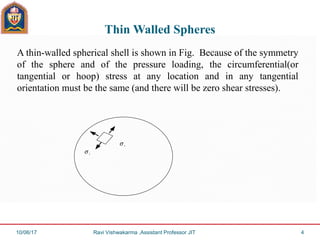
A thin-walled spherical shell is shown in Fig. Because of the symmetry
of the sphere and of the pressure loading, the circumferential(or
tangential or hoop) stress at any location and in any tangential
orientation must be the same (and there will be zero shear stresses).
10/06/17 Ravi Vishwakarma ,Assistant Professor JIT 4
σ t
σ t
Strain in the Thin-walled Sphere
The thin-walled pressure vessel expands when it is internally
pressurized. This results in three principal strains, the circumferential
strain σc (or tangential strain σ t ) in two perpendicular in-plane
directions, and the radial strain σ r. Referring to Fig., these strains are
10/06/17 Ravi Vishwakarma ,Assistant Professor JIT 5
p
C′
A′ B′
D′
A B
C
D
10/06/17 Ravi Vishwakarma ,Assistant Professor JIT 6
AB
ABBA
CD
CDDC
AC
ACCA
rc
−
=
−
=
−
=
''
,
''''
εε
Thin Walled Cylinder
The analysis of a thin-walled internally- pressurized cylindrical vessel
is similar to that of the spherical vessel. The main difference is that the
cylinder has three different principal stress values, the circumferential
stress, the radial stress, and the longitudinal stress σ l,
which acts in the direction of the cylinder axis, Fig.
10/06/17 Ravi Vishwakarma ,Assistant Professor JIT 7
t
pr
l
2
=σ
Thick cylinders
Thick cylinders are the cylindrical vessels, containing fluid under
pressure and whose wall thickness is not small(t ≥ d/20).
10/06/17 Ravi Vishwakarma ,Assistant Professor JIT 8
Stresses in thick cylinders
For thick cylinders such as guns, pipes to hydraulic presses, high
pressure hydraulic pipes the wall thickness is relatively large and
the stress variation across the thickness is also significant. In this
situation the approach made in the previous section is not suitable. The
problem may be solved by considering an axisymmetric about z-axis
and solving the differential equations of stress equilibrium in polar
co-ordinates.
10/06/17 Ravi Vishwakarma ,Assistant Professor JIT 9
In general the stress equations of equilibrium without body forces can
be given as ---
For axisymmetric about z-axis
10/06/17 Ravi Vishwakarma ,Assistant Professor JIT 10
0=
∂
∂
θ
0
02
0
=+
∂
∂
+
∂
∂
=+
∂
∂
+
∂
∂
=
−
+
∂
∂
+
∂
∂
rzr
rzr
rzr
zrzzr
rzr
rrzr
τστ
τττ
σσσσ
θθθ
θ
Compound cylinders
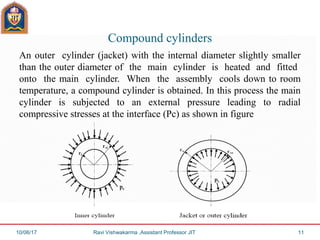
An outer cylinder (jacket) with the internal diameter slightly smaller
than the outer diameter of the main cylinder is heated and fitted
onto the main cylinder. When the assembly cools down to room
temperature, a compound cylinder is obtained. In this process the main
cylinder is subjected to an external pressure leading to radial
compressive stresses at the interface (Pc) as shown in figure
10/06/17 Ravi Vishwakarma ,Assistant Professor JIT 11
Stresses due to Rotation
The bodies like rings, circular discs,cylinders,flywheel
,etc. invariably rotate at high speeds and due to
rotation they are subjected to large magnitudes of
centrifugal forces. The stresses caused by these forces
are distributed symmetrical about their axes of rotation.
10/06/17 Ravi Vishwakarma ,Assistant Professor JIT 12

Thin Cylinders

  • 1.
    JAHANGIRABAD INSTIUTE OFTECHNOLOGY BARABANKI Department of Mechanical Engineering Thin Cylinders & Spheres RAVI VISHWAKARMA 10/06/17 Ravi Vishwakarma ,Assistant Professor JIT 1
  • 2.
    Stresses in thinCylinders If the wall thickness is less than about 7% of the inner diameter then the cylinder may be treated as a thin one. Thin walled cylinders are used as boiler shells, pressure tanks, pipes and in other low pressure processing equipment's. In general three types of stresses are developed in pressure cylinders viz. circumferential or hoop stress, longitudinal stress in closed end cylinders and radial stresses. 10/06/17 Ravi Vishwakarma ,Assistant Professor JIT 2
  • 3.
    The Thin-walled PressureVessel Theory An important practical problem is that of a cylindrical or spherical object which is subjected to an internal pressure p. Such a component is called a pressure vessel, Fig. Applications arise in many areas, for example, the study of cellular organisms, arteries, aerosol cans, scuba-diving tanks and right up to large-scale industrial containers of liquids and gases. In many applications it is valid to assume that the material is isotropic the strains resulting from the pressures are small the wall thickness t of the pressure vessel is much smaller than some characteristic radius: t = ro-ri << ro,ri 10/06/17 Ravi Vishwakarma ,Assistant Professor JIT 3 p
  • 4.
    Thin Walled Spheres Athin-walled spherical shell is shown in Fig. Because of the symmetry of the sphere and of the pressure loading, the circumferential(or tangential or hoop) stress at any location and in any tangential orientation must be the same (and there will be zero shear stresses). 10/06/17 Ravi Vishwakarma ,Assistant Professor JIT 4 σ t σ t
  • 5.
    Strain in theThin-walled Sphere The thin-walled pressure vessel expands when it is internally pressurized. This results in three principal strains, the circumferential strain σc (or tangential strain σ t ) in two perpendicular in-plane directions, and the radial strain σ r. Referring to Fig., these strains are 10/06/17 Ravi Vishwakarma ,Assistant Professor JIT 5 p C′ A′ B′ D′ A B C D
  • 6.
    10/06/17 Ravi Vishwakarma,Assistant Professor JIT 6 AB ABBA CD CDDC AC ACCA rc − = − = − = '' , '''' εε
  • 7.
    Thin Walled Cylinder Theanalysis of a thin-walled internally- pressurized cylindrical vessel is similar to that of the spherical vessel. The main difference is that the cylinder has three different principal stress values, the circumferential stress, the radial stress, and the longitudinal stress σ l, which acts in the direction of the cylinder axis, Fig. 10/06/17 Ravi Vishwakarma ,Assistant Professor JIT 7 t pr l 2 =σ
  • 8.
    Thick cylinders Thick cylindersare the cylindrical vessels, containing fluid under pressure and whose wall thickness is not small(t ≥ d/20). 10/06/17 Ravi Vishwakarma ,Assistant Professor JIT 8
  • 9.
    Stresses in thickcylinders For thick cylinders such as guns, pipes to hydraulic presses, high pressure hydraulic pipes the wall thickness is relatively large and the stress variation across the thickness is also significant. In this situation the approach made in the previous section is not suitable. The problem may be solved by considering an axisymmetric about z-axis and solving the differential equations of stress equilibrium in polar co-ordinates. 10/06/17 Ravi Vishwakarma ,Assistant Professor JIT 9
  • 10.
    In general thestress equations of equilibrium without body forces can be given as --- For axisymmetric about z-axis 10/06/17 Ravi Vishwakarma ,Assistant Professor JIT 10 0= ∂ ∂ θ 0 02 0 =+ ∂ ∂ + ∂ ∂ =+ ∂ ∂ + ∂ ∂ = − + ∂ ∂ + ∂ ∂ rzr rzr rzr zrzzr rzr rrzr τστ τττ σσσσ θθθ θ
  • 11.
    Compound cylinders An outercylinder (jacket) with the internal diameter slightly smaller than the outer diameter of the main cylinder is heated and fitted onto the main cylinder. When the assembly cools down to room temperature, a compound cylinder is obtained. In this process the main cylinder is subjected to an external pressure leading to radial compressive stresses at the interface (Pc) as shown in figure 10/06/17 Ravi Vishwakarma ,Assistant Professor JIT 11
  • 12.
    Stresses due toRotation The bodies like rings, circular discs,cylinders,flywheel ,etc. invariably rotate at high speeds and due to rotation they are subjected to large magnitudes of centrifugal forces. The stresses caused by these forces are distributed symmetrical about their axes of rotation. 10/06/17 Ravi Vishwakarma ,Assistant Professor JIT 12