I . S I M P L E P R E S E N T
I I . P R E S E N T P R O G R E S S I V E
I I I . N O N - A C T I O N V E R B S
Present Tense
by Holly Cin
Fall 2016
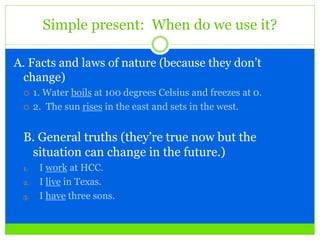
Simple present: When do we use it?
A. Facts and laws of nature (because they don’t
change)
 1. Water boils at 100 degrees Celsius and freezes at 0.
 2. The sun rises in the east and sets in the west.
B. General truths (they’re true now but the
situation can change in the future.)
1. I work at HCC.
2. I live in Texas.
3. I have three sons.
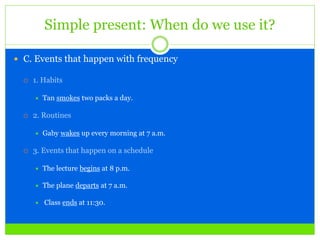
Simple present: When do we use it?
 C. Events that happen with frequency
 1. Habits
 Tan smokes two packs a day.
 2. Routines
 Gaby wakes up every morning at 7 a.m.
 3. Events that happen on a schedule
 The lecture begins at 8 p.m.
 The plane departs at 7 a.m.
 Class ends at 11:30.
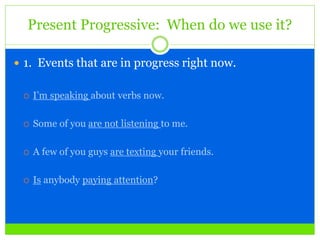
Present Progressive: When do we use it?
 1. Events that are in progress right now.
 I’m speaking about verbs now.
 Some of you are not listening to me.
 A few of you guys are texting your friends.
 Is anybody paying attention?
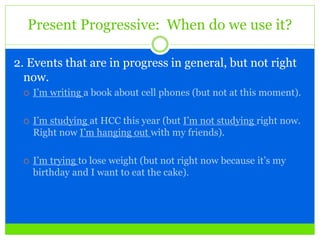
Present Progressive: When do we use it?
2. Events that are in progress in general, but not right
now.
 I’m writing a book about cell phones (but not at this moment).
 I’m studying at HCC this year (but I’m not studying right now.
Right now I’m hanging out with my friends).
 I’m trying to lose weight (but not right now because it’s my
birthday and I want to eat the cake).
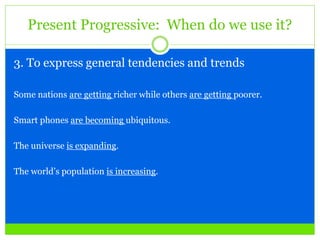
Present Progressive: When do we use it?
3. To express general tendencies and trends
Some nations are getting richer while others are getting poorer.
Smart phones are becoming ubiquitous.
The universe is expanding.
The world’s population is increasing.
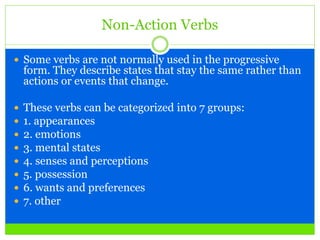
Non-Action Verbs
 Some verbs are not normally used in the progressive
form. They describe states that stay the same rather than
actions or events that change.
 These verbs can be categorized into 7 groups:
 1. appearances
 2. emotions
 3. mental states
 4. senses and perceptions
 5. possession
 6. wants and preferences
 7. other
Non-Action Verbs
1. Appearances
Appear, be, concern, look, mean, seem, represent
 I am the teacher in room 12.
 Ali seems sad right now
 You look worried.
 What does that word mean?
Non-Action Verbs
2. Mental states (know, see (understand), believe, feel
(believe), remember, realize, suspect, suppose,
understand, think, care, hope, wonder, agree, consider,
assume)
 I suppose I could have stayed home and baked cookies.
 Do you believe in miracles?
 I don’t remember what you told me yesterday!
 I think that’s a great idea.
 I wonder what the world will be like in the future.
Non-Action Verbs
3. Emotions: like, love, hate, trust, doubt, appreciate,
admire, envy, fear, regret
 She doesn't like to admit to mistakes.
 That husband doesn’t trust his wife.
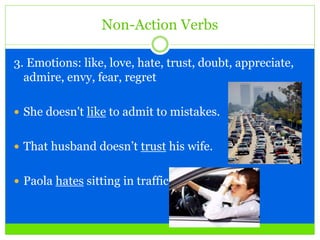
 Paola hates sitting in traffic.
Non-Action Verbs
4. Senses and perception: smell, hear, see, feel, taste,
sound, notice, hurt, look
 I smell something burning.
 Do you see that fly on the wall?
 Do you hear that noise?
 The milk tastes sour. Don’t drink it.
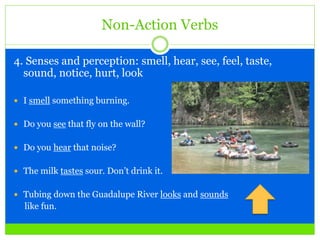
 Tubing down the Guadalupe River looks and sounds
like fun.
State Verbs/Non-Action Verbs
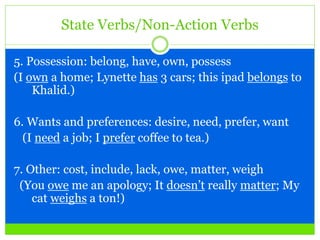
5. Possession: belong, have, own, possess
(I own a home; Lynette has 3 cars; this ipad belongs to
Khalid.)
6. Wants and preferences: desire, need, prefer, want
(I need a job; I prefer coffee to tea.)
7. Other: cost, include, lack, owe, matter, weigh
(You owe me an apology; It doesn’t really matter; My
cat weighs a ton!)
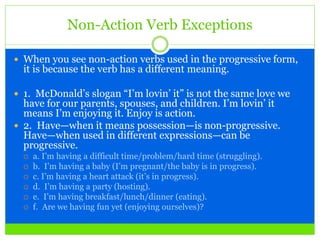
Non-Action Verb Exceptions
 When you see non-action verbs used in the progressive form,
it is because the verb has a different meaning.
 1. McDonald’s slogan “I’m lovin’ it” is not the same love we
have for our parents, spouses, and children. I’m lovin’ it
means I’m enjoying it. Enjoy is action.
 2. Have—when it means possession—is non-progressive.
Have—when used in different expressions—can be
progressive.
 a. I’m having a difficult time/problem/hard time (struggling).
 b. I’m having a baby (I’m pregnant/the baby is in progress).
 c. I’m having a heart attack (it’s in progress).
 d. I’m having a party (hosting).
 e. I’m having breakfast/lunch/dinner (eating).
 f. Are we having fun yet (enjoying ourselves)?
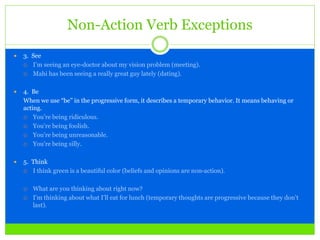
Non-Action Verb Exceptions
 3. See
 I’m seeing an eye-doctor about my vision problem (meeting).
 Mahi has been seeing a really great guy lately (dating).
 4. Be
When we use “be” in the progressive form, it describes a temporary behavior. It means behaving or
acting.
 You’re being ridiculous.
 You’re being foolish.
 You’re being unreasonable.
 You’re being silly.
 5. Think
 I think green is a beautiful color (beliefs and opinions are non-action).
 What are you thinking about right now?
 I’m thinking about what I’ll eat for lunch (temporary thoughts are progressive because they don’t
last).

Presenttenselevel3

  • 1.
    I . SI M P L E P R E S E N T I I . P R E S E N T P R O G R E S S I V E I I I . N O N - A C T I O N V E R B S Present Tense by Holly Cin Fall 2016
  • 2.
    Simple present: Whendo we use it? A. Facts and laws of nature (because they don’t change)  1. Water boils at 100 degrees Celsius and freezes at 0.  2. The sun rises in the east and sets in the west. B. General truths (they’re true now but the situation can change in the future.) 1. I work at HCC. 2. I live in Texas. 3. I have three sons.
  • 3.
    Simple present: Whendo we use it?  C. Events that happen with frequency  1. Habits  Tan smokes two packs a day.  2. Routines  Gaby wakes up every morning at 7 a.m.  3. Events that happen on a schedule  The lecture begins at 8 p.m.  The plane departs at 7 a.m.  Class ends at 11:30.
  • 4.
    Present Progressive: Whendo we use it?  1. Events that are in progress right now.  I’m speaking about verbs now.  Some of you are not listening to me.  A few of you guys are texting your friends.  Is anybody paying attention?
  • 5.
    Present Progressive: Whendo we use it? 2. Events that are in progress in general, but not right now.  I’m writing a book about cell phones (but not at this moment).  I’m studying at HCC this year (but I’m not studying right now. Right now I’m hanging out with my friends).  I’m trying to lose weight (but not right now because it’s my birthday and I want to eat the cake).
  • 6.
    Present Progressive: Whendo we use it? 3. To express general tendencies and trends Some nations are getting richer while others are getting poorer. Smart phones are becoming ubiquitous. The universe is expanding. The world’s population is increasing.
  • 7.
    Non-Action Verbs  Someverbs are not normally used in the progressive form. They describe states that stay the same rather than actions or events that change.  These verbs can be categorized into 7 groups:  1. appearances  2. emotions  3. mental states  4. senses and perceptions  5. possession  6. wants and preferences  7. other
  • 8.
    Non-Action Verbs 1. Appearances Appear,be, concern, look, mean, seem, represent  I am the teacher in room 12.  Ali seems sad right now  You look worried.  What does that word mean?
  • 9.
    Non-Action Verbs 2. Mentalstates (know, see (understand), believe, feel (believe), remember, realize, suspect, suppose, understand, think, care, hope, wonder, agree, consider, assume)  I suppose I could have stayed home and baked cookies.  Do you believe in miracles?  I don’t remember what you told me yesterday!  I think that’s a great idea.  I wonder what the world will be like in the future.
  • 10.
    Non-Action Verbs 3. Emotions:like, love, hate, trust, doubt, appreciate, admire, envy, fear, regret  She doesn't like to admit to mistakes.  That husband doesn’t trust his wife.  Paola hates sitting in traffic.
  • 11.
    Non-Action Verbs 4. Sensesand perception: smell, hear, see, feel, taste, sound, notice, hurt, look  I smell something burning.  Do you see that fly on the wall?  Do you hear that noise?  The milk tastes sour. Don’t drink it.  Tubing down the Guadalupe River looks and sounds like fun.
  • 12.
    State Verbs/Non-Action Verbs 5.Possession: belong, have, own, possess (I own a home; Lynette has 3 cars; this ipad belongs to Khalid.) 6. Wants and preferences: desire, need, prefer, want (I need a job; I prefer coffee to tea.) 7. Other: cost, include, lack, owe, matter, weigh (You owe me an apology; It doesn’t really matter; My cat weighs a ton!)
  • 13.
    Non-Action Verb Exceptions When you see non-action verbs used in the progressive form, it is because the verb has a different meaning.  1. McDonald’s slogan “I’m lovin’ it” is not the same love we have for our parents, spouses, and children. I’m lovin’ it means I’m enjoying it. Enjoy is action.  2. Have—when it means possession—is non-progressive. Have—when used in different expressions—can be progressive.  a. I’m having a difficult time/problem/hard time (struggling).  b. I’m having a baby (I’m pregnant/the baby is in progress).  c. I’m having a heart attack (it’s in progress).  d. I’m having a party (hosting).  e. I’m having breakfast/lunch/dinner (eating).  f. Are we having fun yet (enjoying ourselves)?
  • 14.
    Non-Action Verb Exceptions 3. See  I’m seeing an eye-doctor about my vision problem (meeting).  Mahi has been seeing a really great guy lately (dating).  4. Be When we use “be” in the progressive form, it describes a temporary behavior. It means behaving or acting.  You’re being ridiculous.  You’re being foolish.  You’re being unreasonable.  You’re being silly.  5. Think  I think green is a beautiful color (beliefs and opinions are non-action).  What are you thinking about right now?  I’m thinking about what I’ll eat for lunch (temporary thoughts are progressive because they don’t last).