Non-action
Verbs
Chapter 1
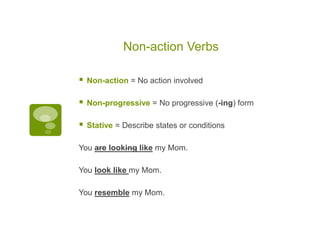
Non-action Verbs
 Non-action = No action involved
 Non-progressive = No progressive (-ing) form
 Stative = Describe states or conditions
You are looking like my Mom.
You look like my Mom.
You resemble my Mom.
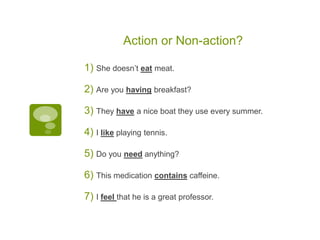
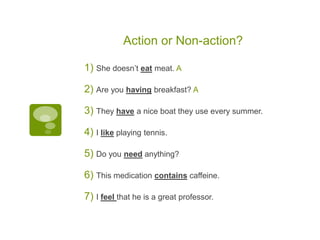
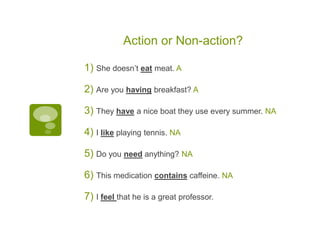
Action or Non-action?
1) She doesn’t eat meat.
2) Are you having breakfast?
3) They have a nice boat they use every summer.
4) I like playing tennis.
5) Do you need anything?
6) This medication contains caffeine.
7) I feel that he is a great professor.
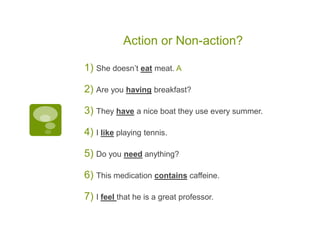
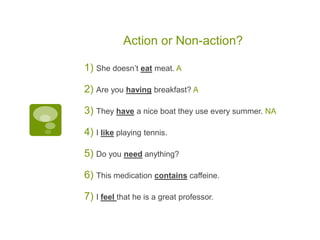
Action or Non-action?
1) She doesn’t eat meat. A
2) Are you having breakfast?
3) They have a nice boat they use every summer.
4) I like playing tennis.
5) Do you need anything?
6) This medication contains caffeine.
7) I feel that he is a great professor.
Action or Non-action?
1) She doesn’t eat meat. A
2) Are you having breakfast? A
3) They have a nice boat they use every summer.
4) I like playing tennis.
5) Do you need anything?
6) This medication contains caffeine.
7) I feel that he is a great professor.
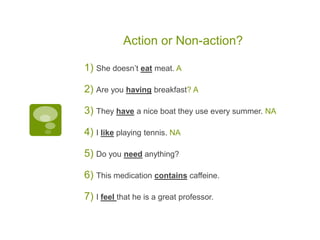
Action or Non-action?
1) She doesn’t eat meat. A
2) Are you having breakfast? A
3) They have a nice boat they use every summer. NA
4) I like playing tennis.
5) Do you need anything?
6) This medication contains caffeine.
7) I feel that he is a great professor.
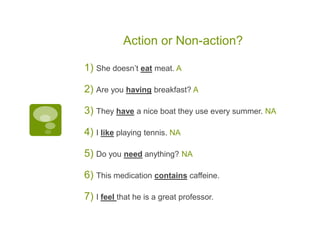
Action or Non-action?
1) She doesn’t eat meat. A
2) Are you having breakfast? A
3) They have a nice boat they use every summer. NA
4) I like playing tennis. NA
5) Do you need anything?
6) This medication contains caffeine.
7) I feel that he is a great professor.
Action or Non-action?
1) She doesn’t eat meat. A
2) Are you having breakfast? A
3) They have a nice boat they use every summer. NA
4) I like playing tennis. NA
5) Do you need anything? NA
6) This medication contains caffeine.
7) I feel that he is a great professor.
Action or Non-action?
1) She doesn’t eat meat. A
2) Are you having breakfast? A
3) They have a nice boat they use every summer. NA
4) I like playing tennis. NA
5) Do you need anything? NA
6) This medication contains caffeine. NA
7) I feel that he is a great professor.
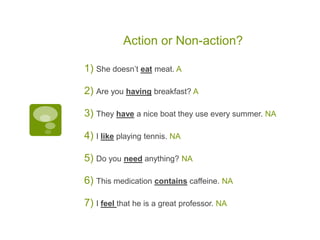
Action or Non-action?
1) She doesn’t eat meat. A
2) Are you having breakfast? A
3) They have a nice boat they use every summer. NA
4) I like playing tennis. NA
5) Do you need anything? NA
6) This medication contains caffeine. NA
7) I feel that he is a great professor. NA
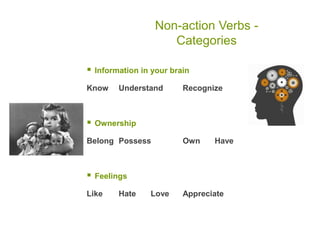
Non-action Verbs -
Categories
 Information in your brain
Know Understand Recognize
 Ownership
Belong Possess Own Have
 Feelings
Like Hate Love Appreciate
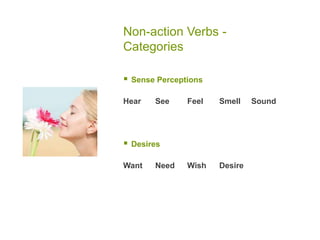
Non-action Verbs -
Categories
 Sense Perceptions
Hear See Feel Smell Sound
 Desires
Want Need Wish Desire
Non-action Verbs
 Use Non-action verbs in the Simple Present
It matters to me.
I love roses.
He is hard-working.
Non-action Verbs
 Can Non-action verbs be in the Present Progressive?
Non-action Verbs
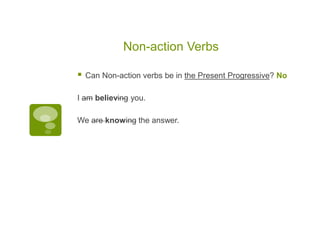
 Can Non-action verbs be in the Present Progressive? No
I am believing you.
We are knowing the answer.
Both Action and Non-action
Meanings
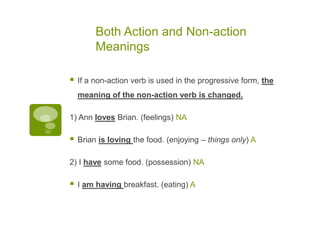
 If a non-action verb is used in the progressive form, the
meaning of the non-action verb is changed.
1) Ann loves Brian. (feelings) NA
 Brian is loving the food. (enjoying – things only) A
2) I have some food. (possession) NA
 I am having breakfast. (eating) A
Both Action and Non-action
Meaning
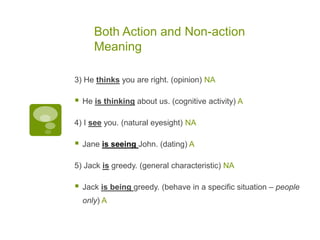
3) He thinks you are right. (opinion) NA
 He is thinking about us. (cognitive activity) A
4) I see you. (natural eyesight) NA
 Jane is seeing John. (dating) A
5) Jack is greedy. (general characteristic) NA
 Jack is being greedy. (behave in a specific situation – people
only) A
Look and Feel – No Change in
Meaning
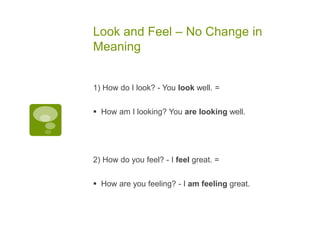
1) How do I look? - You look well. =
 How am I looking? You are looking well.
2) How do you feel? - I feel great. =
 How are you feeling? - I am feeling great.
Non-action Verbs - Summary
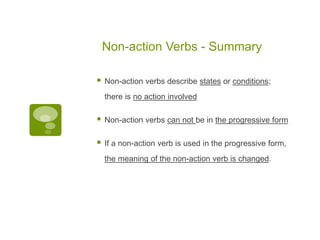
 Non-action verbs describe states or conditions;
there is no action involved
 Non-action verbs can not be in the progressive form
 If a non-action verb is used in the progressive form,
the meaning of the non-action verb is changed.
The ABCs of the Simple Past and
Past Progressive - A
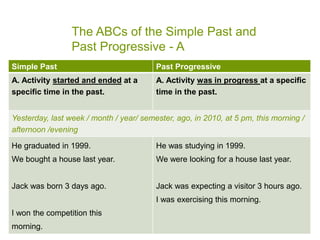
Simple Past Past Progressive
A. Activity started and ended at a
specific time in the past.
A. Activity was in progress at a specific
time in the past.
Yesterday, last week / month / year/ semester, ago, in 2010, at 5 pm, this morning /
afternoon /evening
He graduated in 1999.
We bought a house last year.
Jack was born 3 days ago.
I won the competition this
morning.
He was studying in 1999.
We were looking for a house last year.
Jack was expecting a visitor 3 hours ago.
I was exercising this morning.
The ABCs of the Simple Past and
Past Progressive - B
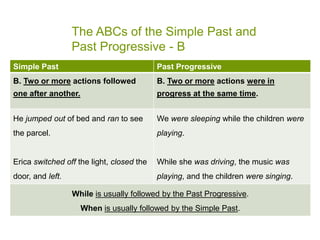
Simple Past Past Progressive
B. Two or more actions followed
one after another.
B. Two or more actions were in
progress at the same time.
He jumped out of bed and ran to see
the parcel.
Erica switched off the light, closed the
door, and left.
We were sleeping while the children were
playing.
While she was driving, the music was
playing, and the children were singing.
While is usually followed by the Past Progressive.
When is usually followed by the Simple Past.
The ABCs of the Simple Past and
Past Progressive - C
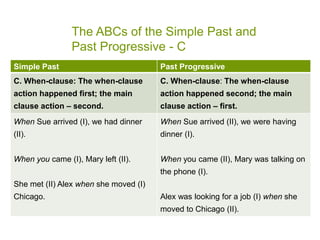
Simple Past Past Progressive
C. When-clause: The when-clause
action happened first; the main
clause action – second.
C. When-clause: The when-clause
action happened second; the main
clause action – first.
When Sue arrived (I), we had dinner
(II).
When you came (I), Mary left (II).
She met (II) Alex when she moved (I)
Chicago.
When Sue arrived (II), we were having
dinner (I).
When you came (II), Mary was talking on
the phone (I).
Alex was looking for a job (I) when she
moved to Chicago (II).
Unfulfilled Intentions
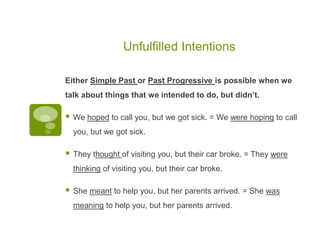
Either Simple Past or Past Progressive is possible when we
talk about things that we intended to do, but didn’t.
 We hoped to call you, but we got sick. = We were hoping to call
you, but we got sick.
 They thought of visiting you, but their car broke. = They were
thinking of visiting you, but their car broke.
 She meant to help you, but her parents arrived. = She was
meaning to help you, but her parents arrived.

Chapter 1: Non-action Verbs

  • 1.
  • 2.
    Non-action Verbs  Non-action= No action involved  Non-progressive = No progressive (-ing) form  Stative = Describe states or conditions You are looking like my Mom. You look like my Mom. You resemble my Mom.
  • 3.
    Action or Non-action? 1)She doesn’t eat meat. 2) Are you having breakfast? 3) They have a nice boat they use every summer. 4) I like playing tennis. 5) Do you need anything? 6) This medication contains caffeine. 7) I feel that he is a great professor.
  • 4.
    Action or Non-action? 1)She doesn’t eat meat. A 2) Are you having breakfast? 3) They have a nice boat they use every summer. 4) I like playing tennis. 5) Do you need anything? 6) This medication contains caffeine. 7) I feel that he is a great professor.
  • 5.
    Action or Non-action? 1)She doesn’t eat meat. A 2) Are you having breakfast? A 3) They have a nice boat they use every summer. 4) I like playing tennis. 5) Do you need anything? 6) This medication contains caffeine. 7) I feel that he is a great professor.
  • 6.
    Action or Non-action? 1)She doesn’t eat meat. A 2) Are you having breakfast? A 3) They have a nice boat they use every summer. NA 4) I like playing tennis. 5) Do you need anything? 6) This medication contains caffeine. 7) I feel that he is a great professor.
  • 7.
    Action or Non-action? 1)She doesn’t eat meat. A 2) Are you having breakfast? A 3) They have a nice boat they use every summer. NA 4) I like playing tennis. NA 5) Do you need anything? 6) This medication contains caffeine. 7) I feel that he is a great professor.
  • 8.
    Action or Non-action? 1)She doesn’t eat meat. A 2) Are you having breakfast? A 3) They have a nice boat they use every summer. NA 4) I like playing tennis. NA 5) Do you need anything? NA 6) This medication contains caffeine. 7) I feel that he is a great professor.
  • 9.
    Action or Non-action? 1)She doesn’t eat meat. A 2) Are you having breakfast? A 3) They have a nice boat they use every summer. NA 4) I like playing tennis. NA 5) Do you need anything? NA 6) This medication contains caffeine. NA 7) I feel that he is a great professor.
  • 10.
    Action or Non-action? 1)She doesn’t eat meat. A 2) Are you having breakfast? A 3) They have a nice boat they use every summer. NA 4) I like playing tennis. NA 5) Do you need anything? NA 6) This medication contains caffeine. NA 7) I feel that he is a great professor. NA
  • 11.
    Non-action Verbs - Categories Information in your brain Know Understand Recognize  Ownership Belong Possess Own Have  Feelings Like Hate Love Appreciate
  • 12.
    Non-action Verbs - Categories Sense Perceptions Hear See Feel Smell Sound  Desires Want Need Wish Desire
  • 13.
    Non-action Verbs  UseNon-action verbs in the Simple Present It matters to me. I love roses. He is hard-working.
  • 14.
    Non-action Verbs  CanNon-action verbs be in the Present Progressive?
  • 15.
    Non-action Verbs  CanNon-action verbs be in the Present Progressive? No I am believing you. We are knowing the answer.
  • 16.
    Both Action andNon-action Meanings  If a non-action verb is used in the progressive form, the meaning of the non-action verb is changed. 1) Ann loves Brian. (feelings) NA  Brian is loving the food. (enjoying – things only) A 2) I have some food. (possession) NA  I am having breakfast. (eating) A
  • 17.
    Both Action andNon-action Meaning 3) He thinks you are right. (opinion) NA  He is thinking about us. (cognitive activity) A 4) I see you. (natural eyesight) NA  Jane is seeing John. (dating) A 5) Jack is greedy. (general characteristic) NA  Jack is being greedy. (behave in a specific situation – people only) A
  • 18.
    Look and Feel– No Change in Meaning 1) How do I look? - You look well. =  How am I looking? You are looking well. 2) How do you feel? - I feel great. =  How are you feeling? - I am feeling great.
  • 19.
    Non-action Verbs -Summary  Non-action verbs describe states or conditions; there is no action involved  Non-action verbs can not be in the progressive form  If a non-action verb is used in the progressive form, the meaning of the non-action verb is changed.
  • 20.
    The ABCs ofthe Simple Past and Past Progressive - A Simple Past Past Progressive A. Activity started and ended at a specific time in the past. A. Activity was in progress at a specific time in the past. Yesterday, last week / month / year/ semester, ago, in 2010, at 5 pm, this morning / afternoon /evening He graduated in 1999. We bought a house last year. Jack was born 3 days ago. I won the competition this morning. He was studying in 1999. We were looking for a house last year. Jack was expecting a visitor 3 hours ago. I was exercising this morning.
  • 21.
    The ABCs ofthe Simple Past and Past Progressive - B Simple Past Past Progressive B. Two or more actions followed one after another. B. Two or more actions were in progress at the same time. He jumped out of bed and ran to see the parcel. Erica switched off the light, closed the door, and left. We were sleeping while the children were playing. While she was driving, the music was playing, and the children were singing. While is usually followed by the Past Progressive. When is usually followed by the Simple Past.
  • 22.
    The ABCs ofthe Simple Past and Past Progressive - C Simple Past Past Progressive C. When-clause: The when-clause action happened first; the main clause action – second. C. When-clause: The when-clause action happened second; the main clause action – first. When Sue arrived (I), we had dinner (II). When you came (I), Mary left (II). She met (II) Alex when she moved (I) Chicago. When Sue arrived (II), we were having dinner (I). When you came (II), Mary was talking on the phone (I). Alex was looking for a job (I) when she moved to Chicago (II).
  • 23.
    Unfulfilled Intentions Either SimplePast or Past Progressive is possible when we talk about things that we intended to do, but didn’t.  We hoped to call you, but we got sick. = We were hoping to call you, but we got sick.  They thought of visiting you, but their car broke. = They were thinking of visiting you, but their car broke.  She meant to help you, but her parents arrived. = She was meaning to help you, but her parents arrived.

Editor's Notes

  • #12 Read more examples on p. 16 (TB).
  • #14 Do ex. 4 and 55 pp. 13-14 (WB).
  • #15 Do ex. 4 and 55 pp. 13-14 (WB).
  • #16 Do ex. 4 and 55 pp. 13-14 (WB).