Coordinating Conjunctions
Holly Cin
Fall 2017
HCC L4/ESOL 0355
Parallel Structure
• We use the conjunctions AND, BUT, OR, and NOR to connect words
or phrases that have the same grammatical function in a sentence.
These words are called “coordinating conjunctions.”
Example:
A. Zulma and Cris are students from Colombia
noun +and+ noun
B. Nazmeen opened her book and began to read.
verb +and+ verb
C. Nancy was talking on the phone and cooking dinner last night.
verb +and+ verb
D. My shoes are old but comfortable.
adjective +but+ adjective
E. Linh wants to see a movie or [to] go to a concert.
infinitive +or+ infinitive
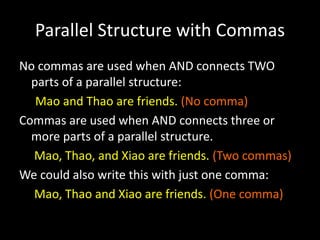
Parallel Structure with Commas
No commas are used when AND connects TWO
parts of a parallel structure:
Mao and Thao are friends. (No comma)
Commas are used when AND connects three or
more parts of a parallel structure.
Mao, Thao, and Xiao are friends. (Two commas)
We could also write this with just one comma:
Mao, Thao and Xiao are friends. (One comma)
Using Coordinating Conjunctions (FANBOYS)
to join to independent clauses
When using a coordinating conjunction to join two independent clauses, a comma is
placed at the end of the first clause (before the conjunction).
Ex 1: Two independent clauses:
1. Ninna didn’t pass level 4.
2. She didn’t care (because she passed the TSI).
Let’s combine them into one compound sentence with a conjunction.
Ninna didn’t pass level 4, BUT she didn’t care because she passed the TSI.
Ex 2: Two independent clauses.
1. Ribesh missed the bus.
2. He still made it to class in time for the test.
Let’s combine them into one compound sentence with a conjunction.
Ribesh missed the bus, YET he still made it to class in time for the test.
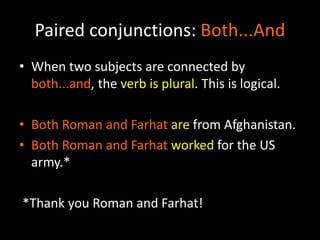
Paired conjunctions: Both...And
• When two subjects are connected by
both...and, the verb is plural. This is logical.
• Both Roman and Farhat are from Afghanistan.
• Both Roman and Farhat worked for the US
army.*
*Thank you Roman and Farhat!
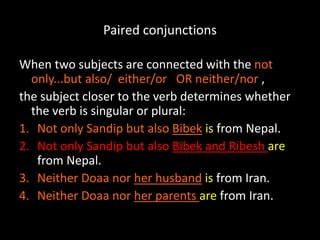
Paired conjunctions
When two subjects are connected with the not
only...but also/ either/or OR neither/nor ,
the subject closer to the verb determines whether
the verb is singular or plural:
1. Not only Sandip but also Bibek is from Nepal.
2. Not only Sandip but also Bibek and Ribesh are
from Nepal.
3. Neither Doaa nor her husband is from Iran.
4. Neither Doaa nor her parents are from Iran.
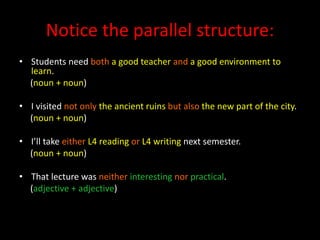
Notice the parallel structure:
• Students need both a good teacher and a good environment to
learn.
(noun + noun)
• I visited not only the ancient ruins but also the new part of the city.
(noun + noun)
• I’ll take either L4 reading or L4 writing next semester.
(noun + noun)
• That lecture was neither interesting nor practical.
(adjective + adjective)

Coordinatingconjunctions

  • 1.
  • 2.
    Parallel Structure • Weuse the conjunctions AND, BUT, OR, and NOR to connect words or phrases that have the same grammatical function in a sentence. These words are called “coordinating conjunctions.” Example: A. Zulma and Cris are students from Colombia noun +and+ noun B. Nazmeen opened her book and began to read. verb +and+ verb C. Nancy was talking on the phone and cooking dinner last night. verb +and+ verb D. My shoes are old but comfortable. adjective +but+ adjective E. Linh wants to see a movie or [to] go to a concert. infinitive +or+ infinitive
  • 3.
    Parallel Structure withCommas No commas are used when AND connects TWO parts of a parallel structure: Mao and Thao are friends. (No comma) Commas are used when AND connects three or more parts of a parallel structure. Mao, Thao, and Xiao are friends. (Two commas) We could also write this with just one comma: Mao, Thao and Xiao are friends. (One comma)
  • 4.
    Using Coordinating Conjunctions(FANBOYS) to join to independent clauses When using a coordinating conjunction to join two independent clauses, a comma is placed at the end of the first clause (before the conjunction). Ex 1: Two independent clauses: 1. Ninna didn’t pass level 4. 2. She didn’t care (because she passed the TSI). Let’s combine them into one compound sentence with a conjunction. Ninna didn’t pass level 4, BUT she didn’t care because she passed the TSI. Ex 2: Two independent clauses. 1. Ribesh missed the bus. 2. He still made it to class in time for the test. Let’s combine them into one compound sentence with a conjunction. Ribesh missed the bus, YET he still made it to class in time for the test.
  • 5.
    Paired conjunctions: Both...And •When two subjects are connected by both...and, the verb is plural. This is logical. • Both Roman and Farhat are from Afghanistan. • Both Roman and Farhat worked for the US army.* *Thank you Roman and Farhat!
  • 6.
    Paired conjunctions When twosubjects are connected with the not only...but also/ either/or OR neither/nor , the subject closer to the verb determines whether the verb is singular or plural: 1. Not only Sandip but also Bibek is from Nepal. 2. Not only Sandip but also Bibek and Ribesh are from Nepal. 3. Neither Doaa nor her husband is from Iran. 4. Neither Doaa nor her parents are from Iran.
  • 7.
    Notice the parallelstructure: • Students need both a good teacher and a good environment to learn. (noun + noun) • I visited not only the ancient ruins but also the new part of the city. (noun + noun) • I’ll take either L4 reading or L4 writing next semester. (noun + noun) • That lecture was neither interesting nor practical. (adjective + adjective)