Fast and Scalable In-
memory Deep Multitask
Learning via Neural Weight
Virtualization
 This paper introduces the concept of Neural Weight Virtualization – which enables fast and scalable in-
memory multitask deep learning on memory-constrained embedded systems.
 The goal of neural weight virtualization is:
 packing multiple DNNs into a fixed-sized main memory whose combined memory requirement is larger than the main
memory.
 enabling fast in-memory execution of the DNNs.
 Propose a two-phase approach:
 virtualization of weight parameters.
 in-memory data structure and run-time execution framework for in-memory execution and context-switching of DNN
tasks.
 Implement two multitask learning systems:
 (1) an embedded GPU-based mobile robot
 (2) a microcontroller-based IoT device.
 Paper evaluates the proposed algorithms as well as the two systems that involve ten state-of-the-art DNNs.
Our evaluation shows that weight virtualization improves memory efficiency, execution time, and energy
efficiency of the multitask learning systems by 4.1x, 36.9x, and 4.2x, respectively.
Introduction
 Packing multiple DNNs into the main memory via weight virtualization is
motivated by: only a small fraction of DNN weights have significant impacts
on the inference result. these high-significance weights are concentrated in a
few blocks in the main memory. Goal: designing a scalable DNN packing
algorithm that matches similar blocks of weights across multiple DNNs and
combines them to construct a single new block of virtual weights that is
shared by the DNNs.
 The matching process is followed by an optimization (retraining) process to
gain back any loss of the inference accuracy of the DNNs.
Weight Virtualization Framework
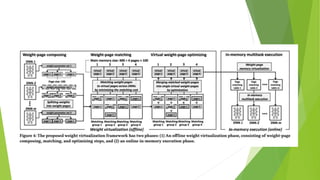
Two-phase weight virtualization framework (Figure 4) having an offline and an online phase.
Weight Virtualization (Offline).
 Weight virtualization is divided into three steps.
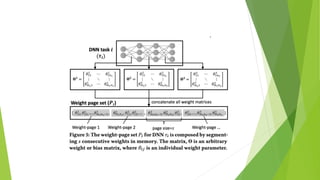
 For each DNN, its weight parameters are split into fixed-sized weight-pages. In Figure 4, the page
size is 100, and each DNN has up to four weight-pages as the main memory size is 400.
 The weight-pages of all DNNs are matched, and similar weight-pages are grouped together.
 The matched weight-pages in each group are combined to create a single virtual weight-page by
optimizing (re-training) all or some of the DNNs. The goal of this optimization is to retain the
accuracy of each DNN that shares one or more virtual weight-pages with others.
 In-Memory Execution (Online).
 The virtual weight-pages are loaded into the main memory of the system.
 For each DNN, a pagmatching table that points a set of memory addresses of virtual weight-pages
required by the DNN is generated.
 At run-time, a DNN is executed in the main memory with the necessary weight parameters obtained
by dereferencing its page matching table.
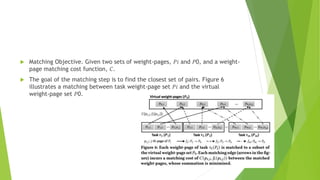
 Matching Objective. Given two sets of weight-pages, 𝑃𝑖 and 𝑃0, and a weight-
page matching cost function, 𝐶.
 The goal of the matching step is to find the closest set of pairs. Figure 6
illustrates a matching between task weight-page set 𝑃𝑖 and the virtual
weight-page set 𝑃0.
 Weight-Page Optimization
 combine the matched weight-pages into single pages and optimize (retrain)
the tasks to retain any accuracy loss due to the changed weight parameters.

PresentationDNN.pptx

  • 1.
    Fast and ScalableIn- memory Deep Multitask Learning via Neural Weight Virtualization
  • 2.
     This paperintroduces the concept of Neural Weight Virtualization – which enables fast and scalable in- memory multitask deep learning on memory-constrained embedded systems.  The goal of neural weight virtualization is:  packing multiple DNNs into a fixed-sized main memory whose combined memory requirement is larger than the main memory.  enabling fast in-memory execution of the DNNs.  Propose a two-phase approach:  virtualization of weight parameters.  in-memory data structure and run-time execution framework for in-memory execution and context-switching of DNN tasks.  Implement two multitask learning systems:  (1) an embedded GPU-based mobile robot  (2) a microcontroller-based IoT device.  Paper evaluates the proposed algorithms as well as the two systems that involve ten state-of-the-art DNNs. Our evaluation shows that weight virtualization improves memory efficiency, execution time, and energy efficiency of the multitask learning systems by 4.1x, 36.9x, and 4.2x, respectively.
  • 3.
    Introduction  Packing multipleDNNs into the main memory via weight virtualization is motivated by: only a small fraction of DNN weights have significant impacts on the inference result. these high-significance weights are concentrated in a few blocks in the main memory. Goal: designing a scalable DNN packing algorithm that matches similar blocks of weights across multiple DNNs and combines them to construct a single new block of virtual weights that is shared by the DNNs.  The matching process is followed by an optimization (retraining) process to gain back any loss of the inference accuracy of the DNNs.
  • 4.
    Weight Virtualization Framework Two-phaseweight virtualization framework (Figure 4) having an offline and an online phase. Weight Virtualization (Offline).  Weight virtualization is divided into three steps.  For each DNN, its weight parameters are split into fixed-sized weight-pages. In Figure 4, the page size is 100, and each DNN has up to four weight-pages as the main memory size is 400.  The weight-pages of all DNNs are matched, and similar weight-pages are grouped together.  The matched weight-pages in each group are combined to create a single virtual weight-page by optimizing (re-training) all or some of the DNNs. The goal of this optimization is to retain the accuracy of each DNN that shares one or more virtual weight-pages with others.  In-Memory Execution (Online).  The virtual weight-pages are loaded into the main memory of the system.  For each DNN, a pagmatching table that points a set of memory addresses of virtual weight-pages required by the DNN is generated.  At run-time, a DNN is executed in the main memory with the necessary weight parameters obtained by dereferencing its page matching table.
  • 7.
     Matching Objective.Given two sets of weight-pages, 𝑃𝑖 and 𝑃0, and a weight- page matching cost function, 𝐶.  The goal of the matching step is to find the closest set of pairs. Figure 6 illustrates a matching between task weight-page set 𝑃𝑖 and the virtual weight-page set 𝑃0.
  • 8.
     Weight-Page Optimization combine the matched weight-pages into single pages and optimize (retrain) the tasks to retain any accuracy loss due to the changed weight parameters.