UNIT - IV
 ARCHITECTURE AND DESIGN (/#/)
 COMPONENT ARCHITECTURES / REFERENCE ARCHITECTURE (/#/)
 ARCHITECTURE MODELS(/#/)
 SYSTEM AND NETWORK ARCHITECTURE
 ADDRESSING AND ROUTING ARCHITECTURE / FUNDAMENTALS
 ADDRESSING MECHANISMS
 ADDRESSING STRATEGIES / ROUTING STRATEGIES
 NETWORK MANAGEMENT ARCHITECTURE / MECHANISMS
 PERFORMANCE ARCHITECTURE / MECHANISMS
 SECURITY AND PRIVACY ARCHITECTURE / MECHANISMS
 Good network design is a process by which an
extremely complex and nonlinear system is
conceptualized.
 Network architecture and design development must
be done in a systematic and reproducible manner.
 Component architecture is a description of how and
where each function of a network is applied within
that network.
 It consists of a set of mechanisms (HARDWARE
AND SOFTWARE) by which that function is
applied to the network.
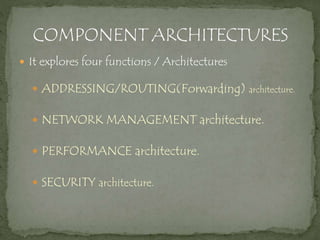
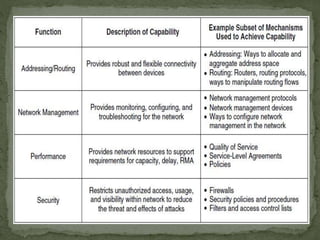
 It explores four functions / Architectures
 ADDRESSING/ROUTING(Forwarding) architecture.
 NETWORK MANAGEMENT architecture.
 PERFORMANCE architecture.
 SECURITY architecture.
 To determine how performance will work for a
network.
 To determine how each mechanism works, and how
they work together to provide performance for the
network.
 This picture bellow shows how
 QoS – Quality of Service,
 SLA-Service Level Agreements and policies are
applied.
 It is the overall performance of a telephony or
computer network,
 particularly the performance seen/measured by the
users of the network.
 A SERVICE LEVEL AGREEMENT is an important
document that is used to define the level of a
service between a service provider and their
customer/service requester.
 It is a contract between a network service provider
and a customer /service requester
 Aspects/Features of the service level agreement
 scope, quality, responsibilities - are agreed
between the service provider and the service user/
service requester.
 Developing COMPONENT ARCHITECTURE
requires input, sets of user(), application, and device
requirements, estimated traffic flows, and
architectural goals defined for each individual
network.
 This input forms a common foundation for all
network functions.
 To facilitate determining where each mechanism
may be applied, the network is divided into regions.
 Commonly used regions include:
 access (edge),
 Distribution(service available for use by a
consumer or business user.),
 core (backbone / fundamental/sets), and
 External interfaces(MATLAB) & DMZs
 Demilitarized Zone (sometimes referred to as a
PERIMETER NETWORK)
 It is a physical or logical sub-network that contains
an organization's external-facing services .
 The characteristics of each region help to identify
where mechanisms are applied.
 When mechanisms have been chosen and applied to
the network and we want to know about the
internal(mechanisms , locations) relationships
between these mechanisms.
 MATLAB (matrix laboratory).
 MATLAB allows matrix manipulations.
 It is a multi-paradigm Numerical Computing
Environment .
 (4GL) Fourth-Generation programming language.
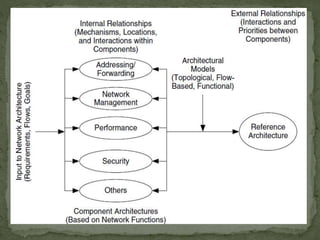
 A reference architecture is a description of the
complete network architecture.
 It contains all functions of the component
architectures (i.e., functions).
 Each component
ADDRESSING AND
ROUTING
 a 32-bit number that uniquely identifies a host(system).
 Simply called IP address
 IP addresses are normally expressed in dotted-decimal
format, with four numbers separated by periods,
 Ex: such as 192.168.123.132.
 Routing is the process of selecting best paths in a network.
 the process of moving a packet of data from source to destination.
 Routing is usually performed by a dedicated device called a router.
 Routing schemes differ in their delivery semantics:
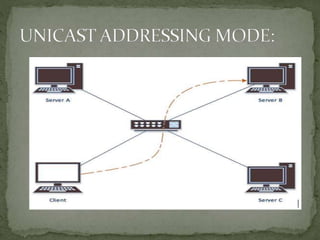
 UNICAST - delivers a message to a single specific node(FM/WTalkie).
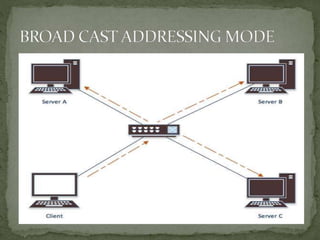
 BROADCAST - delivers a message to all nodes in the network(TV).
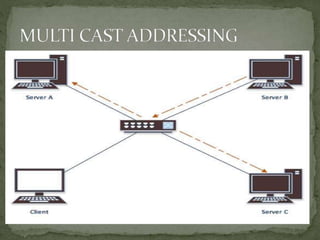
 MULTICAST - delivers a message to a group of nodes that have
expressed interest in receiving the message(email/teleconf/videoconf).
 ANYCAST - delivers a message to anyone out of a group of nodes,
typically the one nearest to the source(network addressing and routing
methodology).
 GEOCAST - delivers a message to a geographic area(ad-hoc networks )
 Addressing is applying identifiers (addresses) to
devices at various protocol layers (e.g., data-link
layers and network layer)
 Ex: class A, B, C, D
 While routing is learning about the connectivity
within and between networks and applying this
connectivity information to forward IP packets
toward their destinations.
 how user and management traffic flows are
forwarded through the network.
 How hierarchy(level), separation, and
grouping of users and devices are supported.
 There are several addressing and routing
mechanisms that could be considered.
 Sub-netting & Super-netting,
 Variable-length Sub-netting,
 Dynamic Addressing,
 Private Addressing,
 Virtual Lans (Vlans),
 Ipv6, And
 Network Address Translation (Nat).
 SUB-NETWORKING:
Dividing a network into two or more
networks is called sub-netting.
 Subnet is a logical.
 visible subdivision of an IP Network.
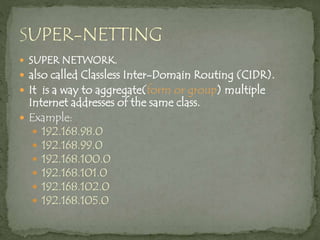
 SUPER NETWORK.
 also called Classless Inter-Domain Routing (CIDR).
 It is a way to aggregate(form or group) multiple
Internet addresses of the same class.
 Example:
 192.168.98.0
 192.168.99.0
 192.168.100.0
 192.168.101.0
 192.168.102.0
 192.168.105.0
 DYNAMIC IP ADDRESSING:
It assigns a different IP address each time
the ISP customer logs on to their
computer.
Ex: 192.168.105.0
 STATIC IP ADDRESSING:
It is for one customer on one IP address.
 Ex: FTP, Interanet.
 PRIVATE - ADDRESSES:
 Each IP node requires an IP address that is globally unique
to the IP internetwork.
 PUBLIC - ADDRESSES:
 When the public addresses are assigned, routes are
programmed into the routers of the Internet so that
traffic to the assigned public addresses can reach their
locations.
 VIRTUAL LAN OR VLAN:
 which are mutually isolated so that packets can only
pass between them via one or more routers.
 such a domain is referred to as a virtual local area
network, virtual LAN or VLAN.
 Internet Protocol version 6 (IPv6) :
 It is the latest version of the Internet Protocol (IP), the
communications protocol that provides an
identification and location system for computers on
networks and routes traffic across the Internet.
 Internet Protocol version 4 (IPv4):
 It is the fourth version in the development of the
Internet Protocol (IP) Internet, and routes most traffic
on the Internet.
 ip v1 - 3 not formally assigned.
 ipv4 - 32 bit IP address. (Decimal)
 Example: 192.168.105.0
 Ipv5 - streamed protocaol(ST). connection oriented
internet level protocol
 IPv6 - 128 bit IP address(Hexa Decimal.)
 Example:
 2607:f0d0:1002:0051:0000:0000:0000:0004
 provides a method of modifying network address
information in Internet Protocol (IP).
 The purpose of remapping one IP address space into
another one IP address space.
 Switching And Routing,
 Classless Inter-Domain Routing (CIDR):
 Multicasts,
 Mobile IP,
 Route Filtering, Peering, Routing
Policies,
 Confederations, And
 IGP, EGP Selection And Location.
 HUB
 A common CONNECTION POINT for devices in a network.
 to connect segments of a LAN.
 A HUB contains multiple ports.
 Switch:
 a device that filters and forwards packets between LAN segments.
 Router:
 A device that forwards data packets along networks.
 A router is connected to at least two networks, commonly
two LANs or WANs or a LAN and its ISP.s network.
Routers are located at gateways,
 CLASSLESS INTER-DOMAIN ROUTING (CIDR):
 It is a method for allocating IP addresses and
routing Internet Protocol packets.
 Mobile IP (or MIP):
 It is an Internet Engineering Task Force (IETF) standard
communications protocol
 It is designed to allow mobile device users to move from
one network to another while maintaining a permanent
IP address.
 ROUTE FILTERING:
 It is the process by which certain routes are not considered for
inclusion input filtering output filtering
 in the local route database,
 ROUTE PEERING
 is a voluntary interconnection.
 the purpose of exchanging traffic between the users of each
network.
 A POLICY:
 It is a principle to guide decisions and achieve rational
outcomes.
 A policy is a statement of intent, and is implemented as a
procedure or protocol.
 Network management is providing functions to control,
plan, allocate, deploy, coordinate, and monitor network
resources.
 Network management mechanisms include:
 Monitoring: Obtaining values for end-to-end, per link,
and per-element network management characteristics.
 Instrumentation: Determining the set of tools and utilities
needed to monitor and probe the network for
management data.
 Configuration: Setting parameters in a network device for
operation and control of that element.
 FCAPS components: FCAPS is the ISO Telecommunications
Management Network model and framework for network
management
 The set of fault, configuration, accounting, performance,
and security management components.
 In-band and out-of-band management: Whether
management data flow along the same path or have a
separate path.
 Centralized and distributed management:
 Whether the management system is in a single hardware
platform or is distributed across the network among
multiple platforms.(platform/language)
 Scaling network management traffic:
 Determining how much network capacity should be
reserved for network management.
 Checks and balances:
 Using multiple mechanisms to verify that variables are
represented correctly.
 Managing network management data:
 Offloading old data, keeping track of storage
availability for data, updating data types.
 MIB selection:
 Determining which management information bases,
and how much of each management information
base, to use.
 (MIB) is a database used for managing the entities in a
communications network
 Integration into OSS:
 How the management system will communicate with
higher-level operations support system.
 Performance consists of the set of mechanisms
used to configure, operate, manage, provision,
and account for resources in the network that
allocate performance to users, applications, and
devices.
 This includes capacity planning and traffic
engineering, as well as a variety of service
mechanisms.
 Performance describes how network resources will be
allocated to user and management traffic flows.
 This consists of prioritizing, scheduling, and
conditioning traffic flows
 mechanisms to correlate(mutual relationship or
connection) user, application, and device requirements
to traffic flows, access control, quality of service,
policies, and service-level agreements (SLAs).
 QoS, is determining, setting, and acting upon priority
levels for traffic flows.
 Resource control refers to mechanisms that will allocate,
control, and manage network resources for traffic.
 (SLAs) are informal or formal contracts between
a provider and user that define the terms of the
provider’s responsibility to the user and the type
and extent of accountability if those
responsibilities are not met.
 Policies are sets (again, formal or informal) of
high-level statements about how network
resources are to be allocated among users.
 Security is a requirement to guarantee the
confidentiality, integrity, and availability of user,
application, device, and network information and
physical resources.
 it describes how system resources are to be
protected from theft, damage, denial of service
(DOS), or unauthorized access.
 This consists of the mechanisms used to apply security,
which may include such:
 hardware and software capabilities as virtual private
networks (VPNs),
 encryption,
 firewalls,
 routing filters, and
 network address translation (NAT).
 In many instances security mechanisms are deployed in
regions, often termed security zones or cells,
 Each region or security zone represents a particular level
of sensitivity and access control.
 Physical security and awareness:
 The protection of devices from physical access, damage,
and theft (including isolating all or parts of the network
from outside access); and getting users educated and
involved with the day-to-day aspects of security in their
network and helping them to understand the potential
risks of violating security policies and procedures
 The security mechanisms that were considered are:
 Security threat analysis:
 The process to determine which components of the
system need to be protected and the types of security
risks (threats) they should be protected from
 Security policies and procedures:
 Formal statements on rules for system, network, and
information access and use, in order to minimize
exposure to security threats
 Protocol and application security:
 Securing management and network protocols and
applications from unauthorized access and misuse.
 Encryption:
 Making data unreadable if they are intercepted, by
applying cipher algorithms together with a secret key.
 Network perimeter security:
 Protecting the external interfaces between your network
and external networks.
 Remote access security:
 Securing network access based on traditional dial-in,
point-to-point sessions, and virtual private network
connections.
 THREE TYPES OF ARCHITECTURAL MODELS :
 topological models(LAN/MAN/WAN)
 which are based on a geographical or topological arrangement.
 flow-based models(Peer to peer, Client-server, Hierarchical client-
server, and Distributed computing)
 which take particular advantage of traffic flows from the flow
specification.
 functional models(service-provider, • intranet/extranet, • single-
/multi-tiered performance, and • end-to-end models.)
 which focus on one or more functions or features planned for in the
network.
THANK YOU

Network architecture - part-I

  • 1.
  • 2.
     ARCHITECTURE ANDDESIGN (/#/)  COMPONENT ARCHITECTURES / REFERENCE ARCHITECTURE (/#/)  ARCHITECTURE MODELS(/#/)  SYSTEM AND NETWORK ARCHITECTURE  ADDRESSING AND ROUTING ARCHITECTURE / FUNDAMENTALS  ADDRESSING MECHANISMS  ADDRESSING STRATEGIES / ROUTING STRATEGIES  NETWORK MANAGEMENT ARCHITECTURE / MECHANISMS  PERFORMANCE ARCHITECTURE / MECHANISMS  SECURITY AND PRIVACY ARCHITECTURE / MECHANISMS
  • 3.
     Good networkdesign is a process by which an extremely complex and nonlinear system is conceptualized.  Network architecture and design development must be done in a systematic and reproducible manner.
  • 4.
     Component architectureis a description of how and where each function of a network is applied within that network.  It consists of a set of mechanisms (HARDWARE AND SOFTWARE) by which that function is applied to the network.
  • 5.
     It exploresfour functions / Architectures  ADDRESSING/ROUTING(Forwarding) architecture.  NETWORK MANAGEMENT architecture.  PERFORMANCE architecture.  SECURITY architecture.
  • 8.
     To determinehow performance will work for a network.  To determine how each mechanism works, and how they work together to provide performance for the network.  This picture bellow shows how  QoS – Quality of Service,  SLA-Service Level Agreements and policies are applied.
  • 9.
     It isthe overall performance of a telephony or computer network,  particularly the performance seen/measured by the users of the network.
  • 10.
     A SERVICELEVEL AGREEMENT is an important document that is used to define the level of a service between a service provider and their customer/service requester.  It is a contract between a network service provider and a customer /service requester  Aspects/Features of the service level agreement  scope, quality, responsibilities - are agreed between the service provider and the service user/ service requester.
  • 11.
     Developing COMPONENTARCHITECTURE requires input, sets of user(), application, and device requirements, estimated traffic flows, and architectural goals defined for each individual network.  This input forms a common foundation for all network functions.
  • 12.
     To facilitatedetermining where each mechanism may be applied, the network is divided into regions.  Commonly used regions include:  access (edge),  Distribution(service available for use by a consumer or business user.),  core (backbone / fundamental/sets), and  External interfaces(MATLAB) & DMZs
  • 13.
     Demilitarized Zone(sometimes referred to as a PERIMETER NETWORK)  It is a physical or logical sub-network that contains an organization's external-facing services .  The characteristics of each region help to identify where mechanisms are applied.  When mechanisms have been chosen and applied to the network and we want to know about the internal(mechanisms , locations) relationships between these mechanisms.
  • 14.
     MATLAB (matrixlaboratory).  MATLAB allows matrix manipulations.  It is a multi-paradigm Numerical Computing Environment .  (4GL) Fourth-Generation programming language.
  • 15.
     A referencearchitecture is a description of the complete network architecture.  It contains all functions of the component architectures (i.e., functions).  Each component
  • 16.
  • 17.
     a 32-bitnumber that uniquely identifies a host(system).  Simply called IP address  IP addresses are normally expressed in dotted-decimal format, with four numbers separated by periods,  Ex: such as 192.168.123.132.
  • 18.
     Routing isthe process of selecting best paths in a network.  the process of moving a packet of data from source to destination.  Routing is usually performed by a dedicated device called a router.  Routing schemes differ in their delivery semantics:  UNICAST - delivers a message to a single specific node(FM/WTalkie).  BROADCAST - delivers a message to all nodes in the network(TV).  MULTICAST - delivers a message to a group of nodes that have expressed interest in receiving the message(email/teleconf/videoconf).  ANYCAST - delivers a message to anyone out of a group of nodes, typically the one nearest to the source(network addressing and routing methodology).  GEOCAST - delivers a message to a geographic area(ad-hoc networks )
  • 22.
     Addressing isapplying identifiers (addresses) to devices at various protocol layers (e.g., data-link layers and network layer)  Ex: class A, B, C, D  While routing is learning about the connectivity within and between networks and applying this connectivity information to forward IP packets toward their destinations.
  • 23.
     how userand management traffic flows are forwarded through the network.  How hierarchy(level), separation, and grouping of users and devices are supported.  There are several addressing and routing mechanisms that could be considered.
  • 24.
     Sub-netting &Super-netting,  Variable-length Sub-netting,  Dynamic Addressing,  Private Addressing,  Virtual Lans (Vlans),  Ipv6, And  Network Address Translation (Nat).
  • 25.
     SUB-NETWORKING: Dividing anetwork into two or more networks is called sub-netting.  Subnet is a logical.  visible subdivision of an IP Network.
  • 26.
     SUPER NETWORK. also called Classless Inter-Domain Routing (CIDR).  It is a way to aggregate(form or group) multiple Internet addresses of the same class.  Example:  192.168.98.0  192.168.99.0  192.168.100.0  192.168.101.0  192.168.102.0  192.168.105.0
  • 27.
     DYNAMIC IPADDRESSING: It assigns a different IP address each time the ISP customer logs on to their computer. Ex: 192.168.105.0  STATIC IP ADDRESSING: It is for one customer on one IP address.  Ex: FTP, Interanet.
  • 28.
     PRIVATE -ADDRESSES:  Each IP node requires an IP address that is globally unique to the IP internetwork.  PUBLIC - ADDRESSES:  When the public addresses are assigned, routes are programmed into the routers of the Internet so that traffic to the assigned public addresses can reach their locations.
  • 29.
     VIRTUAL LANOR VLAN:  which are mutually isolated so that packets can only pass between them via one or more routers.  such a domain is referred to as a virtual local area network, virtual LAN or VLAN.
  • 30.
     Internet Protocolversion 6 (IPv6) :  It is the latest version of the Internet Protocol (IP), the communications protocol that provides an identification and location system for computers on networks and routes traffic across the Internet.  Internet Protocol version 4 (IPv4):  It is the fourth version in the development of the Internet Protocol (IP) Internet, and routes most traffic on the Internet.
  • 31.
     ip v1- 3 not formally assigned.  ipv4 - 32 bit IP address. (Decimal)  Example: 192.168.105.0  Ipv5 - streamed protocaol(ST). connection oriented internet level protocol  IPv6 - 128 bit IP address(Hexa Decimal.)  Example:  2607:f0d0:1002:0051:0000:0000:0000:0004
  • 32.
     provides amethod of modifying network address information in Internet Protocol (IP).  The purpose of remapping one IP address space into another one IP address space.
  • 33.
     Switching AndRouting,  Classless Inter-Domain Routing (CIDR):  Multicasts,  Mobile IP,  Route Filtering, Peering, Routing Policies,  Confederations, And  IGP, EGP Selection And Location.
  • 34.
     HUB  Acommon CONNECTION POINT for devices in a network.  to connect segments of a LAN.  A HUB contains multiple ports.  Switch:  a device that filters and forwards packets between LAN segments.  Router:  A device that forwards data packets along networks.  A router is connected to at least two networks, commonly two LANs or WANs or a LAN and its ISP.s network. Routers are located at gateways,
  • 35.
     CLASSLESS INTER-DOMAINROUTING (CIDR):  It is a method for allocating IP addresses and routing Internet Protocol packets.
  • 36.
     Mobile IP(or MIP):  It is an Internet Engineering Task Force (IETF) standard communications protocol  It is designed to allow mobile device users to move from one network to another while maintaining a permanent IP address.
  • 37.
     ROUTE FILTERING: It is the process by which certain routes are not considered for inclusion input filtering output filtering  in the local route database,  ROUTE PEERING  is a voluntary interconnection.  the purpose of exchanging traffic between the users of each network.  A POLICY:  It is a principle to guide decisions and achieve rational outcomes.  A policy is a statement of intent, and is implemented as a procedure or protocol.
  • 38.
     Network managementis providing functions to control, plan, allocate, deploy, coordinate, and monitor network resources.  Network management mechanisms include:  Monitoring: Obtaining values for end-to-end, per link, and per-element network management characteristics.  Instrumentation: Determining the set of tools and utilities needed to monitor and probe the network for management data.
  • 39.
     Configuration: Settingparameters in a network device for operation and control of that element.  FCAPS components: FCAPS is the ISO Telecommunications Management Network model and framework for network management  The set of fault, configuration, accounting, performance, and security management components.  In-band and out-of-band management: Whether management data flow along the same path or have a separate path.
  • 40.
     Centralized anddistributed management:  Whether the management system is in a single hardware platform or is distributed across the network among multiple platforms.(platform/language)  Scaling network management traffic:  Determining how much network capacity should be reserved for network management.  Checks and balances:  Using multiple mechanisms to verify that variables are represented correctly.
  • 41.
     Managing networkmanagement data:  Offloading old data, keeping track of storage availability for data, updating data types.  MIB selection:  Determining which management information bases, and how much of each management information base, to use.  (MIB) is a database used for managing the entities in a communications network  Integration into OSS:  How the management system will communicate with higher-level operations support system.
  • 42.
     Performance consistsof the set of mechanisms used to configure, operate, manage, provision, and account for resources in the network that allocate performance to users, applications, and devices.  This includes capacity planning and traffic engineering, as well as a variety of service mechanisms.
  • 43.
     Performance describeshow network resources will be allocated to user and management traffic flows.  This consists of prioritizing, scheduling, and conditioning traffic flows  mechanisms to correlate(mutual relationship or connection) user, application, and device requirements to traffic flows, access control, quality of service, policies, and service-level agreements (SLAs).
  • 44.
     QoS, isdetermining, setting, and acting upon priority levels for traffic flows.  Resource control refers to mechanisms that will allocate, control, and manage network resources for traffic.
  • 45.
     (SLAs) areinformal or formal contracts between a provider and user that define the terms of the provider’s responsibility to the user and the type and extent of accountability if those responsibilities are not met.  Policies are sets (again, formal or informal) of high-level statements about how network resources are to be allocated among users.
  • 46.
     Security isa requirement to guarantee the confidentiality, integrity, and availability of user, application, device, and network information and physical resources.  it describes how system resources are to be protected from theft, damage, denial of service (DOS), or unauthorized access.
  • 47.
     This consistsof the mechanisms used to apply security, which may include such:  hardware and software capabilities as virtual private networks (VPNs),  encryption,  firewalls,  routing filters, and  network address translation (NAT).
  • 48.
     In manyinstances security mechanisms are deployed in regions, often termed security zones or cells,  Each region or security zone represents a particular level of sensitivity and access control.
  • 49.
     Physical securityand awareness:  The protection of devices from physical access, damage, and theft (including isolating all or parts of the network from outside access); and getting users educated and involved with the day-to-day aspects of security in their network and helping them to understand the potential risks of violating security policies and procedures
  • 50.
     The securitymechanisms that were considered are:  Security threat analysis:  The process to determine which components of the system need to be protected and the types of security risks (threats) they should be protected from  Security policies and procedures:  Formal statements on rules for system, network, and information access and use, in order to minimize exposure to security threats
  • 51.
     Protocol andapplication security:  Securing management and network protocols and applications from unauthorized access and misuse.  Encryption:  Making data unreadable if they are intercepted, by applying cipher algorithms together with a secret key.  Network perimeter security:  Protecting the external interfaces between your network and external networks.
  • 52.
     Remote accesssecurity:  Securing network access based on traditional dial-in, point-to-point sessions, and virtual private network connections.
  • 53.
     THREE TYPESOF ARCHITECTURAL MODELS :  topological models(LAN/MAN/WAN)  which are based on a geographical or topological arrangement.  flow-based models(Peer to peer, Client-server, Hierarchical client- server, and Distributed computing)  which take particular advantage of traffic flows from the flow specification.  functional models(service-provider, • intranet/extranet, • single- /multi-tiered performance, and • end-to-end models.)  which focus on one or more functions or features planned for in the network.
  • 54.