


INTROUCTION
TO
INTRODUCTION TO
COMPUTER
•
•
•
•
•

Computer comes from the word “COMPUTE”
Compute means “TO CALCULATE”
So computer is calculating device
Perform calculations at enormous speed
Computer is device that operates upon “DATA”
or “INFORMATION”
• E.g. preparing
results, calculations, transactions, scientific
work etc
COMPUTER…
COMPUTER
•
•
•
•

Computer can input “DATA”
Computer can process “DATA”
Computer can store “DATA”
Computer can retrieve “DATA”

Finally…..
computer can be termed as “DATA
PROCESSOR”
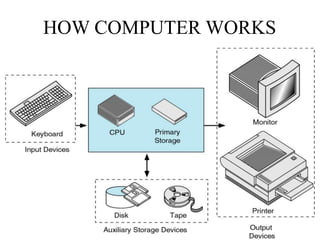
HOW COMPUTER WORKS
CHARACTERSTICS OF
COMPUTER
Main characteristics of the computer can
be summarized as:
1. Speed: Computer is very fast and accurate
device. It can process millions and millions of
instructions within seconds.

2. Accuracy: Computer results are highly
accurate.
3. Memory: Computers have a large amount of
memory to hold a very large amount of data or
information.
4. Programmed Intelligence: Computer are
programmed in such a way that they can
perform those operations which have been fed
into them in the form of executable programs.

5. Diligence: Computer is free from problems like
lack of concentration, and confusions etc.
Computer may never be confused like humans
6. Versatility: We can perform many different
types of tasks on computer. One moment it might
be busy in calculating the statistical date for
annual performance evaluation of a business
organization and next moment it might be
working on playing movies.
7. Power of Remembrance: Unlike humans,
computer can store things for unlimited period of
time.
TYPES OF COMPUTER…
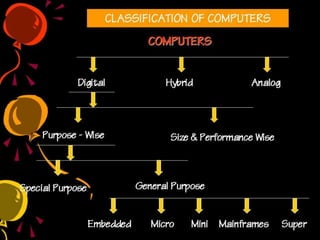
• ANALOG COMPUTER: An analog computer is a
form of computer that uses the continuouslychangeable aspects of physical phenomena
such as electrical, mechanical, or hydraulic
quantities to model the problem being solved.
It represent fractional values exactly, witout
round off…
• DIGITAL COMPUTER : A computer that
performs calculations and logical operations
with quantities represented as digits, usually in
the binary number system i.e 0 and 1.
• HYBRID COMPUTER: A computer that
performs calculations and logical operations
with quantities represented as digits, usually in
the binary number system.
CLASSIFICATION OF COMPUTE
Computers can be generally classified by
size and power as follows, though there is
considerable overlap:

• WORKSTATION: A powerful, single-user
computer. A workstation is like a personal
computer, but it has a more powerful
microprocessor and, in general, a higherquality monitor.
• MINI COMPUTER: A multi-user computer
capable of supporting up to hundreds of users
simultaneously.

• MAINFRAME COMPUTER: A powerful
multi-user computer capable of supporting many
hundreds or thousands of users simultaneously.
• SUPER COMPUTER: An extremely fast
computer that can perform hundreds of millions
of instructions per second.
• PERSONAL COMPUTER: A small, singleuser computer based on a microprocessor. It is
further divided into:

•
•
•
•
•

Desktop
Notebook
Hand-held
Palmtop
Laptop etc
ADVANTAGES AND DISADVANTAGES:
•

ADVANTAGES:

DISADVANTAGES:

•
•
•
•
•

•
•
•
•
•

Speed
Search engine
Calculating power
Storage
Communication

Health risks
Violation of privacy
Public Safety
Cannot think itself
Cannot manage
itself
GROUP MEMBERS:
1. AISHA KHURSHID
2. AMBER NAZ
3. NOOR –US-SABA
4. MARIA WASEEM TALPUR
5. MEHWISH BALOCH
6. SUMAIYAH ASHRAF
THANKYOU..!

THE

Introduction To Computer!!

  • 1.
  • 2.
    INTRODUCTION TO COMPUTER • • • • • Computer comesfrom the word “COMPUTE” Compute means “TO CALCULATE” So computer is calculating device Perform calculations at enormous speed Computer is device that operates upon “DATA” or “INFORMATION” • E.g. preparing results, calculations, transactions, scientific work etc
  • 3.
    COMPUTER… COMPUTER • • • • Computer can input“DATA” Computer can process “DATA” Computer can store “DATA” Computer can retrieve “DATA” Finally….. computer can be termed as “DATA PROCESSOR”
  • 4.
  • 6.
    CHARACTERSTICS OF COMPUTER Main characteristicsof the computer can be summarized as: 1. Speed: Computer is very fast and accurate device. It can process millions and millions of instructions within seconds. 2. Accuracy: Computer results are highly accurate.
  • 7.
    3. Memory: Computershave a large amount of memory to hold a very large amount of data or information. 4. Programmed Intelligence: Computer are programmed in such a way that they can perform those operations which have been fed into them in the form of executable programs. 5. Diligence: Computer is free from problems like lack of concentration, and confusions etc. Computer may never be confused like humans
  • 8.
    6. Versatility: Wecan perform many different types of tasks on computer. One moment it might be busy in calculating the statistical date for annual performance evaluation of a business organization and next moment it might be working on playing movies. 7. Power of Remembrance: Unlike humans, computer can store things for unlimited period of time.
  • 9.
    TYPES OF COMPUTER… •ANALOG COMPUTER: An analog computer is a form of computer that uses the continuouslychangeable aspects of physical phenomena such as electrical, mechanical, or hydraulic quantities to model the problem being solved. It represent fractional values exactly, witout round off…
  • 10.
    • DIGITAL COMPUTER: A computer that performs calculations and logical operations with quantities represented as digits, usually in the binary number system i.e 0 and 1. • HYBRID COMPUTER: A computer that performs calculations and logical operations with quantities represented as digits, usually in the binary number system.
  • 12.
    CLASSIFICATION OF COMPUTE Computerscan be generally classified by size and power as follows, though there is considerable overlap: • WORKSTATION: A powerful, single-user computer. A workstation is like a personal computer, but it has a more powerful microprocessor and, in general, a higherquality monitor.
  • 13.
    • MINI COMPUTER:A multi-user computer capable of supporting up to hundreds of users simultaneously. • MAINFRAME COMPUTER: A powerful multi-user computer capable of supporting many hundreds or thousands of users simultaneously. • SUPER COMPUTER: An extremely fast computer that can perform hundreds of millions of instructions per second.
  • 14.
    • PERSONAL COMPUTER:A small, singleuser computer based on a microprocessor. It is further divided into: • • • • • Desktop Notebook Hand-held Palmtop Laptop etc
  • 15.
    ADVANTAGES AND DISADVANTAGES: • ADVANTAGES: DISADVANTAGES: • • • • • • • • • • Speed Searchengine Calculating power Storage Communication Health risks Violation of privacy Public Safety Cannot think itself Cannot manage itself
  • 16.
    GROUP MEMBERS: 1. AISHAKHURSHID 2. AMBER NAZ 3. NOOR –US-SABA 4. MARIA WASEEM TALPUR 5. MEHWISH BALOCH 6. SUMAIYAH ASHRAF
  • 17.