Presentation of
Distribution, Marketing &
Exhibition
By: M. Ahmad Sheikh
Distribution.
Distributor.
The distribution of a film (or movie) is the
process through which a movie is made
available to watch for an audience by a film
distributor. This task may be accomplished in
a variety of ways; for example, with a
theatrical release, a home entertainment
release (in which the movie is made
available on DVD-Video or Blu-ray Disc) or a
television program for broadcast syndication
and may include digital distribution.
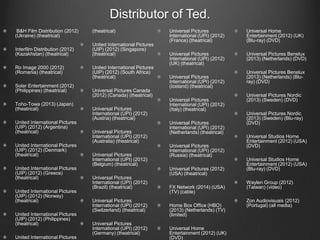
Distributor of Ted.
B&H Film Distribution (2012)
(Ukraine) (theatrical)
Interfilm Distribution (2012)
(Kazakhstan) (theatrical)
Ro Image 2000 (2012)
(Romania) (theatrical)
Solar Entertainment (2012)
(Philippines) (theatrical)
Toho-Towa (2013) (Japan)
(theatrical)
United International Pictures
(UIP) (2012) (Argentina)
(theatrical)
United International Pictures
(UIP) (2012) (Denmark)
(theatrical)
United International Pictures
(UIP) (2012) (Greece)
(theatrical)
United International Pictures
(UIP) (2012) (Norway)
(theatrical)
United International Pictures
(UIP) (2012) (Philippines)
(theatrical)
United International Pictures
(theatrical)
United International Pictures
(UIP) (2012) (Singapore)
(theatrical)
United International Pictures
(UIP) (2012) (South Africa)
(theatrical)
Universal Pictures Canada
(2012) (Canada) (theatrical)
Universal Pictures
International (UPI) (2012)
(Austria) (theatrical)
Universal Pictures
International (UPI) (2012)
(Australia) (theatrical)
Universal Pictures
International (UPI) (2012)
(Belgium) (theatrical)
Universal Pictures
International (UPI) (2012)
(Brazil) (theatrical)
Universal Pictures
International (UPI) (2012)
(Switzerland) (theatrical)
Universal Pictures
International (UPI) (2012)
(Germany) (theatrical)
Universal Pictures
International (UPI) (2012)
(France) (theatrical)
Universal Pictures
International (UPI) (2012)
(UK) (theatrical)
Universal Pictures
International (UPI) (2012)
(Iceland) (theatrical)
Universal Pictures
International (UPI) (2012)
(Italy) (theatrical)
Universal Pictures
International (UPI) (2012)
(Netherlands) (theatrical)
Universal Pictures
International (UPI) (2012)
(Russia) (theatrical)
Universal Pictures (2012)
(USA) (theatrical)
FX Network (2014) (USA)
(TV) (cable)
Home Box Office (HBO)
(2013) (Netherlands) (TV)
(limited)
Universal Home
Entertainment (2012) (UK)
(DVD)
Universal Home
Entertainment (2012) (UK)
(Blu-ray) (DVD)
Universal Pictures Benelux
(2013) (Netherlands) (DVD)
Universal Pictures Benelux
(2013) (Netherlands) (Blu-
ray) (DVD)
Universal Pictures Nordic
(2013) (Sweden) (DVD)
Universal Pictures Nordic
(2013) (Sweden) (Blu-ray)
(DVD)
Universal Studios Home
Entertainment (2012) (USA)
(DVD)
Universal Studios Home
Entertainment (2012) (USA)
(Blu-ray) (DVD)
Waylen Group (2012)
(Taiwan) (video)
Zon Audiovisuais (2012)
(Portugal) (all media)
Positioning.
• The film was released on 29th June 2012
which is in summers, during holidays. People
would go out to watch movies during this
time.
• The film is rated PG-13 which tells that the
target audience for this movie are teenagers
and young adult. These age groups would
like mystery and drama.
Circulation.
• Thousand of copies of film were circulated to
the cinemas all around the world.
• The movie was a saturate release, it was
shown in almost every cinema, all over the
world, especially in United States of America.
Marketing.
Marketing.
Film promotion is the practice of promotion
specifically in the film industry. As with all
business it is an important part of any release
because of the inherent high financial risk; film
studios will invest in expensive marketing
campaigns to maximize revenue early in the
release cycle. Marketing budgets tend to equal
about half the production budget. The distributor
and exhibitors generally handle publicity.
Marketing Methods.
• The marketing of the movie was done through various
methods, including:
• Trailer : A series of extracts from a film or broadcast, used for advance
publicity. Trailer creates an awareness and curiosity among the people
for the movie. Like posters, a Unique Selling Point would be there for a
trailer.
• Posters Campaign: Posters usually have a Unique Selling Point. This
campaign will help to attract the people towards the film due to the
main image on the poster and the cast mentioned/shown on the poster.
• Advertising: Media and advertising via internet was done for the
movie. It was advertised on different
magazines, newspapers, billboards, websites, television (Via
Trailers)and the radio, specially in U.S and Europe
• Promotion: The film Ted was promoted by the posters and trailers only
as it is an adult movie.
Exhibition.
Exhibition.
Exhibition is the retail branch of the film industry. It involves not the
production or the distribution of motion pictures, but their public
screening, usually for paying customers in a site devoted to such
screenings, the movie theater. What the exhibitor sells is the
experience of a film (and, frequently, concessions like soft drinks and
popcorn). Because exhibitors to some extent control how films are
programmed, promoted, and presented to the public, they have
considerable influence over the box-office success and, more
importantly, the reception of films.
Though films have always been shown in nontheatrical as well as
theatrical venues, the business of film exhibition primarily entails the
ownership, management, and operation of theaters. Historically, film
exhibitors have been faced with a number of situations common to
other sectors of the commercial entertainment industry: shifting
market conditions, strong competition, efforts to achieve
monopolization of the field, government regulatory actions, and costly
investment in new technologies.
Ways of Exhibition.
Cinema: The distributor is paid by the cinema for a
copy of the film
Home: The distributor is paid by the company who is
selling the film for a copy.
The Box Office Collection for Ted was more than $
500,000,000 in worldwide, the budget for movie was
$ 50,000,000. The movie made profit more than ten
time as compared to budget cost.
THE END.

Presentation2

  • 1.
    Presentation of Distribution, Marketing& Exhibition By: M. Ahmad Sheikh
  • 2.
  • 3.
    Distributor. The distribution ofa film (or movie) is the process through which a movie is made available to watch for an audience by a film distributor. This task may be accomplished in a variety of ways; for example, with a theatrical release, a home entertainment release (in which the movie is made available on DVD-Video or Blu-ray Disc) or a television program for broadcast syndication and may include digital distribution.
  • 4.
    Distributor of Ted. B&HFilm Distribution (2012) (Ukraine) (theatrical) Interfilm Distribution (2012) (Kazakhstan) (theatrical) Ro Image 2000 (2012) (Romania) (theatrical) Solar Entertainment (2012) (Philippines) (theatrical) Toho-Towa (2013) (Japan) (theatrical) United International Pictures (UIP) (2012) (Argentina) (theatrical) United International Pictures (UIP) (2012) (Denmark) (theatrical) United International Pictures (UIP) (2012) (Greece) (theatrical) United International Pictures (UIP) (2012) (Norway) (theatrical) United International Pictures (UIP) (2012) (Philippines) (theatrical) United International Pictures (theatrical) United International Pictures (UIP) (2012) (Singapore) (theatrical) United International Pictures (UIP) (2012) (South Africa) (theatrical) Universal Pictures Canada (2012) (Canada) (theatrical) Universal Pictures International (UPI) (2012) (Austria) (theatrical) Universal Pictures International (UPI) (2012) (Australia) (theatrical) Universal Pictures International (UPI) (2012) (Belgium) (theatrical) Universal Pictures International (UPI) (2012) (Brazil) (theatrical) Universal Pictures International (UPI) (2012) (Switzerland) (theatrical) Universal Pictures International (UPI) (2012) (Germany) (theatrical) Universal Pictures International (UPI) (2012) (France) (theatrical) Universal Pictures International (UPI) (2012) (UK) (theatrical) Universal Pictures International (UPI) (2012) (Iceland) (theatrical) Universal Pictures International (UPI) (2012) (Italy) (theatrical) Universal Pictures International (UPI) (2012) (Netherlands) (theatrical) Universal Pictures International (UPI) (2012) (Russia) (theatrical) Universal Pictures (2012) (USA) (theatrical) FX Network (2014) (USA) (TV) (cable) Home Box Office (HBO) (2013) (Netherlands) (TV) (limited) Universal Home Entertainment (2012) (UK) (DVD) Universal Home Entertainment (2012) (UK) (Blu-ray) (DVD) Universal Pictures Benelux (2013) (Netherlands) (DVD) Universal Pictures Benelux (2013) (Netherlands) (Blu- ray) (DVD) Universal Pictures Nordic (2013) (Sweden) (DVD) Universal Pictures Nordic (2013) (Sweden) (Blu-ray) (DVD) Universal Studios Home Entertainment (2012) (USA) (DVD) Universal Studios Home Entertainment (2012) (USA) (Blu-ray) (DVD) Waylen Group (2012) (Taiwan) (video) Zon Audiovisuais (2012) (Portugal) (all media)
  • 5.
    Positioning. • The filmwas released on 29th June 2012 which is in summers, during holidays. People would go out to watch movies during this time. • The film is rated PG-13 which tells that the target audience for this movie are teenagers and young adult. These age groups would like mystery and drama.
  • 6.
    Circulation. • Thousand ofcopies of film were circulated to the cinemas all around the world. • The movie was a saturate release, it was shown in almost every cinema, all over the world, especially in United States of America.
  • 7.
  • 8.
    Marketing. Film promotion isthe practice of promotion specifically in the film industry. As with all business it is an important part of any release because of the inherent high financial risk; film studios will invest in expensive marketing campaigns to maximize revenue early in the release cycle. Marketing budgets tend to equal about half the production budget. The distributor and exhibitors generally handle publicity.
  • 9.
    Marketing Methods. • Themarketing of the movie was done through various methods, including: • Trailer : A series of extracts from a film or broadcast, used for advance publicity. Trailer creates an awareness and curiosity among the people for the movie. Like posters, a Unique Selling Point would be there for a trailer. • Posters Campaign: Posters usually have a Unique Selling Point. This campaign will help to attract the people towards the film due to the main image on the poster and the cast mentioned/shown on the poster. • Advertising: Media and advertising via internet was done for the movie. It was advertised on different magazines, newspapers, billboards, websites, television (Via Trailers)and the radio, specially in U.S and Europe • Promotion: The film Ted was promoted by the posters and trailers only as it is an adult movie.
  • 10.
  • 11.
    Exhibition. Exhibition is theretail branch of the film industry. It involves not the production or the distribution of motion pictures, but their public screening, usually for paying customers in a site devoted to such screenings, the movie theater. What the exhibitor sells is the experience of a film (and, frequently, concessions like soft drinks and popcorn). Because exhibitors to some extent control how films are programmed, promoted, and presented to the public, they have considerable influence over the box-office success and, more importantly, the reception of films. Though films have always been shown in nontheatrical as well as theatrical venues, the business of film exhibition primarily entails the ownership, management, and operation of theaters. Historically, film exhibitors have been faced with a number of situations common to other sectors of the commercial entertainment industry: shifting market conditions, strong competition, efforts to achieve monopolization of the field, government regulatory actions, and costly investment in new technologies.
  • 12.
    Ways of Exhibition. Cinema:The distributor is paid by the cinema for a copy of the film Home: The distributor is paid by the company who is selling the film for a copy. The Box Office Collection for Ted was more than $ 500,000,000 in worldwide, the budget for movie was $ 50,000,000. The movie made profit more than ten time as compared to budget cost.
  • 13.