The Film Process
What are the key stages?
What happens at each key stage
The Film Process
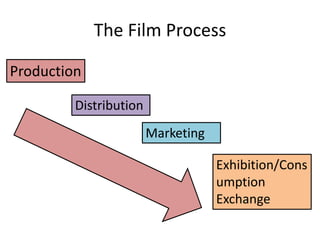
Production
Distribution
Marketing
Exhibition/Cons
umption
Exchange
• Production involves the creation of the media
product and is the responsibility of the
PRODUCTION COMPANY
• Preproduction-Production-Postproduction
• Before this stage FINANCE must be arranged.
– British funding – BFI, Lotteries, Production
Companies, Businesses
– USA – Conglomerates provided financial backing
Production
Producers
• Producers are frequently the first person to
become involved in a project; they participate
directly in all the main producing phases; and see
the project through production, to post-
production, marketing and distribution.
• The Producer's is role to turn story ideas into
profitable cinematic entertainment, and to
persuade others to share in his or her commercial
and creative vision. Producers usually report to
the production company, or to the Executive
Producers appointed to supervise the production
on behalf of the financiers and Distributors.
Responsibilities
• Producers have overall control on every aspect of
a film's production, bringing together the
Screenwriters, Director, cast, finances and
production team.
• Their primary responsibility is to foster an
environment in which the creative talents of the
cast and crew can flourish - Producers are
therefore ultimately accountable for the success
of the finished film.
• Producers many responsibilities span all four
phases of production
Distribution
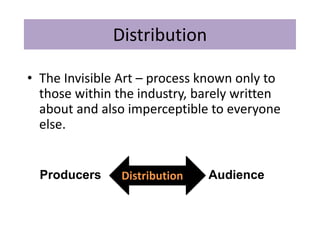
• The Invisible Art – process known only to
those within the industry, barely written
about and also imperceptible to everyone
else.
Producers AudienceDistribution
Distribution
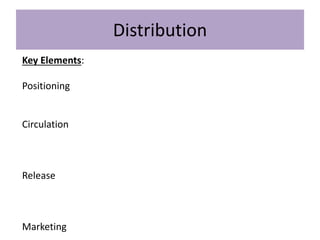
Key Elements:
Positioning
Circulation
Release
Marketing
Distribution
• Releasing and Sustaining a film in the market
place
• Worked best when the three key stages
(Production, Distribution, Exhibition) are linked or
controlled by the same company
• UK system has more focus on marketing and
sustaining a film in the local market
• Independent Studios struggle to get distribution -
No formal connection between Producers,
distributors and exhibitors
• Collaboration – need to get a major company on
side - £££££££££££££$$$$$$$$$$$$$$
Distribution = Power
• Films can not be financed without the help of
distributors
• They have clout with theatre owners (or are
often the owners)
• Brand name recognition
• Own copyright
• Access to capital
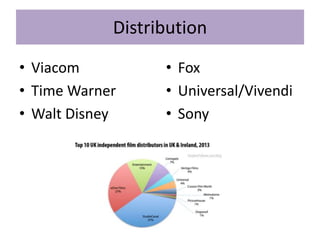
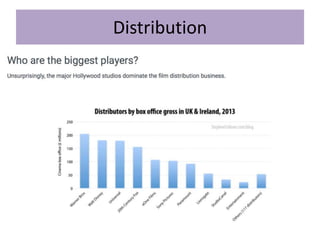
Distribution
• Viacom
• Time Warner
• Walt Disney
• Fox
• Universal/Vivendi
• Sony
Distribution
• Key Terms
– Wide/Blanket/Saturation Release
– Platform release
– Limited Released/Art House Release
Distribution
Marketing
• What techniques can be used to market a
film?
• In recent years the general tactic has been to
‘go big’
• The movie business is cyclical and seasonal
– Summer
– Christmas
– Long holiday weekends (USA)
Marketing
• Every major Hollywood studio/distribution has
an internal department for promotion and the
resources to promote (TV, Magazines, Radio)
• The marketing campaign will be cohesive
across all media platforms
• Most common forms are teaser trailers,
trailers, Adverts in News papers and
Magazines, Television spots, Radio promo,
internet (official websites, viral sites, social
networking) and billboards.
Marketing
• Teaser Trailer – very little info but ‘cool’ looking
• Theatrical Trailer – done by specialist production
houses
• Official Website (with the Trailer), builds as release
date gets closes and is only the start of the internet
campaign
• Press Junket
• A few weeks before release - Publicity Blitz (esp
internet)
• Product tie-ins and corporate partnerships (Happy
Meal)
• Publicity Stunt (The Dark Knight, The Simpsons
Movie)
Marketing
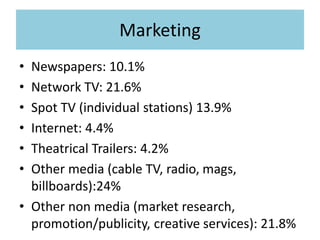
• Newspapers: 10.1%
• Network TV: 21.6%
• Spot TV (individual stations) 13.9%
• Internet: 4.4%
• Theatrical Trailers: 4.2%
• Other media (cable TV, radio, mags,
billboards):24%
• Other non media (market research,
promotion/publicity, creative services): 21.8%
• Exhibition is the retail branch of the film industry.
• What the exhibitor sells is the experience of a
film (and, frequently, concessions like soft drinks
and popcorn).
• Because exhibitors to some extent control how
films are programmed, promoted, and presented
to the public, they have considerable influence
over the box-office success and, more
importantly, the reception of films.
• Exchange is about the relationship between the
audience and institution and what they ‘do’ with
the exhibition
Exhibition/ Exchange
• Exhibition is divided into two sections:
- Cinema – the distributor is paid by the cinema
for a copy of the film
- Home – the distributor is paid by the company
who is selling the film for a copy
• A film’s success is often decided on the
amount of money it makes during it’s cinema
release. This is known as the Box Office
Takings
• Home Exhibition is becoming an increasing
valuable and varied source for distributors to
increase profits.
Exhibition/ Exchange
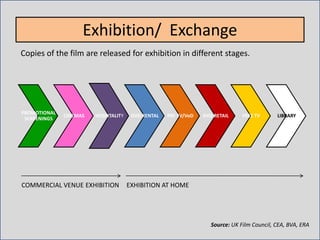
PROMOTIONAL
SCREENINGS
CINEMAS HOSPITALITY DVD RENTAL PAY TV/VoD DVD RETAIL FREE TV LIBRARY
COMMERCIAL VENUE EXHIBITION EXHIBITION AT HOME
Copies of the film are released for exhibition in different stages.
Source: UK Film Council, CEA, BVA, ERA
Exhibition/ Exchange
• Cineworld and Odeon are the two biggest
multiplexes here
• In American there is a lot more choice but the
biggest ones seem to be Cinemark (294) Regal
Entertainment (545), AMC (378) and Carmike
(244)
• There are very strong laws in America about
the separation of Production Companies and
Exhibitors.
Exhibition/ Exchange
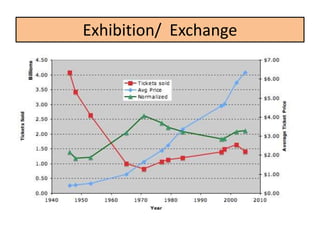
• Why are people not going to the cinema? Give
as many reasons as possible.
Exhibition/ Exchange
• Home Entertainment
– What is it? List as many examples of film based
‘home entertainment’
• This a thriving part of the industry esp here in
the UK. We buy or rent 350m films a year and
it is worth close to £3b a year (three times
that of ticket prices)
Exhibition/ Exchange

Film Production Cycle

  • 1.
    The Film Process Whatare the key stages? What happens at each key stage
  • 2.
  • 3.
    • Production involvesthe creation of the media product and is the responsibility of the PRODUCTION COMPANY • Preproduction-Production-Postproduction • Before this stage FINANCE must be arranged. – British funding – BFI, Lotteries, Production Companies, Businesses – USA – Conglomerates provided financial backing Production
  • 4.
    Producers • Producers arefrequently the first person to become involved in a project; they participate directly in all the main producing phases; and see the project through production, to post- production, marketing and distribution. • The Producer's is role to turn story ideas into profitable cinematic entertainment, and to persuade others to share in his or her commercial and creative vision. Producers usually report to the production company, or to the Executive Producers appointed to supervise the production on behalf of the financiers and Distributors.
  • 5.
    Responsibilities • Producers haveoverall control on every aspect of a film's production, bringing together the Screenwriters, Director, cast, finances and production team. • Their primary responsibility is to foster an environment in which the creative talents of the cast and crew can flourish - Producers are therefore ultimately accountable for the success of the finished film. • Producers many responsibilities span all four phases of production
  • 6.
    Distribution • The InvisibleArt – process known only to those within the industry, barely written about and also imperceptible to everyone else. Producers AudienceDistribution
  • 7.
  • 8.
    Distribution • Releasing andSustaining a film in the market place • Worked best when the three key stages (Production, Distribution, Exhibition) are linked or controlled by the same company • UK system has more focus on marketing and sustaining a film in the local market • Independent Studios struggle to get distribution - No formal connection between Producers, distributors and exhibitors • Collaboration – need to get a major company on side - £££££££££££££$$$$$$$$$$$$$$
  • 9.
    Distribution = Power •Films can not be financed without the help of distributors • They have clout with theatre owners (or are often the owners) • Brand name recognition • Own copyright • Access to capital
  • 10.
    Distribution • Viacom • TimeWarner • Walt Disney • Fox • Universal/Vivendi • Sony
  • 11.
  • 12.
    • Key Terms –Wide/Blanket/Saturation Release – Platform release – Limited Released/Art House Release Distribution
  • 13.
    Marketing • What techniquescan be used to market a film? • In recent years the general tactic has been to ‘go big’ • The movie business is cyclical and seasonal – Summer – Christmas – Long holiday weekends (USA)
  • 14.
    Marketing • Every majorHollywood studio/distribution has an internal department for promotion and the resources to promote (TV, Magazines, Radio) • The marketing campaign will be cohesive across all media platforms • Most common forms are teaser trailers, trailers, Adverts in News papers and Magazines, Television spots, Radio promo, internet (official websites, viral sites, social networking) and billboards.
  • 15.
    Marketing • Teaser Trailer– very little info but ‘cool’ looking • Theatrical Trailer – done by specialist production houses • Official Website (with the Trailer), builds as release date gets closes and is only the start of the internet campaign • Press Junket • A few weeks before release - Publicity Blitz (esp internet) • Product tie-ins and corporate partnerships (Happy Meal) • Publicity Stunt (The Dark Knight, The Simpsons Movie)
  • 16.
    Marketing • Newspapers: 10.1% •Network TV: 21.6% • Spot TV (individual stations) 13.9% • Internet: 4.4% • Theatrical Trailers: 4.2% • Other media (cable TV, radio, mags, billboards):24% • Other non media (market research, promotion/publicity, creative services): 21.8%
  • 17.
    • Exhibition isthe retail branch of the film industry. • What the exhibitor sells is the experience of a film (and, frequently, concessions like soft drinks and popcorn). • Because exhibitors to some extent control how films are programmed, promoted, and presented to the public, they have considerable influence over the box-office success and, more importantly, the reception of films. • Exchange is about the relationship between the audience and institution and what they ‘do’ with the exhibition Exhibition/ Exchange
  • 18.
    • Exhibition isdivided into two sections: - Cinema – the distributor is paid by the cinema for a copy of the film - Home – the distributor is paid by the company who is selling the film for a copy • A film’s success is often decided on the amount of money it makes during it’s cinema release. This is known as the Box Office Takings • Home Exhibition is becoming an increasing valuable and varied source for distributors to increase profits. Exhibition/ Exchange
  • 19.
    PROMOTIONAL SCREENINGS CINEMAS HOSPITALITY DVDRENTAL PAY TV/VoD DVD RETAIL FREE TV LIBRARY COMMERCIAL VENUE EXHIBITION EXHIBITION AT HOME Copies of the film are released for exhibition in different stages. Source: UK Film Council, CEA, BVA, ERA Exhibition/ Exchange
  • 20.
    • Cineworld andOdeon are the two biggest multiplexes here • In American there is a lot more choice but the biggest ones seem to be Cinemark (294) Regal Entertainment (545), AMC (378) and Carmike (244) • There are very strong laws in America about the separation of Production Companies and Exhibitors. Exhibition/ Exchange
  • 21.
  • 22.
    • Why arepeople not going to the cinema? Give as many reasons as possible. Exhibition/ Exchange
  • 23.
    • Home Entertainment –What is it? List as many examples of film based ‘home entertainment’ • This a thriving part of the industry esp here in the UK. We buy or rent 350m films a year and it is worth close to £3b a year (three times that of ticket prices) Exhibition/ Exchange

Editor's Notes

  • #3 What would you expect to happen at each stage
  • #7 Most important part of the film industry. It is the connection between Producers and Audience
  • #8 Positioning: Involves how and when the film should be released. Elements to be considered are the time of year, other film releases and the target audience. Circulation: how many copies of the film should be circulated to cinemas. Each print costs around £1000. The distributor should decide whether the film requires a ‘saturation release’ (700-1000 prints) or an ‘art-house release’ (around 20 prints) Release: Timing is crucial. School holidays are a prime time within the year for the release of blockbusters. If the film is a potential award winner, then it will be released during the traditional season of awards competition: January to March. Competition must also be considered. Marketing: Can often cost as much as making the film!!! Main aim is to create a ‘must see’ feeling about the film. Word-of-mouth is a powerful marketing aid for a film.
  • #9 Each print costs at least $2000 – 3000 screens $6mill 4000 is average now – was in the 100’s in the 1980s. 37000 screens in US
  • #13 Post it notes – one idea per post-it then on the board
  • #14 Post it notes – one idea per post-it then on the board
  • #15 Post it notes – one idea per post-it then on the board
  • #16 Post it notes – one idea per post-it then on the board
  • #17 Post it notes – one idea per post-it then on the board
  • #20 Commercial may refer to: Advertising, commercial messages Radio advertisement, via the medium of radio Television advertisement, via the medium of television