INSTITUTIONS AND AUDIENCES   FILM INDUSTRY DISTRIBUTION (Hollywood v independent )
DISTRIBUTION? In the film business, the term "distribution" refers to the  marketing  and  circulation  of movies in theatres, and for home viewing (DVD, Video-On-Demand, Download, Television etc). This will usually be through a cinema first and then onto DVD, although some films are released straight to DVD.
FILM DISTRIBUTORS A film distributor is an independent company, a subsidiary company or occasionally an individual, which acts as the final agent between a  film production company  and  a film exhibitor , to secure the placement of the producer's film on the exhibitor's screen.  The Distributor is responsible for: Finding exhibitors to screen the film Ensuring there are enough copies of the film produced for the cinema release and that all the cinemas have them Providing (and often producing) the advertising material to ensure the film receives the highest audience possible and making sure they are with the exhibitors in time for the release date. A film will usually have a different distributor for DVD releases, who will be responsible for the marketing and production of the home release. A film will usually have a different distributor for each country or group of countries. Why would there be different distributors for different countries? How important do you think the role of distributor is in the film industry?
HOLLYWOOD Vs. INDEPENDENT? How would you expect the process of distribution for Hollywood and Independent films to be different?
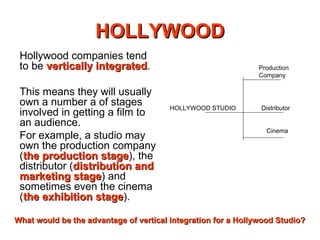
HOLLYWOOD Hollywood companies tend to be  vertically integrated . This means they will usually own a number a of stages involved in getting a film to an audience.  For example, a studio may own the production company ( the production stage ), the distributor ( distribution and marketing stage ) and sometimes even the cinema ( the exhibition stage ).  HOLLYWOOD STUDIO What would be the advantage of vertical integration for a Hollywood Studio? Production Company Distributor Cinema
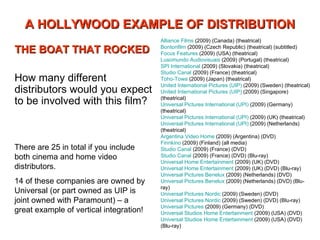
A HOLLYWOOD EXAMPLE OF DISTRIBUTION THE BOAT THAT ROCKED How many different distributors would you expect to be involved with this film? Alliance Films  (2009) (Canada) (theatrical)  Bontonfilm  (2009) (Czech Republic) (theatrical) (subtitled)  Focus Features  (2009) (USA) (theatrical)  Lusomundo Audiovisuais  (2009) (Portugal) (theatrical)  SPI International  (2009) (Slovakia) (theatrical)  Studio Canal  (2009) (France) (theatrical)  Toho-Towa  (2009) (Japan) (theatrical)  United International Pictures (UIP)  (2009) (Sweden) (theatrical)  United International Pictures (UIP)  (2009) (Singapore) (theatrical)  Universal Pictures International (UPI)  (2009) (Germany) (theatrical)  Universal Pictures International (UPI)  (2009) (UK) (theatrical)  Universal Pictures International (UPI)  (2009) (Netherlands) (theatrical)  Argentina Video Home  (2009) (Argentina) (DVD)  Finnkino  (2009) (Finland) (all media)  Studio Canal  (2009) (France) (DVD)  Studio Canal  (2009) (France) (DVD) (Blu-ray)  Universal Home Entertainment  (2009) (UK) (DVD)  Universal Home Entertainment  (2009) (UK) (DVD) (Blu-ray)  Universal Pictures Benelux  (2009) (Netherlands) (DVD)  Universal Pictures Benelux  (2009) (Netherlands) (DVD) (Blu-ray)  Universal Pictures Nordic  (2009) (Sweden) (DVD)  Universal Pictures Nordic  (2009) (Sweden) (DVD) (Blu-ray)  Universal Pictures  (2009) (Germany) (DVD)  Universal Studios Home Entertainment  (2009) (USA) (DVD)  Universal Studios Home Entertainment  (2009) (USA) (DVD) (Blu-ray)  There are 25 in total if you include both cinema and home video distributors.  14 of these companies are owned by Universal (or part owned as UIP is joint owned with Paramount) – a great example of vertical integration!
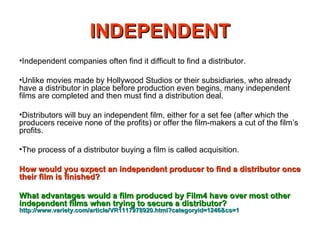
INDEPENDENT Independent companies often find it difficult to find a distributor. Unlike movies made by Hollywood Studios or their subsidiaries, who already have a distributor in place before production even begins, many independent films are completed and then must find a distribution deal. Distributors will buy an independent film, either for a set fee (after which the producers receive none of the profits) or offer the film-makers a cut of the film’s profits. The process of a distributor buying a film is called acquisition.  How would you expect an independent producer to find a distributor once their film is finished? What advantages would a film produced by Film4 have over most other independent films when trying to secure a distributor?   http://www.variety.com/article/VR1117978920.html?categoryid=1246&cs=1

Independent v hollywood distribution

  • 1.
    INSTITUTIONS AND AUDIENCES FILM INDUSTRY DISTRIBUTION (Hollywood v independent )
  • 2.
    DISTRIBUTION? In thefilm business, the term "distribution" refers to the marketing and circulation of movies in theatres, and for home viewing (DVD, Video-On-Demand, Download, Television etc). This will usually be through a cinema first and then onto DVD, although some films are released straight to DVD.
  • 3.
    FILM DISTRIBUTORS Afilm distributor is an independent company, a subsidiary company or occasionally an individual, which acts as the final agent between a film production company and a film exhibitor , to secure the placement of the producer's film on the exhibitor's screen. The Distributor is responsible for: Finding exhibitors to screen the film Ensuring there are enough copies of the film produced for the cinema release and that all the cinemas have them Providing (and often producing) the advertising material to ensure the film receives the highest audience possible and making sure they are with the exhibitors in time for the release date. A film will usually have a different distributor for DVD releases, who will be responsible for the marketing and production of the home release. A film will usually have a different distributor for each country or group of countries. Why would there be different distributors for different countries? How important do you think the role of distributor is in the film industry?
  • 4.
    HOLLYWOOD Vs. INDEPENDENT?How would you expect the process of distribution for Hollywood and Independent films to be different?
  • 5.
    HOLLYWOOD Hollywood companiestend to be vertically integrated . This means they will usually own a number a of stages involved in getting a film to an audience. For example, a studio may own the production company ( the production stage ), the distributor ( distribution and marketing stage ) and sometimes even the cinema ( the exhibition stage ). HOLLYWOOD STUDIO What would be the advantage of vertical integration for a Hollywood Studio? Production Company Distributor Cinema
  • 6.
    A HOLLYWOOD EXAMPLEOF DISTRIBUTION THE BOAT THAT ROCKED How many different distributors would you expect to be involved with this film? Alliance Films (2009) (Canada) (theatrical) Bontonfilm (2009) (Czech Republic) (theatrical) (subtitled) Focus Features (2009) (USA) (theatrical) Lusomundo Audiovisuais (2009) (Portugal) (theatrical) SPI International (2009) (Slovakia) (theatrical) Studio Canal (2009) (France) (theatrical) Toho-Towa (2009) (Japan) (theatrical) United International Pictures (UIP) (2009) (Sweden) (theatrical) United International Pictures (UIP) (2009) (Singapore) (theatrical) Universal Pictures International (UPI) (2009) (Germany) (theatrical) Universal Pictures International (UPI) (2009) (UK) (theatrical) Universal Pictures International (UPI) (2009) (Netherlands) (theatrical) Argentina Video Home (2009) (Argentina) (DVD) Finnkino (2009) (Finland) (all media) Studio Canal (2009) (France) (DVD) Studio Canal (2009) (France) (DVD) (Blu-ray) Universal Home Entertainment (2009) (UK) (DVD) Universal Home Entertainment (2009) (UK) (DVD) (Blu-ray) Universal Pictures Benelux (2009) (Netherlands) (DVD) Universal Pictures Benelux (2009) (Netherlands) (DVD) (Blu-ray) Universal Pictures Nordic (2009) (Sweden) (DVD) Universal Pictures Nordic (2009) (Sweden) (DVD) (Blu-ray) Universal Pictures (2009) (Germany) (DVD) Universal Studios Home Entertainment (2009) (USA) (DVD) Universal Studios Home Entertainment (2009) (USA) (DVD) (Blu-ray) There are 25 in total if you include both cinema and home video distributors. 14 of these companies are owned by Universal (or part owned as UIP is joint owned with Paramount) – a great example of vertical integration!
  • 7.
    INDEPENDENT Independent companiesoften find it difficult to find a distributor. Unlike movies made by Hollywood Studios or their subsidiaries, who already have a distributor in place before production even begins, many independent films are completed and then must find a distribution deal. Distributors will buy an independent film, either for a set fee (after which the producers receive none of the profits) or offer the film-makers a cut of the film’s profits. The process of a distributor buying a film is called acquisition. How would you expect an independent producer to find a distributor once their film is finished? What advantages would a film produced by Film4 have over most other independent films when trying to secure a distributor? http://www.variety.com/article/VR1117978920.html?categoryid=1246&cs=1