The Vietnam
War
Chapter 19
1954-1975
What is a just war?
A just war is that:-

A good intention should be behind it

-

It should be a last resort after diplomatic means failed

-

There must be a chance of success

How should a just war be fought:-

Innocent people should not be harmed

-

Appropriate force should be used to bring the war to a swift conclusion
according to the military commanders recommendations

-

Internationally agreed conventions regulating war must be obeyed
Introduction
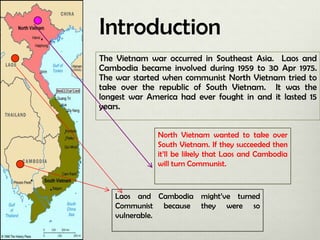
The Vietnam war occurred in Southeast Asia. Laos and
Cambodia became involved during 1959 to 30 Apr 1975.
The war started when communist North Vietnam tried to
take over the republic of South Vietnam. It was the
longest war America had ever fought in and it lasted 15
years.
North Vietnam wanted to take over
South Vietnam. If they succeeded then
it’ll be likely that Laos and Cambodia
will turn Communist.

Laos and Cambodia might’ve turned
Communist because they were so
vulnerable.
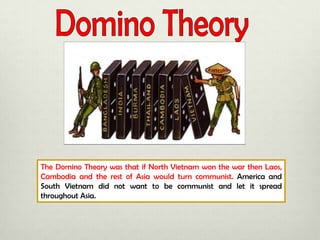
The Domino Theory was that if North Vietnam won the war then Laos,
Cambodia and the rest of Asia would turn communist. America and
South Vietnam did not want to be communist and let it spread
throughout Asia.
Dien Bien Phu
The Battle of Dien Bien Phu (French: Bataille de Diên Biên Phu; Vietnamese:
Chiến dịch Điện Biên Phủ) was the climactic confrontation of the First Indochina
War between the French Union's French Far East Expeditionary Corps and Viet
Minh communist revolutionaries. The battle occurred between March and May
1954 and culminated in a comprehensive French defeat that influenced
negotiations over the future of Indochina at Geneva. Military historian Martin
Windrow wrote that Điện Biên Phủ was "the first time that a non-European colonial
independence movement had evolved through all the stages from guerrilla bands
to a conventionally organized and equipped army able to defeat a modern
Western occupier in pitched battle.”
As a result of blunders in the French decision-making process, the French began
an operation to support the soldiers at Điện Biên Phủ, deep in the hills of
northwestern Vietnam. Its purpose was to cut off Viet Minh supply lines into the
neighboring Kingdom of Laos, a French ally, and tactically draw the Viet Minh into
a major confrontation that would cripple them. Instead, the Viet Minh, under Senior
General Võ Nguyên Giáp, surrounded and besieged the French, who were
unaware of the Viet Minh's possession of heavy artillery (including anti-aircraft
guns) and, more importantly, their ability to move such weapons through extremely
difficult terrain to the mountain crests overlooking the French encampment. The
Viet Minh occupied the highlands around Điện Biên Phủ and were able to
Dien Bien Phu (cont’d)
ensued, reminiscent of the trench
warfare of World War I. The French
repeatedly repulsed Viet Minh assaults
on their positions. Supplies and
reinforcements were delivered by air,
though as the French positions were
overrun and the anti-aircraft fire took its
toll, fewer and fewer of those supplies
reached them. After a two-month siege,
the garrison was overrun and most
French forces surrendered, only a few
successfully escaping to Laos.
Shortly after the battle, the war ended
with the 1954 Geneva Accords, under
which France agreed to withdraw from
its former Indochinese colonies. The
accords partitioned Vietnam in two;
fighting later broke out between
opposing Vietnamese factions in 1959,
resulting in the Vietnam (Second

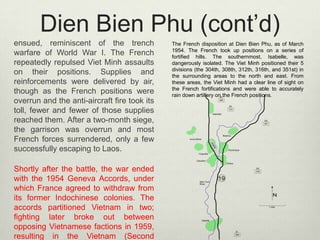
The French disposition at Dien Bien Phu, as of March
1954. The French took up positions on a series of
fortified hills. The southernmost, Isabelle, was
dangerously isolated. The Viet Minh positioned their 5
divisions (the 304th, 308th, 312th, 316th, and 351st) in
the surrounding areas to the north and east. From
these areas, the Viet Minh had a clear line of sight on
the French fortifications and were able to accurately
rain down artillery on the French positions.
Vietnam War 1954-1975
 During the Eisenhower years, the U.S.

assumed the conflict from the French
who were trying to regain their SE Asian
colonial empire after World War II.
 Through the Kennedy years, US troops

trained S. Vietnamese troops to fight the
Reds.
 After the Gulf of Tonkin Resolution,

under LBJ, US troops started to fight
more.
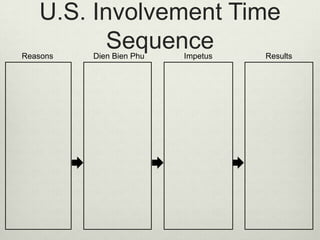
U.S. Involvement Time
Sequence

Reasons

Dien Bien Phu

Impetus

Results
U.S. Involvement Quiz
1.

What was the battle defeat by the French that eventually
involved the United States?

2.

What was the political theory that communism spread
from one country to another?

3.

What were the results of the 1954 Geneva Accords?

4.

Which President involved us in the Vietnam War?

5.

Which President escalated the war?
Vietnam Heats Up
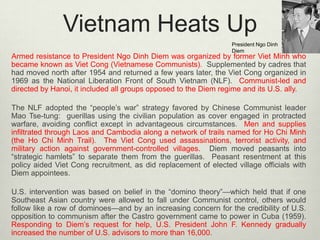
President Ngo Dinh
Diem

Armed resistance to President Ngo Dinh Diem was organized by former Viet Minh who
became known as Viet Cong (Vietnamese Communists). Supplemented by cadres that
had moved north after 1954 and returned a few years later, the Viet Cong organized in
1969 as the National Liberation Front of South Vietnam (NLF). Communist-led and
directed by Hanoi, it included all groups opposed to the Diem regime and its U.S. ally.
The NLF adopted the “people’s war” strategy favored by Chinese Communist leader
Mao Tse-tung: guerillas using the civilian population as cover engaged in protracted
warfare, avoiding conflict except in advantageous circumstances. Men and supplies
infiltrated through Laos and Cambodia along a network of trails named for Ho Chi Minh
(the Ho Chi Minh Trail). The Viet Cong used assassinations, terrorist activity, and
military action against government-controlled villages. Diem moved peasants into
“strategic hamlets” to separate them from the guerillas. Peasant resentment at this
policy aided Viet Cong recruitment, as did replacement of elected village officials with
Diem appointees.
U.S. intervention was based on belief in the “domino theory”—which held that if one
Southeast Asian country were allowed to fall under Communist control, others would
follow like a row of dominoes—and by an increasing concern for the credibility of U.S.
opposition to communism after the Castro government came to power in Cuba (1959).
Responding to Diem’s request for help, U.S. President John F. Kennedy gradually
increased the number of U.S. advisors to more than 16,000.
The Gulf of Tonkin
Incident

In Washington, Kennedy’s successor, Lyndon B. Johnson, moved rapidly to oppose the
insurgents. He authorized the CIA, using mercenaries and U.S. Army Special Forces, to
conduct covert diversionary raids on the northern coast, while the U.S. Navy, in a related
operation, ran electronic intelligence missions in the Gulf of Tonkin. Johnson appointed
GEN William Westmoreland to head the Military Assistance Command- Vietnam (MACV),
increased the number of advisors to 23,000, and expanded economic assistance.
Warning Hanoi that continued support for the revolution would prompt heavy reprisals,
the administration began planning bombing raids on the North.
An incident in the Gulf of Tonkin served to justify escalation of the U.S. effort. On 2 Aug
1964, an American destroyer (USS Maddox DD-731) in international waters involved in
electronic espionage was attacked by North Vietnamese torpedo boats. Unharmed, it
was joined by a second destroyer and on 4 Aug the ships claimed that both had been
attacked. Evidence of the second attack was weak at best (and was later found to be
erroneous), but Johnson ordered retaliatory air strikes and went before Congress to urge
support for the Tonkin Gulf Resolution, a virtual blank check to the executive to conduct
retaliatory military operations. There were only two dissenting votes.

After a Viet Cong attack (Feb 1965) on U.S. Army barracks in Pleiku, the United States
commenced Operation Rolling Thunder, a restricted but massive bombing campaign
against North Vietnam. Protection of air bases then provided the rationale for
introduction of 50,000 U.S. ground combat forces, which were soon increased. The
The Gulf of Tonkin
Incident (cont’d)
not told when their mission and tactics changed from static defense to search-anddestroy, nor was it asked to bear the war’s cost through higher taxes. Desiring both
“guns and butter” Johnson dissimulated, ultimately producing a backlash that full
public and congressional debate at this point might have avoided. The public never
fully supported a war whose purposes were deliberately obscure.
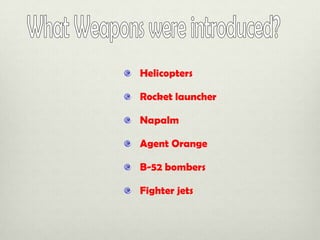
Helicopters
Rocket launcher

Napalm
Agent Orange

B-52 bombers
Fighter jets
The War Escalates Time Sequence
Organizer
Causes
Kennedy Administration
Johnson Administration
The War Escalates Quiz
1. What were the two armed resistance groups that were in

opposition to South Vietnamese President Ngo Dinh
Diem?
2.

What incident escalated the troop levels in Vietnam?

3.

What was the supply route that ran though Laos and
Cambodia?

4.

What did President Johnson authorize in the Gulf of
Tonkin and the maximum amount of troops?

5.

Name two new weapons introduced into the Vietnam War.
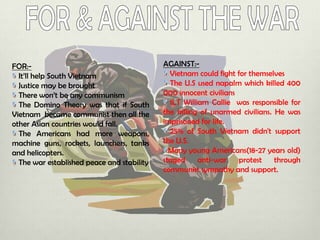
FOR:It’ll help South Vietnam
Justice may be brought
There won’t be any communism
The Domino Theory was that if South
Vietnam became communist then all the
other Asian countries would fall.
The Americans had more weapons,
machine guns, rockets, launchers, tanks
and helicopters.
The war established peace and stability

AGAINST:Vietnam could fight for themselves
The U.S used napalm which killed 400
000 innocent civilians
1LT William Callie was responsible for
the killing of unarmed civilians. He was
imprisoned for life.
25% of South Vietnam didn't support
the U.S.
Many young Americans(18-27 years old)
staged
anti-war
protest
through
communist sympathy and support.
The Opposing Sides
The movement against the involvement of the United States in the Vietnam War
began in the U.S. with demonstrations in 1964 and grew in strength in later
years. The U.S. became polarized between those who advocated continued
involvement in Vietnam, and those who wanted peace.
Many in the peace movement were students, mothers, or anti-establishment
hippies, but there was also involvement from many other groups, including
educators, clergy, academics, journalists, lawyers, physicians (such as
Benjamin Spock and Justin Newlan), military veterans, and ordinary Americans.
Expressions of opposition events ranged from peaceful nonviolent
demonstrations to radical displays of violence.
Violent groups included the Students for a Democratic Society (SDS), Black
Panthers, and the Weather Underground Organization (WUO). All three of
these organizations had communist ties and backing and were kept under strict
surveillance by the FBI. The SDS began as a movement to involve the largest
possible number of American students in the democratic processes had
become by 1969, as a contemporaneous FBI memo summarizes, "an
organization totally dedicated to the destruction of American society...In the
span of seven years, the SDS had evolved into a hard line Marxist-LeninistMaoist organization dedicated to the destruction of Western democratic
traditions and ideals.” The Black Panther Party (originally the Black Panther
Party for Self-Defense) was an African-American revolutionary socialist
organization active in the United States from 1966 until 1982.
The Opposing Sides
The Black Panther Party achieved national and international notoriety through its
involvement in the Black Power movement, illegal activities, police gun battles, social
programs, and U.S. politics of the 1960s and 1970s. The WUO conducted a
campaign of bombings through the mid-1970s, including aiding the jailbreak and
escape of Timothy Leary. The "Days of Rage", their first public demonstration on
October 8, 1969, was a riot in Chicago timed to coincide with the trial of the Chicago
Seven. In 1970 the group issued a "Declaration of a State of War" against the United
States government.
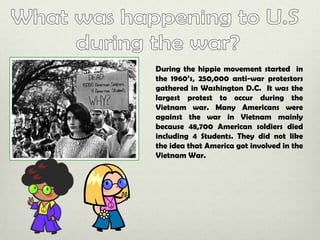
U.S. actress Jane Fonda, aka Hanoi Jane
During the hippie movement started in
the 1960’s, 250,000 anti-war protestors
gathered in Washington D.C. It was the
largest protest to occur during the
Vietnam war. Many Americans were
against the war in Vietnam mainly
because 48,700 American soldiers died
including 4 Students. They did not like
the idea that America got involved in the
Vietnam War.
The Radical Left Turns
Vietnam Sour
Opposition to the war grew with increased U.S. involvement. Leftist college
students, member of traditional pacifist religious groups, long-time peace activists,
and citizens of all ages opposed the conflict. Some were motivated by fear of being
drafted, others out of commitment, some just joined the crowd, and a small minority
became revolutionaries who favored a victory by Ho Chi Minh and a radical
restructuring of U.S. society. College campuses became focal points for rallies and
“teach-ins”—lengthy series of speeches attacking the war. Marches on Washington
began in 1971.
Suspecting that the peace movement was infiltrated by
Communists, President Johnson ordered the FBI to investigate and the CIA to
conduct an illegal domestic infiltration, but they proved only that the radicalism was
homegrown. Although the antiwar movement was frequently associated with the
young, support for the war was actually highest in the age group 20-29. The
effectiveness of the movement is still debated. It clearly boosted North Vietnamese
morale; Hanoi watched it closely and believed that ultimately America’s spirit would
fall victim to attrition, but the Communists were prepared to resist indefinitely
anyway. The movement probably played a role in convincing Lyndon Johnson not
to run for reelection in 1968, and an even larger role in the subsequent victory of
Richard Nixon over the Democrat Hubert Humphrey. It may ultimately have helped
set the parameters for the conflict and prevented an even wider war. Certainly its
presence was an indication of the increasingly divisive effects of war on U.S.
society.
Returning Vietnam
Soldiers Disrespected
The Left has tried to erase the memories that were shown to our returning
soldiers from Vietnam with reports and books written ten to twenty years after
the Vietnam War so as to revise their image and write revisionist history. The
book The Spitting Image: Myth, Memory and the Legacy of Vietnam is a
1998 book by sociologist Jerry Lembcke that is referenced most by liberals
saying that it did not happen.
However, through my personal recollections and military policy during the
time, incidents happened and the military took measures up until the early
1990s to minimize these incidents by not allowing soldiers to wear their
uniforms off of the military reservation. I talked to Vietnam veterans in units
that I served with in the 1970s and 80s and my father-in-law and the treatment
that was received was 180 degrees the opposite from what is received today.
Soldiers were spit on, cursed, called baby killer, (reference to the Americal
23rd IN Division 1LT William Calley massacre at My Lai where 22 women,
children, and elderly were murdered, the division was deactivated and has not
been reactivated since.) physically and verbally abused, and had property
destroyed. On the other side, veterans of the Veterans of Foreign Wars
(VFW) and the American Legion would deride the Vietnam Veterans for losing
the war and not fighting hard enough.
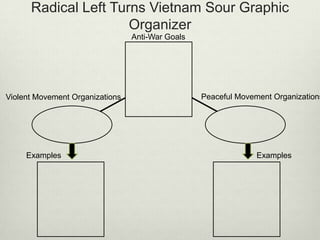
Radical Left Turns Vietnam Sour Graphic
Organizer
Anti-War Goals

Violent Movement Organizations

Examples

Peaceful Movement Organizations

Examples
1.

Radical Left Turns Vietnam Sour
Quiz
Give one of the goals for those against the Vietnam War.

2.

Give three examples of the peaceful protesters.

3.

Give two examples of the violent protesters.

4.

What did all of the protests do for the North Vietnamese and
who was also known as (aka) Hanoi Jane that aided the
enemy?

5.

What were two forms of abuse returning Vietnam veterans
endured from those that opposed the war?
Tet Offensive- Vietnam,
1968
The Tet Offensive
By late 1967, the war was stalemated. Johnson urged Westmoreland to help convince
a public growing more restive that the United States was winning. Although he
promised “light at the end of the tunnel,” increasing casualties as well as growing
disbelief in public pronouncements—the “credibility gap”—fostered increasing
skepticism. U.S. strategy was clearly not producing victory, and Johnson began a
limited reassessment.
Meanwhile, Hanoi began planning a new offensive that involved a series of actions:
first, intensified activity in the border areas including a massive attack against the base
at Khe Sanh to attract ARVN and U.S. forces, followed by attacks on most provincial
capitals and Saigon itself. If these were successful, regular forces poised on the
outskirts of the cities would move to support a general uprising. The initial actions did
draw forces away from the cities, and U.S. attention became riveted on the siege of Khe
Sanh.
Attacks on cities began on Tet, the lunar holiday, 30 Jan 1968. Hitting most provincial
and district capitals and major cities, the Viet Cong also carried out a bold attack on the
U.S. embassy in Saigon. The attack failed, but the attempt shocked U.S. public
opinion. The Tet offensive continued for three weeks. Although they failed in their
military objectives, the revolutionaries won a spectacular propaganda victory. While
captured documents had indicated that the Viet Cong were planning a major offensive,
its size, length, and scope were misjudged, and the Tet Offensive, as it was publicized
in the U.S. media, seemed to confirm fears that the war was unwinnable. The public
The Tet Offensive
(cont’d)
to U.S. casualties, and these had topped a thousand dead a month. Tet appeared
as a defeat, despite official pronouncements to the contrary. The media’s negative
assessment proved more convincing than Washington’s statements of victory
because it confirmed the sense of frustration that most Americans shared over the
conflict.
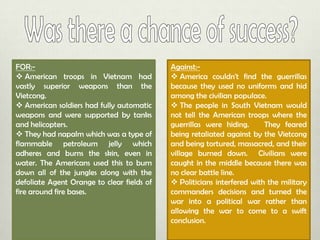
FOR: American troops in Vietnam had
vastly superior weapons than the
Vietcong.
 American soldiers had fully automatic
weapons and were supported by tanks
and helicopters.
 They had napalm which was a type of
flammable petroleum jelly which
adheres and burns the skin, even in
water. The Americans used this to burn
down all of the jungles along with the
defoliate Agent Orange to clear fields of
fire around fire bases.

Against: America couldn't find the guerrillas
because they used no uniforms and hid
among the civilian populace.
 The people in South Vietnam would
not tell the American troops where the
guerrillas were hiding.
They feared
being retaliated against by the Vietcong
and being tortured, massacred, and their
village burned down. Civilians were
caught in the middle because there was
no clear battle line.
 Politicians interfered with the military
commanders decisions and turned the
war into a political war rather than
allowing the war to come to a swift
conclusion.
Following Ho Chi Minh: Memoirs of a North
Vietnamese Colonel (Crawford House, New
South Wales, 202 pages, $24.95)
In a recent interview published in The Wall Street Journal, former colonel Bui Tin who
served on the general staff of the North Vietnamese Army and received the
unconditional surrender of South Vietnam on April 30, 1975; confirmed the American
Tet 1968 military victory: "Our loses were staggering and a complete surprise. Senior
General Võ Nguyên Giáp later told me that Tet had been a military defeat, though we
had gained the planned political advantages when Johnson agreed to negotiate and
did not run for reelection. 
The second and third waves in May and September were,
in retrospect, mistakes. Our forces in the South were nearly wiped out by all the
fighting in 1968. It took us until 1971 to reestablish our presence but we had to use
North Vietnamese troops as local guerrillas. If the American forces had not begun to
withdraw under Nixon in 1969, they could have punished us severely. 
We suffered
badly in 1969 and 1970 as it was." And on strategy: "If Johnson had granted
Westmoreland's requests to enter Laos and block the Ho Chi Minh trail, Hanoi could
not have won the war.... it was the only way to bring sufficient military power to bear on
the fighting in the South. Building and maintaining the trail was a huge effort involving
tens of thousands of soldiers, drivers, repair teams, medical stations, communication
units .... our operations were never compromised by attacks on the trail.
Visits to Hanoi by Jane Fonda and former Attorney General Ramsey Clark and
ministers gave us confidence that we should hold on in the face of battlefield reverses.
We were elated when Jane Fonda, wearing a red Vietnamese dress, said at a press
conference that she was ashamed of American actions in the war and would struggle
along with us .... those people represented the conscience of America .... part of it's
war- making capability, and we turning that power in our favor."
Seeing this on TV led to a
loss of support at home
Hippie bashing!!!
The Vietnam War caused the
breakdown of many families
and also a breakdown of the
Vietnamese culture. Thousands
upon thousands of children
were orphaned during the war
and ended up either in
orphanages or on the streets
without a home. Agent
Orange was used and it
caused a mass amount of
damage to the plants and the
jungle itself as well as U.S.
soldiers. Napalm also caused
damage to the skin and it
burned many innocent people
during the war.
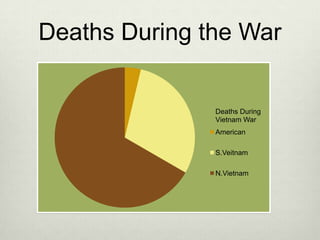
Deaths During the War

Deaths During
Vietnam War
American
S.Veitnam
N.Vietnam
29
Mar
1973
Vietnam
War
Officially
Ends
The Vietnam War is officially over for the United States. The last U.S.
combat soldier leaves Vietnam, but military advisors and some Marines
remain. Over 3 million Americans had served in the war, nearly 60,000 are
dead, some 150,000 are wounded, and at least 1,000 are missing in action.
The military advisors left south Vietnam in 1975 after training the south
Vietnamese to defend themselves and agreeing to a cease fire.
President Gerald Ford, who replaced President Nixon, was shown a video in
which South Vietnam soldiers mobbed a plane intended to evacuate
children.
He said: 'That's it. We're pulling the plug on Vietnam’.
The North Vietnamese rolled into South Vietnam and purged many
thousands of civilians through executions. Next door, Cambodia erected the
‘Killing Fields’ through the efforts of the Khmer Rouge.
Alternate Ending?
Chance of Success?


General Giap was a brilliant, highly respected leader of the North
Vietnam military. The following quote is from his memoirs currently
found in the Vietnam war memorial in Hanoi:



"What we still don't understand is why you Americans stopped the
bombing of Hanoi. You had us on the ropes. If you had pressed us a
little harder, just for another day or two, we were ready to surrender!
It was the same at the battles of TET. You defeated us! We knew
it, and we thought you knew it. But we were elated to notice your
media was definitely helping us. They were causing more disruption
in America than we could in the battlefields. We were ready to
surrender. You had won!"



General Giap has published his memoirs and confirmed what most
Americans knew. The Vietnam war was not lost in Vietnam -- it was
lost at home. The exact same slippery slope, sponsored by the US
media, is currently well underway. It exposes the enormous power of
a biased media to cut out the heart and will of the American
public.



A truism worthy of note: Do not fear the enemy, for they can take
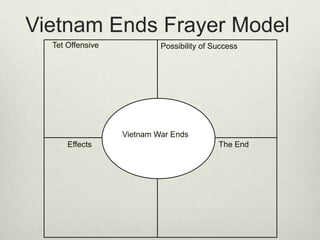
Vietnam Ends Frayer Model
Tet Offensive

Possibility of Success

Vietnam War Ends
Effects

The End
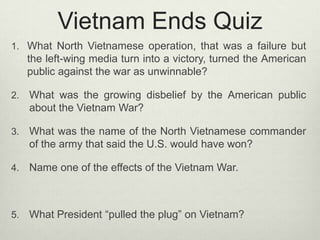
Vietnam Ends Quiz
1. What North Vietnamese operation, that was a failure but

the left-wing media turn into a victory, turned the American
public against the war as unwinnable?
2.

What was the growing disbelief by the American public
about the Vietnam War?

3.

What was the name of the North Vietnamese commander
of the army that said the U.S. would have won?

4.

Name one of the effects of the Vietnam War.

5.

What President “pulled the plug” on Vietnam?

Presentation19

  • 1.
  • 2.
    What is ajust war? A just war is that:- A good intention should be behind it - It should be a last resort after diplomatic means failed - There must be a chance of success How should a just war be fought:- Innocent people should not be harmed - Appropriate force should be used to bring the war to a swift conclusion according to the military commanders recommendations - Internationally agreed conventions regulating war must be obeyed
  • 3.
    Introduction The Vietnam waroccurred in Southeast Asia. Laos and Cambodia became involved during 1959 to 30 Apr 1975. The war started when communist North Vietnam tried to take over the republic of South Vietnam. It was the longest war America had ever fought in and it lasted 15 years. North Vietnam wanted to take over South Vietnam. If they succeeded then it’ll be likely that Laos and Cambodia will turn Communist. Laos and Cambodia might’ve turned Communist because they were so vulnerable.
  • 4.
    The Domino Theorywas that if North Vietnam won the war then Laos, Cambodia and the rest of Asia would turn communist. America and South Vietnam did not want to be communist and let it spread throughout Asia.
  • 5.
    Dien Bien Phu TheBattle of Dien Bien Phu (French: Bataille de Diên Biên Phu; Vietnamese: Chiến dịch Điện Biên Phủ) was the climactic confrontation of the First Indochina War between the French Union's French Far East Expeditionary Corps and Viet Minh communist revolutionaries. The battle occurred between March and May 1954 and culminated in a comprehensive French defeat that influenced negotiations over the future of Indochina at Geneva. Military historian Martin Windrow wrote that Điện Biên Phủ was "the first time that a non-European colonial independence movement had evolved through all the stages from guerrilla bands to a conventionally organized and equipped army able to defeat a modern Western occupier in pitched battle.” As a result of blunders in the French decision-making process, the French began an operation to support the soldiers at Điện Biên Phủ, deep in the hills of northwestern Vietnam. Its purpose was to cut off Viet Minh supply lines into the neighboring Kingdom of Laos, a French ally, and tactically draw the Viet Minh into a major confrontation that would cripple them. Instead, the Viet Minh, under Senior General Võ Nguyên Giáp, surrounded and besieged the French, who were unaware of the Viet Minh's possession of heavy artillery (including anti-aircraft guns) and, more importantly, their ability to move such weapons through extremely difficult terrain to the mountain crests overlooking the French encampment. The Viet Minh occupied the highlands around Điện Biên Phủ and were able to
  • 6.
    Dien Bien Phu(cont’d) ensued, reminiscent of the trench warfare of World War I. The French repeatedly repulsed Viet Minh assaults on their positions. Supplies and reinforcements were delivered by air, though as the French positions were overrun and the anti-aircraft fire took its toll, fewer and fewer of those supplies reached them. After a two-month siege, the garrison was overrun and most French forces surrendered, only a few successfully escaping to Laos. Shortly after the battle, the war ended with the 1954 Geneva Accords, under which France agreed to withdraw from its former Indochinese colonies. The accords partitioned Vietnam in two; fighting later broke out between opposing Vietnamese factions in 1959, resulting in the Vietnam (Second The French disposition at Dien Bien Phu, as of March 1954. The French took up positions on a series of fortified hills. The southernmost, Isabelle, was dangerously isolated. The Viet Minh positioned their 5 divisions (the 304th, 308th, 312th, 316th, and 351st) in the surrounding areas to the north and east. From these areas, the Viet Minh had a clear line of sight on the French fortifications and were able to accurately rain down artillery on the French positions.
  • 7.
    Vietnam War 1954-1975 During the Eisenhower years, the U.S. assumed the conflict from the French who were trying to regain their SE Asian colonial empire after World War II.  Through the Kennedy years, US troops trained S. Vietnamese troops to fight the Reds.  After the Gulf of Tonkin Resolution, under LBJ, US troops started to fight more.
  • 8.
  • 9.
    U.S. Involvement Quiz 1. Whatwas the battle defeat by the French that eventually involved the United States? 2. What was the political theory that communism spread from one country to another? 3. What were the results of the 1954 Geneva Accords? 4. Which President involved us in the Vietnam War? 5. Which President escalated the war?
  • 10.
    Vietnam Heats Up PresidentNgo Dinh Diem Armed resistance to President Ngo Dinh Diem was organized by former Viet Minh who became known as Viet Cong (Vietnamese Communists). Supplemented by cadres that had moved north after 1954 and returned a few years later, the Viet Cong organized in 1969 as the National Liberation Front of South Vietnam (NLF). Communist-led and directed by Hanoi, it included all groups opposed to the Diem regime and its U.S. ally. The NLF adopted the “people’s war” strategy favored by Chinese Communist leader Mao Tse-tung: guerillas using the civilian population as cover engaged in protracted warfare, avoiding conflict except in advantageous circumstances. Men and supplies infiltrated through Laos and Cambodia along a network of trails named for Ho Chi Minh (the Ho Chi Minh Trail). The Viet Cong used assassinations, terrorist activity, and military action against government-controlled villages. Diem moved peasants into “strategic hamlets” to separate them from the guerillas. Peasant resentment at this policy aided Viet Cong recruitment, as did replacement of elected village officials with Diem appointees. U.S. intervention was based on belief in the “domino theory”—which held that if one Southeast Asian country were allowed to fall under Communist control, others would follow like a row of dominoes—and by an increasing concern for the credibility of U.S. opposition to communism after the Castro government came to power in Cuba (1959). Responding to Diem’s request for help, U.S. President John F. Kennedy gradually increased the number of U.S. advisors to more than 16,000.
  • 11.
    The Gulf ofTonkin Incident In Washington, Kennedy’s successor, Lyndon B. Johnson, moved rapidly to oppose the insurgents. He authorized the CIA, using mercenaries and U.S. Army Special Forces, to conduct covert diversionary raids on the northern coast, while the U.S. Navy, in a related operation, ran electronic intelligence missions in the Gulf of Tonkin. Johnson appointed GEN William Westmoreland to head the Military Assistance Command- Vietnam (MACV), increased the number of advisors to 23,000, and expanded economic assistance. Warning Hanoi that continued support for the revolution would prompt heavy reprisals, the administration began planning bombing raids on the North. An incident in the Gulf of Tonkin served to justify escalation of the U.S. effort. On 2 Aug 1964, an American destroyer (USS Maddox DD-731) in international waters involved in electronic espionage was attacked by North Vietnamese torpedo boats. Unharmed, it was joined by a second destroyer and on 4 Aug the ships claimed that both had been attacked. Evidence of the second attack was weak at best (and was later found to be erroneous), but Johnson ordered retaliatory air strikes and went before Congress to urge support for the Tonkin Gulf Resolution, a virtual blank check to the executive to conduct retaliatory military operations. There were only two dissenting votes. After a Viet Cong attack (Feb 1965) on U.S. Army barracks in Pleiku, the United States commenced Operation Rolling Thunder, a restricted but massive bombing campaign against North Vietnam. Protection of air bases then provided the rationale for introduction of 50,000 U.S. ground combat forces, which were soon increased. The
  • 12.
    The Gulf ofTonkin Incident (cont’d) not told when their mission and tactics changed from static defense to search-anddestroy, nor was it asked to bear the war’s cost through higher taxes. Desiring both “guns and butter” Johnson dissimulated, ultimately producing a backlash that full public and congressional debate at this point might have avoided. The public never fully supported a war whose purposes were deliberately obscure.
  • 13.
  • 14.
    The War EscalatesTime Sequence Organizer Causes Kennedy Administration Johnson Administration
  • 15.
    The War EscalatesQuiz 1. What were the two armed resistance groups that were in opposition to South Vietnamese President Ngo Dinh Diem? 2. What incident escalated the troop levels in Vietnam? 3. What was the supply route that ran though Laos and Cambodia? 4. What did President Johnson authorize in the Gulf of Tonkin and the maximum amount of troops? 5. Name two new weapons introduced into the Vietnam War.
  • 16.
    FOR:It’ll help SouthVietnam Justice may be brought There won’t be any communism The Domino Theory was that if South Vietnam became communist then all the other Asian countries would fall. The Americans had more weapons, machine guns, rockets, launchers, tanks and helicopters. The war established peace and stability AGAINST:Vietnam could fight for themselves The U.S used napalm which killed 400 000 innocent civilians 1LT William Callie was responsible for the killing of unarmed civilians. He was imprisoned for life. 25% of South Vietnam didn't support the U.S. Many young Americans(18-27 years old) staged anti-war protest through communist sympathy and support.
  • 17.
    The Opposing Sides Themovement against the involvement of the United States in the Vietnam War began in the U.S. with demonstrations in 1964 and grew in strength in later years. The U.S. became polarized between those who advocated continued involvement in Vietnam, and those who wanted peace. Many in the peace movement were students, mothers, or anti-establishment hippies, but there was also involvement from many other groups, including educators, clergy, academics, journalists, lawyers, physicians (such as Benjamin Spock and Justin Newlan), military veterans, and ordinary Americans. Expressions of opposition events ranged from peaceful nonviolent demonstrations to radical displays of violence. Violent groups included the Students for a Democratic Society (SDS), Black Panthers, and the Weather Underground Organization (WUO). All three of these organizations had communist ties and backing and were kept under strict surveillance by the FBI. The SDS began as a movement to involve the largest possible number of American students in the democratic processes had become by 1969, as a contemporaneous FBI memo summarizes, "an organization totally dedicated to the destruction of American society...In the span of seven years, the SDS had evolved into a hard line Marxist-LeninistMaoist organization dedicated to the destruction of Western democratic traditions and ideals.” The Black Panther Party (originally the Black Panther Party for Self-Defense) was an African-American revolutionary socialist organization active in the United States from 1966 until 1982.
  • 18.
    The Opposing Sides TheBlack Panther Party achieved national and international notoriety through its involvement in the Black Power movement, illegal activities, police gun battles, social programs, and U.S. politics of the 1960s and 1970s. The WUO conducted a campaign of bombings through the mid-1970s, including aiding the jailbreak and escape of Timothy Leary. The "Days of Rage", their first public demonstration on October 8, 1969, was a riot in Chicago timed to coincide with the trial of the Chicago Seven. In 1970 the group issued a "Declaration of a State of War" against the United States government. U.S. actress Jane Fonda, aka Hanoi Jane
  • 19.
    During the hippiemovement started in the 1960’s, 250,000 anti-war protestors gathered in Washington D.C. It was the largest protest to occur during the Vietnam war. Many Americans were against the war in Vietnam mainly because 48,700 American soldiers died including 4 Students. They did not like the idea that America got involved in the Vietnam War.
  • 20.
    The Radical LeftTurns Vietnam Sour Opposition to the war grew with increased U.S. involvement. Leftist college students, member of traditional pacifist religious groups, long-time peace activists, and citizens of all ages opposed the conflict. Some were motivated by fear of being drafted, others out of commitment, some just joined the crowd, and a small minority became revolutionaries who favored a victory by Ho Chi Minh and a radical restructuring of U.S. society. College campuses became focal points for rallies and “teach-ins”—lengthy series of speeches attacking the war. Marches on Washington began in 1971. Suspecting that the peace movement was infiltrated by Communists, President Johnson ordered the FBI to investigate and the CIA to conduct an illegal domestic infiltration, but they proved only that the radicalism was homegrown. Although the antiwar movement was frequently associated with the young, support for the war was actually highest in the age group 20-29. The effectiveness of the movement is still debated. It clearly boosted North Vietnamese morale; Hanoi watched it closely and believed that ultimately America’s spirit would fall victim to attrition, but the Communists were prepared to resist indefinitely anyway. The movement probably played a role in convincing Lyndon Johnson not to run for reelection in 1968, and an even larger role in the subsequent victory of Richard Nixon over the Democrat Hubert Humphrey. It may ultimately have helped set the parameters for the conflict and prevented an even wider war. Certainly its presence was an indication of the increasingly divisive effects of war on U.S. society.
  • 21.
    Returning Vietnam Soldiers Disrespected TheLeft has tried to erase the memories that were shown to our returning soldiers from Vietnam with reports and books written ten to twenty years after the Vietnam War so as to revise their image and write revisionist history. The book The Spitting Image: Myth, Memory and the Legacy of Vietnam is a 1998 book by sociologist Jerry Lembcke that is referenced most by liberals saying that it did not happen. However, through my personal recollections and military policy during the time, incidents happened and the military took measures up until the early 1990s to minimize these incidents by not allowing soldiers to wear their uniforms off of the military reservation. I talked to Vietnam veterans in units that I served with in the 1970s and 80s and my father-in-law and the treatment that was received was 180 degrees the opposite from what is received today. Soldiers were spit on, cursed, called baby killer, (reference to the Americal 23rd IN Division 1LT William Calley massacre at My Lai where 22 women, children, and elderly were murdered, the division was deactivated and has not been reactivated since.) physically and verbally abused, and had property destroyed. On the other side, veterans of the Veterans of Foreign Wars (VFW) and the American Legion would deride the Vietnam Veterans for losing the war and not fighting hard enough.
  • 22.
    Radical Left TurnsVietnam Sour Graphic Organizer Anti-War Goals Violent Movement Organizations Examples Peaceful Movement Organizations Examples
  • 23.
    1. Radical Left TurnsVietnam Sour Quiz Give one of the goals for those against the Vietnam War. 2. Give three examples of the peaceful protesters. 3. Give two examples of the violent protesters. 4. What did all of the protests do for the North Vietnamese and who was also known as (aka) Hanoi Jane that aided the enemy? 5. What were two forms of abuse returning Vietnam veterans endured from those that opposed the war?
  • 25.
  • 26.
    The Tet Offensive Bylate 1967, the war was stalemated. Johnson urged Westmoreland to help convince a public growing more restive that the United States was winning. Although he promised “light at the end of the tunnel,” increasing casualties as well as growing disbelief in public pronouncements—the “credibility gap”—fostered increasing skepticism. U.S. strategy was clearly not producing victory, and Johnson began a limited reassessment. Meanwhile, Hanoi began planning a new offensive that involved a series of actions: first, intensified activity in the border areas including a massive attack against the base at Khe Sanh to attract ARVN and U.S. forces, followed by attacks on most provincial capitals and Saigon itself. If these were successful, regular forces poised on the outskirts of the cities would move to support a general uprising. The initial actions did draw forces away from the cities, and U.S. attention became riveted on the siege of Khe Sanh. Attacks on cities began on Tet, the lunar holiday, 30 Jan 1968. Hitting most provincial and district capitals and major cities, the Viet Cong also carried out a bold attack on the U.S. embassy in Saigon. The attack failed, but the attempt shocked U.S. public opinion. The Tet offensive continued for three weeks. Although they failed in their military objectives, the revolutionaries won a spectacular propaganda victory. While captured documents had indicated that the Viet Cong were planning a major offensive, its size, length, and scope were misjudged, and the Tet Offensive, as it was publicized in the U.S. media, seemed to confirm fears that the war was unwinnable. The public
  • 27.
    The Tet Offensive (cont’d) toU.S. casualties, and these had topped a thousand dead a month. Tet appeared as a defeat, despite official pronouncements to the contrary. The media’s negative assessment proved more convincing than Washington’s statements of victory because it confirmed the sense of frustration that most Americans shared over the conflict.
  • 28.
    FOR: American troopsin Vietnam had vastly superior weapons than the Vietcong.  American soldiers had fully automatic weapons and were supported by tanks and helicopters.  They had napalm which was a type of flammable petroleum jelly which adheres and burns the skin, even in water. The Americans used this to burn down all of the jungles along with the defoliate Agent Orange to clear fields of fire around fire bases. Against: America couldn't find the guerrillas because they used no uniforms and hid among the civilian populace.  The people in South Vietnam would not tell the American troops where the guerrillas were hiding. They feared being retaliated against by the Vietcong and being tortured, massacred, and their village burned down. Civilians were caught in the middle because there was no clear battle line.  Politicians interfered with the military commanders decisions and turned the war into a political war rather than allowing the war to come to a swift conclusion.
  • 29.
    Following Ho ChiMinh: Memoirs of a North Vietnamese Colonel (Crawford House, New South Wales, 202 pages, $24.95) In a recent interview published in The Wall Street Journal, former colonel Bui Tin who served on the general staff of the North Vietnamese Army and received the unconditional surrender of South Vietnam on April 30, 1975; confirmed the American Tet 1968 military victory: "Our loses were staggering and a complete surprise. Senior General Võ Nguyên Giáp later told me that Tet had been a military defeat, though we had gained the planned political advantages when Johnson agreed to negotiate and did not run for reelection. 
The second and third waves in May and September were, in retrospect, mistakes. Our forces in the South were nearly wiped out by all the fighting in 1968. It took us until 1971 to reestablish our presence but we had to use North Vietnamese troops as local guerrillas. If the American forces had not begun to withdraw under Nixon in 1969, they could have punished us severely. 
We suffered badly in 1969 and 1970 as it was." And on strategy: "If Johnson had granted Westmoreland's requests to enter Laos and block the Ho Chi Minh trail, Hanoi could not have won the war.... it was the only way to bring sufficient military power to bear on the fighting in the South. Building and maintaining the trail was a huge effort involving tens of thousands of soldiers, drivers, repair teams, medical stations, communication units .... our operations were never compromised by attacks on the trail. Visits to Hanoi by Jane Fonda and former Attorney General Ramsey Clark and ministers gave us confidence that we should hold on in the face of battlefield reverses. We were elated when Jane Fonda, wearing a red Vietnamese dress, said at a press conference that she was ashamed of American actions in the war and would struggle along with us .... those people represented the conscience of America .... part of it's war- making capability, and we turning that power in our favor."
  • 30.
    Seeing this onTV led to a loss of support at home
  • 31.
  • 32.
    The Vietnam Warcaused the breakdown of many families and also a breakdown of the Vietnamese culture. Thousands upon thousands of children were orphaned during the war and ended up either in orphanages or on the streets without a home. Agent Orange was used and it caused a mass amount of damage to the plants and the jungle itself as well as U.S. soldiers. Napalm also caused damage to the skin and it burned many innocent people during the war.
  • 33.
    Deaths During theWar Deaths During Vietnam War American S.Veitnam N.Vietnam
  • 34.
    29 Mar 1973 Vietnam War Officially Ends The Vietnam Waris officially over for the United States. The last U.S. combat soldier leaves Vietnam, but military advisors and some Marines remain. Over 3 million Americans had served in the war, nearly 60,000 are dead, some 150,000 are wounded, and at least 1,000 are missing in action. The military advisors left south Vietnam in 1975 after training the south Vietnamese to defend themselves and agreeing to a cease fire. President Gerald Ford, who replaced President Nixon, was shown a video in which South Vietnam soldiers mobbed a plane intended to evacuate children. He said: 'That's it. We're pulling the plug on Vietnam’. The North Vietnamese rolled into South Vietnam and purged many thousands of civilians through executions. Next door, Cambodia erected the ‘Killing Fields’ through the efforts of the Khmer Rouge.
  • 35.
    Alternate Ending? Chance ofSuccess?  General Giap was a brilliant, highly respected leader of the North Vietnam military. The following quote is from his memoirs currently found in the Vietnam war memorial in Hanoi:  "What we still don't understand is why you Americans stopped the bombing of Hanoi. You had us on the ropes. If you had pressed us a little harder, just for another day or two, we were ready to surrender! It was the same at the battles of TET. You defeated us! We knew it, and we thought you knew it. But we were elated to notice your media was definitely helping us. They were causing more disruption in America than we could in the battlefields. We were ready to surrender. You had won!"  General Giap has published his memoirs and confirmed what most Americans knew. The Vietnam war was not lost in Vietnam -- it was lost at home. The exact same slippery slope, sponsored by the US media, is currently well underway. It exposes the enormous power of a biased media to cut out the heart and will of the American public.  A truism worthy of note: Do not fear the enemy, for they can take
  • 36.
    Vietnam Ends FrayerModel Tet Offensive Possibility of Success Vietnam War Ends Effects The End
  • 37.
    Vietnam Ends Quiz 1.What North Vietnamese operation, that was a failure but the left-wing media turn into a victory, turned the American public against the war as unwinnable? 2. What was the growing disbelief by the American public about the Vietnam War? 3. What was the name of the North Vietnamese commander of the army that said the U.S. would have won? 4. Name one of the effects of the Vietnam War. 5. What President “pulled the plug” on Vietnam?