Europe and North America
Chapter 29 1945-Present
The Atomic Age
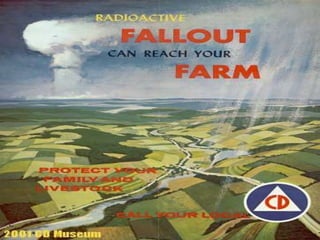
Living in the 1950’s with the threat of
a Nuclear War
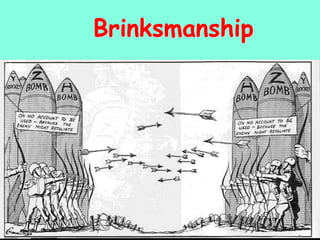
Brinksmanship
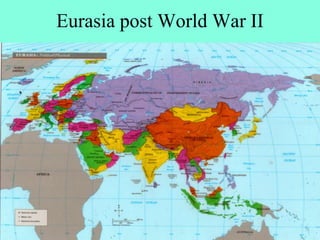
Eurasia post World War II
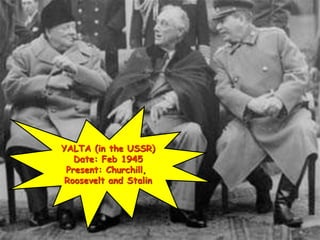
YALTA (in the USSR)
Date: Feb 1945
Present: Churchill,
Roosevelt and Stalin
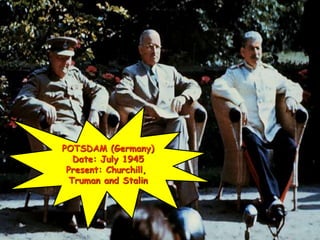
POTSDAM (Germany)
Date: July 1945
Present: Churchill,
Truman and Stalin
Iron Curtain –
A term used by
Winston Churchill
to describe the
separating of
Those communist
lands of East
Europe from the
West.
Improve your knowledge
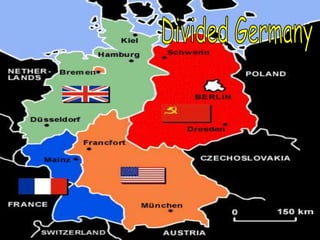
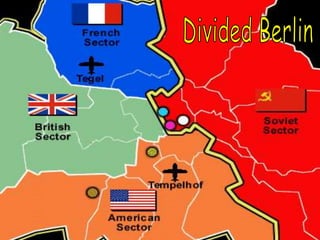
• The Russians took very high casualties to
capture Berlin in May 1945. They spent the
early occupation trying to take over all
zones of the city but were stopped by
German democrats such as Willy Brandt
and Konrad Adenauer. Reluctantly the
Russians had to admit the Americans,
French and British to their respective
zones.
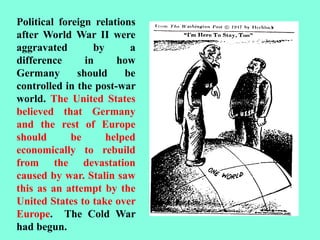
Political foreign relations
after World War II were
aggravated by a
difference in how
Germany should be
controlled in the post-war
world. The United States
believed that Germany
and the rest of Europe
should be helped
economically to rebuild
from the devastation
caused by war. Stalin saw
this as an attempt by the
United States to take over
Europe. The Cold War
had begun.
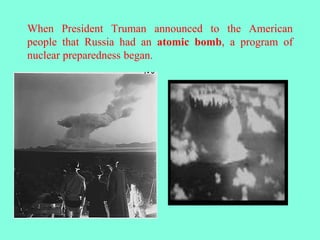
When President Truman announced to the American
people that Russia had an atomic bomb, a program of
nuclear preparedness began.
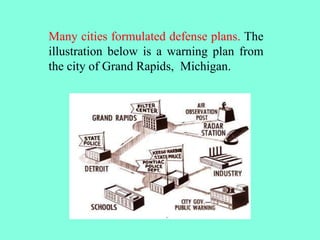
Many cities formulated defense plans. The
illustration below is a warning plan from
the city of Grand Rapids, Michigan.
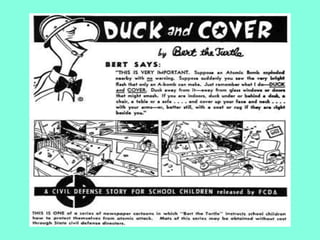
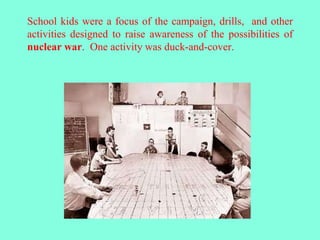
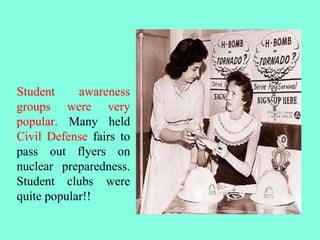
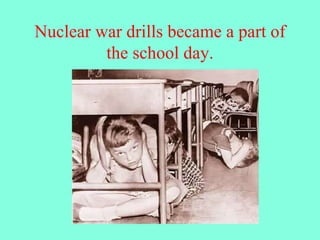
School kids were a focus of the campaign, drills, and other
activities designed to raise awareness of the possibilities of
nuclear war. One activity was duck-and-cover.
Student awareness
groups were very
popular. Many held
Civil Defense fairs to
pass out flyers on
nuclear preparedness.
Student clubs were
quite popular!!
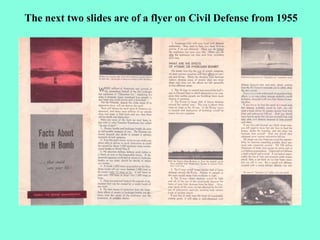
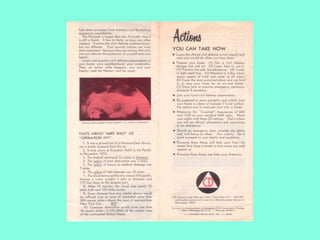
The next two slides are of a flyer on Civil Defense from 1955
Nuclear war drills became a part of
the school day.
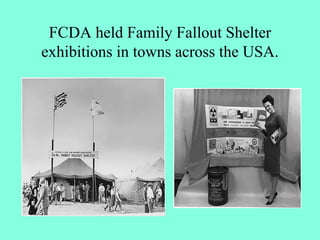
FCDA held Family Fallout Shelter
exhibitions in towns across the USA.
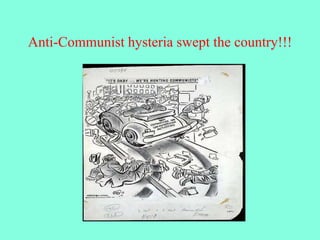
Anti-Communist hysteria swept the country!!!
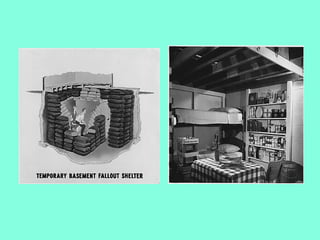
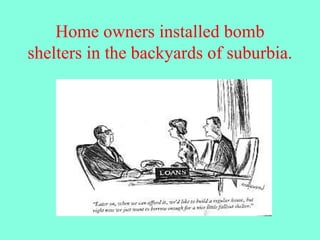
Home owners installed bomb
shelters in the backyards of suburbia.
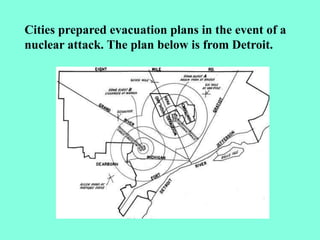
Cities prepared evacuation plans in the event of a
nuclear attack. The plan below is from Detroit.
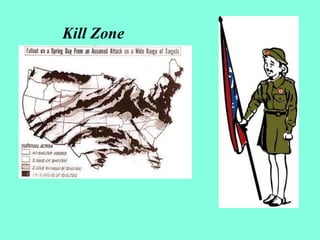
Kill Zone
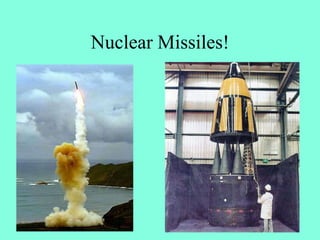
Nuclear Missiles!
Improve your knowledge
• The nuclear bomb gave America a lead
which was expected to last at least 5
years. The rapid Russian development of
nuclear technology, helped by the work of
the “atom spies” was a shock.
Significantly, Russia hurriedly declared
war against Japan at the beginning of
August 1945 and rushed to advance into
Asia to stake out a position for the post-
war settlement. This helped make both the
Korean and Vietnamese conflicts more
likely.
Atomic Age Frayer Model
Atomic Age
Reason for it to occur Schools
CD Interventions Home
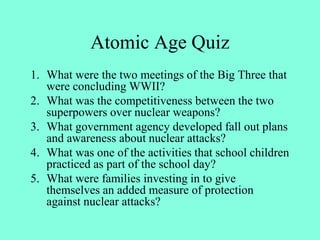
Atomic Age Quiz
1. What were the two meetings of the Big Three that
were concluding WWII?
2. What was the competitiveness between the two
superpowers over nuclear weapons?
3. What government agency developed fall out plans
and awareness about nuclear attacks?
4. What was one of the activities that school children
practiced as part of the school day?
5. What were families investing in to give
themselves an added measure of protection
against nuclear attacks?
How did the USA try to contain
communism?
Cold War
The term cold war refers to the strategic and political struggle that developed after
World War II between the United States and its Western European allies, on one hand,
and the USSR and Communist countries, on the other. The expression was coined by
the American journalist Herbert Bayard Swope in a 1947 speech he wrote for financier
Bernard Baruch.
The cold war initially centered on the use of USSR military forces to install Communist
government in Eastern Europe. These Soviet actions ran counter to the U.S.
government’s insistence upon the right of self-determination for the peoples of Eastern
Europe and raised fears that the USSR, after gaining control of Eastern Europe, would
try to communize Western Europe. The USSR had suffered enormous losses in the war
against Nazi Germany and looked upon Eastern Europe as a bulwark against another
invasion from the West. The Soviet leaders considered U.S. objections to Soviet actions
in Poland, Hungary, and Romania a betrayal of wartime understandings about spheres
of influence in Europe. Thus they placed Eastern Europe behind a military and political
barrier known in the West as the Iron Curtain—coined by Winston Churchill.
The Truman Doctrine
Truman, who has been chosen as vice president for domestic political reasons, was poorly
prepared to assume the presidency. He had no experience in foreign affairs, knew little about
Roosevelt’s intentions, and was intimidated by the giant shoes he now had to fill. His first
decisions were dictated by events or plans already laid. In July, two months after the German
forces surrendered, he met at Potsdam, Ger., with Stalin and Churchill (who was succeeded at the
conference by Clement Attlee) to discuss future operations against Japan and a peace settlement
for Europe. Little was accomplished, and there would not be another meeting between Soviet
and American heads of state for 10 years.
Hopes that good relations between the superpowers would ensure world peace soon faded as a
result of the Stalinization of eastern Europe and Soviet support of communist insurgencies in
various parts of the globe. Events came to a head in 1947 when Britain, weakened by a failing
economy, decided to pull out of the eastern Mediterranean. This would leave both Greece, where
a communist-inspired civil war was raging, and Turkey to the mercies of the Soviet Union.
Truman now came into his own as a national leader, asking Congress to appropriate aid to
Greece and Turkey and asserting, in effect, that henceforth the United States must help free
peoples in general to resist communist aggression. This policy, known as the Truman Doctrine,
has been criticized for committing the United States to the support of unworthy regimes and for
taking on greater burdens than it was safe to assume. At first, however, the Truman Doctrine
was narrowly applied. Congress appropriated $400,000,000 for Greece and Turkey, saving both
from falling into
The Truman Doctrine (cont’d)
unfriendly hands, and thereafter the United States relied mainly on economic assistance to
support its foreign policy.
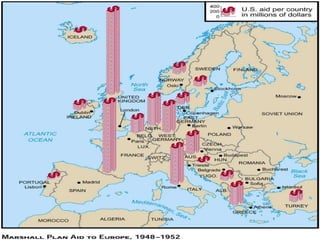
The keystone of this policy, and its greatest success, was the European Recovery Program,
usually called the Marshall Plan. Thus, in June 1947 Secretary of State George C. Marshall
proposed the greatest foreign-aid program in world history in order to bring Europe back to
economic health. In 1948, Congress created the Economic Cooperation Administration and over
the next five years poured some $13,000,000,000 worth of aid into western Europe. (Assistance
was offered to Eastern-bloc countries also, but they were forced by Stalin to decline.)
U.S. policy for limiting Soviet expansion had developed with remarkable speed. Soon after the
collapse of hopes for world peace in 1945 and 1946, the Truman administration had accepted the
danger posed by Soviet aggression and resolved to shore up noncommunist defenses at their
most critical points. This policy, known as containment, a term suggested by its principal
framer, George Kennan, resulted in the Truman Doctrine and the Marshall Plan, as well as in the
decision to make the western zones of Germany (later West Germany) a pillar of strength. When
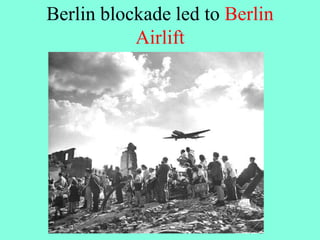
the Soviet Union countered this development in June 1948 by blocking all surface routes into the
western-occupied zones of Berlin (Berlin Blockade), Britain, and the United States supplied the
sectors by air for almost a year until the Soviet Union called off the blockade. A logical
culmination of U.S. policy was the creation in 1949 of the North Atlantic Treaty Organization
(NATO), a military alliance among 12 (later 16) nations to resist Soviet aggression.
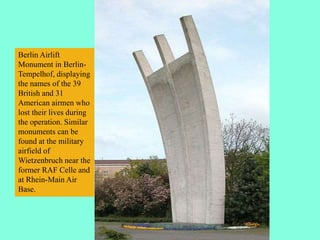
Berlin Airlift
Monument in Berlin-
Tempelhof, displaying
the names of the 39
British and 31
American airmen who
lost their lives during
the operation. Similar
monuments can be
found at the military
airfield of
Wietzenbruch near the
former RAF Celle and
at Rhein-Main Air
Base.
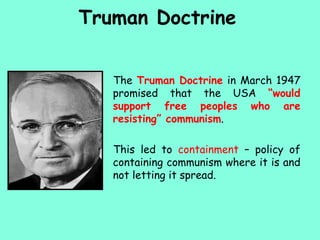
Truman Doctrine
The Truman Doctrine in March 1947
promised that the USA “would
support free peoples who are
resisting” communism.
This led to containment – policy of
containing communism where it is and
not letting it spread.
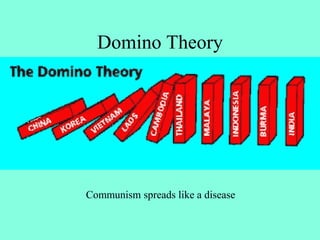
Domino Theory
Communism spreads like a disease
Marshall Plan
The Marshall Plan, formally known as the European Recovery Program, was a program of
U.S. economic and technical assistance to 16 European countries after World War II. Its
objectives were to restore the war-ravaged West European economy and to stimulate
economic growth and trade among the major non-Communist countries.
In early 1947 as the cold war between the United States and the USSR began to take shape,
U.S. policymakers concluded that Western Europe would require substantial economic aid
in order to attain political stability. This program, announced by Secretary of State George
C. Marshall in an address to Harvard University on 5 Jun 1947, proposed that the European
countries draw up a unified plan for economic reconstruction to be funded by the United
States. The USSR and other countries of Eastern Europe were invited to join, but they
declined. The Economic Cooperation administration was established by the United States
to administer the plan, with Paul G. Hoffman as head. The 16 West European countries
then formed the Organization for European Economic Cooperation to coordinate the
program.
From 1948 to 1952, the 16 participating countries received $13.15 billion in U.S. aid. The
program succeeded in reviving the West European economy and setting it on the path of
long-term growth.
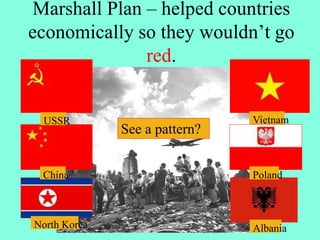
Marshall Plan – helped countries
economically so they wouldn’t go
red.
See a pattern?
USSR
China
North Korea
Vietnam
Poland
Albania
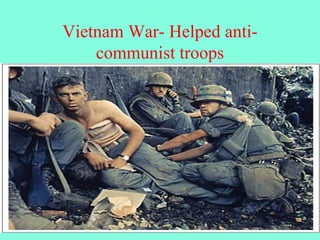
Vietnam War- Helped anti-
communist troops
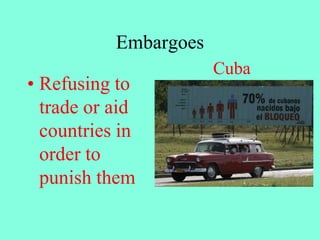
Embargoes
• Refusing to
trade or aid
countries in
order to
punish them
Cuba
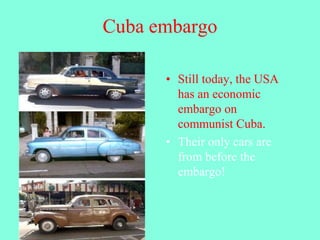
Cuba embargo
• Still today, the USA
has an economic
embargo on
communist Cuba.
• Their only cars are
from before the
embargo!
Marshall Plan
USA’s plan to send food, blankets,
and fuel to Europe to help them
AND to keep them from turning
communist.
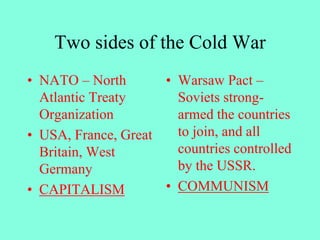
Two sides of the Cold War
• NATO – North
Atlantic Treaty
Organization
• USA, France, Great
Britain, West
Germany
• CAPITALISM
• Warsaw Pact –
Soviets strong-
armed the countries
to join, and all
countries controlled
by the USSR.
• COMMUNISM
Cold War
• The Cold War was a period after
WWII when the USA and the Soviet
Union were the super powers rivaling
for their spheres of world influence.
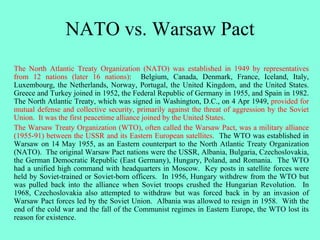
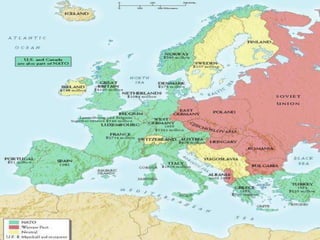
NATO vs. Warsaw Pact
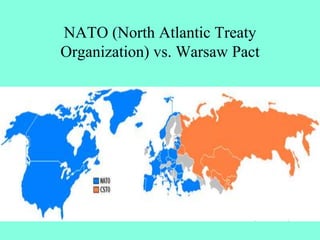
The North Atlantic Treaty Organization (NATO) was established in 1949 by representatives
from 12 nations (later 16 nations): Belgium, Canada, Denmark, France, Iceland, Italy,
Luxembourg, the Netherlands, Norway, Portugal, the United Kingdom, and the United States.
Greece and Turkey joined in 1952, the Federal Republic of Germany in 1955, and Spain in 1982.
The North Atlantic Treaty, which was signed in Washington, D.C., on 4 Apr 1949, provided for
mutual defense and collective security, primarily against the threat of aggression by the Soviet
Union. It was the first peacetime alliance joined by the United States.
The Warsaw Treaty Organization (WTO), often called the Warsaw Pact, was a military alliance
(1955-91) between the USSR and its Eastern European satellites. The WTO was established in
Warsaw on 14 May 1955, as an Eastern counterpart to the North Atlantic Treaty Organization
(NATO). The original Warsaw Pact nations were the USSR, Albania, Bulgaria, Czechoslovakia,
the German Democratic Republic (East Germany), Hungary, Poland, and Romania. The WTO
had a unified high command with headquarters in Moscow. Key posts in satellite forces were
held by Soviet-trained or Soviet-born officers. In 1956, Hungary withdrew from the WTO but
was pulled back into the alliance when Soviet troops crushed the Hungarian Revolution. In
1968, Czechoslovakia also attempted to withdraw but was forced back in by an invasion of
Warsaw Pact forces led by the Soviet Union. Albania was allowed to resign in 1958. With the
end of the cold war and the fall of the Communist regimes in Eastern Europe, the WTO lost its
reason for existence.
NATO (North Atlantic Treaty
Organization) vs. Warsaw Pact
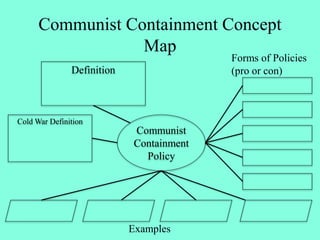
Communist Containment Concept
Map
Communist
Containment
Policy
Definition
Examples
Forms of Policies
(pro or con)
Cold War Definition
Communist Containment Quiz
1. What were the two “super powers” that emerged
from WWII?
2. When the Soviet Union took control of Eastern
Europe, what did Winston Churchill say divided
Europe?
3. Name one of the policies of communist
containment (for or against).
4. Give an example of conflicts during the beginning
of communist containment.
5. What two organizations were developed as a
result of the Cold War?
Berlin blockade led to Berlin
Airlift
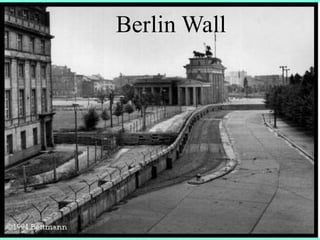
Berlin WallBerlin Wall
The Berlin Wall
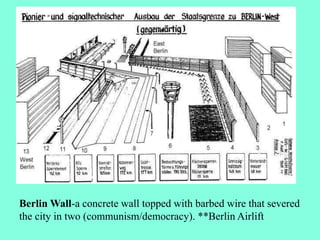
The Berlin Wall (German: Berliner Mauer), was a barrier that surrounded West Berlin and
prevented access to it from East Berlin and adjacent areas of East Germany during the
period from 1961 to 1989. In the years between 1949 and 1961, about 2.5 million East
Germans had fled from East to West Germany, including steadily rising numbers of skilled
workers, professionals, and intellectuals. Their loss threatened to destroy the economic
viability of the East German state. In response, East Germany built a barrier to close off
East Germans’ access to West Berlin (and hence West Germany). This barrier, the Berlin
Wall, was first erected on the night of 12-13 Aug 1961, as the result of a decree passed on
12 Aug by the East German Volkskammer (“People’s Chamber”). The original wall, built
of barbed wire and cinder blocks, was subsequently replaced by a series of concrete walls
(up to 15 ft. high) that were topped with barbed wire and guarded with watchtowers, gun
emplacement, and mines. By the 1980’s, this system of walls, electrified fences, and
fortifications extended 28 miles through Berlin, dividing the two parts of the city, and
extended a further 75 miles around West Berlin, separating it from the rest of East
Germany.
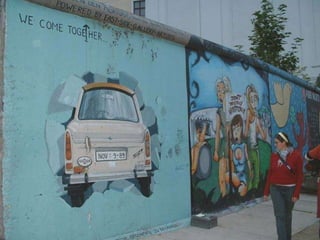
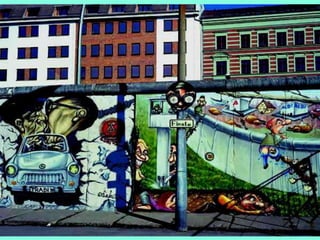
Berlin Wall-a concrete wall topped with barbed wire that severed
the city in two (communism/democracy). **Berlin Airlift
Berlin Wall
• Berlin is Germany’s capital
city.
• The Soviets built the wall to
keep defectors from escaping to
the American sector.
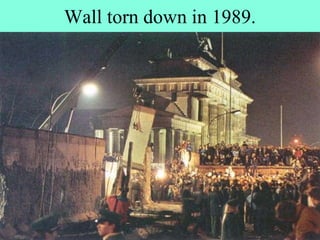
Wall torn down in 1989.
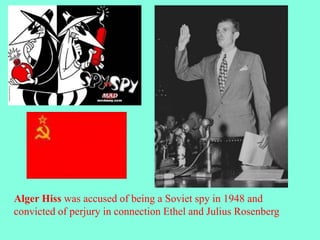
Alger Hiss was accused of being a Soviet spy in 1948 and
convicted of perjury in connection Ethel and Julius Rosenberg
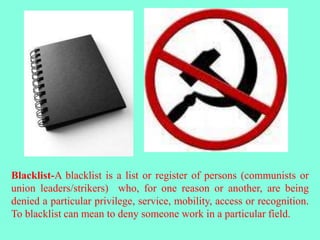
Blacklist-A blacklist is a list or register of persons (communists or
union leaders/strikers) who, for one reason or another, are being
denied a particular privilege, service, mobility, access or recognition.
To blacklist can mean to deny someone work in a particular field.
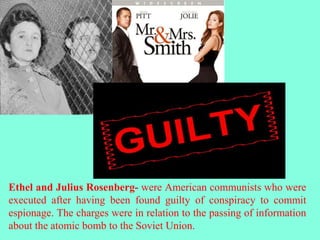
Ethel and Julius Rosenberg- were American communists who were
executed after having been found guilty of conspiracy to commit
espionage. The charges were in relation to the passing of information
about the atomic bomb to the Soviet Union.
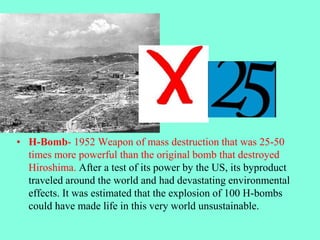
• H-Bomb- 1952 Weapon of mass destruction that was 25-50
times more powerful than the original bomb that destroyed
Hiroshima. After a test of its power by the US, its byproduct
traveled around the world and had devastating environmental
effects. It was estimated that the explosion of 100 H-bombs
could have made life in this very world unsustainable.
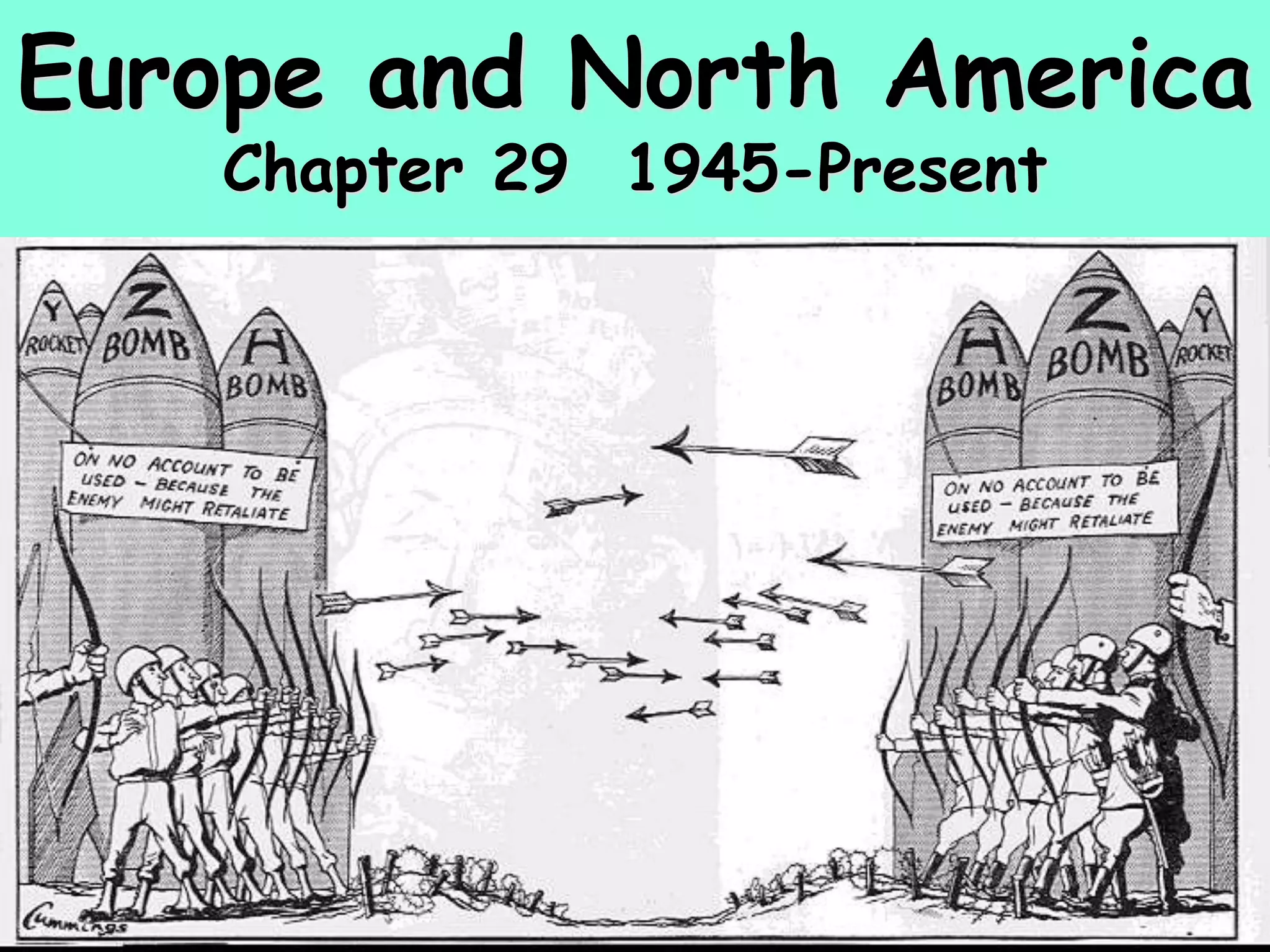
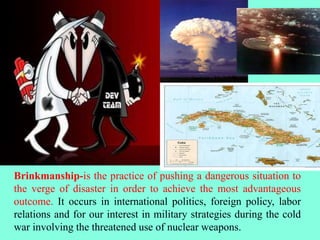
Brinkmanship-is the practice of pushing a dangerous situation to
the verge of disaster in order to achieve the most advantageous
outcome. It occurs in international politics, foreign policy, labor
relations and for our interest in military strategies during the cold
war involving the threatened use of nuclear weapons.
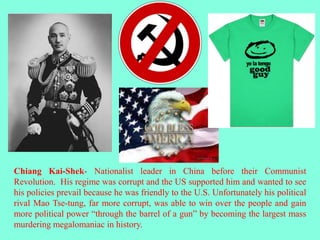
Chiang Kai-Shek- Nationalist leader in China before their Communist
Revolution. His regime was corrupt and the US supported him and wanted to see
his policies prevail because he was friendly to the U.S. Unfortunately his political
rival Mao Tse-tung, far more corrupt, was able to win over the people and gain
more political power “through the barrel of a gun” by becoming the largest mass
murdering megalomaniac in history.
CIA-Central Intelligence Agency (formerly The Office of Strategic
Services OSS)-a U.S. agency created to gather secret information
about foreign governments. Our intelligence on the USSR was not
complete.
Korea and Vietnam
• USA tried to contain
communism. In both wars,
communist troops fought
armies trained and funded by
the USA.
The Korean War
It was a conflict that began in June 1950 between the Democratic People’s Republic of Korea
(North Korea) and the Republic of Korea (South Korea), which resulted in an estimated
4,000,000 casualties, including civilians. The United Nations, with the United States as the
principal participant, joined the war on the side of the South Koreans, and the People’s Republic
of China eventually came to North Korea’s aid. After exceptional vicissitudes, the war ended
inconclusively in July 1953; it established a precedent for United States intervention to contain
communist expansion.
At the end of World War II, the Allies agreed that Soviet forces would accept the surrender of
Japanese troops in Korea north of the 38th degree of latitude, while American troops would
accept the Japanese surrender south of that line. In 1947, after the failure of negotiations to
achieve the unification of the two separate Korean states that had thus been created, the United
States turned the problem over to the United Nations. The Soviet Union refused to cooperate
with UN plans to hold general elections in the two Koreas, and, as a result, a communist state
was permanently established under the Soviet auspices in the north and a pro-Western state was
set up in the south.
On 25 Jun 1950, the North Koreans, with the tacit approval of the Soviet Union, unleashed a
carefully planned attack southward across the 38th parallel. The United Nations Security Council
met in emergency session and passed a resolution calling for the assistance of all UN members in
halting the North Korean invasion. On 27 Jun, U.S. President Harry Truman, without asking
Congress to declare war, ordered United States forces to come to
The Korean War (cont’d)
the assistance of South Korea as part of the UN “police action.”
Meanwhile, GEN Douglas MacArthur was demanding the authority to blockade China’s
coastline and bomb its Manchurian bases. Truman refused, feeling that such a course
would bring the Soviet Union into the war and thus lead to a global conflict. In response,
MacArthur appealed over Truman’s head directly to the American public in an effort to
enlist support for his war aims. On 11 Apr 1951, President Truman relieved MacArthur as
UN commander and as commander of U.S. forces in the Far East and replaced him with
GEN Matthew B. Ridgeway. On 10 Jul 1951, truce talks began while the North Koreans
and Chinese vainly strove for further success on the battlefield. The negotiations dragged
on for months, but in the fall of 1952 and the victory of Dwight D. Eisenhower, who had
criticized the unpopular war and announced his intention to visit Korea if elected.
Eisenhower secretly informed the North Koreans and Chinese that he was prepared to use
nuclear weapons and would also carry the war to China if a peace agreement was not
reached. After a brief renewal of hostilities in June 1953, an armistice was concluded on 27
Jul, and the front line was accepted as the de facto boundary between North and South
Korea. The exchange and repatriation of prisoners soon followed.
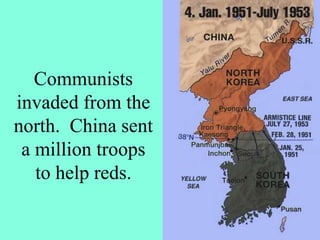
Communists
invaded from the
north. China sent
a million troops
to help reds.
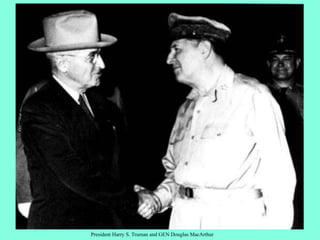
President Harry S. Truman and GEN Douglas MacArthur
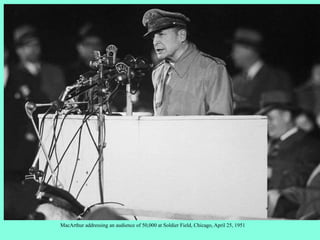
MacArthur addressing an audience of 50,000 at Soldier Field, Chicago, April 25, 1951
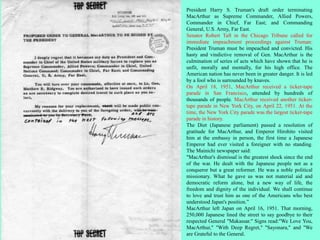
President Harry S. Truman's draft order terminating
MacArthur as Supreme Commander, Allied Powers,
Commander in Chief, Far East; and Commanding
General, U.S. Army, Far East.
Senator Robert Taft in the Chicago Tribune called for
immediate impeachment proceedings against Truman:
President Truman must be impeached and convicted. His
hasty and vindictive removal of Gen. MacArthur is the
culmination of series of acts which have shown that he is
unfit, morally and mentally, for his high office. The
American nation has never been in greater danger. It is led
by a fool who is surrounded by knaves.
On April 18, 1951, MacArthur received a ticker-tape
parade in San Francisco, attended by hundreds of
thousands of people. MacArthur received another ticker-
tape parade in New York City, on April 22, 1951. At the
time, the New York City parade was the largest ticker-tape
parade in history.
The Diet (Japanese parliament) passed a resolution of
gratitude for MacArthur, and Emperor Hirohito visited
him at the embassy in person, the first time a Japanese
Emperor had ever visited a foreigner with no standing.
The Mainichi newspaper said:
"MacArthur's dismissal is the greatest shock since the end
of the war. He dealt with the Japanese people not as a
conqueror but a great reformer. He was a noble political
missionary. What he gave us was not material aid and
democratic reform alone, but a new way of life, the
freedom and dignity of the individual. We shall continue
to love and trust him as one of the Americans who best
understood Japan's position.”
MacArthur left Japan on April 16, 1951. That morning,
250,000 Japanese lined the street to say goodbye to their
respected General "Makassar." Signs read:"We Love You,
MacArthur," "With Deep Regret," "Sayonara," and "We
are Grateful to the General.
Korean War
After the failure of the promise of Korean
independence by the Allied nations, on June
25, 1950, communist North Korean troops
invaded South Korea. Poorly armed, the South
Koreans were no match for the North. The
United Nations ordered North Korea to
withdraw its troops. General MacArthur was
appointed to command all UN troops in
Korea. After three years of fighting a
stalemate, more than 54,000 American troops
perished.
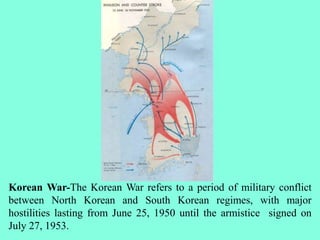
Korean War-The Korean War refers to a period of military conflict
between North Korean and South Korean regimes, with major
hostilities lasting from June 25, 1950 until the armistice signed on
July 27, 1953.
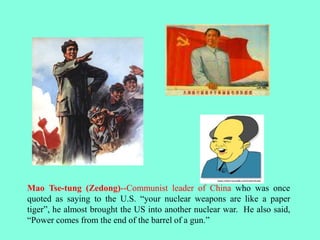
Mao Tse-tung (Zedong)--Communist leader of China who was once
quoted as saying to the U.S. “your nuclear weapons are like a paper
tiger”, he almost brought the US into another nuclear war. He also said,
“Power comes from the end of the barrel of a gun.”
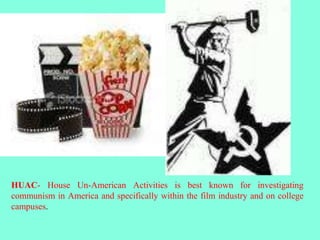
HUAC- House Un-American Activities is best known for investigating
communism in America and specifically within the film industry and on college
campuses.
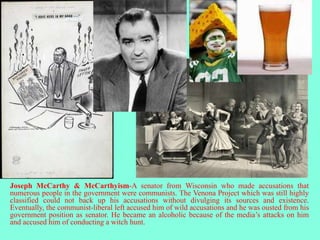
Joseph McCarthy & McCarthyism-A senator from Wisconsin who made accusations that
numerous people in the government were communists. The Venona Project which was still highly
classified could not back up his accusations without divulging its sources and existence.
Eventually, the communist-liberal left accused him of wild accusations and he was ousted from his
government position as senator. He became an alcoholic because of the media’s attacks on him
and accused him of conducting a witch hunt.
VENONA Project
The Venona project was a long-running secret collaboration of the United States and
United Kingdom intelligence agencies involving crypto-analysis of messages sent by
intelligence agencies of the Soviet Union, the majority during World War II. There were at
least 13 codewords for this project that were used by the US and British intelligence
agencies (including the NSA); "Venona" was the last that was used. That code word has no
known meaning. (In the decrypted documents issued from the National Security Agency,
"VENONA" is written in capitals, but lowercasing is common in modern journalism.) The
project was started on February 1, 1941 during World War II but was not regularly
depended on until the Cold War.
During the initial years of the Cold War, the Venona project was a source of information on
Soviet intelligence-gathering activity that was directed at the Western military powers.
Although unknown to the public, and even to Presidents Franklin D. Roosevelt and Harry S.
Truman, these programs were of importance concerning crucial events of the early Cold
War. These included the Julius and Ethel Rosenberg spying case and the defections of
Donald Maclean and Guy Burgess to the Soviet Union.
VENONA Project (cont’d)
There were many new scientists who worked on decrypting the Soviet messages but the
ones who made the biggest difference were Richard Hallock, Cecil Phillips, Robert
Lamphere, and Meredith Gardener.
Most decipherable messages were transmitted and intercepted between 1942 and 1945.
Sometime in 1945, the existence of the Venona program was revealed to the Soviet Union
by the NKVD agent and United States Army SIGINT analyst and cryptologist Bill
Weisband. These messages were slowly and gradually decrypted beginning in 1946 and
continuing (many times at a low-level of effort in the latter years) through 1980, when the
Venona program was terminated, and the remaining amount of effort that was being spent
on it was moved to more important projects.
To what extent the various individuals were involved with Soviet intelligence is a topic of
dispute. While a number of academic people and historians assert that most of the
individuals mentioned in the Venona decrypts were most likely either clandestine assets
and/or contacts of Soviet intelligence agents, others argue that many of those people
probably had no malicious intentions and committed no crimes.
Venona (cont’d)
The parts of the messages deciphered by Gardner and Lamphere held information about
whom and where KGB spies were. These messages contained information about KGB in
Latin America, the presidential campaigns during the 1944 elections, and the names of a few
scientists that worked on the Manhattan Project (creation of the atomic bomb). One note
even said that the Soviets had a man inside the War Department that was giving them U.S.
secrets, but this is unconfirmed. The most important information found by Gardner was the
cover names of the spies that were running missions in the United States, they also found out
who or what some of the cover names stood for. Some of the cover names looked simple
enough to figure out, President Roosevelt’s cover name was Kapitan, but some less
important people had names such as God. Arlington Hall was able to decrypt these names:
Liberal – Julius Rosenberg, Babylon – San Francisco, The Bank – U.S. Dept. of State,
Arsenal – U.S. War Dept., and Anton – Leonid Kvasnikov (the leader of the KGB atomic
bomb espionage). The Soviets were very careful to pick cover names and only made a few
mistakes such as Boris Moros’s name, Frost which means “moroz” in Russian. The
decryptions show that many of Stalin’s top agents were in many top governmental agencies.
Venona (cont’d)
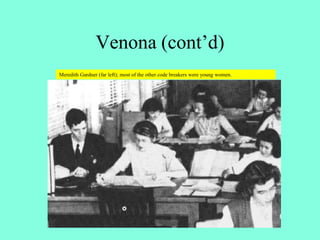
Meredith Gardner (far left); most of the other code breakers were young women.
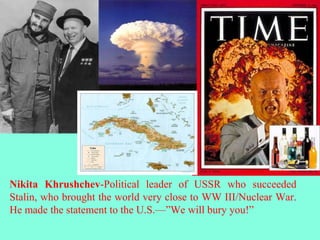
Nikita Khrushchev-Political leader of USSR who succeeded
Stalin, who brought the world very close to WW III/Nuclear War.
He made the statement to the U.S.—”We will bury you!”
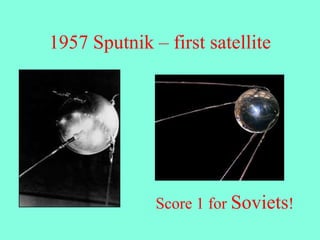
1957 Sputnik – first satellite
Score 1 for Soviets!
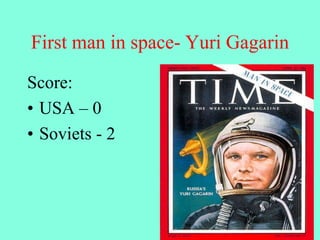
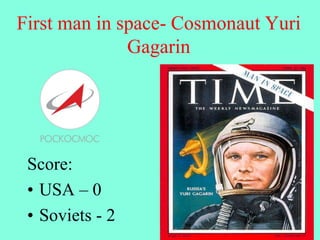
First man in space- Yuri Gagarin
Score:
• USA – 0
• Soviets - 2
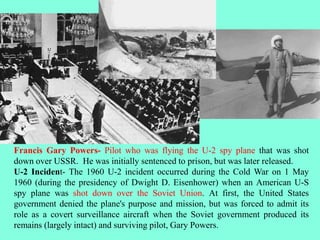
Francis Gary Powers- Pilot who was flying the U-2 spy plane that was shot
down over USSR. He was initially sentenced to prison, but was later released.
U-2 Incident- The 1960 U-2 incident occurred during the Cold War on 1 May
1960 (during the presidency of Dwight D. Eisenhower) when an American U-S
spy plane was shot down over the Soviet Union. At first, the United States
government denied the plane's purpose and mission, but was forced to admit its
role as a covert surveillance aircraft when the Soviet government produced its
remains (largely intact) and surviving pilot, Gary Powers.
Postwar America
Peace brought with it new fears. Demobilizing the armed forces might result in massive
unemployment and another depression. Or, conversely, the huge savings accumulated
during the war could promote runaway inflation. The first anxiety proved to be as not as
great a fear even though there were successive recessions, but the government did little to
ease the transition to a peacetime economy. War contracts were canceled, war agencies
diminished or dissolved, and government-owned war plants sold to private parties. But,
after laying off defense workers, manufacturers rapidly tooled up and began producing
consumer goods in volume. The housing industry grew too, despite shortages of every kind,
thanks to mass construction techniques pioneered by the firm of Levitt and Sons, Inc., and
other developers. All this activity created millions of new jobs. The Serviceman’s
Readjustment Act of 1944, known as the G.I. Bill of Rights, also helped ease military
personnel back into civilian life. It provided veterans with loans, educational subsidies, and
other benefits.
Truman’s difficulties with Congress had begun in Sep 1945 when he submitted a 21-point
domestic program, including proposals for an expansion of social security and public
housing and for the establishment of a permanent Fair Employment Practices Act banning
discrimination. These and subsequent liberal initiatives, later known as the Fair Deal, were
rejected by Congress, which passed only the Employment Act of 1946. This clearly stated
the government’s responsibility for maintaining full employment and established a Council
of Economic Advisers to advise the president.
Postwar America (cont’d)
Truman’s relations with Congress worsened after the 1946 elections. Voters, who were
angered by the price-control debacle, a wave of strikes, and Truman’s seeming inability to
lead or govern, gave control of both houses of Congress to Republicans for the first time
since 1928. The president and the extremely conservative 80th Congress battled from
beginning to end, not over foreign policy, where bipartisanship prevailed, but over domestic
matters. Congress passed two tax reductions over Truman’s vetoes and in 1947, again over
Truman’s veto, passed the Taft-Hartley Act, which restricted unions while extending the
right of management. Congress also rejected various liberal measures submitted by Truman,
who did not expect the proposals to pass but wanted Congress on record as having opposed
important social legislation.
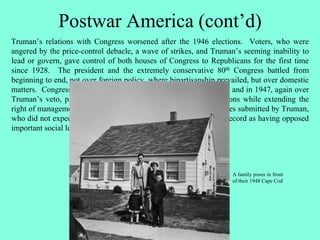
A family poses in front
of their 1948 Cape Cod
Cold War Intervention Concept
Map
What are some people involved?
Cold War Intervention
What are some examples?What are some agencies involved?
Cold War Intervention Quiz
1. What did the Warsaw Pact build to stem the flow of Germans fleeing East
Berlin?
2. What two groups of people were convicted of espionage and imprisoned
and/or executed?
3. Who were the two leaders that the civil war in China were between that
resulted in the Communist Revolution.
4. Give two agencies that were involved in Cold War intervention?
5. What two Soviet events scared the USA that they were falling behind in
technology?
6. What was the housing contractor that started a revolution in the housing
market?
7. What was the government act that helped U.S. servicemen readjust to
American society?
I Like Ike
Urged by figures in both parties to run for president in 1952, Eisenhower was more
receptive to the Republicans, who appealed to his basic conservatism. He allowed the
internationalist wing of the party to adopt him as an alternative to the more isolationist
candidate, Sen, Robert Taft. Returning to the United States to campaign in the spring of
1952, Eisenhower narrowly won the Republican nomination. In the November election,
with Sen. Richard M. Nixon of California as his running mate, he defeated the Democratic
candidate, Illinois Gov. Adlai E. Stevenson, in a landslide; facing Stevenson again in 1956,
he would win by an even larger margin. However, the Republicans won Congress by only
a few votes in 1952 and were ousted from control in 1954. For three-quarters of his
administration, Eisenhower faced a Democratic Congress. Thus his political situation as
well as his personal preferences ensured that he would not depart drastically from the
policies of his Democratic predecessors.
Eisenhower liked to describe himself as a middle-of-the-roader, and his administration was
a relatively faithful expression of the moderately conservative outlook of the U.S. business
community. He hoped to balance the budget, hold down inflation, and give the nation
efficient, economical government. He opposed any major expansion in the functions of
the federal government, but he made no significant effort to repeal established programs in
such policy areas as labor, agriculture, and social welfare.
The Eisenhower Years
There were no major arms-control agreements until the 1960s, by which time the world’s
two emergent superpowers, the United States and the Soviet Union, had each developed
large arsenals of nuclear weapons. The possibility of both nations’ mutually assured
destruction (M.A.D.) in an intercontinental exchange of nuclear-armed missiles prompted
them to undertake increasingly serious efforts to limit first the testing, then the deployment,
and finally the possession of these weapons.
Sputnik restored Soviet prestige after the 1956 embarrassment in Hungary, shook European
confidence in the U.S. nuclear deterrent, magnified the militancy of Maoist China, and
provoked an orgy of self-doubt in the United States itself. The two Sputnik satellites of
1957 were themselves of little military significance, and the test missile that launched them
was too primitive for deployment, but Khrushchev claimed that long-range missiles were
rolling off the assembly line “like sausages,” a bluff that allowed President Eisenhower’s
opponents—and nervous Europeans—to perceive a “missile gap.” This prompted
Eisenhower to launch “the Space Race.”
The Eisenhower Years (cont’d)
In 1960, a confrontation between the United States and the Soviet Union that began with
the shooting down of a U.S. U-2 reconnaissance plane over the Soviet Union and that
caused the collapse of a summit conference in Paris between the United States, the Soviet
Union, Great Britain, and France. On 5 May, the premier Nikita S. Khrushchev told the
Supreme Soviet of the U.S.S.R. that an American spy plane had been shot down on 1 May
over Sverdlovsk (now Yekaterinburg), referring to the flight as an “aggressive act” by the
United States. On 7 May, he revealed that the pilot of the plane, Francis Gary Powers, had
parachuted to safety, was alive and well in Moscow and admitted working for the U.S.
Central Intelligence Agency.
Dwight D. Eisenhower-As President, he oversaw the Korean War and the cease-
fire of the Korean War, kept up the pressure on the Soviet Union during the Cold
War, made nuclear weapons a higher defense priority, launched the Space Race,
enlarged the Social Security program, and began the Interstate Highway System.
Francis Gary Powers- Pilot who was flying the U-2 spy plane that was shot
down over USSR. He was initially sentenced to prison, but was later released.
U-2 Incident- The 1960 U-2 incident occurred during the Cold War on 1 May
1960 (during the presidency of Dwight D. Eisenhower) when an American U-S
spy plane was shot down over the Soviet Union. At first, the United States
government denied the plane's purpose and mission, but was forced to admit its
role as a covert surveillance aircraft when the Soviet government produced its
remains (largely intact) and surviving pilot, Gary Powers.
What is the United Nations?
(In my opinion, a useless organization)
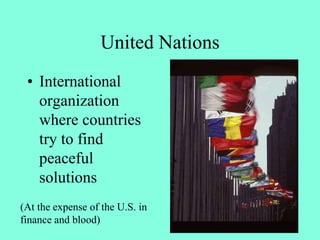
United Nations
• International
organization
where countries
try to find
peaceful
solutions
(At the expense of the U.S. in
finance and blood)
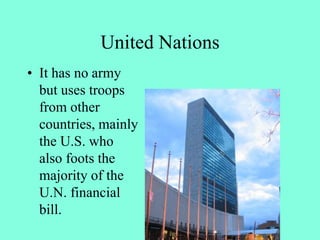
United Nations
• It has no army
but uses troops
from other
countries, mainly
the U.S. who
also foots the
majority of the
U.N. financial
bill.
Eisenhower Years Quiz
1. What former U.S. Army general won the 1952
presidential elections?
2. What highway system did President Eisenhower initiate?
3. Name one of the international or domestic policies or
incidents that occurred under Eisenhower?
4. What did Eisenhower launch after being embarrassed by
the Soviets with Sputnik?
5. Who was the pilot of the downed U-2 CIA spy plane?
The New Frontier and the Great
Society
1961-1968
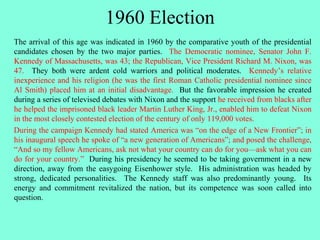
1960 Election
The arrival of this age was indicated in 1960 by the comparative youth of the presidential
candidates chosen by the two major parties. The Democratic nominee, Senator John F.
Kennedy of Massachusetts, was 43; the Republican, Vice President Richard M. Nixon, was
47. They both were ardent cold warriors and political moderates. Kennedy’s relative
inexperience and his religion (he was the first Roman Catholic presidential nominee since
Al Smith) placed him at an initial disadvantage. But the favorable impression he created
during a series of televised debates with Nixon and the support he received from blacks after
he helped the imprisoned black leader Martin Luther King, Jr., enabled him to defeat Nixon
in the most closely contested election of the century of only 119,000 votes.
During the campaign Kennedy had stated America was “on the edge of a New Frontier”; in
his inaugural speech he spoke of “a new generation of Americans”; and posed the challenge,
“And so my fellow Americans, ask not what your country can do for you—ask what you can
do for your country.” During his presidency he seemed to be taking government in a new
direction, away from the easygoing Eisenhower style. His administration was headed by
strong, dedicated personalities. The Kennedy staff was also predominantly young. Its
energy and commitment revitalized the nation, but its competence was soon called into
question.
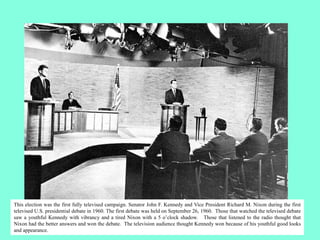
This election was the first fully televised campaign. Senator John F. Kennedy and Vice President Richard M. Nixon during the first
televised U.S. presidential debate in 1960. The first debate was held on September 26, 1960. Those that watched the televised debate
saw a youthful Kennedy with vibrancy and a tired Nixon with a 5 o’clock shadow. Those that listened to the radio thought that
Nixon had the better answers and won the debate. The television audience thought Kennedy won because of his youthful good looks
and appearance.
The Space Race
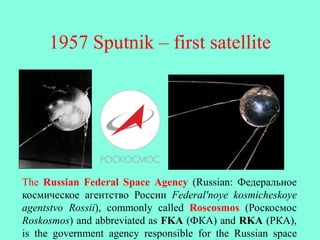
1957 Sputnik – first satellite
The Russian Federal Space Agency (Russian: Федеральное
космическое агентство России Federal'noye kosmicheskoye
agentstvo Rossii), commonly called Roscosmos (Роскосмос
Roskosmos) and abbreviated as FKA (ФКА) and RKA (РКА),
is the government agency responsible for the Russian space
First man in space- Cosmonaut Yuri
Gagarin
Score:
• USA – 0
• Soviets - 2
National Aeronautics and Space
Administration
NASA was created largely in response to the Soviet launching of Sputnik in 1957. It was
organized around the National Advisory Committee for Aeronautics (NACA), which had
been created by Congress in 1915. NASA’s organization was well underway by the early
years of President John F. Kennedy’s administration, when Kennedy proposed that the
United States put a man on the Moon by the end of the 1960’s. To that end the Apollo
program was designed, and in 1969 the U.S. astronaut Neil Armstrong, became the first
man on the Moon. Later unmanned programs—such as Viking, Mariner, Voyager, and
Galileo—explored other bodies of the solar system.
NASA was also responsible for the development and launching of a number of satellites
with Earth applications, such as Landsat, a series of satellites designed to collect
information on natural resources and other Earth features; communications satellites; and
weather satellites. It also planned and developed other programs that could not be
conducted with conventional spacecraft.
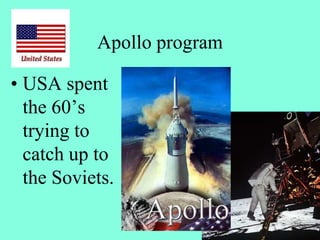
Apollo program
• USA spent
the 60’s
trying to
catch up to
the Soviets.
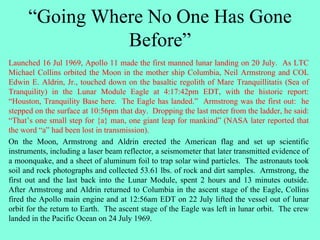
“Going Where No One Has Gone
Before”
Launched 16 Jul 1969, Apollo 11 made the first manned lunar landing on 20 July. As LTC
Michael Collins orbited the Moon in the mother ship Columbia, Neil Armstrong and COL
Edwin E. Aldrin, Jr., touched down on the basaltic regolith of Mare Tranquillitatis (Sea of
Tranquility) in the Lunar Module Eagle at 4:17:42pm EDT, with the historic report:
“Houston, Tranquility Base here. The Eagle has landed.” Armstrong was the first out: he
stepped on the surface at 10:56pm that day. Dropping the last meter from the ladder, he said:
“That’s one small step for {a} man, one giant leap for mankind” (NASA later reported that
the word “a” had been lost in transmission).
On the Moon, Armstrong and Aldrin erected the American flag and set up scientific
instruments, including a laser beam reflector, a seismometer that later transmitted evidence of
a moonquake, and a sheet of aluminum foil to trap solar wind particles. The astronauts took
soil and rock photographs and collected 53.61 lbs. of rock and dirt samples. Armstrong, the
first out and the last back into the Lunar Module, spent 2 hours and 13 minutes outside.
After Armstrong and Aldrin returned to Columbia in the ascent stage of the Eagle, Collins
fired the Apollo main engine and at 12:56am EDT on 22 July lifted the vessel out of lunar
orbit for the return to Earth. The ascent stage of the Eagle was left in lunar orbit. The crew
landed in the Pacific Ocean on 24 July 1969.
Soviet vs. U.S. Space Program
Venn Diagram
Soviet Space Program U.S. Space Program
Soviet vs. U.S. Space Program
Quiz
1. What prompted the USA to launch the space program—NASA?
2. Who was the first man in space?
3. What was President Kennedy’s goal?
4. What NASA program was designed to go to the moon?
5. What two astronauts were the first two men on the moon and what was the date?
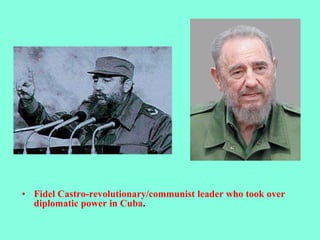
• Fidel Castro-revolutionary/communist leader who took over
diplomatic power in Cuba.
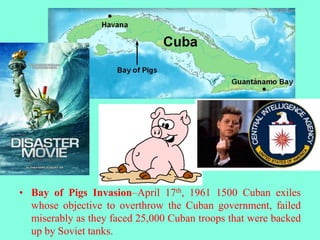
• Bay of Pigs Invasion–April 17th, 1961 1500 Cuban exiles
whose objective to overthrow the Cuban government, failed
miserably as they faced 25,000 Cuban troops that were backed
up by Soviet tanks.
Bay of Pigs
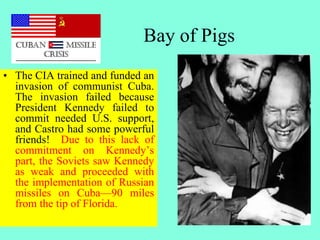
• The CIA trained and funded an
invasion of communist Cuba.
The invasion failed because
President Kennedy failed to
commit needed U.S. support,
and Castro had some powerful
friends! Due to this lack of
commitment on Kennedy’s
part, the Soviets saw Kennedy
as weak and proceeded with
the implementation of Russian
missiles on Cuba—90 miles
from the tip of Florida.
Soviet response.
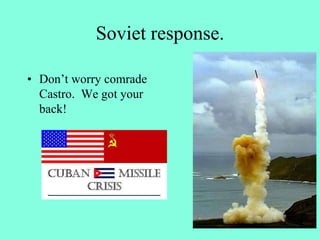
• Don’t worry comrade
Castro. We got your
back!
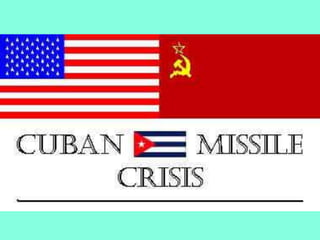
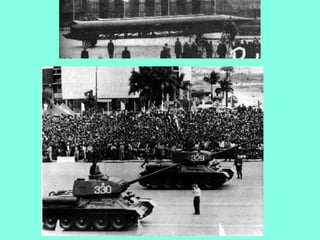
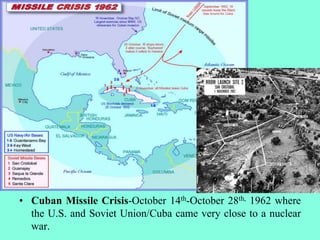
• Cuban Missile Crisis-October 14th-October 28th, 1962 where
the U.S. and Soviet Union/Cuba came very close to a nuclear
war.
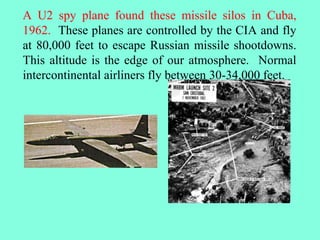
A U2 spy plane found these missile silos in Cuba,
1962. These planes are controlled by the CIA and fly
at 80,000 feet to escape Russian missile shootdowns.
This altitude is the edge of our atmosphere. Normal
intercontinental airliners fly between 30-34,000 feet.
Cuban Missile Crisis
The Cuban Missile Crisis occurred in October 1962, after U.S. intelligence reconnaissance
flights verified reports that the USSR was constructing launching sites for medium-range and
intermediate-range nuclear missiles on the island of Cuba. The USSR apparently hoped to
achieve a more favorable balance of power, to protect the Cuban Communist government of
Fidel Castro (which the United States had attempted to overthrow in the abortive Bay of Pigs
invasion of 1961), to gain greater diplomatic leverage vis-à-vis the United States, to damage
U.S. credibility, and to achieve greater influence in Latin America. The failure of the Bay of
Pigs invasion was seen as a weakness of the Kennedy administration which gave the USSR
boldness to act thinking that the U.S. would relent again.
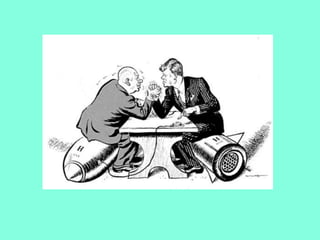
President John F. Kennedy rejected military advice for a full-scale surprise attack on Cuba
and instead delivered a public ultimatum to the USSR on 22 Oct. He declared a “quarantine,”
or naval blockade, of Cuba and demanded withdrawal of all offensive missiles. After nearly
two weeks of unprecedented tension, the Soviet government of Nikita Khrushchev yielded.
Kennedy, in return, agreed to refrain from attempting an overthrow of Castro’s government.
Despite this concession, all sides regarded the outcome as a substantial victory for the United
States, and Kennedy won a reputation as a formidable international statesman. The USSR
began a long-term effort to strengthen its military capability, but in the immediate future both
nations sought to relax hostilities.
World War III Averted
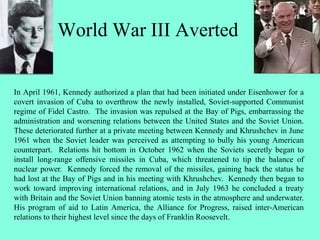
In April 1961, Kennedy authorized a plan that had been initiated under Eisenhower for a
covert invasion of Cuba to overthrow the newly installed, Soviet-supported Communist
regime of Fidel Castro. The invasion was repulsed at the Bay of Pigs, embarrassing the
administration and worsening relations between the United States and the Soviet Union.
These deteriorated further at a private meeting between Kennedy and Khrushchev in June
1961 when the Soviet leader was perceived as attempting to bully his young American
counterpart. Relations hit bottom in October 1962 when the Soviets secretly began to
install long-range offensive missiles in Cuba, which threatened to tip the balance of
nuclear power. Kennedy forced the removal of the missiles, gaining back the status he
had lost at the Bay of Pigs and in his meeting with Khrushchev. Kennedy then began to
work toward improving international relations, and in July 1963 he concluded a treaty
with Britain and the Soviet Union banning atomic tests in the atmosphere and underwater.
His program of aid to Latin America, the Alliance for Progress, raised inter-American
relations to their highest level since the days of Franklin Roosevelt.
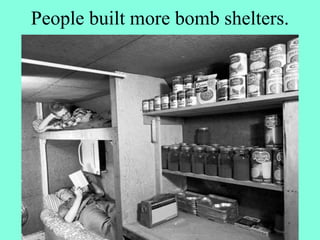
People built more bomb shelters.
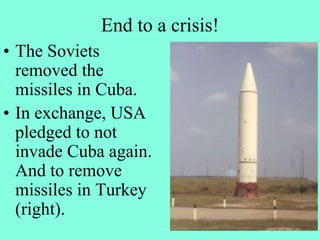
End to a crisis!
• The Soviets
removed the
missiles in Cuba.
• In exchange, USA
pledged to not
invade Cuba again.
And to remove
missiles in Turkey
(right).
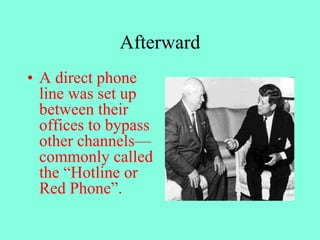
Afterward
• A direct phone
line was set up
between their
offices to bypass
other channels—
commonly called
the “Hotline or
Red Phone”.
Cuban Missile Crisis/Bay of Pigs
Timeline Sequence
Bay of Pigs Intelligence Cuban Missile Crisis
Cuban Missile Crisis/Bay of Pigs
Quiz
1. What event was the prelude to showing President Kennedy’s weakness to the
Cuban Missile Crisis?
2. What type of reconnaissance plane by the CIA found the Russian missiles in
Cuba?
3. What military strategy did President Kennedy use against the Russians?
4. What was the results of the Cuban Missile Crisis?
5. What was installed in both leaders offices to stave off any further crises?
Kennedy Assassination
Cutting through Conspiracies
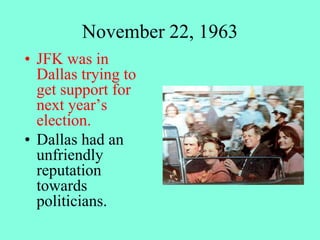
November 22, 1963
• JFK was in
Dallas trying to
get support for
next year’s
election.
• Dallas had an
unfriendly
reputation
towards
politicians.
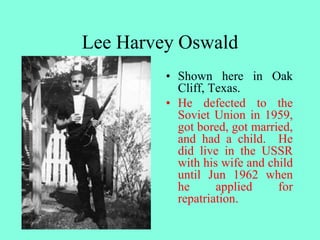
Lee Harvey Oswald
• Shown here in Oak
Cliff, Texas.
• He defected to the
Soviet Union in 1959,
got bored, got married,
and had a child. He
did live in the USSR
with his wife and child
until Jun 1962 when
he applied for
repatriation.
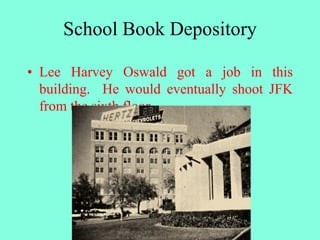
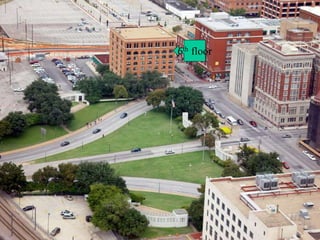
School Book Depository
• Lee Harvey Oswald got a job in this
building. He would eventually shoot JFK
from the sixth floor.
6th floor
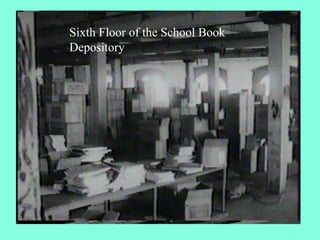
Sixth Floor of the School Book
Depository
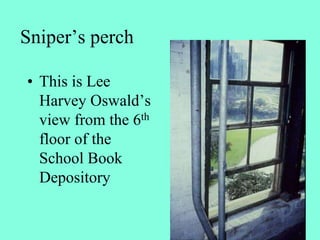
Sniper’s perch
• This is Lee
Harvey Oswald’s
view from the 6th
floor of the
School Book
Depository
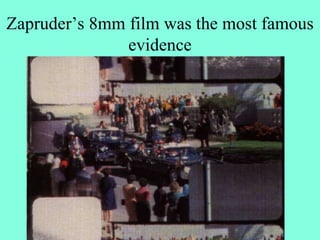
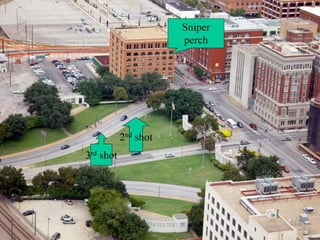
Zapruder’s 8mm film was the most famous
evidence
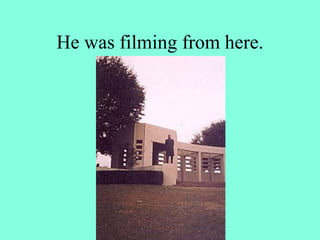
He was filming from here.
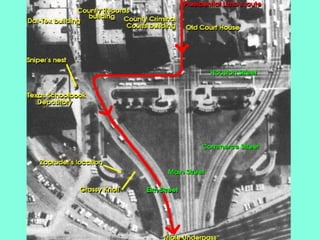
3rd shot
2nd shot
Sniper
perch
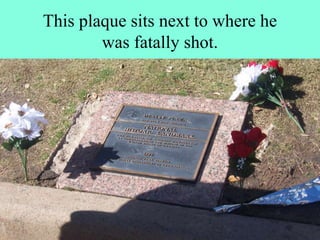
This plaque sits next to where he
was fatally shot.
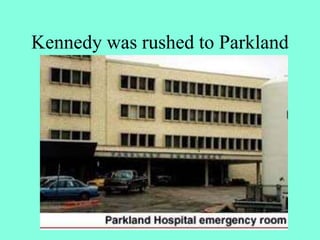
Kennedy was rushed to Parkland
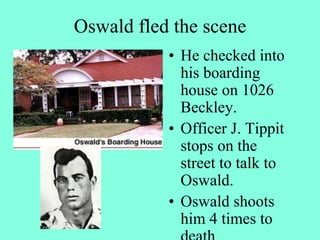
Oswald fled the scene
• He checked into
his boarding
house on 1026
Beckley.
• Officer J. Tippit
stops on the
street to talk to
Oswald.
• Oswald shoots
him 4 times to
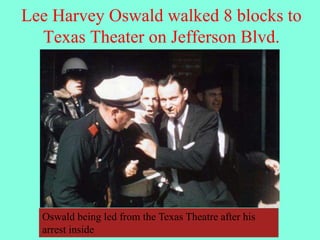
Lee Harvey Oswald walked 8 blocks to
Texas Theater on Jefferson Blvd.
Oswald being led from the Texas Theatre after his
arrest inside
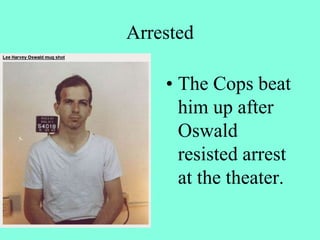
Arrested
• The Cops beat
him up after
Oswald
resisted arrest
at the theater.
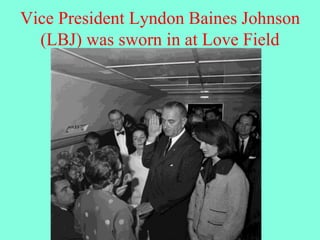
Vice President Lyndon Baines Johnson
(LBJ) was sworn in at Love Field
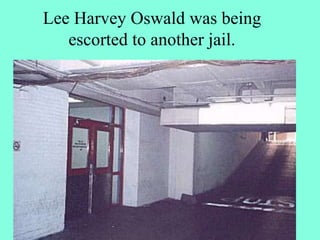
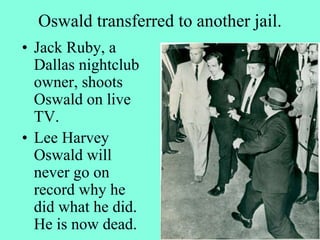
Lee Harvey Oswald was being
escorted to another jail.
Oswald transferred to another jail.
• Jack Ruby, a
Dallas nightclub
owner, shoots
Oswald on live
TV.
• Lee Harvey
Oswald will
never go on
record why he
did what he did.
He is now dead.
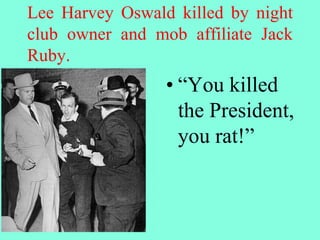
Lee Harvey Oswald killed by night
club owner and mob affiliate Jack
Ruby.
• “You killed
the President,
you rat!”
Case Closed?
The Warren Commission
• Oswald fired 3 shots (missed the first one)
• The assassination was filmed (Zapruder)
• The government investigated the murder for
years and concluded that Oswald acted
alone.
• Virtually no witness at that time gave
indication that more than 3 shots were fired
at Kennedy.
• However. . . .
80% of people today
believe JFK was killed
by someone else!!!!
Composite Conspiracy Story
• JFK was killed by a conspiracy of high
government officials with LBJ working with
the CIA, the mafia, and anti-Castro
Americans who all want revenge for
Kennedy’s lack of support in the failed Bay
of Pigs invasion of Cuba. At the same time
(in contradiction), Castro killed JFK with
Russia’s help. Jack Ruby killed Lee Harvey
Oswald so he wouldn’t talk. Ruby died with a
deep, dark secret!
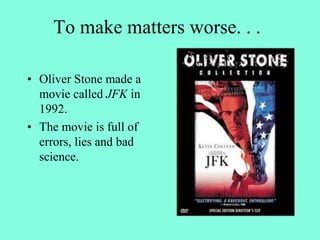
To make matters worse. . .
• Oliver Stone made a
movie called JFK in
1992.
• The movie is full of
errors, lies and bad
science.
Stone’s JFK helped advance these
falsehoods about the assassination:
• Oswald could not have shot JFK from the
sixth floor in less than 6 seconds.
• Kennedy was shot from the front by
gunmen on the grassy knoll.
• Jack Ruby killed Oswald on orders from the
mafia to keep Oswald quiet about
everything.
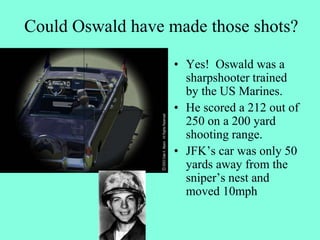
Could Oswald have made those shots?
• Yes! Oswald was a
sharpshooter trained
by the US Marines.
• He scored a 212 out of
250 on a 200 yard
shooting range.
• JFK’s car was only 50
yards away from the
sniper’s nest and
moved 10mph
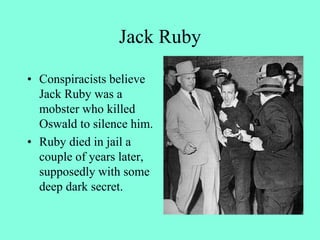
Jack Ruby
• Conspiracists believe
Jack Ruby was a
mobster who killed
Oswald to silence him.
• Ruby died in jail a
couple of years later,
supposedly with some
deep dark secret.
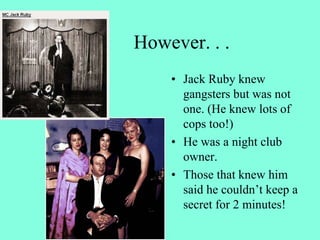
However. . .
• Jack Ruby knew
gangsters but was not
one. (He knew lots of
cops too!)
• He was a night club
owner.
• Those that knew him
said he couldn’t keep a
secret for 2 minutes!
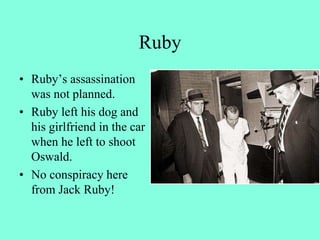
Ruby
• Ruby’s assassination
was not planned.
• Ruby left his dog and
his girlfriend in the car
when he left to shoot
Oswald.
• No conspiracy here
from Jack Ruby!
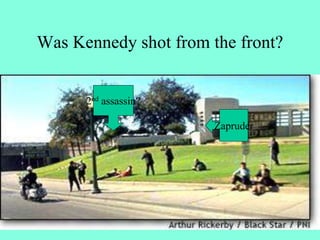
Was Kennedy shot from the front?
2nd assassin?
Zapruder
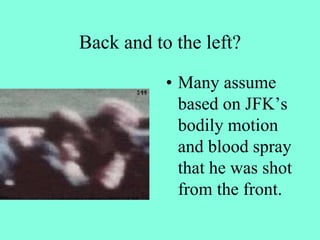
Back and to the left?
• Many assume
based on JFK’s
bodily motion
and blood spray
that he was shot
from the front.
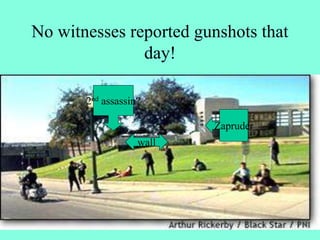
No witnesses reported gunshots that
day!
2nd assassin?
Zapruder
wall
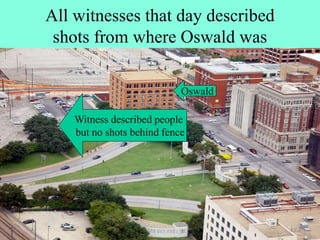
All witnesses that day described
shots from where Oswald was
Witness described people
but no shots behind fence
Oswald
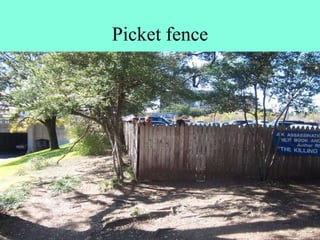
Picket fence
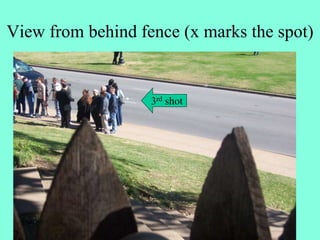
View from behind fence (x marks the spot)
3rd shot
Picket fence shooter theory
• There were plenty of witnesses in that area.
None reported hearing shots. A few
attention seekers claimed they did years
later.
• The witness behind the fence died in a
single car crash 2 years later, festering
conspirators' ideas.
• Many witnesses have been accused of being
a part of the conspiracy, including Zapruder
(born in Russia).
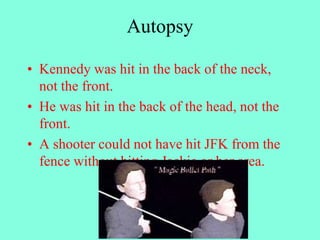
Autopsy
• Kennedy was hit in the back of the neck,
not the front.
• He was hit in the back of the head, not the
front.
• A shooter could not have hit JFK from the
fence without hitting Jackie or her area.
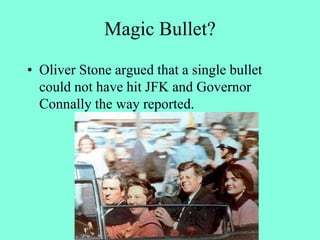
Magic Bullet?
• Oliver Stone argued that a single bullet
could not have hit JFK and Governor
Connally the way reported.
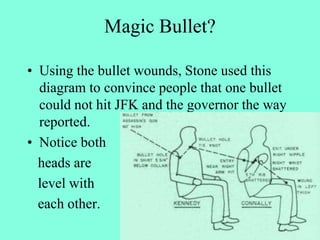
Magic Bullet?
• Using the bullet wounds, Stone used this
diagram to convince people that one bullet
could not hit JFK and the governor the way
reported.
• Notice both
heads are
level with
each other.
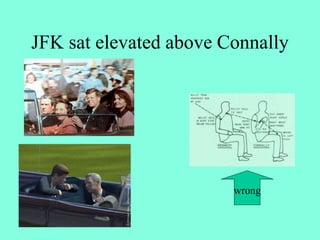
JFK sat elevated above Connally
wrong
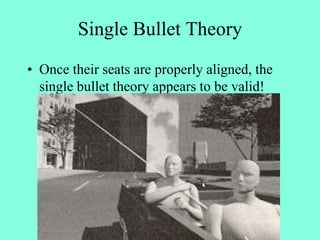
Single Bullet Theory
• Once their seats are properly aligned, the
single bullet theory appears to be valid!
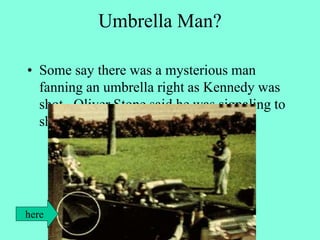
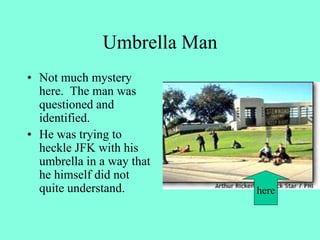
Umbrella Man?
• Some say there was a mysterious man
fanning an umbrella right as Kennedy was
shot. Oliver Stone said he was signaling to
shoot JFK.
here
Umbrella Man
• Not much mystery
here. The man was
questioned and
identified.
• He was trying to
heckle JFK with his
umbrella in a way that
he himself did not
quite understand. here
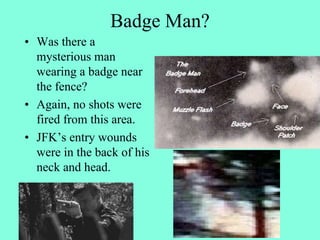
Badge Man?
• Was there a
mysterious man
wearing a badge near
the fence?
• Again, no shots were
fired from this area.
• JFK’s entry wounds
were in the back of his
neck and head.
Motives?
• Everybody seemed to
have a reason to kill
JFK if one thinks
about it hard enough.
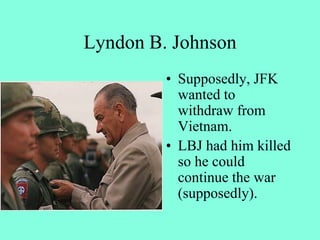
Lyndon B. Johnson
• Supposedly, JFK
wanted to
withdraw from
Vietnam.
• LBJ had him killed
so he could
continue the war
(supposedly).
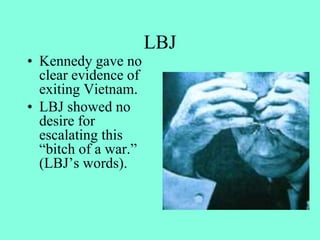
LBJ
• Kennedy gave no
clear evidence of
exiting Vietnam.
• LBJ showed no
desire for
escalating this
“bitch of a war.”
(LBJ’s words).
The Mob?
• The mob supposedly wanted to murder
Kennedy.
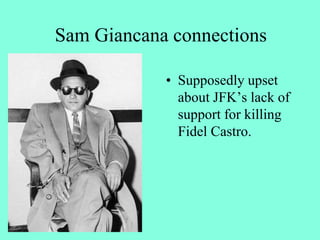
Sam Giancana connections
• Supposedly upset
about JFK’s lack of
support for killing
Fidel Castro.
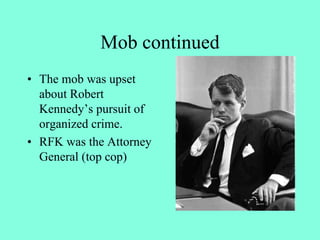
Mob continued
• The mob was upset
about Robert
Kennedy’s pursuit of
organized crime.
• RFK was the Attorney
General (top cop)
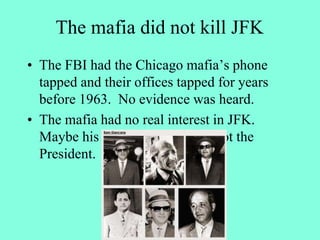
The mafia did not kill JFK
• The FBI had the Chicago mafia’s phone
tapped and their offices tapped for years
before 1963. No evidence was heard.
• The mafia had no real interest in JFK.
Maybe his brother Robert, but not the
President.
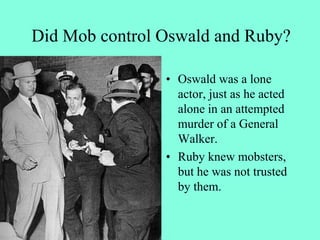
Did Mob control Oswald and Ruby?
• Oswald was a lone
actor, just as he acted
alone in an attempted
murder of a General
Walker.
• Ruby knew mobsters,
but he was not trusted
by them.
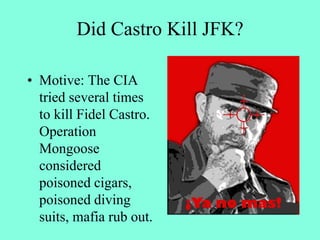
Did Castro Kill JFK?
• Motive: The CIA
tried several times
to kill Fidel Castro.
Operation
Mongoose
considered
poisoned cigars,
poisoned diving
suits, mafia rub out.
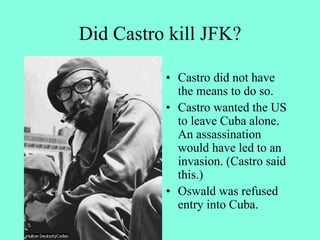
Did Castro kill JFK?
• Castro did not have
the means to do so.
• Castro wanted the US
to leave Cuba alone.
An assassination
would have led to an
invasion. (Castro said
this.)
• Oswald was refused
entry into Cuba.
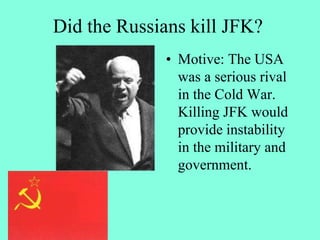
Did the Russians kill JFK?
• Motive: The USA
was a serious rival
in the Cold War.
Killing JFK would
provide instability
in the military and
government.
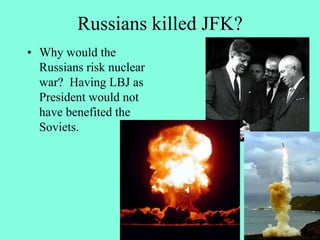
Russians killed JFK?
• Why would the
Russians risk nuclear
war? Having LBJ as
President would not
have benefited the
Soviets.
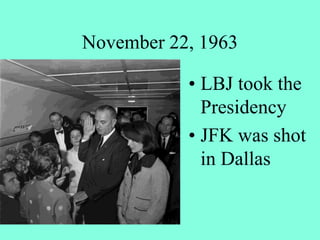
November 22, 1963
• LBJ took the
Presidency
• JFK was shot
in Dallas
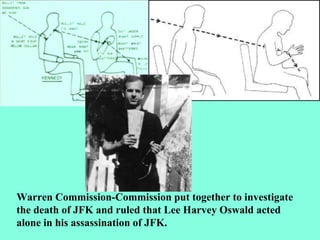
Warren Commission-Commission put together to investigate
the death of JFK and ruled that Lee Harvey Oswald acted
alone in his assassination of JFK.
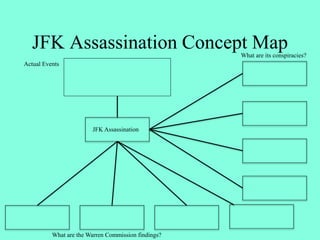
JFK Assassination Concept Map
What are the Warren Commission findings?
JFK Assassination
What are its conspiracies?
Actual Events
JFK Assassination Quiz
1. Why was President Kennedy in Dallas?
2. To what country did Lee Harvey Oswald defect?
3. Give one of the Warren Commission’s findings.
4. Give one of the conspiracy theory parties to the JFK assassination and their reason.
5. What does the autopsy say about the two shots that hit President Kennedy?
The New Frontier Closes
Kennedy’s domestic policies were designed to stimulate international trade, reduce
unemployment, provide medical care for the aged, reduce federal income taxes, and
protect the civil rights of blacks. The latter issue, which had aroused national concern in
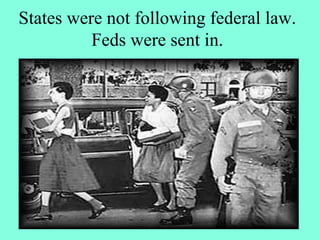
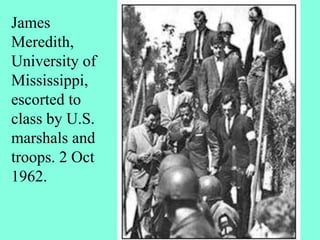
1962 when federal troops were employed to assure the admission of a Negro at the
University of Mississippi, caused further concern in 1963, when similar action was taken
at the University of Alabama and mass demonstrations were held in support of
desegregation. Although the Democrats controlled both houses of Congress, the
administration’s proposals usually encountered strong opposition from Southern
Democrats called “Dixiecrats”. With Congress’ support, Kennedy was able to increase
military spending substantially. This led to greater readiness but also to a significant rise in
the number of long-range U.S. missiles, which prompted a similar Soviet response.
On 22 Nov 1963, President Kennedy was assassinated in Dallas, TX, most probably by
lone gunman, Lee Harvey Oswald, though conspiracy theories abounded. Vice President
Lyndon B. Johnson took the oath of office immediately.
The Great Society
The Great Society was a political slogan used by U.S. President Lyndon B. Johnson (served
1963-69) to identify his legislative program of national reform. In his first State of the
Union message (4 Jan 1965) after election in his own right, the president proclaimed his
vision of a “Great Society” and declared a “war on poverty.” He called for an enormous
program of social welfare legislation including federal support for education, medical care
for the aged through an expanded Social Security Program, and federal legal protection for
citizens deprived of the franchise by certain state registration laws. After a landslide victory
for the Democratic Party (JFK assassination) in the elections of November 1964, a
sympathetic Congress passed almost all the president’s bills.
With this clear mandate, Johnson submitted the most sweeping legislative program to
Congress since the New Deal. He outlined his plan for achieving a “Great Society” in his
1965 state-of-the-Union address, and over the next two years he persuaded Congress to
approve most of his proposals. The Appalachian Regional Development Act provided aid
for that economically depressed area. The Housing and Urban Development Act of 1965
established a Cabinet-level department to coordinate federal housing programs. Johnson’s
Medicare bill fulfilled President Truman’s dream of providing health care for the aged. The
Elementary and Secondary Education Act of 1965 provided federal funding for public and
private education below the college level. The Higher Education Act of 1965 provided
scholarships for more than 140,000 needy students and authorized a National Teachers
Corps. The Immigration Act of 1965 abolished the discriminatory national-origins quota
The Great Society (cont’d)
system. The minimum wage was raised and its coverage extended in 1966. In 1967, Social
Security pensions were raised and coverage extended. The Demonstration Cities and
Metropolitan Area Redevelopment Act of 1966 provided aid to cities rebuilding blighted
areas. Other measures dealt with mass transit, truth in packaging and lending,
beautification, conservation, water and air quality, safety, and support for the arts.
Results of the Great Society
The following statistics are provided by Star Parker's Coalition of Urban Renewal, (CURE).
*60 percent of black children grow up in fatherless homes. *800,000 black men are in
jail or prison. *70 percent of black babies are born to unwed mothers. *Over 300,000
black babies are aborted annually. *50 percent of new AIDS cases are in the black
community. *Almost half of young black men in America's cities are neither working nor
in school. What we have here is a ticking time bomb waiting to explode.
Results of the Great Society
What was the message of the social programs that came out of LBJ's Great Society? One of
the most devastating to the family was that if an unwed woman became pregnant, moved out
of the home of her parents, did not name or know who the father was, then Big Daddy in
Washington would provide for all her essential needs. Ergo she no longer needed a husband
or the support of her family. In fact, the more children she had out of wedlock, the more
money she would receive from the government. This program was the death knell for many
families, especially in the black community. Unfortunately many black men saw this as the
best of all possible worlds. They could father as many children as they wanted, from multiple
women, without ever having to accept the responsibility of fatherhood. Many women
rejected marriage in favor of a boyfriend who could slip in the back door and not jeopardize
her government check. In this dysfunctional culture why would education be important?
Why seek an education only to have to compete for a good job in the market place when they
could just hang around the neighborhood and have all of life's amenities? In fact studying
and getting good grades, for many blacks, became a social stigma. They were called "Uncle
Toms" and accused of trying to act "white". Many blacks who had the potential to succeed
gave in to this pressure and opted for failure. After all they had the perfect excuse. Did not
the NAACP and race hustlers like Jesse Jackson tell them that it was not their fault? That
they were just innocent "victims" of white racism?
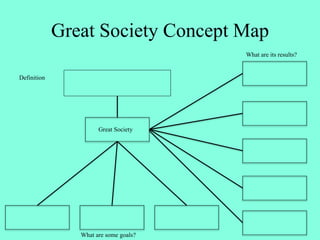
Great Society Concept Map
What are some goals?
Great Society
What are its results?
Definition
Great Society Quiz
1. Give one of the goals of President Johnson’s Great Society.
2. What was the fulfillment of President Truman’s dream of providing health care for
the aged?
3. Was the Great Society legislation difficult to pass in congress?
4. Give a 1950s status quo statistic for the black American family.
5. Give one of the results of the Great Society for the black American family.
The Vietnam War
Chapter 19
1954-1975
What is a just war?
A just war is that:-
- A good intention should be behind it
- It should be a last resort after diplomatic means failed
- There must be a chance of success
How should a just war be fought:-
- Innocent people should not be harmed
- Appropriate force should be used to bring the war to a
swift conclusion according to the military commanders
recommendations
- Internationally agreed conventions regulating war must
be obeyed
Introduction
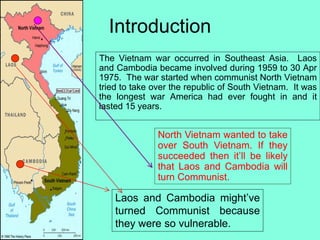
The Vietnam war occurred in Southeast Asia. Laos
and Cambodia became involved during 1959 to 30 Apr
1975. The war started when communist North Vietnam
tried to take over the republic of South Vietnam. It was
the longest war America had ever fought in and it
lasted 15 years.
North Vietnam wanted to take
over South Vietnam. If they
succeeded then it’ll be likely
that Laos and Cambodia will
turn Communist.
Laos and Cambodia might’ve
turned Communist because
they were so vulnerable.
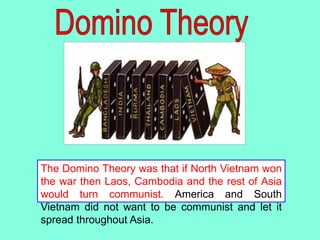
The Domino Theory was that if North Vietnam won
the war then Laos, Cambodia and the rest of Asia
would turn communist. America and South
Vietnam did not want to be communist and let it
spread throughout Asia.
Dien Bien Phu
The Battle of Dien Bien Phu (French: Bataille de Diên Biên Phu; Vietnamese: Chiến dịch
Điện Biên Phủ) was the climactic confrontation of the First Indochina War between the
French Union's French Far East Expeditionary Corps and Viet Minh communist
revolutionaries. The battle occurred between March and May 1954 and culminated in a
comprehensive French defeat that influenced negotiations over the future of Indochina at
Geneva. Military historian Martin Windrow wrote that Điện Biên Phủ was "the first time
that a non-European colonial independence movement had evolved through all the stages
from guerrilla bands to a conventionally organized and equipped army able to defeat a
modern Western occupier in pitched battle.”
As a result of blunders in the French decision-making process, the French began an
operation to support the soldiers at Điện Biên Phủ, deep in the hills of northwestern
Vietnam. Its purpose was to cut off Viet Minh supply lines into the neighboring Kingdom
of Laos, a French ally, and tactically draw the Viet Minh into a major confrontation that
would cripple them. Instead, the Viet Minh, under Senior General Võ Nguyên Giáp,
surrounded and besieged the French, who were unaware of the Viet Minh's possession of
heavy artillery (including anti-aircraft guns) and, more importantly, their ability to move
such weapons through extremely difficult terrain to the mountain crests overlooking the
French encampment. The Viet Minh occupied the highlands around Điện Biên Phủ and
were able to accurately bombard French positions at will. Tenacious fighting on the
ground
Dien Bien Phu (cont’d)
ensued, reminiscent of the trench warfare
of World War I. The French repeatedly
repulsed Viet Minh assaults on their
positions. Supplies and reinforcements
were delivered by air, though as the French
positions were overrun and the anti-aircraft
fire took its toll, fewer and fewer of those
supplies reached them. After a two-month
siege, the garrison was overrun and most
French forces surrendered, only a few
successfully escaping to Laos.
Shortly after the battle, the war ended with
the 1954 Geneva Accords, under which
France agreed to withdraw from its former
Indochinese colonies. The accords
partitioned Vietnam in two; fighting later
broke out between opposing Vietnamese
factions in 1959, resulting in the Vietnam
(Second Indochina) War.
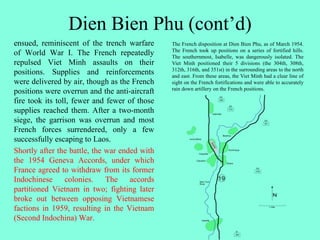
The French disposition at Dien Bien Phu, as of March 1954.
The French took up positions on a series of fortified hills.
The southernmost, Isabelle, was dangerously isolated. The
Viet Minh positioned their 5 divisions (the 304th, 308th,
312th, 316th, and 351st) in the surrounding areas to the north
and east. From these areas, the Viet Minh had a clear line of
sight on the French fortifications and were able to accurately
rain down artillery on the French positions.
Vietnam War 1954-1975
• During the Eisenhower years, the U.S.
assumed the conflict from the French
who were trying to regain their SE Asian
colonial empire after World War II.
• Through the Kennedy years, US troops
trained S. Vietnamese troops to fight the
Reds.
• After the Gulf of Tonkin Resolution,
under Lyndon Baines Johnson (LBJ), US
troops started to fight more.
U.S. Involvement Time
Sequence
Reasons Impetus ResultsDien Bien Phu
U.S. Involvement Quiz
1. What was the battle defeat by the French that eventually
involved the United States?
2. What was the political theory that communism spread from one
country to another?
3. What were the results of the 1954 Geneva Accords?
4. Which President involved us in the Vietnam War?
5. Which President escalated the war?
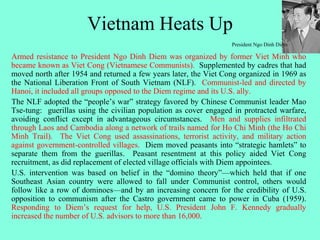
Vietnam Heats Up
Armed resistance to President Ngo Dinh Diem was organized by former Viet Minh who
became known as Viet Cong (Vietnamese Communists). Supplemented by cadres that had
moved north after 1954 and returned a few years later, the Viet Cong organized in 1969 as
the National Liberation Front of South Vietnam (NLF). Communist-led and directed by
Hanoi, it included all groups opposed to the Diem regime and its U.S. ally.
The NLF adopted the “people’s war” strategy favored by Chinese Communist leader Mao
Tse-tung: guerillas using the civilian population as cover engaged in protracted warfare,
avoiding conflict except in advantageous circumstances. Men and supplies infiltrated
through Laos and Cambodia along a network of trails named for Ho Chi Minh (the Ho Chi
Minh Trail). The Viet Cong used assassinations, terrorist activity, and military action
against government-controlled villages. Diem moved peasants into “strategic hamlets” to
separate them from the guerillas. Peasant resentment at this policy aided Viet Cong
recruitment, as did replacement of elected village officials with Diem appointees.
U.S. intervention was based on belief in the “domino theory”—which held that if one
Southeast Asian country were allowed to fall under Communist control, others would
follow like a row of dominoes—and by an increasing concern for the credibility of U.S.
opposition to communism after the Castro government came to power in Cuba (1959).
Responding to Diem’s request for help, U.S. President John F. Kennedy gradually
increased the number of U.S. advisors to more than 16,000.
President Ngo Dinh Diem
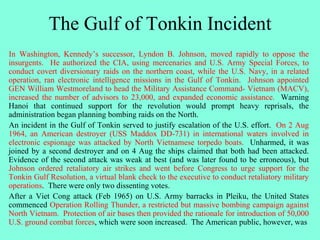
The Gulf of Tonkin Incident
In Washington, Kennedy’s successor, Lyndon B. Johnson, moved rapidly to oppose the
insurgents. He authorized the CIA, using mercenaries and U.S. Army Special Forces, to
conduct covert diversionary raids on the northern coast, while the U.S. Navy, in a related
operation, ran electronic intelligence missions in the Gulf of Tonkin. Johnson appointed
GEN William Westmoreland to head the Military Assistance Command- Vietnam (MACV),
increased the number of advisors to 23,000, and expanded economic assistance. Warning
Hanoi that continued support for the revolution would prompt heavy reprisals, the
administration began planning bombing raids on the North.
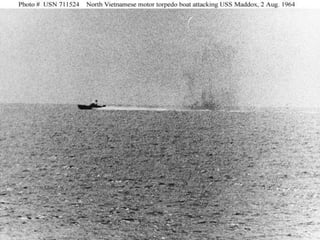
An incident in the Gulf of Tonkin served to justify escalation of the U.S. effort. On 2 Aug
1964, an American destroyer (USS Maddox DD-731) in international waters involved in
electronic espionage was attacked by North Vietnamese torpedo boats. Unharmed, it was
joined by a second destroyer and on 4 Aug the ships claimed that both had been attacked.
Evidence of the second attack was weak at best (and was later found to be erroneous), but
Johnson ordered retaliatory air strikes and went before Congress to urge support for the
Tonkin Gulf Resolution, a virtual blank check to the executive to conduct retaliatory military
operations. There were only two dissenting votes.
After a Viet Cong attack (Feb 1965) on U.S. Army barracks in Pleiku, the United States
commenced Operation Rolling Thunder, a restricted but massive bombing campaign against
North Vietnam. Protection of air bases then provided the rationale for introduction of 50,000
U.S. ground combat forces, which were soon increased. The American public, however, was
The Gulf of Tonkin Incident
(cont’d)
not told when their mission and tactics changed from static defense to search-and-destroy,
nor was it asked to bear the war’s cost through higher taxes. Desiring both “guns and butter”
Johnson dissimulated, ultimately producing a backlash that full public and congressional
debate at this point might have avoided. The public never fully supported a war whose
purposes were deliberately obscure.
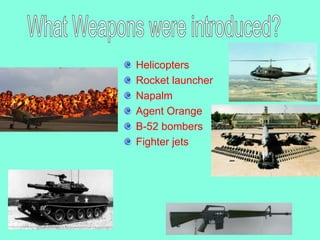
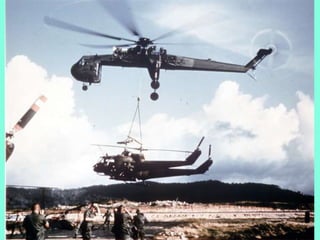
Helicopters
Rocket launcher
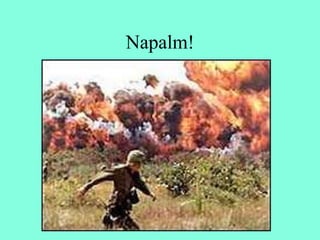
Napalm
Agent Orange
B-52 bombers
Fighter jets
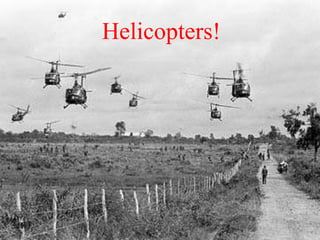
Helicopters!
Napalm!
The War Escalates Time Sequence Organizer
Causes Kennedy Administration Johnson Administration
The War Escalates Quiz
1.What were the two armed resistance groups that
were in opposition to South Vietnamese President
Ngo Dinh Diem?
2. What incident escalated the troop levels in
Vietnam?
3. What was the supply route that ran though Laos
and Cambodia?
4. What did President Johnson authorize in the Gulf
of Tonkin and the maximum amount of troops?
5. Name two new weapons introduced into the
Vietnam War.
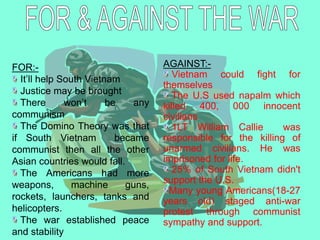
FOR:-
It’ll help South Vietnam
Justice may be brought
There won’t be any
communism
The Domino Theory was that
if South Vietnam became
communist then all the other
Asian countries would fall.
The Americans had more
weapons, machine guns,
rockets, launchers, tanks and
helicopters.
The war established peace
and stability
AGAINST:-
Vietnam could fight for
themselves
The U.S used napalm which
killed 400, 000 innocent
civilians
1LT William Callie was
responsible for the killing of
unarmed civilians. He was
imprisoned for life.
25% of South Vietnam didn't
support the U.S.
Many young Americans(18-27
years old) staged anti-war
protest through communist
sympathy and support.
The Opposing Sides
The movement against the involvement of the United States in the Vietnam War
began in the U.S. with demonstrations in 1964 and grew in strength in later years.
The U.S. became polarized between those who advocated continued involvement in
Vietnam, and those who wanted peace.
Many in the peace movement were students, mothers, or anti-establishment hippies,
but there was also involvement from many other groups, including educators,
clergy, academics, journalists, lawyers, physicians (such as Benjamin Spock and
Justin Newlan), military veterans, and ordinary Americans. Expressions of
opposition events ranged from peaceful nonviolent demonstrations to radical
displays of violence.
Violent groups included the Students for a Democratic Society (SDS), Black
Panthers, and the Weather Underground Organization (WUO). All three of these
organizations had communist ties and backing and were kept under strict
surveillance by the FBI. The SDS began as a movement to involve the largest
possible number of American students in the democratic processes had become by
1969, as a contemporaneous FBI memo summarizes, "an organization totally
dedicated to the destruction of American society...In the span of seven years, the
SDS had evolved into a hard line Marxist-Leninist-Maoist organization dedicated to
the destruction of Western democratic traditions and ideals.” The Black Panther
Party (originally the Black Panther Party for Self-Defense) was a black American
revolutionary socialist organization active in the United States from 1966 until
1982.
The Opposing Sides
The Black Panther Party achieved national and international notoriety through its
involvement in the Black Power movement, illegal activities, police gun battles, social
programs, and U.S. politics of the 1960s and 1970s. The WUO conducted a campaign of
bombings through the mid-1970s, including aiding the jailbreak and escape of Timothy
Leary. The "Days of Rage", their first public demonstration on October 8, 1969, was a riot in
Chicago timed to coincide with the trial of the Chicago Seven. In 1970 the group issued a
"Declaration of a State of War" against the United States government.
Jeff Jones (above) of the Apollo Alliance
authored President Obama’s 2009 $787 billion
stimulus bill and the Obamacare healthcare bill.
It was in Bill Ayers’ (left) living room in Chicago
(a neighbor down the street) that President
Obama launched his political career.
Weathermen
During the hippie movement
started in the 1960’s, 250,000
anti-war protestors gathered in
Washington D.C. It was the
largest protest to occur during
the Vietnam war. Many
Americans were against the
war in Vietnam mainly
because 48,700 American
soldiers died including 4
Students. They did not like the
idea that America got involved
in the Vietnam War.
The Radical Left Turns Vietnam Sour
Opposition to the war grew with increased U.S. involvement. Leftist college students,
members of traditional pacifist religious groups, long-time peace activists, and citizens of all
ages opposed the conflict. Some were motivated by fear of being drafted, others out of
commitment, some just joined the crowd, and a small minority became revolutionaries who
favored a victory by Ho Chi Minh and a radical restructuring of U.S. society. College
campuses became focal points for rallies and “teach-ins”—lengthy series of speeches
attacking the war. Marches on Washington began in 1971. Suspecting that the peace
movement was infiltrated by Communists, President Johnson ordered the FBI to investigate
and the CIA to conduct an illegal domestic infiltration, but they proved only that the
radicalism was homegrown. Although the antiwar movement was frequently associated
with the young, support for the war was actually highest in the age group 20-29. The
effectiveness of the movement is still debated. It clearly boosted North Vietnamese morale;
Hanoi watched it closely and believed that ultimately America’s spirit would fall victim to
attrition, but the Communists were prepared to resist indefinitely anyway. The movement
probably played a role in convincing Lyndon Johnson not to run for reelection in 1968, and
an even larger role in the subsequent victory of Richard Nixon over the Democrat Hubert
Humphrey. It may ultimately have helped set the parameters for the conflict and prevented
an even wider war. Certainly its presence was an indication of the increasingly divisive
effects of war on U.S. society.
U.S. actress Jane Fonda,
aka Hanoi Jane, tours
North Vietnam, during
which she is photographed
sitting on a North
Vietnamese anti-aircraft
gun.
Returning Vietnam Soldiers
Disrespected
The Left has tried to erase the memories that were shown to our returning soldiers
from Vietnam with reports and books written ten to twenty years after the
Vietnam War so as to revise their image and write revisionist history. The book
The Spitting Image: Myth, Memory and the Legacy of Vietnam is a 1998 book
by sociologist Jerry Lembcke that is referenced most by liberals saying that it did
not happen.
However, through my personal recollections and military policy during the time,
incidents happened and the military took measures up until the early 1990s to
minimize these incidents by not allowing soldiers to wear their uniforms off of
the military reservation. I talked to Vietnam veterans in units that I served with
in the 1970s and 80s and my father-in-law and the treatment that was received
was 180 degrees the opposite from what is received today.
Soldiers were spit on, cursed, called baby killer, (reference to the Americal 23rd
IN Division 1LT William Calley massacre at My Lai where 22 women, children,
and elderly were murdered, the division was deactivated and has not been
reactivated since.) physically and verbally abused, and had property destroyed.
On the other side, veterans of the Veterans of Foreign Wars (VFW) and the
American Legion would deride the Vietnam Veterans for losing the war and not
fighting hard enough.
Radical Left Turns Vietnam Sour Graphic Organizer
Anti-War Goals
Violent Movement Organizations Peaceful Movement Organizations
ExamplesExamples
Radical Left Turns Vietnam Sour Quiz
1. Give one of the goals for those against the Vietnam
War.
2. Give three examples of the peaceful protesters.
3. Give two examples of the violent protesters.
4. What did all of the protests do for the North
Vietnamese and who was also known as (aka)
Hanoi Jane that aided the enemy?
5. What were two forms of abuse returning Vietnam
veterans endured from those that opposed the war?
Tet Offensive- Vietnam, 1968
The Tet Offensive
By late 1967, the war was stalemated. Johnson urged Westmoreland to help convince a
public growing more restive that the United States was winning. Although he promised
“light at the end of the tunnel,” increasing casualties as well as growing disbelief in public
pronouncements—the “credibility gap”—fostered increasing skepticism. U.S. strategy was
clearly not producing victory, and Johnson began a limited reassessment.
Meanwhile, Hanoi began planning a new offensive that involved a series of actions: first,
intensified activity in the border areas including a massive attack against the base at Khe
Sanh to attract ARVN and U.S. forces, followed by attacks on most provincial capitals and
Saigon itself. If these were successful, regular forces poised on the outskirts of the cities
would move to support a general uprising. The initial actions did draw forces away from
the cities, and U.S. attention became riveted on the siege of Khe Sanh.
Attacks on cities began on Tet, the lunar holiday, 30 Jan 1968. Hitting most provincial and
district capitals and major cities, the Viet Cong also carried out a bold attack on the U.S.
embassy in Saigon. The attack failed, but the attempt shocked U.S. public opinion. The
Tet offensive continued for three weeks. Although they failed in their military objectives,
the revolutionaries won a spectacular propaganda victory. While captured documents had
indicated that the Viet Cong were planning a major offensive, its size, length, and scope
were misjudged, and the Tet Offensive, as it was publicized in the U.S. media, seemed to
confirm fears that the war was unwinnable. The public oppose the war in direct proportion
The Tet Offensive (cont’d)
to U.S. casualties, and these had topped a thousand dead a month. Tet appeared as a defeat,
despite official pronouncements to the contrary. The media’s negative assessment proved
more convincing than Washington’s statements of victory because it confirmed the sense of
frustration that most Americans shared over the conflict.
FOR:-
 American troops in Vietnam
had vastly superior weapons
than the Vietcong.
 American soldiers had fully
automatic weapons and were
supported by tanks and
helicopters.
 They had napalm which was
a type of flammable petroleum
jelly which adheres and burns
the skin, even in water. The
Americans used this to burn
down all of the jungles along
with the defoliate Agent
Orange to clear fields of fire
around fire bases.
Against:-
 America couldn't find the
guerrillas because they used no
uniforms and hid among the
civilian populace.
 The people in South Vietnam
would not tell the American troops
where the guerrillas were hiding.
They feared being retaliated
against by the Vietcong and being
tortured, massacred, and their
village burned down. Civilians
were caught in the middle
because there was no clear battle
line.
 Politicians interfered with the
military commanders decisions
and turned the war into a political
war rather than allowing the war to
come to a swift conclusion.
Following Ho Chi Minh: Memoirs of a North
Vietnamese Colonel (Crawford House, New South
Wales, 202 pages, $24.95)
In a recent interview published in The Wall Street Journal, former colonel Bui Tin who
served on the general staff of the North Vietnamese Army and received the unconditional
surrender of South Vietnam on April 30, 1975; confirmed the American Tet 1968 military
victory: "Our loses were staggering and a complete surprise. Senior General Võ Nguyên
Giáp later told me that Tet had been a military defeat, though we had gained the planned
political advantages when Johnson agreed to negotiate and did not run for reelection. The
second and third waves in May and September were, in retrospect, mistakes. Our forces in
the South were nearly wiped out by all the fighting in 1968. It took us until 1971 to
reestablish our presence but we had to use North Vietnamese troops as local guerrillas. If
the American forces had not begun to withdraw under Nixon in 1969, they could have
punished us severely. We suffered badly in 1969 and 1970 as it was." And on strategy:
"If Johnson had granted Westmoreland's requests to enter Laos and block the Ho Chi
Minh trail, Hanoi could not have won the war.... it was the only way to bring sufficient
military power to bear on the fighting in the South. Building and maintaining the trail was
a huge effort involving tens of thousands of soldiers, drivers, repair teams, medical
stations, communication units .... our operations were never compromised by attacks on
the trail.
Visits to Hanoi by Jane Fonda and former Attorney General Ramsey Clark and ministers
gave us confidence that we should hold on in the face of battlefield reverses. We were
elated when Jane Fonda, wearing a red Vietnamese dress, said at a press conference that
she was ashamed of American actions in the war and would struggle along with us ....
those people represented the conscience of America .... part of it's war- making capability,
and we turning that power in our favor."
Seeing this on TV led to a
loss of support at home
Hippie bashing!!!
The Vietnam War caused
the breakdown of many
families and also a
breakdown of the
Vietnamese culture.
Thousands upon thousands
of children were orphaned
during the war and ended up
either in orphanages or on
the streets without a home.
Agent Orange was used and
it caused a mass amount of
damage to the plants and
the jungle itself as well as
U.S. soldiers. Napalm also
caused damage to the skin
and it burned many innocent
people during the war.
Deaths During the War
Deaths During
Vietnam War
American
S.Veitnam
N.Vietnam
29 Mar 1973
Vietnam War Officially Ends
The Vietnam War is officially over for the United States. The last
U.S. combat soldier leaves Vietnam, but military advisors and some
Marines remain. Over 3 million Americans had served in the war,
nearly 60,000 are dead, some 150,000 are wounded, and at least
1,000 are missing in action. The military advisors left south
Vietnam in 1975 after training the south Vietnamese to defend
themselves and agreeing to a cease fire.
President Gerald Ford, who replaced President Nixon, was shown
a video in which South Vietnam soldiers mobbed a plane intended
to evacuate children.
He said: 'That's it. We're pulling the plug on Vietnam’.
The North Vietnamese rolled into South Vietnam and purged many
thousands of civilians through executions. Next door, Cambodia
erected the ‘Killing Fields’ through the efforts of the Khmer Rouge.
Alternate Ending?
Chance of Success?
• General Giap was a brilliant, highly respected leader of the North
Vietnam military. The following quote is from his memoirs currently
found in the Vietnam war memorial in Hanoi:
• "What we still don't understand is why you Americans stopped the
bombing of Hanoi. You had us on the ropes. If you had pressed us a little
harder, just for another day or two, we were ready to surrender! It was
the same at the battles of TET. You defeated us! We knew it, and we
thought you knew it. But we were elated to notice your media was
definitely helping us. They were causing more disruption in America than
we could in the battlefields. We were ready to surrender. You had
won!"
• General Giap has published his memoirs and confirmed what most
Americans knew. The Vietnam war was not lost in Vietnam -- it was lost
at home. The exact same slippery slope, sponsored by the US media, is
currently well underway. It exposes the enormous power of a biased
media to cut out the heart and will of the American public.
• A truism worthy of note: Do not fear the enemy, for they can take only
your life. Fear the media far more, for they will destroy your honor.
Vietnam Ends Frayer Model
Vietnam War Ends
Tet Offensive Possibility of Success
Effects The End
Vietnam Ends Quiz
1.What North Vietnamese operation, that was a failure
but the left-wing media turn into a victory, turned
the American public against the war as unwinnable?
2. What was the growing disbelief by the American
public about the Vietnam War?
3. What was the name of the North Vietnamese
commander of the army that said the U.S. would
have won?
4. Name one of the effects of the Vietnam War.
5. What President “pulled the plug” on Vietnam?
US Civil Rights Movement
Beginnings through the 60s
Abolitionists
• Frederick Douglas was the editor of an
abolitionist newspaper, The North Star.
Harriet Tubman
• Helped slaves escape via the Underground
Railroad.
John Brown
• He and his sons
brutally murdered 5
slave masters in
Kansas. (1858)
• Tried to incite a slave
revolt at Harper’s
Ferry, but failed.
The slaves did not
rise up.
Reconstruction 1865-77
• After the War Between the States 1861-
1865, the federal government made
strides toward equality.
• Blacks voted, held many political
offices.
• The Freedmen’s Bureau was a
government program to help Blacks find
land, it established schools and colleges.
Reconstruction
• The Fourteenth Amendment
guaranteed all citizens with equal
protection under the law.
• The Fifteenth Amendment said
the right to vote shall not be
denied on the basis of race.
However. . .
• The Supreme Court decided in
Plessy vs. Ferguson that separate
institutions are okay if they are
equal.
• Jim Crow laws required that
Blacks have separate facilities.
Dallas Bus Station
Jim Crow Laws
Texas sign
Jim Crow Laws
Jim Crow Laws
Jim Crow Laws
National Association for the
Advancement of Colored People
(NAACP)
• Started by four white
Progressives
(socialists)
• Joined in 1909 by
W.E.B. Dubois
• Fought for equality as
a Progressive socialist,
later communist and
finally left the U.S. as
a social pariah
4
The Great
Migration- The
movement of 1.75
million black
Americans out of
the Southern U.S. to
the North and
Midwest and West
from the early
1900’s -1930.
Early Civil Rights Concept Map
Time Period
Reconstruction to
the Great
Migration
People and Leaders
Gov’t Policies/Acts
Early Civil Rights
Actions/ Agencies
Early Civil Rights Quiz
1. Name an early civil rights leader and their contribution.
2. Name the two amendments pertaining to freed blacks and what they
concern.
3. What were the laws that allowed segregation?
4. What organization started fighting for civil rights?
5. What was the movement of southern blacks to the north and west?
School Desegregation
Brown v. The Board of Education of Topeka, KS was the case in which, on 17 May 1954,
the U.S. Supreme Court ruled unanimously that racial segregation in public schools
violated the Fourteenth Amendment to the Constitution, which says that no state may
deny equal protection of the laws to any person within its jurisdiction. The 1954 decision
declared that separate educational facilities were inherently unequal. Based on a series of
Supreme Court cases argued between 1938 and 1950, Brown v. Board of Education of
Topeka completed the reversal of an earlier Supreme Court ruling (Plessy v. Ferguson,
1896) that permitted “separate but equal” public facilities. The 1954 decision was limited
to the public schools, but it was believed to imply that segregation was not permissible in
other public facilities.
In 1957, Little Rock, AR became the focus of world attention over the right of nine black
students to attend Central High School under a gradual desegregation plan adopted by the
city school board in accordance with the 1954 decision of the U.S. Supreme Court
holding racial segregation in public schools unconstitutional. The result was a test of
power between the federal and state governments. Governor Orval E. Faubus ordered
state militia to prevent blacks from entering the school, but the state was enjoined from
interfering by U.S. President Dwight D. Eisenhower, who sent federal troops to the city to
maintain order. Within the next decade, desegregation was accomplished in all public
schools.
NAACP fought in the courts
• Thurgood Marshall was hired by
the NAACP to argue in the
Supreme Court against school
segregation. He won.
• He was later the 1st Black
Supreme Court Justice.
Thurgood Marshall
Brown vs. Board of Education
1954
Civil Rights
Rights have been expanded through legislation. Since 1957, federal Civil Rights Acts and
a Voting Rights Acts have been passed in an effort to guarantee voting rights, access to
housing, and equal opportunity in employment. These have been accompanied by much
state and local civil rights legislation.
Throughout recent history, people have organized to struggle for rights to which they felt
entitled either by law or by a sense of justice. In the United states, black militancy spread
in the 1950’s and ‘60’s through the activities of the Congress of Racial Equality (CORE),
Southern Christian Leadership Conference (SCLC) headed by Martin Luther King, Jr.,
and the Student Nonviolent Coordinating Committee (SNCC). These groups achieved
major successes in arousing national opinion against segregation in the South and in
stimulating the civil rights legislation of the 1960’s. They failed, however, to eliminate
some of the deep-rooted segregation patterns in urban areas of the country in the North
primarily.
The Fight
• Many black Americans and whites
risked their lives and lost their lives
to remedy this situation.
• Rosa Parks was not the first, but she
was the beginning of something
special.
Civil Disobedience
Civil disobedience is the act of disobeying a law on the grounds of moral or political
principle. It is an attempt to force society to accept a dissenting point of view. Although it
adopts tactics of nonviolence, it is more than mere passive resistance since it often takes
active forms such as illegal street demonstrations or peaceful occupation of premises. It is
distinguished from other forms of rebellion because the civil disobeyer invites arrest and
accepts punishment.
The most ambitious and perhaps most successful examples of mass civil disobedience
were those of Mohandas K. Gandhi and Martin Luther King, Jr. Gandhi called civil
disobedience—satyagraha, a term meaning “truth-force,” and taught it as an austere
practice requiring great self-discipline and moral purity. With a versatile use of
disobedience, Gandhi led the campaign for Indian independence. In the 1940’s, American
blacks and their white sympathizers began to use forms of civil disobedience to challenge
discrimination in public transportation and restaurants, but the major movement began in
1955 with illegal sit-ins in support of boycotts of segregated establishments. King was the
chief advocate of nonviolent civil disobedience in the civil rights movement of the 1960’s.
Montgomery Bus Boycott, 1955
• Rosa Parks was arrested for violating the
segregation laws of Montgomery, Alabama.
Free At Last, Free At Last
After a black woman, Rosa Parks, was arrested for refusing to move to the Negro section
of a bus in Montgomery, AL on 1 Dec 1955, blacks staged a one-day local boycott of the
bus system to protest her arrest. Fusing these protest elements with the historic force of
the Negro churches, a local Baptist minister, Martin Luther King, Jr., succeeded in
transforming a spontaneous racial protest into a massive resistance movement, led from
1957 by his Southern Christian Leadership Conference (SCLC). After a protracted boycott
of the Montgomery bus company forced it to desegregate its facilities, picketing and
boycotting spread rapidly to other communities. During the period from 1955 to 1960,
some progress was made toward integrating schools and other public facilities in the upper
South and the border states, but the Deep South remained adamant in its opposition to
most desegregation measures.
In 1960, the sit-in movement (largely under the auspices of the newly formed Student
Nonviolent Coordinating Committee- SNCC) was launched at Greensboro, NC, when
black college students insisted on service at a local segregated lunch counter. Patterning
its techniques on the nonviolent methods of Indian leader Mohandas K. Gandhi, the
movement spread across the nation, forcing the desegregation of department stores,
supermarkets, libraries, and movie theaters. In May 1961, the Congress of Racial Equality
(CORE) sent “Freedom Riders” of both races through the South and elsewhere to test and
break down segregated accommodations in interstate transportation. By September, it was
Free At Last, Free At Last (cont’d)
estimated that more than 70,000 students had participated in the movement, with
approximately 3,600 arrested; more than 100 cities in 20 states had been affected. The
movement reached its climax in Aug 1963 with a massive march on Washington, D.C., to
protest racial discrimination and demonstrate support for major civil-rights legislation that
was pending in Congress.
In Response. . .
• For over a year,
Blacks boycotted
the buses.
• They carpooled and
walked through all
weather conditions
Many were arrested for an “illegal boycott”
including their leader. . .
Martin Luther King Jr.
• While the NAACP fought in the
courts, MLK’s organization led the
boycott.
http://www.africanaonline.com/Graphic/rosa_parks_bus.gif
King’s sacrifice
• King was arrested
thirty times in his
38 year life.
• His house was
bombed or nearly
bombed several other
times
• Death threats
constantly
Success!
•Gandhi
inspired
King to be
direct and
nonviolent
towards
whites.
• Violence never solves problems. It only
creates new and more complicated ones. If
we succumb to the temptation of using
violence in our struggle for justice, unborn
generations will be the recipients of a long
and desolate night of bitterness, and our
chief legacy to the future will be an endless
reign of meaningless chaos.
--Dr. Martin Luther King, Jr., Facing the
Challenge of a New Age
Sit ins
This was in Greensboro, North Carolina
They were led not by MLK but by college
students—Students Non-violent Coordinating
Committee (SNCC)
Sit-in Tactics
• Dress in your Sunday best.
• Be respectful to employees and police.
• Do not resist arrest!
• Do not fight back!
• Remember, journalists are everywhere!
Students were ready to take your place
if you had a class to attend.
Why march and risk personal
injury?
Headlines!
• People around the
world will convert
to your cause if
they see you on
TV or on the front
page of the
newspaper.
Birmingham, Alabama 1963
Police use dogs to
quell civil unrest in
Birmingham, Ala.
in May of 1963.
Birmingham's
police
commissioner
"Bull" Connor also
allowed fire hoses
to be turned on
young civil rights
demonstrators.
Birmingham
Birmingham
• White America saw 500 kids get
arrested and attacked with dogs.
• There was much support now for
civil rights legislation.
Civil Rights Act of 1964
• Banned segregation in
public places such as
restaurants, buses
Everybody Gets to Vote
The Voting Rights Act was passed by the U.S. Congress in 1965. In 1957 and 1960,
Congress had passed laws to protect the rights of black voters, and the 24th Amendment
(1964) banned the use of poll taxes in federal elections. Nevertheless, in the presidential
elections of 1964, blacks continued to have difficulty registering to vote in many areas.
Voter registration drives met with bitter, and sometimes violent, opposition. In March
1965, Martin Luther King, Jr., led a march from Selma to Montgomery, AL, to dramatize
the voting issue. Immediately after the march, President Lyndon B. Johnson sent a voting
bill to Congress, and it was quickly passed.
The Voting Rights Act authorized the U.S. Attorney General to send federal examiners to
register black voters under certain circumstances. It also suspended literacy tests in states
in which less than 50% of the voting-age population had been registered or had voted in
the 1964 election. The law had an immediate impact. By the end of 1965, a quarter of a
million new black voters had been registered, one third by federal examiners. The Voting
Rights Act was readopted and strengthened in 1970, 1975, and 1982.
Voter Registration
• Congress of
Racial Equality
(CORE)
volunteers came
to Mississippi to
register Blacks
to vote.
These volunteers risked arrest, violence and death
every day.
The Fight
• This man spent 5
days in jail for
“carrying a
placard.”
• Sign says “Voter
registration
worker”
"Your work is just beginning. If you
go back home and sit down and
take what these white men in
Mississippi are doing to us. ...if you
take it and don't do something
about it. ...then *%# damn your
souls."
— Mississippi CORE leader Dave Dennis delivering the
eulogy for James Chaney, murdered by cops and Klan in
Philadelphia MS, 1964.
Voter Registration
• If blacks
registered to
vote, the local
banks could call
the loan on their
farm.
Lyndon B. Johnson ’63-’68
• Pushed Civil Rights
Act through
Congress against his
own Democratic
party (Dixiecrats)
• Passed more pro-
civil rights laws
than any other
president
Lyndon Baines Johnson (LBJ)
• Civil Rights Act of
’64
• Civil Rights Act of
’68
• Voting Rights Act
of ’65
• 24th Amendment
banning poll taxes
Not only were there sit-ins. .
• Swim-ins (beaches, pools)
• Kneel-ins (churches)
• Drive-ins (at motels)
• Study-ins (universities)
Hydrochloric Acid in a St. Augustine,
FL Swimming Pool Swim-in
In 1964, a few young blacks decided to take a dip in a whites-only pool at a
whites-only hotel in St. Augustine, Florida. The hotel’s owner, James Brock,
reacted by emptying jugs of hydrochloric acid into the water to expel the
unwanted swimmers.
This act of civil disobedience was one among many in the small city on the
northeast coast of Florida, which in 1964 was celebrating its 400th anniversary.
Because of that anniversary, the national spotlight was already on America’s
oldest settlement, and the leaders of the civil rights movement took advantage of
that attention to bring some to their own cause.
Modern Civil Rights Begins
Semantic Map
Civil
Rights
Movement
School
Desegregation
Organizations
Impetus
Civil Disobedience
Legislation
Modern Civil Rights Begins Quiz
1. Name 2 other civil rights leaders other than
Martin Luther King, Jr.
2. Whose arrest sparked the Montgomery Bus
Boycott?
3. Name one of the Civil Rights Groups formed
during the 1950s-60s.
4. Who inspired MLK’s nonviolent strategies?
5. Which Supreme Court case integrated
schools?
The Civil Rights Bill of 1957
The Civil Rights Act of 1957 was introduced in Eisenhower’s presidency and was the act that
kick-started the civil rights legislative programme that was to include the 1964 Civil Rights
Act and the 1965 Voting Rights Act. Eisenhower had not been known for his support of the
civil rights movement. Rather than lead the country on the issue, he had to respond to
problems such as in Little Rock. He never publicly gave support to the civil rights movement
believing that you could not force people to change their beliefs; such changes had to come
from the heart of the people involved, not as the result of legislation from Washington.
However, he did push through during his presidency the 1957 Civil Rights Act. Cynics have
stated that this was simply to win the ‘Black Vote’. Up to 1957, and for a variety of reasons,
only 20% of African Americans had registered to vote. In Britain, the government takes the
initiative in sending out voter registration forms which individuals have to return. In America
it is up to each person to take the responsibility to register their vote. In the South plain
intimidation and official apathy and obstacles meant that very few African Americans
registered their vote. Those that did not disqualified themselves from voting.
The 1957 Civil Rights Bill aimed to ensure that all black Americans could exercise their right
to vote. It wanted a new division within the federal Justice Department to monitor civil rights
abuses and a joint report to be done by representatives of both major political parties
(Democrats and Republicans) on the issue of race relations.
The Civil Rights Bill of 1957 (cont’d)
Eisenhower, perhaps shocked by the news broadcasts of Little Rock, publicly supported the
bill (it was, after all, his Attorney-General who had produced the bill). However, the final act
became a much watered done affair due to the lack of support among the Democrats. The
Senate leader, Lyndon Baines Johnson, was a Democrat, and he realised that the bill and its
journey through Congress, could tear apart his party as it had right wing Southern senators in
it and liberal west coast ones.
In keeping with Congressional procedure, Johnson sent the bill to a judiciary committee
which would examine it for flaws, controversial and unconstitutional points etc. This
committee was led by Senator James Eastland - senator for Mississippi. Committee heads
have great powers in changing bills and altering them almost beyond recognition. Eastland
did just this especially after the very public outburst by Senator Richard Russell from
Georgia who claimed that it was an example of the Federal government wanting to impose its
laws on states, thus weakening highly protected states rights of self-government as stated in
the Constitution. He was most critical of the new division which would be created within the
Justice Department.
Johnson had other reasons for taking his stance. No civil rights act had been introduced into
America for 82 years. If this one went through successfully and had support from both
parties, it would do his position within the Democrats a great deal of good as he had plans in
1957 to be the party’s future presidential candidate. If he
The Civil Rights Bill of 1957 (cont’d)
could get the credit for maintaining party unity and get the support of the South’s Democrats
for ‘killing the bill’, then his position would be greatly advanced. If he was seen to be
pushing through the first civil rights act in 82 years he hoped to get the support of the more
liberal west and east coast Democrat senators. However, he required Eisenhower to remove
Section 3 of the bill before passage. Section 3 allowed the Federal Attorney General to bring
suit for matters of civil rights violations.
The Civil Rights Act of 1957 maintained the mood of the bill - it aimed to increase the
number of registered black voters and stated its support for such a move. However, any
person found guilty of obstructing someone’s right to register barely faced the prospect of
punishment as a trial by jury in the South meant the accused had to face an all-white jury as
only whites could be jury members.
March on Washington 1963
• President Kennedy was pushing
for a civil rights bill.
• To show support, 500,000 black
Americans went to Washington
D.C.
March on Washington 1963
The event was
highlighted by
King's "I Have a
Dream" speech
in front of the
Lincoln
Memorial.
August 28, 1963.
School Integration
• The attitude of many Northern and Southern
schools after the 1954 Brown decision was
like:
Federalism
• When Federal troops are sent to make
states follow federal laws, this struggle
for power is called federalism.
• The Civil Rights Movement was
mostly getting the federal government
to make state governments to follow
federal law.
Little Rock, Arkansas 1957
States were not following federal law.
Feds were sent in.
James
Meredith,
University of
Mississippi,
escorted to
class by U.S.
marshals and
troops. 2 Oct
1962.
Ole Miss fought against integration
200 were arrested during riots at Ole
Miss
States ignored the ’54 Brown decision, so
Feds were sent in.
•
The Federal Government Acts
The federal government under presidents Dwight D. Eisenhower (1953-61) and John F.
Kennedy had been reluctant to vigorously enforce the Brown decision when this entailed
directly confronting the resistance of Southern whites. In 1961-63, President Kennedy
won a following in the black community by encouraging the movement’s leaders, but
Kennedy’s administration lacked the political capacity to persuade Congress to pass new
legislation guaranteeing integration and equal rights. After President Kennedy’s
assassination (Nov 1963), Congress, under the prodding of President Lyndon B. Johnson,
in 1964 passed the Civil Rights Act (q.v.). This was the most far-reaching bill in the
nation’s history (indeed, in world history), forbidding discrimination in public
accommodations and threatening to withhold federal funds from communities that
persisted in maintaining segregated schools. It was followed in 1965 by the passage of the
Voting Rights Act, the enforcement of which eradicated the tactics previously used in the
South to disenfranchise black voters. This act led to drastic increases in the numbers of
black registered voters in the South, with a comparable increase in the numbers of blacks
holding elective offices there.
• Harry Truman
ordered the
armed forces
AND the
government to
be
desegregated.
Dwight D. Eisenhower
• Sent 101st
airborne to Little
Rock, Arkansas
to maintain
order.
John F. Kennedy
• Called Coretta Scott
King to pledge support
while MLK was in jail.
• Eventually sent federal
protection for freedom
riders
• Proposed need for civil
rights legislation
Federal Government Intervenes
Concept Map
Federal
Government
Intervention
Initial Legislation
Government Officials
Legislative Examples
Thousands marched to the Courthouse in Montgomery to protest
rough treatment given voting rights demonstrators. The Alabama
Capitol is in the background. 18 Mar 1965
High Schoolers jailed for marching
Oh Wallace,
you never can jail us
all,
Oh Wallace,
segregation's bound
to fall
Bloody Sunday
• In Selma,
pro-vote
marchers
face
Alabama
cops.
Selma to Montgomery, Alabama
Tending the wounded
Marchers cross the bridge
Many were arrested.
Police set up a rope barricade.
Marchers stayed there for days.
We're gonna
stand here 'till it
falls,
‘Till it falls,
‘Till it falls,
We're gonna
stand here 'till it
falls
In Selma,
Alabama.
The Supreme Court ruled that protesters
had a 1st Amendment right to march.
Crime Scene
• This woman was
killed by the
KKK while on
her way to join
voter activists in
Mississippi
• Who was she?
Sacrifice for Suffrage
This is the interior of Viola Liuzzo's car with
blood everywhere and her shoes still on the
floor of the automobile. She was shot in the
head twice by members of the Ku Klux Klan
while driving a participant from the Selma to
Montgomery freedom march to the
Montgomery Airport.
Viola Fauver Gregg Liuzzo (April
11, 1925-March 25, 1965), a
Unitarian Universalist committed
to work for education and
economic justice, gave her life for
the cause of civil rights. The 39-
year-old mother of five was
murdered by white supremacists
after her participation in the protest
march from Selma to Montgomery,
Alabama.
Selma to Montgomery Part 2
Part 2
Freedom Riders
• Now it is time to test the
small-town bus stops and
highways!
Freedom Riders
• CORE volunteers, white and
black, got on buses and sat inter-
racially on the bus.
• They went into bus station lunch
counters
Freedom Riders attacked!
Mobs also attacked them at the bus
stations.
Highways
• The highways were obviously
not safe.
James Meredith, right, pulled himself to cover against a
parked car after he was shot by a sniper. Meredith had been
leading a march to encourage black Americans to vote. He
recovered from the wound, and later completed the march.
June 7, 1966
Malcolm X and MLK
• There was no love lost
between these two
• They despised each
other’s method to
achieve racial equality
Left to right: Hosea
Williams, Jesse
Jackson, Martin
Luther King Jr., Rev.
Ralph David
Abernathy on the
balcony of the
Lorraine Motel
Memphis hotel, a
day before King's
assassination.
April 3,1968
Aides of the Rev. Dr. Martin Luther King point out to police the path of
the assassin's bullet. Joseph Louw, photographer for the Public Broadcast
Laboratory, rushed from his nearby motel room in Memphis to record the
scene moments after the shot. Life magazine, which obtained exclusive
rights to the photograph, made it public. April 4, 1968.
The Final Push Frayer Model
Viola Liuzzo
Freedom Riders Assassination
Selma to Montgomery
Marches
The Close of
the
Movement
The Politics of Protest
1960-1980
A REVIEW OF THE VIETNAM
PROTEST
During the hippie movement
started in the 1960’s, 250,000
anti-war protestors gathered in
Washington D.C. It was the
largest protest to occur during
the Vietnam war. Many
Americans were against the
war in Vietnam mainly
because 48,700 American
soldiers died including 4
Students. They did not like the
idea that America got involved
in the Vietnam War.
The Radical Left Turns Vietnam Sour
Opposition to the war grew with increased U.S. involvement. Leftist college students,
member of traditional pacifist religious groups, long-time peace activists, and citizens of all
ages opposed the conflict. Some were motivated by fear of being drafted, others out of
commitment, some just joined the crowd, and a small minority became revolutionaries who
favored a victory by Ho Chi Minh and a radical restructuring of U.S. society. College
campuses became focal points for rallies and “teach-ins”—lengthy series of speeches
attacking the war. Marches on Washington began in 1971. Suspecting that the peace
movement was infiltrated by Communists, President Johnson ordered the FBI to investigate
and the CIA to conduct an illegal domestic infiltration, but they proved only that the
radicalism was homegrown. Although the antiwar movement was frequently associated
with the young, support for the war was actually highest in the age group 20-29. The
effectiveness of the movement is still debated. It clearly boosted North Vietnamese morale;
Hanoi watched it closely and believed that ultimately America’s spirit would fall victim to
attrition, but the Communists were prepared to resist indefinitely anyway. The movement
probably played a role in convincing Lyndon Johnson not to run for reelection in 1968, and
an even larger role in the subsequent victory of Richard Nixon over the Democrat Hubert
Humphrey. It may ultimately have helped set the parameters for the conflict and prevented
an even wider war. Certainly its presence was an indication of the increasingly divisive
effects of war on U.S. society.
U.S. actress Jane Fonda,
aka Hanoi Jane, tours
North Vietnam, during
which she is photographed
sitting on a North
Vietnamese anti-aircraft
gun.
2004 Presidential candidate- “Swift boat”
John Kerry
“Hanoi Jane” Fonda
NEW TECHNOLOGY AND
CULTURAL TRENDS
Salk and the Solution
Poliomyelitis has sometimes been considered a disease
of developed nations, where improved hygiene has
reduced the chances of contact with the virus during
infancy and hence also reduced the protection provided
by maternal antibodies to the disease, but in fact
poliomyelitis’ worldwide rates of occurrence show no
selectivity. The World Health Organization is
conducting an ongoing immunization program against
poliomyelitis and other common childhood diseases. In
the United States, development by Jonas Salk
(injection) and Albert Sabin (oral) in the 1950s of a
vaccine for all three strains of poliovirus brought about
a dramatic reduction in the incidence of the disease. In
the 1980s, concern was aroused when long-term
survivors of the disease began reporting various
symptoms of joint and muscle pain, fatigue, respiratory
problems, and sometimes an increasing loss of muscle
strength (postpolio muscular atrophy). Post-polio
syndrome is apparently related to a destabilizing of
overburdened motor neurons. Treatment for this
condition includes physical and occupational therapy.
Rock & Roll
Rock and roll has been described as a merger of country music and rhythm and blues, but,
if it were that simple, it would have existed long before it burst into the national
consciousness. The seeds of the music had been in place for decades, but they flowered in
the mid-1950’s when nourished by a volatile mix of black culture and white spending
power. Black vocal groups such as the Dominoes and the Spaniels began combining
gospel-style harmonies and call-and-response singing with earthy subject matter and more
aggressive rhythm-and-blues rhythms. Heralding this new sound were disc jockeys such
as Alan Freed of Cleveland, OH, Dewey Phillips of Memphis, TN, and William (“Hoss”)
Allen of WLAC in Nashville, TN—who created rock-and-roll radio by playing hard-
driving rhythm and blues and raunchy blues records that introduced white suburban
teenagers to a culture that sounded more exotic, thrilling, and illicit than anything they had
ever known. In 1954, that sound coalesced around an image; that of a handsome white
singer, Elvis Presley, who sounded like a black man.
The Beatles’ triumphant arrival in New York City on 7 Feb 1964, opened America’s doors
to a wealth of British musical talent. What followed would be called—with historical
condescension by the willingly reconquered colony—the second British Invasion. Like
their transatlantic counterparts in the 1950’s, British youth heard their future in the frantic
beats and suggestive lyrics of American rock and roll. But initial attempts to replicate it
failed. Rock swept Britain. By 1964, Greater London could claim the Rolling Stones, the
Rock & Roll (cont’d)
Yardbirds, the Who, the Kinks, the Pretty Things, Dusty Springfield, the Dave Clark Five,
Peter and Gordon, Chad and Jeremy, and Manfred Mann. Manchester had the Hollies,
Wayne Fontana and the Mindbenders, Freddie and the Dreamers, and Herman’s Hermits,
Newcastle had the Animals. And Birmingham had the Spencer Davis Group (featuring
Steve Winwood) and the Moody Blues. Bands sprang up from Belfast (Them, with Van
Morrison) to St. Albans (the Zombies), with more inventive artists arriving to keep the
styles moving forward, including the Small Faces, the Move, the Creation, the Troggs,
Donovan, the Walker Brothers, and John’s Children.
The Hippie Counterculture
“Make love, not war,” for which they were sometimes called “flower children” became
their mantra. They promoted openness and tolerance as an alternative to the restrictions
and regimentation they saw in middle-class society. Hippies often practiced open sexual
relationships and lived in various types of family groups (communes). They commonly
sought spiritual guidance from sources outside the Judeo-Christian tradition, particularly
Buddhism and other Eastern religions, and sometimes in various combinations. Astrology
was popular, and the period was often referred to as the Age of Aquarius. Hippies
promoted the recreational use of hallucinogenic drugs, particularly marijuana and LSD
(lysergic acid diethylamide), in so-called head trips, justifying the practice as a way of
expanding consciousness.
Both folk and rock music were an integral part of hippie culture. Singers such as Bob
Dylan and Joan Baez and groups such as the Beatles, Grateful Dead, Jefferson Airplane,
and Rolling Stones were among those clearly identified with the movement.
The musical “Hair,” a celebration of the hippie lifestyle, opened on Broadway in 1968, and
the film Easy Rider, which reflected hippie values and aesthetics, appeared in 1969. The
novelist Ken Kesey was one of the best-known literary spokesmen for the movement, but
he became equally famous for the bus tours he made with a group called the Merry
Pranksters.
Students for a
Democratic Society
(SDS)
SDS, founded in 1959, had its origins in the student
branch of the League for Industrial Democracy, a
social-democratic educational organization. An
organizational meeting was held in Ann Arbor,
Mich., in 1960, and Robert Alan Haber was elected
president of SDS. Operating under the principles of
the “Port Huron Statement,” a manifesto written by
Tom Hayden and Haber and issued in 1962, the
organization grew slowly until the escalation of
U.S. involvement in Vietnam (1965). SDS
organized a national march on Washington, D.C.,
in April 1965, and, from about that period, SDS
grew increasingly militant, especially about issues
relating to the war, such as the drafting of students.
Tactics included the occupation of university and
college administration buildings on campuses
across the country. By 1969 the organization had
split into several factions, the most notorious of
which was the “Weathermen,” or “Weather
Underground,” which employed terrorist tactics in
its activities.
Jeff Jones (above) of the Apollo Alliance
authored President Obama’s 2009 $787
billion stimulus bill and the Obamacare
healthcare bill. It was in Bill Ayers’ (left)
living room in Chicago (a neighbor down
the street) that President Obama launched
his political career.
Weathermen
I Am Woman
The National Organization for Women (NOW), an American activist organization
(founded 1966) that promotes equal rights for women, was established by a small
group of feminists who were dedicated to actively challenging sex discrimination in
all areas of American society but particularly in employment. The organization is
composed of both men and women, and in the late 20th century, it had some 250,000
members.
Among the issues that NOW addresses by means of lobbying and litigation are child
care, pregnancy leave, and abortion and pension rights. Its major concern during the
1970’s was passage of a national Equal Rights Amendment to the Constitution; the
amendment failed to gain ratification in 1982. NOW has also campaigned for such
issues as passage of state equal rights amendments and comparable-worth legislation
(equal pay for work of comparable value) and has met with greater success on the
state level.
Gloria Steinem Betty Friedan,
author of the
book, The
Feminine
Mystic in
1963
The Majority of Women—
Conservative
Antifeminists such as Phyllis Schlafly organized a crusade against the Equal Rights
Amendment (ERA), warning that it would, among other things, invalidate state sodomy
laws, outlaw single sex bathrooms in public places, legalize same-sex marriage, and make
taxpayer-funded abortion a constitutional right. Needing 38 states to ratify within 10 years
of its passage by Congress, the amendment fell three states short.
By the 1990s, a movement that was once defined by its radical pitch had taken on new
tones—some of them conservative. The divide over abortion continued to alienate many
women, such as the Feminists for Life, who believed fervently in women's rights but
disagreed with the mainstream movement's position on abortion. That divide deepened
when, in 1998, Norma McCorvey, the plaintiff in Roe v. Wade, declared her opposition to
abortion on demand.
Eventually, a backlash cast doubt on many of the social and economic achievements
fostered by the women's movement. Faced with increasing numbers of single mothers and
older divorced women living in poverty, many Americans began to wonder whether no-fault
divorce and the end of most alimony had, in fact, served women's best interests. With a
growing number of young children spending their early years in institutional day care,
Phyllis Schlafly
The Majority of Women—
Conservative (cont’d)
debates erupted over whether women were abdicating their maternal responsibilities and
whether federal policies that gave tax breaks to working mothers were encouraging a further
deterioration of the family unit. Feminists were further targeted as the primary culprits
behind the many by-products of the sexual revolution, from the increased rate of teen
pregnancy to the spread of AIDS.
Phyllis Schlafly and I at
the 9/11 2009 TN Eagle
Forum
Minority Equality
César Estrada Chavez was the organizer of the migrant American farm workers and
founder of the National Farm Workers Association (NFWA) in 1962. Chavez, who was
a farm laborer himself, grew up in a migrant farm-labor family of Mexican American
descent. He lived in a succession of migrant camps and attended school sporadically.
After two years in the U.S. Navy during World War II, Chavez returned to migrant farm
work in Arizona and California. In 1966, the NFWA merged with an American
Federation of Labor-Congress of Industrial Organizations (AFL-CIO) group to form the
United Farm Workers of America (UFW). In recognition of his nonviolent activism and
support of working people, Chavez was awarded the Presidential Medal of Freedom
posthumously in 1994. His wife, Helen, accepted the award.
The American Indian Movement (AIM) was a militant American Indian civil rights
organization founded in Minneapolis, MN, in 1968 by Dennis Banks, Clyde Vernon
Bellecourt, Eddie Benton Banai, and George Mitchell. Later, Russell Means became a
prominent spokesman for the group. Its original purpose was to help Indians in urban
ghettos who had been displaced by government programs that had the effect of forcing
them from the reservations. Its goals eventually encompassed the entire spectrum of
Indian demands—economic independence, revitalization of traditional culture, protection
of legal rights, and most especially, autonomy over tribal areas and the restoration of
lands that they believed had been illegally seized.
César is signing an important agreement while many union
supporters watch with reporters from radio stations and newspapers.
Flag of the American Indian
Movement
La Raza Unida
The La Raza Unida Party (RUP) started with
simultaneous efforts throughout the U.S. Southwest.
The most widely known and accepted story is that the
La Raza Unida Party was established on January 17,
1970 at a meeting of 300 Mexican-Americans in
Crystal City, Texas by José Ángel Gutiérrez and Mario
Compean, who had also helped in the foundation of the
Mexican American Youth Organization (MAYO) in
1967.
The goals of the Raza Movement (RUP) are constantly
changing and adjusting. It is a racially biased
movement promoting greater economic, social, and
political self-determination to Mexican Americans.
Over the years it has supported several issues including
bilingual education, women's and workers' rights
(presumably Latinos), prosecution of industrial
polluters (presumably NOT Latinos), new modes of
transportation, improved funding of public education
(bi-lingual), better medical care, and solutions to urban
problems. Like every political movement they have
their radical fringe ..... a few radicals want to see the
American southwest ceded back to Mexico.
Mario Compean at a house meeting in
Uvalde, Texas when he was running for
Governor in 1978 under the banner of La
Raza Unida Party
The Black Panther Party
The Black Panther party was a militant organization of blacks founded in Oakland, Calif., in 1966
by Huey P. Newton and Bobby G. Seale. Panther leaders called upon blacks to arm themselves for
a struggle against their oppressors and collected small arsenals. At the same time the party
provided free breakfasts, financed by donations from local merchants and wealthy sympathizers,
for children in some ghetto areas. It also opened schools and medical clinics.
Several armed clashes with the police occurred. Huey Newton was found guilty of killing an
Oakland policeman in 1967, but the conviction was reversed on appeal. He was charged with
murder in a street brawl in 1974 and fled to Cuba. Seale and other Panther leaders were accused of
torturing and murdering a former Panther whom they suspected of being a police informer, but the
jury failed to reach a verdict. Another leader, Eldridge Cleaver, fled abroad to avoid imprisonment
for parole violation; he later returned, abandoned radicalism, and became a proselytizer for
Christianity.
The Panthers lost a leader in 1969 when Chicago police made an early-morning raid on a Panther
residence and killed Fred Hampton in his bed. The movement declined after quarrels among its
leaders increased and as black radicalism waned in the 1970s. Two former Black Panthers were
implicated in the Brink's robbery incident in New York in 1981.
However, Meet the New
Black Panthers
Politics of Protest Concept Map
Examples/Movements
People involved
Form of culture
Definition
1950’s and 60’s Culture Quiz1. Who were the doctors that developed the polio vaccine?
2. Name one of the rock and roll groups that emerged in the 1950’s and 60’s.
3. Name one of the various aspects that defined the hippie counterculture.
4. The feminist movement had two differing viewpoints. Name a leader of one side.
5. Hispanics and American Indians were making strides in recognition. Name a leader of either
movement.
Politics and Economics
1968-1980
Establishment Document Date
Paris Treaty 23 Jul 1952
Rome Treaty 1 Jan 1958
Maastricht Treaty (EU) 1 Nov 1993
Lisbon Treaty 1 Dec 2009
Common Market
The European Union (EU)—known until 1993 as the European Community (EC)—is an
intergovernmental organization of 15 western European nations with it own institutional
structures and decision-making framework. The aim of the EU’s founders was to
construct a united Europe through peaceful means and create conditions for economic
growth, social cohesion among the European peoples, and for greater political integration
and cooperation among governments. The member nations of the EU are Austria,
Denmark, Finland, France, Germany, Greece, Ireland, Italy, Luxembourg, the Netherlands,
Portugal, Spain, Sweden, and the United Kingdom.
Establishment Document Date
Paris Treaty 23 Jul 1952
Rome Treaty 1 Jan 1958
Maastricht Treaty (EU) 1 Nov 1993
Lisbon Treaty 1 Dec 2009
Separatism
By the 1960’s, Quebecers had abandoned the traditional defense of French-Canadian
culture—a conservative Catholicism. They finally discovered that state power could be a
powerful instrument for a people who had preferred group interests to individualism.
Their provincial government could ensure cultural survival and collective power, at least
for the 6 million French-Canadians in Quebec. Another million scattered across Canada
might be lost, and a million English-speaking Quebecers could submit or move out.
Quebec’s “Quiet Revolution” created a dynamic new business and political elite,
determined to protect and increase Quebec’s constitutional status.
Some Quebecers went further. If other conquered peoples around the world claimed
independence, Quebecers could at least be equals with the rest of Canada, “the English.”
As early as the 1870’s, some Quebecers insisted that the British North America (BNA)
Act was a “compact” between the French and the English in Canada. Reviving the “two-
nations” theory in the 1960’s infuriated Canadians whose ethnic roots were neither
French nor English, to say nothing of a million or more aboriginal people who soon
christened themselves “First Nations.”
Nixon: The International
Diplomat
In the White House, the contradictions in President Nixon were most obvious. He could
be bold, yet also cautious; effective, yet often inept. Working closely with his national
security advisor (later, Secretary of State), Henry Kissinger, he forsook the anti-
Communist policies that he had supported throughout most of his career in favor of détente
with the USSR and rapprochement with the Communist government of China. In 1969, he
began the Strategic Arms Limitation Talks (SALT) with the Soviet Union. In Feb. 1972,
he made a historic trip to Beijing (first by an American president)—where he was received
by Mao Tse-Tung—thus reversing the U.S. policy of not recognizing the Communist
government. In 1973, after 4 years of waging war in Vietnam—including heavy bombing
raids on North Vietnam (1972) and the invasion (1970) of Cambodia—the administration
managed to arrange a cease-fire that would last long enough to permit U.S. withdrawal
from the Indochinese war zone. After the Arab-Israeli War in 1973, the efforts of Henry
Kissinger led to a cease-fire and troop disengagement in the Middle East. Domestically,
under the banner of “A New Federalism,” Nixon attempted to shift important elements of
governmental power and responsibility back to state and local governments. He cut back
and opposed federal welfare services, proposed anti-busing legislation, and used wage-
and-price controls to fight inflation. A combination of domestic and international
developments, notable the quintupling of oil prices by the Organization of Petroleum
Exporting Countries (OPEC) in 1973, led to the economic recession of 1974-75.
President Nixon and
Chairman Mao Tse-
Tung during the China
visit
Nixon’s “New Federalism”
At the time Nixon took office in 1969, inflation was at 4.7 percent—its
highest rate since the Korean War. The Great Society had been enacted under
Johnson, which, together with the Vietnam War costs, was causing large
budget deficits. There was little unemployment, but interest rates were at their
highest in a century. Nixon's major economic goal was to reduce inflation;
the most obvious means of doing so was to end the war. This could not be
accomplished overnight, and the U.S. economy continued to struggle through
1970.
Nixon was far more interested in foreign affairs than domestic policies, but
believed that voters tend to focus on their own financial condition, and that
economic conditions were a threat to his reelection. As part of his "New
Federalism" views, he proposed grants to the states, but these proposals were
for the most part lost in the congressional budget process. However, Nixon
gained political credit for advocating them. In 1970, Congress had granted
the President the power to impose wage and price freezes, though the
Democratic majorities, knowing Nixon had opposed such controls through his
career, did not expect Nixon to actually use the authority. With inflation
unresolved by August 1971, and an election year looming, Nixon convened a
summit of his economic advisers at Camp David. He then announced
temporary wage and price controls, allowed the dollar to float against other
currencies, and ended the convertibility of the dollar into gold.
Watergate
Re-nominated with Spiro Agnew in 1972, President Richard Nixon defeated his
Democratic challenger, the liberal Senator George S. McGovern, in one of the largest
landslide victories in the history of American presidential elections: 47.1 million to 29.1
million in the popular vote and 520 to 17 in the electoral vote. Despite his resounding
victory, Nixon would soon be forced to resign in disgrace in one of the worst political
scandals in United States history.
The Watergate Scandal stemmed from illegal activities by Nixon and his aides related to
the burglary and wiretapping of the national headquarters of the Democratic Party at the
Watergate office complex in Washington, D.C and its cover-up; eventually it came to
encompass allegations of other loosely related crimes committed both before and after the
break-in. The five men involved in the burglary, who were hired by the Republican
Party’s Committee to Re-elect the President, were arrested and charged on 17 Jun 1972. In
the days following the arrests, Nixon secretly directed the White House counsel, John
Dean, to oversee a ‘cover-up’ to conceal the administration’s involvement. Nixon also
obstructed the Federal Bureau of Investigation in its inquiry and authorized secret cash
payments to the Watergate burglars in an effort to prevent them from implicating the
administration.
Watergate (cont’d)
The burglars and two co-plotters—G. Gordon Liddy and E. Howard Hunt—were indicted
(September 1972) on charges of burglary, conspiracy, and wiretapping. Four months later,
they were convicted and sentenced to prison terms by District Court Judge John J. Sirica,
who was convinced that pertinent details had not been unveiled during the trial and
proffered leniency in exchange for further information. As it became increasingly evident
that the Watergate burglars were closely tied to the Central Intelligence Agency and the
Committee to Re-elect the President (CRP), some of Nixon’s aides began talking to federal
prosecutors.
Watergate (cont’d)
From left to right: Fred Thompson (minority counsel), Howard Baker, and Sam Ervin of the Senate
Watergate Committee in 1973.
Watergate (cont’d)
Details of Hillary Clinton’s firing from the
House Judiciary Committee staff for
unethical behavior as she helped prepare
articles of impeachment against Richard
Nixon have been confirmed by the panel’s
chief Republican counsel.
Franklin Polk backed up major claims by
Jerry Zeifman, the general counsel and chief
of staff of the House Judiciary Committee
who supervised Clinton’s work on the
Watergate investigation in 1974,
Zeifman, a lifelong Democrat, called Clinton
a “liar” and “an unethical, dishonest lawyer.”
He contends Clinton was collaborating with
allies of the Kennedys to block revelation of
Kennedy-administration activities that made
Watergate “look like a day at the beach.”
Her brief, Zeifman said, was so fraudulent
and ridiculous, she would have been
disbarred if she had submitted it to a judge.
Read more at
http://mobile.wnd.com/2008/04/60962/#vJI1
6MIsjrOUMszo.99
President Nixon Concept Map
Nixon
Administration
Policies
Watergate actions that take place
Foreign Policy actions
President Nixon Quiz
1. Name a foreign policy and a domestic policy of
President Richard Nixon.
2. What trip did President Nixon make that was a
first for an American president?
3. What two economic factors did President Nixon
attack with his “New Federalism” policy?
4. What crimes were committed during the
Watergate Scandal?
5. What was the outcome of the Watergate Scandal
for President Nixon?
Regulatory Presidents
• Nixon Administration
– OSHA (Occupational Safety and Health
Administration)
– MSHA (Mine Safety and Health
Administration)
– NIOSH (National Institute for Occupational
Safety and Health)
– EPA (Environmental Protection Agency)
• Carter Administration
– United States Department of Education
The Egyptian-Israeli Peace Initiative
(Camp David Accords)
In 1974, the United States and Egypt resumed diplomatic relations, previously severed by
Egypt in 1967. By September 1975, through U.S. mediating efforts, Egypt and Israel had
reached several agreements on the disengagement of their forces. In March 1976, President
Anwar Sadat of Egypt abrogated a friendship treaty with the USSR signed in 1971.
Sadat took a dramatic and significant step toward peace with Israel by visiting Jerusalem in
November 1977. President Jimmy Carter sponsored a peace summit in September 1978
between Sadat and Israeli Prime Minister Menachem Begin. Egypt and Israel signed
preliminary documents for a peace treaty. The actual treaty, signed on 26 Mar 1979, in
Washington, D.C., called for the gradual withdrawal of Israeli troops from the Sinai over a
period of 3 years. The withdrawal proceeded smoothly, and in January 1980, Egypt and
Israel established diplomatic relations. Little progress was made, however, in the difficult
negotiations on Palestinian autonomy, and the rest of the Arab world rejected the
rapprochement with Israel.
From 1974, Sadat had followed a policy entirely different from that of President Abdul
Nasser, who advocated war with Israel, Arab socialism, and Arab unity. Sadat promoted
peace with Israel, economic liberalism, and Egyptian nationalism. Although Sadat increased
political freedoms, he also periodically cracked down on dissidents. In 1981, he was killed
by Muslim fundamentalists.
America Held Hostage
The Ayatollah (Arabic: “Reflection of Allah”) Ruhollah Khomeni (Ruhollah Hendi), b.
Khomein, Iran 1900, d. 3 Jun 1989, became leader of Iran in 1979 by forcing the overthrow
of the shah (Muhammad Reza Shah Pahlavi) and Prime Minister Shahpur Baktiar. The son
of an ayatollah of the Shi’ia sect, he studied theology and by 1962 was one of the six grand
ayatollahs of Iran’s Shi’ia Muslims. Exiled in 1963 for his part in religious demonstrations
against the shah, he was expelled from Iran in 1978 and moved to France, where he
emerged as the leader of the anti-shah movement. In January 1979, after the shah left Iran,
he returned to lead the country, becoming in December faqih (supreme religious guide) of
Iran’s Islamic republic for life.
In his efforts to transform Iran into an Islamic state, Khomeni was hostile to the West—
U.S., the Great Satan and Israel, the Little Satan. In November 1979, he supported militant
students who invaded the U.S. embassy and precipitated the Iranian Hostage Crisis.
Khomeni and other fundamentalist clerics faced opposition from Western-educated
moderates, from minorities within the country, and from various leftist guerilla groups but
gradually consolidated control, imposing rigid censorship, executing members of the
opposition, and banning Western customs. Khomeni used the Iran-Iraq War initiated by
Iraq in 1980 to help unify the country, although he was less than successful in exporting his
revolution and reluctantly accepted a cease-fire in the costly conflict in 1988. After his
death, which prompted an outpouring of religious fervor, Iran remained a theocracy,
although the constitution was revised to grant more power to the president.
After months of negotiations, helped by Algerian intermediaries and
the Shah's death, US diplomacy bore fruit. On the day of President
Ronald Reagan's inauguration, 20 January 1981, the hostages were set
free. A day later they arrived at a US Air Force base in West Germany.
Here Air Force attaché David Roader shouts with joy as he arrives on
German soil. In return the US had agreed to unfreeze Iranian assets
worth $8 billion and give hostage takers immunity. From Germany,
the freed Americans were taken to Washington where they were given
a hero's welcome along Pennsylvania Avenue before a reception
hosted by Ronald Reagan at the White House. The crisis may have
helped bury the Carter administration's re-election hopes but it gave
Mr. Reagan a massive boost at the beginning of his presidency.
However, some skeptics remarked at the convenient timing of the
release. Newly inaugurated US President Ronald Reagan listens to
Bruce Laingen, top diplomatic hostage during the Iran hostage crisis
who was one of the three seized at the Iranian foreign ministry on 4
November 1979.
On 4 November 1979 revolutionary students stormed the United States embassy in Tehran taking dozens of
US staff hostage. Thousands of other protesters pressed around the compound, responding to a call by the
country's new leader, Ayatollah Khomeini, to attack US and Israeli interests. Of the 90 people in the
compound, six Americans managed to escape to other embassies. Other non-US citizens were released. But 66
were captured, including three seized at the Foreign Ministry.
The Carter Economy
Despite calling for a reform of the tax system in his presidential campaign, once in office
Carter did very little to change it. President Carter reduced the minimum tax on capital gains
to 28% from as high as 98%. The government was in deficit every year of the Carter
presidency. However, the debt as a percentage of the GDP decreased slightly.
When the energy crisis set in, Carter was planning on delivering his fifth major speech on
energy; however, he felt that the American people were no longer listening. On July 15, 1979,
Carter gave a nationally-televised address in which he identified what he believed to be a
"crisis of confidence" among the American people. This came to be known as his "malaise"
speech, although Carter himself never uses the word in the speech:
“I want to talk to you right now about a fundamental threat to American democracy. . . . I do
not refer to the outward strength of America, a nation that is at peace tonight everywhere in the
world, with unmatched economic power and military might. The threat is nearly invisible in
ordinary ways. It is a crisis of confidence. It is a crisis that strikes at the very heart and soul
and spirit of our national will. We can see this crisis in the growing doubt about the meaning of
our own lives and in the loss of a unity of purpose for our nation. . . .
In a nation that was proud of hard work, strong families, close-knit communities, and our faith
in God, too many of us now tend to worship self-indulgence and consumption. Human identity
is no longer defined by what one does, but by what one owns. But we've discovered that
owning things and consuming things does not satisfy our longing for meaning....
I'm asking you for your good and for your nation's security to take no unnecessary trips, to use
carpools or public transportation whenever you can, to park your car one extra day per week,
to obey the speed limit, and to set your thermostats to save fuel.... I have seen the strength of
America in the inexhaustible resources of our people. In the days to come, let us renew that
strength in the struggle for an energy-secure nation. . . .”
Carter Inflation
• Year Inflation
Unemployment (1)
• --------------------------
-----
• 1961 1.0%
6.7%
• 1962 1.0 5.6
• 1963 1.3 5.6
• 1964 1.3 5.2
• 1965 1.6 4.5 <
Vietnam war
spending increases
• 1966 2.9 3.8
• 1967 3.1 3.8
• 1968 4.2 3.5
• 1969 5.5 3.5
• 1970 5.7 5.0
• 1971 4.4 6.0
• 1972 3.2 5.6
• 1973 6.2 4.9
• 1974 11.0 5.6
< First oil crisis
• 1975 9.1 8.5
• 1976 5.8 7.7
• 1977 6.5 7.1
• 1978 7.6 6.1
• 1979 11.3 5.9
< Second oil crisis
• 1980 13.5 7.2
• 1981 10.3 7.6
• 1982 6.2 9.7
• 1983 3.2 9.6
• 1984 4.3 7.5
President Carter Frayer Model
Carter
Administration
Camp David Accords Regulatory
Iran Hostage Crisis Economy
President Carter Quiz
1. What was the speech that President Carter made when he had a “crisis of
confidence” in the economy with the American public?
2. What economic factor was consistently high during the Carter
administration?
3. What was the greatest accomplishment of the Carter administration?
4. Who was responsible for taking 400 American hostages in Iran posing
President Carter’s greatest failure?
5. Who got the release of the American hostages just prior to his inaugural
address?
Resurgence of Conservatism
1980-1992
The Election of the
Great Communicator
Democrats began the campaign by underestimating California Gov. Ronald Reagan’s
strengths. His age was offset by robust health and relaxed self-assurance. His views on
domestic policy appeared to be further to the right than the majority opinion but they
weren’t, and his foreign-policy views carried overtones of ideological crusades and “Great
Power” confrontation (that led to the demise of the Soviet Union and communism)—
vulnerabilities that President Jimmy Carter expected to exploit. Most of this opinion was
fabricated by a socialist media in order to shape public opinion against Reagan. But
Reagan, the master of television, phrased his conservative views with an air of
reasonableness and geniality, promising prosperity by “getting government off our backs.”
Burdened by his failure to free the Americans held hostage by Iran, the weakening of the
American image around the world, and by a deteriorating economy that was the worst in 25
years, President Carter saw his thinly based support erode as the voters concluded that
Reagan was a safe choice to replace an ineffective regime. Reagan’s margin of victory was
sizable, the Californian carrying 44 states against Carter’s 6, the popular vote 43 million to
36 million (with 5.7 million for independent John B. Anderson).
The New Conservatism
In this respect, Ronald Reagan, elected to his first two terms in 1980 was different. As
he memorably observed, “Government is not the solution to our problems. Government
is the problem.” Reagan’s popularity, coupled with his support for privatization, his
confidence in the American entrepreneurial spirit, and his belief in the moral superiority
of the free market went a long way toward making these positions, ridiculed and
despised by socialists and communists during the 1960’s and 1970’s intellectually
respectable again.
Critics called it the “decade of greed” because of the immense rebounding of the
economy after the depths of the Carter economy. That’s hardly a surprise; as Jon
Sobran once said, “Today, wanting someone else’s money is called ‘need,’ wanting to
keep your own money is called ‘greed,’ and ‘compassion’ is when politicians arrange the
transfer of wealth.
The fact is, the 1980’s were no such thing. The most direct refutation of this phony
claim is that charitable giving—which, after all, represents pretty much the opposite of
greed—increased substantially during the 1980’s, and at a much faster rate that it had
been increasing in previous decades. In real terms, charitable giving increased from
$77.5 billion in 1980 to $121 billion in 1989.
Reaganomics
A fix to the
unemployment and
inflation of the time.
ELECTING RONALD
REAGAN…TWICE
• Ronald Reagan for Reagan/Bush '84
http://www.youtube.com/watch?v=SDMksN-
ZTR4&feature=related
• Ronald Reagan TV Ad: "Reaganomics"
http://www.youtube.com/watch`?v=GhgiOSgBEYY
Reagan won 525 electoral votes and 49/50 states leaving
Mondale with his only state of Minnesota and 3800 votes.
Reagan received 58.8% of the popular vote to Mondale’s
40.6%. (This was Reagan’s Second Term)
(Wikipedia)
(Youtube)
Stagflation
- Economic predicament before Reagan’s Administration
- The economy was not expanding but stagnate
- Prices were out of control (inflation) because of
government interference and regulation
- Political pressure results in expansion of money supply.
- Nixon's wage and price controls abandoned
- Under Ford the problems continued but policy was more
prudent.
- Federal oil reserves created to ease future short term
shocks (only has proven to be a short term fix- 2 weeks
at most)
- Carter started phasing out price controls on petroleum
Stagflation
-Much of the credit for resolution of the
stagflation is given to…
…a three year contraction of the money
supply by the Federal Reserve under
Paul Volcker to long term easing of supply
and pricing in oil during the 1980s oil glut
This Cartoon Shows the differences between Reaganomics and FDR’s economic policies like the New Deal.
The Four Pillars
Reagan+Economics=Reaganomics
1. reduce govt. spending
2. reduce marginal tax rates on income
from labor and capital
3. reduce government regulation of the
economy
4. control the money supply to reduce
inflation
ReducegovernmentSpending
ReduceMarginalTaxRates
Reducegovt.RegulationofEconomy
Control$supplytoreduceinflation
The Roots
-Reaganomics roots in two of Reagan's campaign
promises:
1) lower taxes
2) a smaller government
-reduced income tax rates
 with the largest rate reductions on
the high incomes
-in a time of battling inflation Reagan raised
deficit spending to its highest level since
World War II.
The Beginnings
- lifted remaining domestic petroleum price and
allocation controls on January 28, 1981
- lowered Oil Windfall profits tax in August
1981, helping end the 1979 energy crisis
- ended Oil Windfall profits tax in 1988 during
1980s oil glut
- Tax Reform Act of 1986, Reagan and Congress
sought to broaden the tax base and reduce
perceived tax favoritism
The Growing Economy
- Top income tax rates dropped from 70% to 28% in 7 years
- Payroll taxes increased because there were more jobs and more
people working which equals more government tax revenue
- Real Gross Domestic Product (GDP) growth recovered
strongly after the 1982 recession at annual rate of 3.4% per
year slightly lower than post-World War II average of 3.6%
- Unemployment peaked over 10.7% percent in 1982 then
dropped during rest Reagan's terms
- inflation significantly decreased
- job increase of 16 million occurred
Trickle Down Affect
- Reagan’s policies were derided as “Trickle-down economics”
due to the significant cuts in the upper tax brackets
- massive increase in Cold War related defense spending caused
large budget deficits because the Democratically-controlled
congress refused to scale back on agreed upon domestic spending
- the U.S. trade deficit expansion contributed to the Savings and
Loan crisis (which was nothing compared to the 2008-9 banking
crisis)
- covered new federal budget deficits, United States borrowed
heavily both domestically and abroad raising national debt $700
billion to $3 trillion (Reagan cut but democrats kept spending)
Reagan described the new debt as the "greatest disappointment" of
his presidency
Tax Revenue
Tax Bill 1 2 3 4 First 2
yr avg
4 yr
avg
Econ. Recovery Tax Act of 1981 -1.21 -2.60 -3.58 -4.15 -1.91 -2.89
Tax Equity and Fiscal Responsibility Act
of 1982
0.53 1.07 1.08 1.23 0.80 0.98
Highway Revenue Act of 1982 0.05 0.11 0.10 0.09 0.08 0.09
Social Security Amendments of 1983 0.17 0.22 0.22 0.24 0.20 0.21
Interest and Dividend Tax Compliance
Act of 1983
-0.07 -0.06 -0.05 -0.04 -0.07 -0.05
Deficit Reduction Act of 1984 0.24 0.37 0.47 0.49 0.30 0.39
Omnibus Budget Reconciliation Act of
1985
0.02 0.06 0.06 0.06 0.04 0.05
Tax Reform Act of 1986 0.41 0.02 -0.23 -0.16 0.22 0.01
Omnibus Budget Reconciliation Act of
1987
0.19 0.28 0.30 0.27 0.24 0.26
Number of Years after Enactment
Laffer Curve
• Arthur Laffer’s model predicting excessive tax
rates reduce tax revenues by lowering production.
• Theoretical taxation model
• Vogue among some American Conservatives during
1970’s
• if tax rates lowered, tax revenues will lower by the
amount of decrease in rate- What Democrats thought
-reverse is true for an increase in tax rates
The Laffer Curve: Past Present and Future
Achievements
 American economy did better than any other pre-
or post- Reagan years
 Median family income grew by $4,000 annually,
during Reagan Era and afterwards decreased by
$1500
 Interest Rates, Inflation, and Unemployment
decreased faster than pre- and post- Reagan years
 Productivity Rate increased, declined and then
stayed the same
Perspectives…
• President Ronald Wilson Reagan
• Clintonomics vs. Reaganomics
• Tony Horwitz – journalist
• Conservatives vs. Liberals- Redistribution
of Wealth
• Belgian Prime Minister, Guy Verhofstadt
Ronald Reagan • As seen in the previous
videos, Reagan feels that
Reaganomics are essential
to helping the American
People move forward and
grow economically as
Reaganomics allows for a
decrease in interest rates,
inflation, and
unemployment.
• With Reaganomics,
America’s beliefs will grow
in time as the promises of
prosperity will become true
The pictures above represent Reagan’s pride and approval of the idea of Reaganomics.
• Opportunity belief came out of
Reaganomics, which people didn’t
have during this time period
– opportunity was achieved
through Reaganomics for
everyday Americans as
economic increase provided
people with items that they
would not normally have
• education increased for people as
they began to grow in their
education, and the opportunities
education provided.
– Better jobs=more family income
to spend
• Faith in the people however made
the ideas of Reaganomics come true
-Ronald Wilson Reagan
“We who live in free market societies
believe that growth, prosperity, and
ultimately human fulfillment, are created
from the bottom up, not the government
down. Only when the human spirit is
allowed to invent, and create, only when
individuals are given a personal stake in
deciding economic policies…only then can
societies remain economically alive,
dynamic, progressive, and free.”
A quote connecting Economics to Society by
Ronald Reagan.
Conservative or Liberal????
Redistribution of Wealth…
“For conservatives, wealth is redistributed
by companies, via profits. What is not
returned to the masses directly (to
employees in the form of pay and
benefits) is passed on to the consumer in
terms of goods and services (both
products and charity work that many
corporations participate in.) For liberals,
wealth is redistributed by the
government, via taxes. What is not(Reaganomics, Wealth Distribution…)
A Foreign Look on Reaganomics
“When I think of Reagan, I'm thinking
of Reaganomics and the Laffer curve.
Do you remember: a tax cut could
create more revenues! Reagan is dead
now, but several of his ideas are now
self-evident”
-Guy Verhorstadt (Belgian
Prime Minister)
(Reaganomics, as a Success Story)
Belgium loves Reaganomics
-On the global scale, other governments, like
Belgium, find Reaganomics helpful as they see
pluses in the lowering of taxes.
-As the government lowered the estate and gift
taxes, the government got a higher revenue.
-This allows for a higher amount of money the
government can use for public works, along with
up-keeping and the maintaining of the military to
protect the nation.
(Reaganomics, a Success Story)
Belgium loves Reagan
The Following 6 points are how the Belgian government used Reaganomics.
1) gradual but considerable cut of the highest marginal tax rates to 28%.
2) complete abolition of corporate taxes, with a repeal of all subsidies
to corporations
3) abolition of taxes on dividends: Investment and risk taking has to be
encouraged, not punished
4) abolition of all agricultural subsidies
5) shrinking of the size of government
6) abolition of the transfers of tax money from Flanders to Wallonia:
10 billion euro is transferred each year from the Flemish tax payers to the
French speaking part of Belgium. The reason invoked for these transfers is that
Wallonia has an unemployment rate of 18% compared with 8% for Flanders
(Reaganomics a Success Story)
Guy Verhorstadt (left).
How Reaganomics is working
in Belgium.
Ronald Reagan Economic Quiz
1. According to Ronald Reagan, what was the problem with our society?
2. What was the economic problem that Reaganomics was designed to
overcome?
3. Name one of the four pillars of Reaganomics.
4. How did President Reagan want to distribute the wealth, what policy?
5. What is the proven policy that increases revenue to the government while
decreasing tax rates to the citizens?
The World Begins to Thaw
In May 1981, at Notre Dame University, the recently inaugurated Reagan predicted that
the years ahead would be great ones for the cause of freedom and that Communism was “a
sad, bizarre chapter in human history whose last pages are even now being written.” At
the time few took his words for more than a morale-boosting exhortation, but in fact the
Soviet economy and polity were under terrific stress in the last Brezhnev years, though the
Soviets did their best to hide the fact. They were running hidden budget deficits of 7 or 8
percent of GNP, suffering from extreme inflation that took the form (because of price
controls) of chronic shortages of consumer goods, and falling farther behind the West in
computers and other technologies vital to civilian and military performance. The Reagan
administration recognized and sought to exploit this Soviet economic vulnerability.
Young, educated, and urban members of the Communist elite came gradually to recognize
the need for radical change if the Soviet Union was to survive, much less hold its own with
the capitalist world. They waited in frustration as Brezhnev was followed by Andropov,
then by Chernenko. The reformers finally rose to the pinnacle of party leadership,
however, when Mikhail Gorbachev was named general secretary in 1985. A lawyer by
training and a loyal Communist, Gorbachev did not begin his tenure by urging a relaxation
of the Cold War. Gorbachev was a phenomenon, charming Western reporters, crowds,
and leaders (Prime Minister Margaret Thatcher was especially impressed) with his breezy
style, sophistication, and peace advocacy. What convinced most Western observers that
The World Begins to Thaw (cont’d)
genuine change had occurred, however, was not what Gorbachev said but what he allowed
others to say under his policy of glasnost, or openness.
Throughout his first four years in power, Gorbachev inspired and presided over an
extraordinary outpouring of new ideas and new options. Western skeptics wondered
whether he meant to dismantle Communism and the Soviet empire and, if he did, whether
he could possibly avoid being overthrown by party hard-liners, the KGB, or the army. In
truth, Gorbachev faced a severe dilemma born of three simultaneous crises: diplomatic
encirclement abroad, economic and technological stagnation at home, and growing
pressure for liberal reform in Poland and Hungary and for autonomy in the non-Russian
republics of the USSR.
Perestroika and Glasnost
Perestroika (Russian: restructuring) was the term used by Soviet president Mikhail
Gorbachev to describe his program of political and economic reforms, implemented
between 1985 to 1991. It was closely linked to his concepts of glasnost (openness) and
democratization. The aim of perestroika was to rejuvenate the Soviet system. Instead, the
forces of change unleashed by Gorbachev’s reforms led to the breakdown of the system and
the dissolution of the USSR. The political reforms included a restructuring of the Soviet
central government, a relaxation of censorship, and an end to the Communist party’s
monopoly of power. Among the economic changes were a reintroduction of limited private
enterprise, a more flexible price structure, and decentralization of economic decision
making. In foreign policy, perestroika led to the breakup of the Soviet satellite system in
Europe and the end of the cold war with the West. At home the partial dismantling of the
system crippled it altogether, causing a series of crises that ended in the failed coup of
August 1991 and the subsequent demise of the Soviet Union.
Glasnost (Russian: publicity or openness) was the word used by Soviet leader Mikhail
Gorbachev to describe his program of liberalizing the strict censorship policy of the USSR
and allowing greater freedom of speech. The glasnost policy, by which he hoped to reform
and strengthen the stagnating Soviet system, served instead to hasten its downfall. Having
Perestroika and Glasnost (cont’d)
moved away from the rigid thought control that had formerly been the rule, Gorbachev,
starting in 1985, introduced a new tolerance for criticism, a broader range of opinions in the
press and in the arts, and more accurate rendering of Soviet history.
End of the Cold War
Reagan’s performance at a second summit conference with Soviet leader Mikhail
Gorbachev in Iceland during October 1986 (the first meeting had been in Geneve in
November 1985) deepened strains between U.S.-Soviet relations. Reagan’s persistent
advocacy of his costly Strategic Defense Initiative (SDI; berated by the liberal media as
“Star Wars”) appeared to block an agreement to reduce nuclear missiles. In December
1987, however, a buoyant Reagan, having resolved some of the differences with the
Soviets, signed an arms-control agreement with Gorbachev in Washington. This
agreement eliminated intermediate-range missiles in Europe. Reagan visited Moscow in
the spring of 1988.
As Reagan left Washington for retirement in California, his poll ratings were the highest
(two-thirds of those polled approved of his performance) of any president since World War
II.
Mikhail Gorbachev’s espousal of “new thinking” in foreign policy, with its promise of
more friendly relations with the West, won him much popularity abroad. Within the
Soviet Union, however, Gorbachev’s reform program encountered political opposition,
bureaucratic obstruction, and popular skepticism. At his behest, the Soviet Communist
party gave up its Leninist claim to a monopoly of political power, grudgingly accepting a
degree of political pluralism and the prospect of genuine parliamentary democracy. This
alienated Communist hardliners without satisfying radical reformers, many of whom
End of the Cold War (cont’d)
expressed their discontent by resigning from the party. As centrifugal forces increased, a
cabal of hardliners in August 1991 arrested President Gorbachev and mounted an abortive
coup. That precipitated the end of Communist rule over the Soviet Union, and the end of
the Soviet Union itself. By the end of 1991, the USSR had disintegrated into separate
republics, all of which repudiated communism.
U.S. President Ronald Reagan speaking in front of the Brandenburg Gate at the Berlin Wall. He
made his famous speech to end the Cold War stating, “Mr. Gorbachev, tear down this wall!”
Reagan Foreign Policy
1. What aspect of the Soviet Union did the Reagan
administration seek to exploit to bring its demise?
2. Who was looked at as a Soviet reformer but in the end
brought an end to the Soviet Union?
3. What were the two terms that the Soviet leader used to
bring about political and economic reform?
4. What was the defensive program that President Reagan
proposed that brought the Soviets to their knees?
5. What famous statement did President Reagan make at the
Brandenburg Gate in West Berlin bringing an end to the
Cold War?
Agenda 21
• Agenda 21, which reportedly means an agenda for the 21st century, is a United
Nations program launched in 1992 for the vague purpose of achieving global
"sustainable development." Congress never approved Agenda 21, although Presidents
Obama, Clinton and George H.W. Bush have all signed Executive Orders
implementing it. 178 other world leaders agreed to it in 1992 at the Rio Summit. Since
then, the U.N. has mostly bypassed national governments, using Agenda 21’s
International Council of Local Environmental Initiatives (“ICLEI”) to make
agreements directly with local governments. ICLEI's U.S. presence has grown to
include agreements with over 600 cities, towns and counties here, which are now
copying the land use plans prescribed in Agenda 21.
• Americans are so focused on Congress and Obama at the federal level of government
right now that most are overlooking the socialism creeping in at the local level through
Agenda 21. It is easy to overlook local government since people are saturated with too
much information in the internet age. Compounding this is the fact that Agenda 21 is a
dull topic, and it becomes understandable how it has been able to fly mostly under the
radar since 1992, slowly working its way into our cities and counties. Left wing
billionaire George Soros's Open Society has provided $2,147,415 to ICLEI. Van Jones'
Green for All and the Tides Foundations’ Apollo Alliance are also reportedly ICLEI
contributors.
Agenda 21 (cont’d)
• Agenda 21 ostensibly seeks to promote "sustainability" (the latest revisionist word for
"environmentalism," since Americans have learned too many negative things about
environmentalism). "Sustainability" is an amorphous concept that can be interpreted to
an extreme degree that would regulate and restrict many parts of our lives. When will
the level of carbon emissions be low enough? How much must we reduce our
consumption of fossil fuels? Preserving the environment is a dubious science, and
what steps are really necessary to protect the environment are anyone's guess.
• Agenda 21 promotes European socialist goals that will erode our freedoms and
liberties. Most of its vague, lofty sounding phrases cause the average person’s eyes to
glaze over, making it easier to sneak into our communities. The environmentalist goals
include atmospheric protection, combating pollution, protecting fragile environments,
and conserving biological diversity. Agenda 21 goes well beyond environmentalism.
Other broad goals include combating poverty, changing consumption patterns,
promoting health, and reducing private property ownership, single-family homes,
private car ownership, and privately owned farms. It seeks to cram people into small
livable areas and institute population control. There is a plan for “social justice” that
will redistribute wealth.
Agenda 21 (cont’d)
• Once these vague, overly broad goals are adopted, they are being interpreted to allow
massive amounts of new, overreaching regulations. Joyce Morrison from Eco-logic
Powerhouse says Agenda 21 is so broad it will affect the way we "live, eat, learn and
communicate." Berit Kjos, author of Brave New Schools, warns that Agenda 21
"regulation would severely limit water, electricity, and transportation - even deny
human access to our most treasured wilderness areas, it would monitor all lands and
people. No one would be free from the watchful eye of the new global tracking and
information system." Even one of the authors of Agenda 21 has admitted that it
"…calls for specific changes in the activities of all people…" These steps are already
being enacted little by little at the local levels.
• Since the U.S. is one of the wealthiest countries in the world, and uses more energy
than any other country, it stands to lose the most from environmental regulations. The
goal of "sustainability," which comes down to using government to heavy-handedly
accomplish vague goals of caring for the earth, goes contrary to our free market
capitalism. Even more unfair, struggling third world countries and communist
countries that cannot financially afford to comply with the onerous environmental
regulations will continue their high levels of fossil fuel consumption, and the U.S. will
be forced by U.N. regulators to conserve even more to make up for those countries.
Agenda 21 (cont’d)
• Obama signed Executive Order 13575 earlier this month, establishing a "White
House Rural Council" prescribed by Agenda 21. The amount of government Obama
has directed to administer this is staggering. Obama committed thousands of federal
employees in 25 federal agencies to promote sustainability in rural areas, completely
bypassing Congressional approval. Some of these agencies are unrelated to rural areas.
The agencies will entice local communities into adopting Agenda 21 programs by
providing them millions of dollars in grants. Dr. Ileana Johnson Paugh writing for
Canada Free Press analyzed the order and wrote, "it establishes unchecked federal
control into rural America in education, food supply, land use, water use, recreation,
property, energy, and the lives of 16% of the U.S. population."
Desert Storm
The Persian Gulf War also called Gulf War (1990–91), international conflict that was
triggered by Iraq's invasion of Kuwait on August 2, 1990. Iraq's leader, Saddam Hussein,
ordered the invasion and occupation of Kuwait with the apparent aim of acquiring that
nation's large oil reserves, canceling a large debt Iraq owed Kuwait, and expanding Iraqi
power in the region. On August 3 the United Nations Security Council called for Iraq to
withdraw from Kuwait, and on August 6 the council imposed a worldwide ban on trade with
Iraq. (The Iraqi government responded by formally annexing Kuwait on August 8.) Iraq's
invasion and the potential threat it then posed to Saudi Arabia, the world's largest oil
producer and exporter, prompted the United States and its western European NATO allies to
rush troops to Saudi Arabia to deter a possible attack. Egypt and several other Arab nations
joined the anti-Iraq coalition and contributed forces to the military buildup, known as
Operation Desert Shield. Iraq meanwhile built up its occupying army in Kuwait to about
300,000 troops.
The Persian Gulf War began on January 16–17, 1991, with a massive U.S.-led air offensive
against Iraq that continued throughout the war. Over the next few weeks, this sustained
aerial bombardment, which had been named Operation Desert Storm, destroyed Iraq's air
defenses before attacking its communications networks, government buildings, weapons
plants, oil refineries, and bridges and roads. By mid February the allies had shifted their air
attacks to Iraq's forward ground forces in Kuwait and southern Iraq, destroying their
fortifications and tanks.
Interests in the U.S.-Iraq Persian Gulf War
Pro Con
Liberation of Kuwait “Blood for Oil”
Defense of Saudi Arabia Resolution by diplomatic means
Risk of war for a longer, stable peace Anti-war movement increasing
International terrorism “Another Vietnam”
Destruction of a “mad man” or “loose gun” and his army
in the Middle East
“Policeman of the World” concept
Medical advances during war Economy is less likely to support a war
-Economy is in a recession
- $3.5 trillion national debt
Majority supports war and always have (59-74%) Help from other nations
- Egypt, Turkey, Germany, France, Great Britain, Japan,
Syria
Majority now believe that diplomatic means are at an end
(51%)
Let Arabs settle their own disputes
Congressional approval of war
- Senate Armed Services Joint Resolution #2 to U.N.
Resolution #678- passed
House- 250 to 183 Senate- 52 to 47
Place a U.N. peacekeeping force in the area
U.N. Secretary General Javier Perez de Cuellar’s meeting
with Saddam Hussein is unsuccessful
Take Iraq to the world court in Den Haag
1. United States
Interests in the U.S.-Iraq Persian Gulf War
(cont’d)
Either Pro or Con
Let sanctions work longer (45%)
Need for a quick war
Soviet invasion of Lithuania
Poll of age demographics conducted by CNN/Time
18 to 35: For
36 to 59: Against
60 and older: For
2. Iraq
Oil: their claim to the fields
13th province of Kuwait- British colonized and separated from Iraq in the 1700’s.
Reneging of massive Kuwaiti debt
Establishment of Palestinian Liberation Organization (PLO) state
- Abu Abbas and his terrorists
Legislative approval “rubberstamped” for war by Iraqi parliament
Use of chemical, biological, and nuclear weapons
Purification of Islam and a jihad against the infidels
Held international hostages for five months
3. Israel
Israel is a certain target for Iraqi attack- chemical and conventional
Stepped up PLO activity in occupied territories
Israel intervention is sure if attacked; rejected U.S. plea not to intervene
Interests in the U.S.-Iraq Persian Gulf War
(cont’d)4. Arab
Purification of Islam
Hope for a PLO state
Dissolution of anti-Iraq coalition if Israel enter the war
Jordan aligning with Iraq if Israel enters the war; ask for aid from Egypt, Syria, and Iraq
Syrian option to war: Complete Iraqi withdrawal and Syrian military assistance against any
invasion
Yemeni option to war: Complete Iraqi withdrawal and a U.N. observance army imposed
(U.S. backed)
Saddam Hussein is the only Arab to stand against the infidel U.S.—a savior
Deposition of Israeli rule
A war between the “Haves” and the “Have-nots”
- The Arab world is sharply divided between the oil producing nations and the poor
ones who have none
Haves GNP per capita Population
U.A.E $15, 720 1.5 million
Kuwait $13, 680 2.0 million
Qatar $11,610 .4 million
Bahrain $6,610 .5 million
Saudi Arabia $6,170 14.0 million
Oman $5,070 1.4 million
Interests in the U.S.-Iraq Persian Gulf War
(cont’d)
5. United Nations
Resolution 661- ordering worldwide trade/financial embargo
Resolution 662- declaration that Iraq’s annexation of Kuwait is null and void
Resolution 664- demand of all foreign nationals to be released in Kuwait and Iraq
Resolution 665- authorization of military force to halt maritime trade with Iraq
Resolution 678- authorization of force to remove Iraq from Kuwait
Have-nots GNP per capita Population
Algeria $2,450 23.9 million
Iraq $1,950 17.7 million
Syria $1,670 11.7 million
Jordan $1,500 4.0 million
Tunisia $1,230 7.8 million
Morocco $750 23.9 million
Egypt $650 51.5 million
Yemen $600 11.0 million
Interests in the U.S.-Iraq Persian Gulf War
(cont’d)
6. Europe
International terrorism
Resolution by diplomatic means
Soviet troops invade Lithuania
Emergency U.N. session and observing team requested by Lithuania
“Blood for Oil”
Possible Soviet invasion of Latvia: Ruling party asked for invasion
Lithuanians provoked aggression- TASS news agency
Gorbachev disavows Soviet attack; says it was the call of the local military commander
Anti-war protests increase
Soviet people/Europeans side with the Lithuanians against Supreme Soviet’s aggression
7. 7:00pm EST, 16 Jan 91—Operation “Desert Storm” was launched with a massive
bombing raid that has destroyed many military targets to include all military air bases,
the chemical agent plant, all command and control nodes, and the nuclear plant. The
bombing, which used FB-111, F15E, A-16, F-16, and F-117A jets, ended at
approximately 12:00pm EST so that satellites could survey the situation because of
daybreak. Operations resumed at approximately 1:00am EST.
Oil fires set by the Iraqi army upon being forced out of
Kuwait during the ground war- 11-12 Mar 1991
The USS Missouri launches a Tomahawk
missile. The Gulf War was the last conflict
in which battleships were deployed in a
combat role
AH-64 Apache Attack Helicopter M1A1 Abrams Main Battle Tank
M2 Bradley Infantry Fighting Vehicle
M3 Bradley Cavalry Fighting Vehicle
M1025 High Mobility Multi-Purpose Wheeled
Vehicle (HMMWV)
UH-60 Blackhawk Utility Helicopter
First Time in Battle during the Persian Gulf War
XM-93 Fox Nuclear-Biological-Chemical
(NBC) Reconnaissance Vehicle
A-10 Thunderbolt II “Warthog”B-2 Strategic Bomber
F-117 Fighter Bomber
Patriot Advanced Capability-3 (PAC-3) Air
Defense System
UH-60 Blackhawk Utility Helicopter
 Dodging the draft
 Protesting the Vietnam War with communists in Russia
 Gennifer Flowers
 Smoking but not inhaling marijuana
 1993 Income Tax increase
 Social Security increase
 Energy tax increase
 1992/96 promise to cut taxes and never did
 Attempted socialization of the U.S. Healthcare System (1/7 of the
U.S. GDP)
 Whitewater
 Cattle Futuresgate
 Travelgate
 Vince Foster
 Whitewater Billing records
The Sins of Clinton:
Scandals, Lies, or Poor Judgment?
The Sins of Clinton:
Scandals, Lies, or Poor Judgment? (cont’d)
 Other alleged rapes or misogyny- Kathleen Willey (WH), Juanita Broaddrick
(AR), Eileen Wellstone (Oxford), Elizabeth Ward Gracen, Regina Hopper
Blakely, Judy Gibbs (AR), Sandra Allen James (DC), a 22 year old in 1972
(Yale), Kathy Bradshaw (AK), Cristy Zercher, Paula Jones (AR), Carolyn
Moffet, 1974 student at Univ. of Arkansas, 1978-80- seven complaints per
Arkansas state troopers, Dolly Kyle Browning, Sally Perdue, Betty Dalton,
Denise Reeder, Kathy Ferguson, Deborah Mathis (WH)
 1993 Branch Davidian Compound massacre and fiasco
 1996 Federal Building Campaign Phone Calls
 1996 Lincoln Bedroom Donors
 Jorge Cabrera- Drug kingpin contribution of $250,000 and weapons dealers
 White House photos with Hillary Clinton and Al Gore
 1996 Buddhist Temple Donations
 1996 Illegal Indonesian Campaign Funds from the Lippo Group (Johnny
Huang, James Riady)
 1996 Chinagate (Charlie Trie- fled prosecution, Johnny Chung)
 Monica Lewinsky
 Jean Bertrand Aristide
 Reinstallation of the communist Haitian dictator
 First president to reinstall a communist dictator
 Unemployment at 70% in Haiti
 Web Hubbell prison phone call
 Chinese espionage and selling military technology
 Sale of 600 super computers—China now has supercomputers twice as fast
as the best we have in the Pentagon
 50 years of top-secret nuclear testing code stolen from Los Alamos
Laboratories by Win Ho Li
 Top-secret laptop computers lost at Los Alamos
 Loral and Hughes Aircraft were allowed to improve missile technology-
reliability (4 of 5 missiles crashed on the launch pad prior), accuracy, range,
Multiple Independently Targetable Reentry Vehicles—MIRV (warhead
capacity)
 Elian Gonzales home invasion
 Put U.S. troops under U.N. control- Somalia, Serbia, Kosovo
 Wag-the-Doggate- attempts to use the U.S. military to draw attention away from
his impeachment
 Lost law practice as president for perjury
 Vandalgate and Lootergate
The Sins of Clinton:
Scandals, Lies, or Poor Judgment? (cont’d)
The Sins of Clinton: Scandals, Lies, or Poor
Judgment? (cont’d)
 On May 7, 1999, during the NATO Bombing of Yugoslavia (Operation Allied
Force), five US JDAM bombs hit the People's Republic of China Embassy in
the Belgrade district of New Belgrade, killing three PRC citizens and outraging
the Chinese public.
 Pardongate- Midnight pardons and commutations of felons before leaving office
 Clinton failures against capturing Usama bin Laden
 26 Feb 1993 World Trade Center bombing- 6 Americans killed, 1000 injured
 3-4 Oct 1993 Mogadishu, Somalia (Black Hawk Down Incident)- 18 Americans killed
 6 Nov 1995 car bomb at a military complex in Riyadh, Saudi Arabia- 7 Americans killed
 25 Jun 1996 Khobar Tower Air Force barracks bombing, Dhahran, Saudi Arabia- 19
Americans killed and 500 injured
 7 Aug 1998 U.S. embassies of Kenya and Tanzania bombings- 12 Americans killed, 224
native Kenyans and Tanzanians killed, and thousands of Muslims injured. Response was 1
Cruise missile to bomb a Sudanese aspirin factory and another to bomb an empty al-Qa’eda
training camp in Afghanistan
 12 Oct 2000 USS Cole bombing- Port of Aden, Yemen- 17 Americans killed. No military
response but the FBI was sent to investigate
 President Bush
 2001- 9/11
 Destroyed the Taliban in Afghanistan and Saddam Hussein in Iraq
The Sins of Clinton:
Scandals, Lies, or Poor Judgment?
(cont’d)
The Bush Years: The Good and
Sins of Compromise
 Global War on Terrorism (GWOT)
 9/11
 Afghanistan
 Iraq
 No further terrorist attacks on U.S. soil
 The Bush tax cuts and rebates
 Worst fiscal spending until President Obama
 Dubai contracted for U.S. port security
 Illegal Immigration
 Dream Act
 No Child Left Behind
 Appointment of conservative Supreme Court Justices- Chief Justice Robert
and Justice Alito
 Hurricane Katrina
The Bush Years: The Good and
Sins of Compromise Jose Ramos and Ignacio Compean U.S. border patrol agents imprisoned with
11 and 12 yr. sentence respectively
 Shot a drug runner with 800 lbs. of marijuana after he shot at them
 Finally issued a pardon effective 20 Mar 09
 $350 billion bail out of a $700 billion stimulus (porkulus) bill to the Wall
Street C.E.O.’s with Congressional approval. No oversight or accountability
required. Sec. of Treasury Paulson forced the banks to take the money in
Mafia style whether they wanted it or not.
 The Federal Reserve Board on 16 Sep 08, with the full support of the Treasury
Department, authorized the Federal Reserve Bank of New York to lend up to
$85 billion to the American International Group (AIG), the largest insurer in
the world, under section 13(3) of the Federal Reserve Act. More creeping
socialism of the federal government buying up the private sector.
 $30 billion bail out to Big 3 auto makers over Congress’ denial
 Non-U.N. help to Africa in areas of malaria and A.I.D.S.
 Most help from any U.S. President
The September 11 attacks were a series of airline hijackings and homicide attacks
committed by 19 militants associated with the Islamic extremist group al-Qa’eda against
targets in the United States. The attacks caused extensive death and destruction and
triggered an enormous U.S. effort to combat terrorism.
The hijackers, most of whom were from Saudi Arabia, established themselves in the
United States, many well in advance of the attacks. They traveled in small groups, and
some of them received commercial flight training. On 11 Sep 2001, groups of attackers
boarded four domestic aircraft (a 20th suspected militant had been detained by U.S.
authorities) at three East Coast airports and soon after takeoff disabled the crews and
took control of the planes. The aircraft, all large and bound for the West Coast, had full
loads of fuel.
9/11
The crashes—the worst terrorist incident on U.S. soil—killed more than 3,000 people and
prompted calls around the world for a global war on terrorism. Domestic security and the fight
against terrorism subsequently became the chief focus of the Bush administration. Shortly after
the September attacks, the administration accused alleged terrorist mastermind Osama bin
Laden and his network, al-Qa’eda (Arabic: “the Base”), of responsibility and charged the
Taliban government of Afghanistan with harboring bin Laden and his followers. Bush built an
international coalition against terrorism and ordered a massive bombing campaign, which began
on October 7, against terrorist and Taliban targets in Afghanistan called Operation Enduring
Freedom; after U.S. forces routed al-Qa’eda and forced the Taliban from power, the Bush
administration began working with Afghanistan's various ethnic and political factions to
establish a stable regime there.
Bush subsequently drew worldwide attention to Iraqi President Saddam Hussein and to
suspicions that Iraq had attempted to develop biological, chemical, and nuclear weapons in
violation of UN Security Council resolutions. In November 2002 the Bush administration
successfully lobbied for a new Security Council resolution providing for the return of weapons
inspectors to Iraq. After Saddam's public refusal to leave and as the 48-hour deadline
approached, Bush ordered an attack on Iraq, called Operation Iraqi Freedom.
OEF/OIF
1. Name a policy or action of the George W. Bush
administration.
1. What event happened during the George W. Bush
administration that changed the culture and thinking of the
American government and public at that point and the
future?
George W. Bush Administration
Quiz
3. What were the subsequent wars that ensued as a
result of the aforementioned question?
4. Who was the al Qaeda leader that
masterminded the 9/11 attacks?
5. Who was the leader of Iraq that defied the U.S.
and U.N. and aided al Qaeda with training
camps in Iraq?
George W. Bush Administration
Quiz Cont’d

Presentation29

  • 1.
    Europe and NorthAmerica Chapter 29 1945-Present
  • 2.
    The Atomic Age Livingin the 1950’s with the threat of a Nuclear War
  • 3.
  • 5.
  • 7.
    YALTA (in theUSSR) Date: Feb 1945 Present: Churchill, Roosevelt and Stalin
  • 8.
    POTSDAM (Germany) Date: July1945 Present: Churchill, Truman and Stalin
  • 9.
    Iron Curtain – Aterm used by Winston Churchill to describe the separating of Those communist lands of East Europe from the West.
  • 10.
    Improve your knowledge •The Russians took very high casualties to capture Berlin in May 1945. They spent the early occupation trying to take over all zones of the city but were stopped by German democrats such as Willy Brandt and Konrad Adenauer. Reluctantly the Russians had to admit the Americans, French and British to their respective zones.
  • 11.
    Political foreign relations afterWorld War II were aggravated by a difference in how Germany should be controlled in the post-war world. The United States believed that Germany and the rest of Europe should be helped economically to rebuild from the devastation caused by war. Stalin saw this as an attempt by the United States to take over Europe. The Cold War had begun.
  • 12.
    When President Trumanannounced to the American people that Russia had an atomic bomb, a program of nuclear preparedness began.
  • 14.
    Many cities formulateddefense plans. The illustration below is a warning plan from the city of Grand Rapids, Michigan.
  • 16.
    School kids werea focus of the campaign, drills, and other activities designed to raise awareness of the possibilities of nuclear war. One activity was duck-and-cover.
  • 17.
    Student awareness groups werevery popular. Many held Civil Defense fairs to pass out flyers on nuclear preparedness. Student clubs were quite popular!!
  • 18.
    The next twoslides are of a flyer on Civil Defense from 1955
  • 20.
    Nuclear war drillsbecame a part of the school day.
  • 21.
    FCDA held FamilyFallout Shelter exhibitions in towns across the USA.
  • 23.
  • 24.
    Home owners installedbomb shelters in the backyards of suburbia.
  • 25.
    Cities prepared evacuationplans in the event of a nuclear attack. The plan below is from Detroit.
  • 26.
  • 27.
  • 28.
    Improve your knowledge •The nuclear bomb gave America a lead which was expected to last at least 5 years. The rapid Russian development of nuclear technology, helped by the work of the “atom spies” was a shock. Significantly, Russia hurriedly declared war against Japan at the beginning of August 1945 and rushed to advance into Asia to stake out a position for the post- war settlement. This helped make both the Korean and Vietnamese conflicts more likely.
  • 29.
    Atomic Age FrayerModel Atomic Age Reason for it to occur Schools CD Interventions Home
  • 30.
    Atomic Age Quiz 1.What were the two meetings of the Big Three that were concluding WWII? 2. What was the competitiveness between the two superpowers over nuclear weapons? 3. What government agency developed fall out plans and awareness about nuclear attacks? 4. What was one of the activities that school children practiced as part of the school day? 5. What were families investing in to give themselves an added measure of protection against nuclear attacks?
  • 31.
    How did theUSA try to contain communism?
  • 32.
    Cold War The termcold war refers to the strategic and political struggle that developed after World War II between the United States and its Western European allies, on one hand, and the USSR and Communist countries, on the other. The expression was coined by the American journalist Herbert Bayard Swope in a 1947 speech he wrote for financier Bernard Baruch. The cold war initially centered on the use of USSR military forces to install Communist government in Eastern Europe. These Soviet actions ran counter to the U.S. government’s insistence upon the right of self-determination for the peoples of Eastern Europe and raised fears that the USSR, after gaining control of Eastern Europe, would try to communize Western Europe. The USSR had suffered enormous losses in the war against Nazi Germany and looked upon Eastern Europe as a bulwark against another invasion from the West. The Soviet leaders considered U.S. objections to Soviet actions in Poland, Hungary, and Romania a betrayal of wartime understandings about spheres of influence in Europe. Thus they placed Eastern Europe behind a military and political barrier known in the West as the Iron Curtain—coined by Winston Churchill.
  • 33.
    The Truman Doctrine Truman,who has been chosen as vice president for domestic political reasons, was poorly prepared to assume the presidency. He had no experience in foreign affairs, knew little about Roosevelt’s intentions, and was intimidated by the giant shoes he now had to fill. His first decisions were dictated by events or plans already laid. In July, two months after the German forces surrendered, he met at Potsdam, Ger., with Stalin and Churchill (who was succeeded at the conference by Clement Attlee) to discuss future operations against Japan and a peace settlement for Europe. Little was accomplished, and there would not be another meeting between Soviet and American heads of state for 10 years. Hopes that good relations between the superpowers would ensure world peace soon faded as a result of the Stalinization of eastern Europe and Soviet support of communist insurgencies in various parts of the globe. Events came to a head in 1947 when Britain, weakened by a failing economy, decided to pull out of the eastern Mediterranean. This would leave both Greece, where a communist-inspired civil war was raging, and Turkey to the mercies of the Soviet Union. Truman now came into his own as a national leader, asking Congress to appropriate aid to Greece and Turkey and asserting, in effect, that henceforth the United States must help free peoples in general to resist communist aggression. This policy, known as the Truman Doctrine, has been criticized for committing the United States to the support of unworthy regimes and for taking on greater burdens than it was safe to assume. At first, however, the Truman Doctrine was narrowly applied. Congress appropriated $400,000,000 for Greece and Turkey, saving both from falling into
  • 34.
    The Truman Doctrine(cont’d) unfriendly hands, and thereafter the United States relied mainly on economic assistance to support its foreign policy. The keystone of this policy, and its greatest success, was the European Recovery Program, usually called the Marshall Plan. Thus, in June 1947 Secretary of State George C. Marshall proposed the greatest foreign-aid program in world history in order to bring Europe back to economic health. In 1948, Congress created the Economic Cooperation Administration and over the next five years poured some $13,000,000,000 worth of aid into western Europe. (Assistance was offered to Eastern-bloc countries also, but they were forced by Stalin to decline.) U.S. policy for limiting Soviet expansion had developed with remarkable speed. Soon after the collapse of hopes for world peace in 1945 and 1946, the Truman administration had accepted the danger posed by Soviet aggression and resolved to shore up noncommunist defenses at their most critical points. This policy, known as containment, a term suggested by its principal framer, George Kennan, resulted in the Truman Doctrine and the Marshall Plan, as well as in the decision to make the western zones of Germany (later West Germany) a pillar of strength. When the Soviet Union countered this development in June 1948 by blocking all surface routes into the western-occupied zones of Berlin (Berlin Blockade), Britain, and the United States supplied the sectors by air for almost a year until the Soviet Union called off the blockade. A logical culmination of U.S. policy was the creation in 1949 of the North Atlantic Treaty Organization (NATO), a military alliance among 12 (later 16) nations to resist Soviet aggression.
  • 35.
    Berlin Airlift Monument inBerlin- Tempelhof, displaying the names of the 39 British and 31 American airmen who lost their lives during the operation. Similar monuments can be found at the military airfield of Wietzenbruch near the former RAF Celle and at Rhein-Main Air Base.
  • 36.
    Truman Doctrine The TrumanDoctrine in March 1947 promised that the USA “would support free peoples who are resisting” communism. This led to containment – policy of containing communism where it is and not letting it spread.
  • 37.
  • 38.
    Marshall Plan The MarshallPlan, formally known as the European Recovery Program, was a program of U.S. economic and technical assistance to 16 European countries after World War II. Its objectives were to restore the war-ravaged West European economy and to stimulate economic growth and trade among the major non-Communist countries. In early 1947 as the cold war between the United States and the USSR began to take shape, U.S. policymakers concluded that Western Europe would require substantial economic aid in order to attain political stability. This program, announced by Secretary of State George C. Marshall in an address to Harvard University on 5 Jun 1947, proposed that the European countries draw up a unified plan for economic reconstruction to be funded by the United States. The USSR and other countries of Eastern Europe were invited to join, but they declined. The Economic Cooperation administration was established by the United States to administer the plan, with Paul G. Hoffman as head. The 16 West European countries then formed the Organization for European Economic Cooperation to coordinate the program. From 1948 to 1952, the 16 participating countries received $13.15 billion in U.S. aid. The program succeeded in reviving the West European economy and setting it on the path of long-term growth.
  • 39.
    Marshall Plan –helped countries economically so they wouldn’t go red. See a pattern? USSR China North Korea Vietnam Poland Albania
  • 40.
    Vietnam War- Helpedanti- communist troops
  • 41.
    Embargoes • Refusing to tradeor aid countries in order to punish them Cuba
  • 42.
    Cuba embargo • Stilltoday, the USA has an economic embargo on communist Cuba. • Their only cars are from before the embargo!
  • 43.
    Marshall Plan USA’s planto send food, blankets, and fuel to Europe to help them AND to keep them from turning communist.
  • 44.
    Two sides ofthe Cold War • NATO – North Atlantic Treaty Organization • USA, France, Great Britain, West Germany • CAPITALISM • Warsaw Pact – Soviets strong- armed the countries to join, and all countries controlled by the USSR. • COMMUNISM
  • 45.
    Cold War • TheCold War was a period after WWII when the USA and the Soviet Union were the super powers rivaling for their spheres of world influence.
  • 46.
    NATO vs. WarsawPact The North Atlantic Treaty Organization (NATO) was established in 1949 by representatives from 12 nations (later 16 nations): Belgium, Canada, Denmark, France, Iceland, Italy, Luxembourg, the Netherlands, Norway, Portugal, the United Kingdom, and the United States. Greece and Turkey joined in 1952, the Federal Republic of Germany in 1955, and Spain in 1982. The North Atlantic Treaty, which was signed in Washington, D.C., on 4 Apr 1949, provided for mutual defense and collective security, primarily against the threat of aggression by the Soviet Union. It was the first peacetime alliance joined by the United States. The Warsaw Treaty Organization (WTO), often called the Warsaw Pact, was a military alliance (1955-91) between the USSR and its Eastern European satellites. The WTO was established in Warsaw on 14 May 1955, as an Eastern counterpart to the North Atlantic Treaty Organization (NATO). The original Warsaw Pact nations were the USSR, Albania, Bulgaria, Czechoslovakia, the German Democratic Republic (East Germany), Hungary, Poland, and Romania. The WTO had a unified high command with headquarters in Moscow. Key posts in satellite forces were held by Soviet-trained or Soviet-born officers. In 1956, Hungary withdrew from the WTO but was pulled back into the alliance when Soviet troops crushed the Hungarian Revolution. In 1968, Czechoslovakia also attempted to withdraw but was forced back in by an invasion of Warsaw Pact forces led by the Soviet Union. Albania was allowed to resign in 1958. With the end of the cold war and the fall of the Communist regimes in Eastern Europe, the WTO lost its reason for existence.
  • 47.
    NATO (North AtlanticTreaty Organization) vs. Warsaw Pact
  • 51.
  • 52.
    Communist Containment Quiz 1.What were the two “super powers” that emerged from WWII? 2. When the Soviet Union took control of Eastern Europe, what did Winston Churchill say divided Europe? 3. Name one of the policies of communist containment (for or against). 4. Give an example of conflicts during the beginning of communist containment. 5. What two organizations were developed as a result of the Cold War?
  • 53.
    Berlin blockade ledto Berlin Airlift
  • 54.
  • 55.
    The Berlin Wall TheBerlin Wall (German: Berliner Mauer), was a barrier that surrounded West Berlin and prevented access to it from East Berlin and adjacent areas of East Germany during the period from 1961 to 1989. In the years between 1949 and 1961, about 2.5 million East Germans had fled from East to West Germany, including steadily rising numbers of skilled workers, professionals, and intellectuals. Their loss threatened to destroy the economic viability of the East German state. In response, East Germany built a barrier to close off East Germans’ access to West Berlin (and hence West Germany). This barrier, the Berlin Wall, was first erected on the night of 12-13 Aug 1961, as the result of a decree passed on 12 Aug by the East German Volkskammer (“People’s Chamber”). The original wall, built of barbed wire and cinder blocks, was subsequently replaced by a series of concrete walls (up to 15 ft. high) that were topped with barbed wire and guarded with watchtowers, gun emplacement, and mines. By the 1980’s, this system of walls, electrified fences, and fortifications extended 28 miles through Berlin, dividing the two parts of the city, and extended a further 75 miles around West Berlin, separating it from the rest of East Germany.
  • 56.
    Berlin Wall-a concretewall topped with barbed wire that severed the city in two (communism/democracy). **Berlin Airlift
  • 59.
    Berlin Wall • Berlinis Germany’s capital city. • The Soviets built the wall to keep defectors from escaping to the American sector.
  • 60.
  • 61.
    Alger Hiss wasaccused of being a Soviet spy in 1948 and convicted of perjury in connection Ethel and Julius Rosenberg
  • 62.
    Blacklist-A blacklist isa list or register of persons (communists or union leaders/strikers) who, for one reason or another, are being denied a particular privilege, service, mobility, access or recognition. To blacklist can mean to deny someone work in a particular field.
  • 63.
    Ethel and JuliusRosenberg- were American communists who were executed after having been found guilty of conspiracy to commit espionage. The charges were in relation to the passing of information about the atomic bomb to the Soviet Union.
  • 64.
    • H-Bomb- 1952Weapon of mass destruction that was 25-50 times more powerful than the original bomb that destroyed Hiroshima. After a test of its power by the US, its byproduct traveled around the world and had devastating environmental effects. It was estimated that the explosion of 100 H-bombs could have made life in this very world unsustainable.
  • 65.
    Brinkmanship-is the practiceof pushing a dangerous situation to the verge of disaster in order to achieve the most advantageous outcome. It occurs in international politics, foreign policy, labor relations and for our interest in military strategies during the cold war involving the threatened use of nuclear weapons.
  • 66.
    Chiang Kai-Shek- Nationalistleader in China before their Communist Revolution. His regime was corrupt and the US supported him and wanted to see his policies prevail because he was friendly to the U.S. Unfortunately his political rival Mao Tse-tung, far more corrupt, was able to win over the people and gain more political power “through the barrel of a gun” by becoming the largest mass murdering megalomaniac in history.
  • 67.
    CIA-Central Intelligence Agency(formerly The Office of Strategic Services OSS)-a U.S. agency created to gather secret information about foreign governments. Our intelligence on the USSR was not complete.
  • 68.
    Korea and Vietnam •USA tried to contain communism. In both wars, communist troops fought armies trained and funded by the USA.
  • 69.
    The Korean War Itwas a conflict that began in June 1950 between the Democratic People’s Republic of Korea (North Korea) and the Republic of Korea (South Korea), which resulted in an estimated 4,000,000 casualties, including civilians. The United Nations, with the United States as the principal participant, joined the war on the side of the South Koreans, and the People’s Republic of China eventually came to North Korea’s aid. After exceptional vicissitudes, the war ended inconclusively in July 1953; it established a precedent for United States intervention to contain communist expansion. At the end of World War II, the Allies agreed that Soviet forces would accept the surrender of Japanese troops in Korea north of the 38th degree of latitude, while American troops would accept the Japanese surrender south of that line. In 1947, after the failure of negotiations to achieve the unification of the two separate Korean states that had thus been created, the United States turned the problem over to the United Nations. The Soviet Union refused to cooperate with UN plans to hold general elections in the two Koreas, and, as a result, a communist state was permanently established under the Soviet auspices in the north and a pro-Western state was set up in the south. On 25 Jun 1950, the North Koreans, with the tacit approval of the Soviet Union, unleashed a carefully planned attack southward across the 38th parallel. The United Nations Security Council met in emergency session and passed a resolution calling for the assistance of all UN members in halting the North Korean invasion. On 27 Jun, U.S. President Harry Truman, without asking Congress to declare war, ordered United States forces to come to
  • 70.
    The Korean War(cont’d) the assistance of South Korea as part of the UN “police action.” Meanwhile, GEN Douglas MacArthur was demanding the authority to blockade China’s coastline and bomb its Manchurian bases. Truman refused, feeling that such a course would bring the Soviet Union into the war and thus lead to a global conflict. In response, MacArthur appealed over Truman’s head directly to the American public in an effort to enlist support for his war aims. On 11 Apr 1951, President Truman relieved MacArthur as UN commander and as commander of U.S. forces in the Far East and replaced him with GEN Matthew B. Ridgeway. On 10 Jul 1951, truce talks began while the North Koreans and Chinese vainly strove for further success on the battlefield. The negotiations dragged on for months, but in the fall of 1952 and the victory of Dwight D. Eisenhower, who had criticized the unpopular war and announced his intention to visit Korea if elected. Eisenhower secretly informed the North Koreans and Chinese that he was prepared to use nuclear weapons and would also carry the war to China if a peace agreement was not reached. After a brief renewal of hostilities in June 1953, an armistice was concluded on 27 Jul, and the front line was accepted as the de facto boundary between North and South Korea. The exchange and repatriation of prisoners soon followed.
  • 71.
    Communists invaded from the north.China sent a million troops to help reds.
  • 72.
    President Harry S.Truman and GEN Douglas MacArthur
  • 73.
    MacArthur addressing anaudience of 50,000 at Soldier Field, Chicago, April 25, 1951
  • 74.
    President Harry S.Truman's draft order terminating MacArthur as Supreme Commander, Allied Powers, Commander in Chief, Far East; and Commanding General, U.S. Army, Far East. Senator Robert Taft in the Chicago Tribune called for immediate impeachment proceedings against Truman: President Truman must be impeached and convicted. His hasty and vindictive removal of Gen. MacArthur is the culmination of series of acts which have shown that he is unfit, morally and mentally, for his high office. The American nation has never been in greater danger. It is led by a fool who is surrounded by knaves. On April 18, 1951, MacArthur received a ticker-tape parade in San Francisco, attended by hundreds of thousands of people. MacArthur received another ticker- tape parade in New York City, on April 22, 1951. At the time, the New York City parade was the largest ticker-tape parade in history. The Diet (Japanese parliament) passed a resolution of gratitude for MacArthur, and Emperor Hirohito visited him at the embassy in person, the first time a Japanese Emperor had ever visited a foreigner with no standing. The Mainichi newspaper said: "MacArthur's dismissal is the greatest shock since the end of the war. He dealt with the Japanese people not as a conqueror but a great reformer. He was a noble political missionary. What he gave us was not material aid and democratic reform alone, but a new way of life, the freedom and dignity of the individual. We shall continue to love and trust him as one of the Americans who best understood Japan's position.” MacArthur left Japan on April 16, 1951. That morning, 250,000 Japanese lined the street to say goodbye to their respected General "Makassar." Signs read:"We Love You, MacArthur," "With Deep Regret," "Sayonara," and "We are Grateful to the General.
  • 75.
    Korean War After thefailure of the promise of Korean independence by the Allied nations, on June 25, 1950, communist North Korean troops invaded South Korea. Poorly armed, the South Koreans were no match for the North. The United Nations ordered North Korea to withdraw its troops. General MacArthur was appointed to command all UN troops in Korea. After three years of fighting a stalemate, more than 54,000 American troops perished.
  • 76.
    Korean War-The KoreanWar refers to a period of military conflict between North Korean and South Korean regimes, with major hostilities lasting from June 25, 1950 until the armistice signed on July 27, 1953.
  • 77.
    Mao Tse-tung (Zedong)--Communistleader of China who was once quoted as saying to the U.S. “your nuclear weapons are like a paper tiger”, he almost brought the US into another nuclear war. He also said, “Power comes from the end of the barrel of a gun.”
  • 78.
    HUAC- House Un-AmericanActivities is best known for investigating communism in America and specifically within the film industry and on college campuses.
  • 79.
    Joseph McCarthy &McCarthyism-A senator from Wisconsin who made accusations that numerous people in the government were communists. The Venona Project which was still highly classified could not back up his accusations without divulging its sources and existence. Eventually, the communist-liberal left accused him of wild accusations and he was ousted from his government position as senator. He became an alcoholic because of the media’s attacks on him and accused him of conducting a witch hunt.
  • 80.
    VENONA Project The Venonaproject was a long-running secret collaboration of the United States and United Kingdom intelligence agencies involving crypto-analysis of messages sent by intelligence agencies of the Soviet Union, the majority during World War II. There were at least 13 codewords for this project that were used by the US and British intelligence agencies (including the NSA); "Venona" was the last that was used. That code word has no known meaning. (In the decrypted documents issued from the National Security Agency, "VENONA" is written in capitals, but lowercasing is common in modern journalism.) The project was started on February 1, 1941 during World War II but was not regularly depended on until the Cold War. During the initial years of the Cold War, the Venona project was a source of information on Soviet intelligence-gathering activity that was directed at the Western military powers. Although unknown to the public, and even to Presidents Franklin D. Roosevelt and Harry S. Truman, these programs were of importance concerning crucial events of the early Cold War. These included the Julius and Ethel Rosenberg spying case and the defections of Donald Maclean and Guy Burgess to the Soviet Union.
  • 81.
    VENONA Project (cont’d) Therewere many new scientists who worked on decrypting the Soviet messages but the ones who made the biggest difference were Richard Hallock, Cecil Phillips, Robert Lamphere, and Meredith Gardener. Most decipherable messages were transmitted and intercepted between 1942 and 1945. Sometime in 1945, the existence of the Venona program was revealed to the Soviet Union by the NKVD agent and United States Army SIGINT analyst and cryptologist Bill Weisband. These messages were slowly and gradually decrypted beginning in 1946 and continuing (many times at a low-level of effort in the latter years) through 1980, when the Venona program was terminated, and the remaining amount of effort that was being spent on it was moved to more important projects. To what extent the various individuals were involved with Soviet intelligence is a topic of dispute. While a number of academic people and historians assert that most of the individuals mentioned in the Venona decrypts were most likely either clandestine assets and/or contacts of Soviet intelligence agents, others argue that many of those people probably had no malicious intentions and committed no crimes.
  • 82.
    Venona (cont’d) The partsof the messages deciphered by Gardner and Lamphere held information about whom and where KGB spies were. These messages contained information about KGB in Latin America, the presidential campaigns during the 1944 elections, and the names of a few scientists that worked on the Manhattan Project (creation of the atomic bomb). One note even said that the Soviets had a man inside the War Department that was giving them U.S. secrets, but this is unconfirmed. The most important information found by Gardner was the cover names of the spies that were running missions in the United States, they also found out who or what some of the cover names stood for. Some of the cover names looked simple enough to figure out, President Roosevelt’s cover name was Kapitan, but some less important people had names such as God. Arlington Hall was able to decrypt these names: Liberal – Julius Rosenberg, Babylon – San Francisco, The Bank – U.S. Dept. of State, Arsenal – U.S. War Dept., and Anton – Leonid Kvasnikov (the leader of the KGB atomic bomb espionage). The Soviets were very careful to pick cover names and only made a few mistakes such as Boris Moros’s name, Frost which means “moroz” in Russian. The decryptions show that many of Stalin’s top agents were in many top governmental agencies.
  • 83.
    Venona (cont’d) Meredith Gardner(far left); most of the other code breakers were young women.
  • 84.
    Nikita Khrushchev-Political leaderof USSR who succeeded Stalin, who brought the world very close to WW III/Nuclear War. He made the statement to the U.S.—”We will bury you!”
  • 85.
    1957 Sputnik –first satellite Score 1 for Soviets!
  • 86.
    First man inspace- Yuri Gagarin Score: • USA – 0 • Soviets - 2
  • 87.
    Francis Gary Powers-Pilot who was flying the U-2 spy plane that was shot down over USSR. He was initially sentenced to prison, but was later released. U-2 Incident- The 1960 U-2 incident occurred during the Cold War on 1 May 1960 (during the presidency of Dwight D. Eisenhower) when an American U-S spy plane was shot down over the Soviet Union. At first, the United States government denied the plane's purpose and mission, but was forced to admit its role as a covert surveillance aircraft when the Soviet government produced its remains (largely intact) and surviving pilot, Gary Powers.
  • 88.
    Postwar America Peace broughtwith it new fears. Demobilizing the armed forces might result in massive unemployment and another depression. Or, conversely, the huge savings accumulated during the war could promote runaway inflation. The first anxiety proved to be as not as great a fear even though there were successive recessions, but the government did little to ease the transition to a peacetime economy. War contracts were canceled, war agencies diminished or dissolved, and government-owned war plants sold to private parties. But, after laying off defense workers, manufacturers rapidly tooled up and began producing consumer goods in volume. The housing industry grew too, despite shortages of every kind, thanks to mass construction techniques pioneered by the firm of Levitt and Sons, Inc., and other developers. All this activity created millions of new jobs. The Serviceman’s Readjustment Act of 1944, known as the G.I. Bill of Rights, also helped ease military personnel back into civilian life. It provided veterans with loans, educational subsidies, and other benefits. Truman’s difficulties with Congress had begun in Sep 1945 when he submitted a 21-point domestic program, including proposals for an expansion of social security and public housing and for the establishment of a permanent Fair Employment Practices Act banning discrimination. These and subsequent liberal initiatives, later known as the Fair Deal, were rejected by Congress, which passed only the Employment Act of 1946. This clearly stated the government’s responsibility for maintaining full employment and established a Council of Economic Advisers to advise the president.
  • 89.
    Postwar America (cont’d) Truman’srelations with Congress worsened after the 1946 elections. Voters, who were angered by the price-control debacle, a wave of strikes, and Truman’s seeming inability to lead or govern, gave control of both houses of Congress to Republicans for the first time since 1928. The president and the extremely conservative 80th Congress battled from beginning to end, not over foreign policy, where bipartisanship prevailed, but over domestic matters. Congress passed two tax reductions over Truman’s vetoes and in 1947, again over Truman’s veto, passed the Taft-Hartley Act, which restricted unions while extending the right of management. Congress also rejected various liberal measures submitted by Truman, who did not expect the proposals to pass but wanted Congress on record as having opposed important social legislation. A family poses in front of their 1948 Cape Cod
  • 90.
    Cold War InterventionConcept Map What are some people involved? Cold War Intervention What are some examples?What are some agencies involved?
  • 91.
    Cold War InterventionQuiz 1. What did the Warsaw Pact build to stem the flow of Germans fleeing East Berlin? 2. What two groups of people were convicted of espionage and imprisoned and/or executed? 3. Who were the two leaders that the civil war in China were between that resulted in the Communist Revolution. 4. Give two agencies that were involved in Cold War intervention? 5. What two Soviet events scared the USA that they were falling behind in technology? 6. What was the housing contractor that started a revolution in the housing market? 7. What was the government act that helped U.S. servicemen readjust to American society?
  • 92.
    I Like Ike Urgedby figures in both parties to run for president in 1952, Eisenhower was more receptive to the Republicans, who appealed to his basic conservatism. He allowed the internationalist wing of the party to adopt him as an alternative to the more isolationist candidate, Sen, Robert Taft. Returning to the United States to campaign in the spring of 1952, Eisenhower narrowly won the Republican nomination. In the November election, with Sen. Richard M. Nixon of California as his running mate, he defeated the Democratic candidate, Illinois Gov. Adlai E. Stevenson, in a landslide; facing Stevenson again in 1956, he would win by an even larger margin. However, the Republicans won Congress by only a few votes in 1952 and were ousted from control in 1954. For three-quarters of his administration, Eisenhower faced a Democratic Congress. Thus his political situation as well as his personal preferences ensured that he would not depart drastically from the policies of his Democratic predecessors. Eisenhower liked to describe himself as a middle-of-the-roader, and his administration was a relatively faithful expression of the moderately conservative outlook of the U.S. business community. He hoped to balance the budget, hold down inflation, and give the nation efficient, economical government. He opposed any major expansion in the functions of the federal government, but he made no significant effort to repeal established programs in such policy areas as labor, agriculture, and social welfare.
  • 94.
    The Eisenhower Years Therewere no major arms-control agreements until the 1960s, by which time the world’s two emergent superpowers, the United States and the Soviet Union, had each developed large arsenals of nuclear weapons. The possibility of both nations’ mutually assured destruction (M.A.D.) in an intercontinental exchange of nuclear-armed missiles prompted them to undertake increasingly serious efforts to limit first the testing, then the deployment, and finally the possession of these weapons. Sputnik restored Soviet prestige after the 1956 embarrassment in Hungary, shook European confidence in the U.S. nuclear deterrent, magnified the militancy of Maoist China, and provoked an orgy of self-doubt in the United States itself. The two Sputnik satellites of 1957 were themselves of little military significance, and the test missile that launched them was too primitive for deployment, but Khrushchev claimed that long-range missiles were rolling off the assembly line “like sausages,” a bluff that allowed President Eisenhower’s opponents—and nervous Europeans—to perceive a “missile gap.” This prompted Eisenhower to launch “the Space Race.”
  • 95.
    The Eisenhower Years(cont’d) In 1960, a confrontation between the United States and the Soviet Union that began with the shooting down of a U.S. U-2 reconnaissance plane over the Soviet Union and that caused the collapse of a summit conference in Paris between the United States, the Soviet Union, Great Britain, and France. On 5 May, the premier Nikita S. Khrushchev told the Supreme Soviet of the U.S.S.R. that an American spy plane had been shot down on 1 May over Sverdlovsk (now Yekaterinburg), referring to the flight as an “aggressive act” by the United States. On 7 May, he revealed that the pilot of the plane, Francis Gary Powers, had parachuted to safety, was alive and well in Moscow and admitted working for the U.S. Central Intelligence Agency.
  • 96.
    Dwight D. Eisenhower-AsPresident, he oversaw the Korean War and the cease- fire of the Korean War, kept up the pressure on the Soviet Union during the Cold War, made nuclear weapons a higher defense priority, launched the Space Race, enlarged the Social Security program, and began the Interstate Highway System.
  • 97.
    Francis Gary Powers-Pilot who was flying the U-2 spy plane that was shot down over USSR. He was initially sentenced to prison, but was later released. U-2 Incident- The 1960 U-2 incident occurred during the Cold War on 1 May 1960 (during the presidency of Dwight D. Eisenhower) when an American U-S spy plane was shot down over the Soviet Union. At first, the United States government denied the plane's purpose and mission, but was forced to admit its role as a covert surveillance aircraft when the Soviet government produced its remains (largely intact) and surviving pilot, Gary Powers.
  • 98.
    What is theUnited Nations? (In my opinion, a useless organization)
  • 99.
    United Nations • International organization wherecountries try to find peaceful solutions (At the expense of the U.S. in finance and blood)
  • 100.
    United Nations • Ithas no army but uses troops from other countries, mainly the U.S. who also foots the majority of the U.N. financial bill.
  • 101.
    Eisenhower Years Quiz 1.What former U.S. Army general won the 1952 presidential elections? 2. What highway system did President Eisenhower initiate? 3. Name one of the international or domestic policies or incidents that occurred under Eisenhower? 4. What did Eisenhower launch after being embarrassed by the Soviets with Sputnik? 5. Who was the pilot of the downed U-2 CIA spy plane?
  • 102.
    The New Frontierand the Great Society 1961-1968
  • 103.
    1960 Election The arrivalof this age was indicated in 1960 by the comparative youth of the presidential candidates chosen by the two major parties. The Democratic nominee, Senator John F. Kennedy of Massachusetts, was 43; the Republican, Vice President Richard M. Nixon, was 47. They both were ardent cold warriors and political moderates. Kennedy’s relative inexperience and his religion (he was the first Roman Catholic presidential nominee since Al Smith) placed him at an initial disadvantage. But the favorable impression he created during a series of televised debates with Nixon and the support he received from blacks after he helped the imprisoned black leader Martin Luther King, Jr., enabled him to defeat Nixon in the most closely contested election of the century of only 119,000 votes. During the campaign Kennedy had stated America was “on the edge of a New Frontier”; in his inaugural speech he spoke of “a new generation of Americans”; and posed the challenge, “And so my fellow Americans, ask not what your country can do for you—ask what you can do for your country.” During his presidency he seemed to be taking government in a new direction, away from the easygoing Eisenhower style. His administration was headed by strong, dedicated personalities. The Kennedy staff was also predominantly young. Its energy and commitment revitalized the nation, but its competence was soon called into question.
  • 104.
    This election wasthe first fully televised campaign. Senator John F. Kennedy and Vice President Richard M. Nixon during the first televised U.S. presidential debate in 1960. The first debate was held on September 26, 1960. Those that watched the televised debate saw a youthful Kennedy with vibrancy and a tired Nixon with a 5 o’clock shadow. Those that listened to the radio thought that Nixon had the better answers and won the debate. The television audience thought Kennedy won because of his youthful good looks and appearance.
  • 105.
  • 106.
    1957 Sputnik –first satellite The Russian Federal Space Agency (Russian: Федеральное космическое агентство России Federal'noye kosmicheskoye agentstvo Rossii), commonly called Roscosmos (Роскосмос Roskosmos) and abbreviated as FKA (ФКА) and RKA (РКА), is the government agency responsible for the Russian space
  • 107.
    First man inspace- Cosmonaut Yuri Gagarin Score: • USA – 0 • Soviets - 2
  • 108.
    National Aeronautics andSpace Administration NASA was created largely in response to the Soviet launching of Sputnik in 1957. It was organized around the National Advisory Committee for Aeronautics (NACA), which had been created by Congress in 1915. NASA’s organization was well underway by the early years of President John F. Kennedy’s administration, when Kennedy proposed that the United States put a man on the Moon by the end of the 1960’s. To that end the Apollo program was designed, and in 1969 the U.S. astronaut Neil Armstrong, became the first man on the Moon. Later unmanned programs—such as Viking, Mariner, Voyager, and Galileo—explored other bodies of the solar system. NASA was also responsible for the development and launching of a number of satellites with Earth applications, such as Landsat, a series of satellites designed to collect information on natural resources and other Earth features; communications satellites; and weather satellites. It also planned and developed other programs that could not be conducted with conventional spacecraft.
  • 109.
    Apollo program • USAspent the 60’s trying to catch up to the Soviets.
  • 110.
    “Going Where NoOne Has Gone Before” Launched 16 Jul 1969, Apollo 11 made the first manned lunar landing on 20 July. As LTC Michael Collins orbited the Moon in the mother ship Columbia, Neil Armstrong and COL Edwin E. Aldrin, Jr., touched down on the basaltic regolith of Mare Tranquillitatis (Sea of Tranquility) in the Lunar Module Eagle at 4:17:42pm EDT, with the historic report: “Houston, Tranquility Base here. The Eagle has landed.” Armstrong was the first out: he stepped on the surface at 10:56pm that day. Dropping the last meter from the ladder, he said: “That’s one small step for {a} man, one giant leap for mankind” (NASA later reported that the word “a” had been lost in transmission). On the Moon, Armstrong and Aldrin erected the American flag and set up scientific instruments, including a laser beam reflector, a seismometer that later transmitted evidence of a moonquake, and a sheet of aluminum foil to trap solar wind particles. The astronauts took soil and rock photographs and collected 53.61 lbs. of rock and dirt samples. Armstrong, the first out and the last back into the Lunar Module, spent 2 hours and 13 minutes outside. After Armstrong and Aldrin returned to Columbia in the ascent stage of the Eagle, Collins fired the Apollo main engine and at 12:56am EDT on 22 July lifted the vessel out of lunar orbit for the return to Earth. The ascent stage of the Eagle was left in lunar orbit. The crew landed in the Pacific Ocean on 24 July 1969.
  • 111.
    Soviet vs. U.S.Space Program Venn Diagram Soviet Space Program U.S. Space Program
  • 112.
    Soviet vs. U.S.Space Program Quiz 1. What prompted the USA to launch the space program—NASA? 2. Who was the first man in space? 3. What was President Kennedy’s goal? 4. What NASA program was designed to go to the moon? 5. What two astronauts were the first two men on the moon and what was the date?
  • 114.
    • Fidel Castro-revolutionary/communistleader who took over diplomatic power in Cuba.
  • 115.
    • Bay ofPigs Invasion–April 17th, 1961 1500 Cuban exiles whose objective to overthrow the Cuban government, failed miserably as they faced 25,000 Cuban troops that were backed up by Soviet tanks.
  • 116.
    Bay of Pigs •The CIA trained and funded an invasion of communist Cuba. The invasion failed because President Kennedy failed to commit needed U.S. support, and Castro had some powerful friends! Due to this lack of commitment on Kennedy’s part, the Soviets saw Kennedy as weak and proceeded with the implementation of Russian missiles on Cuba—90 miles from the tip of Florida.
  • 117.
    Soviet response. • Don’tworry comrade Castro. We got your back!
  • 119.
    • Cuban MissileCrisis-October 14th-October 28th, 1962 where the U.S. and Soviet Union/Cuba came very close to a nuclear war.
  • 121.
    A U2 spyplane found these missile silos in Cuba, 1962. These planes are controlled by the CIA and fly at 80,000 feet to escape Russian missile shootdowns. This altitude is the edge of our atmosphere. Normal intercontinental airliners fly between 30-34,000 feet.
  • 122.
    Cuban Missile Crisis TheCuban Missile Crisis occurred in October 1962, after U.S. intelligence reconnaissance flights verified reports that the USSR was constructing launching sites for medium-range and intermediate-range nuclear missiles on the island of Cuba. The USSR apparently hoped to achieve a more favorable balance of power, to protect the Cuban Communist government of Fidel Castro (which the United States had attempted to overthrow in the abortive Bay of Pigs invasion of 1961), to gain greater diplomatic leverage vis-à-vis the United States, to damage U.S. credibility, and to achieve greater influence in Latin America. The failure of the Bay of Pigs invasion was seen as a weakness of the Kennedy administration which gave the USSR boldness to act thinking that the U.S. would relent again. President John F. Kennedy rejected military advice for a full-scale surprise attack on Cuba and instead delivered a public ultimatum to the USSR on 22 Oct. He declared a “quarantine,” or naval blockade, of Cuba and demanded withdrawal of all offensive missiles. After nearly two weeks of unprecedented tension, the Soviet government of Nikita Khrushchev yielded. Kennedy, in return, agreed to refrain from attempting an overthrow of Castro’s government. Despite this concession, all sides regarded the outcome as a substantial victory for the United States, and Kennedy won a reputation as a formidable international statesman. The USSR began a long-term effort to strengthen its military capability, but in the immediate future both nations sought to relax hostilities.
  • 123.
    World War IIIAverted In April 1961, Kennedy authorized a plan that had been initiated under Eisenhower for a covert invasion of Cuba to overthrow the newly installed, Soviet-supported Communist regime of Fidel Castro. The invasion was repulsed at the Bay of Pigs, embarrassing the administration and worsening relations between the United States and the Soviet Union. These deteriorated further at a private meeting between Kennedy and Khrushchev in June 1961 when the Soviet leader was perceived as attempting to bully his young American counterpart. Relations hit bottom in October 1962 when the Soviets secretly began to install long-range offensive missiles in Cuba, which threatened to tip the balance of nuclear power. Kennedy forced the removal of the missiles, gaining back the status he had lost at the Bay of Pigs and in his meeting with Khrushchev. Kennedy then began to work toward improving international relations, and in July 1963 he concluded a treaty with Britain and the Soviet Union banning atomic tests in the atmosphere and underwater. His program of aid to Latin America, the Alliance for Progress, raised inter-American relations to their highest level since the days of Franklin Roosevelt.
  • 124.
    People built morebomb shelters.
  • 125.
    End to acrisis! • The Soviets removed the missiles in Cuba. • In exchange, USA pledged to not invade Cuba again. And to remove missiles in Turkey (right).
  • 126.
    Afterward • A directphone line was set up between their offices to bypass other channels— commonly called the “Hotline or Red Phone”.
  • 127.
    Cuban Missile Crisis/Bayof Pigs Timeline Sequence Bay of Pigs Intelligence Cuban Missile Crisis
  • 128.
    Cuban Missile Crisis/Bayof Pigs Quiz 1. What event was the prelude to showing President Kennedy’s weakness to the Cuban Missile Crisis? 2. What type of reconnaissance plane by the CIA found the Russian missiles in Cuba? 3. What military strategy did President Kennedy use against the Russians? 4. What was the results of the Cuban Missile Crisis? 5. What was installed in both leaders offices to stave off any further crises?
  • 129.
  • 130.
    November 22, 1963 •JFK was in Dallas trying to get support for next year’s election. • Dallas had an unfriendly reputation towards politicians.
  • 131.
    Lee Harvey Oswald •Shown here in Oak Cliff, Texas. • He defected to the Soviet Union in 1959, got bored, got married, and had a child. He did live in the USSR with his wife and child until Jun 1962 when he applied for repatriation.
  • 132.
    School Book Depository •Lee Harvey Oswald got a job in this building. He would eventually shoot JFK from the sixth floor.
  • 133.
  • 134.
    Sixth Floor ofthe School Book Depository
  • 135.
    Sniper’s perch • Thisis Lee Harvey Oswald’s view from the 6th floor of the School Book Depository
  • 137.
    Zapruder’s 8mm filmwas the most famous evidence
  • 138.
    He was filmingfrom here.
  • 139.
  • 140.
    This plaque sitsnext to where he was fatally shot.
  • 141.
    Kennedy was rushedto Parkland
  • 142.
    Oswald fled thescene • He checked into his boarding house on 1026 Beckley. • Officer J. Tippit stops on the street to talk to Oswald. • Oswald shoots him 4 times to
  • 143.
    Lee Harvey Oswaldwalked 8 blocks to Texas Theater on Jefferson Blvd. Oswald being led from the Texas Theatre after his arrest inside
  • 144.
    Arrested • The Copsbeat him up after Oswald resisted arrest at the theater.
  • 145.
    Vice President LyndonBaines Johnson (LBJ) was sworn in at Love Field
  • 146.
    Lee Harvey Oswaldwas being escorted to another jail.
  • 147.
    Oswald transferred toanother jail. • Jack Ruby, a Dallas nightclub owner, shoots Oswald on live TV. • Lee Harvey Oswald will never go on record why he did what he did. He is now dead.
  • 148.
    Lee Harvey Oswaldkilled by night club owner and mob affiliate Jack Ruby. • “You killed the President, you rat!”
  • 149.
    Case Closed? The WarrenCommission • Oswald fired 3 shots (missed the first one) • The assassination was filmed (Zapruder) • The government investigated the murder for years and concluded that Oswald acted alone. • Virtually no witness at that time gave indication that more than 3 shots were fired at Kennedy. • However. . . .
  • 150.
    80% of peopletoday believe JFK was killed by someone else!!!!
  • 151.
    Composite Conspiracy Story •JFK was killed by a conspiracy of high government officials with LBJ working with the CIA, the mafia, and anti-Castro Americans who all want revenge for Kennedy’s lack of support in the failed Bay of Pigs invasion of Cuba. At the same time (in contradiction), Castro killed JFK with Russia’s help. Jack Ruby killed Lee Harvey Oswald so he wouldn’t talk. Ruby died with a deep, dark secret!
  • 152.
    To make mattersworse. . . • Oliver Stone made a movie called JFK in 1992. • The movie is full of errors, lies and bad science.
  • 153.
    Stone’s JFK helpedadvance these falsehoods about the assassination: • Oswald could not have shot JFK from the sixth floor in less than 6 seconds. • Kennedy was shot from the front by gunmen on the grassy knoll. • Jack Ruby killed Oswald on orders from the mafia to keep Oswald quiet about everything.
  • 154.
    Could Oswald havemade those shots? • Yes! Oswald was a sharpshooter trained by the US Marines. • He scored a 212 out of 250 on a 200 yard shooting range. • JFK’s car was only 50 yards away from the sniper’s nest and moved 10mph
  • 155.
    Jack Ruby • Conspiracistsbelieve Jack Ruby was a mobster who killed Oswald to silence him. • Ruby died in jail a couple of years later, supposedly with some deep dark secret.
  • 156.
    However. . . •Jack Ruby knew gangsters but was not one. (He knew lots of cops too!) • He was a night club owner. • Those that knew him said he couldn’t keep a secret for 2 minutes!
  • 157.
    Ruby • Ruby’s assassination wasnot planned. • Ruby left his dog and his girlfriend in the car when he left to shoot Oswald. • No conspiracy here from Jack Ruby!
  • 158.
    Was Kennedy shotfrom the front? 2nd assassin? Zapruder
  • 159.
    Back and tothe left? • Many assume based on JFK’s bodily motion and blood spray that he was shot from the front.
  • 160.
    No witnesses reportedgunshots that day! 2nd assassin? Zapruder wall
  • 161.
    All witnesses thatday described shots from where Oswald was Witness described people but no shots behind fence Oswald
  • 162.
  • 163.
    View from behindfence (x marks the spot) 3rd shot
  • 164.
    Picket fence shootertheory • There were plenty of witnesses in that area. None reported hearing shots. A few attention seekers claimed they did years later. • The witness behind the fence died in a single car crash 2 years later, festering conspirators' ideas. • Many witnesses have been accused of being a part of the conspiracy, including Zapruder (born in Russia).
  • 165.
    Autopsy • Kennedy washit in the back of the neck, not the front. • He was hit in the back of the head, not the front. • A shooter could not have hit JFK from the fence without hitting Jackie or her area.
  • 166.
    Magic Bullet? • OliverStone argued that a single bullet could not have hit JFK and Governor Connally the way reported.
  • 167.
    Magic Bullet? • Usingthe bullet wounds, Stone used this diagram to convince people that one bullet could not hit JFK and the governor the way reported. • Notice both heads are level with each other.
  • 168.
    JFK sat elevatedabove Connally wrong
  • 169.
    Single Bullet Theory •Once their seats are properly aligned, the single bullet theory appears to be valid!
  • 170.
    Umbrella Man? • Somesay there was a mysterious man fanning an umbrella right as Kennedy was shot. Oliver Stone said he was signaling to shoot JFK. here
  • 171.
    Umbrella Man • Notmuch mystery here. The man was questioned and identified. • He was trying to heckle JFK with his umbrella in a way that he himself did not quite understand. here
  • 172.
    Badge Man? • Wasthere a mysterious man wearing a badge near the fence? • Again, no shots were fired from this area. • JFK’s entry wounds were in the back of his neck and head.
  • 173.
    Motives? • Everybody seemedto have a reason to kill JFK if one thinks about it hard enough.
  • 174.
    Lyndon B. Johnson •Supposedly, JFK wanted to withdraw from Vietnam. • LBJ had him killed so he could continue the war (supposedly).
  • 175.
    LBJ • Kennedy gaveno clear evidence of exiting Vietnam. • LBJ showed no desire for escalating this “bitch of a war.” (LBJ’s words).
  • 176.
    The Mob? • Themob supposedly wanted to murder Kennedy.
  • 177.
    Sam Giancana connections •Supposedly upset about JFK’s lack of support for killing Fidel Castro.
  • 178.
    Mob continued • Themob was upset about Robert Kennedy’s pursuit of organized crime. • RFK was the Attorney General (top cop)
  • 179.
    The mafia didnot kill JFK • The FBI had the Chicago mafia’s phone tapped and their offices tapped for years before 1963. No evidence was heard. • The mafia had no real interest in JFK. Maybe his brother Robert, but not the President.
  • 180.
    Did Mob controlOswald and Ruby? • Oswald was a lone actor, just as he acted alone in an attempted murder of a General Walker. • Ruby knew mobsters, but he was not trusted by them.
  • 181.
    Did Castro KillJFK? • Motive: The CIA tried several times to kill Fidel Castro. Operation Mongoose considered poisoned cigars, poisoned diving suits, mafia rub out.
  • 182.
    Did Castro killJFK? • Castro did not have the means to do so. • Castro wanted the US to leave Cuba alone. An assassination would have led to an invasion. (Castro said this.) • Oswald was refused entry into Cuba.
  • 183.
    Did the Russianskill JFK? • Motive: The USA was a serious rival in the Cold War. Killing JFK would provide instability in the military and government.
  • 184.
    Russians killed JFK? •Why would the Russians risk nuclear war? Having LBJ as President would not have benefited the Soviets.
  • 185.
    November 22, 1963 •LBJ took the Presidency • JFK was shot in Dallas
  • 186.
    Warren Commission-Commission puttogether to investigate the death of JFK and ruled that Lee Harvey Oswald acted alone in his assassination of JFK.
  • 187.
    JFK Assassination ConceptMap What are the Warren Commission findings? JFK Assassination What are its conspiracies? Actual Events
  • 188.
    JFK Assassination Quiz 1.Why was President Kennedy in Dallas? 2. To what country did Lee Harvey Oswald defect? 3. Give one of the Warren Commission’s findings. 4. Give one of the conspiracy theory parties to the JFK assassination and their reason. 5. What does the autopsy say about the two shots that hit President Kennedy?
  • 189.
    The New FrontierCloses Kennedy’s domestic policies were designed to stimulate international trade, reduce unemployment, provide medical care for the aged, reduce federal income taxes, and protect the civil rights of blacks. The latter issue, which had aroused national concern in 1962 when federal troops were employed to assure the admission of a Negro at the University of Mississippi, caused further concern in 1963, when similar action was taken at the University of Alabama and mass demonstrations were held in support of desegregation. Although the Democrats controlled both houses of Congress, the administration’s proposals usually encountered strong opposition from Southern Democrats called “Dixiecrats”. With Congress’ support, Kennedy was able to increase military spending substantially. This led to greater readiness but also to a significant rise in the number of long-range U.S. missiles, which prompted a similar Soviet response. On 22 Nov 1963, President Kennedy was assassinated in Dallas, TX, most probably by lone gunman, Lee Harvey Oswald, though conspiracy theories abounded. Vice President Lyndon B. Johnson took the oath of office immediately.
  • 190.
    The Great Society TheGreat Society was a political slogan used by U.S. President Lyndon B. Johnson (served 1963-69) to identify his legislative program of national reform. In his first State of the Union message (4 Jan 1965) after election in his own right, the president proclaimed his vision of a “Great Society” and declared a “war on poverty.” He called for an enormous program of social welfare legislation including federal support for education, medical care for the aged through an expanded Social Security Program, and federal legal protection for citizens deprived of the franchise by certain state registration laws. After a landslide victory for the Democratic Party (JFK assassination) in the elections of November 1964, a sympathetic Congress passed almost all the president’s bills. With this clear mandate, Johnson submitted the most sweeping legislative program to Congress since the New Deal. He outlined his plan for achieving a “Great Society” in his 1965 state-of-the-Union address, and over the next two years he persuaded Congress to approve most of his proposals. The Appalachian Regional Development Act provided aid for that economically depressed area. The Housing and Urban Development Act of 1965 established a Cabinet-level department to coordinate federal housing programs. Johnson’s Medicare bill fulfilled President Truman’s dream of providing health care for the aged. The Elementary and Secondary Education Act of 1965 provided federal funding for public and private education below the college level. The Higher Education Act of 1965 provided scholarships for more than 140,000 needy students and authorized a National Teachers Corps. The Immigration Act of 1965 abolished the discriminatory national-origins quota
  • 191.
    The Great Society(cont’d) system. The minimum wage was raised and its coverage extended in 1966. In 1967, Social Security pensions were raised and coverage extended. The Demonstration Cities and Metropolitan Area Redevelopment Act of 1966 provided aid to cities rebuilding blighted areas. Other measures dealt with mass transit, truth in packaging and lending, beautification, conservation, water and air quality, safety, and support for the arts.
  • 192.
    Results of theGreat Society
  • 193.
    Results of theGreat Society The following statistics are provided by Star Parker's Coalition of Urban Renewal, (CURE). *60 percent of black children grow up in fatherless homes. *800,000 black men are in jail or prison. *70 percent of black babies are born to unwed mothers. *Over 300,000 black babies are aborted annually. *50 percent of new AIDS cases are in the black community. *Almost half of young black men in America's cities are neither working nor in school. What we have here is a ticking time bomb waiting to explode.
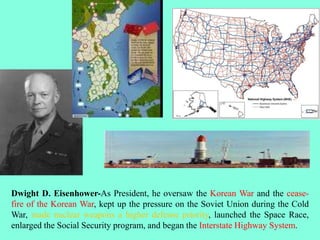
  • 194.
    Results of theGreat Society What was the message of the social programs that came out of LBJ's Great Society? One of the most devastating to the family was that if an unwed woman became pregnant, moved out of the home of her parents, did not name or know who the father was, then Big Daddy in Washington would provide for all her essential needs. Ergo she no longer needed a husband or the support of her family. In fact, the more children she had out of wedlock, the more money she would receive from the government. This program was the death knell for many families, especially in the black community. Unfortunately many black men saw this as the best of all possible worlds. They could father as many children as they wanted, from multiple women, without ever having to accept the responsibility of fatherhood. Many women rejected marriage in favor of a boyfriend who could slip in the back door and not jeopardize her government check. In this dysfunctional culture why would education be important? Why seek an education only to have to compete for a good job in the market place when they could just hang around the neighborhood and have all of life's amenities? In fact studying and getting good grades, for many blacks, became a social stigma. They were called "Uncle Toms" and accused of trying to act "white". Many blacks who had the potential to succeed gave in to this pressure and opted for failure. After all they had the perfect excuse. Did not the NAACP and race hustlers like Jesse Jackson tell them that it was not their fault? That they were just innocent "victims" of white racism?
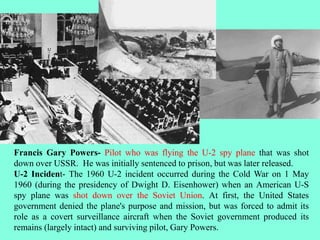
  • 195.
    Great Society ConceptMap What are some goals? Great Society What are its results? Definition
  • 196.
    Great Society Quiz 1.Give one of the goals of President Johnson’s Great Society. 2. What was the fulfillment of President Truman’s dream of providing health care for the aged? 3. Was the Great Society legislation difficult to pass in congress? 4. Give a 1950s status quo statistic for the black American family. 5. Give one of the results of the Great Society for the black American family.
  • 197.
  • 198.
    What is ajust war? A just war is that:- - A good intention should be behind it - It should be a last resort after diplomatic means failed - There must be a chance of success How should a just war be fought:- - Innocent people should not be harmed - Appropriate force should be used to bring the war to a swift conclusion according to the military commanders recommendations - Internationally agreed conventions regulating war must be obeyed
  • 199.
    Introduction The Vietnam waroccurred in Southeast Asia. Laos and Cambodia became involved during 1959 to 30 Apr 1975. The war started when communist North Vietnam tried to take over the republic of South Vietnam. It was the longest war America had ever fought in and it lasted 15 years. North Vietnam wanted to take over South Vietnam. If they succeeded then it’ll be likely that Laos and Cambodia will turn Communist. Laos and Cambodia might’ve turned Communist because they were so vulnerable.
  • 200.
    The Domino Theorywas that if North Vietnam won the war then Laos, Cambodia and the rest of Asia would turn communist. America and South Vietnam did not want to be communist and let it spread throughout Asia.
  • 201.
    Dien Bien Phu TheBattle of Dien Bien Phu (French: Bataille de Diên Biên Phu; Vietnamese: Chiến dịch Điện Biên Phủ) was the climactic confrontation of the First Indochina War between the French Union's French Far East Expeditionary Corps and Viet Minh communist revolutionaries. The battle occurred between March and May 1954 and culminated in a comprehensive French defeat that influenced negotiations over the future of Indochina at Geneva. Military historian Martin Windrow wrote that Điện Biên Phủ was "the first time that a non-European colonial independence movement had evolved through all the stages from guerrilla bands to a conventionally organized and equipped army able to defeat a modern Western occupier in pitched battle.” As a result of blunders in the French decision-making process, the French began an operation to support the soldiers at Điện Biên Phủ, deep in the hills of northwestern Vietnam. Its purpose was to cut off Viet Minh supply lines into the neighboring Kingdom of Laos, a French ally, and tactically draw the Viet Minh into a major confrontation that would cripple them. Instead, the Viet Minh, under Senior General Võ Nguyên Giáp, surrounded and besieged the French, who were unaware of the Viet Minh's possession of heavy artillery (including anti-aircraft guns) and, more importantly, their ability to move such weapons through extremely difficult terrain to the mountain crests overlooking the French encampment. The Viet Minh occupied the highlands around Điện Biên Phủ and were able to accurately bombard French positions at will. Tenacious fighting on the ground
  • 202.
    Dien Bien Phu(cont’d) ensued, reminiscent of the trench warfare of World War I. The French repeatedly repulsed Viet Minh assaults on their positions. Supplies and reinforcements were delivered by air, though as the French positions were overrun and the anti-aircraft fire took its toll, fewer and fewer of those supplies reached them. After a two-month siege, the garrison was overrun and most French forces surrendered, only a few successfully escaping to Laos. Shortly after the battle, the war ended with the 1954 Geneva Accords, under which France agreed to withdraw from its former Indochinese colonies. The accords partitioned Vietnam in two; fighting later broke out between opposing Vietnamese factions in 1959, resulting in the Vietnam (Second Indochina) War. The French disposition at Dien Bien Phu, as of March 1954. The French took up positions on a series of fortified hills. The southernmost, Isabelle, was dangerously isolated. The Viet Minh positioned their 5 divisions (the 304th, 308th, 312th, 316th, and 351st) in the surrounding areas to the north and east. From these areas, the Viet Minh had a clear line of sight on the French fortifications and were able to accurately rain down artillery on the French positions.
  • 203.
    Vietnam War 1954-1975 •During the Eisenhower years, the U.S. assumed the conflict from the French who were trying to regain their SE Asian colonial empire after World War II. • Through the Kennedy years, US troops trained S. Vietnamese troops to fight the Reds. • After the Gulf of Tonkin Resolution, under Lyndon Baines Johnson (LBJ), US troops started to fight more.
  • 204.
    U.S. Involvement Time Sequence ReasonsImpetus ResultsDien Bien Phu
  • 205.
    U.S. Involvement Quiz 1.What was the battle defeat by the French that eventually involved the United States? 2. What was the political theory that communism spread from one country to another? 3. What were the results of the 1954 Geneva Accords? 4. Which President involved us in the Vietnam War? 5. Which President escalated the war?
  • 206.
    Vietnam Heats Up Armedresistance to President Ngo Dinh Diem was organized by former Viet Minh who became known as Viet Cong (Vietnamese Communists). Supplemented by cadres that had moved north after 1954 and returned a few years later, the Viet Cong organized in 1969 as the National Liberation Front of South Vietnam (NLF). Communist-led and directed by Hanoi, it included all groups opposed to the Diem regime and its U.S. ally. The NLF adopted the “people’s war” strategy favored by Chinese Communist leader Mao Tse-tung: guerillas using the civilian population as cover engaged in protracted warfare, avoiding conflict except in advantageous circumstances. Men and supplies infiltrated through Laos and Cambodia along a network of trails named for Ho Chi Minh (the Ho Chi Minh Trail). The Viet Cong used assassinations, terrorist activity, and military action against government-controlled villages. Diem moved peasants into “strategic hamlets” to separate them from the guerillas. Peasant resentment at this policy aided Viet Cong recruitment, as did replacement of elected village officials with Diem appointees. U.S. intervention was based on belief in the “domino theory”—which held that if one Southeast Asian country were allowed to fall under Communist control, others would follow like a row of dominoes—and by an increasing concern for the credibility of U.S. opposition to communism after the Castro government came to power in Cuba (1959). Responding to Diem’s request for help, U.S. President John F. Kennedy gradually increased the number of U.S. advisors to more than 16,000. President Ngo Dinh Diem
  • 207.
    The Gulf ofTonkin Incident In Washington, Kennedy’s successor, Lyndon B. Johnson, moved rapidly to oppose the insurgents. He authorized the CIA, using mercenaries and U.S. Army Special Forces, to conduct covert diversionary raids on the northern coast, while the U.S. Navy, in a related operation, ran electronic intelligence missions in the Gulf of Tonkin. Johnson appointed GEN William Westmoreland to head the Military Assistance Command- Vietnam (MACV), increased the number of advisors to 23,000, and expanded economic assistance. Warning Hanoi that continued support for the revolution would prompt heavy reprisals, the administration began planning bombing raids on the North. An incident in the Gulf of Tonkin served to justify escalation of the U.S. effort. On 2 Aug 1964, an American destroyer (USS Maddox DD-731) in international waters involved in electronic espionage was attacked by North Vietnamese torpedo boats. Unharmed, it was joined by a second destroyer and on 4 Aug the ships claimed that both had been attacked. Evidence of the second attack was weak at best (and was later found to be erroneous), but Johnson ordered retaliatory air strikes and went before Congress to urge support for the Tonkin Gulf Resolution, a virtual blank check to the executive to conduct retaliatory military operations. There were only two dissenting votes. After a Viet Cong attack (Feb 1965) on U.S. Army barracks in Pleiku, the United States commenced Operation Rolling Thunder, a restricted but massive bombing campaign against North Vietnam. Protection of air bases then provided the rationale for introduction of 50,000 U.S. ground combat forces, which were soon increased. The American public, however, was
  • 208.
    The Gulf ofTonkin Incident (cont’d) not told when their mission and tactics changed from static defense to search-and-destroy, nor was it asked to bear the war’s cost through higher taxes. Desiring both “guns and butter” Johnson dissimulated, ultimately producing a backlash that full public and congressional debate at this point might have avoided. The public never fully supported a war whose purposes were deliberately obscure.
  • 209.
  • 210.
  • 212.
  • 213.
    The War EscalatesTime Sequence Organizer Causes Kennedy Administration Johnson Administration
  • 214.
    The War EscalatesQuiz 1.What were the two armed resistance groups that were in opposition to South Vietnamese President Ngo Dinh Diem? 2. What incident escalated the troop levels in Vietnam? 3. What was the supply route that ran though Laos and Cambodia? 4. What did President Johnson authorize in the Gulf of Tonkin and the maximum amount of troops? 5. Name two new weapons introduced into the Vietnam War.
  • 215.
    FOR:- It’ll help SouthVietnam Justice may be brought There won’t be any communism The Domino Theory was that if South Vietnam became communist then all the other Asian countries would fall. The Americans had more weapons, machine guns, rockets, launchers, tanks and helicopters. The war established peace and stability AGAINST:- Vietnam could fight for themselves The U.S used napalm which killed 400, 000 innocent civilians 1LT William Callie was responsible for the killing of unarmed civilians. He was imprisoned for life. 25% of South Vietnam didn't support the U.S. Many young Americans(18-27 years old) staged anti-war protest through communist sympathy and support.
  • 216.
    The Opposing Sides Themovement against the involvement of the United States in the Vietnam War began in the U.S. with demonstrations in 1964 and grew in strength in later years. The U.S. became polarized between those who advocated continued involvement in Vietnam, and those who wanted peace. Many in the peace movement were students, mothers, or anti-establishment hippies, but there was also involvement from many other groups, including educators, clergy, academics, journalists, lawyers, physicians (such as Benjamin Spock and Justin Newlan), military veterans, and ordinary Americans. Expressions of opposition events ranged from peaceful nonviolent demonstrations to radical displays of violence. Violent groups included the Students for a Democratic Society (SDS), Black Panthers, and the Weather Underground Organization (WUO). All three of these organizations had communist ties and backing and were kept under strict surveillance by the FBI. The SDS began as a movement to involve the largest possible number of American students in the democratic processes had become by 1969, as a contemporaneous FBI memo summarizes, "an organization totally dedicated to the destruction of American society...In the span of seven years, the SDS had evolved into a hard line Marxist-Leninist-Maoist organization dedicated to the destruction of Western democratic traditions and ideals.” The Black Panther Party (originally the Black Panther Party for Self-Defense) was a black American revolutionary socialist organization active in the United States from 1966 until 1982.
  • 217.
    The Opposing Sides TheBlack Panther Party achieved national and international notoriety through its involvement in the Black Power movement, illegal activities, police gun battles, social programs, and U.S. politics of the 1960s and 1970s. The WUO conducted a campaign of bombings through the mid-1970s, including aiding the jailbreak and escape of Timothy Leary. The "Days of Rage", their first public demonstration on October 8, 1969, was a riot in Chicago timed to coincide with the trial of the Chicago Seven. In 1970 the group issued a "Declaration of a State of War" against the United States government.
  • 218.
    Jeff Jones (above)of the Apollo Alliance authored President Obama’s 2009 $787 billion stimulus bill and the Obamacare healthcare bill. It was in Bill Ayers’ (left) living room in Chicago (a neighbor down the street) that President Obama launched his political career. Weathermen
  • 219.
    During the hippiemovement started in the 1960’s, 250,000 anti-war protestors gathered in Washington D.C. It was the largest protest to occur during the Vietnam war. Many Americans were against the war in Vietnam mainly because 48,700 American soldiers died including 4 Students. They did not like the idea that America got involved in the Vietnam War.
  • 220.
    The Radical LeftTurns Vietnam Sour Opposition to the war grew with increased U.S. involvement. Leftist college students, members of traditional pacifist religious groups, long-time peace activists, and citizens of all ages opposed the conflict. Some were motivated by fear of being drafted, others out of commitment, some just joined the crowd, and a small minority became revolutionaries who favored a victory by Ho Chi Minh and a radical restructuring of U.S. society. College campuses became focal points for rallies and “teach-ins”—lengthy series of speeches attacking the war. Marches on Washington began in 1971. Suspecting that the peace movement was infiltrated by Communists, President Johnson ordered the FBI to investigate and the CIA to conduct an illegal domestic infiltration, but they proved only that the radicalism was homegrown. Although the antiwar movement was frequently associated with the young, support for the war was actually highest in the age group 20-29. The effectiveness of the movement is still debated. It clearly boosted North Vietnamese morale; Hanoi watched it closely and believed that ultimately America’s spirit would fall victim to attrition, but the Communists were prepared to resist indefinitely anyway. The movement probably played a role in convincing Lyndon Johnson not to run for reelection in 1968, and an even larger role in the subsequent victory of Richard Nixon over the Democrat Hubert Humphrey. It may ultimately have helped set the parameters for the conflict and prevented an even wider war. Certainly its presence was an indication of the increasingly divisive effects of war on U.S. society.
  • 221.
    U.S. actress JaneFonda, aka Hanoi Jane, tours North Vietnam, during which she is photographed sitting on a North Vietnamese anti-aircraft gun.
  • 222.
    Returning Vietnam Soldiers Disrespected TheLeft has tried to erase the memories that were shown to our returning soldiers from Vietnam with reports and books written ten to twenty years after the Vietnam War so as to revise their image and write revisionist history. The book The Spitting Image: Myth, Memory and the Legacy of Vietnam is a 1998 book by sociologist Jerry Lembcke that is referenced most by liberals saying that it did not happen. However, through my personal recollections and military policy during the time, incidents happened and the military took measures up until the early 1990s to minimize these incidents by not allowing soldiers to wear their uniforms off of the military reservation. I talked to Vietnam veterans in units that I served with in the 1970s and 80s and my father-in-law and the treatment that was received was 180 degrees the opposite from what is received today. Soldiers were spit on, cursed, called baby killer, (reference to the Americal 23rd IN Division 1LT William Calley massacre at My Lai where 22 women, children, and elderly were murdered, the division was deactivated and has not been reactivated since.) physically and verbally abused, and had property destroyed. On the other side, veterans of the Veterans of Foreign Wars (VFW) and the American Legion would deride the Vietnam Veterans for losing the war and not fighting hard enough.
  • 223.
    Radical Left TurnsVietnam Sour Graphic Organizer Anti-War Goals Violent Movement Organizations Peaceful Movement Organizations ExamplesExamples
  • 224.
    Radical Left TurnsVietnam Sour Quiz 1. Give one of the goals for those against the Vietnam War. 2. Give three examples of the peaceful protesters. 3. Give two examples of the violent protesters. 4. What did all of the protests do for the North Vietnamese and who was also known as (aka) Hanoi Jane that aided the enemy? 5. What were two forms of abuse returning Vietnam veterans endured from those that opposed the war?
  • 226.
  • 227.
    The Tet Offensive Bylate 1967, the war was stalemated. Johnson urged Westmoreland to help convince a public growing more restive that the United States was winning. Although he promised “light at the end of the tunnel,” increasing casualties as well as growing disbelief in public pronouncements—the “credibility gap”—fostered increasing skepticism. U.S. strategy was clearly not producing victory, and Johnson began a limited reassessment. Meanwhile, Hanoi began planning a new offensive that involved a series of actions: first, intensified activity in the border areas including a massive attack against the base at Khe Sanh to attract ARVN and U.S. forces, followed by attacks on most provincial capitals and Saigon itself. If these were successful, regular forces poised on the outskirts of the cities would move to support a general uprising. The initial actions did draw forces away from the cities, and U.S. attention became riveted on the siege of Khe Sanh. Attacks on cities began on Tet, the lunar holiday, 30 Jan 1968. Hitting most provincial and district capitals and major cities, the Viet Cong also carried out a bold attack on the U.S. embassy in Saigon. The attack failed, but the attempt shocked U.S. public opinion. The Tet offensive continued for three weeks. Although they failed in their military objectives, the revolutionaries won a spectacular propaganda victory. While captured documents had indicated that the Viet Cong were planning a major offensive, its size, length, and scope were misjudged, and the Tet Offensive, as it was publicized in the U.S. media, seemed to confirm fears that the war was unwinnable. The public oppose the war in direct proportion
  • 228.
    The Tet Offensive(cont’d) to U.S. casualties, and these had topped a thousand dead a month. Tet appeared as a defeat, despite official pronouncements to the contrary. The media’s negative assessment proved more convincing than Washington’s statements of victory because it confirmed the sense of frustration that most Americans shared over the conflict.
  • 229.
    FOR:-  American troopsin Vietnam had vastly superior weapons than the Vietcong.  American soldiers had fully automatic weapons and were supported by tanks and helicopters.  They had napalm which was a type of flammable petroleum jelly which adheres and burns the skin, even in water. The Americans used this to burn down all of the jungles along with the defoliate Agent Orange to clear fields of fire around fire bases. Against:-  America couldn't find the guerrillas because they used no uniforms and hid among the civilian populace.  The people in South Vietnam would not tell the American troops where the guerrillas were hiding. They feared being retaliated against by the Vietcong and being tortured, massacred, and their village burned down. Civilians were caught in the middle because there was no clear battle line.  Politicians interfered with the military commanders decisions and turned the war into a political war rather than allowing the war to come to a swift conclusion.
  • 230.
    Following Ho ChiMinh: Memoirs of a North Vietnamese Colonel (Crawford House, New South Wales, 202 pages, $24.95) In a recent interview published in The Wall Street Journal, former colonel Bui Tin who served on the general staff of the North Vietnamese Army and received the unconditional surrender of South Vietnam on April 30, 1975; confirmed the American Tet 1968 military victory: "Our loses were staggering and a complete surprise. Senior General Võ Nguyên Giáp later told me that Tet had been a military defeat, though we had gained the planned political advantages when Johnson agreed to negotiate and did not run for reelection. The second and third waves in May and September were, in retrospect, mistakes. Our forces in the South were nearly wiped out by all the fighting in 1968. It took us until 1971 to reestablish our presence but we had to use North Vietnamese troops as local guerrillas. If the American forces had not begun to withdraw under Nixon in 1969, they could have punished us severely. We suffered badly in 1969 and 1970 as it was." And on strategy: "If Johnson had granted Westmoreland's requests to enter Laos and block the Ho Chi Minh trail, Hanoi could not have won the war.... it was the only way to bring sufficient military power to bear on the fighting in the South. Building and maintaining the trail was a huge effort involving tens of thousands of soldiers, drivers, repair teams, medical stations, communication units .... our operations were never compromised by attacks on the trail. Visits to Hanoi by Jane Fonda and former Attorney General Ramsey Clark and ministers gave us confidence that we should hold on in the face of battlefield reverses. We were elated when Jane Fonda, wearing a red Vietnamese dress, said at a press conference that she was ashamed of American actions in the war and would struggle along with us .... those people represented the conscience of America .... part of it's war- making capability, and we turning that power in our favor."
  • 231.
    Seeing this onTV led to a loss of support at home
  • 232.
  • 233.
    The Vietnam Warcaused the breakdown of many families and also a breakdown of the Vietnamese culture. Thousands upon thousands of children were orphaned during the war and ended up either in orphanages or on the streets without a home. Agent Orange was used and it caused a mass amount of damage to the plants and the jungle itself as well as U.S. soldiers. Napalm also caused damage to the skin and it burned many innocent people during the war.
  • 234.
    Deaths During theWar Deaths During Vietnam War American S.Veitnam N.Vietnam
  • 235.
    29 Mar 1973 VietnamWar Officially Ends The Vietnam War is officially over for the United States. The last U.S. combat soldier leaves Vietnam, but military advisors and some Marines remain. Over 3 million Americans had served in the war, nearly 60,000 are dead, some 150,000 are wounded, and at least 1,000 are missing in action. The military advisors left south Vietnam in 1975 after training the south Vietnamese to defend themselves and agreeing to a cease fire. President Gerald Ford, who replaced President Nixon, was shown a video in which South Vietnam soldiers mobbed a plane intended to evacuate children. He said: 'That's it. We're pulling the plug on Vietnam’. The North Vietnamese rolled into South Vietnam and purged many thousands of civilians through executions. Next door, Cambodia erected the ‘Killing Fields’ through the efforts of the Khmer Rouge.
  • 236.
    Alternate Ending? Chance ofSuccess? • General Giap was a brilliant, highly respected leader of the North Vietnam military. The following quote is from his memoirs currently found in the Vietnam war memorial in Hanoi: • "What we still don't understand is why you Americans stopped the bombing of Hanoi. You had us on the ropes. If you had pressed us a little harder, just for another day or two, we were ready to surrender! It was the same at the battles of TET. You defeated us! We knew it, and we thought you knew it. But we were elated to notice your media was definitely helping us. They were causing more disruption in America than we could in the battlefields. We were ready to surrender. You had won!" • General Giap has published his memoirs and confirmed what most Americans knew. The Vietnam war was not lost in Vietnam -- it was lost at home. The exact same slippery slope, sponsored by the US media, is currently well underway. It exposes the enormous power of a biased media to cut out the heart and will of the American public. • A truism worthy of note: Do not fear the enemy, for they can take only your life. Fear the media far more, for they will destroy your honor.
  • 237.
    Vietnam Ends FrayerModel Vietnam War Ends Tet Offensive Possibility of Success Effects The End
  • 238.
    Vietnam Ends Quiz 1.WhatNorth Vietnamese operation, that was a failure but the left-wing media turn into a victory, turned the American public against the war as unwinnable? 2. What was the growing disbelief by the American public about the Vietnam War? 3. What was the name of the North Vietnamese commander of the army that said the U.S. would have won? 4. Name one of the effects of the Vietnam War. 5. What President “pulled the plug” on Vietnam?
  • 239.
    US Civil RightsMovement Beginnings through the 60s
  • 240.
    Abolitionists • Frederick Douglaswas the editor of an abolitionist newspaper, The North Star.
  • 241.
    Harriet Tubman • Helpedslaves escape via the Underground Railroad.
  • 242.
    John Brown • Heand his sons brutally murdered 5 slave masters in Kansas. (1858) • Tried to incite a slave revolt at Harper’s Ferry, but failed. The slaves did not rise up.
  • 243.
    Reconstruction 1865-77 • Afterthe War Between the States 1861- 1865, the federal government made strides toward equality. • Blacks voted, held many political offices. • The Freedmen’s Bureau was a government program to help Blacks find land, it established schools and colleges.
  • 244.
    Reconstruction • The FourteenthAmendment guaranteed all citizens with equal protection under the law. • The Fifteenth Amendment said the right to vote shall not be denied on the basis of race.
  • 245.
    However. . . •The Supreme Court decided in Plessy vs. Ferguson that separate institutions are okay if they are equal. • Jim Crow laws required that Blacks have separate facilities.
  • 250.
  • 251.
  • 252.
  • 254.
  • 255.
  • 256.
  • 257.
    National Association forthe Advancement of Colored People (NAACP) • Started by four white Progressives (socialists) • Joined in 1909 by W.E.B. Dubois • Fought for equality as a Progressive socialist, later communist and finally left the U.S. as a social pariah
  • 258.
    4 The Great Migration- The movementof 1.75 million black Americans out of the Southern U.S. to the North and Midwest and West from the early 1900’s -1930.
  • 259.
    Early Civil RightsConcept Map Time Period Reconstruction to the Great Migration People and Leaders Gov’t Policies/Acts Early Civil Rights Actions/ Agencies
  • 260.
    Early Civil RightsQuiz 1. Name an early civil rights leader and their contribution. 2. Name the two amendments pertaining to freed blacks and what they concern. 3. What were the laws that allowed segregation? 4. What organization started fighting for civil rights? 5. What was the movement of southern blacks to the north and west?
  • 261.
    School Desegregation Brown v.The Board of Education of Topeka, KS was the case in which, on 17 May 1954, the U.S. Supreme Court ruled unanimously that racial segregation in public schools violated the Fourteenth Amendment to the Constitution, which says that no state may deny equal protection of the laws to any person within its jurisdiction. The 1954 decision declared that separate educational facilities were inherently unequal. Based on a series of Supreme Court cases argued between 1938 and 1950, Brown v. Board of Education of Topeka completed the reversal of an earlier Supreme Court ruling (Plessy v. Ferguson, 1896) that permitted “separate but equal” public facilities. The 1954 decision was limited to the public schools, but it was believed to imply that segregation was not permissible in other public facilities. In 1957, Little Rock, AR became the focus of world attention over the right of nine black students to attend Central High School under a gradual desegregation plan adopted by the city school board in accordance with the 1954 decision of the U.S. Supreme Court holding racial segregation in public schools unconstitutional. The result was a test of power between the federal and state governments. Governor Orval E. Faubus ordered state militia to prevent blacks from entering the school, but the state was enjoined from interfering by U.S. President Dwight D. Eisenhower, who sent federal troops to the city to maintain order. Within the next decade, desegregation was accomplished in all public schools.
  • 262.
    NAACP fought inthe courts • Thurgood Marshall was hired by the NAACP to argue in the Supreme Court against school segregation. He won. • He was later the 1st Black Supreme Court Justice.
  • 263.
  • 264.
    Brown vs. Boardof Education 1954
  • 265.
    Civil Rights Rights havebeen expanded through legislation. Since 1957, federal Civil Rights Acts and a Voting Rights Acts have been passed in an effort to guarantee voting rights, access to housing, and equal opportunity in employment. These have been accompanied by much state and local civil rights legislation. Throughout recent history, people have organized to struggle for rights to which they felt entitled either by law or by a sense of justice. In the United states, black militancy spread in the 1950’s and ‘60’s through the activities of the Congress of Racial Equality (CORE), Southern Christian Leadership Conference (SCLC) headed by Martin Luther King, Jr., and the Student Nonviolent Coordinating Committee (SNCC). These groups achieved major successes in arousing national opinion against segregation in the South and in stimulating the civil rights legislation of the 1960’s. They failed, however, to eliminate some of the deep-rooted segregation patterns in urban areas of the country in the North primarily.
  • 266.
    The Fight • Manyblack Americans and whites risked their lives and lost their lives to remedy this situation. • Rosa Parks was not the first, but she was the beginning of something special.
  • 267.
    Civil Disobedience Civil disobedienceis the act of disobeying a law on the grounds of moral or political principle. It is an attempt to force society to accept a dissenting point of view. Although it adopts tactics of nonviolence, it is more than mere passive resistance since it often takes active forms such as illegal street demonstrations or peaceful occupation of premises. It is distinguished from other forms of rebellion because the civil disobeyer invites arrest and accepts punishment. The most ambitious and perhaps most successful examples of mass civil disobedience were those of Mohandas K. Gandhi and Martin Luther King, Jr. Gandhi called civil disobedience—satyagraha, a term meaning “truth-force,” and taught it as an austere practice requiring great self-discipline and moral purity. With a versatile use of disobedience, Gandhi led the campaign for Indian independence. In the 1940’s, American blacks and their white sympathizers began to use forms of civil disobedience to challenge discrimination in public transportation and restaurants, but the major movement began in 1955 with illegal sit-ins in support of boycotts of segregated establishments. King was the chief advocate of nonviolent civil disobedience in the civil rights movement of the 1960’s.
  • 268.
    Montgomery Bus Boycott,1955 • Rosa Parks was arrested for violating the segregation laws of Montgomery, Alabama.
  • 270.
    Free At Last,Free At Last After a black woman, Rosa Parks, was arrested for refusing to move to the Negro section of a bus in Montgomery, AL on 1 Dec 1955, blacks staged a one-day local boycott of the bus system to protest her arrest. Fusing these protest elements with the historic force of the Negro churches, a local Baptist minister, Martin Luther King, Jr., succeeded in transforming a spontaneous racial protest into a massive resistance movement, led from 1957 by his Southern Christian Leadership Conference (SCLC). After a protracted boycott of the Montgomery bus company forced it to desegregate its facilities, picketing and boycotting spread rapidly to other communities. During the period from 1955 to 1960, some progress was made toward integrating schools and other public facilities in the upper South and the border states, but the Deep South remained adamant in its opposition to most desegregation measures. In 1960, the sit-in movement (largely under the auspices of the newly formed Student Nonviolent Coordinating Committee- SNCC) was launched at Greensboro, NC, when black college students insisted on service at a local segregated lunch counter. Patterning its techniques on the nonviolent methods of Indian leader Mohandas K. Gandhi, the movement spread across the nation, forcing the desegregation of department stores, supermarkets, libraries, and movie theaters. In May 1961, the Congress of Racial Equality (CORE) sent “Freedom Riders” of both races through the South and elsewhere to test and break down segregated accommodations in interstate transportation. By September, it was
  • 271.
    Free At Last,Free At Last (cont’d) estimated that more than 70,000 students had participated in the movement, with approximately 3,600 arrested; more than 100 cities in 20 states had been affected. The movement reached its climax in Aug 1963 with a massive march on Washington, D.C., to protest racial discrimination and demonstrate support for major civil-rights legislation that was pending in Congress.
  • 272.
    In Response. .. • For over a year, Blacks boycotted the buses. • They carpooled and walked through all weather conditions
  • 273.
    Many were arrestedfor an “illegal boycott” including their leader. . .
  • 275.
  • 276.
    • While theNAACP fought in the courts, MLK’s organization led the boycott. http://www.africanaonline.com/Graphic/rosa_parks_bus.gif
  • 277.
    King’s sacrifice • Kingwas arrested thirty times in his 38 year life. • His house was bombed or nearly bombed several other times • Death threats constantly
  • 278.
  • 279.
    •Gandhi inspired King to be directand nonviolent towards whites.
  • 280.
    • Violence neversolves problems. It only creates new and more complicated ones. If we succumb to the temptation of using violence in our struggle for justice, unborn generations will be the recipients of a long and desolate night of bitterness, and our chief legacy to the future will be an endless reign of meaningless chaos. --Dr. Martin Luther King, Jr., Facing the Challenge of a New Age
  • 281.
    Sit ins This wasin Greensboro, North Carolina
  • 282.
    They were lednot by MLK but by college students—Students Non-violent Coordinating Committee (SNCC)
  • 283.
    Sit-in Tactics • Dressin your Sunday best. • Be respectful to employees and police. • Do not resist arrest! • Do not fight back! • Remember, journalists are everywhere!
  • 285.
    Students were readyto take your place if you had a class to attend.
  • 288.
    Why march andrisk personal injury?
  • 289.
    Headlines! • People aroundthe world will convert to your cause if they see you on TV or on the front page of the newspaper.
  • 290.
  • 292.
    Police use dogsto quell civil unrest in Birmingham, Ala. in May of 1963. Birmingham's police commissioner "Bull" Connor also allowed fire hoses to be turned on young civil rights demonstrators.
  • 293.
  • 296.
    Birmingham • White Americasaw 500 kids get arrested and attacked with dogs. • There was much support now for civil rights legislation.
  • 297.
    Civil Rights Actof 1964 • Banned segregation in public places such as restaurants, buses
  • 298.
    Everybody Gets toVote The Voting Rights Act was passed by the U.S. Congress in 1965. In 1957 and 1960, Congress had passed laws to protect the rights of black voters, and the 24th Amendment (1964) banned the use of poll taxes in federal elections. Nevertheless, in the presidential elections of 1964, blacks continued to have difficulty registering to vote in many areas. Voter registration drives met with bitter, and sometimes violent, opposition. In March 1965, Martin Luther King, Jr., led a march from Selma to Montgomery, AL, to dramatize the voting issue. Immediately after the march, President Lyndon B. Johnson sent a voting bill to Congress, and it was quickly passed. The Voting Rights Act authorized the U.S. Attorney General to send federal examiners to register black voters under certain circumstances. It also suspended literacy tests in states in which less than 50% of the voting-age population had been registered or had voted in the 1964 election. The law had an immediate impact. By the end of 1965, a quarter of a million new black voters had been registered, one third by federal examiners. The Voting Rights Act was readopted and strengthened in 1970, 1975, and 1982.
  • 299.
    Voter Registration • Congressof Racial Equality (CORE) volunteers came to Mississippi to register Blacks to vote.
  • 300.
    These volunteers riskedarrest, violence and death every day.
  • 301.
    The Fight • Thisman spent 5 days in jail for “carrying a placard.” • Sign says “Voter registration worker”
  • 302.
    "Your work isjust beginning. If you go back home and sit down and take what these white men in Mississippi are doing to us. ...if you take it and don't do something about it. ...then *%# damn your souls." — Mississippi CORE leader Dave Dennis delivering the eulogy for James Chaney, murdered by cops and Klan in Philadelphia MS, 1964.
  • 303.
    Voter Registration • Ifblacks registered to vote, the local banks could call the loan on their farm.
  • 304.
    Lyndon B. Johnson’63-’68 • Pushed Civil Rights Act through Congress against his own Democratic party (Dixiecrats) • Passed more pro- civil rights laws than any other president
  • 305.
    Lyndon Baines Johnson(LBJ) • Civil Rights Act of ’64 • Civil Rights Act of ’68 • Voting Rights Act of ’65 • 24th Amendment banning poll taxes
  • 306.
    Not only werethere sit-ins. . • Swim-ins (beaches, pools) • Kneel-ins (churches) • Drive-ins (at motels) • Study-ins (universities)
  • 307.
    Hydrochloric Acid ina St. Augustine, FL Swimming Pool Swim-in In 1964, a few young blacks decided to take a dip in a whites-only pool at a whites-only hotel in St. Augustine, Florida. The hotel’s owner, James Brock, reacted by emptying jugs of hydrochloric acid into the water to expel the unwanted swimmers. This act of civil disobedience was one among many in the small city on the northeast coast of Florida, which in 1964 was celebrating its 400th anniversary. Because of that anniversary, the national spotlight was already on America’s oldest settlement, and the leaders of the civil rights movement took advantage of that attention to bring some to their own cause.
  • 308.
    Modern Civil RightsBegins Semantic Map Civil Rights Movement School Desegregation Organizations Impetus Civil Disobedience Legislation
  • 309.
    Modern Civil RightsBegins Quiz 1. Name 2 other civil rights leaders other than Martin Luther King, Jr. 2. Whose arrest sparked the Montgomery Bus Boycott? 3. Name one of the Civil Rights Groups formed during the 1950s-60s. 4. Who inspired MLK’s nonviolent strategies? 5. Which Supreme Court case integrated schools?
  • 310.
    The Civil RightsBill of 1957 The Civil Rights Act of 1957 was introduced in Eisenhower’s presidency and was the act that kick-started the civil rights legislative programme that was to include the 1964 Civil Rights Act and the 1965 Voting Rights Act. Eisenhower had not been known for his support of the civil rights movement. Rather than lead the country on the issue, he had to respond to problems such as in Little Rock. He never publicly gave support to the civil rights movement believing that you could not force people to change their beliefs; such changes had to come from the heart of the people involved, not as the result of legislation from Washington. However, he did push through during his presidency the 1957 Civil Rights Act. Cynics have stated that this was simply to win the ‘Black Vote’. Up to 1957, and for a variety of reasons, only 20% of African Americans had registered to vote. In Britain, the government takes the initiative in sending out voter registration forms which individuals have to return. In America it is up to each person to take the responsibility to register their vote. In the South plain intimidation and official apathy and obstacles meant that very few African Americans registered their vote. Those that did not disqualified themselves from voting. The 1957 Civil Rights Bill aimed to ensure that all black Americans could exercise their right to vote. It wanted a new division within the federal Justice Department to monitor civil rights abuses and a joint report to be done by representatives of both major political parties (Democrats and Republicans) on the issue of race relations.
  • 311.
    The Civil RightsBill of 1957 (cont’d) Eisenhower, perhaps shocked by the news broadcasts of Little Rock, publicly supported the bill (it was, after all, his Attorney-General who had produced the bill). However, the final act became a much watered done affair due to the lack of support among the Democrats. The Senate leader, Lyndon Baines Johnson, was a Democrat, and he realised that the bill and its journey through Congress, could tear apart his party as it had right wing Southern senators in it and liberal west coast ones. In keeping with Congressional procedure, Johnson sent the bill to a judiciary committee which would examine it for flaws, controversial and unconstitutional points etc. This committee was led by Senator James Eastland - senator for Mississippi. Committee heads have great powers in changing bills and altering them almost beyond recognition. Eastland did just this especially after the very public outburst by Senator Richard Russell from Georgia who claimed that it was an example of the Federal government wanting to impose its laws on states, thus weakening highly protected states rights of self-government as stated in the Constitution. He was most critical of the new division which would be created within the Justice Department. Johnson had other reasons for taking his stance. No civil rights act had been introduced into America for 82 years. If this one went through successfully and had support from both parties, it would do his position within the Democrats a great deal of good as he had plans in 1957 to be the party’s future presidential candidate. If he
  • 312.
    The Civil RightsBill of 1957 (cont’d) could get the credit for maintaining party unity and get the support of the South’s Democrats for ‘killing the bill’, then his position would be greatly advanced. If he was seen to be pushing through the first civil rights act in 82 years he hoped to get the support of the more liberal west and east coast Democrat senators. However, he required Eisenhower to remove Section 3 of the bill before passage. Section 3 allowed the Federal Attorney General to bring suit for matters of civil rights violations. The Civil Rights Act of 1957 maintained the mood of the bill - it aimed to increase the number of registered black voters and stated its support for such a move. However, any person found guilty of obstructing someone’s right to register barely faced the prospect of punishment as a trial by jury in the South meant the accused had to face an all-white jury as only whites could be jury members.
  • 313.
    March on Washington1963 • President Kennedy was pushing for a civil rights bill. • To show support, 500,000 black Americans went to Washington D.C.
  • 314.
  • 315.
    The event was highlightedby King's "I Have a Dream" speech in front of the Lincoln Memorial. August 28, 1963.
  • 316.
    School Integration • Theattitude of many Northern and Southern schools after the 1954 Brown decision was like:
  • 317.
    Federalism • When Federaltroops are sent to make states follow federal laws, this struggle for power is called federalism. • The Civil Rights Movement was mostly getting the federal government to make state governments to follow federal law.
  • 318.
  • 319.
    States were notfollowing federal law. Feds were sent in.
  • 320.
    James Meredith, University of Mississippi, escorted to classby U.S. marshals and troops. 2 Oct 1962.
  • 321.
    Ole Miss foughtagainst integration
  • 322.
    200 were arrestedduring riots at Ole Miss
  • 323.
    States ignored the’54 Brown decision, so Feds were sent in. •
  • 324.
    The Federal GovernmentActs The federal government under presidents Dwight D. Eisenhower (1953-61) and John F. Kennedy had been reluctant to vigorously enforce the Brown decision when this entailed directly confronting the resistance of Southern whites. In 1961-63, President Kennedy won a following in the black community by encouraging the movement’s leaders, but Kennedy’s administration lacked the political capacity to persuade Congress to pass new legislation guaranteeing integration and equal rights. After President Kennedy’s assassination (Nov 1963), Congress, under the prodding of President Lyndon B. Johnson, in 1964 passed the Civil Rights Act (q.v.). This was the most far-reaching bill in the nation’s history (indeed, in world history), forbidding discrimination in public accommodations and threatening to withhold federal funds from communities that persisted in maintaining segregated schools. It was followed in 1965 by the passage of the Voting Rights Act, the enforcement of which eradicated the tactics previously used in the South to disenfranchise black voters. This act led to drastic increases in the numbers of black registered voters in the South, with a comparable increase in the numbers of blacks holding elective offices there.
  • 325.
    • Harry Truman orderedthe armed forces AND the government to be desegregated.
  • 326.
    Dwight D. Eisenhower •Sent 101st airborne to Little Rock, Arkansas to maintain order.
  • 327.
    John F. Kennedy •Called Coretta Scott King to pledge support while MLK was in jail. • Eventually sent federal protection for freedom riders • Proposed need for civil rights legislation
  • 328.
    Federal Government Intervenes ConceptMap Federal Government Intervention Initial Legislation Government Officials Legislative Examples
  • 329.
    Thousands marched tothe Courthouse in Montgomery to protest rough treatment given voting rights demonstrators. The Alabama Capitol is in the background. 18 Mar 1965
  • 330.
    High Schoolers jailedfor marching Oh Wallace, you never can jail us all, Oh Wallace, segregation's bound to fall
  • 331.
    Bloody Sunday • InSelma, pro-vote marchers face Alabama cops.
  • 333.
  • 334.
  • 335.
  • 336.
  • 337.
    Police set upa rope barricade.
  • 338.
  • 339.
    We're gonna stand here'till it falls, ‘Till it falls, ‘Till it falls, We're gonna stand here 'till it falls In Selma, Alabama.
  • 340.
    The Supreme Courtruled that protesters had a 1st Amendment right to march.
  • 341.
    Crime Scene • Thiswoman was killed by the KKK while on her way to join voter activists in Mississippi • Who was she?
  • 342.
    Sacrifice for Suffrage Thisis the interior of Viola Liuzzo's car with blood everywhere and her shoes still on the floor of the automobile. She was shot in the head twice by members of the Ku Klux Klan while driving a participant from the Selma to Montgomery freedom march to the Montgomery Airport. Viola Fauver Gregg Liuzzo (April 11, 1925-March 25, 1965), a Unitarian Universalist committed to work for education and economic justice, gave her life for the cause of civil rights. The 39- year-old mother of five was murdered by white supremacists after her participation in the protest march from Selma to Montgomery, Alabama.
  • 343.
  • 344.
  • 345.
    Freedom Riders • Nowit is time to test the small-town bus stops and highways!
  • 346.
    Freedom Riders • COREvolunteers, white and black, got on buses and sat inter- racially on the bus. • They went into bus station lunch counters
  • 347.
  • 348.
    Mobs also attackedthem at the bus stations.
  • 349.
    Highways • The highwayswere obviously not safe.
  • 350.
    James Meredith, right,pulled himself to cover against a parked car after he was shot by a sniper. Meredith had been leading a march to encourage black Americans to vote. He recovered from the wound, and later completed the march. June 7, 1966
  • 351.
    Malcolm X andMLK • There was no love lost between these two • They despised each other’s method to achieve racial equality
  • 352.
    Left to right:Hosea Williams, Jesse Jackson, Martin Luther King Jr., Rev. Ralph David Abernathy on the balcony of the Lorraine Motel Memphis hotel, a day before King's assassination. April 3,1968
  • 353.
    Aides of theRev. Dr. Martin Luther King point out to police the path of the assassin's bullet. Joseph Louw, photographer for the Public Broadcast Laboratory, rushed from his nearby motel room in Memphis to record the scene moments after the shot. Life magazine, which obtained exclusive rights to the photograph, made it public. April 4, 1968.
  • 354.
    The Final PushFrayer Model Viola Liuzzo Freedom Riders Assassination Selma to Montgomery Marches The Close of the Movement
  • 355.
    The Politics ofProtest 1960-1980
  • 356.
    A REVIEW OFTHE VIETNAM PROTEST
  • 357.
    During the hippiemovement started in the 1960’s, 250,000 anti-war protestors gathered in Washington D.C. It was the largest protest to occur during the Vietnam war. Many Americans were against the war in Vietnam mainly because 48,700 American soldiers died including 4 Students. They did not like the idea that America got involved in the Vietnam War.
  • 358.
    The Radical LeftTurns Vietnam Sour Opposition to the war grew with increased U.S. involvement. Leftist college students, member of traditional pacifist religious groups, long-time peace activists, and citizens of all ages opposed the conflict. Some were motivated by fear of being drafted, others out of commitment, some just joined the crowd, and a small minority became revolutionaries who favored a victory by Ho Chi Minh and a radical restructuring of U.S. society. College campuses became focal points for rallies and “teach-ins”—lengthy series of speeches attacking the war. Marches on Washington began in 1971. Suspecting that the peace movement was infiltrated by Communists, President Johnson ordered the FBI to investigate and the CIA to conduct an illegal domestic infiltration, but they proved only that the radicalism was homegrown. Although the antiwar movement was frequently associated with the young, support for the war was actually highest in the age group 20-29. The effectiveness of the movement is still debated. It clearly boosted North Vietnamese morale; Hanoi watched it closely and believed that ultimately America’s spirit would fall victim to attrition, but the Communists were prepared to resist indefinitely anyway. The movement probably played a role in convincing Lyndon Johnson not to run for reelection in 1968, and an even larger role in the subsequent victory of Richard Nixon over the Democrat Hubert Humphrey. It may ultimately have helped set the parameters for the conflict and prevented an even wider war. Certainly its presence was an indication of the increasingly divisive effects of war on U.S. society.
  • 359.
    U.S. actress JaneFonda, aka Hanoi Jane, tours North Vietnam, during which she is photographed sitting on a North Vietnamese anti-aircraft gun.
  • 360.
    2004 Presidential candidate-“Swift boat” John Kerry “Hanoi Jane” Fonda
  • 361.
  • 362.
    Salk and theSolution Poliomyelitis has sometimes been considered a disease of developed nations, where improved hygiene has reduced the chances of contact with the virus during infancy and hence also reduced the protection provided by maternal antibodies to the disease, but in fact poliomyelitis’ worldwide rates of occurrence show no selectivity. The World Health Organization is conducting an ongoing immunization program against poliomyelitis and other common childhood diseases. In the United States, development by Jonas Salk (injection) and Albert Sabin (oral) in the 1950s of a vaccine for all three strains of poliovirus brought about a dramatic reduction in the incidence of the disease. In the 1980s, concern was aroused when long-term survivors of the disease began reporting various symptoms of joint and muscle pain, fatigue, respiratory problems, and sometimes an increasing loss of muscle strength (postpolio muscular atrophy). Post-polio syndrome is apparently related to a destabilizing of overburdened motor neurons. Treatment for this condition includes physical and occupational therapy.
  • 363.
    Rock & Roll Rockand roll has been described as a merger of country music and rhythm and blues, but, if it were that simple, it would have existed long before it burst into the national consciousness. The seeds of the music had been in place for decades, but they flowered in the mid-1950’s when nourished by a volatile mix of black culture and white spending power. Black vocal groups such as the Dominoes and the Spaniels began combining gospel-style harmonies and call-and-response singing with earthy subject matter and more aggressive rhythm-and-blues rhythms. Heralding this new sound were disc jockeys such as Alan Freed of Cleveland, OH, Dewey Phillips of Memphis, TN, and William (“Hoss”) Allen of WLAC in Nashville, TN—who created rock-and-roll radio by playing hard- driving rhythm and blues and raunchy blues records that introduced white suburban teenagers to a culture that sounded more exotic, thrilling, and illicit than anything they had ever known. In 1954, that sound coalesced around an image; that of a handsome white singer, Elvis Presley, who sounded like a black man. The Beatles’ triumphant arrival in New York City on 7 Feb 1964, opened America’s doors to a wealth of British musical talent. What followed would be called—with historical condescension by the willingly reconquered colony—the second British Invasion. Like their transatlantic counterparts in the 1950’s, British youth heard their future in the frantic beats and suggestive lyrics of American rock and roll. But initial attempts to replicate it failed. Rock swept Britain. By 1964, Greater London could claim the Rolling Stones, the
  • 364.
    Rock & Roll(cont’d) Yardbirds, the Who, the Kinks, the Pretty Things, Dusty Springfield, the Dave Clark Five, Peter and Gordon, Chad and Jeremy, and Manfred Mann. Manchester had the Hollies, Wayne Fontana and the Mindbenders, Freddie and the Dreamers, and Herman’s Hermits, Newcastle had the Animals. And Birmingham had the Spencer Davis Group (featuring Steve Winwood) and the Moody Blues. Bands sprang up from Belfast (Them, with Van Morrison) to St. Albans (the Zombies), with more inventive artists arriving to keep the styles moving forward, including the Small Faces, the Move, the Creation, the Troggs, Donovan, the Walker Brothers, and John’s Children.
  • 365.
    The Hippie Counterculture “Makelove, not war,” for which they were sometimes called “flower children” became their mantra. They promoted openness and tolerance as an alternative to the restrictions and regimentation they saw in middle-class society. Hippies often practiced open sexual relationships and lived in various types of family groups (communes). They commonly sought spiritual guidance from sources outside the Judeo-Christian tradition, particularly Buddhism and other Eastern religions, and sometimes in various combinations. Astrology was popular, and the period was often referred to as the Age of Aquarius. Hippies promoted the recreational use of hallucinogenic drugs, particularly marijuana and LSD (lysergic acid diethylamide), in so-called head trips, justifying the practice as a way of expanding consciousness. Both folk and rock music were an integral part of hippie culture. Singers such as Bob Dylan and Joan Baez and groups such as the Beatles, Grateful Dead, Jefferson Airplane, and Rolling Stones were among those clearly identified with the movement. The musical “Hair,” a celebration of the hippie lifestyle, opened on Broadway in 1968, and the film Easy Rider, which reflected hippie values and aesthetics, appeared in 1969. The novelist Ken Kesey was one of the best-known literary spokesmen for the movement, but he became equally famous for the bus tours he made with a group called the Merry Pranksters.
  • 366.
    Students for a DemocraticSociety (SDS) SDS, founded in 1959, had its origins in the student branch of the League for Industrial Democracy, a social-democratic educational organization. An organizational meeting was held in Ann Arbor, Mich., in 1960, and Robert Alan Haber was elected president of SDS. Operating under the principles of the “Port Huron Statement,” a manifesto written by Tom Hayden and Haber and issued in 1962, the organization grew slowly until the escalation of U.S. involvement in Vietnam (1965). SDS organized a national march on Washington, D.C., in April 1965, and, from about that period, SDS grew increasingly militant, especially about issues relating to the war, such as the drafting of students. Tactics included the occupation of university and college administration buildings on campuses across the country. By 1969 the organization had split into several factions, the most notorious of which was the “Weathermen,” or “Weather Underground,” which employed terrorist tactics in its activities. Jeff Jones (above) of the Apollo Alliance authored President Obama’s 2009 $787 billion stimulus bill and the Obamacare healthcare bill. It was in Bill Ayers’ (left) living room in Chicago (a neighbor down the street) that President Obama launched his political career. Weathermen
  • 367.
    I Am Woman TheNational Organization for Women (NOW), an American activist organization (founded 1966) that promotes equal rights for women, was established by a small group of feminists who were dedicated to actively challenging sex discrimination in all areas of American society but particularly in employment. The organization is composed of both men and women, and in the late 20th century, it had some 250,000 members. Among the issues that NOW addresses by means of lobbying and litigation are child care, pregnancy leave, and abortion and pension rights. Its major concern during the 1970’s was passage of a national Equal Rights Amendment to the Constitution; the amendment failed to gain ratification in 1982. NOW has also campaigned for such issues as passage of state equal rights amendments and comparable-worth legislation (equal pay for work of comparable value) and has met with greater success on the state level. Gloria Steinem Betty Friedan, author of the book, The Feminine Mystic in 1963
  • 368.
    The Majority ofWomen— Conservative Antifeminists such as Phyllis Schlafly organized a crusade against the Equal Rights Amendment (ERA), warning that it would, among other things, invalidate state sodomy laws, outlaw single sex bathrooms in public places, legalize same-sex marriage, and make taxpayer-funded abortion a constitutional right. Needing 38 states to ratify within 10 years of its passage by Congress, the amendment fell three states short. By the 1990s, a movement that was once defined by its radical pitch had taken on new tones—some of them conservative. The divide over abortion continued to alienate many women, such as the Feminists for Life, who believed fervently in women's rights but disagreed with the mainstream movement's position on abortion. That divide deepened when, in 1998, Norma McCorvey, the plaintiff in Roe v. Wade, declared her opposition to abortion on demand. Eventually, a backlash cast doubt on many of the social and economic achievements fostered by the women's movement. Faced with increasing numbers of single mothers and older divorced women living in poverty, many Americans began to wonder whether no-fault divorce and the end of most alimony had, in fact, served women's best interests. With a growing number of young children spending their early years in institutional day care, Phyllis Schlafly
  • 369.
    The Majority ofWomen— Conservative (cont’d) debates erupted over whether women were abdicating their maternal responsibilities and whether federal policies that gave tax breaks to working mothers were encouraging a further deterioration of the family unit. Feminists were further targeted as the primary culprits behind the many by-products of the sexual revolution, from the increased rate of teen pregnancy to the spread of AIDS. Phyllis Schlafly and I at the 9/11 2009 TN Eagle Forum
  • 370.
    Minority Equality César EstradaChavez was the organizer of the migrant American farm workers and founder of the National Farm Workers Association (NFWA) in 1962. Chavez, who was a farm laborer himself, grew up in a migrant farm-labor family of Mexican American descent. He lived in a succession of migrant camps and attended school sporadically. After two years in the U.S. Navy during World War II, Chavez returned to migrant farm work in Arizona and California. In 1966, the NFWA merged with an American Federation of Labor-Congress of Industrial Organizations (AFL-CIO) group to form the United Farm Workers of America (UFW). In recognition of his nonviolent activism and support of working people, Chavez was awarded the Presidential Medal of Freedom posthumously in 1994. His wife, Helen, accepted the award. The American Indian Movement (AIM) was a militant American Indian civil rights organization founded in Minneapolis, MN, in 1968 by Dennis Banks, Clyde Vernon Bellecourt, Eddie Benton Banai, and George Mitchell. Later, Russell Means became a prominent spokesman for the group. Its original purpose was to help Indians in urban ghettos who had been displaced by government programs that had the effect of forcing them from the reservations. Its goals eventually encompassed the entire spectrum of Indian demands—economic independence, revitalization of traditional culture, protection of legal rights, and most especially, autonomy over tribal areas and the restoration of lands that they believed had been illegally seized.
  • 371.
    César is signingan important agreement while many union supporters watch with reporters from radio stations and newspapers. Flag of the American Indian Movement
  • 372.
    La Raza Unida TheLa Raza Unida Party (RUP) started with simultaneous efforts throughout the U.S. Southwest. The most widely known and accepted story is that the La Raza Unida Party was established on January 17, 1970 at a meeting of 300 Mexican-Americans in Crystal City, Texas by José Ángel Gutiérrez and Mario Compean, who had also helped in the foundation of the Mexican American Youth Organization (MAYO) in 1967. The goals of the Raza Movement (RUP) are constantly changing and adjusting. It is a racially biased movement promoting greater economic, social, and political self-determination to Mexican Americans. Over the years it has supported several issues including bilingual education, women's and workers' rights (presumably Latinos), prosecution of industrial polluters (presumably NOT Latinos), new modes of transportation, improved funding of public education (bi-lingual), better medical care, and solutions to urban problems. Like every political movement they have their radical fringe ..... a few radicals want to see the American southwest ceded back to Mexico. Mario Compean at a house meeting in Uvalde, Texas when he was running for Governor in 1978 under the banner of La Raza Unida Party
  • 373.
    The Black PantherParty The Black Panther party was a militant organization of blacks founded in Oakland, Calif., in 1966 by Huey P. Newton and Bobby G. Seale. Panther leaders called upon blacks to arm themselves for a struggle against their oppressors and collected small arsenals. At the same time the party provided free breakfasts, financed by donations from local merchants and wealthy sympathizers, for children in some ghetto areas. It also opened schools and medical clinics. Several armed clashes with the police occurred. Huey Newton was found guilty of killing an Oakland policeman in 1967, but the conviction was reversed on appeal. He was charged with murder in a street brawl in 1974 and fled to Cuba. Seale and other Panther leaders were accused of torturing and murdering a former Panther whom they suspected of being a police informer, but the jury failed to reach a verdict. Another leader, Eldridge Cleaver, fled abroad to avoid imprisonment for parole violation; he later returned, abandoned radicalism, and became a proselytizer for Christianity. The Panthers lost a leader in 1969 when Chicago police made an early-morning raid on a Panther residence and killed Fred Hampton in his bed. The movement declined after quarrels among its leaders increased and as black radicalism waned in the 1970s. Two former Black Panthers were implicated in the Brink's robbery incident in New York in 1981.
  • 374.
    However, Meet theNew Black Panthers
  • 375.
    Politics of ProtestConcept Map Examples/Movements People involved Form of culture Definition
  • 376.
    1950’s and 60’sCulture Quiz1. Who were the doctors that developed the polio vaccine? 2. Name one of the rock and roll groups that emerged in the 1950’s and 60’s. 3. Name one of the various aspects that defined the hippie counterculture. 4. The feminist movement had two differing viewpoints. Name a leader of one side. 5. Hispanics and American Indians were making strides in recognition. Name a leader of either movement.
  • 377.
  • 378.
    Establishment Document Date ParisTreaty 23 Jul 1952 Rome Treaty 1 Jan 1958 Maastricht Treaty (EU) 1 Nov 1993 Lisbon Treaty 1 Dec 2009 Common Market The European Union (EU)—known until 1993 as the European Community (EC)—is an intergovernmental organization of 15 western European nations with it own institutional structures and decision-making framework. The aim of the EU’s founders was to construct a united Europe through peaceful means and create conditions for economic growth, social cohesion among the European peoples, and for greater political integration and cooperation among governments. The member nations of the EU are Austria, Denmark, Finland, France, Germany, Greece, Ireland, Italy, Luxembourg, the Netherlands, Portugal, Spain, Sweden, and the United Kingdom.
  • 379.
    Establishment Document Date ParisTreaty 23 Jul 1952 Rome Treaty 1 Jan 1958 Maastricht Treaty (EU) 1 Nov 1993 Lisbon Treaty 1 Dec 2009
  • 380.
    Separatism By the 1960’s,Quebecers had abandoned the traditional defense of French-Canadian culture—a conservative Catholicism. They finally discovered that state power could be a powerful instrument for a people who had preferred group interests to individualism. Their provincial government could ensure cultural survival and collective power, at least for the 6 million French-Canadians in Quebec. Another million scattered across Canada might be lost, and a million English-speaking Quebecers could submit or move out. Quebec’s “Quiet Revolution” created a dynamic new business and political elite, determined to protect and increase Quebec’s constitutional status. Some Quebecers went further. If other conquered peoples around the world claimed independence, Quebecers could at least be equals with the rest of Canada, “the English.” As early as the 1870’s, some Quebecers insisted that the British North America (BNA) Act was a “compact” between the French and the English in Canada. Reviving the “two- nations” theory in the 1960’s infuriated Canadians whose ethnic roots were neither French nor English, to say nothing of a million or more aboriginal people who soon christened themselves “First Nations.”
  • 381.
    Nixon: The International Diplomat Inthe White House, the contradictions in President Nixon were most obvious. He could be bold, yet also cautious; effective, yet often inept. Working closely with his national security advisor (later, Secretary of State), Henry Kissinger, he forsook the anti- Communist policies that he had supported throughout most of his career in favor of détente with the USSR and rapprochement with the Communist government of China. In 1969, he began the Strategic Arms Limitation Talks (SALT) with the Soviet Union. In Feb. 1972, he made a historic trip to Beijing (first by an American president)—where he was received by Mao Tse-Tung—thus reversing the U.S. policy of not recognizing the Communist government. In 1973, after 4 years of waging war in Vietnam—including heavy bombing raids on North Vietnam (1972) and the invasion (1970) of Cambodia—the administration managed to arrange a cease-fire that would last long enough to permit U.S. withdrawal from the Indochinese war zone. After the Arab-Israeli War in 1973, the efforts of Henry Kissinger led to a cease-fire and troop disengagement in the Middle East. Domestically, under the banner of “A New Federalism,” Nixon attempted to shift important elements of governmental power and responsibility back to state and local governments. He cut back and opposed federal welfare services, proposed anti-busing legislation, and used wage- and-price controls to fight inflation. A combination of domestic and international developments, notable the quintupling of oil prices by the Organization of Petroleum Exporting Countries (OPEC) in 1973, led to the economic recession of 1974-75. President Nixon and Chairman Mao Tse- Tung during the China visit
  • 382.
    Nixon’s “New Federalism” Atthe time Nixon took office in 1969, inflation was at 4.7 percent—its highest rate since the Korean War. The Great Society had been enacted under Johnson, which, together with the Vietnam War costs, was causing large budget deficits. There was little unemployment, but interest rates were at their highest in a century. Nixon's major economic goal was to reduce inflation; the most obvious means of doing so was to end the war. This could not be accomplished overnight, and the U.S. economy continued to struggle through 1970. Nixon was far more interested in foreign affairs than domestic policies, but believed that voters tend to focus on their own financial condition, and that economic conditions were a threat to his reelection. As part of his "New Federalism" views, he proposed grants to the states, but these proposals were for the most part lost in the congressional budget process. However, Nixon gained political credit for advocating them. In 1970, Congress had granted the President the power to impose wage and price freezes, though the Democratic majorities, knowing Nixon had opposed such controls through his career, did not expect Nixon to actually use the authority. With inflation unresolved by August 1971, and an election year looming, Nixon convened a summit of his economic advisers at Camp David. He then announced temporary wage and price controls, allowed the dollar to float against other currencies, and ended the convertibility of the dollar into gold.
  • 383.
    Watergate Re-nominated with SpiroAgnew in 1972, President Richard Nixon defeated his Democratic challenger, the liberal Senator George S. McGovern, in one of the largest landslide victories in the history of American presidential elections: 47.1 million to 29.1 million in the popular vote and 520 to 17 in the electoral vote. Despite his resounding victory, Nixon would soon be forced to resign in disgrace in one of the worst political scandals in United States history. The Watergate Scandal stemmed from illegal activities by Nixon and his aides related to the burglary and wiretapping of the national headquarters of the Democratic Party at the Watergate office complex in Washington, D.C and its cover-up; eventually it came to encompass allegations of other loosely related crimes committed both before and after the break-in. The five men involved in the burglary, who were hired by the Republican Party’s Committee to Re-elect the President, were arrested and charged on 17 Jun 1972. In the days following the arrests, Nixon secretly directed the White House counsel, John Dean, to oversee a ‘cover-up’ to conceal the administration’s involvement. Nixon also obstructed the Federal Bureau of Investigation in its inquiry and authorized secret cash payments to the Watergate burglars in an effort to prevent them from implicating the administration.
  • 384.
    Watergate (cont’d) The burglarsand two co-plotters—G. Gordon Liddy and E. Howard Hunt—were indicted (September 1972) on charges of burglary, conspiracy, and wiretapping. Four months later, they were convicted and sentenced to prison terms by District Court Judge John J. Sirica, who was convinced that pertinent details had not been unveiled during the trial and proffered leniency in exchange for further information. As it became increasingly evident that the Watergate burglars were closely tied to the Central Intelligence Agency and the Committee to Re-elect the President (CRP), some of Nixon’s aides began talking to federal prosecutors.
  • 385.
    Watergate (cont’d) From leftto right: Fred Thompson (minority counsel), Howard Baker, and Sam Ervin of the Senate Watergate Committee in 1973.
  • 386.
    Watergate (cont’d) Details ofHillary Clinton’s firing from the House Judiciary Committee staff for unethical behavior as she helped prepare articles of impeachment against Richard Nixon have been confirmed by the panel’s chief Republican counsel. Franklin Polk backed up major claims by Jerry Zeifman, the general counsel and chief of staff of the House Judiciary Committee who supervised Clinton’s work on the Watergate investigation in 1974, Zeifman, a lifelong Democrat, called Clinton a “liar” and “an unethical, dishonest lawyer.” He contends Clinton was collaborating with allies of the Kennedys to block revelation of Kennedy-administration activities that made Watergate “look like a day at the beach.” Her brief, Zeifman said, was so fraudulent and ridiculous, she would have been disbarred if she had submitted it to a judge. Read more at http://mobile.wnd.com/2008/04/60962/#vJI1 6MIsjrOUMszo.99
  • 387.
    President Nixon ConceptMap Nixon Administration Policies Watergate actions that take place Foreign Policy actions
  • 388.
    President Nixon Quiz 1.Name a foreign policy and a domestic policy of President Richard Nixon. 2. What trip did President Nixon make that was a first for an American president? 3. What two economic factors did President Nixon attack with his “New Federalism” policy? 4. What crimes were committed during the Watergate Scandal? 5. What was the outcome of the Watergate Scandal for President Nixon?
  • 389.
    Regulatory Presidents • NixonAdministration – OSHA (Occupational Safety and Health Administration) – MSHA (Mine Safety and Health Administration) – NIOSH (National Institute for Occupational Safety and Health) – EPA (Environmental Protection Agency) • Carter Administration – United States Department of Education
  • 390.
    The Egyptian-Israeli PeaceInitiative (Camp David Accords) In 1974, the United States and Egypt resumed diplomatic relations, previously severed by Egypt in 1967. By September 1975, through U.S. mediating efforts, Egypt and Israel had reached several agreements on the disengagement of their forces. In March 1976, President Anwar Sadat of Egypt abrogated a friendship treaty with the USSR signed in 1971. Sadat took a dramatic and significant step toward peace with Israel by visiting Jerusalem in November 1977. President Jimmy Carter sponsored a peace summit in September 1978 between Sadat and Israeli Prime Minister Menachem Begin. Egypt and Israel signed preliminary documents for a peace treaty. The actual treaty, signed on 26 Mar 1979, in Washington, D.C., called for the gradual withdrawal of Israeli troops from the Sinai over a period of 3 years. The withdrawal proceeded smoothly, and in January 1980, Egypt and Israel established diplomatic relations. Little progress was made, however, in the difficult negotiations on Palestinian autonomy, and the rest of the Arab world rejected the rapprochement with Israel. From 1974, Sadat had followed a policy entirely different from that of President Abdul Nasser, who advocated war with Israel, Arab socialism, and Arab unity. Sadat promoted peace with Israel, economic liberalism, and Egyptian nationalism. Although Sadat increased political freedoms, he also periodically cracked down on dissidents. In 1981, he was killed by Muslim fundamentalists.
  • 391.
    America Held Hostage TheAyatollah (Arabic: “Reflection of Allah”) Ruhollah Khomeni (Ruhollah Hendi), b. Khomein, Iran 1900, d. 3 Jun 1989, became leader of Iran in 1979 by forcing the overthrow of the shah (Muhammad Reza Shah Pahlavi) and Prime Minister Shahpur Baktiar. The son of an ayatollah of the Shi’ia sect, he studied theology and by 1962 was one of the six grand ayatollahs of Iran’s Shi’ia Muslims. Exiled in 1963 for his part in religious demonstrations against the shah, he was expelled from Iran in 1978 and moved to France, where he emerged as the leader of the anti-shah movement. In January 1979, after the shah left Iran, he returned to lead the country, becoming in December faqih (supreme religious guide) of Iran’s Islamic republic for life. In his efforts to transform Iran into an Islamic state, Khomeni was hostile to the West— U.S., the Great Satan and Israel, the Little Satan. In November 1979, he supported militant students who invaded the U.S. embassy and precipitated the Iranian Hostage Crisis. Khomeni and other fundamentalist clerics faced opposition from Western-educated moderates, from minorities within the country, and from various leftist guerilla groups but gradually consolidated control, imposing rigid censorship, executing members of the opposition, and banning Western customs. Khomeni used the Iran-Iraq War initiated by Iraq in 1980 to help unify the country, although he was less than successful in exporting his revolution and reluctantly accepted a cease-fire in the costly conflict in 1988. After his death, which prompted an outpouring of religious fervor, Iran remained a theocracy, although the constitution was revised to grant more power to the president.
  • 392.
    After months ofnegotiations, helped by Algerian intermediaries and the Shah's death, US diplomacy bore fruit. On the day of President Ronald Reagan's inauguration, 20 January 1981, the hostages were set free. A day later they arrived at a US Air Force base in West Germany. Here Air Force attaché David Roader shouts with joy as he arrives on German soil. In return the US had agreed to unfreeze Iranian assets worth $8 billion and give hostage takers immunity. From Germany, the freed Americans were taken to Washington where they were given a hero's welcome along Pennsylvania Avenue before a reception hosted by Ronald Reagan at the White House. The crisis may have helped bury the Carter administration's re-election hopes but it gave Mr. Reagan a massive boost at the beginning of his presidency. However, some skeptics remarked at the convenient timing of the release. Newly inaugurated US President Ronald Reagan listens to Bruce Laingen, top diplomatic hostage during the Iran hostage crisis who was one of the three seized at the Iranian foreign ministry on 4 November 1979.
  • 393.
    On 4 November1979 revolutionary students stormed the United States embassy in Tehran taking dozens of US staff hostage. Thousands of other protesters pressed around the compound, responding to a call by the country's new leader, Ayatollah Khomeini, to attack US and Israeli interests. Of the 90 people in the compound, six Americans managed to escape to other embassies. Other non-US citizens were released. But 66 were captured, including three seized at the Foreign Ministry.
  • 394.
    The Carter Economy Despitecalling for a reform of the tax system in his presidential campaign, once in office Carter did very little to change it. President Carter reduced the minimum tax on capital gains to 28% from as high as 98%. The government was in deficit every year of the Carter presidency. However, the debt as a percentage of the GDP decreased slightly. When the energy crisis set in, Carter was planning on delivering his fifth major speech on energy; however, he felt that the American people were no longer listening. On July 15, 1979, Carter gave a nationally-televised address in which he identified what he believed to be a "crisis of confidence" among the American people. This came to be known as his "malaise" speech, although Carter himself never uses the word in the speech: “I want to talk to you right now about a fundamental threat to American democracy. . . . I do not refer to the outward strength of America, a nation that is at peace tonight everywhere in the world, with unmatched economic power and military might. The threat is nearly invisible in ordinary ways. It is a crisis of confidence. It is a crisis that strikes at the very heart and soul and spirit of our national will. We can see this crisis in the growing doubt about the meaning of our own lives and in the loss of a unity of purpose for our nation. . . . In a nation that was proud of hard work, strong families, close-knit communities, and our faith in God, too many of us now tend to worship self-indulgence and consumption. Human identity is no longer defined by what one does, but by what one owns. But we've discovered that owning things and consuming things does not satisfy our longing for meaning.... I'm asking you for your good and for your nation's security to take no unnecessary trips, to use carpools or public transportation whenever you can, to park your car one extra day per week, to obey the speed limit, and to set your thermostats to save fuel.... I have seen the strength of America in the inexhaustible resources of our people. In the days to come, let us renew that strength in the struggle for an energy-secure nation. . . .”
  • 395.
    Carter Inflation • YearInflation Unemployment (1) • -------------------------- ----- • 1961 1.0% 6.7% • 1962 1.0 5.6 • 1963 1.3 5.6 • 1964 1.3 5.2 • 1965 1.6 4.5 < Vietnam war spending increases • 1966 2.9 3.8 • 1967 3.1 3.8 • 1968 4.2 3.5 • 1969 5.5 3.5 • 1970 5.7 5.0 • 1971 4.4 6.0 • 1972 3.2 5.6 • 1973 6.2 4.9 • 1974 11.0 5.6 < First oil crisis • 1975 9.1 8.5 • 1976 5.8 7.7 • 1977 6.5 7.1 • 1978 7.6 6.1 • 1979 11.3 5.9 < Second oil crisis • 1980 13.5 7.2 • 1981 10.3 7.6 • 1982 6.2 9.7 • 1983 3.2 9.6 • 1984 4.3 7.5
  • 396.
    President Carter FrayerModel Carter Administration Camp David Accords Regulatory Iran Hostage Crisis Economy
  • 397.
    President Carter Quiz 1.What was the speech that President Carter made when he had a “crisis of confidence” in the economy with the American public? 2. What economic factor was consistently high during the Carter administration? 3. What was the greatest accomplishment of the Carter administration? 4. Who was responsible for taking 400 American hostages in Iran posing President Carter’s greatest failure? 5. Who got the release of the American hostages just prior to his inaugural address?
  • 398.
  • 399.
    The Election ofthe Great Communicator Democrats began the campaign by underestimating California Gov. Ronald Reagan’s strengths. His age was offset by robust health and relaxed self-assurance. His views on domestic policy appeared to be further to the right than the majority opinion but they weren’t, and his foreign-policy views carried overtones of ideological crusades and “Great Power” confrontation (that led to the demise of the Soviet Union and communism)— vulnerabilities that President Jimmy Carter expected to exploit. Most of this opinion was fabricated by a socialist media in order to shape public opinion against Reagan. But Reagan, the master of television, phrased his conservative views with an air of reasonableness and geniality, promising prosperity by “getting government off our backs.” Burdened by his failure to free the Americans held hostage by Iran, the weakening of the American image around the world, and by a deteriorating economy that was the worst in 25 years, President Carter saw his thinly based support erode as the voters concluded that Reagan was a safe choice to replace an ineffective regime. Reagan’s margin of victory was sizable, the Californian carrying 44 states against Carter’s 6, the popular vote 43 million to 36 million (with 5.7 million for independent John B. Anderson).
  • 400.
    The New Conservatism Inthis respect, Ronald Reagan, elected to his first two terms in 1980 was different. As he memorably observed, “Government is not the solution to our problems. Government is the problem.” Reagan’s popularity, coupled with his support for privatization, his confidence in the American entrepreneurial spirit, and his belief in the moral superiority of the free market went a long way toward making these positions, ridiculed and despised by socialists and communists during the 1960’s and 1970’s intellectually respectable again. Critics called it the “decade of greed” because of the immense rebounding of the economy after the depths of the Carter economy. That’s hardly a surprise; as Jon Sobran once said, “Today, wanting someone else’s money is called ‘need,’ wanting to keep your own money is called ‘greed,’ and ‘compassion’ is when politicians arrange the transfer of wealth. The fact is, the 1980’s were no such thing. The most direct refutation of this phony claim is that charitable giving—which, after all, represents pretty much the opposite of greed—increased substantially during the 1980’s, and at a much faster rate that it had been increasing in previous decades. In real terms, charitable giving increased from $77.5 billion in 1980 to $121 billion in 1989.
  • 401.
    Reaganomics A fix tothe unemployment and inflation of the time.
  • 402.
    ELECTING RONALD REAGAN…TWICE • RonaldReagan for Reagan/Bush '84 http://www.youtube.com/watch?v=SDMksN- ZTR4&feature=related • Ronald Reagan TV Ad: "Reaganomics" http://www.youtube.com/watch`?v=GhgiOSgBEYY Reagan won 525 electoral votes and 49/50 states leaving Mondale with his only state of Minnesota and 3800 votes. Reagan received 58.8% of the popular vote to Mondale’s 40.6%. (This was Reagan’s Second Term) (Wikipedia) (Youtube)
  • 403.
    Stagflation - Economic predicamentbefore Reagan’s Administration - The economy was not expanding but stagnate - Prices were out of control (inflation) because of government interference and regulation - Political pressure results in expansion of money supply. - Nixon's wage and price controls abandoned - Under Ford the problems continued but policy was more prudent. - Federal oil reserves created to ease future short term shocks (only has proven to be a short term fix- 2 weeks at most) - Carter started phasing out price controls on petroleum
  • 406.
    Stagflation -Much of thecredit for resolution of the stagflation is given to… …a three year contraction of the money supply by the Federal Reserve under Paul Volcker to long term easing of supply and pricing in oil during the 1980s oil glut
  • 407.
    This Cartoon Showsthe differences between Reaganomics and FDR’s economic policies like the New Deal.
  • 408.
    The Four Pillars Reagan+Economics=Reaganomics 1.reduce govt. spending 2. reduce marginal tax rates on income from labor and capital 3. reduce government regulation of the economy 4. control the money supply to reduce inflation ReducegovernmentSpending ReduceMarginalTaxRates Reducegovt.RegulationofEconomy Control$supplytoreduceinflation
  • 409.
    The Roots -Reaganomics rootsin two of Reagan's campaign promises: 1) lower taxes 2) a smaller government -reduced income tax rates  with the largest rate reductions on the high incomes -in a time of battling inflation Reagan raised deficit spending to its highest level since World War II.
  • 410.
    The Beginnings - liftedremaining domestic petroleum price and allocation controls on January 28, 1981 - lowered Oil Windfall profits tax in August 1981, helping end the 1979 energy crisis - ended Oil Windfall profits tax in 1988 during 1980s oil glut - Tax Reform Act of 1986, Reagan and Congress sought to broaden the tax base and reduce perceived tax favoritism
  • 411.
    The Growing Economy -Top income tax rates dropped from 70% to 28% in 7 years - Payroll taxes increased because there were more jobs and more people working which equals more government tax revenue - Real Gross Domestic Product (GDP) growth recovered strongly after the 1982 recession at annual rate of 3.4% per year slightly lower than post-World War II average of 3.6% - Unemployment peaked over 10.7% percent in 1982 then dropped during rest Reagan's terms - inflation significantly decreased - job increase of 16 million occurred
  • 412.
    Trickle Down Affect -Reagan’s policies were derided as “Trickle-down economics” due to the significant cuts in the upper tax brackets - massive increase in Cold War related defense spending caused large budget deficits because the Democratically-controlled congress refused to scale back on agreed upon domestic spending - the U.S. trade deficit expansion contributed to the Savings and Loan crisis (which was nothing compared to the 2008-9 banking crisis) - covered new federal budget deficits, United States borrowed heavily both domestically and abroad raising national debt $700 billion to $3 trillion (Reagan cut but democrats kept spending) Reagan described the new debt as the "greatest disappointment" of his presidency
  • 413.
    Tax Revenue Tax Bill1 2 3 4 First 2 yr avg 4 yr avg Econ. Recovery Tax Act of 1981 -1.21 -2.60 -3.58 -4.15 -1.91 -2.89 Tax Equity and Fiscal Responsibility Act of 1982 0.53 1.07 1.08 1.23 0.80 0.98 Highway Revenue Act of 1982 0.05 0.11 0.10 0.09 0.08 0.09 Social Security Amendments of 1983 0.17 0.22 0.22 0.24 0.20 0.21 Interest and Dividend Tax Compliance Act of 1983 -0.07 -0.06 -0.05 -0.04 -0.07 -0.05 Deficit Reduction Act of 1984 0.24 0.37 0.47 0.49 0.30 0.39 Omnibus Budget Reconciliation Act of 1985 0.02 0.06 0.06 0.06 0.04 0.05 Tax Reform Act of 1986 0.41 0.02 -0.23 -0.16 0.22 0.01 Omnibus Budget Reconciliation Act of 1987 0.19 0.28 0.30 0.27 0.24 0.26 Number of Years after Enactment
  • 414.
    Laffer Curve • ArthurLaffer’s model predicting excessive tax rates reduce tax revenues by lowering production. • Theoretical taxation model • Vogue among some American Conservatives during 1970’s • if tax rates lowered, tax revenues will lower by the amount of decrease in rate- What Democrats thought -reverse is true for an increase in tax rates The Laffer Curve: Past Present and Future
  • 415.
    Achievements  American economydid better than any other pre- or post- Reagan years  Median family income grew by $4,000 annually, during Reagan Era and afterwards decreased by $1500  Interest Rates, Inflation, and Unemployment decreased faster than pre- and post- Reagan years  Productivity Rate increased, declined and then stayed the same
  • 416.
    Perspectives… • President RonaldWilson Reagan • Clintonomics vs. Reaganomics • Tony Horwitz – journalist • Conservatives vs. Liberals- Redistribution of Wealth • Belgian Prime Minister, Guy Verhofstadt
  • 417.
    Ronald Reagan •As seen in the previous videos, Reagan feels that Reaganomics are essential to helping the American People move forward and grow economically as Reaganomics allows for a decrease in interest rates, inflation, and unemployment. • With Reaganomics, America’s beliefs will grow in time as the promises of prosperity will become true The pictures above represent Reagan’s pride and approval of the idea of Reaganomics.
  • 418.
    • Opportunity beliefcame out of Reaganomics, which people didn’t have during this time period – opportunity was achieved through Reaganomics for everyday Americans as economic increase provided people with items that they would not normally have • education increased for people as they began to grow in their education, and the opportunities education provided. – Better jobs=more family income to spend • Faith in the people however made the ideas of Reaganomics come true
  • 419.
    -Ronald Wilson Reagan “Wewho live in free market societies believe that growth, prosperity, and ultimately human fulfillment, are created from the bottom up, not the government down. Only when the human spirit is allowed to invent, and create, only when individuals are given a personal stake in deciding economic policies…only then can societies remain economically alive, dynamic, progressive, and free.” A quote connecting Economics to Society by Ronald Reagan.
  • 420.
    Conservative or Liberal???? Redistributionof Wealth… “For conservatives, wealth is redistributed by companies, via profits. What is not returned to the masses directly (to employees in the form of pay and benefits) is passed on to the consumer in terms of goods and services (both products and charity work that many corporations participate in.) For liberals, wealth is redistributed by the government, via taxes. What is not(Reaganomics, Wealth Distribution…)
  • 421.
    A Foreign Lookon Reaganomics “When I think of Reagan, I'm thinking of Reaganomics and the Laffer curve. Do you remember: a tax cut could create more revenues! Reagan is dead now, but several of his ideas are now self-evident” -Guy Verhorstadt (Belgian Prime Minister) (Reaganomics, as a Success Story)
  • 422.
    Belgium loves Reaganomics -Onthe global scale, other governments, like Belgium, find Reaganomics helpful as they see pluses in the lowering of taxes. -As the government lowered the estate and gift taxes, the government got a higher revenue. -This allows for a higher amount of money the government can use for public works, along with up-keeping and the maintaining of the military to protect the nation. (Reaganomics, a Success Story)
  • 423.
    Belgium loves Reagan TheFollowing 6 points are how the Belgian government used Reaganomics. 1) gradual but considerable cut of the highest marginal tax rates to 28%. 2) complete abolition of corporate taxes, with a repeal of all subsidies to corporations 3) abolition of taxes on dividends: Investment and risk taking has to be encouraged, not punished 4) abolition of all agricultural subsidies 5) shrinking of the size of government 6) abolition of the transfers of tax money from Flanders to Wallonia: 10 billion euro is transferred each year from the Flemish tax payers to the French speaking part of Belgium. The reason invoked for these transfers is that Wallonia has an unemployment rate of 18% compared with 8% for Flanders (Reaganomics a Success Story)
  • 424.
    Guy Verhorstadt (left). HowReaganomics is working in Belgium.
  • 425.
    Ronald Reagan EconomicQuiz 1. According to Ronald Reagan, what was the problem with our society? 2. What was the economic problem that Reaganomics was designed to overcome? 3. Name one of the four pillars of Reaganomics. 4. How did President Reagan want to distribute the wealth, what policy? 5. What is the proven policy that increases revenue to the government while decreasing tax rates to the citizens?
  • 426.
    The World Beginsto Thaw In May 1981, at Notre Dame University, the recently inaugurated Reagan predicted that the years ahead would be great ones for the cause of freedom and that Communism was “a sad, bizarre chapter in human history whose last pages are even now being written.” At the time few took his words for more than a morale-boosting exhortation, but in fact the Soviet economy and polity were under terrific stress in the last Brezhnev years, though the Soviets did their best to hide the fact. They were running hidden budget deficits of 7 or 8 percent of GNP, suffering from extreme inflation that took the form (because of price controls) of chronic shortages of consumer goods, and falling farther behind the West in computers and other technologies vital to civilian and military performance. The Reagan administration recognized and sought to exploit this Soviet economic vulnerability. Young, educated, and urban members of the Communist elite came gradually to recognize the need for radical change if the Soviet Union was to survive, much less hold its own with the capitalist world. They waited in frustration as Brezhnev was followed by Andropov, then by Chernenko. The reformers finally rose to the pinnacle of party leadership, however, when Mikhail Gorbachev was named general secretary in 1985. A lawyer by training and a loyal Communist, Gorbachev did not begin his tenure by urging a relaxation of the Cold War. Gorbachev was a phenomenon, charming Western reporters, crowds, and leaders (Prime Minister Margaret Thatcher was especially impressed) with his breezy style, sophistication, and peace advocacy. What convinced most Western observers that
  • 427.
    The World Beginsto Thaw (cont’d) genuine change had occurred, however, was not what Gorbachev said but what he allowed others to say under his policy of glasnost, or openness. Throughout his first four years in power, Gorbachev inspired and presided over an extraordinary outpouring of new ideas and new options. Western skeptics wondered whether he meant to dismantle Communism and the Soviet empire and, if he did, whether he could possibly avoid being overthrown by party hard-liners, the KGB, or the army. In truth, Gorbachev faced a severe dilemma born of three simultaneous crises: diplomatic encirclement abroad, economic and technological stagnation at home, and growing pressure for liberal reform in Poland and Hungary and for autonomy in the non-Russian republics of the USSR.
  • 428.
    Perestroika and Glasnost Perestroika(Russian: restructuring) was the term used by Soviet president Mikhail Gorbachev to describe his program of political and economic reforms, implemented between 1985 to 1991. It was closely linked to his concepts of glasnost (openness) and democratization. The aim of perestroika was to rejuvenate the Soviet system. Instead, the forces of change unleashed by Gorbachev’s reforms led to the breakdown of the system and the dissolution of the USSR. The political reforms included a restructuring of the Soviet central government, a relaxation of censorship, and an end to the Communist party’s monopoly of power. Among the economic changes were a reintroduction of limited private enterprise, a more flexible price structure, and decentralization of economic decision making. In foreign policy, perestroika led to the breakup of the Soviet satellite system in Europe and the end of the cold war with the West. At home the partial dismantling of the system crippled it altogether, causing a series of crises that ended in the failed coup of August 1991 and the subsequent demise of the Soviet Union. Glasnost (Russian: publicity or openness) was the word used by Soviet leader Mikhail Gorbachev to describe his program of liberalizing the strict censorship policy of the USSR and allowing greater freedom of speech. The glasnost policy, by which he hoped to reform and strengthen the stagnating Soviet system, served instead to hasten its downfall. Having
  • 429.
    Perestroika and Glasnost(cont’d) moved away from the rigid thought control that had formerly been the rule, Gorbachev, starting in 1985, introduced a new tolerance for criticism, a broader range of opinions in the press and in the arts, and more accurate rendering of Soviet history.
  • 430.
    End of theCold War Reagan’s performance at a second summit conference with Soviet leader Mikhail Gorbachev in Iceland during October 1986 (the first meeting had been in Geneve in November 1985) deepened strains between U.S.-Soviet relations. Reagan’s persistent advocacy of his costly Strategic Defense Initiative (SDI; berated by the liberal media as “Star Wars”) appeared to block an agreement to reduce nuclear missiles. In December 1987, however, a buoyant Reagan, having resolved some of the differences with the Soviets, signed an arms-control agreement with Gorbachev in Washington. This agreement eliminated intermediate-range missiles in Europe. Reagan visited Moscow in the spring of 1988. As Reagan left Washington for retirement in California, his poll ratings were the highest (two-thirds of those polled approved of his performance) of any president since World War II. Mikhail Gorbachev’s espousal of “new thinking” in foreign policy, with its promise of more friendly relations with the West, won him much popularity abroad. Within the Soviet Union, however, Gorbachev’s reform program encountered political opposition, bureaucratic obstruction, and popular skepticism. At his behest, the Soviet Communist party gave up its Leninist claim to a monopoly of political power, grudgingly accepting a degree of political pluralism and the prospect of genuine parliamentary democracy. This alienated Communist hardliners without satisfying radical reformers, many of whom
  • 431.
    End of theCold War (cont’d) expressed their discontent by resigning from the party. As centrifugal forces increased, a cabal of hardliners in August 1991 arrested President Gorbachev and mounted an abortive coup. That precipitated the end of Communist rule over the Soviet Union, and the end of the Soviet Union itself. By the end of 1991, the USSR had disintegrated into separate republics, all of which repudiated communism.
  • 432.
    U.S. President RonaldReagan speaking in front of the Brandenburg Gate at the Berlin Wall. He made his famous speech to end the Cold War stating, “Mr. Gorbachev, tear down this wall!”
  • 433.
    Reagan Foreign Policy 1.What aspect of the Soviet Union did the Reagan administration seek to exploit to bring its demise? 2. Who was looked at as a Soviet reformer but in the end brought an end to the Soviet Union? 3. What were the two terms that the Soviet leader used to bring about political and economic reform? 4. What was the defensive program that President Reagan proposed that brought the Soviets to their knees? 5. What famous statement did President Reagan make at the Brandenburg Gate in West Berlin bringing an end to the Cold War?
  • 434.
    Agenda 21 • Agenda21, which reportedly means an agenda for the 21st century, is a United Nations program launched in 1992 for the vague purpose of achieving global "sustainable development." Congress never approved Agenda 21, although Presidents Obama, Clinton and George H.W. Bush have all signed Executive Orders implementing it. 178 other world leaders agreed to it in 1992 at the Rio Summit. Since then, the U.N. has mostly bypassed national governments, using Agenda 21’s International Council of Local Environmental Initiatives (“ICLEI”) to make agreements directly with local governments. ICLEI's U.S. presence has grown to include agreements with over 600 cities, towns and counties here, which are now copying the land use plans prescribed in Agenda 21. • Americans are so focused on Congress and Obama at the federal level of government right now that most are overlooking the socialism creeping in at the local level through Agenda 21. It is easy to overlook local government since people are saturated with too much information in the internet age. Compounding this is the fact that Agenda 21 is a dull topic, and it becomes understandable how it has been able to fly mostly under the radar since 1992, slowly working its way into our cities and counties. Left wing billionaire George Soros's Open Society has provided $2,147,415 to ICLEI. Van Jones' Green for All and the Tides Foundations’ Apollo Alliance are also reportedly ICLEI contributors.
  • 435.
    Agenda 21 (cont’d) •Agenda 21 ostensibly seeks to promote "sustainability" (the latest revisionist word for "environmentalism," since Americans have learned too many negative things about environmentalism). "Sustainability" is an amorphous concept that can be interpreted to an extreme degree that would regulate and restrict many parts of our lives. When will the level of carbon emissions be low enough? How much must we reduce our consumption of fossil fuels? Preserving the environment is a dubious science, and what steps are really necessary to protect the environment are anyone's guess. • Agenda 21 promotes European socialist goals that will erode our freedoms and liberties. Most of its vague, lofty sounding phrases cause the average person’s eyes to glaze over, making it easier to sneak into our communities. The environmentalist goals include atmospheric protection, combating pollution, protecting fragile environments, and conserving biological diversity. Agenda 21 goes well beyond environmentalism. Other broad goals include combating poverty, changing consumption patterns, promoting health, and reducing private property ownership, single-family homes, private car ownership, and privately owned farms. It seeks to cram people into small livable areas and institute population control. There is a plan for “social justice” that will redistribute wealth.
  • 436.
    Agenda 21 (cont’d) •Once these vague, overly broad goals are adopted, they are being interpreted to allow massive amounts of new, overreaching regulations. Joyce Morrison from Eco-logic Powerhouse says Agenda 21 is so broad it will affect the way we "live, eat, learn and communicate." Berit Kjos, author of Brave New Schools, warns that Agenda 21 "regulation would severely limit water, electricity, and transportation - even deny human access to our most treasured wilderness areas, it would monitor all lands and people. No one would be free from the watchful eye of the new global tracking and information system." Even one of the authors of Agenda 21 has admitted that it "…calls for specific changes in the activities of all people…" These steps are already being enacted little by little at the local levels. • Since the U.S. is one of the wealthiest countries in the world, and uses more energy than any other country, it stands to lose the most from environmental regulations. The goal of "sustainability," which comes down to using government to heavy-handedly accomplish vague goals of caring for the earth, goes contrary to our free market capitalism. Even more unfair, struggling third world countries and communist countries that cannot financially afford to comply with the onerous environmental regulations will continue their high levels of fossil fuel consumption, and the U.S. will be forced by U.N. regulators to conserve even more to make up for those countries.
  • 437.
    Agenda 21 (cont’d) •Obama signed Executive Order 13575 earlier this month, establishing a "White House Rural Council" prescribed by Agenda 21. The amount of government Obama has directed to administer this is staggering. Obama committed thousands of federal employees in 25 federal agencies to promote sustainability in rural areas, completely bypassing Congressional approval. Some of these agencies are unrelated to rural areas. The agencies will entice local communities into adopting Agenda 21 programs by providing them millions of dollars in grants. Dr. Ileana Johnson Paugh writing for Canada Free Press analyzed the order and wrote, "it establishes unchecked federal control into rural America in education, food supply, land use, water use, recreation, property, energy, and the lives of 16% of the U.S. population."
  • 438.
    Desert Storm The PersianGulf War also called Gulf War (1990–91), international conflict that was triggered by Iraq's invasion of Kuwait on August 2, 1990. Iraq's leader, Saddam Hussein, ordered the invasion and occupation of Kuwait with the apparent aim of acquiring that nation's large oil reserves, canceling a large debt Iraq owed Kuwait, and expanding Iraqi power in the region. On August 3 the United Nations Security Council called for Iraq to withdraw from Kuwait, and on August 6 the council imposed a worldwide ban on trade with Iraq. (The Iraqi government responded by formally annexing Kuwait on August 8.) Iraq's invasion and the potential threat it then posed to Saudi Arabia, the world's largest oil producer and exporter, prompted the United States and its western European NATO allies to rush troops to Saudi Arabia to deter a possible attack. Egypt and several other Arab nations joined the anti-Iraq coalition and contributed forces to the military buildup, known as Operation Desert Shield. Iraq meanwhile built up its occupying army in Kuwait to about 300,000 troops. The Persian Gulf War began on January 16–17, 1991, with a massive U.S.-led air offensive against Iraq that continued throughout the war. Over the next few weeks, this sustained aerial bombardment, which had been named Operation Desert Storm, destroyed Iraq's air defenses before attacking its communications networks, government buildings, weapons plants, oil refineries, and bridges and roads. By mid February the allies had shifted their air attacks to Iraq's forward ground forces in Kuwait and southern Iraq, destroying their fortifications and tanks.
  • 439.
    Interests in theU.S.-Iraq Persian Gulf War Pro Con Liberation of Kuwait “Blood for Oil” Defense of Saudi Arabia Resolution by diplomatic means Risk of war for a longer, stable peace Anti-war movement increasing International terrorism “Another Vietnam” Destruction of a “mad man” or “loose gun” and his army in the Middle East “Policeman of the World” concept Medical advances during war Economy is less likely to support a war -Economy is in a recession - $3.5 trillion national debt Majority supports war and always have (59-74%) Help from other nations - Egypt, Turkey, Germany, France, Great Britain, Japan, Syria Majority now believe that diplomatic means are at an end (51%) Let Arabs settle their own disputes Congressional approval of war - Senate Armed Services Joint Resolution #2 to U.N. Resolution #678- passed House- 250 to 183 Senate- 52 to 47 Place a U.N. peacekeeping force in the area U.N. Secretary General Javier Perez de Cuellar’s meeting with Saddam Hussein is unsuccessful Take Iraq to the world court in Den Haag 1. United States
  • 440.
    Interests in theU.S.-Iraq Persian Gulf War (cont’d) Either Pro or Con Let sanctions work longer (45%) Need for a quick war Soviet invasion of Lithuania Poll of age demographics conducted by CNN/Time 18 to 35: For 36 to 59: Against 60 and older: For 2. Iraq Oil: their claim to the fields 13th province of Kuwait- British colonized and separated from Iraq in the 1700’s. Reneging of massive Kuwaiti debt Establishment of Palestinian Liberation Organization (PLO) state - Abu Abbas and his terrorists Legislative approval “rubberstamped” for war by Iraqi parliament Use of chemical, biological, and nuclear weapons Purification of Islam and a jihad against the infidels Held international hostages for five months 3. Israel Israel is a certain target for Iraqi attack- chemical and conventional Stepped up PLO activity in occupied territories Israel intervention is sure if attacked; rejected U.S. plea not to intervene
  • 441.
    Interests in theU.S.-Iraq Persian Gulf War (cont’d)4. Arab Purification of Islam Hope for a PLO state Dissolution of anti-Iraq coalition if Israel enter the war Jordan aligning with Iraq if Israel enters the war; ask for aid from Egypt, Syria, and Iraq Syrian option to war: Complete Iraqi withdrawal and Syrian military assistance against any invasion Yemeni option to war: Complete Iraqi withdrawal and a U.N. observance army imposed (U.S. backed) Saddam Hussein is the only Arab to stand against the infidel U.S.—a savior Deposition of Israeli rule A war between the “Haves” and the “Have-nots” - The Arab world is sharply divided between the oil producing nations and the poor ones who have none Haves GNP per capita Population U.A.E $15, 720 1.5 million Kuwait $13, 680 2.0 million Qatar $11,610 .4 million Bahrain $6,610 .5 million Saudi Arabia $6,170 14.0 million Oman $5,070 1.4 million
  • 442.
    Interests in theU.S.-Iraq Persian Gulf War (cont’d) 5. United Nations Resolution 661- ordering worldwide trade/financial embargo Resolution 662- declaration that Iraq’s annexation of Kuwait is null and void Resolution 664- demand of all foreign nationals to be released in Kuwait and Iraq Resolution 665- authorization of military force to halt maritime trade with Iraq Resolution 678- authorization of force to remove Iraq from Kuwait Have-nots GNP per capita Population Algeria $2,450 23.9 million Iraq $1,950 17.7 million Syria $1,670 11.7 million Jordan $1,500 4.0 million Tunisia $1,230 7.8 million Morocco $750 23.9 million Egypt $650 51.5 million Yemen $600 11.0 million
  • 443.
    Interests in theU.S.-Iraq Persian Gulf War (cont’d) 6. Europe International terrorism Resolution by diplomatic means Soviet troops invade Lithuania Emergency U.N. session and observing team requested by Lithuania “Blood for Oil” Possible Soviet invasion of Latvia: Ruling party asked for invasion Lithuanians provoked aggression- TASS news agency Gorbachev disavows Soviet attack; says it was the call of the local military commander Anti-war protests increase Soviet people/Europeans side with the Lithuanians against Supreme Soviet’s aggression 7. 7:00pm EST, 16 Jan 91—Operation “Desert Storm” was launched with a massive bombing raid that has destroyed many military targets to include all military air bases, the chemical agent plant, all command and control nodes, and the nuclear plant. The bombing, which used FB-111, F15E, A-16, F-16, and F-117A jets, ended at approximately 12:00pm EST so that satellites could survey the situation because of daybreak. Operations resumed at approximately 1:00am EST.
  • 444.
    Oil fires setby the Iraqi army upon being forced out of Kuwait during the ground war- 11-12 Mar 1991
  • 445.
    The USS Missourilaunches a Tomahawk missile. The Gulf War was the last conflict in which battleships were deployed in a combat role AH-64 Apache Attack Helicopter M1A1 Abrams Main Battle Tank M2 Bradley Infantry Fighting Vehicle M3 Bradley Cavalry Fighting Vehicle M1025 High Mobility Multi-Purpose Wheeled Vehicle (HMMWV) UH-60 Blackhawk Utility Helicopter First Time in Battle during the Persian Gulf War XM-93 Fox Nuclear-Biological-Chemical (NBC) Reconnaissance Vehicle A-10 Thunderbolt II “Warthog”B-2 Strategic Bomber F-117 Fighter Bomber Patriot Advanced Capability-3 (PAC-3) Air Defense System UH-60 Blackhawk Utility Helicopter
  • 446.
     Dodging thedraft  Protesting the Vietnam War with communists in Russia  Gennifer Flowers  Smoking but not inhaling marijuana  1993 Income Tax increase  Social Security increase  Energy tax increase  1992/96 promise to cut taxes and never did  Attempted socialization of the U.S. Healthcare System (1/7 of the U.S. GDP)  Whitewater  Cattle Futuresgate  Travelgate  Vince Foster  Whitewater Billing records The Sins of Clinton: Scandals, Lies, or Poor Judgment?
  • 447.
    The Sins ofClinton: Scandals, Lies, or Poor Judgment? (cont’d)  Other alleged rapes or misogyny- Kathleen Willey (WH), Juanita Broaddrick (AR), Eileen Wellstone (Oxford), Elizabeth Ward Gracen, Regina Hopper Blakely, Judy Gibbs (AR), Sandra Allen James (DC), a 22 year old in 1972 (Yale), Kathy Bradshaw (AK), Cristy Zercher, Paula Jones (AR), Carolyn Moffet, 1974 student at Univ. of Arkansas, 1978-80- seven complaints per Arkansas state troopers, Dolly Kyle Browning, Sally Perdue, Betty Dalton, Denise Reeder, Kathy Ferguson, Deborah Mathis (WH)  1993 Branch Davidian Compound massacre and fiasco  1996 Federal Building Campaign Phone Calls  1996 Lincoln Bedroom Donors  Jorge Cabrera- Drug kingpin contribution of $250,000 and weapons dealers  White House photos with Hillary Clinton and Al Gore  1996 Buddhist Temple Donations  1996 Illegal Indonesian Campaign Funds from the Lippo Group (Johnny Huang, James Riady)  1996 Chinagate (Charlie Trie- fled prosecution, Johnny Chung)
  • 448.
     Monica Lewinsky Jean Bertrand Aristide  Reinstallation of the communist Haitian dictator  First president to reinstall a communist dictator  Unemployment at 70% in Haiti  Web Hubbell prison phone call  Chinese espionage and selling military technology  Sale of 600 super computers—China now has supercomputers twice as fast as the best we have in the Pentagon  50 years of top-secret nuclear testing code stolen from Los Alamos Laboratories by Win Ho Li  Top-secret laptop computers lost at Los Alamos  Loral and Hughes Aircraft were allowed to improve missile technology- reliability (4 of 5 missiles crashed on the launch pad prior), accuracy, range, Multiple Independently Targetable Reentry Vehicles—MIRV (warhead capacity)  Elian Gonzales home invasion  Put U.S. troops under U.N. control- Somalia, Serbia, Kosovo  Wag-the-Doggate- attempts to use the U.S. military to draw attention away from his impeachment  Lost law practice as president for perjury  Vandalgate and Lootergate The Sins of Clinton: Scandals, Lies, or Poor Judgment? (cont’d)
  • 449.
    The Sins ofClinton: Scandals, Lies, or Poor Judgment? (cont’d)  On May 7, 1999, during the NATO Bombing of Yugoslavia (Operation Allied Force), five US JDAM bombs hit the People's Republic of China Embassy in the Belgrade district of New Belgrade, killing three PRC citizens and outraging the Chinese public.  Pardongate- Midnight pardons and commutations of felons before leaving office  Clinton failures against capturing Usama bin Laden  26 Feb 1993 World Trade Center bombing- 6 Americans killed, 1000 injured  3-4 Oct 1993 Mogadishu, Somalia (Black Hawk Down Incident)- 18 Americans killed  6 Nov 1995 car bomb at a military complex in Riyadh, Saudi Arabia- 7 Americans killed  25 Jun 1996 Khobar Tower Air Force barracks bombing, Dhahran, Saudi Arabia- 19 Americans killed and 500 injured  7 Aug 1998 U.S. embassies of Kenya and Tanzania bombings- 12 Americans killed, 224 native Kenyans and Tanzanians killed, and thousands of Muslims injured. Response was 1 Cruise missile to bomb a Sudanese aspirin factory and another to bomb an empty al-Qa’eda training camp in Afghanistan  12 Oct 2000 USS Cole bombing- Port of Aden, Yemen- 17 Americans killed. No military response but the FBI was sent to investigate
  • 450.
     President Bush 2001- 9/11  Destroyed the Taliban in Afghanistan and Saddam Hussein in Iraq The Sins of Clinton: Scandals, Lies, or Poor Judgment? (cont’d)
  • 451.
    The Bush Years:The Good and Sins of Compromise  Global War on Terrorism (GWOT)  9/11  Afghanistan  Iraq  No further terrorist attacks on U.S. soil  The Bush tax cuts and rebates  Worst fiscal spending until President Obama  Dubai contracted for U.S. port security  Illegal Immigration  Dream Act  No Child Left Behind  Appointment of conservative Supreme Court Justices- Chief Justice Robert and Justice Alito  Hurricane Katrina
  • 452.
    The Bush Years:The Good and Sins of Compromise Jose Ramos and Ignacio Compean U.S. border patrol agents imprisoned with 11 and 12 yr. sentence respectively  Shot a drug runner with 800 lbs. of marijuana after he shot at them  Finally issued a pardon effective 20 Mar 09  $350 billion bail out of a $700 billion stimulus (porkulus) bill to the Wall Street C.E.O.’s with Congressional approval. No oversight or accountability required. Sec. of Treasury Paulson forced the banks to take the money in Mafia style whether they wanted it or not.  The Federal Reserve Board on 16 Sep 08, with the full support of the Treasury Department, authorized the Federal Reserve Bank of New York to lend up to $85 billion to the American International Group (AIG), the largest insurer in the world, under section 13(3) of the Federal Reserve Act. More creeping socialism of the federal government buying up the private sector.  $30 billion bail out to Big 3 auto makers over Congress’ denial  Non-U.N. help to Africa in areas of malaria and A.I.D.S.  Most help from any U.S. President
  • 453.
    The September 11attacks were a series of airline hijackings and homicide attacks committed by 19 militants associated with the Islamic extremist group al-Qa’eda against targets in the United States. The attacks caused extensive death and destruction and triggered an enormous U.S. effort to combat terrorism. The hijackers, most of whom were from Saudi Arabia, established themselves in the United States, many well in advance of the attacks. They traveled in small groups, and some of them received commercial flight training. On 11 Sep 2001, groups of attackers boarded four domestic aircraft (a 20th suspected militant had been detained by U.S. authorities) at three East Coast airports and soon after takeoff disabled the crews and took control of the planes. The aircraft, all large and bound for the West Coast, had full loads of fuel. 9/11
  • 454.
    The crashes—the worstterrorist incident on U.S. soil—killed more than 3,000 people and prompted calls around the world for a global war on terrorism. Domestic security and the fight against terrorism subsequently became the chief focus of the Bush administration. Shortly after the September attacks, the administration accused alleged terrorist mastermind Osama bin Laden and his network, al-Qa’eda (Arabic: “the Base”), of responsibility and charged the Taliban government of Afghanistan with harboring bin Laden and his followers. Bush built an international coalition against terrorism and ordered a massive bombing campaign, which began on October 7, against terrorist and Taliban targets in Afghanistan called Operation Enduring Freedom; after U.S. forces routed al-Qa’eda and forced the Taliban from power, the Bush administration began working with Afghanistan's various ethnic and political factions to establish a stable regime there. Bush subsequently drew worldwide attention to Iraqi President Saddam Hussein and to suspicions that Iraq had attempted to develop biological, chemical, and nuclear weapons in violation of UN Security Council resolutions. In November 2002 the Bush administration successfully lobbied for a new Security Council resolution providing for the return of weapons inspectors to Iraq. After Saddam's public refusal to leave and as the 48-hour deadline approached, Bush ordered an attack on Iraq, called Operation Iraqi Freedom. OEF/OIF
  • 455.
    1. Name apolicy or action of the George W. Bush administration. 1. What event happened during the George W. Bush administration that changed the culture and thinking of the American government and public at that point and the future? George W. Bush Administration Quiz
  • 456.
    3. What werethe subsequent wars that ensued as a result of the aforementioned question? 4. Who was the al Qaeda leader that masterminded the 9/11 attacks? 5. Who was the leader of Iraq that defied the U.S. and U.N. and aided al Qaeda with training camps in Iraq? George W. Bush Administration Quiz Cont’d