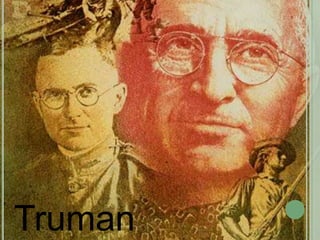
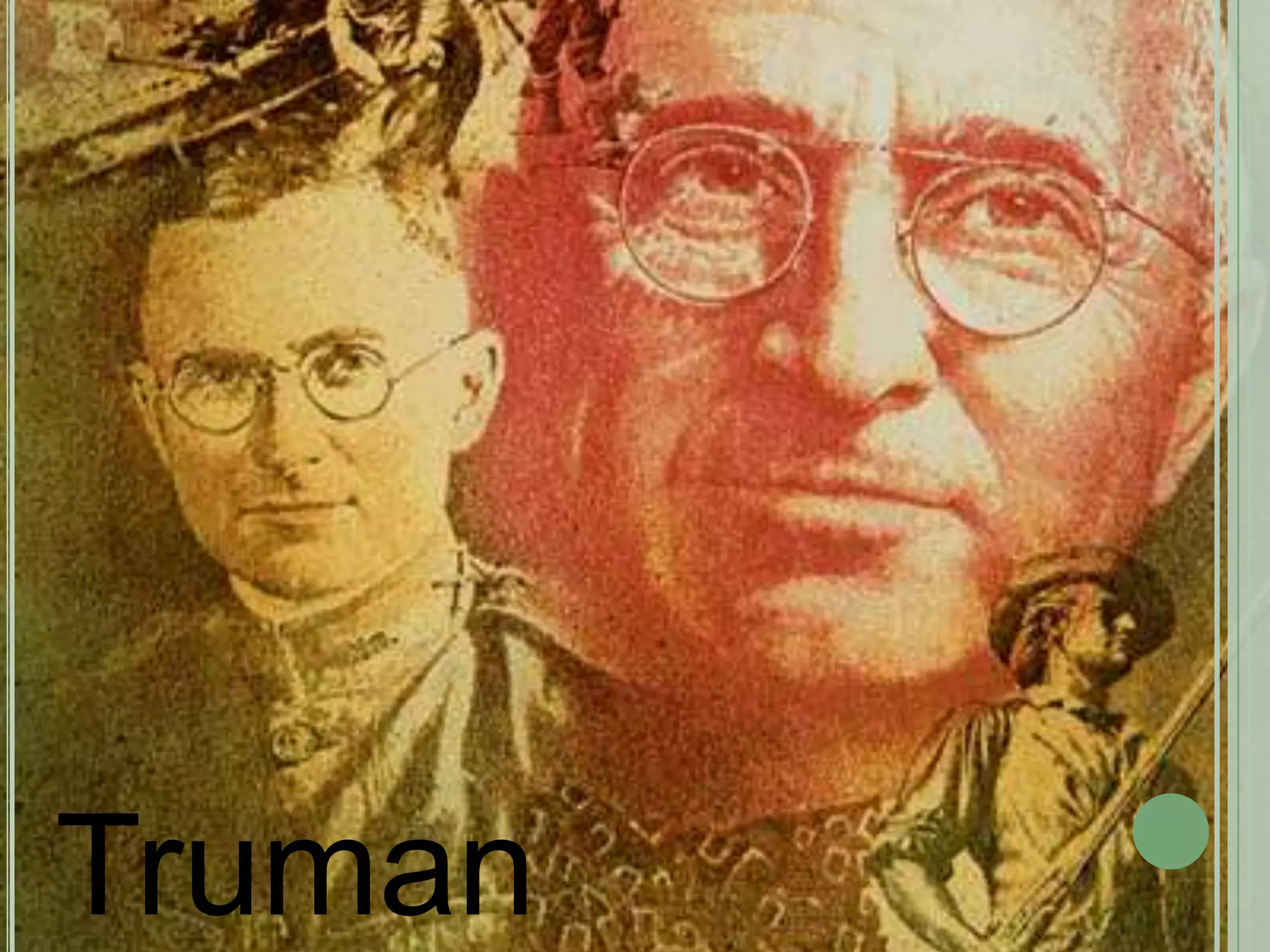
Truman
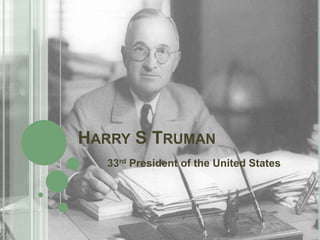
Harry S Truman		33rd President of the United States
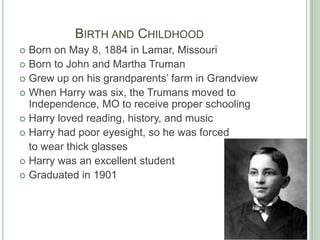
               Birth and ChildhoodBorn on May 8, 1884 in Lamar, MissouriBorn to John and Martha TrumanGrew up on his grandparents’ farm in GrandviewWhen Harry was six, the Trumans moved to Independence, MO to receive proper schoolingHarry loved reading, history, and musicHarry had poor eyesight, so he was forced 	to wear thick glassesHarry was an excellent student Graduated in 1901
                  As A Young AdultInitially, Harry didn’t attend college because his family didn’t have the moneyStudied for 2 years in the 1920’s towards a law degree, but eventually had to stop because of financial troublesHe worked as a timekeeper on the Sante Fe Railroad for 6 monthsIn 1903, he began working as a bank clerk in Kansas CityIn 1905, he signed up with the National GuardHarry was told to quit his job and come back to help on the farm because his family struggling
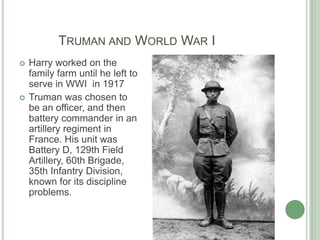
Truman and World War IHarry worked on the family farm until he left to serve in WWI  in 1917Truman was chosen to be an officer, and then battery commander in an artillery regiment in France. His unit was Battery D, 129th Field Artillery, 60th Brigade, 35th Infantry Division, known for its discipline problems.
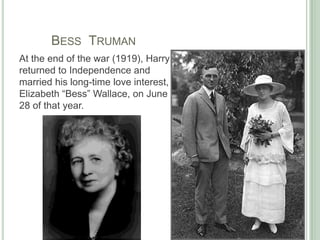
	Bess  TrumanAt the end of the war (1919), Harry returned to Independence and married his long-time love interest, Elizabeth “Bess” Wallace, on June 28 of that year.
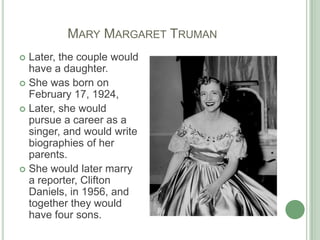
             Mary Margaret TrumanLater, the couple would have a daughter.She was born on February 17, 1924,Later, she would pursue a career as a singer, and would write biographies of her parents. She would later marry a reporter, Clifton Daniels, in 1956, and together they would have four sons.
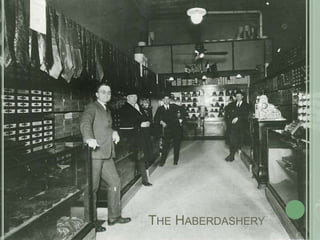
		The HaberdasheryWhen Harry returned to Independence in 1919, he decided that he did not want to be a farmer anymore, so he sold his farm.Instead, he opened a haberdashery (a men’s clothing store) with one of his friends from the Army, Eddie Jacobson. The store was prosperous for a short while, however, a recession in 1921 caused the store to become bankrupt. Fifteen years later, Truman would still be paying off debt on the shop.
                   The Haberdashery
 Pendergasts/ County AdministratorIn 1922, Truman was elected as a judge (an administrative, not judicial, job) of Jackson, with help from the PendergastsThe Pendergasts were a powerful (and corrupt) family in Kansas City and the surrounding Jackson County, and even held sway elsewhere in the countryTruman served his term (2 years), and was not reelected in 1924However, Truman was elected as presiding judge in 1926, served his term (4 years) and was reelected in 1930There, Truman created the “Ten Year Plan”, in which he built 224 miles of roads and a new county courthouse
      ‘The Senator From Pendergast’ ?Truman wanted to run for either Governor or Congress, and approached the Pendergasts to ask for help, who initially rejected him but later grudgingly accepted to back Harry In 1934, Harry ran for Senator of Missouri and wonAssumed office under Pendergast cloudWorked diligently, spoke little, listened oftenIgnored by many, esp. Franklin D. Roosevelt Had yet to be taken seriously
		      Reelection !!In 1940, Henry ran for reelection for SenatorThis time was much harder- he had no support from the Pendergasts  or FDRTruman campaigned tirelessly & combativelyDuring the general election, he defeated Kansas City State Senator Manvel H. Davis, retaining his seat in the SenateThis is to be a common theme in Truman’s political life- he was usually the underdog (esp. 1948 run for White House)
	     The Truman CommitteeIn 1941,  Truman took a 10,000- mile tour of military basesHe saw many cases of military wastefulness, so he made a Senate committee intended to investigate thisSenior military officials opposed the idea 		However, congressional leaders advised FDR that it would be better for Truman to head such a committee than someone less sympathetic to the PresidentThey also said the committee wouldn’t cause much trouble because the committee’s budget was $15,000  and was to investigate billions in defenseCommittee created by unanimous Senate consent on March 1, 1941Saved estimated billions of $ in cost overruns
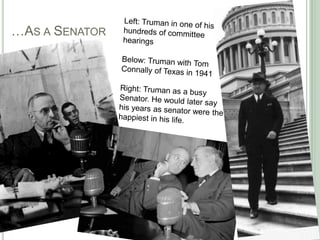
	…As a SenatorLeft: Truman in one of his hundreds of committeehearingsBelow: Truman with Tom Connally of Texas in 1941Right: Truman as a busy Senator. He would later say his years as senator were the happiest in his life.
	Nomination  for Vice PresidentTruman was selected as Franklin Roosevelt's vice presidential candidate in 1944Advisors to Roosevelt said that the incumbent VP, Henry Wallace, was too liberalIn contrast, James Byrnes of NC was too conservativeTruman was nicknamed the ‘Missouri Compromise’ because of his appeal to the party centerTruman did not want to serve as VP, but he reluctantly did so anyway because he felt it was his duty to the countryIn the presidential race of 1944, the Roosevelt/Truman team easily won against Republican candidates Dewey/Brickler (432 to 99 electoral votes)
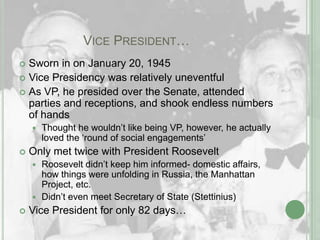
		Vice President…Sworn in on January 20, 1945Vice Presidency was relatively uneventfulAs VP, he presided over the Senate, attended parties and receptions, and shook endless numbers of handsThought he wouldn’t like being VP, however, he actually loved the ‘round of social engagements’Only met twice with President Roosevelt Roosevelt didn’t keep him informed- domestic affairs, how things were unfolding in Russia, the Manhattan Project, etc.Didn’t even meet Secretary of State (Stettinius)Vice President for only 82 days…
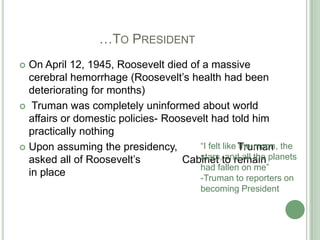
			…To PresidentOn April 12, 1945, Roosevelt died of a massive cerebral hemorrhage (Roosevelt’s health had been deteriorating for months) Truman was completely uninformed about world affairs or domestic policies- Roosevelt had told him practically nothingUpon assuming the presidency, 	         Truman asked all of Roosevelt’s		 Cabinet to remain in place“I felt like the moon, the stars, and all the planets had fallen on me”-Truman to reporters on becoming President
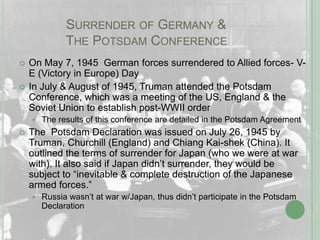
	    Surrender of Germany & 		    The Potsdam ConferenceOn May 7, 1945  German forces surrendered to Allied forces- V-E (Victory in Europe) DayIn July & August of 1945, Truman attended the Potsdam Conference, which was a meeting of the US, England & the Soviet Union to establish post-WWII order	The results of this conference are detailed in the Potsdam AgreementThe  Potsdam Declaration was issued on July 26, 1945 by Truman, Churchill (England) and Chiang Kai-shek (China). It outlined the terms of surrender for Japan (who we were at war with). It also said if Japan didn’t surrender, they would be subject to “inevitable & complete destruction of the Japanese armed forces.”Russia wasn’t at war w/Japan, thus didn’t participate in the Potsdam Declaration
“I knew what I was doing when I stopped the war…I have no regrets, and under the same circumstances I would do it again.”-Truman on the decision to authorize the 	         use of the atomic bomb	    Hiroshima 	    & NagasakiHowever, the Japanese government dismissed                   the Potsdam Declaration and chose to ignore it.In the end, Truman made the decision to drop atomic bombs on Japan. His intention was to bring about a   quick resolution to the war by inflicting destruction       and to basically shock Japan into surrendering.August 6th, 1945- Hiroshima	140,000 deadAugust 9th, 1945- Nagasaki	80,000   dead	On August 15th, Japan announced its surrender to the Allied Powers.Some say the bombs probably saved hundreds of thousands of lives that would’ve been lost in an invasion of mainland Japan that was also being planned. Eleanor Roosevelt supported this viewHowever, many critics have argued that the use of the bombs was immoral.
	      The Truman Doctrine“ I believe that it must be the policy of the United States to support free peoples who are resisting attempted subjugation by armed minorities or by outside pressures.I believe that we must assist free peoples to work out their own destinies in their own way.I believe that our help should be primarily through economic and financial aid which is essential to economic stability and orderly political processes.”  – Truman, March 12 1947, before a Joint Session of CongressA set of  international policies put forth by TrumanArose from a speech Truman gave to CongressDeclared that the U.S., as the leader of the free world, must support democracy worldwide and fight against communismRequested $4 million in aid to both Turkey & Greece to help rebuild their countries (from WWII) and to fight against (the Soviet Union’s) Communism
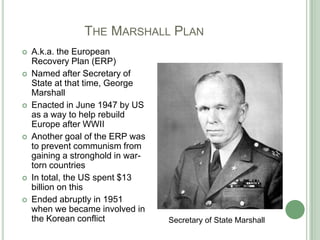
	         The Marshall PlanA.k.a. the European Recovery Plan (ERP)Named after Secretary of State at that time, George MarshallEnacted in June 1947 by US as a way to help rebuild Europe after WWIIAnother goal of the ERP was to prevent communism from gaining a stronghold in war-torn countries In total, the US spent $13 billion on thisEnded abruptly in 1951 when we became involved in the Korean conflictSecretary of State Marshall
		    The Fair Deal"Every segment of our population, and every individual, has a right to expect from his government a fair deal.”-Truman, 1949 State of the Union address to Congress Was a broad legislative agenda of Truman’s & a major push to transform the U.S.’ wartime economy to a peacetime oneCalled for national health insuranceInfluenced LBJ’s enactment of MedicareCalled for the  repeal of the anti-union                  	 Taft- Hartely ActInstigated an aggressive civil rights programIntegrated the armed forcesFirst president to address the NAACPThe Fair Deal wasn’t too successful- 	only the Housing Act of 1949 was ever enacted
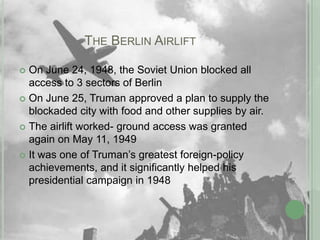
	         The Berlin AirliftOn June 24, 1948, the Soviet Union blocked all access to 3 sectors of BerlinOn June 25, Truman approved a plan to supply the blockaded city with food and other supplies by air.The airlift worked- ground access was granted again on May 11, 1949It was one of Truman’s greatest foreign-policy achievements, and it significantly helped his presidential campaign in 1948
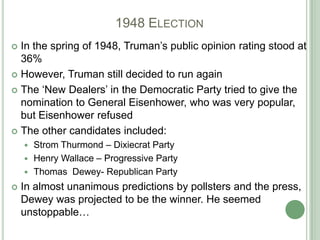
			1948 ElectionIn the spring of 1948, Truman’s public opinion rating stood at 36%However, Truman still decided to run againThe ‘New Dealers’ in the Democratic Party tried to give the nomination to General Eisenhower, who was very popular, but Eisenhower refusedThe other candidates included:Strom Thurmond – Dixiecrat PartyHenry Wallace – Progressive PartyThomas  Dewey- Republican PartyIn almost unanimous predictions by pollsters and the press, Dewey was projected to be the winner. He seemed unstoppable…
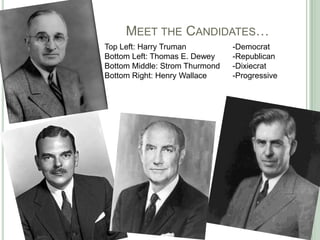
Meet the Candidates…Top Left: Harry Truman		-DemocratBottom Left: Thomas E. Dewey	-RepublicanBottom Middle: Strom Thurmond	-DixiecratBottom Right: Henry Wallace	-Progressive
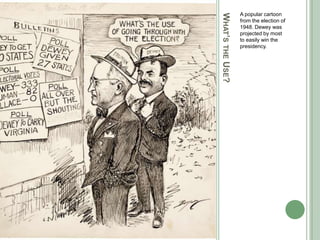
What’s the Use?A popular cartoon from the election of 1948. Dewey was projected by most to easily win the presidency.
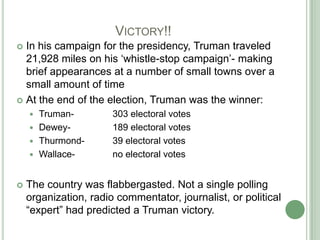
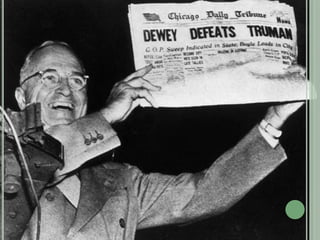
			Victory!!In his campaign for the presidency, Truman traveled 21,928 miles on his ‘whistle-stop campaign’- making brief appearances at a number of small towns over a small amount of timeAt the end of the election, Truman was the winner:Truman- 		303 electoral votesDewey- 		189 electoral votesThurmond- 	39 electoral votesWallace- 		no electoral votesThe country was flabbergasted. Not a single polling organization, radio commentator, journalist, or political “expert” had predicted a Truman victory.
	    Truman’s Second TermNATO- Truman was a strong supporter of the North Atlantic Treaty Organization. It established a formal military peacetime alliance with Canada and many European nations that hadn’t fallen under Soviet control during WWIITruman successfully guided the treaty through the Senate in 1949People’s Republic of China- On December 21, 1949, Chiang Kai-Shek fled to Taiwan from Mao Zedong’s Communist ArmyIn June 1950, Truman ordered the U.S. Navy  into the Taiwan Strait to prevent conflict between the warring Communist government and government-in-exile
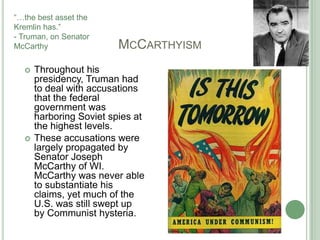
“…the best asset the Kremlin has.”- Truman, on Senator McCarthy           	   McCarthyismThroughout his presidency, Truman had to deal with accusations that the federal government was harboring Soviet spies at the highest levels.These accusations were largely propagated by Senator Joseph McCarthy of WI. McCarthy was never able to substantiate his claims, yet much of the U.S. was still swept up  by Communist hysteria.
		The Korean War &	       General MacArthurOn June 25, 1950, the North Korean People’s Army invaded South Korea, and the South Korean Army was quickly pushed out of their capital, Seoul. This precipitated the  Korean War.Truman promptly urged the UN to intervene, which it did. With UN forces, General MacArthur led a counterattack, scoring a stunning but extremely risky surprise victory at the Battle of Inchon.By 1951 the war had become a stalemate at the 38th parallel.On April 11, 1951, Truman fired General MacArthur from all his posts in Korea and Japan because MacArthur had disregarded Truman’s explicit orders. This was a hugely unpopular decision by Truman- after this, many called for his impeachment. An armistice was signed on July 27,1953, ‘ending’ the conflict.
   …Most Famous Balcony in HistoryIn 1948, Truman ordered that a balcony be added to the White House’s second floor, arguing that it would ‘balance’ the look of the White House. This decision was largely unpopular.A short while later, engineering experts concluded that the building was in a dangerously dilapidated condition.  These findings weren’t released until after the 1948 election.  Ironically, the only safe place was Truman’s new balcony (“Doesn’t that beat all!” he said.)The decision was made to demolish and rebuild the whole interior of the White House, while retaining the famous exterior of the structure.The work lasted from December 1949 to March 1952. Meanwhile, Truman lived across the street at Blair House.
	   Assassination AttemptOn November 1, 1950, Puerto Rican nationalists Griselio Torresola and Oscar Collazo attempted to assassinate Truman at Blair House.Truman wasn’t harmed, but White House policeman Leslie Coffelt was mortally wounded.Torresola was also shot and died on the spot.Collazo was sentenced to death, but was later commuted to life in prison.Ironically, Truman had done a lot more for Puerto Rico than other Presidents. He appointed the first the first native to serve as governor, allowed Puerto Rico to determine its relationship status with the United States, and extended Social Security to them.
	      After the PresidencyTruman decided to worked to raise private donations to build a presidential library.After his presidency, Truman was practically broke- if weren’t for his army pensions and some property he had inherited from his mother, he would have been broke.As it was, Truman was forced to take out a loan.He decided to publish memoirs of his life; these proved to be great successes. In 1956, Truman decided to take a trip to Europe with his wife. In Britain, he received an honorary degree in Civic Law from Oxford University. On December 26, 1972, Truman died from multiple organ failure. Bess Truman died 10 years later, on October 18, 1982.
			Fun FactsTruman’s vice-presidential acceptance speech was less than a minute longTruman was a key figure in the establishment & recognition of IsraelTruman’s mother, a Confederate sympathizer, refused to sleep in Lincoln’s bed during a visit to the White HouseTruman’s middle initial, S , doesn’t actually stand for anything. It was actually a compromise between both of his grandfathers’ middle names, Shippe and Solomon.
			Sourceshttp://books.google.com/books?id=S1MiZwdZPPMC& http://en.wikipedia.org/wiki/Truman_Balconyhttp://en.wikipedia.org/wiki/Harry_S._Truman http://en.wikipedia.org/wiki/Griselio_Torresola http://en.wikipedia.org/wiki/Oscar_Collazo http://en.wikipedia.org/wiki/Truman_assassination_attempt http://us.history.wisc.edu/hist102/lectures/lecture23.html http://www.palestinefacts.org/pf_independence_recognition_who.phphttp://en.wikipedia.org/wiki/Joseph_McCarthyhttp://en.wikipedia.org/wiki/McCarthyismhttp://en.wikipedia.org/wiki/Whistle_stop_train_tourhttp://en.wikipedia.org/wiki/Strom_Thurmondhttp://en.wikipedia.org/wiki/Henry_A._Wallacehttp://en.wikipedia.org/wiki/Thomas_E._Deweyhttp://en.wikipedia.org/wiki/Dewey_Defeats_Truman
		Sources (continued)http://www.wisegeek.com/what-was-the-marshall-plan.htmhttp://en.wikipedia.org/wiki/Domino_theoryhttp://www.americanrhetoric.com/speeches/harrystrumantrumandoctrine.htmlhttp://www.state.gov/r/pa/ho/time/cwr/82210.htmhttp://en.wikipedia.org/wiki/Marshall_Planhttp://en.wikipedia.org/wiki/Truman_Doctrinehttp://en.wikipedia.org/wiki/Atomic_bombings_of_Hiroshima_and_Nagasakihttp://en.wikipedia.org/wiki/Manhattan_Projecthttp://www.nvr.org/pres_content.php?pro=pres&sec=timeline&subsec=3http://en.wikipedia.org/wiki/Potsdam_Declarationhttp://en.wikipedia.org/wiki/Potsdam_Conferencehttp://en.wikipedia.org/wiki/Potsdam_Agreementhttp://www.trumanlibrary.org/hst-bio.htmhttp://en.wikipedia.org/wiki/United_States_presidential_election,_1944http://www.whitehouse.gov/about/presidents/harrystruman/
		Sources (Images)http://z.about.com/d/americanhistory/1/0/y/9/33_truman_1.jpghttp://www.wisconsinhistory.org/museum/exhibits/elections/images/1948_DeweyDefeatsTruman56976.jpghttp://upload.wikimedia.org/wikipedia/commons/thumb/f/fa/Joseph_McCarthy.jpg/160px-Joseph_McCarthy.jpghttp://thebsreport.files.wordpress.com/2009/08/sturmond.jpghttp://en.wikipedia.org/wiki/File:Henry-A.-Wallace-Townsend.jpeghttp://en.wikipedia.org/wiki/File:Thomas_E._Dewey.jpghttp://www.archives.gov/exhibits/running-for-office/assets/images/artifacts/45-zoom.jpghttp://www.stltoday.com/blogzone/the-platform/files/2008/07/berlin_airlift01_opt.jpghttp://en.wikipedia.org/wiki/File:George_Catlett_Marshall,_general_of_the_US_army.jpghttp://upload.wikimedia.org/wikipedia/commons/8/82/Bundesarchiv_Bild_183-R67561%2C_Potsdamer_Konferenz%2C_Konferenztisch.jpghttp://4.bp.blogspot.com/_J9eISH0JgC0/SWLRpHwXGKI/AAAAAAAAKMM/je0gp-ByaZI/s400/Harry-Truman-and-Franklin-D-Roosevelt.jpghttp://www.geppisentertainment.com/images/hake/roosevelt_truman.jpg
Uploaded by: SkippySkiddooAPUSH RULES!!

Truman Power Point

  • 1.
  • 2.
    Harry S Truman 33rdPresident of the United States
  • 3.
    Birth and ChildhoodBorn on May 8, 1884 in Lamar, MissouriBorn to John and Martha TrumanGrew up on his grandparents’ farm in GrandviewWhen Harry was six, the Trumans moved to Independence, MO to receive proper schoolingHarry loved reading, history, and musicHarry had poor eyesight, so he was forced to wear thick glassesHarry was an excellent student Graduated in 1901
  • 4.
    As A Young AdultInitially, Harry didn’t attend college because his family didn’t have the moneyStudied for 2 years in the 1920’s towards a law degree, but eventually had to stop because of financial troublesHe worked as a timekeeper on the Sante Fe Railroad for 6 monthsIn 1903, he began working as a bank clerk in Kansas CityIn 1905, he signed up with the National GuardHarry was told to quit his job and come back to help on the farm because his family struggling
  • 5.
    Truman and WorldWar IHarry worked on the family farm until he left to serve in WWI in 1917Truman was chosen to be an officer, and then battery commander in an artillery regiment in France. His unit was Battery D, 129th Field Artillery, 60th Brigade, 35th Infantry Division, known for its discipline problems.
  • 6.
    Bess TrumanAtthe end of the war (1919), Harry returned to Independence and married his long-time love interest, Elizabeth “Bess” Wallace, on June 28 of that year.
  • 7.
    Mary Margaret TrumanLater, the couple would have a daughter.She was born on February 17, 1924,Later, she would pursue a career as a singer, and would write biographies of her parents. She would later marry a reporter, Clifton Daniels, in 1956, and together they would have four sons.
  • 8.
    The HaberdasheryWhen Harryreturned to Independence in 1919, he decided that he did not want to be a farmer anymore, so he sold his farm.Instead, he opened a haberdashery (a men’s clothing store) with one of his friends from the Army, Eddie Jacobson. The store was prosperous for a short while, however, a recession in 1921 caused the store to become bankrupt. Fifteen years later, Truman would still be paying off debt on the shop.
  • 9.
    The Haberdashery
  • 10.
    Pendergasts/ CountyAdministratorIn 1922, Truman was elected as a judge (an administrative, not judicial, job) of Jackson, with help from the PendergastsThe Pendergasts were a powerful (and corrupt) family in Kansas City and the surrounding Jackson County, and even held sway elsewhere in the countryTruman served his term (2 years), and was not reelected in 1924However, Truman was elected as presiding judge in 1926, served his term (4 years) and was reelected in 1930There, Truman created the “Ten Year Plan”, in which he built 224 miles of roads and a new county courthouse
  • 11.
    ‘The Senator From Pendergast’ ?Truman wanted to run for either Governor or Congress, and approached the Pendergasts to ask for help, who initially rejected him but later grudgingly accepted to back Harry In 1934, Harry ran for Senator of Missouri and wonAssumed office under Pendergast cloudWorked diligently, spoke little, listened oftenIgnored by many, esp. Franklin D. Roosevelt Had yet to be taken seriously
  • 12.
    Reelection !!In 1940, Henry ran for reelection for SenatorThis time was much harder- he had no support from the Pendergasts or FDRTruman campaigned tirelessly & combativelyDuring the general election, he defeated Kansas City State Senator Manvel H. Davis, retaining his seat in the SenateThis is to be a common theme in Truman’s political life- he was usually the underdog (esp. 1948 run for White House)
  • 13.
    The Truman CommitteeIn 1941, Truman took a 10,000- mile tour of military basesHe saw many cases of military wastefulness, so he made a Senate committee intended to investigate thisSenior military officials opposed the idea However, congressional leaders advised FDR that it would be better for Truman to head such a committee than someone less sympathetic to the PresidentThey also said the committee wouldn’t cause much trouble because the committee’s budget was $15,000 and was to investigate billions in defenseCommittee created by unanimous Senate consent on March 1, 1941Saved estimated billions of $ in cost overruns
  • 14.
    …As a SenatorLeft:Truman in one of his hundreds of committeehearingsBelow: Truman with Tom Connally of Texas in 1941Right: Truman as a busy Senator. He would later say his years as senator were the happiest in his life.
  • 15.
    Nomination forVice PresidentTruman was selected as Franklin Roosevelt's vice presidential candidate in 1944Advisors to Roosevelt said that the incumbent VP, Henry Wallace, was too liberalIn contrast, James Byrnes of NC was too conservativeTruman was nicknamed the ‘Missouri Compromise’ because of his appeal to the party centerTruman did not want to serve as VP, but he reluctantly did so anyway because he felt it was his duty to the countryIn the presidential race of 1944, the Roosevelt/Truman team easily won against Republican candidates Dewey/Brickler (432 to 99 electoral votes)
  • 16.
    Vice President…Sworn inon January 20, 1945Vice Presidency was relatively uneventfulAs VP, he presided over the Senate, attended parties and receptions, and shook endless numbers of handsThought he wouldn’t like being VP, however, he actually loved the ‘round of social engagements’Only met twice with President Roosevelt Roosevelt didn’t keep him informed- domestic affairs, how things were unfolding in Russia, the Manhattan Project, etc.Didn’t even meet Secretary of State (Stettinius)Vice President for only 82 days…
  • 17.
    …To PresidentOn April12, 1945, Roosevelt died of a massive cerebral hemorrhage (Roosevelt’s health had been deteriorating for months) Truman was completely uninformed about world affairs or domestic policies- Roosevelt had told him practically nothingUpon assuming the presidency, Truman asked all of Roosevelt’s Cabinet to remain in place“I felt like the moon, the stars, and all the planets had fallen on me”-Truman to reporters on becoming President
  • 18.
    Surrender of Germany & The Potsdam ConferenceOn May 7, 1945 German forces surrendered to Allied forces- V-E (Victory in Europe) DayIn July & August of 1945, Truman attended the Potsdam Conference, which was a meeting of the US, England & the Soviet Union to establish post-WWII order The results of this conference are detailed in the Potsdam AgreementThe Potsdam Declaration was issued on July 26, 1945 by Truman, Churchill (England) and Chiang Kai-shek (China). It outlined the terms of surrender for Japan (who we were at war with). It also said if Japan didn’t surrender, they would be subject to “inevitable & complete destruction of the Japanese armed forces.”Russia wasn’t at war w/Japan, thus didn’t participate in the Potsdam Declaration
  • 19.
    “I knew whatI was doing when I stopped the war…I have no regrets, and under the same circumstances I would do it again.”-Truman on the decision to authorize the use of the atomic bomb Hiroshima & NagasakiHowever, the Japanese government dismissed the Potsdam Declaration and chose to ignore it.In the end, Truman made the decision to drop atomic bombs on Japan. His intention was to bring about a quick resolution to the war by inflicting destruction and to basically shock Japan into surrendering.August 6th, 1945- Hiroshima 140,000 deadAugust 9th, 1945- Nagasaki 80,000 dead On August 15th, Japan announced its surrender to the Allied Powers.Some say the bombs probably saved hundreds of thousands of lives that would’ve been lost in an invasion of mainland Japan that was also being planned. Eleanor Roosevelt supported this viewHowever, many critics have argued that the use of the bombs was immoral.
  • 20.
    The Truman Doctrine“ I believe that it must be the policy of the United States to support free peoples who are resisting attempted subjugation by armed minorities or by outside pressures.I believe that we must assist free peoples to work out their own destinies in their own way.I believe that our help should be primarily through economic and financial aid which is essential to economic stability and orderly political processes.” – Truman, March 12 1947, before a Joint Session of CongressA set of international policies put forth by TrumanArose from a speech Truman gave to CongressDeclared that the U.S., as the leader of the free world, must support democracy worldwide and fight against communismRequested $4 million in aid to both Turkey & Greece to help rebuild their countries (from WWII) and to fight against (the Soviet Union’s) Communism
  • 21.
    The Marshall PlanA.k.a. the European Recovery Plan (ERP)Named after Secretary of State at that time, George MarshallEnacted in June 1947 by US as a way to help rebuild Europe after WWIIAnother goal of the ERP was to prevent communism from gaining a stronghold in war-torn countries In total, the US spent $13 billion on thisEnded abruptly in 1951 when we became involved in the Korean conflictSecretary of State Marshall
  • 22.
    The Fair Deal"Every segment of our population, and every individual, has a right to expect from his government a fair deal.”-Truman, 1949 State of the Union address to Congress Was a broad legislative agenda of Truman’s & a major push to transform the U.S.’ wartime economy to a peacetime oneCalled for national health insuranceInfluenced LBJ’s enactment of MedicareCalled for the repeal of the anti-union Taft- Hartely ActInstigated an aggressive civil rights programIntegrated the armed forcesFirst president to address the NAACPThe Fair Deal wasn’t too successful- only the Housing Act of 1949 was ever enacted
  • 23.
    The Berlin AirliftOn June 24, 1948, the Soviet Union blocked all access to 3 sectors of BerlinOn June 25, Truman approved a plan to supply the blockaded city with food and other supplies by air.The airlift worked- ground access was granted again on May 11, 1949It was one of Truman’s greatest foreign-policy achievements, and it significantly helped his presidential campaign in 1948
  • 24.
    1948 ElectionIn thespring of 1948, Truman’s public opinion rating stood at 36%However, Truman still decided to run againThe ‘New Dealers’ in the Democratic Party tried to give the nomination to General Eisenhower, who was very popular, but Eisenhower refusedThe other candidates included:Strom Thurmond – Dixiecrat PartyHenry Wallace – Progressive PartyThomas Dewey- Republican PartyIn almost unanimous predictions by pollsters and the press, Dewey was projected to be the winner. He seemed unstoppable…
  • 25.
    Meet the Candidates…TopLeft: Harry Truman -DemocratBottom Left: Thomas E. Dewey -RepublicanBottom Middle: Strom Thurmond -DixiecratBottom Right: Henry Wallace -Progressive
  • 26.
    What’s the Use?Apopular cartoon from the election of 1948. Dewey was projected by most to easily win the presidency.
  • 27.
    Victory!!In his campaignfor the presidency, Truman traveled 21,928 miles on his ‘whistle-stop campaign’- making brief appearances at a number of small towns over a small amount of timeAt the end of the election, Truman was the winner:Truman- 303 electoral votesDewey- 189 electoral votesThurmond- 39 electoral votesWallace- no electoral votesThe country was flabbergasted. Not a single polling organization, radio commentator, journalist, or political “expert” had predicted a Truman victory.
  • 29.
    Truman’s Second TermNATO- Truman was a strong supporter of the North Atlantic Treaty Organization. It established a formal military peacetime alliance with Canada and many European nations that hadn’t fallen under Soviet control during WWIITruman successfully guided the treaty through the Senate in 1949People’s Republic of China- On December 21, 1949, Chiang Kai-Shek fled to Taiwan from Mao Zedong’s Communist ArmyIn June 1950, Truman ordered the U.S. Navy into the Taiwan Strait to prevent conflict between the warring Communist government and government-in-exile
  • 30.
    “…the best assetthe Kremlin has.”- Truman, on Senator McCarthy McCarthyismThroughout his presidency, Truman had to deal with accusations that the federal government was harboring Soviet spies at the highest levels.These accusations were largely propagated by Senator Joseph McCarthy of WI. McCarthy was never able to substantiate his claims, yet much of the U.S. was still swept up by Communist hysteria.
  • 31.
    The Korean War& General MacArthurOn June 25, 1950, the North Korean People’s Army invaded South Korea, and the South Korean Army was quickly pushed out of their capital, Seoul. This precipitated the Korean War.Truman promptly urged the UN to intervene, which it did. With UN forces, General MacArthur led a counterattack, scoring a stunning but extremely risky surprise victory at the Battle of Inchon.By 1951 the war had become a stalemate at the 38th parallel.On April 11, 1951, Truman fired General MacArthur from all his posts in Korea and Japan because MacArthur had disregarded Truman’s explicit orders. This was a hugely unpopular decision by Truman- after this, many called for his impeachment. An armistice was signed on July 27,1953, ‘ending’ the conflict.
  • 32.
    …Most Famous Balcony in HistoryIn 1948, Truman ordered that a balcony be added to the White House’s second floor, arguing that it would ‘balance’ the look of the White House. This decision was largely unpopular.A short while later, engineering experts concluded that the building was in a dangerously dilapidated condition. These findings weren’t released until after the 1948 election. Ironically, the only safe place was Truman’s new balcony (“Doesn’t that beat all!” he said.)The decision was made to demolish and rebuild the whole interior of the White House, while retaining the famous exterior of the structure.The work lasted from December 1949 to March 1952. Meanwhile, Truman lived across the street at Blair House.
  • 33.
    Assassination AttemptOn November 1, 1950, Puerto Rican nationalists Griselio Torresola and Oscar Collazo attempted to assassinate Truman at Blair House.Truman wasn’t harmed, but White House policeman Leslie Coffelt was mortally wounded.Torresola was also shot and died on the spot.Collazo was sentenced to death, but was later commuted to life in prison.Ironically, Truman had done a lot more for Puerto Rico than other Presidents. He appointed the first the first native to serve as governor, allowed Puerto Rico to determine its relationship status with the United States, and extended Social Security to them.
  • 34.
    After the PresidencyTruman decided to worked to raise private donations to build a presidential library.After his presidency, Truman was practically broke- if weren’t for his army pensions and some property he had inherited from his mother, he would have been broke.As it was, Truman was forced to take out a loan.He decided to publish memoirs of his life; these proved to be great successes. In 1956, Truman decided to take a trip to Europe with his wife. In Britain, he received an honorary degree in Civic Law from Oxford University. On December 26, 1972, Truman died from multiple organ failure. Bess Truman died 10 years later, on October 18, 1982.
  • 35.
    Fun FactsTruman’s vice-presidentialacceptance speech was less than a minute longTruman was a key figure in the establishment & recognition of IsraelTruman’s mother, a Confederate sympathizer, refused to sleep in Lincoln’s bed during a visit to the White HouseTruman’s middle initial, S , doesn’t actually stand for anything. It was actually a compromise between both of his grandfathers’ middle names, Shippe and Solomon.
  • 36.
    Sourceshttp://books.google.com/books?id=S1MiZwdZPPMC& http://en.wikipedia.org/wiki/Truman_Balconyhttp://en.wikipedia.org/wiki/Harry_S._Truman http://en.wikipedia.org/wiki/Griselio_Torresolahttp://en.wikipedia.org/wiki/Oscar_Collazo http://en.wikipedia.org/wiki/Truman_assassination_attempt http://us.history.wisc.edu/hist102/lectures/lecture23.html http://www.palestinefacts.org/pf_independence_recognition_who.phphttp://en.wikipedia.org/wiki/Joseph_McCarthyhttp://en.wikipedia.org/wiki/McCarthyismhttp://en.wikipedia.org/wiki/Whistle_stop_train_tourhttp://en.wikipedia.org/wiki/Strom_Thurmondhttp://en.wikipedia.org/wiki/Henry_A._Wallacehttp://en.wikipedia.org/wiki/Thomas_E._Deweyhttp://en.wikipedia.org/wiki/Dewey_Defeats_Truman
  • 37.
    Sources (continued)http://www.wisegeek.com/what-was-the-marshall-plan.htmhttp://en.wikipedia.org/wiki/Domino_theoryhttp://www.americanrhetoric.com/speeches/harrystrumantrumandoctrine.htmlhttp://www.state.gov/r/pa/ho/time/cwr/82210.htmhttp://en.wikipedia.org/wiki/Marshall_Planhttp://en.wikipedia.org/wiki/Truman_Doctrinehttp://en.wikipedia.org/wiki/Atomic_bombings_of_Hiroshima_and_Nagasakihttp://en.wikipedia.org/wiki/Manhattan_Projecthttp://www.nvr.org/pres_content.php?pro=pres&sec=timeline&subsec=3http://en.wikipedia.org/wiki/Potsdam_Declarationhttp://en.wikipedia.org/wiki/Potsdam_Conferencehttp://en.wikipedia.org/wiki/Potsdam_Agreementhttp://www.trumanlibrary.org/hst-bio.htmhttp://en.wikipedia.org/wiki/United_States_presidential_election,_1944http://www.whitehouse.gov/about/presidents/harrystruman/
  • 38.
    Sources (Images)http://z.about.com/d/americanhistory/1/0/y/9/33_truman_1.jpghttp://www.wisconsinhistory.org/museum/exhibits/elections/images/1948_DeweyDefeatsTruman56976.jpghttp://upload.wikimedia.org/wikipedia/commons/thumb/f/fa/Joseph_McCarthy.jpg/160px-Joseph_McCarthy.jpghttp://thebsreport.files.wordpress.com/2009/08/sturmond.jpghttp://en.wikipedia.org/wiki/File:Henry-A.-Wallace-Townsend.jpeghttp://en.wikipedia.org/wiki/File:Thomas_E._Dewey.jpghttp://www.archives.gov/exhibits/running-for-office/assets/images/artifacts/45-zoom.jpghttp://www.stltoday.com/blogzone/the-platform/files/2008/07/berlin_airlift01_opt.jpghttp://en.wikipedia.org/wiki/File:George_Catlett_Marshall,_general_of_the_US_army.jpghttp://upload.wikimedia.org/wikipedia/commons/8/82/Bundesarchiv_Bild_183-R67561%2C_Potsdamer_Konferenz%2C_Konferenztisch.jpghttp://4.bp.blogspot.com/_J9eISH0JgC0/SWLRpHwXGKI/AAAAAAAAKMM/je0gp-ByaZI/s400/Harry-Truman-and-Franklin-D-Roosevelt.jpghttp://www.geppisentertainment.com/images/hake/roosevelt_truman.jpg
  • 39.